Tuesday, August 1, 2023

How Distilling Carved a Society from a Wilderness

 Foreword:  Much of the history of the early American whiskey trade is being brought to light by initiatives from the nation’s expanding distilling industry.  I recently became aware of Cincinnati Distilling, a company that has reconstructed the history of the Waldschmidt-Kugler family, beginning in the aftermath of the Revolutionary War, whose premises it now occupies.  Drawing on that resource  and adding supplemental information, this post presents 75 years of early American development in which distilling played a major role.

Christian Waldschmidt, a veteran of the Revolutionary War with the mind of a pioneer, in 1794 crossed the Allegheny Mountains and traveled down the Ohio River on a flatboat until he reached the mouth of the Little Miami River where a friend had a primitive frontier tavern.  Stopping there he saw the possibilities for development.  Proceeding to near present day Cincinnati, Waldschmidt bought 1,240 acres of land.


Joined by 20 other families, Waldschmidt directed the settlers at clearing the trees to  build a church, school, general store, grist mill, saw mill, woolen mill, blacksmith shop, and the first paper mill in Ohio.  Important among the enterprises was a distillery, owned and operated by Waldschmidt. He called the community “New Germany” and built an impressive stone home, below, in which to house his growing family.


Enter Mathias Kugler who reached the settlement at age 17 in 1874, barefoot in a rowboat.  Born in hard-scrabble surroundings, Mathias’ only hat blew off down river as the boy waded ashore.  Waldschmidt hired him as a mill hand and was unhappy when not long after Mathias began to court his eldest daughter, Katherine. Within a year they were married.  The family disapproved of her wedding a simple mill worker.  They seriously had underestimated their new son-in-law.


Over the next 16 years Waldschmidt built a business empire in the Southwestern Ohio wilderness of astounding proportions.  When he died in 1814 during a flu epidemic, he was accounted one of the richest men in Ohio.  Waldschmidt had lived to be 59 years and 7 days old, as accounted by his marker in a family graveyard.  He left no will and his sons proved unable or unwilling  to take over their father’s many enterprises.  In stepped Mathias Kugler.  Somehow he had accrued the resources necessary to own and manage the properties.


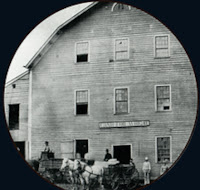
Mathias rapidly built on the success of his father-in law, including continuing emphasis on a distillery.  A rustic facility, likely similar to the one shown above, it produced a cash flow that helped facilitate the other enterprises in New Germany.  Moreover, it assisted area farmers by the constant need for grain to mash and distill.  The first 14 years of Mathias’ direction continued the community’s  growth until 1828 when fire destroyed many of the enterprises, including the distillery, but spared the prosperous paper mill.

By this time Mathias’ and Katherine’s son, John, had reached maturity and became a full partner in the family business.  The Kuglers had sufficient funds to rebuild after the fire.  They also expand operations into the nearby town of Milford, Ohio, buying a bankrupt mill, a tannery and a cobbler’s shop.  More important they purchased a Milford distillery, shown here, to augment their newly rebuilt New Germany plant.   As nearby Cincinnati developed, so did  the market for their whiskey.


The next few years found the Kuglers flourishing.  John moved to Milford with his wife, Matilda, to look after the properties there. The Kuglers were also involved with the meat packing industry.  John raised pigs on his farms outside Milford, riding into town frequently to supervise the shops and whiskey-making.  He eventually was appointed postmaster and a trustee of Milford.  Meanwhile Mathias had become a major stockholder and director of the Little Miami Railroad.


In 1843, John built a second distillery in Milford at 220 Mill Street.  It consumed so much corn that he built a warehouse next door, shown here.  Five years later the complex burned down, believed to be arson.  Undeterred, John quickly rebuilt, indicating how important whiskey was to the Kuglers. Leaving John to pilot the many family businesses, Mathias died in 1854 and was buried in the Waldschmidt family cemetery.  His monument is shown below.


With the outbreak of the Civil War, Southern Ohio was a hotbed of Confederate sympathizers.  The Lincoln government was very interested in establishing a military presence in the vicinity.  A strong Unionist, John permitted Ohio troops use a major portion of the New Germany settlement as a training grounds and camp.  The installation became known as Camp Dennison, large enough to house 12,000 troops at a given time.


The war also meant a boom time for Kugler distilling.  By 1862 distilling capacity reached a peak, producing 3,814 barrels of whiskey annually.  Responding to the demand, John added a two-story stone building to the Milford complex. The bottom floor provided additional space for storing and aging whiskey; the top floor was a cooperage where the barrels were made.  The buildings were virtually across the street from the Kugler mansion home, shown below, that John commissioned to house his family. 


In January 1868, John died and was buried in the Milford Cemetery. His grave is marked by a large obelisk.  Well known throughout Southern Ohio for his many businesses and numerous land holdings, at his death this Kugler was accounted the wealthiest man in Claremont County.  With his passing, the business empire that Waldschmidt and the Kuglers had built over almost 75 years came to an abrupt halt.  With no real plan for succession, virtually all operations, including the distilleries, stopped.  Dozens lost their jobs and Milford underwent a severe depression.  Only the paper mill, run by a nephew, survived for a few more years.


Unlike inspiring pioneer stories that have been lost in the mists of time, the Waldschmidt-Kugler saga has been kept alive by two developments.  First, at what is now known as Camp Dennison, Ohio, the Ohio Chapter of the Daughters of the American Revolution own and maintain a museum in the stone Waldschmidt homestead, conducting docent-led tours of the house and grounds.  The women have installed a plaque on the building that briefly recounts the history of the site. Unfortunately, it carries no mention of the distilleries.


That omission was filled by the second development.  The Waldschmidt home is only a 2.5 mile trip to Milford where an outfit called Cincinnati Distilling has preserved the Kugler Mansion as part of its whiskey-making complex.  It also has documented the family’s distilling history in detail that made possible this post.  Under the general name of “Milcroft” it markets a variety of whiskeys, including “Milford Bourbon” and “Small Batch American Whiskey.” the latter’s label depicting the Kugler homestead.


Notes:  This post draws heavily on information provided by the Cincinnati Distillery Company online site, supplemented by newspaper articles and the “find a grave” website.  Additionally, this website just passed 400 in people who regularly follow it and are notified about a new post.  I am grateful to them for their patronage. 


Friday, July 28, 2023

Seeing Whiskey Through a Reverse Glass


Reverse painting on glass consists of applying paint to the back of a piece of glass and then viewing the image by turning the glass over and seeing it through the glass. This art form has been around for centuries. It was used for sacral paintings in the Middle Ages and frequently was employed for gilded images.


“Verre eglomise,” as the French call it, had something of a renaissance during the 1800s and early 1900s, used by both artists and by the fledging advertising community in Europe and the United States. Quick to see its commercial value in merchandising were American whiskey distillers and dealers. An attractive reverse glass sign in a saloon might entice more customers to imbibe their product.


I find these signs among the most attractive artifacts that the pre-Prohibition whiskey-makers have left to posterity. One favorite is the elegant “art nouveau” sign from John A. Dougherty’s Sons of Philadelphia. The elaborate “W” in “whiskey” is particularly decorative. This distillery was founded by John Alexander Dougherty, a native of Ireland who arrived as a youth in Philly in 1814 by way of Halifax, Nova Scotia. Originally a baker, Dougherty eventually moved to making whiskey and in 1849 founded the distillery that bore his name. He had several sons who, upon his death in 1866, continued the business until Prohibition.


Pennsylvania was a state that seems to have fostered elegant glass signage. The second example, also from Philadelphia, is redolent with gold. It advertised a distillery founded in 1874 by Angelo Myers. Framed in gold, the sign also features two medallions that commemorate gold medals the whiskey had won at national expositions. The company, with Myers father and son as presidents, survived 44 years before Prohibition closed its door. Quite unusually, two of four Myers’ corporate officers were women.


A third Philadelphia sign advertised the “Army and Navy Whiskey” from the James Moroney Co. A wholesalers and importer, Moroney founded his firm in 1875. Other brands he featured were “Moroney Pure Rye,” “Old Navy,” and “Round the World Scotch.”  The company survived National Prohibition by selling sacramental wines and was in business as recently as 2022, a record for longevity.


In Pittsburgh, the Joseph S. Finch & Co. was founded in 1873 to great success and made its “Golden Wedding Rye” into one of America’s best known brands of whiskey. It was responsible for an elegant reverse glass signs, one that screamed gold and a second that replicated its Golden Wedding logo. In this case, we know the identity of the creator of at least one of the signs. The back of the first, faint but visible, is written: John Golding Glass Sign, 240 Pearl Street, New York.


Although Hill Side Rye is advertised as being Pennsylvania whiskey, the brand actually was distributed by a New York City based outfit (1880-1918) known as Steinhardt Bros. There were four brothers - Lewis, Henry, Morris and David. Together they forged a highly successful whiskey business. Not distillers, they collected whiskey from a variety of sources, “rectified” (mixed it) and sold it nationally and from outlets in New York under a number of brand names, including “White Lily Pure Rye,” “Emerald,” and “Lafayette Club.” Their sign bears the signature of artist Thomas G. Jones of New York.


Unlike most of the distillers and wholesalers above, Pfieffer Bros. of Louisville , Kentucky, were relative latecomers to the whiskey business, first opening their doors in 1902. Rectifiers and wholesalers, their glass sign features the firm’s flagship brand, “Silas Moore.” Pfieffer Bros. also sold their whiskey under such brands names as “Dixie Belle,” “Old Cornelius,” and “Tom Hudson.”


Pfieffer Bros. and the other whiskey companies cited above successfully were in business from the time of their founding until National Prohibition. This time spread makes it virtually impossible to date exactly any of these signs. Not so with the company that produced the final example shown here. “Royalty Club” was a brand name of the Anton Friedmann company in Cincinnati. City directories first show Friedmann’s organization in 1870. By 1874 it had disappeared.


Although reverse glass advertising signs are still being made, many of them attractive, our legacy from the pre-Prohibition whiskey makers set an artistic standard that will be difficult to match--ever.


Note:  More detailed information about many of the “whiskey men” responsible for the reverse glass signs shown here may be found elsewhere on this website.  They are:  Dougherty, January 16, 2012;  Myers, December 2, 2011, Moroney, June 2, 2023;  Finch, January 31, 2015;  Steinhardt Bros., November 29, 2012; and Pfeiffer Bros., October 18, 2011, 


Monday, July 24, 2023

Henry Ramos, Huey Long, and an Iconic Gin Fizz

In 1935 when infamous Louisiana politician, Huey Long, decided to hint his candidacy for President against Franklin Roosevelt, he kicked off his campaign by throwing a cocktail party in Washington, D.C. for the press.  The only libation served, Long’s favorite, had been invented by a New Orleans saloon-keeper named Henry “Carl” Ramos.  He named it the “Ramos Gin Fizz.”  It became a cocktail of which legends are made.

Shown here,  Ramos was born in Vincennes, Indiana, in August 1856.  His father Charles was an immigrant from Prussia, his mother, Barbara, had originated in Bavaria.  When Henry “Carl” was just a child, the family moved to New Orleans to where his father had a job as a watchman at a United States Navy base.  Of Ramos early life and education there is scant information.


He appears early to have been drawn to the liquor trade, believed to have worked in saloons in Baton Rouge, Louisiana, and Birmingham, Alabama.  By 1887, he had returned to New Orleans and was employed at a beer saloon in Exchange Alley, shown here in an artist’s version..  That same year, age 21, Ramos with his brother Charles opened the Imperial Cabinet Saloon at Gravier and Carondelet Streets in downtown New Orleans.  The Imperial Cabinet was 3,500 square feet of classic New Orleans decor, with an ornate hardwood bar and views of Canal and Magazine Streets. 


There Ramos invented the cocktail that bore his name, the “Ramos Gin Fizz.”  A photo of the interior of the saloon above shows the large staff he employed for his drinking establishment.  This was necessary because as one writer expressed it: “In the city that literally invented the cocktail. Ramos moved things forward  with his invention of the Ramos Gin Fizz. Frothy, citrusy, smooth-as-silk.” His cocktail was an instant hit with the New Orleans drinking public.


Ramos’ libation also was highly labor intensive.  As many as 20 “shaker boys” would be employed behind the Cabinet Saloon bar providing the strenuous shaking the cocktail required to achieve the creamy texture required.  Some recipes suggest the motion go on for from two to ten minutes.  Others put the time even longer.  Evidence is that Ramos’s crew “nearly shook their arms off and still were unable to keep up with the demand.”  During Mardi Gras, the saloonkeeper is said to have employed as many as 35 behind his bar.  "A whole lot of shaking was goin' on" as the good times rolled.


As unique as the gin fizz was the character of Ramos himself.  One local newspaper characterized him like this: "... his ruddy face and genial blue eyes sparkling behind silver rimmed, ear bowed spectacles, his snowy hair, his pure white shirt with the diamond in its bosom, his short, stout frame…”  Despite the diamond stickpin, virtually standard for successful publicans, Ramos was not a flamboyant character.  A teetotaler, he took seriously the responsibility of peddling booze. 


 Writer Theodora Sutcliffe records:  “He closed his saloon at 8 o'clock every evening, and opened for only two hours on Sundays. He kept a wary eye for signs of drunkenness in his bar, and would stop service at the slightest sign of rowdiness. Apparently, if Ramos heard that a customer was drinking too much outside his premises, he would take him to one side and endeavor to assist him — even, in some cases, helping him out financially.”


Ramos also was a dedicated family man.  In 1883 he had married Marianne Weicker, a widow with two children, Frank and Ida.  The couple would have two children of their own, Carl and Stella. The 1890 census found the combined family living at 728 North Ramparts Street.  Stella unfortunately died while still in her teens, said to be a source of considerable grief to her father.


Shown above is an 1907 ad for the Cabinet Saloon and its “world renowned” cocktail.  Note that Ramos also had become an agent for the Dr. Brown line of patent medicines, specifically Brown’s “Sarsaparilla for the Blood” — the bottle at right — and his “Celery for the Nerves.” This was not an unusual juxtaposition  of products since many such nostrums were heavily laced with alcohol. 


In 1907, Ramos added a second upscale drinking establishment when he purchased the Stag Saloon near Gravier and St. Charles Streets, shown above in a post card.  The caption on the back reads: “The Stag Saloon… Showing Oyster Counter and Famous Oil Painting ‘Life on the Metairie’ or the Old Metairie Race Course.”   This painting had been created in 1867 by American artist Theodore Moise and his British collaborator Victor Pierson.  It depicted 44 distinguished New Orleanians at the last meet of the Metairie Race Track.  The facility subsequently became the Metairie Cemetery where tombs were arranged around the race track oval.  When he died in September 1928, Ramos was buried there.


With the coming of National Prohibition in 1920, Ramos was forced to close both his drinking establishments and was reported to pledge never to sell another gin fizz.  Twenty years later, however, the Ramos Gin Fizz was again making news.  This time it was at the hands of “Kingfish” Huey Long, the most famous political figure in Louisiana history.   A populist and demagogue, Long was elected governor in 1924, serving one term before running for and winning a U.S. Senate seat in 1932.  With his colorful and outspoken ways, he soon was a national figure, a prominent Democratic antagonist to President Franklin Roosevelt and a likely opponent in the 1936 election. Long also was a devoted fan of the Ramos Gin Fizz.


During his senatorial career, Long spent much of his time in New York City staying at the posh Roosevelt Hotel, a far more exciting venue than sleepy Washington, D.C.  When National Prohibition ended and the hotel bar opened once again, the Louisiana politician balked at the kind of gin fizz being served there.  He got on the phone and ordered the best gin fizz maker in New Orleans to fly up and "teach these New York sophisticates how and what to drink.”  The next day Sam Guarino, head bartender at The Sazerac Bar, arrived and spent  three hours training his counterparts at the Roosevelt on the proper way to make Long's treasured Ramos Gin Fizz.


When that gambit garnered considerable media attention in New York City and beyond, Long decided that a repeat performance in Washington with the local press corps would be a good way to vet his opposition to Roosevelt and hint at his forthcoming bid for the Presidency.  This time he brought the newly trained head bartender from New York to a Washington hotel to make his favorite cocktail.


Surrounded by journalists, ever eager for a free drink, and with newsreel cameras grinding, Long declared  “Now this here chap knows how to mix a Ramos Gin Fizz.”  He went on to extoll the cocktail, rating it superior to Roosevelt’s “New Deal”  calling the President “no good” and a “faker.” He left little doubt about his own Presidential ambitions.  The press obliged with stories. Via newsreels, Long’s gin fizz party was screened in movie theaters throughout America, a stunt seen by millions of Americans.  Below are two frames taken from the film:


Although Long’s publicity gambit had the desired effect, it proved in the end to be inconsequential when the Kingfish was gunned down by a constituent at the Louisiana Statehouse in September 1935.  The Ramos Gin Fizz, however, lived on.  Here is the recipe as said to have been revealed by Henry “Carl” Ramos himself:


Ingredients


    2 ounces gin


    1 ounce simple syrup


    1 ounce heavy cream


    1/2 ounce lemon juice, freshly squeezed


    1/2 ounce lime juice, freshly squeezed


    3 dashes orange flower water


    1 fresh egg white


  Steps


 Add the gin, simple syrup, heavy cream, lemon and lime juices, orange flower water and egg white into a shaker and dry-shake (without ice) vigorously for about 10 seconds.  Add ice and shake for at least several minutes, until well-chilled and you can no longer hear the ice cubes.  Pour into a chilled glass and slowly top with club soda to rise the foamy top.


Notes:  There are multiple Internet sources on Henry Ramos, the Ramos Gin Fizz, and Huey Long.  They differ in details  but I have tried to reconstruct the story in a single narrative, choosing the more likely versions.


Thursday, July 20, 2023

John Ford’s Cairo Ill: “A Breeding Place of…Death”


“At the junction of the two rivers, on ground so flat and low and marshy, that at certain seasons of the year it is inundated to the house-tops, lies a breeding-place of fever, ague, and death…. A hotbed of disease, an ugly sepulchre, a grave uncheered by any gleam of promise: a place without one single quality, in earth or air or water, to commend it: such is this dismal Cairo" — Charles Dickens, American Notes, 1847.


Fast forward 60 years from the city Dickens knew to Cairo (pronounced kay-ro) in the early 1900s.  Seventy-six saloons and other drinking establishments flourished.  In addition, local wholesale and mail order liquor houses did a rousing business.  Estimated by the Cairo Bulletin newspaper to ship 200,00 packages a week, the booze traffic was enough that railroads serving Cairo put on extra trains.  Awash in alcohol, prostitution and gambling, Cairo’s reputation for crime and violence made it notorious. According to Author John A. Beadles, the city was “stained with blood and tears.” John Ford, who operated a successful liquor house on the outskirts of Cairo, was well acquainted with both.


Born in Union City, Tennessee in October 1870, the son of William and Mary Valentine Ford, John Ford gravitated fifty miles north to Cairo as a young man recognizing the opportunities that the whiskey trade offered there.  As many saloonkeepers cum retailers did, Ford featured his own brand of liquor.  He called it “Monogram Whiskey,” advertising it as “a blend of straight whiskies” and guaranteed it under the “Food and Drugs Act, June 30, 1806.” As shown below, he even provided the label with a trademark, although there is no record of his having registered the brand with the government.


Ford was not a distiller but a “rectifier,” that is, blending whiskeys from several sources brought to Cairo via the Mobile & Ohio Railroad and other carriers.  His objective was to achieve a specific color, smoothness and flavor likely to draw a customer base.  Like many other dealers, he gave away advertising corkscrews to both wholesale and retail customers for his “Monogram Whiskey.”


This “whiskey man” had married at 25, his bride was Cora, a slightly younger woman of German heritage born “at sea” according to the 1920 Census.  They had no children but kept a lodger named Bam West, who worked as a bartender in Ford’s Ohio Street saloon, located near the riverfront. Ford called it “The Two Johns Saloon.”  Nothing in the proprietor’s past predicted the series of events that ensued.


On a day in late October 1907, Ford — possibly drunk, definitely on a rampage —was being sought by Cairo police for a fracas he had caused in a local billiard parlor by beating man named Brown over the head with a billiard cue during a quarrel.  Brown had sworn out a warrant for his arrest.  Meanwhile Ford was still on the street and entered Lee Beckworth’s Saloon at Fourth and Commercial Avenue where he called for drinks for the crowd.


For an unexplained reason, Ford’s presence triggered a dispute with another patron, John W. Lewis, a well known figure in town who ran a ferry between Cairo and East Cairo, Kentucky.  That ended when Lewis and a friend left Beckwirth’s  and headed to the nearby Riddle’s Saloon at Eighth Street  and Commercial Street.  They were sitting by the stove in a back room talking whenFord burst into the room.  According to press accounts, Ford said, "Aren't you the fellow I had the quarrel with back at Beckwith's?"  Lewis replied, "I think that I am.”


Armed with a 44 Colt pistol, Ford pulled the gun and struck at Lewis three times with the barrel, holding the handle in his hand.  Lewis got up and began to run out of the saloon.  As he did, Ford shot him.  Lewis continued for a few steps to the front of the saloon and fell to the floor.  Ford continued after him, cursing  witnesses said.   Finding that the man was dead, Ford is said to have given over his gun, called the coroner, and waited until a trio of local policemen took him into custody.


From the outset, Ford insisted he had acted in self defense, claiming that Lewis had threatened him with a knife.  Indeed, a pocket knife was found not far from where the dead man’s body lay.  Friends of Lewis insisted, however, they had never known him to carry a knife.  They intimated that Ford had planted it to excuse his shooting. Local opinion ran strongly against the assailant.  According to the local newspaper, Lewis:  “…had acquired a reputation that appeared to be entirely in his favor.  He was very accommodating and frequently delivered things in Cairo for the people across the river who could not take the time to come over.”  Moreover Lewis was a widower caring for a 12 year old son, who now was  orphaned.


For the moment at least, Ford evaded arrest and incarceration.  A sheriff’s deputy into whose custody he was given, allowed him to go home for the night.  The following day he returned  to the Cairo courthouse, shown here, to stand before by a coroner’s jury inquiring into Lewis’ homicide.  After a series of witnesses gave conflicting testimony about the circumstances of the shooting, the jury found:  “…The said John R. Ford was not justified in the act and we therefore recommend that he be held until discharged by due process of law.”


The Cairo Evening Citizen newspaper reported: “Ford was lodged in jail last night and put in the steel cage.  When seen by The Citizen representative this morning, he said that he had nothing to say about the tragedy.  In the cell with him were three negroes who were amusing him by dancing and singing.”   While awaiting trial, Ford was allowed to make bail and returned to running his liquor business.


For reasons not supplied in the record, Ford’s murder trial did not occur for almost two years.  In the meantime a key witness, the only one who had seen the earlier encounter of the two men, died.  Over time memories had fogged over and public anger subsided.  On May 24, 1909, probably to no great surprise, a jury of his peers acquitted Ford of killing James Lewis.


Ford long since had settled back into his lucrative liquor trade and had even expanded his Cairo business interests.  According to the 1915 city directory, he now owned and operated a wholesale liquor house at 703 Ohio Street, a saloon at 607 Ohio, a restaurant at 8-10 Sixth St., and a barbershop next door at 12 Sixth.  Apparently the lynchings and other violence during that period in Cairo’s history had overshadowed memories of that fatal day in October 1907 when John Lewis was murdered. 


John Ford lived another 27 years before dying of natural causes in September 1934 in Cairo.  He was buried in Fairview Cemetery in Fulton County, Kentucky, about 50 miles south of Cairo on the shores of the Mississippi River.


Note:  Internet sites record local newspaper reports on the rampant violence that characterized Cairo during the early 1900s. John Beadles’ book on the city’s lawlessness and decline is called “Stained with Blood and Tears:  Lynchings, Murder and Mob Violence in Cairo , Illinois, 1909-1910.”  Although the author treats the Ford-Lewis murder only in passing, the book sets the backdrop of anarchy for the homicide narrated here.