Thursday, February 10, 2022

Love and Death Among Whiskey Men

Foreword:  As a rule, but not always, America’s pre-Prohibition “whiskey men” tended toward non-violent activities even when they overstepped the law.   When “love” entered the picture, however, stronger and more reckless impulses might lead to acts of homicide.  Below are three brief accounts of how an intense passion for a woman could lead to death for one or more individuals, caught up in the heat of the moment.

Stanley Cooney was part of a Irish-American family that ran a grocery and liquor store in Nashville, Tennessee.  The youth might have spent his life there had he not fallen in love with Mary Isabelle Wheeler from a prominent Texas family.  In 1888 the couple married.  Mary was 21 and her husband 28.  After a year of living with Stanley in Nashville,  Mary became homesick for her family.   She persuaded her spouse to relocate to the Lone Star State and open a business there.  The town they selected was New Birmingham, a newly minted community in East Texas built around local iron ore operations. It was a boom town that quickly had grown to more than 3,000 residents boasting a business district of 15 blocks.


General Hamman

But life was not to be tranquil for the Cooneys in New Birmingham.  Townsfolk were gossiping scandal about Mary, some of it reputedly coming from the household of former Confederate Gen. William H. Hamman, an influential citizen. Despite being described as usually  “notably quiet and gentlemanly in his demeanor,” Cooney was neither when he encountered Hamman.   Blinded by anger, he used both barrels of his shotgun to shoot the general down in the street.   The Tennessean’s motive was said to be that Hamman had defamed the character of his wife.  Some whispered, however, that it was Hamman’s wife who had traduced Mary.


Caught with the smoking gun still in his hand, young Stanley waived a preliminary hearing, was arrested and sent to jail.  When word of this killing reached Nashville, his father and other family members immediately left for Texas to help the boy.  A Nashville paper opined:  “The news of yesterday was a great shock to them and the universal opinion is that he must have been justifiable in what he did.”  Those sentiments did not translate to Texas.  Despite able legal assistance, young Cooney was convicted of manslaughter and sentenced to prison.  Meanwhile Hamman was buried in the Owensville Cemetery in nearby Calvert, Texas.


In 1892 Cooney — likely with help from Mary’s politically potent Wheeler family — was pardoned and released from jail.
  The couple quickly headed back to Nashville where Stanley resumed selling liquor and Mary made a career as an artist.  The news appears to have unhinged the Widow Hamman.  “In a fit of outrage and grief,” as it is told, she ran through the streets screaming to the heavens to “leave no stick or stone standing” in the town.  As New Birmingham slowly lapsed into a ghost town, many saw her diatribe as an omen or perhaps a curse.

                                                          *****

"Long Henry"

After killing the owner of the Valley Saloon in a gun battle and disposing of whatever financial interest he had in the drinking establishment, “Long Henry” Thompson left Seco, Montana, for several years.  In the meantime his reputation as a gunslinger continued to grow.  Shown here in a drawing,  it was said of Long Henry that whatever his target, even birds on the wing, he rarely missed.  Some called him "the most desperate character in Montana.”


In February 1902, Thompson returned to Seco with a wad of cash.  The money drew the attention of his former lover, Georgia Grant.  In his absence Georgia had taken up residence with a local named Eddie Shufeldt, now co-owner of the Valley Saloon.  When Shufeldt found Long Henry and Georgia drinking together at his bar, he cursed her. In retaliation Thompson slugged him on the jaw.  The gunslinger then left the premises reputedly telling Shufeldt:  “You want to look out for me, for when I come back, I’ll come a shootin.’


When Long Henry returned 15 minutes later, Shufeldt was standing next to the saloon door.  Although he later claimed Thompson had a gun in his hand when he entered, no one else saw it.  The jilted lover immediately emptied his sixgun point blank into Thompson’s body, killing him instantly.  Later Georgia Grant announced she would shoot the first man who claimed she was the cause of the fight.  That did not discourage newspapers in Montana and elsewhere in the West from headlines claiming that the notorious gunman had been killed by a jealous man.  Long Henry was buried in the Grandview Cemetery in Seco.  Shufeldt went free.


                                                            *****

The letterhead above for James W. Cornell, introduces a successful saloonkeeper and liquor dealer of Cascade, Montana, whose passion for a “soiled dove” led to a tragic end.  Cornell, 45 years old and 17 years married, found Goldie Graham at a Great Falls brothel and became totally enamored of her.  Their relationship over time apparently became strained as he might have seen her transfer her affections elsewhere.  He began to drink heavily and when drunk was known to threaten Goldie. On the night of July 16, 1911, according to the Great Falls Leader, Cornell, now estranged from his wife Mary, closed his saloon and mounting the Great Northern train in Cascade arrived in Great Falls about 10 p.m.  Bystanders said he appeared to be sober.


Cornell went straight to the brothel and accosted Goldie who was a front room with other women.  According to witnesses they argued.  He stood up, took a 44. caliber pistol from his pocket, looked at Goldie, and shouted:  “I’ve been going to do this for a long time and now I’ll finish it.”  The madam tried to hustle Goldie out of the room when she sensed trouble, but the young woman was slow to heed the warning. 


 At last sensing the danger, Goldie tried to run out a back door.  Said one newspaper account:  “Cornell was too quick for her and shot her.  The bullet entered Goldie’s left side well toward the base of the lungs, passed entirely through her body, coming out the right side, tore a hole in her right arm and lodged in the wall.”  Then the saloonkeeper raised the pistol one more time, pointed it at his head and blew his brains out.  His passion and fury spent, James Cornell lay in a pool of blood, dead on the brothel floor.  


Meanwhile, Goldie, badly wounded, staggered into the back yard where she was assisted by another prostitute who caught her as she fell.  The friend beat out a fire on her dress that had been ignited by the powder flash and carried her to a bed. The young woman was rushed to a hospital where she lingered in pain for a week before dying.  Her death certificate listed the cause as “gun shot wound of lungs” and labeled it a homicide.  Cornell’s body was claimed by his estranged wife along with a ring some said he earlier had intended for Goldie.


Note: Expanded posts on each of the three men featured here may be found on this site:   Stanley Cooney, April 22, 2015;  Long Henry Thompson, March 5, 2020; and James Cornell, March 2, 2021.


Sunday, February 6, 2022

Why Louisville’s Oscar Rehm Stars on YouTube


Shown here is the way a YouTube illustrator imagined that a Louisville, Kentucky, liquor dealer named Oscar E. Rehm might have looked.  Why this pre-Prohibition “whiskey man” is featured on a contemporary video involves a now century old breach of contract lawsuit he filed against a Kentucky distiller. If you want admittance to the bar, you had better be familiar with Rehm-Zeiher Co. vs. F. G. Walker Co.


Rehm came late to the whiskey trade.  His father, John Frederick Rehm, an immigrant from Baden-Wurttemberg, Germany, ran a Louisville grocery store and initially Oscar took up the occupation.  After a few years, he apparently decided that selling liquor was much more lucrative than peddling leaks and lettuce.  In 1904, he joined with two other Louisville locals to form the Rehm-Zeiher liquor company, incorporating with a capital stock of $10,000, divided into 100 shares of $100 each.  Rehm as president held 57 shares.  His partners shared 33.


From the outset Rehm, not a distiller himself, had a problem obtaining whiskey.  Although Louisville and the surrounding area boasted more distilleries than any other place in America, most established distillers had longstanding arrangements for sales to liquor dealers.  Moreover, the Kentucky-based “Whiskey Trust,” although weakening over time, had tied up much of the whiskey being produced in Kentucky and hiked prices.  Rehm needed a steady supplier to sustain his business.  


He found it in a distillery founded by Felix G. Walker, a resident of Nelson County, Kentucky.  Sometime before 1876, Walker had built a distillery approximately one mile west of Bardstown on the Bardstown-Boston Pike adjacent to College Creek.  By 1890, the distillery was mashing 240 bushels of grain daily with a yield of 20 barrels.  Shown here, the facility held two bonded warehouses with a capacity of 6,000 barrels.  It also had onsite bottling capability.  Walker’s successor as owner of the distillery, R.H. Edelen, had become friendly with Rehm.


According to Rehm’s court testimony, Edelen in November 1908, brought him a proposed contract, saying:  “Read this; I believe you can use this whiskey.”  It proposed that Rehm-Zeiher would buy 2,000 cases of Walker whiskey in 1909, 3,000 cases in 1910, 4,000 cases in 1911 and 5,000 cases in 1912.  There would be a set price for the four years. Rehm told the court he replied:  “That is too much whiskey for us; we are a young firm just building up our trade, and I don’t believe we can use it.”  He testified that Edelen then suggested:  “You don’t have to take it all if you can’t use it; you are a growing firm; your business will increase that much.”  On those grounds, Rehm claimed, he signed a contract — a scene rendered here by YouTube.


Rehm named the whiskey to be purchased from the Walker distillery, “Fernwood,” ironically the same name as a Henderson, Kentucky, cemetery.  As part of the deal Edelen agreed to bottle and label the whiskey and provide it by the case to the Louisville liquor house.  That apparently was enough to allow Rehm to anoint his company as “distillers” in his advertising.


As it turned out, Rehm-Zeiher took only about one-third of the agreed cases of Fernwood whiskey in both 1909 and 1910.  In 1911, by contrast, the Louisville company requested all 4,000 cases prescribed in the agreement.  The price of whiskey had risen sharply in the interim and at the set price Oscar Rehm anticipated windfall profits.  Obviously able to sell its whiskey elsewhere for considerably more than had been agreed with Rehm, the Walker distillery delivered only 1,004 cases. 


Crying breach of contract, Rehm and his partners took the matter to court.  Their attorneys argued that since under the contract F. G. Walker & Co. could have compelled Rehm-Zeiher to take all the agreed whiskey (but didn’t), the Louisville firm could compel Walker to deliver all 4,000 cases.  When a lower court found for the Walker company, Rehm appealed to Kentucky’s Court of Appeals, the state’s highest judicial body.  That court also found for Walker, ruling that a reservation in a purchase agreement by a buyer in which he may, at his own discretion, refuse to make a purchase voids the contract for lack of mutuality.  Over time, perhaps because of the alcoholic nature of the commodity, Rehm-Zeiher Co. vs. F.G. Walker Co. has become a classic court ruling in contract law.  Thus the case has gained multiple references on Internet legal sites and engendered a YouTube video used for bar exam preparation.


The legal setback for Oscar Rehm was followed in a few years by the imposition of National Prohibition.  His liquor house was shut down.   Rehm’s subsequent business foray was to start a company called Ream Motors “to engage in the automobile business in Louisville.”  He took his sons Oscar F. and Warren as partners.  When that enterprise fizzled, he shifted Rehm-Zeiher from booze to stocks and bonds, advertising as an investment firm.  That business died with the Great Depression.  When Prohibition was repealed in 1934, Rehm was 65.  He did not reenter the whiskey trade and died in 1956 at the age of 86.


Oscar Rehm was buried in Cave Hill Cemetery where so many luminaries in Kentucky whiskey history are interred.   Unlike many of them who have elaborate monuments to mark the spot, Rehm’s grave has a simple cement bench.   Anyone paying their respects may sit there and ponder the vagaries of life and time that have transformed Rehm’s failed lawsuit into a 21st Century legal icon.


Note:  This post was occasioned by finding the Fernwood bottle on line and tracking its origin to Oscar Rehm and then to the YouTube video that so graphically illustrates a case in contract law that may have achieved celebrity  because whiskey is involved.  The video was produced by Quimby Bar Review, an outfit that for $999 will help lawyer wannabes pass the bar exam.  To see the entire video (1.5 minutes) enter the case name.


Wednesday, February 2, 2022

Philip Bissinger’s Own “Greek Tragedy”


Philip Bissinger, a saloonkeeper in Reading, Pennsylvania, lived a tale of horror that closely resembled the plot of the Greek tragedy “Medea” by Euripides. In the play Medea is thrown over by her husband, Jason, for another woman.  She then takes her revenge by killing their children.  Jason is blamed by both the gods and men and dies ignominiously.  Could Bissinger, shown here in later life, evade that fate?


The real life tragedy unfolded on a sunny August day in 1875 when Bissinger’s wife,  a pregnant Louisa, took their three children, Lillie (age 9), Mollie (age 6), and Philip (age 3) on a trolley to Reading’s Penn Street Bridge, crossed the span and walked them two miles down a canal towpath to the area of Gring’s Mill and Lock No. 49 East.  Shown here in a newspaper sketch, Louisa was carrying a basket and told the children they were going to have a picnic. 


Once thy reached the spot, shown below, Louisa loaded the basket with rocks, some of which at her direction the children had picked up along the way.  She then tied the basket to her waist, grabbed hold of the unsuspecting children, and plunged with them into the murky waters of the canal.  Weighed down by the stones, the mother sank immediately.  Although she lost her grip on the children,they could not swim and struggled to stay afloat.  The only onlooker, a non-swimmer, ran for a boat but was too late.  By the time he reached them Louisa and all three children had drowned, along with the unborn in her womb.  Below are photos of the site of the drownings.


The press reported that Louisa’s commission of this final desperate act came about as the culmination of her husband’s longtime “undo respect” toward her and his open affair with another woman whom he eventually brought into their home.  A newspaper story, datelined “Reading, Pa., August 21,” claimed that an argument had led to Bissinger ordering Louisa from their living quarters and told to take the two girls, but to leave their son.  Louisa, not known previously to have emotional problems, seemingly had been “driven to the wall” and decided to kill herself as well as her offspring.


Inflamed by press accounts, the mood in Reading was ugly.  An estimated 5,000 people showed up to view the four bodies at a wake in Bissinger’s saloon and to shout at the proprietor, shown left in an unflattering newspaper drawing.  Calling Bissinger “a monster,”  the crowd accused him of causing the deaths.  He needed five police escorts to Reading’s Charles Evens Cemetery where the four were buried in a single grave. Mourners followed the hearses and continued their verbal assaults against Bissinger.


The crowd’s fury reached a crescendo during funeral services at the grave.  Onlookers screamed, “Hang him!”. Two gunshots were said to have been aimed in Bissinger’s direction.  Finally a mob estimated at more than 1,000 rushed toward him, apparently determined to “string him up.”  Police intervened and got Bissinger into a carriage and escorted him out of the area.


The media and community continued to heap scorn on Bissinger until he felt obliged to respond.  In a lengthy statement to the press, the saloonkeeper asserted: “I deny maltreatment, threatening her life, insulting her, offering her money to separate, improper intercourse with others, and I did not neglect to provide or care for my wife and children.”  Earlier in his statement, however, Bissinger exposed his controlling personality:  “Louisa and I had a difference in character and disposition, plus I asked her to have an inclination to let go of her individuality and natural spirit to ensure happiness. I requested she…mend her womanly failings, which caused us great problems…My unhappy wife failed to understand how to assimilate herself with my disposition….


Livid at the response from Bissinger, her brother, Fred, responded in the press on behalf of her family.   Among his allegations: “Captain Phillip Bissinger married Louisa then distanced her from her family. My family was never allowed to see Louisa or her children. Louisa was a tortured and weak woman who was quite literally tortured to misery and death!….Captain Philip Bissinger and the strumpet he ran around with caused the ruin of Louisa’s family. She couldn’t let someone else raise her children….”


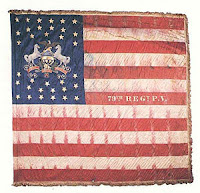
After these exchanges, Bissinger apparently never publicly addressed the events at Lock 49 East again but set about trying to restore his reputation in Reading as a respected citizen.  Among the his assets was his service in the Civil War.  Born in Germany and brought to America as a boy, he was schooled in Pennsylvania and in the Civil War joined the 79th Pennsylvania Volunteer Infantry Regiment, whose battle flag is shown here.  Compiling a distinguished war record, Bissinger rose from the enlisted ranks to become the captain of the regiment’s Company F.  He would be called “captain” for the rest of his life.


Bissinger also could point to his success as a Reading businessman.  At his marriage to Louisa her family had gifted him with one of their businesses, a restaurant and saloon, that he renamed “Cafe Bissinger.”  Located in a large building at 611 Penn Street it became one of Reading’s most prominent and prestigious eateries and meeting places.  As indicated in an ad, Bissinger also was selling liquor, wine and beer both at wholesale and retail from the premises.

Later he would go on to co-found the Reading Brewing Company, a highly successful enterprise providing substantial employment for the city.


Moreover, for two decades (1864-1883) Bissinger was highly influential and successful in the cultural life of Reading.  When two German singing societies merged there, he was chosen as the director.  Bissinger went on to become musical director of the Germania Orchestra, one chosen to play at the U.S. Centennial Celebration in Philadelphia.  Described as a “musician of ability,” in 1879 Bissinger organized the Philharmonic Society of Reading and directed its concerts for four years.


The saloonkeeper also was cautious about pursuing his affair with “the other woman” who reputedly had precipitated the tragic events of 1875.  Described in one news story as a “femme fatale” from Philadelphia, Bissinger’s amorata was in fact a Reading native named Ida Sebald Rosenthal, the daughter of William Rosenthal a journalist and founder of the Reading Post.  Ida, an accomplished musician,  was eight years younger than Philip.  While no doubt continuing their relationship Bissinger waited until 1880, five years after the drownings, to marry Ida, apparently expecting — correctly, it seems — that public anger would dissipate.  Despite having housed Louisa and their children in quarters above Cafe Bissinger, for Ida the new bridegroom promptly built a spacious home, shown here, on Readings’ Mineral Spring Road.  They would have no children.  


Bissinger’s strategy of staying the course of his career in Reading paid off.  Public anger about his treatment of Louisa faded and soon people seemed to forget about his misdeeds.  Eventually, without public outcry, Bissinger was able to be appointed by Reading’s City Council as park commissioner.  He served from 1891 to 1897. 


In 1910 after 30 years of marriage, Ida, who had been in ill-health for some time, died in the couple’s home of what her obituary called “complications.”  Philip lived on another 16 years, but eventually sold his saloon and liquor business. Bissinger’s death certificate put the immediate cause as pneumonia brought on by heart disease.  The couple lay buried in the same Reading cemetery that contains the joint graves of Louisa and the children. 


Although events surrounding the Reading tragedy bear important resemblances to the Medea story, the impact on the husbands involved could not be different.  Jason, the unfaithful spouse of Euripides' tragedy, having alienated the Greek chorus and more important, the gods, died lonely and unhappy.  He was said to be sleeping on the stern of his rotting ship when it collapsed, killing him instantly.  Bissinger, by contrast, earned a lengthy complimentary write-up in a 1909 volume of Berks County biographies.  No mention is made of his first marriage or the drownings.  The article concludes:  “He possesses a genial and good natured disposition, is a pleasant conversationalist, and has scores of friends throughout this section.”


The story does not end there.  Since the 1875 tragic deaths of Louisa, Mollie, Lillie, Philip and an unborn child, Gring’s Mill’s Lock #49 regularly has been the site of ghostly sightings.  For example,  two nuns walking the canal towpath encountered two little girls in Amish-looking clothing who were soaking wet.  After they passed the nuns turned to look again and the girls had vanished.  Lillie and Mollie?


Note:  Newspaper and other articles abound on the story told here.  Two principal sources were “The Historical and Biographical Annals of Berks County Pennsylvania,” by Morton Montgomery, 1909, and “Reading’s Famous Ghost Family” by Printz, The Reading Eagle, October 18, 2020.


Saturday, January 29, 2022

A Fated Steamboat Could Not Sink John Murphy

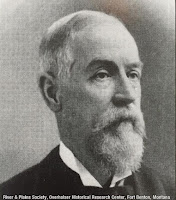
On April 1, 1865, the steamboat Bertrand struck a submerged log in the Missouri River about 25 miles upstream from Omaha, Nebraska, and within ten minutes sank in twelve feet of water.  No one died but almost the entire cargo was lost including hundreds of bottles of whiskey and alcoholic tonics bound for a Helena, Montana, store owned by John T. Murphy, shown here. Such a devastating loss might have discouraged another man, but Murphy was steadfast.  He simply re-ordered his liquor and other supplies and went on to become a multi-millionaire.

Murphy’s march to economic prominence began modestly when he was born in 1842 on a farm in Platte County, Missouri, the son of William S. and Amelia Tyler Murphy, both originally from Pennsylvania.  His family was able to send him to a private school until he was 17.   Then drawn by the news of gold strikes Murphy headed West, settling initially in Denver where he clerked in a store.


That was the last time Murphy ever worked for someone else.  As one biographerput it:  “It seems John Murphy was one of those rare individuals who could touch anything and turn it to gold.”  By 1863 he had moved to Nevada City. Colorado, where he opened his own store, one selling liquor among other supplies.  Sensing the end of the gold mining boom there, Murphy loaded a wagon with merchandise, including whiskey,  and headed 800 miles northwest to Virginia City, Montana,  Gold had been discovered there in May 1863.  Within weeks Virginia City had become a boomtown of thousands of prospectors and fortune seekers in the midst of a gold rush. 
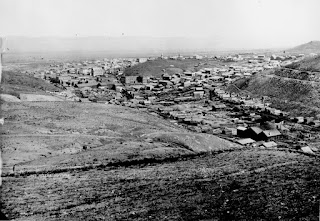

Aware of the transitory prosperity of such towns, Murphy next set his sights on Helena, Montana.  Shown here, Helena was the site of The Last Chance Placer Mine, one of the most famous gold deposits in the western United States. It is estimated to have yielded gold worth $3.6 billion in today’s dollars  By 1888 an estimated 50 millionaires lived in Helena, boasting more per capita than in any city in the world.  The city eventually would become the capital of Montana and  Murphy’s home for the rest of his life.
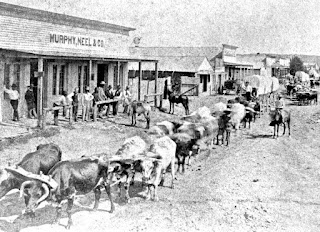


With local partner Sam Neel, Murphy opened a general store in Helena.  A photo of the establishment indicates it was a “false front” structure on the main street where the owners could watch the ox-drawn Conestoga wagons rattle through town. To fetch supplies Murphy floated down the Missouri River on a flatboat to Nebraska City, Nebraska, a commercial center for goods brought by steamboat via the Ohio and Mississippi Rivers.  There he ordered merchandise to be transported overland to Helena the following spring.  Continuing downriver to St. Louis, he ordered more goods to be shipped by steamboat to Fort Benton, a port on the Upper Missouri River, then to be carried overland 130 miles to Helena. 
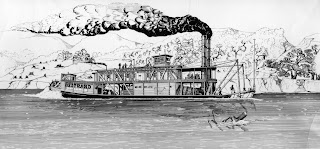

The Bertrand

Stowed aboard the ill-fated Bertrand, Murphy’s supplies ended at the bottom of the Missouri River.  In 1968, more than 100 years later,  private salvagers discovered the wreck in an area of the river managed by the U.S. Department of the Interior.  Since the boat was found on government property the recovered artifacts were relinquished to the U.S. Fish and Wildlife Service for permanent preservation. More than 10,000 cubic feet of cargo and over 500,000 artifacts were recovered from the hold during excavation and now are on display at the museum of the DeSoto National Wildlife Refuge near Missouri Valley, Iowa.


Consignment records indicate that a considerable quantity of the whiskey and other liquor on board, including alcoholic bitters, were destined for Murphy & Neel in Helena.  The whiskey bottles long since have had their labels washed away.  They largely are un-embossed and identifying the brands is impossible.  In contrast the bitters bottles have distinctive shapes and are embossed. Illustrated here, they held “Drake’s Plantation Bitters,”  “Dr. J. Hostetter’s Stomach Bitters,” “Kelly’s Old Cabin Bitters,” and “J. H. Schroeder Stomach Bitters.”   The first three brands through national advertising likely had a customer base even in far off Montana.  The fourth bitters was less well known, the product of a Louisville wholesale liquor house.


During this period, Murphy was engaged in a courtship with Elizabeth Morton, the daughter of William and Adaliza Thornton of Clay County, Missouri.  Although John was eleven years older than Elizabeth neither were young at the time of their marriage — the groom 57; the bride, 46.  They married at her home and left for Montana the following spring.  They would have four children.  Of Elizabeth, a newspaper obituary said:  “It is allotted to few to have more friends than Mrs. Murphy.  Those who knew her best, loved her best.  She was one of the most unselfish of women.  Her life was one succession of good deeds.”
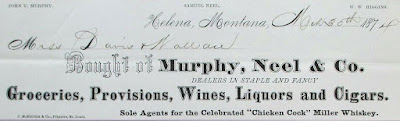


Murphy, Neel & Co. flourished during the late 1860s and the 1870s.  As indicated by a letterhead the company was dealing in staple and fancy “Groceries, Provisions, Wines, Liquors, and Cigars.”  The owners advertised as sole agents for Miller’s “Chicken Cock” whiskey from Bourbon County, Kentucky, a popular nationally sold brand. [See post on J. A. Miller, August 8, 2015.]  Day to day management in Helena fell to Sam Neel, with help from a third partner, W. W. Higgins. 
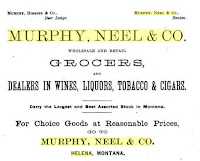
 

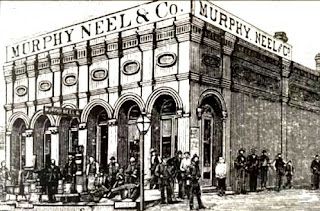
Thirty-two years younger than Murphy, Neel rapidly became known as “one of the most successful and able businessmen of the western country,” according to a biographer.  Recognizing the talent of his partners, Murphy created general stores in Deer Lodge in the name of Murphy, Higgins  Co. and Fort Benton as Murphy, Neel & Co.  In 1882 Murphy teamed with Edgar Maclay to open  hardware stores in Helena and Fort Benton under the name Murphy-Maclay, expanding two years later to a third store in Great Falls, Montana.  Murphy and Neel eventually built a new Helena headquarters for their operations, shown below.


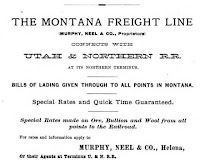
His sprawling retail empire brought forcefully to Murphy’s mind the need for improved freighting services over a large section of western Montana.  Under the aegis of Murphy, Neel & Co. he created the Montana Freight Line.  It was aimed at serving local business needs and moving supplies and equipment to the state’s burgeoning mining camps.  The Union Pacific railroad about 1878 had bought a small Mormon-initiated railroad in Utah and extended it to Butte, Montana, to service the copper mines there.  Murphy advertised that his freighting service could carry cargo, including ore, bullion and wool,  from across Montana to the railhead.  His ox and mule trains were said to have the capacity to haul 400,000 pounds per trip. Filling a definite and growing need, the Montana Freight Line again demonstrated Murphy’s “Midas touch.”


Now among Montana’s richest businessmen, Murphy expanded his activities into banking, helping to organize the Helena National Bank in 1891 and a year later creating the Montana Savings Bank.  His mining interests included investments in the Poorman, Jay Gould, Rumley and Silver Bell mines. From his winter home in Fort Meyers he is reported to have invested in Florida citrus farming. 

Murphy’s most notable enterprise was raising livestock.  In October 11, 1911, with three partners he formed the Powder River Land & Cattle Co., with ranch operations on more than 24,000 acres in Custer and Carter Counties, Montana, and other pasturage in South Dakota. There he grazed herds varying in size from 2,300 to 13,000 head.  The operation was incorporated as the Seventy-Nine Ranch with its “79” brand.  Murphy became known as the greatest of Montana’s cattle kings.  George T. Armitage, a cowboy on the “79,” wrote about his experience.  According Armitage, Murphy remained “a shadowy figure” to the many cowboys who worked on the huge ranch.


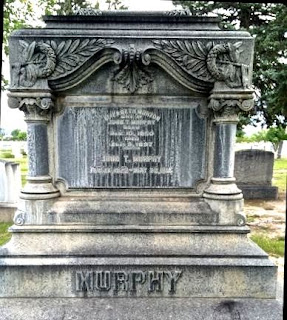
In his later years, through death Murphy lost some of those closest to him.  In 1897 after a short illness that initially did not seem serious, his wife Elizabeth succumbed to a malady described in the press as “brain fever.”  After a few months, Murphy married again.  She was Clara Cobb, originally from Providence, Rhode island.  Several years later a young son died, followed by his partner, Sam Neel, still only 34 years old.  After what a biographer called “a long and exhausting career,” John T. Murphy himself died in May 1914 and was buried beside Elizabeth in Helena’s Forestvale Cemetery.


Over his lifetime, Murphy, the Western tycoon, had carved out an empire of productive enterprises that made him one of the richest men in the West.  More than a century later the raising of the Bertrand confirmed the principal beginnings of his wealth — selling whiskey and other forms of alcohol.


Notes:  This post was drawn from a variety of sources.  Chief among them were “The Steamboat Bertrand and Missouri River Commerce” and “A Study of 19th Century Glass and Ceramic Containers,” both by Roland R. Switzer;  “Progressive Men of Montana, Illustrated,” A. G. Bowen & Co., 1902; and George T. Armitage, “Prelude to the Last Roundup: the Dying Days of the Great 79,” Montana, Vol II, No. 4. Historical Society of Montana.