Wednesday, March 13, 2024

Three American Authors & Their Saloons

 Foreword:  The importance of alcohol to American literature has been the subject of numerous books and articles down through the years.  This post is devoted to three famous authors who have saloons associated with their names. I am struck by the fact that the three saloonkeepers were all immigrants of German heritage.  There may be a hint in the welcoming environments that  commonly have characterized German-owned drinking establishments.

While living summers in Elmira, New York, Mark Twain (aka Samuel Clemens), already a world famous author, frequently found occasion to visit a local saloon run by an immigrant German named August Klapproth, and his son, Charles.  Years later the National Distillers Product Co.,, the source of “Old Crow” bourbon, as part of a series of “history re-imagined” magazine ads featured Twain at Klapproth’s.  Most were fanciful.


From the little to be gleaned from the historical record, the Klapproths were stolid German publicans content with running a decent tavern.  August Klapproth had been born in Darmstadt, Germany, and immigrated to America as a youth.  His son Charles, born in America, never married and lived much of his later life with his widowed mother and an unmarried sister.  Fame came when Twain chose the Klapproth saloon as his favorite Elmira watering hole.


It was not until the early 1980s that Old Crow’s representations of Twain finally approached reality.  The ad shown below recreates the tavern interior as it actually looked, including the wood paneling, the fireplace and the metal bas relief sculpture above it.  This ad has Twain telling his rapt audience:  “Thunder is good, thunder is impressive; but it is lightening that does the work.”


When he died in 1910, Twain was buried in Elmira’s Woodlawn Cemetery, the same burial ground where both August and Charles Klapproth are interred.  The story does not end there.  When the saloon was being torn down, the paneled wall, fireplace and decorative metal casting were saved and now are the centerpiece of the Mark Twain Archive at the Gannett-Tripp Library of Elmira College.  Shown below, note the similarity to the ad above.


                                                           ***

American author Jack London as a boy found a second home and a source of inspiration in an Oakland, California, saloon run by a friendly German immigrant named Johnny Heinhold.   Memorialized by London in his novels and autobiography, Heinhold’s still stands as a tribute to London, shown here, who never forgot the proprietor nor the drinking establishment where his writer’s imagination first was ignited.


London is said to have found a “second home” in Heinhold’s Oakland, California saloon when he was as young as ten. Shown here, the saloonkeeper was known for his kind heart.  He must have seen something special in the boy and made a place for him.  Shown below is an extraordinary photo of the young London sitting in Heinhold’s, engrossed in a dictionary .  At the same time the boy was listening to the stories of “the hard mixed crowd” that frequented the saloon, including crews of whaling vessels, sealing ships, and windjammers.


In his autobiographical book, “John Barleycorn,” London dwelled on his relationship with the saloonkeeper:  “More than once in the brief days of my struggles for an education, I went to Johnny Heinhold to borrow money.  When I entered the university I borrowed forty dollars from him, without interest, without security, without buying a drink.  And yet…in the days of my prosperity, after the lapse of years, I have gone out of my way by many a long block to spend across Johnny Heinhold’s bar deferred interest on the various loans.  Not that Johnny Heinhold asked me to do it, or expected me to do it.”


London's association with the saloon has more than been repaid. Now on the National Register of Historic Places, Johnny Heinhold’s saloon has been altered on the outside.  As shown here, the front has been updated to accommodate a large neon sign announcing the saloon as “Jack London’s Rendevous.”  The north side of the building is hidden behind a billboard-like appendage decorated with a late 1990’s mural honoring London, commissioned by the Port of Oakland.


                                                                ***

Virtually any anthology of American poetry will have a verse or two from Eugene Field, an author, poet, and editor of newspapers ranging from Denver to Chicago.  Known for him dislike of prohibition, when in his home town of St. Louis, Field regularly found his way to a saloon run by a German immigrant named John Henry Bloeser.


In 1876 while Field in St. Louis writing editorials for the St. Louis Journal, he met John Henry Bloeser, a German immigrant who had arrived in the United States in the mid-1860s, living first in Chicago and after his marriage in 1872, moving to St. Louis.  There he opened a saloon at Pine and Eighth Streets, shown below.  His drinking establishment soon became a regular hangout for the newspaper and literati crowd.  Field was among Bloeser’s regulars. 


Bloeser sold both wholesale and retail liquor, calling his company the Bloeser Distilling Company.  He was not making whiskey but buying it from distillers and blending it in his facilities to achieve a desired color, taste and smoothness.  He used the brand names “Empire Rye” and “Harlem Club” for his blends.  Although Bloeser failed to trademark either label, he advertised his whiskey widely though shot glasses and corkscrews.


Bloeser must have missed Field’s steady patronage of when he left St. Louis in 1880 to become managing editor of the Kansas City Times. Field landed a similar position with the Denver Tribune and then moved to the Chicago Morning News as a reporter.  From his Chicago base, Field with some frequency returned to St. Louis, possibly to visit relatives, despite once having described it as an “ineffably uninteresting city.” According to newspaper reports, when in town he regularly visited Bloeser’s saloon where he presumably found companions who were not entirely “uninteresting.”  I fantasize that a Field’s drinking poem may have had this “watering hole” in mind.  An excerpt reads:


And you, oh, friends from west and east


And other foreign parts,


Come share the rapture of our feast,


The love of loyal hearts;


And in the wassail that suspends


All matter burdensome,


We’ll drink a health to good old friends,


And good friends yet to come.


Note:   Longer posts on each of these authors and their favorite saloons may be found elsewhere on this website:  Twain and Klapproth’s, March 10, 2023;  London and Heinhold’s, February 10, 2023, and Field and Bloeser’s, May 17, 2023.


Thursday, March 7, 2024

N. R. Bianchi: Liquor & Survival in the UP

When 20-year-old Narciso Bianchi arrived in America in 1897, the young Italian immigrant headed straight to a northern tip of Michigan’s Upper Peninsula (UP) shown here,  a rugged territory rich in underground copper.  Amid years of tumult and tragedy in the area’s mining region, Bianchi persevered in the liquor trade, living there the rest of his life, and lies buried there.  His story is one of survival as a world crumbled around him.


First, some details about the environment in which Bianchi found himself.  As shown on the map here, what is now the city of Calumet in the northern most peninsula of  Upper Michigan was first settled in 1864 and named originally for “Red Jacket,” a chief of the Seneca Indian tribe, shown here.  This is a puzzling choice since Red Jacket resided far from Michigan in upper New York State and was known for his antipathy toward white settlers and Christianity.


“Calumet” also had Native American origins, meaning a clay bowl at the end of a long “peace pipe.”  The name first appeared applied to a small community that had grown up near Red Jacket adjacent to a highly productive copper mine.  It subsequently was the name given to the township encompassing Red Jacket and nearby copper mining settlements. In 1929 Calumet officially became the name of the city itself.


Copper mining fueled the economic life of the region.  The Boston-based Calumet and Hecla Mining Company produced more than half of United States copper from 1871 through 1880.  It drew immigrant miners from all over Europe to this desolate outpost.  By 1900 Red Jacket had a population of 4,668 and Calumet Township counted 25,991.  It was hailed as one of the richest communities in America.  What had begun as an isolated settlement virtually touching Canada, was now, at least for the time being, a busy city, as shown below.


After his arrival in America, Bianchi seems to have made straight for the UP, as it commonly is known.  Born about 1878 and raised in the lush landscape of Tuscany, the son of Renaldo and Viola Bianchi, the youth must have been startled by the bleakness of the terrain. He likely had  relatives or friends among the many Italian-born men working in the mines.  Whether he joined them underground for a time is unclear, but about 1904, with a partner, Bianchi opened a saloon and a liquor store. 


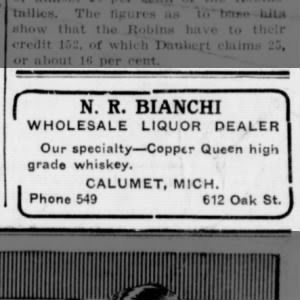
He had entered a crowded field.  By 1910 the city directory indicated that Red Jacket/Calumet was home to 82 saloons, Bianchi’s among them.  But the immigrant youth had a better idea than simply providing drinks over the bar.At the time, Red Jacket could claim distinction as the railroad center of the UP. The heyday of the Mineral Range railroad, its station shown here, was in the early 1900’s,  employing 200 trainmen in addition to 250 men in the shops. Bianchi saw the opportunity to buy whiskey from the many distilleries in the Midwest and ship it to him by the barrel via railroad.  Rather than just selling to the public, Bianchi understood the considerable business that would come from peddling whiskey to the other 81 saloons.  He was now advertising himself as “N.R. Bianchi, Wholesale Liquor Dealer.” 


When shipments arrived Bianchi would open the barrels and empty the contents into smaller containers, usually ceramic jugs from one to three gallons in size.  When purchased by local saloon keepers they would be repackaged in smaller containers, often glass, to be poured out to their customers.  Shown here and below are examples of the several of the variety of ceramic jugs bearing Bianchi’s name that are still in existence today.  The jugs may have been the product of the famed Red Wing potteries in Minnesota.


In addition, Bianchi likely was doing some “rectifying,” that is, blending several whiskeys and perhaps other ingredients to create his own brand that would have been sold both to the public and wholesale.  He called it “Copper Queen” and featured a label that depicted a Native American woman in a headdress.   Bianci  advertised Copper Queen as a “high grade” whiskey and truthfully as “a blend.”  Although it was his proprietary brand, Bianchi, possibly because of cost, failed to register his trademark with the government.


As Bianchi was building his liquor business he was also gaining a family.  In February 1905, he married Edith Cheli, an italian immigrant woman who was 20 at the time of their nuptials.  Narciso was 27.  The couple would have a family of five. The 1920 census recorded Julius 13, Myra 11, Reynold 7 and Marie, under a year old.  A fifth child, Elizabeth, would come later. Bianchi’s occupation in the census was given as “owning store-liquor.”


 As the 1900s moved on, however, the economic bloom faded from Red Jacket/Calumet to be replaced by violence.  As copper prices fell, the mine owners began to cut the workforce and require more hours from those retained.

Labor unrest and strikes resulted.  The situation triggered what became know as the “Seeberville Affair” in August 1913.  After two strikers disobeyed an order from a mine boss, a group of mine “enforcers” surrounded a boarding house in which the men were living and opened fire.  Two boarders with no connection to the strikers were killed and two others wounded.  


Although four of the shooters later were convicted of manslaughter, the deaths increased the intensity of the strike.  The incident also was a prelude to a disaster at the Italian Hall, a building operated by an Italian mutual aid society, on Christmas Eve 1913.  Union wives gave a Christmas party for the strikers and their families.   I am assuming that Bianchi was among those donating gifts for the children and money for party supplies.  Hundreds of mining families attended, packed into the hall ballroom.


Here is newspaper account of what happened next:   “At some point during the evening, according to most witnesses, an unidentified man stepped into the ballroom and shouted "Fire!", beginning a panic and stampede for the doors. The main exit from the ballroom was a steep stairway down to the front doors of the building. In the ensuing panic, 73 people were crushed to death in the stairwell, 60 of them were children.”


There was no fire but the perpetrator of the disaster, believed to a strike breaker, was never identified.   Shown below is a photo of a line of coffins in varying sizes waiting to be delivered to the families of victims. Folk singer Woody Guthrie's 1945 song, "1913 Massacre,” memorialized this event.  Whether Bianchi was in Italian Hall that night is unknown but among the dead, injured and grieving must have been many friends and acquaintances.


Although World War One revived the need for copper and boosted the Calumet economy, the lift was temporarily.  Following the conflict the demand for copper declined sharply and prices dropped.  Thousands of workers and their families left Red Jacket/Calumet, many to find work in the fast-growing auto industry in Detroit.  By this time state and national prohibition had been enacted, forcing Bianchi to shut down his wholesale liquor trade and saloon. Without fanfare he turned the latter into a soft drink parlor.  While many such “parlors” were a front for liquor sales, Bianchi apparently was never cited for violations.  Selling “soda pop” he persevered in Calumet through the 14 years of National Prohibition.


With Repeal, Bianchi went back to running a saloon.  According to the 1940 census, his wife Edith, her children grown,  was helping as the cook.  Son Julius, now married and living next door with his wife, was assisting his father in running the establishment.  A witness of many years to the strife and decline that had afflicted Calumet, Bianchi continued to operate his tavern over the next decade.  The 1950 census found him still the proprietor.  By this time Julius had moved on.  A younger son, Reynold, was now working as the bartender and assisting the 70-year old Bianchi with running the tavern.


Five years later, in July 1952, Narciso Bianchi died, age 74.  Joining victims of the Italian Hall disaster, he was buried in  Calumet ’s Lake View Cemetery, right.  Below is Bianci’s headstone and that of wife Edith, who joined him in 1964.  Meanwhile Calumet, once considered among the richest areas in the America with a population approaching 30,000 also was dying.  In the 2020 census the population had dwindled to 621.


Addendum:  Narciso Bianchi’s “Copper Queen” brand of whiskey has been revived by the Iron Fish Distillery, located in Thompsonville, Michigan, a small town on Lake Huron in Lower Michigan.  As shown below, the new label largely has replicated the earlier one with a notable exception.  Gone is the Native American woman with an Indian headdress.  She has been replaced by a white woman rearing a Gay Nineties’ feathered hat.  Thus political correctness is served.  The distillery website states that Iron Fish can deliver Copper Queen whiskey to 39 states and DC.  Wherever he is, Narciso would be pleased.


Friday, March 1, 2024

Thierman & Ruedeman — Immigrant Whiskey Success

On page 207 of a 1902 volume entitled “Fetter’s Notable Men of Kentucky” are photographs of two men facing each other under the headline “Distillers.” They are Henry Thierman and William Ruedeman.  Unlike the members of such well known whiskey dynasties as the Beams, Stitzels and Browns, both men came from obscure beginnings in Germany.  After Immigrating to the United States as virtually penniless youths, Thierman and Ruedeman eventually joined in creating a distilling company hailed in 1895 as “an immense business, broadly distributed over the whole of the United States, the total of which average $750,000 each year.”  — today more than $37 million dollars annually.

Shown here, Henry Augustus Thierman was to first to arrive on these shores.  He was born in Germany in January 1836 and educated in the good local schools.  In May 1853 at the age of 17 he left Hanover for America.  Upon arrival he appears to have gone almost immediately to Louisville, Kentucky.  Burial records for that city indicate Henry likely had Thierman relatives there who initially took him in.


According to his obituary, Thierman’s first business venture was as a dairyman where “…He displayed the same shrewdness and business then that afterward made him successful in a broader field.”  That unnamed field was selling liquor.  About 1864, he ditched sour cream for sour mash, becoming a Louisville wholesale liquor dealer.  


With a local  named Prande (aka Prante), Thierman opened a store at 221 Market Street.  The partnership was short-lived.  After two years, he stuck out on his own with a firm he called “H.A. Thierman Company.”  Over the next few years, he would move several times as success brought a need for larger quarters.


While Thierman was growing his whiskey trade, he met and in May 1865 married a local woman, Louise Simm, the daughter of a well known Louisville furniture dealer.  At the time of their nuptials Henry was 29 years old, Louisa, 25.  The couple would have three children over the next 11 years, girls Ida and Lillie, and son Julius who died in early adulthood.  


Meanwhile in Hessen, Germany, William Ruedeman,was born in May 1854, the son of  Dorothy and Ernest Ruedeman.  Eighteen years younger than Thierman, William was 17 when he arrived in America in 1871 aboard the steamship Berlin from Bremen and settled in Louisville.  Whatever brought the two men together, the bond became close.  Ruedeman joined Thierman at his liquor house, initially as a porter.  Before long he had been promoted to vice president of the firm and had married Elizabeth Thierman, a relative of the boss.  The couple named their first son “Henry” after William’s benefactor.


With a third man, E. M. Babbitt, the H.A. Thierman Company now began a period of acquisition and growth.  At that time the firm was located on Louisville’s West Main Street. the so-called “Whiskey Row,” a prestigious address for a liquor company without its own Kentucky distillery.  Thierman remedied that omission in 1882 when he bought an existing faclity in Jefferson County that had been producing whiskey brands “Mayflower” and “Ashton.”  Thierman promptly changed the name to the Mayflower Distilling Company.


As recorded by insurance underwriters, the distillery, shown below, was of frame construction and had the capacity to mash 400 bushels of grain daily.  The plant included three warehouses:   Warehouse A  was brick with a metal or slate roof and located 46 feet east of the still.   Warehouse B was brick with a metal or slate roof, located 63 feet SW of the still.  Warehouse C was iron-clad with a metal or slate roof, located 6 feet beyond Warehouse A.  These warehouses were capable of holding 20,000 barrels. Cattle pens were 115 feet downwind of the still-house.

Responsibility for managing this distillery seemingly fell primarily to Ruedeman and Babbett until Thierman sold it in 1892.


In the meantime Thierman in 1864 had bought a second distillery, this one located in Louisville at 36th Street and Missouri Avenue.  This facility had been operated by John Roach and colleagues producing such brands as “Belle of Louisville.” (See my post on Roach Feb. 15, 2022.)  Initially called the American Distillery, it was renamed by Thierman as the Rugby Distillery Company, RD#360, 5th District in federal records.  He undertook to expand the facility in ensuing years.


Insurance underwriter inventories of 1892 indicate that the distillery was frame with a metal or slate roof. The property included four warehouses, all brick with metal or slate roofs:  Warehouse A  was located 62 feet south of the still; Warehouse B, 66 feet SE;  Warehouse C, 80 feet east of the still, and Warehouse D,  84 feet east. The warehouses were all heated "not over 80 degrees”. In total, the Rugby Distillery had a daily mashing capacity of 400 bushels of grain and storage capacity for 35,000 barrels of aging whiskey.   The property also contained a cattle barn.


Owning these two distilleries and having a significant financial interest in the John T. Barbee & Company distillery in Woodford County, Kentucky, had thrust Thierman from a whiskey dealer, buying his stock from others, almost overnight into a major force in the Louisville distilling community.  A report in the 1895 publication “Louisville of Today” enthused:  “With these exceptionally fine facilities for the production of high grade whiskies, the company transacts an immense business, broadly distributed over the whole of the United States, the total of which average $750,000 each year.”  Thierman had become a self-made millionaire.


His company claimed three names as its proprietary labels,  “Belle of Jefferson,”Mayflower,” and “Indian Hill.”  It would register their trademarks in 1902.  Shown here, the label for Indian Hill Whiskey showed the silhouette of a Native American watching from a hillside.  More interesting, as shown below, were the heads of two Indian chiefs and the “bas relief” lettering of “Indian Hill” bourbon whiskey” embossed on the bottles.


During the late 1800s, Thierman, using the substantial profits of the distilleries, bought Louisville’s Garvey Hotel as another investment.  Shown here as it looked initially, the hotel has survived through the years, renamed “The Normandy,” and is an attractive lodging currently.


Time, however, was running out for Henry Thierman.   Reputedly having contacted the flu, called “grip,” he first showed symptoms after Christmas 1900, when he was 65.  Never hospitalized, his condition, initially not thought serious, took a turn in early February.  According to Thierman’s newspaper obituary, doctors warned that his recovery would be unlikely.  He lingered several more days before dying at home on February 15, 1901.  


Thierman was buried in Louisville’s Cave Hill Cemetery, the grounds where so many Kentucky “whiskey barons” are interred. He lies in Section P, Lot 25. Below is the monument and headstone memorializing this immigrant boy who rose to the pinnacle of Kentucky’s distilling hierarchy.


Ruedeman almost immediately stepped in as president of the H.A. Thierman Company, assisted by Babbit.  He was active in the Louisville business community as a member of the Board of Trade, Commercial Club and the Masons.  His caricature appeared along with other prominent figures, with a bowling ball and a pot belly.  The uncomplimentary likeness cannot have pleased his wife, Elizabeth.  She was living with their five children, Mary Louise, Dora, Henry, Ernest and William in a spacious home provided by her husband in an upscale neighborhood at 109 West Ormsby Avenue, shown below.


From the beginning Ruedeman demonstrated competent management of the H. A. Thierman Company. Throughout the early 1900s, however, he was facing increasingly strong prohibitionary forces that cut sharply into company profitability. Moreover, the Ohio River floods of 1913 were a disaster for the company’s Rugby Distillery.  A warehouse containing 3,460 barrels of prime bourbon collapsed and was inundated.  Although most of the whiskey was saved, many barrels were damaged and 200 barrels were a complete loss. In the aftermath of the flood, Ruedeman decided only partially to rebuild the distillery.


Ruedeman’s health began to falter as he enter his 60s and he died 1918 at the age of 64.  The coroner’s verdict was “softening of the brain,” i.e. dementia.  He was buried in Cave Hill Cemetery not far from Thierman’s grave.  Meanwhile, with National Prohibition looming, the distillery was shuttered.  After 1920 the site was vacated and its structures were allowed to fall into disrepair.


This sad ending does not, however, tarnish the reputations of two enterprising German youths who emigrated to the United States and over 32 years together built a Kentucky liquor house and distillery enterprise capable of generating the current annual equivalent of some $37 million dollars. Youthful immigrants Henry Thierman and William Ruedeman had become true Kentucky whiskey royalty.

Note:  This post has been compiled from a wide range of sources, of which the two most important were the 1895 publication “Louisville of Today,” and the Louisville Courier Journal obituary of Thierman, dated February 16, 1900.  

Afterword:  For years I have tried to post a new story on this website every four days.  As time goes by and having achieved 1,127 entries,  now approach 89 years, finding good new stories of pre-Prohibition whiskey becomes increasingly more difficult and time consuming.  As a result, in the future I will attempt to post every six days, beginning with the next entry.