Foreword: Most purveyor of whiskey were content to use standard size and shaped containers, whether of glass or ceramic. Artistic impulses usually were reserved for the paper labels. A few, however, spent time, effort and money on putting their alcoholic wares in bottles of unique design that have achieved “iconic” status. Herein are short narratives of three such whiskey men.
 The whiskey flask of a saluting soldier is emblematic of the production of unique liquor containers that the New York City grocery firm of Bulkley, Fiske & Co. issued over the short span of four years. The partners gave the Nation some of its most valued spirits jugs — shown throughout this post. The saluting soldier at right, for example, has listed at auction for $4,500.
Willam F. Bulkley, a native New Yorker, was committed to the grocery trade, albeit one heavily into liquor sales. In 1858 he teamed with Frederick B. Fiske in a firm at No. 51 Vesey Street in Manhattan. From the outset the partners began to issue pottery liquor containers that have become coveted by collectors. Some of those ceramics have a “Rockingham” glaze, both a tan and a darker brown. That attractive marbled look was highly popular in the United States during the early 1800s, copied from British glazes with a similar look.

 Among them is a whiskey jug entitled “Game Bag.” Each side has a bas relief picture. One shows a game bag with four dead quarry hanging from it, from left, pheasant, duck, rabbit and dove. The other side is another hunting scene featuring two dogs and a standing shotgun. Some are marked with an embossed “B.F. & Co.” on one side and an incised “Bulkley. Fiske & Co., New York” on the other.
As for the military man above, from the shoulder epaulets and tunic we may infer he is an officer, perhaps a high-ranking one. His belt reads “Morning Salute,” a reference that would have been widely understood. Many men would take a shot of whiskey every morning before going off to work, believing that it was beneficial both to health and mental wellbeing, and that snort commonly was termed a “morning salute.”
 From the archives of the New York Historical Society comes another example of a Bulkley-Fiske figural flask. This one is called “Man with a Fiddle.” This bottle is the standing form of a man sticking his tongue out, in perhaps a smile. His battered hat is the spout. He is wearing an overcoat and holding a violin and a bow against his chest. Might he be an itinerant fiddler? The name Bulkley, Fiske & Co., is impressed in the base.
  Only six inches high, the milk glass bottle shown here is shaped like a mountain range or glacier with brown and gold paint on both side that emphasize the rugged nature of the terrain being depicted. Known widely as the “Klondike Flask,” it has been called “one of bottle collecting’s classical figural bottles.” George Smithhisler is the Ohio liquor dealer who designed it, provided the several swallows of liquor the bottle contained, and issued the flasks in substantial numbers, apparently as a memorial to the Yukon Gold Rush of 1896.
 Smithhisler’s flask bore a round red label, announcing the contents as “Nuggets of Pure Gold from Klondyke” -- an alternative spelling -- and included his name and location. The flask also featured a metal screw cap that sealed the threaded neck and covered the ground-off top of the bottle. The bottle was blown in a mold that took a considerable amount of time and attention to create the mountain effect. It also required painting by hand to overlay the glass with gold and brown pigments. Over the years, as shown here, some examples have lost their labels and significant amounts of paint. In one case an owner stripped the bottle down to its milk glass base,revealing the full extent of the ridges and valleys.
  Although there is no mark on the flask, a likely guess is that it was the product of the A.H. Heisey Company of Newark, Ohio. That glassworks made a line of milk glass objects and was located only twenty-five miles from Smithhisler’s home. A leading expert on American glass and bottles, Dr. Cecil Munsey, has been fascinated with Smithhisler’s creation and has hailed it as a “classic.”
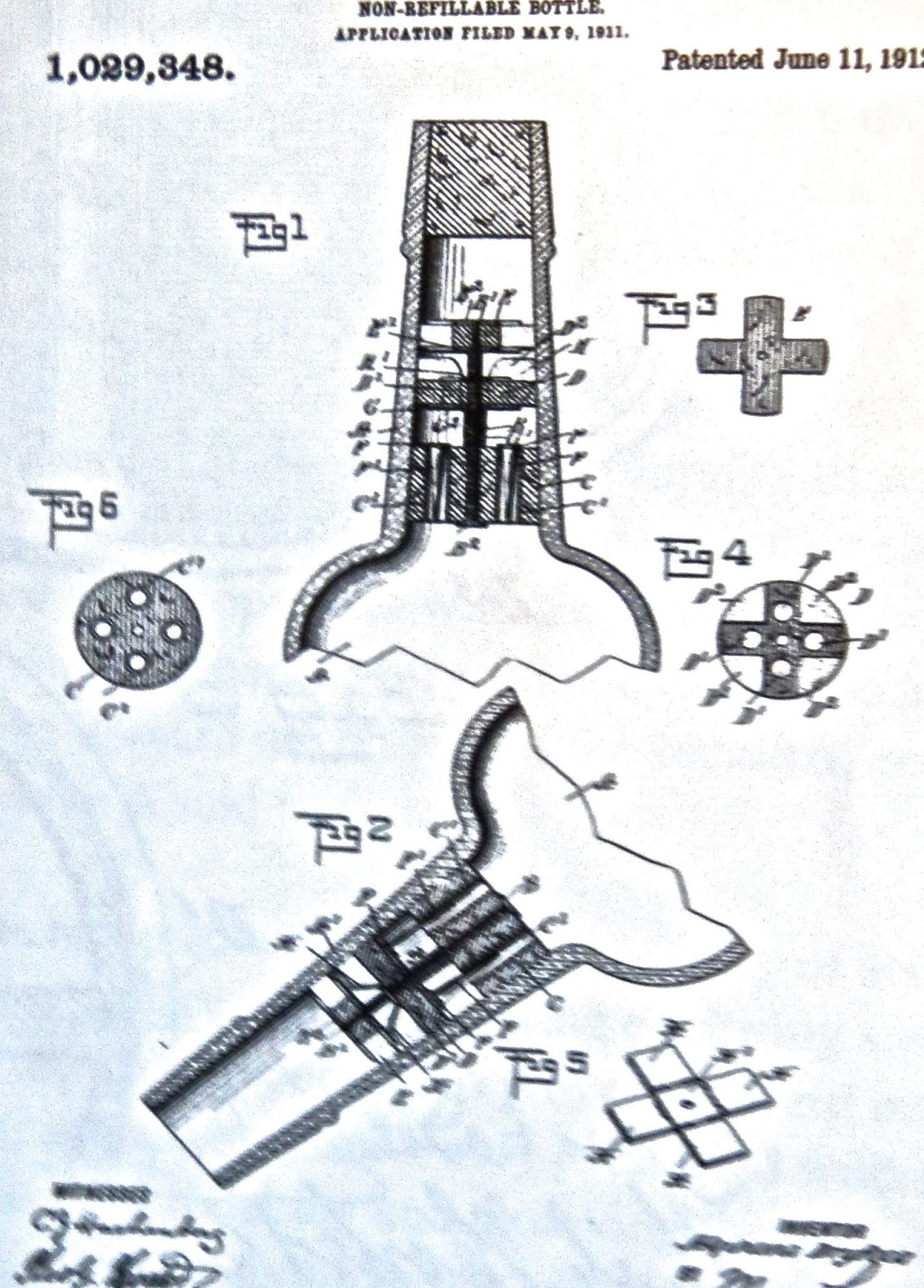
  Alphons Dryfoos was listed in New York directories as a liquor dealer from 1875 until National Prohibition shut him down in 1920. Through much of that history he was fixated on bottles, in particular designing and patenting unusual and extravagant ones. Clearly proud of his inventive abilities, Dryfoos displayed some of his “brainchildren” on his letterhead, as shown here.
  The whiskey man’s first foray into bottles was in September 1900. Dryfoos filed with U.S. Patent and Trademark authorities a design for a bottle he called a “composite receptacle” that comprised “a plurality of sections forming together a unitary body, and a covering inclosing said sections and provided at its upper end with a contracted tubular portion or neck serving as a handle for said body and also as a means for preventing the upward movement of the sections.” He provided no model but simply an illustration that shows the three sections, each with a hinged cap.
  A little more than a year later, Dryfoos was back with a new bottle. This time he had given up on multiple sections but clearly was enamored of the idea of items clustered around a central decanter. As shown here, this bottle had three niches into which he had inserted what he called “statues,” that is, miniature standing figures. The accompanying drawing showed a gentleman in a top hat and a policeman.
  For once, however, Alphons appears to have had a model made. It surfaced in November of last year and was put at auction. Purchased by Bob Ferri, a Texan, for $1,000, it since has been displayed in detail in Bottles and Extras, the magazine of the Federation of Historical Bottle Collectors. While the carved figures differ from those shown in the drawing, they remain unique in the bottle world. In all probability it is the only such bottle in existence. Dryfoos’ invention is reported to be on display at a tavern owned by Mr. Ferri’s son in Memphis, Tennessee.
Note: Longer articles on each of these whiskey men can be found on this blog. Bulkley & Fiske, May 16, 2016; George Smithhisler, April 13, 2014; and Alphons Dryfoos, June 1, 2018.