Foreword: This is the third in a series of posts that examines the activities of whiskey men that previously have been profiled, grouping them for analysis under various headings. In this case the common thread in their life stories was loving fine art and having the financial resources derived from liquor sales to be able to collect it. The four men featured here geographically were spread from coast to coast but seemingly shared an appreciation of beauty.
 The whiskey man most closely connected with the art world — then and now — was William Thompson Walters, shown here in a full-length portrait by the French artist, Leon Bonnat, who was a friend of Walters. Born in a small mining town in mid-Pennsylvania, Walters early on decamped to Baltimore where he open his own liquor house in 1847. Torn in his loyalties during the Civil War and leaving the management of his business to a brother, in 1861 he packed his family off to Paris. Almost immediately Walters and his wife, Ellen, began collecting works of art, scouring Europe from England to Italy for paintings, sculptures, ceramics and other object d’art. They and their money were eagerly welcomed by a host of artists and dealers. Among their acquisitions was Jean-Leon Geromes “The Christian Martyrs’ Last Prayer,” shown below.

Then tragedy struck. While on a trip to London in November 1862, Ellen contracted pneumonia, and with antibiotics still unknown, died. She was only 40 and left two minor children. Even her death could not prompt Walters to return to the United States. Instead — it has been suggested to console himself — he threw his energies even more fervently into collecting.
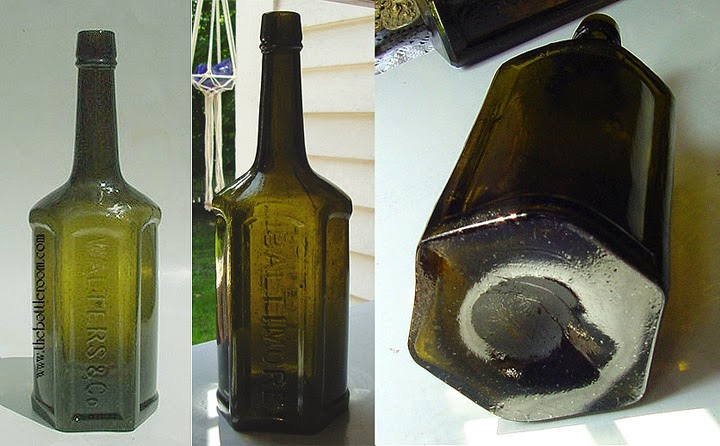
 Only with the end of the Civil War in 1865 did Walters return to Baltimore. With characteristic vigor he plunged into everyday management of his liquor business. Walters was not a distiller but a “rectifier,” creating his own proprietary brands with whiskeys purchased from Maryland and Pennsylvania distilleries. His embossed bottles carried a panel that said simply “Walters & Co.”
 Not satisfied with collecting just for his own pleasure he began to open his house periodically for tours. With his death in 1894, he left his art works to his son, Henry Walters, himself a collector. Henry, true to his father’s interest in opening the collection to the public, created an art galley on Charles street on the edge of downtown Baltimore. The original gallery interior is shown above.

At his death in 1931 Henry gave the building and its contents to the City of Baltimore where it has become the Walters Art Museum. During his lifetime in Baltimore the media frequently played down the source of William Walters’ wealth. Several years ago, however, the Museum ran a newspaper ad headlined “From Rye to Raphael,” highlighting the fact that its founder initially made his fortune selling quality whiskey.

 A second Baltimore whiskey man with a yen for art unfortunately was pushed in a different direction by circumstances. He was Nicholas Matthews. Unlike Walters, Matthews was from a distinguished and wealthy old Maryland family. Possibly with family backing in 1888, when he was 30, Matthews opened a wholesale liquor establishment in Baltimore. As shown by his elaborate “art nouveau” letterhead, the company initially was located in a four story building at 128 Calvert Street, a major commercial avenue. For the next 22 years, Mathews operated a highly successful liquor business. His proprietary brand was “Altamont Rye.”
Throughout this entire period, Matthews was buying fine art at a furious pace. Whether his passion stemmed from his upbringing or was encouraged by his wife, Bessie, it is evident that a substantial part of the wealth he was accruing from whiskey sales he was plowing into buying fine paintings, both European and American. Although he was said to have had a particular eye for Dutch painters, he also held a significant number of French artists of the Barbizon School, including Courbet and Gericault.

His collection also included paintings by such well-known American artists as Thomas Cole, William Harnett, Albert Bierstadt, William Trost Richards and Arthur Quartley, the last a close associate of Winslow Homer. Shown above is a painting in the Matthews collection by the noted American landscape artist, George Inness. It is entitled “The Juniata River near Harrisburg, Pennsylvania.”
In 1912, however, Matthews wholesale liquor business was terminated abruptly and Altamont Maryland Rye disappeared as a brand. Soon after, 134 pieces from his art collection were put up for auction. Before the sale the paintings were exhibited at the American Art Galleries in New York City where they drew national attention and critical applause. But a Matthew museum was never to be. The collection ended being scattered across the U.S.

Shown here is the front page of the auction catalogue. It depicts a painting by the Belgian artist, Frans Synders entitled “The King is Dead, Long Live the King.” The picture is a humorous rendition of a varied group of birds all presumably celebrating after seeing a proclamation of a king’s demise posted on a stump. Why did Matthews sell? A descendant has written me that Nicolas and Bessie divorced about that time and he may have needed the money.
 We have neither museum nor auction catalogue to determine the extent of the Franklin O. Day art collection, once accounted among the finest in St. Louis, Missouri. How Day became a connoisseur of fine art is not entirely clear. He was born in Burlington, Vermont, in October 1816 and left off formal education in his mid-teens to work in father’s dry goods store. After an 1842 business failure that left him with $200, Day, shown left, headed west to St. Louis, where he quickly succeeded in business. There in 1855, with a partner, he established a wholesale liquor business called Derby & Day. It featured as its flagship brand, “Sunny South Whiskey.” The firm proved very lucrative.
 As a successful businessman, Day was alert to a trend among his St. Louis colleagues to spend their excess wealth by investing in works of art. Although the Impressionist movement was in its initial stages, few if any St. Louis collectors were interested in anything earlier than the 1930-1870 Barbizon School. As for Franklin Day, his taste was clearly toward traditionalist French and English genre paintings.
 His local reputation as a collector rested primarily on his purchase of a single painting for $10,000 — roughly equivalent today to $250,000. Painted by a Scottish artist, Erskine Nicol, the work was called “Paying the Rent,” one of the artist’s many depictions of Scotch and Irish peasant life. Called “clever” by critics, the painting has been described as being…”Laid in the library of the agent of a estate, the tenant farmers are settling their rent with faces in which dissatisfaction is the chief expression.” The oil was exhibited at the Royal Academy in London in 1866 and again at the Paris Exposition in 1867. Despite its reputation as one of Nicol’s most famous works, I have been unable to find an image of the painting, instead including here a similar Nicol genre piece to illustrate Day’s taste in art.
Likely because of the price paid, Day’s purchase made headlines in St. Louis newspapers and led to his collection being identified among those “which contain good and important examples of the work of nearly two hundred of the most celebrated of modern painters.” The whiskey man eventually seems to have tired of Nicol’s work and later sold it to Cornelius Vanderbilt, the railroad and shipping baron, who displayed it prominently in his New York City museum. I can find no mention of the sale price. The ultimate fate of Day’s art collection so far has escaped my research. I find no indication of a museum collection. Most likely it was sold at auction after his death and the individual works scattered widely.
 Our final whiskey man cum art aficionado was James J. Kelley. A native of Massachusetts, Kelley early in the 20th Century moved to Seattle, Washington, where in 1903 directories he was listed as a saloonkeeper. By 1906 he had moved to larger quarters that he named “The Art Palace.” He lavishly decorated the walls with large genre paintings bearing such titles as “Halibut Fishing” and “Sheep in the Fold.” The saloon operated along side a wholesale and retail outlet he called the “Family Liquor Store.” He package his whiskey in large ceramic jugs like the one shown here.
His “Art Palace” prospered until 1916 when Washington State enacted stiff prohibition laws that closed all saloons and liquor stores. Whiskey could still be obtained by prescription from a doctor, however, and drug stories proliferated. Among them was the Art Palace that Kelley quickly converted into a drug store. Intermittently in trouble with authorities about the amount of liquor being dispensed as medicine, he somehow was able to keep the establishment open for several months.

In May 1916, however, a corrupt, vindictive mayor personally led a large cohort of police on a heavily publicized raid on drug stores, restaurants and even private clubs. He seems particularly to have singled out Kelley’s Art Palace for his vendetta. Armed with axes and other implements of destruction the raiders demolished fixtures and a large quantity of liquor. They broke down Kelley’s bar and shattered a large expensive mirror. Local press put the damage to the Art Palace at $10,000, the equivalent of more than $200,000 today. Photos here shown what Kelley’s establishment looked like after the onslaught. The art collection was high enough on the walls to be spared.

At that point Kelley exited the drug store trade and became a successful Seattle hotel manager. What happened to his collection of paintings is unclear. The logical answer is that he sold them.
Of the “whiskey men” art collectors only William Walters and his son seems to have been able to mass a collection that continues to be on display. The other three, for various reasons, had their paintings disbursed through auctions and other sales. Ironically, genre paintings — like those that seemed to appeal to all of them — have made a return into public fashion and currently fetch good prices on the art market.
Note: For anyone wishing to read more expansive biographies of these four, they appeared previously as: Walters, October 31, 2014; Matthews, October 7, 2013; Day, June 23, 2017; Kelley, January 2017.