Foreword: Spring inevitably brings the quintessential American sport to the fore — baseball. Several whiskey men have made it an important part of their marketing or their lives. As the baseball season “heats up” both weather-wise and figuratively, it seems appropriate to bring three of these gentlemen to the fore.
 After the Civil War Solomon Klinordlinger, a German immigrant, for years operated a profitable but modest wholesale liquor business in Pittsburgh. Then he named a whiskey brand after the emerging local Pirates baseball team and hit a merchandising home run. A man with a baseball bat in his hand, shown here, paved the way to Klinordlinger’s fame and fortune.
Klinordlinger had faced stiff competition in the liquor trade. In the latter years of the 1880s, no fewer than 41 wholesale wine and liquor dealers were operating in the Pittsburgh area. Each of them was vying to sell to 70 retail dealers, and more important, 1,400 saloons. They were seeking a healthy slice of the estimated $6,100,000 in annual Pittsburgh liquor sales -- in today’s dollar, more than $91 million.
Meanwhile a home town baseball team named the “Alleghenies” had joined the newly formed National League. After pulling out of their earlier league the squad had been denounced by the competition as “piratical.” Making sport of the accusation and obviously noting the alliteration with Pittsburgh, the team officially changed its name to the “Pirates.” Simulaneously the baseballers were showing great baseball prowess and gaining huge Pittsburgh fan support. Winning season followed winning season. The Pirates were the National League champions in 1901 and 1902 and played in the first World Series in 1903, losing to the Boston Americans. In 1909 the team won the World Series against the Detroit Tigers.

 Klinordlinger was not just cheering the Pirates from the grandstand. With the wisdom of his namesake, Solomon foresaw the potential for selling whiskey through baseball in the Steel City. Capitalizing on the team’s immense popularity he named a whiskey brand after them, calling it “Pirate Club Pure Rye Whiskey.” The picture on the label showed a strapping man with a large mustache and a baseball bat in hand with “Pittsburg” prominent on his chest. Sol merchandised the brand in three sizes of bottle. He also issued shot glasses with an etched picture of the player.
  Although he was shut down by the coming of National Prohibition, Klinordlinger continued to be remembered in Pittsburgh because, as one observer put it: He “...brewed some of the finest spirits in Western Pennsylvania from the 1880s through the early 1900s...Perhaps tastiest to all Steel City sports folks...Pirate Club.” In Pittsburgh Klinordlinger clearly had hit a home run.
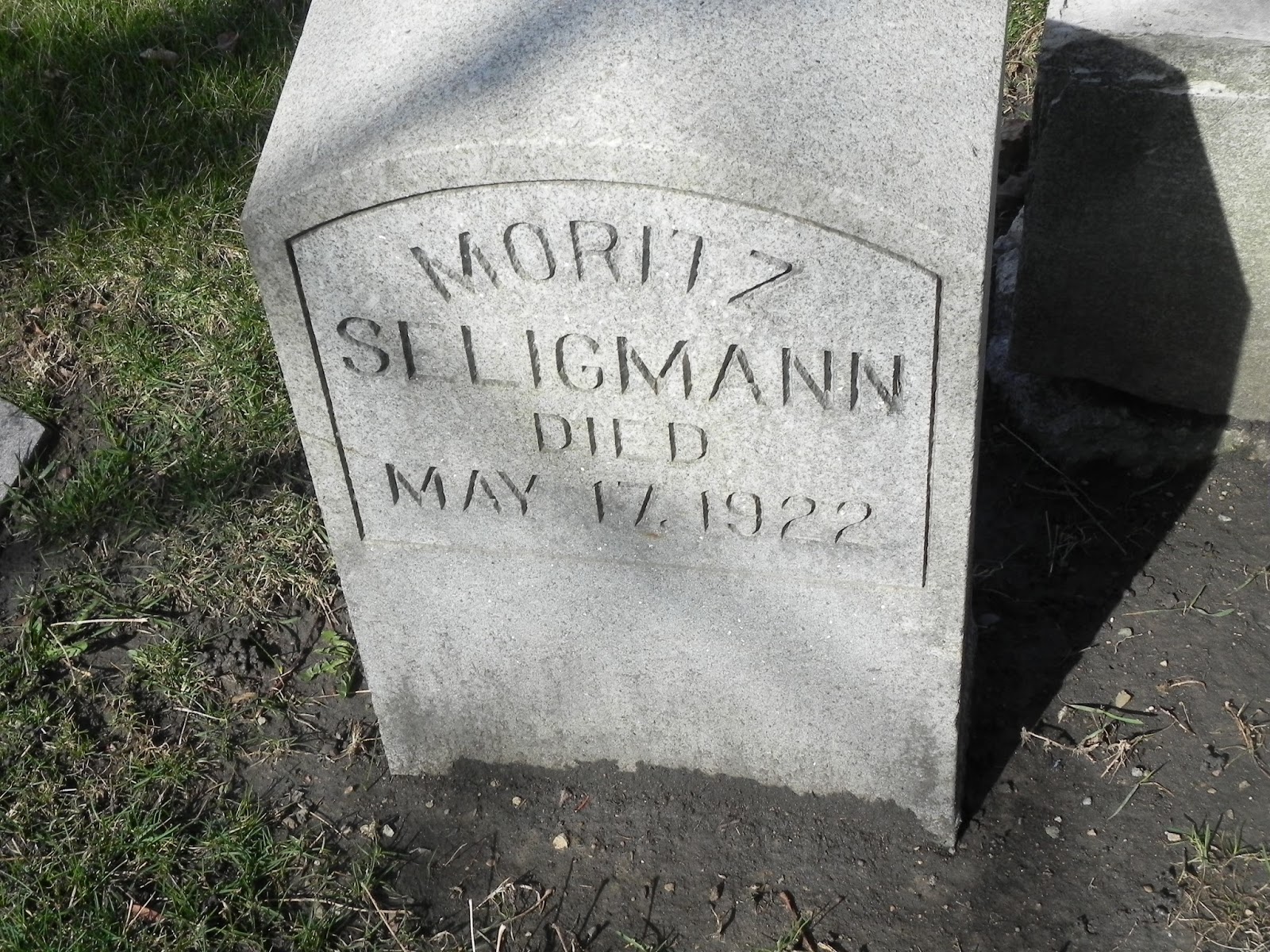
Moritz Seligmann was a successful whiskey wholesaler whose tall silk hat and passion for Milwaukee’s baseball team, the Brewers, made him a local celebrity. “Hi-Hi,” as the colorful Seligmann was known, became a virtual household name in Milwaukee.
 In a story on the Republican House, Milwaukee’s fanciest hotel during the late 1800s, the Milwaukee Sentinel reported: “Seated every afternoon at the bar, where merchants, bankers, actors, cigar manufacturers, brewers and men about town discussed politics, baseball and other topics of the day, was Hi-Hi Seligmann, immaculate and resplendent in a high silk hat and black suit and a red carnation in his buttonhole. As sure as 4 o’clock rolled around, ‘Hi-Hi’ walked in. He was a great baseball fan and did a lot of talking between drinks.”
I assume that Moritz also wore a top hat to the Milwaukee Brewers baseball stadium at Borchert Field where he was a familiar figure and frequently the subject of attention by local sports writers. On June 26, 1896, The Sentinel, reporting on a bad loss by the local team, recorded that: “Even Hi-Hi Seligman left the scorers stand and took a seat in a rear section of the grandstand where he grieved alone….” How Seligmann came to be nicknamed “Hi-Hi” is not clear. From hints in press accounts, it likely stemmed from his familiar loud cheering for the home team.
 Seligmann’s liquor house featured several proprietary brands, including “Eremite Sour Mash Rye,” "Prince William Rye,” “Challenge Kentucky Bourbon,” and “Gold Star Sour Mash.” He never named one after his favorite baseball club, but did issue a saloon sign for Eremite Rye that feature four men at a bar including one wearing a top hat. My instinct tells me that man is Hi-Hi himself, indulging in his favorite pastime, talking baseball with one foot on the brass rail.
 An inheritor of a thriving Chicago liquor house founded by his Irish immigrant father, Thomas Dennehy proved to have a flair for advertising puffery. He first tried to identify his “Old Underoof Rye” with Native American themes including an Indian chief called “Old Un-Der-Oof, but that gambit fell short of expectations. He then switched to an aristocratic look featuring colonial grandees, but that advertising failed to be satisfactory. Dennehy hit his stride several years later when he conceived of a series of ads in Chicago newspapers keyed to what was happening with the Chicago Cubs baseball team.
The Cubs were in their heyday in 1910, sparked by the famous double play combination of Tinker to Evers to Chance. The Cubs had won the World Series in 1907 and 1908 and although coming in second in 1909 had compiled a record of 104 wins against only 49 losses. When the team sparkled in 1910 and gained the World Series again, Dennehy hired local cartoonists to craft Old Underoof ads that discussed the contests.
 One cartoon, entitled “Still in the Game,” showed a bear holding an elephant gun with four spent shells on the ground. They represented the four Cub pitchers who had given up 13 runs in the two previous Series games to the Philadelphia Athletics. The Cubs also lost a third game, occasioning a cartoon entitled, “No They Are Not Dead.” The Chicagoans won the fourth game by one run in extra innings and then lost the next and the Series. Undaunted about the loss, by opening day 1911 Old Underoof was back and Dennehy was optimistic about the season. It would be 108 years and 2016, however, until the Cubs would win their next World Series.
Although it might seem that other whiskey men might have jumped on the baseball bandwagon to sell their brands, the answer may be that beer, not hard liquor, has always been closely associated with baseball. In a sense Klinordlinger and Dennehy were breaking out of the mold in their celebration of the Pirates and Cubs. Hi-Hi Seligmann faced a different reality. He hardly could have advertised a whiskey named “The Brewers.”
Note: Considerably more detailed information on of each of these whiskey men can be found at the following posts: Solomon Klinordlinger, January 4, 2014; Moritz “Hi-Hi” Seligmann, June 28, 2016; and Thomas Dennehy, June 18, 2014.