Foreword: In writing about the whiskey men who operated saloons, I have particularly struck by three such West Coast drinking institutions. For different reasons two not only reached iconic status in retrospect, but were well recognized in their own time for having notable qualities. The third is still operating, recognized for its longevity and the man whose name it bears.
 Nautically named, for more than 55 years the Ensign Saloon was a favorite watering hole for seafaring populations along San Francisco’s waterfront. While the proprietors probably knew, few patrons likely were aware that the Ensign, on the ground floor of one of city’s then taller buildings, sat on top of a ship, the schooner Rome, shown here, sunk deliberately in 1890 by a developer who urgently needed to claim title on an underwater lot at the wharf at what would become the southwest corner of Market Street and the Embarcadero.
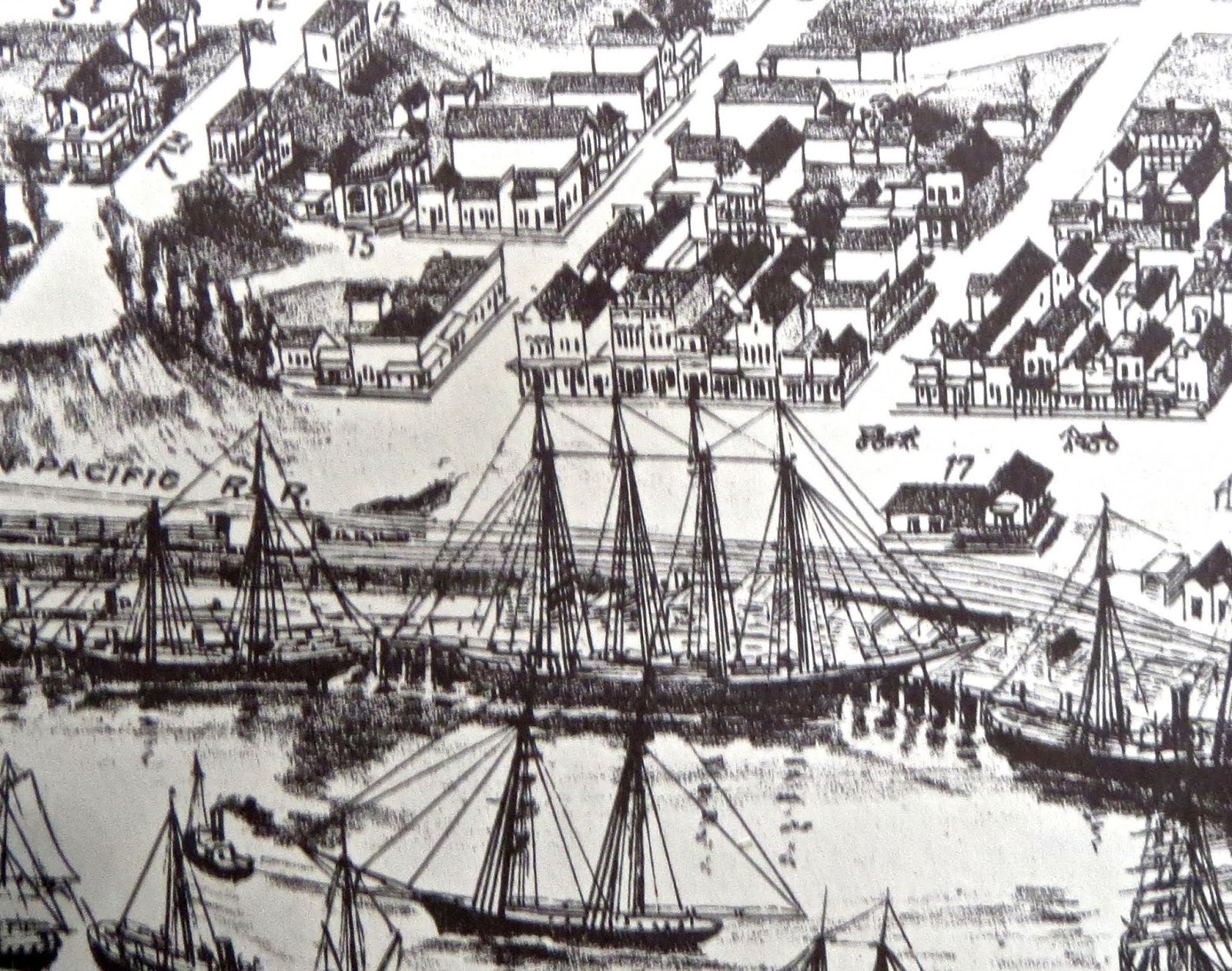
Over the next few years the wharf area gradually was filled in and the Rome disappeared underground. A 1895 drawing of the dock area above shows the extent of the fill area on which a number of structures had been built, including the ferry dock and the Southern Pacific Railroad station. The Ensign Saloon looms large on the landscape as the ground floor of a three story building. It became the favored hangout for the seafaring crowd.
 During its history the Ensign Saloon knew multiple owners. The first proprietors were George and Charles Osmer, German immigrants who ran it from about 1860 to 1869. They sold to Claus Schwartz, Rathy Husing and Alfred Meyer who operated it for the next 40 years, rebuilding the saloon when it was destroyed in the 1906 San Francisco earthquake and fire. About 1910, the Ensign Saloon was sold for a third time to M. Theodore Reinke. Like previous owners an immigrant from Germany, Reinke was forced to shut the Ensign down with the advent of National Prohibition.
  But the story does not end there. Although the Ensign Saloon had sat on top of a sunken ship for decades, when the building was torn down and the site subsequently turned into a civic plaza, San Francisco forgot the vessel was down there. In 1994, however, while the city was excavating a subway tunnel from the Embarcadero Station to Folsom Street, construction crews ran smack dab into the Rome, where it had laid undisturbed for 144 years. It was too large to be excavated so the tunnel was bored right through the ship, as shown on the illustration here. Remnants of the Rome are now in a local museum.
Today in the San Pedro district of Los Angeles a central open space, shown below, is designated Pepper Tree Plaza. A metal plaque on a water fountain marks the former site of the Pepper Tree Saloon, a sometimes rowdy drinking establishment whose history paralleled that of the community. The waterfront saloon flourished under the aegis of three California proprietors.

Gustave Falk was the founder. Born in Sweden in 1840, reputedly of German ancestry, he early went to sea and over time advanced to captain. Visiting San Pedro with his ship periodically, Falk could see the potential for growth and in 1890 settled there permanently. He bought property at the corner of Sixth and Front Streets and constructed a block of buildings that included the Pepper Tree Saloon. An 1893 map of the San Pedro showed the area and in a detail below, the site of the saloon.
 Although one author cited the Pepper Tree as “infamous,” it was teeming at all hours with sailors and dock workers and appears to have had a good reputation with ships captains looking to recruit reliable seamen for their vessels and for wharf bosses seeking stevedores. About 1900 Falk sold it to John Goudie, a Scotsman, who in 1915 sold it to another Scot, Caspar McKelvy. He ran it until closed by National Prohibition.
The Pepper Tree Saloon remained in the lore of San Pedro which was originally a city in its own right, but subsequently annexed by Los Angeles. In 1988 — 100 years to the day the town incorporated — a group of longtime residents re-enacted the signing of San Pedro’s incorporation papers in a replica of the Pepper Tree Saloon. By that time the building itself had been torn down and in its place a community park was created, appropriately named Pepper Tree Plaza.

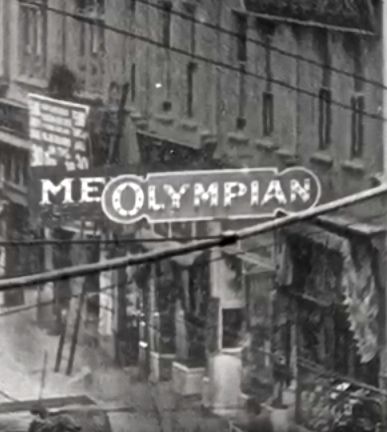
Unlike the prior two saloons, Kelly’s Olympian of Portland, Oregon, shown above, is still operating. Local news media regularly feature the drinking establishment because of its more than one hundred years in existence. The saloon owes its continuity to John Kelly who opened his first Portland “watering hole” in 1888 at the age of 23 and went on to become one of the city’s best known publicans.
 The Olympian opened in 1902 as a saloon “tied” to the newly founded Olympia Brewing Company, a practice common in pre-Prohibition days. According to one account: “It is truly a colorful part of Portland’s history. In the early days it was a popular gathering spot for locals as well as visiting timber men, sailors, shipyard workers, longshoremen and others passing through.”
In 1916, however, both Olympia Brewery and the Olympian were forced to shut down by state prohibitionary laws. Eager to unload the property, the owners were happy to sell it to Kelly. He incorporated, naming himself as president. The Olympian Company, as it was now designated, advertised cigars and tobacco, soft drinks and restaurant food. Before long, the name was altered to Kelly’s Olympian.
 Evidence is, however, that Kelly was not finished selling booze. The Olympian sits above the Old Portland Underground, better known locally as the “Shanghai Tunnels,” a complex of passages that connected the basements of saloons and hotels to the waterfront. One tunnel had an opening into Kelly’s basement. A section of that space has been discovered to contain a wall and remnants of an old tile floor, strongly suspected as the remains of a subterranean speakeasy that Kelly operated under the Olympian during “dry” times. He died in 1925 without ever seeing Repeal and the revival of his saloon — or revealing his secret.
More than a century after Kelly owned the saloon, the establishment still bears his name, offering whiskey and other liquor as he did before, and likely during, Prohibition. This iconic West Coast saloon that can still be visited. If you go, be sure to lift a glass to John Kelly, a whiskey man worth remembering.
Note: More complete articles on each of these saloons may be found on this blog at the following dates: Ensign Saloon, August 22, 2019; Pepper Tree Saloon, November 25, 2018; and John Kelly Saloon, March 18, 2018.
Note: More complete articles on each of these saloons may be found on this blog at the following dates: Ensign Saloon, August 22, 2019; Pepper Tree Saloon, November 25, 2018; and John Kelly Saloon, March 18, 2018.