When Albert E. Fyan put Bedford, Pennsylvania, on the label of his rye whiskey and advertising shot glasses, he must have recognized that he would be conjuring up memories of an earlier day when President (and Commander-in-Chief) George Washington marched into town at the head of government troops and quickly put down what has come to be known as “The Whiskey Rebellion.”
Born in Bedford County in 1841, Albert grew up hearing the stories of those fateful days in area history when Pennsylvania farmer-distillers staged a major revolt against the national government over a whiskey tax mandated by the Federal Excise Tax Act of 1791. The national government had agreed to pay state debts after the Revolutionary War amounting to $54 million. From the viewpoint of Washington, D.C., taxing whiskey was a good way to get the money.
 Compared to the taxes paid on liquor today, the levy does not seem oppressive. The farmer-distillers of Western Pennsylvania, however, detested any tax. Paper currency was disfavored in commercial exchange but whiskey was a valuable commodity for barter. Even though the excise rates meant the average distiller would pay only a few dollars in liquor tax each year, even $5 would have consumed a good portion of the average farmer-distiller’s cash income. In 1794 an angry group of protesters gathered in the Jean Bonnet Tavern just west of Bedford, shown above, and agreed to join others in armed resistance. They raised a “liberty pole” as a sign of their non-conpliance.
 The rebellion brought a swift answer from President Washington: The laws of the United States WILL be obeyed. Some 13,000 militiamen were called to Bedford at Washington's direction. The Whiskey Rebellion quickly collapsed. One historian has observed: "It was at Bedford that the new federal government was finally to establish itself as sovereign in its own time and place.” Some disgruntled distillers left Pennsylvania at that point and headed to Kentucky to began making whiskey again.
 Enter the Fyans. Albert’s father was Louis (sometimes, Lewis) Fyan, born in 1819 in County Cork, Ireland. He had immigrated to America with his brother Robert and settled in Bedford, shown here as it looked about 1840, and later moved to Shanksville, Somerset County. In 1841 he married Susanna Burkett in Berlin, Pennsylvania. Although a Catholic, Louis was married in a Lutheran church. Albert was born a year later, destined to be an only child.
Returning to the Bedford area, Louis eventually became a wealthy farmer and storekeeper on the western edge of the county at Juniata Township. The 1850 census found the family there, with Louis listed as “merchant,” living with wife Susan, son Albert, his mother Mary, and two servants. Ten years later, records indicate that Louis had become the equivalent of a millionaire today.
Albert, now 18, was listed as a “farm hand” working on his father’s extensive acreage. Registering for the Civil War draft in 1863, he called himself a merchant, likely working in his father’s store. (Albert never served.) The 1870 census listed both father and son as dry goods merchants. The following year Albert, now 29 years old, married Ida Virginia Burns, a native-born Pennsylvanian who was 11 years his junior. They would have four children, including Robert in 1872; Lena, 1873; Lula, 1881, and Louise, 1882.

Meanwhile Louis was faltering in health and died in 1876, leaving management of his businesses and property to his son. In addition to selling dry goods, Albert moved into “wet” products like whiskey and revived distilling in the Bedford area. A snippet from an 1877 topographical map shows the west side of Filson District No. 5. At the far left a crossroads is evident with identification of the Fyan store at the north and the distillery and Fyan home on the south.
The plant was identified in federal annals as Registered Distillery #33, Pennsylvania Tax District #9. Unlike his distilling predecessors, Fyan was resigned to paying federal taxes — and at much higher rates than the Rebellion fomenters could ever have imagined. Warehouse records disclose that Fyan under the scrutiny of government agents regularly was making whiskey, storing it on site, and withdrawing it from time to time as it aged. The distillery location was known as “Kegg,” about twelve miles west of Bedford, named not because Fyan’s whiskey came in kegs but for a Bedford county family. At one time Kegg even merited its own post office but now simply is a blip off the Pennsylvania Turnpike.

 From the artifacts we have from Fyan it is clear that not only was he distilling whiskey, he was marketing it himself, likely from his Kegg-located complex to restaurants and saloons throughout Western Pennsylvania, including Pittsburgh, and perhaps beyond. The Fyan’s Rye whiskey bottle shown here provides evidence. Known as “label-under-glass,” such bottles were given to saloons and restaurants for display behind a bar as a marketing strategy. Those glass containers were relatively expensive to produce and usually were deployed where competition among brands of whiskey was highly intense. Fancy etched shot glasses, while more common, served a similar purpose. Fyan seems to have had a flair for advertising.
 As his father before him, Fyan prospered in business, affording to take trips to Europe with his wife, Ida, and other family members in 1890 and 1907. As the decade came to an end, Albert’s health began to fail, however, and he died in January 1910. As his family grieved around his casket, Fyan was accorded a Requiem Mass at his parish church, St. Thomas in Bedford. He was interred at the Fyan family mausoleum in Bedford Cemetery. It is shown here marked with a plaque that discloses that Albert lies there in company of his mother, father, wife, son and daughter-in-law.
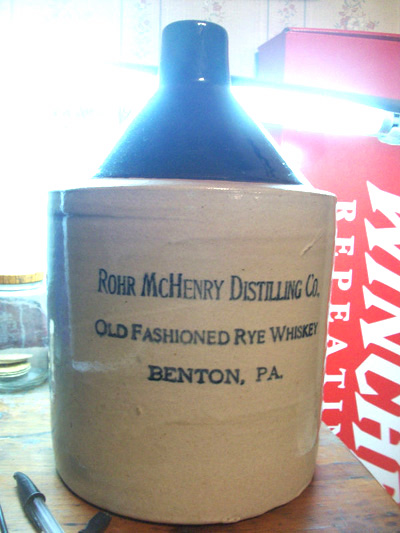
What happened with Fyan’s whiskey enterprise is not clear. Federal records show 1904 as a final date for Fyan’s warehouse transactions. In 1914, a transaction was recorded at RD #33, Dist. #9, by Rohr McHenry Distilling Company. This was a well-known Pennsylvania rye-maker, located at Benton, about 172 miles from Bedford. Whether the McHenry’s had purchased Fyan’s distillery or just the stored whiskey is unclear.
 Today Bedford is a quiet town of 2,800 that attracts tourists interested in its historic buildings. Many people visit sites of the Whiskey Rebellion, particularly the Jean Bonnet Tavern. That hostelry continues to provide food, drink, and lodging. A plaque has been placed at the inn as a reminder of the tumultuous events that once occurred there. It reads, in part: “In mid-1794, during the Whiskey Rebellion, embattled farmers met here and raised a liberty pole to protest the federal excise tax on whiskey. The October troops called by President Washington camped here on their march west to quell the insurrection.”