Showing posts with label Thomas Gaff. Show all posts

Saturday, June 15, 2019

Whiskey Men Who Became Midwest Millionaires


Foreword:  During the 18th Century, more than a few distillers, whiskey rectifiers and wholesale dealers found that the profits made in making and selling liquor could be used profitably in other productive enterprises.  By canny investing some became “captains of industry” and exceedingly wealthy.  The Midwest, experiencing boom times after the Civil War, presented a particularly favorable economic climate.  Presented here briefly are three stories involving whiskey men in Illinois and Indiana.  

The Herget Brothers, John and George, enhanced the economy of Pekin, Illinois, through their enterprise and investments encompassing a variety of enterprises.  At the center of their local business conglomerate was making and selling whiskey.   A 1910 history of Illinois described the Hergets this way:   “The members of the family stand high in the social circles of the city, and are universally respected for worth and nobility of character.” 

The Hergets immigrated to the United States from Germany as young men, eventually settling in Pekin.  Shown here, John on left, about 1860 they opened a grocery store that specialized in liquor.  

Seeing whiskey as good investment, in the fall of 1888 the brothers built the Star Distillery in Pekin and two years later opened a second facility they called Crescent Distillery. Later selling both, with the proceeds they then erected the Globe Distillery, at the time the largest whiskey-making plant in Pekin, having the capacity to mashing 5,000 bushels of grain daily.

During the late 1890s the brothers shut down their grocery and liquor enterprises actively to pursue other business interests.  John was involved with the Pekin Steam Cooperage Company, Pekin Gas and Electric Light Company., Turner-Hudnut Grain firm, Globe Cattle Company, Farmer’s National Bank, a beet sugar factory, and was a large landowner in Tazewell County.  George was a major investor in the founding of the Illinois Sugar Refining Company; the Globe Cattle Company, and the Pekin Stave and Barrel Manufacturing Company, of which he was president. In 1905, with sons Henry and William, he founded the Herget & Sons Bank, shown right.  Whiskey had fueled their business success.

Born into an immigrant Scottish family, brothers Thomas, James and John Gaff found opportunity in America’s midsection to create a commercial empire of extraordinary size and breadth. The Gaff saga began in 1811 when parents James and Margaret Wilson Gaff pulled up stakes in Edinburgh, Scotland and immigrated to the United States with their three-year-old son, Thomas.  The family settled first in New Jersey where son James was born in 1817 and John in 1820. Far from wealthy, the brothers from early on honed their skills in the mercantile trade.

After an initial move to Pennsylvania where the Gaffs ran a profitable general store and distilling operation, they were enticed to move to Aurora, a small town in along the Ohio River in southeastern Indiana, by an offer of free land and tax incentives.  With James Gaff, shown here, in the lead, upon arrival the Gaffs almost immediately built a distillery near town on the banks of Hogan’s Creek, a waterway that emptied into the Ohio River.  This distillery eventually produced rye, bourbon, and a scotch-type whiskey that the brothers dubbed “Thistle Dew.” The brothers called their facility  “T. and J. W. Gaff & Co.”  By 1850 it had become one of the largest distilleries in the United States.  An illustration of the complex in the 1800s shows its growth and proximity to the Ohio River.


The success of their whiskey-making spurred the brothers to build a brewery in Aurora, stretching for 300 feet along Market Street, an enterprise they called the Crescent Brewing Company.  With their access to the Ohio River multiplying products, it was almost natural that the Gaffs would gravitate to shipping.  They built and owned a fleet of steamboats,  

Founded on revenues from distilling  and brewing,  Gaff Brother investments came to encompass the Fleischmann Yeast Company,  Indiana grain and hog farms, a Louisiana plantation, a silver mine in Nevada, turnpike construction, railroad financing, banking, and a factory that reputedly produced the world’s first ready-made breakfast cereal.  An 1880 history of Indiana's eminent and self-made men captured Thomas Gaff's wide range of interests, both business and philanthropic, noting:  “His executive ability is remarkable. No transaction within the range of his complicated affairs escapes his observation.   

Crawford Fairbanks, shown here as a young man, has been characterized as a poor boy with limited education who studied by candle light.  A Union soldier during the Civil War, Fairbanks returned to Terre Haute, Indiana to start a grain business that soon transitioned to distilling.  After a number of false starts, explosions and fires in his facilities in 1884 he turned to John H. Beggs, a distillery executive from Peoria, for help. Together they organized the Terre Haute Distilling Co., that ultimately would be accounted the world’s largest of the time.  In time Fairbanks became immensely wealthy,  owning the Terre Haute Brewing Company, a strawboard factory, Terre Haute’s principal newspaper, and paper mills in Massachusetts, Chicago and New York.  


Additionally, Fairbanks liked owning hotels, buying the Terre Haute House, shown above;  the Denison Hotel in Indianapolis; and co-owning the French Lick Springs Hotel, a resort popular for its warm springs and reputed healing waters. He also was principal investor in Indiana Sonora Copper & Mining Co., and president of the Terre Haute Water Works and Terre Haute Street Railway Co.  At the time of his death Crawford also was the principal owner of the Standard Wheel Co. and president and major stockholder of Wabash Realty & Loan Co., that held title to most of his real estate, including several farms where he raised race horses.   

May 1924 obituaries of Crawford Fairbanks ran in newspapers throughout Indiana and beyond.  One state journal hailed him as “Indiana’s greatest financial genius.”  Another newspaper declared him “Indiana’s Richest Man.”  What too frequently was ignored was the original driving source of Fairbanks' wealth and enterprises — making and selling whiskey.  

Note:  Longer profiles of each of these men may be found posted on this blog.  Herget Brothers:  June 5, 2018;  Gaff Brothers, July 8, 2018;  and Crawford Fairbanks, June 13, 2018.  There also is a vignette on J. C. Beggs and his family, Oct. 17, 2017.


Sunday, July 8, 2018

The Astounding Ascent of the Brothers Gaff


Born into an immigrant Scottish family, brothers Thomas, James and John Gaff found opportunity in America’s midsection to create a business empire of extraordinary size and breadth.  Founded on revenues from distilling whiskey,  Gaff enterprises encompassed a brewery, a fleet of steamships plying the Mississippi and Ohio Rivers, Indiana grain and hog farms, a Louisiana plantation, a silver mine in Nevada, turnpike construction, railroad financing, banking, and likely the world’s first ready-made breakfast cereal.

The Gaff saga began in 1811 when James and Margaret Wilson Gaff pulled up stakes in Edinburgh, Scotland and emigrated to the United States with their three-year-old son, Thomas.  The family settled first in New Jersey where James was born in 1817 and John in 1820.  Subsequent moves took the Gaffs to upstate New York and then to Brooklyn where Margaret’s brother, Charles, was operating a distillery.  There he taught his nephew Thomas the distilling business.

Armed with that knowledge Thomas, eventually accompanied by younger brothers James and John, moved to Pennsylvania.  There the Gaff brothers engaged in several businesses, including storekeeping, papermaking, and most important, making whiskey.  For a number of years they were highly successful and made money until the financial Panic of 1837 depressed the national economy.  About the same time the brothers began having difficulty obtaining sufficient grain for their distilling and found taxes increasing on their liquor, depressing their profits.

The combination was enough to have the Gaffs looking around for other opportunities.  Out on the frontier of Indiana, pioneer local businessmen were eager to attract young entrepreneurs with money.  They offered the brothers tax incentives and free land to move their activities to Aurora, a small town along the Ohio River in southeastern Indiana.  The Gaffs accepted and sent James, shown here in maturity, to established a general merchandise store.  Thomas stayed in Pennsylvania to close out businesses there and joined James about 1843.  John followed in 1845.  After the Gaffs’ father died, their widowed mother and three sisters also moved to Aurora.

Upon Thomas’ arrival, the Gaffs almost immediately began to build a distillery near town on the banks of Hogan’s Creek, a waterway that emptied into the Ohio River.  This distillery eventually produced rye, bourbon, and a scotch-type whiskey that the brothers dubbed “Thistle Dew.”  The Gaffs also used the brand names “Excelsior," "Howe & Hubbel Excelsior’” "Pleasant Valley,” "Silver Lake,” "Wild Cat,” and "Wild Cat Family Whiskey.”  The latter two names showed a certain sly sense of humor since “wild cat” was a name at the time applied to illegal moonshine.  The brothers called their distillery “T. and J. W. Gaff & Co.”  By 1850 it had become one of the largest in the United States.  An illustration of the complex later in the 1800s shows its growth and proximity to the Ohio River.


The success of their whiskey-making spurred the brothers to build a brewery in Aurora, stretching for 300 feet along Market Street adjacent to the Ohio River, an enterprise they called the Crescent Brewing Company.  A drawing of the six-story building shows a substantial complex on the slope of the steep riverbank. The entrance was on the third floor.   Below at riverside were large stone cellars  where the beer could be kept cool.  The Gaffs’  primary brand was "Aurora Lager Beer," said not only to be sold in the American Midwest but also exported, including to Germany.  The brewery was under the direction of James Gaff.

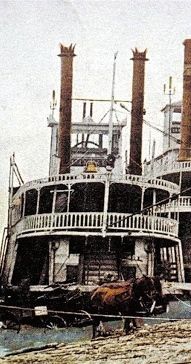
With their multiplying products, it was almost natural that the Gaffs would gravitate to shipping.  They built and owned a fleet of steamboats, among them Diana, Mary Pell, Eclipse, J.W. Gaff, and Forest Queen.  Despite the pro-Confederacy feeling among some in southern Indiana, the Gaffs loaned the Forest Queen, shown right, to the Union where it served for a time as General William Tecumseh Sherman's headquarters at Vicksburg, and later successfully ran the blockade there during the Civil War battle.  Below are the Eclipse, left, and Diana, the latter involved in perhaps the longest, closest and most exciting contest of the steamboat era.  Challenged by the Baltic steamboat in March 1858 for a race up the Mississippi 1,382 miles, the Diana kept pace but lost narrowly.


Meanwhile the brothers were having personal lives.  Thomas, for whom there are no known photographs, at the age of 27 in 1835 in Brooklyn married Sarah Darling Whipple, a widow four years older than he.  The couple would have six children, only three of whom would live to adulthood.  At the outset of their residence in Aurora, the family lived in cramped quarters above a Gaff mercantile store, a household that also included Thomas’ mother, Margaret.  

With his growing wealth from distilling, brewing and the fleet of steamboats, Thomas Gaff saw an opportunity to provide his family with a twelve room, three story home on a wooded slope on the outskirts of town, affording a view of Aurora below and a broad sweep of the Ohio River Valley beyond. Completed in 1855, Thomas called his mansion “Hillforest.”  Shown here, it is an outstanding example of Italian Renaissance architecture.


The ten acres of ground on which the house sits were equally impressive.  Influenced by Italian landscaping, the hillside behind the house had formal gardens, a lake, gazebo, terraced gardens, and baths. The ravines of the landscape influenced the use of a rusticated footbridge and a grotto built of local stone to form a barrel vault.  On the hill above were vegetable gardens, vineyards, orchards, and pasture land.

Meanwhile brother James Gaff at 28 had married Rachel Susannah Cornwell, an Indiana native who was 18 when they wed.   They would have six children, three boys and three girls.  He anticipated his brother by building a large home in Aurora before the construction of Hillforest.  It was located at Fourth and Main Streets in Aurora.  James called his abode “Linden Terrace” named for linden trees he had imported from Germany.  Although the home later was razed, a photo suggests that it too was done in Italian Renaissance style.

Sometime in the late 1860s, James moved his family to Cincinnati where he engaged in a partnership with Charles and Julius Fleischmann who had emigrated from Germany to the United States to make yeast.  Impressed with the brothers, James helped bankroll their efforts in a business called Gaff, Fleischmann and Company, Manufacturers of Compressed Yeast.  The investment seemed like a failure until, as a gamble, a pastry shop and restaurant were set up at the 1876 Philadelphia Centennial Exposition with the yeast used in the baking there.  The product revolutionized the industry and made James and the Fleischmanns multi-millionaires.

Because distilling was in James’ blood, he convinced the brothers to make liquor — yeast being a component — and again invested with them.  About 1872  the trio founded two distilleries in nearby Riverside, Ohio.  Fleischmann distilleries  gained a national market by being the first American operation to produce good gin.  Rivaling imported Dutch and English gins and less expensive, Fleischmann’s gin proved very popular, amassing more profits for the partners.  James Gaff also had a quarter share in the Boone County Distillery, located at the hamlet of Petersburg, Kentucky, a short 25 miles from Cincinnati.

Meanwhile back in Aurora, Thomas was busy investing Gaff family funds in a diverse set of enterprises including the Treasure Hill Silver Mine in Nevada, a strike that between 1867 and 1880 yielded silver valued at the current equivalent of $500 million.  Through Thomas the family also was engaged in farming operations, raising cotton and selling horses, owning a plantation in Louisiana, and dealing in land in three states.  They owned a foundry and machine works and financed turnpike and canal construction.  Thomas was one of the original stockholders of the Ohio and Mississippi Road, a line that subsequently became the B & O. 

Perhaps the Gaffs’ most historic business venture resulted from a grain mill that they built in Columbus, Indiana, some 65 miles west of Aurora about 1867.  They needed it to grind corn being used in their brewing process.  The mill created corn grits in the form of uncooked flakes.  Eventually the prospect dawned on the Gaffs of selling the product directly to the public. Cerealine, as it was called, has been cited as the first dry breakfast food in America, predating Kellogg by several years. 

Besides their many enterprises, the Gaff brothers were heavily involved in Aurora civic affairs, backing the town's first utility company, the Aurora Gas and Coke Company, and founding in 1856 the First National Bank of Aurora with Thomas as president.  Moreover, the Gaff distillery was issuing its own currency, a bill that included two comely women and one of its steamboats. Thomas also helped to organize Aurora's school system, served on the City Council with his brother James (John was mayor), and, with his brothers, bought  Aurora a fire engine and town clock. 
An 1880 history of Indiana's eminent and self-made men captured Thomas Gaff's wide range of interests, both business and philanthropic, noting:  “His executive ability is remarkable. No transaction within the range of his complicated affairs escapes his observation. He is generous, and ready to relieve the deserving poor. Few men have been more liberal in the contributions to religious and charitable objects."

Although Thomas was among the incorporators of the Riverview Cemetery in Aurora, the Gaff brothers and families are buried in Spring Grove Cemetery in Cincinnati, their monument shown here.  The first brother to go was James who died in January 1879 at the age of 62.  He was followed in death only a month later by John, 59 years old, who apparently never married.  Thomas, the eldest, lived to be 76, passing in April 1884.

After Thomas’ death, the Gaff business empire was directed by Thomas T. Gaff, a son of James, who continued add to the family fortune primarily in distilling and the Gaff heavy machinery business in Cincinnati.  Appointed by William Howard Taft as a commissioner for the construction of the Panama Canal, this second generation Gaff later moved to Washington, D.C.  Thomas Gaff’s Hillforest mansion home remained in the family until it was sold in 1926.  Today it is maintained by Aurora townsfolk as a museum and is on the National Register of Historic Places.

Note:  This post is drawn from a variety of sources, a primary one being an  unsigned Park Service document nominating Hillforest for the National Register.  The paper contains a great deal of information about the Gaff family and an extensive bibliography.