Tuesday, August 21, 2012

Lang, Schenck and Co.: Swimming in the Olentangy

Few stories about the effects of Prohibition on the whiskey industry are as dramatic as its impact on the highly successful Columbus, Ohio,  whiskey dealers,  Lang, Schenck & Company and their flagship brand, Olentangy Club Rye.

Founded in 1879 by George Lang and brothers William and Charles Schenck,  by 1904 their company had prospered mightily.  It operated from an imposing three-story building at 404 S. High Street, immediately adjacent to the Franklin County Courthouse, shown here.  Emblazoned on the facade in foot high letters was the proud designation:  “Liquor Merchants.”   Moreover that year Charles Schenck was elected an officer of the Wholesale Liquor Association at the national organization’s convention in New York City.

The firm’s flagship whiskey,  Olentangy Club Rye, was a best-selling brand,  not just in the vicinity of Columbus but throughout Ohio and in neighboring states.  Named after the Olentangy River that flows through the city, shown here in a painting by Susan Astleford,  the partners registered this brand with the federal government in 1906. It was packaged in quart bottles and pint flasks , each bearing a distinctive label with a distinctive triangle trade mark.

Faced with strong competition by other Ohio origin whiskey brands,  chiefly from Cincinnati,  Lang, Schenck strove for customer loyalty through generous giveaways.  Chief among them were advertising shot glasses . Despite being etched, these were relatively cheap to make. They could be given by the dozens without great expense to bartenders, distributors, and even directly to retail customers.

Pricier giveaways were “back-of-the-bar” bottles.  At least two examples exist from Olentangy Club Rye.  The first is a fluted bottle with a tall neck that probably held a fancy closure. The other is a bulbous  container that, like the other,  has applied white lettering.  Both were made to display in a saloon, filled with Lang, Schenck’s whiskey and ready to pour.

An even more expensive giveaway to saloons was an Olentangy Club pewter tea kettle, with the legend incised into the metal. While a number of distillers used pewter or silver plated jugs as back of the bar giveaways,  this item is very unusual and speaks to the innovative merchandising of the company.

In addition to its flagship Olentangy Club Rye,  the Columbus liquor distributor featured a number of other house brands,  including Ageno, Deer Creek, Eastern Star Rye, Fern Dell, Jackson Country, Old Dominion,  Old Mill Bourbon and Rye, Old Virginia Dominion,  Three Bunnie, and Windsor Town. The Deer Creek label displayed  the head and antlers of a large stag on its label. Ageno may have been a whiskey meant for using in mixed drinks.  It was advertised on a giveaway “highball” glasses.

On the personal side,  the Schenck brothers were born in Ohio, the sons of immigrant parents,  the father from Germany, the mother from France.  Charles was the elder, born in 1860;  William came along three years later, in 1863.  At the time of the 1900 census Charles was living in Columbus with his wife Mary and four children, Frank, Stanley, Lida and May.  Their ages ranged from 11 to 16.   Vital statistics on George Lang are scanty.  He was born in 1860, married and had at least one son.

As they prospered, the Lang, Schenck partners would have been painfully aware of the struggle going on in Ohio over liquor sales. In a very real sense the “Dry” movement had been founded in the state.  At the same time, efforts to induce Ohio voters to initiate statewide prohibition had failed repeatedly.  With the onset of World War One the tide turned.   Liquor was depicted as hurting the war effort in addition to causing other social ills. In 1918 Ohio narrowly passed statewide prohibition. It went into effect a year before the entire U.S. went dry.

The impact on the Lang, Schenck & Co. was immediate.  A report from the Ohio Secretary of State recorded that in 1919 the assets of the company dropped from $60,000 to $6,500.  The liquor firm quickly disappeared from Columbus business directories.  Olentangy Club Rye and other company brands disappeared, never to be seen again.  Death also overtook the partners.  William Schenck died in 1917, age 54, and George Lang in 1919, age 61.

Out of the wreckage caused by Prohibition was born a new business, called the Lang, Schenck Reality Co.  It was incorporated in 1919 with assets of $20,000.  Its principals included Charles Schenck and Lang’s son, George Junior.  Schenck would live to be 71, dying in 1931 and thus never seeing the end of Prohibition.  All three original partners are interred in Green Lawn Cemetery, Columbus.


Saturday, August 18, 2012

The Levaggis of San Francisco: Mixing Whiskey and Olive Oil


It may have been an ad like the one shown here that first lured the Levaggis from their native town of Lucca in Tuscany, Italy, to California to search for gold.  Whether they found prosperity in the mines is unclear, but they found real prosperity in the mercantile field,  establishing a reputation for both whiskey and olive oil.

The pioneers in the family were Bernadino (aka Bernardo), born in 1842, and Giovanni (aka G.B.) born in 1844.  They may have been brothers but certainly were close relatives.  Bernadino appears to have been the first to have arrived in America and is recorded as having worked as a miner for 12 years.  Giovanni, shown here, arrived in California from Lucca after 1865 and mined for eight years.

Both Levaggis quit toiling for gold about the same time.  In 1874 Bernadino went to San Francisco and opened a saloon.  A city directory of 1880 recorded him running the establishment at 3 Vallejo Street.   By this time he had married Mary Craviotto,  an immigrant from Italy who had arrived in San Francisco as a girl.  They would have six children, three sons and three daughters.   Meanwhile, G.B. had established a fruit commission company called Levaggi & Barbiera.

Early in the 1880’s, reportedly for the health of a child, Bernadino left San Francisco and the saloon for Plymouth, California, a small town east of Sacramento in the foothills of the Sierra Mountains.   There he began a general mercantile business that proved so successful that it became one of the most important enterprises in the region, according to contemporary accounts.   Among key products for sale was liquor.  Eventually two of his sons, Jules and Anthony, joined him.  Bernadino used his increasing wealth to accumulate considerable property in San Francisco and became well known throughout the Bay District.

The effects of the the Great San Francisco Earthquake on Levaggi holdings are not recorded but Bernadino clearly saw an opportunity.  Barely had the ashes cooled that his son Jules was sent to the city in 1907 to open a grocery and liquor store at 615-619 Front Street.   Jules’ brother Anthony was listed as vice president.  The Levaggis’ establishment included a whiskey blending facility.

By 1910, Levaggi & Company had outgrown its original quarters and moved to a three-story building at 333-339 Clay Street.  With the move they abandoned the grocery department and concentrated on liquor.   It was reported that they had become the West Coast representatives of “several large Eastern distilleries.”   The firm issued several of its own brands, including “Royal Life Whiskey,” “High Life,” “Old Silver Creek,” “N.A. Hawkins,” and “Clermont.” 

The company also claimed the Clermont Distilling Company at Clermont, Kentucky.  The only distillery in that town, however, was the Murphy Barber Co., located on the Louisville & Nashville Railroad Line.  It had been founded in 1880 with a capacity of 1,800 barrels annually and sold its product to a number of whiskey rectifiers. The Levaggis apparently were drawing on those supplies for its blends and felt comfortable claiming the distillery for their own, a common practice in the pre-Prohibition whiskey industry.


Meanwhile,  G.B. Levaggi was making his own fortune.  He married another Italian immigrant named Rose.  After a visit back to Tuscany in 1894, he returned to San Francisco and launched the Levaggi Import Company, that featured prime olive oil from Lucca.  It became a product leader not only in California but the Nation.  G.B.  supplied most firms on the Pacific Coast as well as Italian groceries across the United States.

The close ties between Bernadino and G.B. were revealed when E. N. Cadenasso was named secretary of Levaggi & Co.  He was married to Linda Levaggi, born in San Francisco and the daughter of Giovanni and Rose.  G.B.’s son-in-law was working for Bernadino’s family firm.   Moreover, in 1908 the two Levaggi companies had joined in a protest against certain U.S. Customs fees.  Their pleas were summarily dismissed by  authorities as “without merit.”

As National Prohibition began to draw a noose around the liquor trade,  Levaggi & Co. in permissive California continued to thrive.  Jules and his family moved from their home at 810 Union Street in  1917 to 1025 Green Street on Russian Hill.  This home, now in an historic district, had been constructed in 1911 as an architectural mixture of the Mission Revival, Colonial Revival and Craftsman styles.  Family descendants owned the house into the 1980s.

Probably seeing the coming end of the liquor business,  Jules branched out into other areas.   In 1919 he set up a dehydrating plant for making dried fruit.  He also became well known in the Bay Area as an importer, according to one account, “building up  a large and important business.”   By contrast,  Levaggi whiskey brands disappeared forever with the onset of National Prohibition in 1920.

Meanwhile, Bernadino was living in semi-retirement in Plymouth, from time to time visiting San Francisco.  We assume one of those occasions was the funeral of G.B. who died in 1920.  His son Jules would also succeed him in death in 1927.  Bernandino died two years later,  age 87.   His obituary stated:  “He continued his active interest in the mercantile business to the time of his death.”  This pioneer Levaggi is buried in Plymouth Memorial Cemetery in the crypt shown here.  His epitaph reads simply, “At Rest.”


Sunday, August 12, 2012

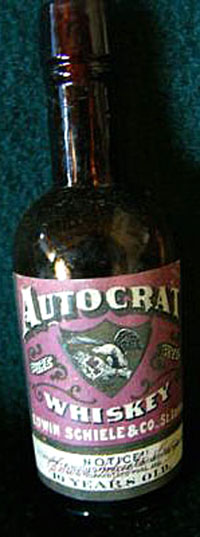
Edwin Schiele Sat an Autocrat at the Bar

Edwin Schiele’s family were anything but aristocracy.  His father, Sigmund Schiele was a German Jewish  immigrant to America who settled in St. Louis, Missouri. For reasons unknown, in the immediate post Civil War era Sigmund suffered the indignity of being made to swear a special pledge of allegiance to the Union.  Sigmund’s signed oath, shown here, now resides in a Missouri museum.  The practice has subsequently been denounced by observers as a disgrace on the state.  Born in 1862, at the time of this incident Edwin was only three years old.

Not discouraged by his treatment at the hands of Missouri officialdom,  Sigmund engaged in the wholesale liquor business in St. Louis.  With his wife,  Fanny Shulman Schiele, he groomed Edmund for a business career.   The boy attended public schools until he was fourteen, then went to work for a local wholesale notions store called Judd & Pratt.  After three years in that business, Edmund became part of his father's liquor establishment at age 17, as a traveling salesman hawking his father's liquors.  

In 1882, age 56,  Sigmund died and was buried in New Mount Sinai Cemetery in St. Louis County.  His monument is shown here.   His son, now just 22 years old,  took over the father’s business and  changed the name to Edwin Shiele & Co.  The company was located at 107 North Main Street in St. Louis.   After 14 years of building his business,  Edwin in 1898 married Minnie Kramer, daughter of Abraham Kramer.  Over the next few years they had three children,  Herbert, born 1899;  Frances, born 1903, and Edwin Sidney, born 1909.  The family lived at 4558 Washington Avenue.

Schiele proved to be a excellent merchandiser for his alcoholic products.  Among the limited number of brands he featured were “Five Feathers," “Geisha Malt Rye,” and "Old 91,” the last shown in a purple bottle.   His flagship label was "Autocrat Whiskey."  He did not come to “own” that name, however, without a fight.   The Autocrat brand was contested between Schiele and the Wichman, Lutgen Co. of San Francisco. (See my July  2012 post on Lutgen).  Both outfits registered the trademark with the Federal Government in 1905.  How the dispute was settled is not clear, but Schiele continued to feature the Autocrat brand.

His merchandising to saloons included shot glasses and other giveaways, with tip trays being his special mode of advertising for Autocrat whiskey.  Displayed throughout this post are four examples of the lithographer’s art that Schiele featured on his trays.  All of them present two figures and often, but not always,  a bottle.   One shown above is an exception, showing an elderly, apparently married, couple sharing a cup of tea and a newspaper.   The couple shown above seem a  bit more lively and presumably are preparing to quaff a bottle of Autocrat Whiskey.  The same bottle has more prominence in the tableau of a monk playing cards with a vested gent.   It plays an even larger role in the picture of a bare breasted woman and a cherub in a woodsy scene.

As his business prospered, Schiele became well known in club circles,  belonging to the Westwood Country Club,  the City Club,  the Triple A Club and Columbian Club.  A 1921 biography said he was “widely and favorably known in the membership of these organizations.”  He also was active in Masonic orders and attained the 32nd degree of the Scottish rite.  A member of the Ethical Society, he also attended a St. Louis synagogue.

Unlike most whiskey men, in politics Schiele was a Republican, apparently ignoring the many “dry” advocates in the party.  During the height of the Temperance Movement  before nationwide Prohibition, the voters of Missouri rejected prohibition in three separate initiative elections in 1910, 1912, and 1918. When temperance crusader Carrie A. Nation entered a bar in Kansas City in April 1901 and began to smash liquor bottles with her hatchet, she was promptly arrested and fined $500 ($12,926 in 2010 dollars), which the judge stayed as long as she agreed to leave Missouri and never return. The Missouri General Assembly did ratify the 18th Amendment in 1919, but only after it already had received enough ratifications to become part of the Constitution.


As a result of Missouri’s tolerance for alcohol,  Schiele was able to operate for
some 36 years.  In 1903, he moved the company to 204 S. Fourth Street, a location he would occupy for the next 13 years.  About the same time,  as other whiskey wholesalers and blenders were doing, he added to the company name the designation “distillers.”   A final move occurred in 1916 when Schiele moved one last time to 118 North Third Street, before shutting down because of Prohibition.

Even with losing his whiskey business Schiele never missed a beat.  In 1913 with a brother, Seymour, he had founded an advertising business which proved to be very creative and grew, according to contemporary accounts, into one of the leading firms of its kind in St. Louis.  After 1920 he concentrated on the advertising business.  He also was the treasurer of Griesedick Beverage Company.  The Schiele family became well-known nationally for their pioneering work in the phonograph and records industry.  With Edwin’s money backing the effort, son Herbert Schiele founded Artophone in St. Louis.  It produced an early phonograph and subsequently became a national distributor of phonograph records.  Edwin was a director and the outfit’s treasurer and likely principal financial backer.


In 1935, at the age of 73,  Edwin Schiele died in St. Louis and was buried next to his father and mother and other family members in New Mount Sinai Cemetery. Whatever indignities had been visited on his family were long in the past and the Schiele name had come to be highly respected in St. Louis business circles.   Edwin was no autocrat but he put the brand name into many a Midwest saloon.


Thursday, August 9, 2012

Christian Hanlen: Winning in War, Whiskey and Politics

 Whatever the enterprise,  Christian Hanlen of Harrisburg, Pennsylvania, throughout his life exhibited an uncanny ability to be on the side of success.   As a soldier in the Yankee Army during the Civil War, as a whisky dealer, and as a delegate to the 1892 Democratic National Convention,  Christian could pick a winner.

Born in 1843 in Marietta, Pennsylvania into, I believe, a German Lutheran family,  Christian was just 18 when the war between North and South broke out.  Over a period of three years, Confederate armies repeatedly invaded Pennsylvania even threatening Harrisburg, the State Capital.  Hanlen appears to have been in no hurry to enlist, as many young Pennsylvanians did.  He may have been completing his education, one indication being that after having enlisted he rapidly rose through the ranks to the position of sergeant major and finally became a chaplain.

Truth to tell, however, the war was just months from being over.  Hanlen’s unit, the 195th Pennsylvania Infantry never saw a battle.  The unit initially was deployed to guard duty in Maryland and West Virginia.  After being reorganized for one year in February, 1865, and following Lee’s surrender at Appomattox, the regiment was sent into the Shenandoah Valley and now-conquered Virginia to keep order and stand guard in towns like Berryville, Staunton and Harrisonburg.  The 195th’s final stop was Washington, D.C., where Hanlen and his comrades were mustered out in January, 1866.   Not a single man in the regiment had been lost to hostile fire.  The only casualties were 10 felled by disease.   Nonetheless,  a ballad was written commemorating the unit, with a cover for the song showing the unit moving off to a new post.

During the ensuing two decades, details about Christian’s life are scanty. Sometime in this period, he married Anne Bahn.  They would have four children, boys Irvin and Frederick; girls, Mary and Josephine. It can be assumed that Hanlen was engaged in learning the mercantile life,  likely including the whiskey trade.  In 1882, he emerged as an owner/ manager of a wholesale liquor business called Hanlen Bros., located a 330 Market St. in Harrisburg.   The brother presumably was Walter (aka W.C.) Hanlen who is listed as working at the establishment.  Walter also appears to have operated a liquor store in Reading, Pennsylvania.  Hanlen Bros. advertised widely its rye whiskeys, brandies, gins, imported and domestic wine, ales and stouts.  You apparently could get any kind of alcoholic beverage you wanted from Hanlen Bros.  As his two sons grew to maturity, Christian took them into the business.  The entire family lived at 108 Locust Street.

Unlike many whiskey merchants and rectifiers, however, Christian concentrated his attention on only two house brands,  “Belle of Dauphin”  and “Old Put,”  neither of which labels he bothered to trademark.  The former name referred to the fact that Harrisburg is located in Dauphin County.   Christian featured a range of giveaways to saloons stocking his brands, his tip trays being particularly notable.  One tray depicted the ever-popular dogs and horses,  Another provided a detail of a famous British painting of a stag at dawn called “Monarch of the Glen.”  He also issued shot glasses for his two brands.   One of the more interesting Hanlen artifacts is a cream colored mini-jug issued at Christmas, the year unknown.

As Hanlen’s business flourished, so did his stature in the community.  Like many of the whiskey dealers and saloonkeepers of the time who saw Prohibitionist forces heading to the Republican banner,  Christian was a strong Democrat.  His involvement in party activities came during a particularly crucial period.  Grover Cleveland, the first Democrat to be elected President since before the Civil War, had been defeated for reelection in 1888 by the Republican Benjamin Harrison despite Cleveland having garnered a majority in the popular vote.   When Cleveland ran again in 1892, serious opposition to him erupted within the Democratic Party.  Hanlen, however, was cited by the New York Times as a particularly ardent Cleveland supporter.

Elected as a delegate to the Democratic Convention in Chicago,  Hanlen headed across the country by train and emerged upon a convention center nicknamed “The Wigwam.”  Shown here it was a temporary building that had been thrown up in 30 days, located on Michigan Avenue between Washington and Madison.  Whatever excitement Christian experienced as a delegate, the Wigwam provided much of it.   The first day of the convention was marred by a rainstorm when the building sprung a massive leak.  Delegates were opening  umbrellas inside.  The following day as nominations were made, the roof broke again during a rain, showering the delegates.

Presidential balloting did not begun until 3 a.m. that morning.  Cleveland received enough votes to be nominated on the first ballot.  When the convention broke up at almost 5 a.m. Hanlen presumably was tired but  jubilant.   He would celebrate again on the night of the general election when Cleveland went on to victory and a return to the Presidency.

The Hanlens apparently suffered a genetically based heart problem.  At the age of 55 and at the height of his financial and social success Christian became increasingly ill and on May 3, 1898, died.  The diagnosis was “fatty degeneration of the heart.”  Sons Frederick and Irvin took over management of the liquor business,  keeping the name, Hanlen Bros.  The brothers seem to have added a new brand of whiskey called “98,”  perhaps commemorating the year of their father’s death.  Was the bulldog on the tip tray shown here a hint at Christian’s personality?

The Hanlen heart troubles were destined to strike soon again.  In 1908, after a long illness that confined him to his home, Irvin died at the age of 34. His brother Frederick, also young, had preceded him in death by 10 weeks.  They left behind a grieving mother and their two sisters.   By the time of the brothers’ deaths they already had sold their liquor business to a Harrisburg resident who kept the Hanlen name.  He was unable to sustain the Hanlen family  business acumen, however, and the company disappeared from city directories in 1909.

Christian Hanlen throughout his life was on the winning side.  He could not, however, beat an apparent genetic flaw that prematurely took his life and later apparently the lives of his sons.  Christian is interred in Marietta Cemetery in the Pennsylvania town where he was born.  Beside him lies his wife, Anne, who died in 1923.  She had been widowed for 25 years.


Thursday, August 2, 2012

Nathan Uri: The Dear Departed Brother-in-Law


As a leading Kentucky whiskey man from a leading distilling family,  Nathan Uri cannot have found it easy living in the shadow of his famous brother-in-law.  That is one possible reason he ultimately departed from partnership with Isaac Wolfe (I.W.) Bernheim, the entrepreneur who gave the world “I.W. Harper Bourbon.”

Nathan’s father, Morris “Moses” Uri, an immigrant from Hechingen, Germany, was an early settler in Paducah, Kentucky. He owned a small frontier type general store there that burned in a citywide conflagration in 1851. Surviving the loss, Morris continued in commerce, running a grocery with a large liquor component.  He ultimately became part owner of a distillery and opened a liquor sales office in Chicago.  With wife Amelia (Halheimer),  also a German immigrant, Morris sired a family of six,  five girls and Nathan, born in 1857.

When Nathan was a boy of eleven, the Bernheim brothers,  I.W. and Bernard, arrived in town with only a few dollars between them.  The Uri family warmly greeted them as did others in the Reformed Jewish congregation in Paducah.  Among welcomers was Nathan’s sister Amanda, four years his junior, who later would marry I.W. Bernheim.  It appears that her father actively assisted the Bernheims in their efforts to enter the liquor business in Paducah.   Meanwhile, as he grew toward maturity, Nathan was increasingly active in his father’s liquor business. 


In 1875, the two families merged their activities and the wholesale liquor company known as Bernheim Bros. & Uri was born.  Because of their proximity to large waterways and the ability to ship product throughout the Midwest, the company prospered.  Meanwhile Nathan found time for a personal life.  About 1879 he wooed and wed Adda (aka Addie),  a woman four years his junior.  She was born in Paducah, the daughter of immigrants from Prussia.  The 1880 census found Nathan, newly married in Paducah, with a ten month old daughter, Ella. The couple subsequently would add two sons, Morris and Walter.

As the surge of business dictated,  Bernheim Bros. and Uri eventually outgrew Paducah.  Chicago directories indicate that the company opened an office there in 1883, located at 87 Washington Street.  That probably was the same location where Morris Uri earlier had opened an office.  Later the company moved its Chicago quarters to 95 East Washington.  At the urging of I.W. Bernheim and with the blessing and likely financial support of the Uri family, in 1888 the company moved lock, stock and whiskey barrels to Louisville, recognized center of the Kentucky whiskey industry.  They located at 135-137 Main Street. 


About 1890, Bernheim Bros. and Uri acquired an interest in the Pleasure Ridge Park distillery, seven miles southwest of Louisville.  That facility had been built in the early 1870s but the owner had lost it in the Panic of 1870 and they joined a combine of investors to buy him out.  At this time Bernheim and Uri were not distillers themselves but  rectifiers and wholesalers of a wide variety of alcoholic spirits.  Pleasure Ridge provided them with the raw whiskey for blending into brands they vigorously marketed nationwide. The arrangement was that Isaac worked sales to the West, Nathan to the East. Endowed with a strong work ethic, the two men were on the road constantly.  Meanwhile Bernard looked after day to day operations.

Then, seemingly without warning,  the brother-in-law departed.  On June 1, 1891, Nathan Uri broke away from the Bernheims and set up his own company, calling it N. M. Uri & Company, located at 100 Main Street at Louisville’s “Whiskey Row.”  He also began operating  and eventually purchased, the International Distillery at Hunters Station.  It was located near a depot on the L & N Railroad, four miles north of Bardstown, Kentucky.   Originally built in the 1840s, the distillery had been destroyed by fire in 1880 and rebuilt in 1885.  Insurance records compiled after Uri’s ownership suggest that it was of frame construction with a shingle roof with two adjacent warehouses.  Uri’s distillery continued to operate until Prohibition.

The International Distillery provided Uri with whiskey for his manifold brands, that included  "Brookwood.” "International.” "Jim Pearce.” "Kendall Club’” "Kenton Club,”"Lime Springs,"”Montreal.” "Mumm's Extra Rye,” "Old International," “Old Roman," “Oyama,” "Proctor Knott,” "Queen Bee”  and "The Clay Pool."  Uri’s flagship brand was “R.H. Parker Rye,”  sometimes given as just “Parker Rye.”  Uri packaged his goods in glass and ceramic containers.  Some of his whiskey jugs were very fancy, including one cream and cobalt blue item, shown here, imported from Germany.  He also used American potters who made whiskey jugs, including one with rampant angels from the Swasey Pottery of Portland, Maine. 

Uri also featured a large array of giveaway items for favored customers.  Among the most unusual were metal containers, in the shape of tea kettles,  jugs, pitchers and urns, most of them silver plated and clearly pricey items. Uri’s giveaways most often advertised Parker Rye,  including saloon signs, back of the bar bottles, and shot glasses. Some items, like a tip tray for his Mumm’s whiskey, were issued for other brands.   In 1902, apparently needing larger quarters, Uri moved the firm to 219-221 West Main Street.

In 1909 Nathan Uri died.  With his grieving family grouped around his grave site, he was interred in Louisville’s Temple Cemetery, a Jewish burying ground that his father Morris had helped found years earlier.  Uri’s marker, shown here, is located in Section A-3, Plot 37.  Beside him lies his wife Addie who died in 1928.

After Nathan’s death Walter Uri, his second son,  took the management reins at N.M Uri & Company.  The firm moved once more, this time to 215 West Main where it flourished for the next six years,  relocating in 1909 for a last time to 801-803 West Main.   Prohibition closed the company doors forever in 1919.

The question remains,  why did Nathan make the break from the Bernheim brothers?  Was it dissatisfaction with being on the road selling while his children were growing up?  Was Addie nagging him to stay home more?   Or was Nathan chafing at being his own boss and under the large shadow of I.W. Bernheim?  Perhaps there were serious business differences between the two.  In 1912 Bernheim wrote a book called “History of the Settlement of Jews in Paducah and the Lower Ohio Valley.” In it he wrote favorably about Morris Uri and included mentions of two of Nathan’s sisters, one of them his wife Amanda.   By contrast nary a word appears in the book about his brother-in-law and former partner, Nathan.

Other clues to a rivalry may reside in the rich trove of whiskey collectibles that Uri left behind.  The Bernheims also were noted for issuing a flurry of silver plated teapots, fancy jugs, shot glasses and tip trays.   To my mind -- and ear -- the brand name “R. H. Parker” sounds suspiciously like “I.W.Harper.”  Could it be that the brothers-in-law were fervently competing?