Friday, February 7, 2014

Henry Naylon and Thwarting "The Whiskey Trust”

In 1917 Moody’s list of “Industrial and Miscellaneous Corporations” included a organization known as the New York and Kentucky Company “incorporated under the laws of New York State for prosecuting a general distilling and wholesale business in cologne, spirits, alcohol, whiskey, medicinal preparations, etc.”     Henry M. Naylon of Buffalo, New York, was listed as both president and chairman of the board.   Moody’s failed to mention what the liquor industry knew:  Naylon was leading the backlash to the notorious Whiskey Trust -- and succeeding.

Twenty years earlier as number of Midwest distillers had turned their plants over to a board of trustees who were to control the liquor trade through the kind of monopolistic cartel that had developed in oil, sugar, steel, beef and other commodities.  Officially named the “Distillers and Cattle Feeders Trust,” it was popularly known as "The Whiskey Trust.”  The organization, based in Peoria, Illinois, gathered in more than 80 distilleries, often using tactics like dynamite to convince holdouts.  Most of the plants the Trust procured were shut down. The idea was to control supplies and drive up whiskey prices.

That tactic did not sit well with other American distillers who feared being muscled out of the market.  This antipathy was strongest in New York and Kentucky.  In 1900 Walter B. Duffy, owner of two distilleries in Rochester, New York, organized a group of three major Kentucky distilleries and five New York alcohol manufacturers into a stock company.  The idea was strength in numbers to prevent the Whiskey Trust from threatening them.  A chief Duffy ally in this gambit was Henry Naylon.

Naylon like Duffy was a native of Rochester. He was born 1870 into a family of native New Yorkers with ancestral origins in Ireland.  Little of Naylon’s early life is recorded but at least one account indicates that he may have been involved in real estate as a young man.  That pursuit may have led him into the field of distilling.   In the late 1800s the Federal Government had, in effect, shut down several small distilleries in Western New York.  Naylon apparently saw an opportunity,  moved to Buffalo, bought three plants and about 1897 consolidated their production under the name, The Erie Distilling Company.

Naylon’s first business address was on Genesee near Ellicott but by 1900 he had moved to a spacious five-story building at 141 Seneca Street, shown here.  The address also appeared on a cobalt jug produced for him by the Lyons Stoneware Company of Lyons, New York.  Naylon’s company adopted a number of proprietary brand names for its whiskeys, none of which the owner bothered to trademark.   They included  “Clover Dry Gin,” “Lafayette  Special,” “Maryland Flower,” “Orange Blossom,”  “Society Cocktails,”   and “Yankee Club.”   His flagship label was “Erie Club Whiskey,” advertised as “It Is the Best!”  As many whiskey men, Naylon gifted favored customers,  saloons and public houses featuring his brands.  He furnished them with advertising wares such as shot glasses and serving trays featuring Erie Club.   For retail customers he provided inexpensive, celluloid-backed pocket mirrors. 

Naylon also was having a personal life.  In 1881 he married Ellen (called Nellie) A. Corcoran.   Like himself, his wife was native-born New Yorker.   The 1900 Census found them living in Buffalo with three children,  William, 7; Loretta, 5, and Ethel, 4.  Henry would take William into his liquor business as the boy matured.

Meanwhile the New York and Kentucky Company, with main offices in Rochester, was thriving while it defied the infamous Whiskey Trust.  The capital stock of the company consisted of $1,000,000 in preferred stock and $1,000,000 in common stock,  about 25 times that in  2014 dollars.  It was paying dividends of 7% on the preferred stock and 6% on common.  Moody’s listed the assets as “real estate and appurtenances (conservatively valued at upwards of $850,000), fixtures, machinery, brands and good will of said concerns, all absolutely free from mortgage, debt or other liability.”  

One major liability was Walter Duffy,  president  and organizer of the combine.  Duffy ran one of the most notorious whiskey operations in the country, criticized for his outrageous advertising,  blasted in the press for shoddy products, and hounded by Federal and state officials for selling his liquor as medicine. [See my post on Duffy, May 1911.]  Duffy’s leadership of the New York and Kentucky Company particularly incurred the wrath of Col. E. H. Taylor Jr., considered the Kentucky high priest of straight bourbon.  Taylor earlier had lost distilleries through debt to George Stagg, a Kentuckian who was part of  the New York and Kentucky Co.  Even though a court had ruled 1894 that Taylor’s name could no longer be used in connection with his former distilleries, the ban was ignored by Duffy.

Outraged that someone whom he considered to be so disreputable had come to control his previously owned and prized whiskey operations,  Col. Taylor minced no words:  There are people who do not know the difference between a jumping-jack and a jackass, and a composite photograph of the two would look so much like him that his nearest friends would call it an excellent portrait of Mr. Walter B. Duffy, President of the "New York and Kentucky Company," owner and great promulgator of  “Duffy's Malt Whiskey.”

When Duffy died in 1911, the directors took no time in naming Naylon the president and chairman of the board, likely because of his good business reputation.  Henry’s son, William, also was named to the board and eventually would be moved up to the position of corporate secretary.  At the same time Naylon was branching out into other enterprises.  He was president of Naylon Securities Company and a founding director of the Lafayette National Bank of Buffalo, a member of the Federal Reserve System.  He also was a power on the Buffalo political scene and eventually became chair of the Erie County Democratic Party.


During this same period Naylon found his own liquor business in need of expansion and in 1915 he moved to an eight-story building at 154-156 Eagle Street.  As shown on his letterhead of that period, not only was he featuring his own brands but had become the sole agent for such national and regional labels as “O.F.C. Whiskey,” “Carlisle,”  “McGinnis Rye,” “Walnut Hill,” “Seneca Chief,” and “Burke Hollow.”  Naylon’s new quarters were very up-to-date, featuring both telephone exchanges and solid-tire trucks to make deliveries.  Naylon issued jugs with the new address.


Increasingly Naylon was being heard as a spokesman for the liquor industry.  In a 1916 letter to the Brewer’s Journal, he opined that the lack of revenues from whiskey taxes was shifting the burden of taxation to real estate and incomes.  “Many of the Prohibition States are bankrupt today because the fanatics fear that if their controlled legislatures increase taxation upon citizens who have ignorantly assented to the destruction of lawful revenue, the whole fabric of deception will tumble down,” he wrote.   He predicted that politicians kowtowing to the Prohibition “fanatics” would lose their jobs if taxation was visibly shifted.

In 1903 Naylon bought a house, shown left, at 361 Pennsylvania Avenue in Buffalo.  It had been designed and built in 1875 by an internationally known Philadelphia architect named Richard A. Waite who had made it his own home for many years.  As Naylon’s millions accrued, however, the family decided a much larger and fancier house was required.  The result was the mansion below on Buffalo’s then fashionable North Street.  Son William, a bachelor, continued  to live his with parents as part of the household.

Under Naylon’s leadership, the New York and Kentucky Company continued to pay dividends to its stockholders.  Meanwhile its despised rival, the “Distillers & Cattle Feeders Trust,” was falling apart, reputedly because of its weight of debt and reputation for violence.  As fast as the Trust shut down distilleries they sprang up elsewhere.  Price fixing in the whiskey industry had proved to be elusive.  In place of the Whiskey Trust a number of smaller, more regional combinations emerged.  Meanwhile Naylon’s organization rolled on until its operations and those of its distilleries, including the Erie Distilling Company, were forced to shut down by National Prohibition.

Naylon emerged unfazed.  He began to devote himself full-time to real estate, in which he previously had been an investor. His real estate empire grew extensively, with properties located throughout Buffalo and across New York State.   The 1930 census found him, now age 60, living in his mansion with wife Nellie and son William.  Naylon gave his occupation as “capitalist-real estate.”   William was listed as “salesman - real estate.”  The family was out of the whiskey business for good.

Henry Naylon died at age 69 in June 1939 and was buried in Mount Olivet Cemetery located in the town of Tonawanda,  a cemetery of the Catholic Diocese of Buffalo. Both Nellie and William had preceded Naylon in death, both passing in 1935.  The Naylons lie together in a striking mausoleum, a hewed granite structure that today stands tall and solid in the graveyard.  Meanwhile the Naylon mansion on North Street long since has been demolished to make way for new development.




Monday, February 3, 2014

Marching Along with Sig & Sol -- the Freibergs

Whiskey wholesalers were famous for their giveaway items to saloon stocking their liquor and other favored customers, including back of the bar bottles and pitchers, tip trays, shot glasses, and bar games.  Brothers Solomon and Sigmund Freiberg of Cincinnati provided all of those items in profusion but added one more gift:  Music, a stirring march dedicated to their flagship brand whiskey.

Shown here is the sheet music for the “Gannymede ‘76’ March,” published in 1903. It was written by Gus. W. Bernard, a songwriter and composer at the turn of the 20th Century whose marches and dance tunes are said to found in several university libraries.  Other than that reference Gus does not seem to have been a major force in American music. The cover of the  music presents a very dramatic picture.  It shows a figure being carried into the heavens by a giant bird.  The sheet lists the publishers as Sig and Sol Freiberg.

Sig, shown here in a  contemporary cartoon, was the elder of the brothers, born in 1866.  Sol was four years younger, born in 1870. Their father,  Henry Freiberg was a native of Renish Bavaria and there married their mother, Amalia Loeb.  Not long after their marriage the couple emigrated to the United States, settling in Cincinnati, the home of many German immigrants.  Although Henry had experience in distilling as well as in leather tanning, he preferred the latter trade and and founded one of the first tanning businesses in the city.  One author has called it “the famous old tannery on Livingston Street.”

Although their father had disdained distilling, his sons would embrace it.  Born in Cincinnati both Sig and Sol were reared and educated there. They both entered the liquor business during their teen years working for Cincinnati liquor interests and advancing into management  positions.  The 1900 U.S. Census found Sig, listed as a “liquor merchant,” living with his wife Stella (sometimes given as Estella) in the home of his in-laws,  Henry and Helena Marks,  and with two of Stella’s siblings.   Although at that point the Freibergs had been married for 12 years, they had no children.   The  same census found Sol Freiberg, also listed as a “liquor merchant,” living in Cincinnati with his wife,  Helen, and their five-year-old son, Henry.  Shown right, Sol too was residing in the home of in-laws,  Bernard and Dora Kahn.  By that time both men likely were  working with a relative, Julius Freilberg.


About 1898 the brothers decided to break out on their own.  They joined forces and finances to create their own liquor business at  58 Main Street under the name S. & S. Freiberg.  They remained at that location for the next six years, moving to larger quarters at 424-426 West Fourth Street in 1906.  There they occupied an entire six-story building, shown here, and provided employment for some 50 people.  A 1912 account described what Sig and Sol had accomplished:   “Theirs is one of the largest and most substantial concerns of its kind in Cincinnati....It has grown phenomenally through their own efforts and their trade now extends over the entire United States, selling to large dealers.”

The brothers also owned an interest in the Peacock Distillery located in Paris, Bourbon County, Kentucky.  It was reputed to have been founded in 1840, making it one of the state’s oldest.  Insurance records indicate that the distillery was built of stone with a metal or slate roof.  There were two ironclad warehouses, one located 500 feet north of the still and a second adjacent.  The former was a fully government bonded warehouse and the latter partially bonded.  

The Freibergs were also rectifying whiskey at their Cincinnati address and selling it both at wholesale and retail under a blizzard of brand names.   Their labels included:  "Beach Grove,” "Carnation,” "Chevalier,” "Claymont", "Fairview", "Fresno Club",  "Hollerding", "J. M. Watson,"J. Walter,” "Liederkranz,” "Louisiana 1803 Purchase,”  "Loyal Club,” "Mac Laren,” "Maratime Club.” Millview,” "New Era, "Old Malvern Export,” "Old Manchester,” "Pike Mountain,” "Rocky Ford,” "Spearhead, " "St. Louis World's Fair Celebration,” "Teakwood,” "Three Ribbons,” and "Walnut Grove."  Canny about protecting their proprietary rights, the brothers registered a dozen of these brands with the Federal Government in 1905.   Mac Laren was trademarked in 1906 and Old Malvern Export in 1911.

Far and away the flagship brand for S. & S. Freiberg was Old Gannymede ‘76.’ In Greek  mythology Ganymede (note the different spelling) was a handsome young shepherd who caught the eye of the god, Zeus, who promptly send down a giant eagle to carry him off to Mount Olympus. His was the picture on the front of the sheet music.  On Olympus with Zeus the youth became “an immortal” and served as a cup bearer to the Greek gods.  While there is no evidence that Ganymede served up rye whiskey to his clients, the fact that he was the bearer of spirituous drink probably made his name and image appropriate for the Freibergs’ whiskey.

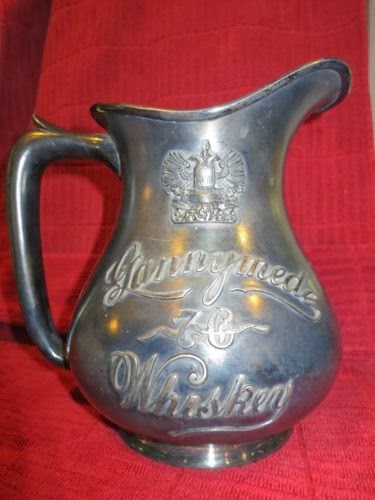
They certainly made the most of the name, advertising and merchandising the brand widely.  It also was featured on the brothers’ giveaway items to favored customers such as saloons and restaurants carrying their whiskey.  Among them were back-of-the-bar bottles bearing the Gannymede label, of which two are shown above.  Banned after the end of Prohibition because adulterated liquor could easily be substituted, the idea was for these vessels to hold the whiskey being advertised.  Silver-plated water pitchers were also poplar items behind the bar, holding water or cold tea.  The Freibergs served up one of the most elegant of those.  More standard in the liquor trade were glasses and the brothers gave away those in both shot glass and drinking glass size.
 

Bar games were also a popular staple in saloons.  The Freibergs provided at least four such to clients featuring their brands, including two dice game (good for shaking for drinks), a roulette wheel and a “Shuffle ‘Em” BB drop.  Note that two of the games advertised Gannymede Pure Rye.  So did a colorfully lithographed serving tray.  As with many Gannymede items, the tray featured a two-headed eagle in a Germanic-looking coat of arms.  It may have symbolize the two brothers united in a single purpose or, a stretch, the eagle that fetched up Ganymede.

As the brothers advanced in business, they became active in philanthropic and civic affairs.
Both men were known for their charitable giving to Jewish and other causes. Sigmund Freiberg was active in public health matters in Cincinnati for many years, particularly in the fight against tuberculosis, a scourge of that era.  He was a founder of the Cincinnati Anti-Tuberculosis League and served on its board of directors continuously for more than 25 years.  In 1924 the city’s mayor appointed Sig to a ten year term on the Board of Health and following that term, which apparently had been distinguished, reappointed him to another ten year term.  Sol Freiberg was a member of the Civic and Commercial Clubs and the Cincinnati Improvement Association. When the Cincinnati Reds baseball team celebrated its 50th Anniversary in 1936 both Freibergs were selected to the “Old Timers’ Committee” for the celebration.

During the 20th Century, the Freiberg’s business interests changed drastically.  In the early 1900s they sold their stake in the Peacock Distillery to the “Whiskey Trust,” which initially expanded the facility and then abandoned it.  The coming of Prohibition in Ohio and the Nation shut down their liquor business in 1918 and terminated with it was the Gannymede Rye brand. The 1920 U.S. Census indicated that, as some other whiskey men did, the Freibergs shifted their enterprise into non-alcoholic beverages and groceries.  Sig was listed as president of a “food products company” and Sol as its manager.  This endeavor apparently was not successful because the 1930 census found the brothers running a retail furniture store in Cincinnati. 

Throughout their lives the Freibergs enjoyed travel.  A 1912 biography recorded that the brothers had toured Europe and traveled extensively through the United States.  Their touring apparently was lifelong.  The American Israelite publication of 1937 reported that Mr. and Mrs. Sigmund Freiberg and Mr. and Mrs. Sol H. Freiberg with their son Dr. Henry Freiberg would sail August 14th on the S.S. Vulcania from New York on a cruise and tour, “visiting the Azores; Lisbon, Portugal; Algiers, Africa; Palmero, Sicily; Athens, Greece; Ragusa, Jugoslavia. They will disembark at Venice, Italy, to motor through the Dolomites and Switzerland, returning by motor through Italy to Rome.  The entire party will be at the Excelsior Hotel, Rome, Italy Sept. 14th-21st.”   Once in Rome Sig and Stella celebrated their golden wedding anniversary.

My research has not revealed the dates of death for the Freiberg brothers nor their burial sites.  As they marched through life to the sweet music of Gannymede “76,”  the brothers had created a liquor business of national scope, contributed significantly to the civic weal of Cincinnati, and provided an array of attractive artifacts by which to be remembered.  A contemporary biography averred that both Sig and Sol were “gentlemen of liberal culture, broad-minded and intelligent.”   Their lives and works make that a fitting epitaph.


Wednesday, January 29, 2014

The Whallen Brothers Ran Politics in “Whiskey City”

 Louisville earned the title “Whiskey City” as the center of the Kentucky distilling industry, a place where many leading liquor producers and wholesalers operated.  The Whallen Brothers, John Henry, shown left, and James Patrick, dominated politics in Louisville for many years as well as being whiskey men in their own right.

John was the elder of the two brothers, born in May 1850 in New Orleans to Irish immigrants Patrick and Bridget (Burke) Whallen.   Soon after the family moved to Maysville, Kentucky, and then settled near Covington.  In 1862 at age 11,  John enlisted in the Southern Army.  The Confederate Veteran Magazine of 1908, called him “the youngest Confederate veteran in the United States,”  and told this story:  “...When some youths of the neighborhood formed a party to cast their fortunes with the South, Whallen who was well grown for his age and of most adventurous spirit, persuaded them to accept him. On their first start a band of home guards who had learned what they were about undertook to intercept them. There was a sharp brush, and Whallen shot one man, wounding him seriously.”

Joining the 4th Kentucky Cavalry,  John chiefly saw duty in Southwestern Virginia and although he participated in few big battles, his outfit was engaged in countless skirmishes with Union troops and bushwhackers.  He was credited with saving the life of his commanding officer by holding off a band of marauders until help arrived.  Shown here as a Confederate soldier,  he served three years until the South surrendered and was mustered out at the age of 14.   Subsequently he was singled out by the Kentucky Cavaliers in Dixie organization for its “Legion of Honor” and called “a superbly brilliant youth, model soldier and graceful courtier in any society.” The Daughters of the Confederacy gave him the “Cross of Honor,” its highest award.  John also would become a “Kentucky colonel” and carry that honorific for the rest of his life.

John Whallen’s charm and charisma would be his lifetime hallmark, although details are scanty about his immediate post-war activities.  One account says he did detective and police duties in Cincinnati and worked on the railroad.  He also clearly was gaining experience in business,  likely in the entertainment field.  About 1876 he moved to Louisville to work and four years later had accumulated sufficient capital to open the Buckingham Theater on West Jefferson Street.   He would go on to own several theaters including the Grand Opera (later Savoy), shown here.  Although John undertook legitimate theatrics, his made his money with burlesque, notorious because of its ties to prostitution and gambling. 

As his business interests increased,  John called his brother James, seven years his junior, to join him in Louisville as his partner.  Shown here, James proved to be a valuable ally. The Kentucky Irish American newspaper proclaimed that when “the Whallens buy a pair of shoes, one belongs to Jim and the other to John.”  It was the older brother, however, who managed the Whallen interests.  Meanwhile, John was not finding his partnerships in marriage as successful as that with his brother.  Whether the result of divorce or death, John Whallen was married three times.   His first wife was Marian Hickey who gave him three children,  two girls, Ella and Nora, and a boy, Orie.  By 1800, however, at age 29, he was married again to a woman named Sarah Jane.  She had been born in Tennessee of a French father and Irish mother.  The 1880 Census did not indicate any children living with them.  By the time of the 1900 census Sara Jane was gone and Whallen was married to Grace Edwards Goodrich, whose roots were in New York State.  She had one daughter whom John adopted.

In the 1900 census, John Whallen gave his occupation as “capitalist.”  Indeed, the brothers were branching out in their business activities.   John became half owner of the Whallen & Martell Mammoth Company.  He also was a principal in a national vaudeville circuit.  Perhaps appreciative of the money being made in Louisville by the whiskey barons, about 1902 the brothers established their own whiskey wholesale and retail business.  The Whallens advertised “mail orders our specialty,”  a trade that was booming as states and localities were going “dry” but shipped-in liquor was still legal.  Locating their business at 219-227 West Jefferson St., Whallen Brothers were “rectifiers,” that is, blending whiskeys to taste, then bottling, labeling, and selling them.

Their flagship brand was Spring Bank Whiskey, advertised here on a paperweight.   In fact, many of the Whallen’s products bore the name, including “Spring Bank High Ball Split,” “Spring Bank Lithia High Ball Splits,” and “Spring Bank Lithia Cherry Phosphate,” all trademarked in 1903.  John named his sprawling Louisville estate “Spring Bank Park.” As on the jug shown here, the Whallens pushed the medicinal value of lithia water, a mineral water with purported health benefits, particularly for the kidneys and liver.  Whallen beverages also came in glass bottles.

It was neither rectified whiskey nor phony medicinals, however, that thrust the Whallens into the political arena.  It was the need to protect their entertainment business.  Having abandoned serious theater for shows featuring scantily-clad women who provided “female companionship” and off-stage services to male patrons.  Although the Whallens gave free passes to members of the Louisville police force and usually were repaid with a blind eye, in 1880 an undercover police taskforce raided the Buckingham Theater and closed down a production called “Female Bathers in the Sea.”  A Louisville grand jury of thirteen men,  all workers or unemployed, were unimpressed by the evidence, however, and refused to indict the Whallens on a charge of obscenity.

John immediately recognized that his theatrical enterprises would be under constant pressure from the more respectable elements in Louisville.  By the mid-1880s the upstairs “Green Room” in the Buckingham Theater had become the hub of local Democratic politics  and John was dubbed the “Buckingham Boss.”  Others called him “Boss John” and some “Napoleon.”  In 1885 he engineered the election of Louisville’s mayor and for his efforts was rewarded with being named Chief of Police.  No more surprise raids on Whallen theaters.  One biography asserted that Whallen “... influenced every Louisville and statewide Kentucky election for the rest of his life. In addition to bribing officials and controlling assistance programs, at his peak Whallen controlled the awarding of 1,200 city patronage jobs.”

The Pulitzer-prize winning journalist Arthur Krock recalled Whallen’s dominance of Louisville politics in his memoirs, describing the Buckingham Green Room as “the political sewer through which the political filth of Louisville runs.”  Not all in Louisville shared that attitude.  John was noted for his charitable work, providing food to the out-of-work and assisting the poor.  As a result he was popular among immigrants, blue collar workers, and Catholics. They saw him as their champion against the Louisville establishment.

Even as his power increased, however,  John was to know multiple tragedies.  His third wife, Grace, died in the early 1900s.  Then, in December 1909,  his only son, Orie, died at St. Mary and Elizabeth Hospital after a short bout of pneumonia.  Orie had been deputy clerk of the Circuit Court and later worked for his father as superintendent of the Spring Bank Lithia Water Company.   John was devastated with grief and it was his brother James who claimed the young Whallen’s remains and arranged for the wake, funeral and burial. 

John Whallen would live four more years, dying at  age 63  while still wielding political influence in Louisville.  With his passing in 1913, the reins of the Whallen machine were handed to James.  The brother, although he had been important in the rise of the family fortunes, was unable to maintain the power of the political organization John had built.  James lacked the charisma of his older brother and gradually the power of the Whallen political machine faded.  James lived another 17 years, dying in 1930.   Partners in life, the brothers were reunited in death in a mausoleum bearing their name in Louisville’s St. Louis Catholic Cemetery.  Their caskets are stacked one above the other.  Appropriately,  John’s is on top.

The Whallens left few legacies of their once dominant role in Louisville.  John’s Spring Bank Park estate became public open space known as Chickasaw Park.  James’  mansion at 4420 River Drive was razed in 1947 and became the site of Bishop Flaget High School.  One remaining relic is a stained glass window in the mausoleum.   It features a wreath in which are intertwined two letters,  “W” and  “B”:  the Whallen Brothers.


Saturday, January 25, 2014

The Aronhimes: Winning and Losing Virginia Liquor Battles

Steeped in the liquor trade,  members of the Aronhime family found themselves locked in combat with Virginia’s prohibition forces for years during the early part of the 20th Century, winning an important battle in 1909 but losing the war just seven years later.

The Aronhime whiskey men were three.  Father Samuel was born in Germany in 1836.  He emigrated to the United States in 1855 at the age of 19, and eventually settled in Charlottesville, Virginia.  He married Hannah, 20 year his junior, in 1880 and sired three sons, Gordon, Morris and Percy.  Samuel was a saloon keeper, running a Charlottesville drinking establishment and billiards parlor on Main Street at the corner of Market.  He also was the proprietor of the classy-sounding “The Opera Bar,”  located beneath the Jefferson Theater in the 600 block of West Main.  Shown here, it was the focus of Charlottesville's entertainment scene.   Samuel advertised his “up-to-date” service and claimed mixed drinks to be a specialty.  The father’s ads also emphasized “family trade solicited.”

The Senior Aronhime also was providing opportunities for his sons to join him in the liquor business.  The 1900 census found the family living together in Charlottesville.  The father’s occupation was given as “merchant.”  Son Gordon, still just 18, was already working, his occupation “salesman,” likely for his father.  Morris, 16 years old at the time, soon would be inducted into the whiskey trade.  Charlottesville business directories of that period listed the Aronhime Bros. liquor dealership.

Eventually Gordon and Morris, probably financed by their father,  headed to Roanoke, Virginia, and established a distillery there about 1907. Their  leaving Charlottesville may have been prompted by increasing pressure from pro-Prohibition forces.  The Virginia WCTU was founded in Richmond in 1882 but had developed a chapter in Charlottesville by the very next year.   Roanoke by contrast was more of a “boom town” and a hotbed of liquor dealers who sold whiskey by rail express into totally “dry” North Carolina and other non-alcoholic localities.

A 1908 Roanoke business directory listed the brothers’ operation as the Aronhime Distillery Company, located on Tinker Creek Road.  The facility was noted in government revenue logs as Registered Distillery #275, Tax District #6.  Shown here is a mini-jug from the company with that name and federal distillery designation.   The brothers received a charter from the State of Virginia in 1909 for their distillery and also opened the Aronhime Liquor Company at 127 Salem Avenue.  Shown here, the street was a major Roanoke commercial area.

It is startling to understand that the brothers both were still in their 20’s when they began operations in Roanoke, although they may have posed as being older.  In the 1910 U.S. Census Morris’ age was given as 35 when in reality he was only 26.  He had been married about three years to Sara, a Kentucky-born woman, and they were boarding with another family.  Early in their marriage the couple would deal with grief as when a daughter died shortly after birth. The occupation listed for Morris by the 1910 census was “liquor merchant.”

The Aronhimes issued their whiskey in embossed quart bottles, shown here, as well as in larger containers.  They also sold a line of California fruit brandies under the “Old Abbey” label.  Like many of their competitors they issued shot glasses to saloons and other favored customers that advertised their  “Flying A” brand.  Their advertising emphasized that they were a “Mail Order Liquor House” and suggested that the railroad express companies operating from Roanoke “make us next door neighbors.”

The brothers were finding, however, that sometimes neighbors could rejected being “next door” to liquor.  The year was 1909 when four far western Virginia towns -- Radford, Marion, Saltville, and Glade Springs -- officially went “dry” under local option laws operative in Virginia. Alcoholic beverages were strictly forbidden to be sold within their city limits.  Violations meant stiff fines.  The Southern Express Company, the carrier of choice, refused to deliver booze from Roanoke to the four towns, apparently fearing arrest of its agents.  This did not sit well with Roanoke’s whiskey merchants,  particularly those who were heavily involved in the mail order trade.  Although much of their whiskey went to North Carolina where prohibition was statewide, Virginia consumers also were important. 

Although usually business competitors, the Roanoke whiskey men joined forces to do battle with the four towns.  The Aronhimes were lead plaintiffs, spearheading the battle against the four dry communities.   They took their case to the Virginia Corporation Commission, a body clearly sympathetic to their cause.  After hear arguments from both sides, that body handed victory to the Aronhimes and their Roanoke colleagues.  The Commission declared the four ordinances void.  It also ruled that the whiskey merchants could sell liquor up to five gallons at a time to customers in any of the towns. Furthermore, the Commission required Southern Express to deliver the goods to consignees.

After their victory over the Western Virginia communities, the Aronhimes flourished for several years with their mail order trade.  Their price list book, available from the company by mail, ran to 31 numbered pages within stiff covers.  Their inventory covered a wide variety of whiskeys and other liquor items to be shipped into those otherwise non-alcoholic areas.  During this period Gordon Aronhime married.  His wife’s name was Fedora and they would have two boys,  Charles born in 1910 and Samuel (after his Grandfather) born in 1912.

In 1913, however,  the U.S. Congress by law curbed the mail order traffic of liquor into dry localities.  As Prohibition forces grew ever stronger and markets for whiskey continued to close, the brothers may have anticipated further curtailment.  About 1914 they sold their distillery to Charles H. Martin who promptly changed its name to the Martin Distilling Co., Inc.  In 1916 the entire state of Virginia voted statewide Prohibition. The Aronhimes continued to operate their Roanoke liquor dealership until the very end.

Although the brothers now were completely out of the whiskey trade, they were still young men, had proven business abilities, and one assumes had amassed sufficient capital to enter into other enterprises.  In 1917 the brothers announced the creation of the Aronhime Packing Company located in Bristol, Virginia, on the border of Tennessee.  Morris was president and Gordon secretary-treasurer.  With capitalization recorded at $50,000 (15 times that in today’s dollar), they announced the opening of an new slaughterhouse with a capacity to handle 30 cattle and 250 hogs daily.

The meat packing business apparently did not go well for them, however, and after about three years the Aronhimes either sold out or went bankrupt.  In any case, the 1920 census found Morris Aronhime residing in Louisville with wife Sara.  His occupation was given as “advertising salesman.”  Gordon was living in Bristol with his wife Fedora and their two sons. His occupation was listed in the census as the owner/proprietor of a automobile parking company.

The subsequent activities of the Aronhime brothers, living apart and out of the liquor trade, are shrouded in time.  Both of them spent the rest of their lives in the towns where they settled after Roanoke.  Morris died first at age 47 in 1931. He is buried in the Temple Cemetery in Jefferson County, Kentucky.   Gordon followed in 1950, age 68, and was buried in Bristol’s Glenwood Cemetery.  The Aronhimes had fought the good fight for whiskey in Virginia and won an important battle but, in the end, lost the war.


Wednesday, January 22, 2014

How Mary Dowling Outwitted National Prohibition

 Having for several years tried to find a female who played an important role as a “whiskey man” in America,  I have at last come across an extraordinary woman.  She is Mary Dowling of Anderson County, Kentucky.  Not only did she own and run a major distillery, shown above, she found a way to stay in the liquor business after 1920 and, in effect, thumbed her nose at National Prohibition.

She was born Mary Murphy in 1858 in the State of Kentucky, the daughter of Irish immigrants.  Little of her girlhood or education is recorded until she reached the age of 17 when in 1875  she married a man at least 17 years her senior.   His name was John Dowling.  They would have nine children of whom eight would live to maturity.

Born in Ireland in 1841, John Dowling had come to the United States with a brother, Edward, and was already established in the Kentucky whiskey trade at the time of their marriage.  He was a partner in a distillery in Anderson County, located on Bailey’s Run about four miles south of Lawrenceburg Courthouse.  The facility had been built in 1810 and after several owners the facility had come into the hands of J. M. Waterfill and G.G Frazier during the Civil War.  They produced a brand of whiskey they called “Waterfill & Frazier.”

During the early 1880s Dowling joined the original partners and the firm became Waterfill, Dowling & Company.  At the time the distillery was mashing 60 bushels a day and had a storage capacity for about 3,000 barrels for aging the whiskey.  Over the next few years the facilities were greatly expanded.  By 1890 mashing capacity had been increased to 125 bushels and warehouse capacity exceeded 9,000 barrels.  Insurance records from 1892 noted that the entire distillery was ironclad with metal or slate roofs, including four bonded warehouses and one “free” (from Federal regulation) warehouse.  Slops from the fermentation process were being used to feed hogs that were housed in pens near the still house.

By 1890 the Anderson County distillery was mashing 250 bushels per day and had a warehouse capacity for 21,000 barrels.   Over the years John Dowling increased his ownership of the facility and in early in the 1900s became the full owner, with his brother Edward assisting him.  They kept the “Waterfill & Frazier” name for their flagship brand and also did business as the Pilgrimage Distilling Co., with offices in Cincinnati.  About the same time, apparently recognizing the business acumen of his wife, John brought Mary into the company.   Not long after,  he died at age 61.  His grieving widow inherited the firm and its management, becoming one of a handful of women in that era to run a major distillery.

During ensuing years,  Mary Dowling became part of Kentucky whiskey lore in her evident ability to control a major operation.   Even a major fire in 1904 that destroyed the distillery did not deter her and the facility was quickly rebuilt.  When Mary’s sons came to maturity, they too were brought into the business.  As her reputation as a businesswoman rose in Anderson County, she followed other economic opportunities.  She became a founding stockholder of the Anderson National Bank in 1907, capitalized at $100,000.  Mary was not, however, given a seat on the bank board.

Mary’s success of almost two decades, however, came to screeching halt with the imposition of National Prohibition.   Federal records shown her withdrawing large quantities of whiskey from her bonded warehouse in the run up to the ban on alcohol.   Some of this whiskey she is reported to have sold to those Kentucky distillers fortunate enough to be licensed to sell liquor for “medicinal purposes.”   Other stocks, it would appear, she was bootlegging.  It was during this period, I assume, that she earned the reputation for being “mysterious” and caused at least one writer to term her “infamous.”

Her illegal business worked for about four years until 1924 when revenue agents set a trap for the Dowlings, who were operating both out of their home and from an office next to two distillery warehouses, supposedly sealed, in which large quantities of liquor were stored.  Federal agents arrived with two “turncoat” bootleggers in their automobiles, men who had done business with Mary in the past.   The agents watched as the bootleggers entered the house and bought out two sacks of whiskey, each containing a dozen bottles.   They watched as the sacks were placed in one of the autos, then searched and seized them, as their stool -pigeons reputedly ‘fessed up.  The “sting” had worked. The agents thereupon entered the Dowling home with search warrants.

In the basement they found and sized 478 sacks, each holding 12 quarts of whiskey, exactly like the ones deposited in the bootlegger’s car.  They seized the liquor and arrested members of the Dowling family, including three of Mary’s sons. This was in spite of her contention, as a court record later narrated, that the whiskey had been there before Prohibition and was “to be for the use of family and guests, whom she entertained on a large scale.”

The Dowlings were prosecuted for a conspiracy to possess, transport, and sell intoxicating liquors in violation of the National Prohibition Act. There ensued three years of court cases both in Kentucky and Federal courts as the Dowlings through their attorneys contended that the search warrant was flawed, that criminal charges should be dropped,  and the seized liquor returned.  An initial trial was adjourned when Mary Dowling became sick.  The indictment was renewed by the government in 1925 and this time the Dowlings were convicted.   Then fate intervened.  Upon the Dowlings' appeal of the conviction to the U.S. Sixth Court of Appeals, it was found that the stenographer who had taken the record of the earlier trial had died and no one could read his notes. That was enough for the Circuit Court and they threw out the convictions.

By this time Mary Dowling had hatched a new -- and more successful -- business plan.  About 1926 she hired Joseph Beam, one of Kentucky’s premier distillers but now out of work, to dismantle the Waterfill & Frazier distillery, transport the pieces to Juarez, Mexico, reassemble it there, and resume making whiskey.  Mexico had no prohibition so the liquor production was completely legal.  Beam, shown right, was all too glad to oblige.  With two of his seven sons, Otis and Harry, he decamped South of the Border and built the facility shown here on a postcard.  They called it the “Dowling Mexican” (D.M.) Distillery.  Beam stayed several years on the job and a relative said his son Harry “essentially grew up in Mexico.”

The primary market for this Waterfill & Frazier whiskey was in Mexico and Central and South America.  Compared to the local whiskeys,  Mary Dowling’s “bourbon,” (actually a blend) was a quality product and highly successful.  As a result a number of artifacts bearing Spanish language and theme,  particularly trip trays, can be found on auction sites.

Because Juarez, in the state of Chihuahua is so close to the U.S. border,  thirsty American tourists also could enjoy it and even, as an ad hinted, bring a bottle or two with them back to the U.S.  There also is evidence that Mary Dowling had found other ways to get her whiskey to the American consumer.  A letter exists to her from Julian Van Winkle, one of those lucky distillers with a “medicinal” license.  He complained that his sales reps were having trouble selling her Kentucky-made Waterfill & Frazier Bourbon because of competition from other quarters selling her Mexican product.  Van Winkle did not even hint at how Mexican bourbon might have made it onto the legal market in the United States.   He knew Mary already knew.

In 1930, four years short of Repeal,  Mary Dowling died and was laid to rest in Section 5 of the Lawrenceburg Cemetery in Anderson County.   In the grave next to her is John Dowling whom she outlived by 27 years. As shown here, the remaining buildings of the Anderson County  distillery were allowed to decay as the forest grew up around them.  After the end of Prohibition in 1934,  one of Mary’s sons,  also named John, built a new distillery at Fisherville, just outside Louisville at Echo Trail at Ford’s Fork.  Sometime later he sold the property to a Kentuckian who closed the facility but kept the Waterfill & Frazier brand name and label design, transferring both to Bardstown where he had another distillery.  Thus some U.S. bottles and artifacts designated “Waterfill & Frazier” are post-Prohibition.

Although she died before witnessing Repeal, Mary Dowling had forged a path for women  -- and men --  in whiskey history that may never be surpassed.  Unlike most of the male Kentucky distillers who quietly shut down, Mary actively rebelled against the “Dry Laws” and after one attempt to circumvent them proved to be problematic, created a second strategy that succeeded beyond all expectations.  Call her “mysterious" or “infamous,” as some have done,  I call her a genius for having thumbed her nose at National Prohibition and beaten it.