This business-savvy Monarch brother went from a Kentucky log cabin to a mansion and then lost it all. Or so people think.
Note: As described in the past when I find a story on a whiskey man that is as good or better than I could compose, it is my custom to ask the author for permission to reprint it, with full credit of their authorship, and always have been given permission. This post about a Kentucky distiller named Richard Monarch is by Aileen Blomgren, a great-great grand daughter of P. Edwin Payne, another well known Kentucky whiskey man. Ms. Blomgren first approached me several months ago about a factual error in one of my earlier posts and informed me about the research she had done on Monarch. I suggested that rather than my doing his story, that she write it up. She agreed and, presented here, hers is a highly informative article that corrects some of the earlier misinformation that had misled me and others. I have added images at appropriate points in the narrative.
It was 1834. Richard Monarch’s parents, Thomas J. and Susan (Davis) Monarch, trudged towards Owensboro with everything they owned in an ox-cart. Although born in Maryland, Thomas had lived in Marion County, Kentucky, since he was a few weeks old. But now, at the age of 33, it was time to head out on his own with his wife and three small children. The family settled in a log cabin on a 150-acre farm Thomas had purchased about eight miles east of Owensboro (still called “Yellow Banks” back then). It was on Hardinsburg Road near Thruston. Sixty years later, along that same road but seven miles closer to Owensboro, three of his sons (Sylvester, Martin Van Buren, and Richard) would build their gorgeous mansions on land once owned by Jo Daviess himself—his farm called “Cornland.” It was quite a step up from their father’s log cabin.
Thomas and Susan Monarch, who eventually had ten children, were some of the earliest pioneers in Daviess County. On June 2, 1838, four years after their arrival, their 7th child, Richard was born. Amazingly, six of Thomas’ sons ended up in the distilling business—and thus the Monarch family bourbon dynasty was born. And of those six sons, Richard became one of the wealthiest. But the bourbon business can be fickle. He was bankrupt by the age of 60.
Like many of his brothers, Richard did not start out as a distiller. In his twenties, he worked on farms in Owensboro and Paducah, and then turned his hand to tobacco production. But by the age of 31, he felt it was time to turn to the family’s “newer” venture—distilling. His older brother, Thomas J., had already opened the Eagle Distillery at Grissom’s Landing in 1860. During the summer of 1869, with limited funds and the enthusiasm of youth, Richard partnered with his oldest brother, Daniel, to build a distillery in a ravine about a mile west of Owensboro, on W. Fifth Street (near Crabtree today). They named it the D. Monarch & Brother Distillery.
Production started on a small scale, but it was not long before all the Monarch brands became well known. As demand increased, so did production. Profits were quickly invested in bigger facilities. Within ten years of his marriage to Mary Elizabeth “Bettie” England on December 3, 1873, the whiskey business would be booming and distillers would be making more money than they ever dreamed of. Since Richard and Bettie had no children, he was free to spend his increasing wealth on his businesses and on each other. It seemed like that would never end.

When his brother, Daniel, died in June of 1875. Richard (known as “Dick” to his friends) continued to operate the distillery alone for the next three years, but changed the name to the R. Monarch Distillery. Then in 1878 he invited a good customer of his, J. F. Magle of Texas, as well as another gentleman, R. F. Burnham, to enter into a partnership for this distillery for five years. Unfortunately, Mr. Magle died in June of 1880, dissolving that partnership. One month later, Monarch convinced Magle’s wife, Virginia, to join with him and Burnham for another five years under “R. Monarch & Co., Kentucky Standard Distilling Company” name. Burnham eventually backed out. It all was not a match made in heaven, anyway, and trouble brewed just a few years later.
In November of 1885, Magle’s widow made national headlines when she filed a sensational lawsuit listing detailed claims that Richard Monarch had committed fraud by hiding profits in various ways (including purchasing a steamboat) so he wouldn’t have to pay her what she and her husband had been owed. Headlines across the country screamed, “Widow Defrauded by Distiller!” She asked for a receiver to be appointed to take charge of the dissolution of distillery partnership.
Unfortunately, history often only remembers the headlines and not the final decision. What people should know is that at the conclusion of the trial in January of 1886, the judge actually read a lengthy statement specifically detailing why he was clearing Mr. Monarch of all charges and accusations to his character. The judge then unexpectedly appointed Richard Monarch as the receiver of the distillery, putting him in charge of dissolution. The Galveston, Texas, Daily News (25 January 1886, p. 4) declared this to be “a very unusual procedure and a high compliment to Mr. Monarch.” Oh…and what happened to his steamboat? Yes, he owned one. Called the “Edna Adams” (formerly named “Two States”), it burned to the ground in September of 1889 while undergoing repairs.
That particular lawsuit with all its specifics, however, certainly hinted at Richard’s complicated business personality. It was well known that he had no problem firmly expressing his opinion when he believed he was in the right. He also had a knack for quickly understanding what it took to get things accomplished. Cautious in business dealings, he therefore had no problem managing multiple distilleries and businesses.
He often had to juggle other lawsuits, too, not unlike many other distillers. The Owensboro Tri-Weekly Messenger (December 21, 1886) even wrote a front-page story on the history of the Monarch brothers’ suits! That was all part of the process since they had trademarks, recipes, and their good names to protect. To add to his responsibilities, by 1890 he was also working as President of the National Bank of Owensboro. But in general, notwithstanding his large personality and sometimes colorful language, he was considered to be courteous, kind, upright and faithful, “with a heart as big as all outdoors.”
 In September of 1890, he purchased his deceased brother’s distillery, the Eagle Distillery (formerly the T.J. Monarch Distillery at Grissom’s Landing). Since the plant was on the Ohio River and a short distance from the railroad it was considered perfect for transportation of the whiskey. Richard actually outbid his brother, M.V. Monarch, at the auction! After some very competitive bidding, they pushed the price up to $110,000 before M.V. Monarch dropped out.
 Thus, by 1892--only six short years after that sensational trial--he now owned the Glenmore Distilling Company (RD #24); the Daviess County Distilling Company (RD #2) purchased in 1888; and the Eagle Distilling Company (RD #8) purchased in 1890. His companies produced such brands as the “R. Monarch”, “Kentucky Club,” and “Kentucky Tavern” as well as “Doherty Short Horn” and “Glenmore.”
Hmmm…that Glenmore name. There are so many explanations of where it came from! However, Richard wrote an interesting article in the Pacific Wine and Review (August 21, 1895, p. 26) where he jocularly said that the Kentucky Standard Distilling Company had been named Glenmore after “that noted race-horse.” It turns out that there actually was an 1875 thoroughbred named “Glenmore” who raced for several years. The American Thoroughbred (p. 15) described him as “one of the best cup-horses of his day and a winner of the fastest second heat of four miles ever run.” Bourbon and racing have a long history together, so maybe that is where the name Glenmore actually came from!

Around this same time, the 1892-1893 crop of whiskey was overproduced. By the time it would mature and be sold several years later, it would be worth less than it cost to make. This overproduction trend continued in the mid-1890s and--although the distillers didn’t know it-- the boom was ending and the bust was on the horizon.
 But to Richard Monarch, things looked so good in 1893 that he began construction on a palatial mansion on the banks of the Ohio River, within sight of his Glenmore Distillery. From there he could already see the grand homes of his brothers, Sylvester and M.V. Monarch, and his friend, P. Edwin Payne who was vice-president of M.V.’s Sour Mash Distilling Company. But Richard’s home was to be bigger, grander, and more spectacular than them all. He insisted on sparing no expense. The home cost around $100,000 (over $2.5 million today).
 The mansion was three stories high, but if you included the “look-out” at the top of the house it was actually five stories, according to Elizabeth Evans Mattingly who lived there in the early 1900s. There were stunning balcony porches that ran around the outside of the home, on both the first and second floors. Beautiful buggies would pull up to the porte-cochere where the step was high enough that the ladies never had to worry about their gowns touching the dirt or mud. The large front entrance hall had two windows and a fireplace with a mantle. Within the home there was a wide stairway with two landings, one of which had a balcony seat with velvet cushions. The landings were large enough for an oriental rug and couches. There was a music room with rare curved glass at one end of the room.
At the end of the second-floor hallway it was wide enough for a library table to be placed in front of three windows overlooking the porte-cochere. On the third floor, there was stage room for theatrical plays, and another room that was perfectly round. The house included a gorgeous library as well. The lookout, accessed from the third floor, was glass-enclosed and had a fabulous view of the Ohio River. It was a great way to watch the riverboat traffic. All the hardwoods used downstairs were foreign woods (including white Australian mahogany in the music room), and upstairs native woods were used. Much of the furniture was French provincial. There were fabulous fireplaces and mantles; and even the bathrooms had mosaic tile floors, Italian marble walls, and gold fixtures.
The Owensboro community was supremely excited in December of 1894 when they finally got their first look at the house when the Monarchs hosted the wedding of Bettie’s sister, Miss Bertye England and Mr. Henrie Symmes. It was said that no one declined those invitations! The Monarchs continued to be lavish entertainers over the next few years. But everything was about to change. By December of 1897, just three years later, Richard Monarch had to declare bankruptcy when his liabilities of nearly a million dollars were more than his assets could cover. His brothers had already, or would also, declare bankruptcy. The whiskey in his warehouses had declined in price so much that it was essentially worthless, and buyers were scarce. This is why they all failed. It had nothing at all to do with Prohibition (which seems to be a rampant internet rumor).
That same December, the Columbia Finance and Trust Company was assigned control of Richard’s companies. He signed a deed of assignment on January 28, 1898 for the Eagle Distillery Company, which (strangely) listed the brands of “Glenmore” and “Doherty Short Horn.” The inventory totaled just $40,000, which included an office safe worth $20. I’m not sure that was even worth mentioning but I guess they were looking for every penny they could get.
The Glenmore and Eagle distilleries were sold on January 22, 1901 for $17,000 each, to E.G. Buckner on behalf of various creditors. That was immediately challenged in court because of the low price (and only bid), and the lack of an appraisement. The judge reversed the sale of the Glenmore and ordered the seller to re-advertise and resell it. The court, though, confirmed the sale of the Eagle Distillery, because no objections had been filed. On May 6, 1901, the Glenmore was actually sold for $200,000 by the Columbia Finance and Trust. The buyer was James A. Thompson & Bro. of Louisville, with Mr. Harry Barton named as manager. They planned to put the Glenmore Distillery back into operation by May 15th. Then on May 29, 1901, James A. Thompson & Co. transferred the Glenmore Distillery to the Glenmore Distilleries Company for $70,000. As with so many distilleries, there is definitely a confusing paper trail of name changes and ownership of this company! A side note: Richard Monarch had at one time turned down an offer of $225,000 for Glenmore by the Columbia Trust. Ah, hindsight makes us all wiser.
The Monarchs continued to live in their mansion they called “Monarchdale” until June 1902, when it was sold to Hiram E. and Nellie B. Rose for just $20,500. The home then became known as “Rosedale.” Columbia College bought the home from the Rose family in August of 1909, but it then sold the home to Mr. C. O. Evans around 1913. The Evans family, including Elizabeth Evans Mattingly, lived there for about ten years.
Around 1927, the Daviess County Public Schools purchased the property to use for a junior high school, and added a classroom addition and gymnasium on either side of the home. The home was torn down in 1960 to make room for more classrooms.
In the meantime, in June of 1902 Richard and Bettie reportedly moved to Louisville because he was interested in the Pleasure Ridge Park Distillery located there. It is unknown if he actually bought any shares, but he is not listed in the Owensboro City Directory for 1903-1905 so perhaps he did move out of Owensboro then. However, in October of 1902 he also opened up a wholesale whiskey house on Frederica St. in Owensboro, so he did keep some business dealings there.
By February of 1906 the Monarchs were definitely back in Owensboro, on the Bon Hill farm west of town on River Road, on a 154-acre plot of land. This is the same amount of acreage that his wife, Bettie, left to Richard when she passed away so it may be the same property. Richard Monarch actually operated the R. Monarch Distillery here, producing the “R. Monarch” brand he registered c1907. It closed around 1913, about two years before he died, when the distillery’s production was essentially nothing. His last few years were spent managing the farm.
Bettie England Monarch passed away on February 27, 1915, in a horrific accident at home. She was sitting in front of a fireplace when her nightgown caught fire. Richard, in another room, heard her scream and ran to help her but could do nothing but stay by her side all night. He couldn’t even leave her to telephone for help; she died at 7 am that morning. He was devastated.
 Richard lived only a few months longer than his wife. He died on July 9, 1915, of a stroke. On his death certificate, his occupation is notably listed as “Farmer.” And thus he came full circle, back to his childhood roots. After starting with almost nothing, then becoming one of the wealthiest and best-liked distillers in Kentucky, people often presume he lost everything after his bankruptcy and faded into obscurity. Although he did lose his large distilleries and never lived at the grand scale he once enjoyed, he lived another 17 years. He had at least some farm income left, and later a small distillery on Bon Hill farm. After the bankruptcy, he and his beloved wife spent all but a few years living in Owensboro among family and friends. They still continued to play a large part in local events, although it must have been hard to see others living in his grand mansion. He was still highly respected in the community when he died.
 There is one postscript to his life, though. After his death, a lawsuit was filed by Bettie England Monarch’s family saying they should inherit her estate. Bettie died with a will, leaving property she had in her name (including a 154-acre farm and all its income) to her husband with the specific power to dispose of it by whatever instructions he wrote in his own will. Some called it a “life estate.” However, when he died four months later Richard did not leave a will and therefore left no legal document providing for the disposal of his wife’s property. She had also neglected to name an executor or trustee to carry out disposal of her property if he left no will. A judge ruled in favor of Bettie’s family, stating that they were entitled to all of her estate that had passed to Richard after she died. This included his wife’s farm worth $25,000, and a paid-up insurance policy for over $8,000. That is worth over $600,000 in today’s money. It was a complicated end to Richard’s story. Because even when you have it all and then lose most of it, nothing is ever simple again.
SOME SOURCES
Crittendon Press, Marion, Kentucky (September 25, 1890) – T.J. Monarch Distillery at Grissom’s Landing Sold to R. Monarch
Eagle Distillery Assignment Document, dated 28 January 1898.
Evansville, Indiana Courier and Press, November 21, 1894 (p. 4) – “A Big Society Event in December at Owensboro.”
History of Daviess County, Kentucky (Interstate Publishing, 1883, p.475) Biography of Edward P. Millett
History of Daviess County, Kentucky (Interstate Publishing, 1883, p.343-345) Description of Owensboro distilleries.
Mattingly, Elizabeth Evans (5 page document dated May 1, 1989) – Most of the descriptions of Richard Monarch’s home come from her recollections.
Pacific Wine and Spirit Review, Vol. XXVII, No. 1 (February 1892, p. 12) – “R. Monarch, a self-made man…”
Pacific Wine and Spirit Review (July 6, 1892, p. 29) – A King of Distillers, A Brief Sketch of R. Monarch and a Synopsis of His Many Interests
The American Thoroughbred by Thomas B. Merry (Published by Commercial Printing House, Los Angeles, CA in 1905), p. 115
The Courier-Journal, Louisville, Kentucky (February 23, 1902, p. 9) – (Jo Daviess at “Cornland”) The article says that Jo Daviess’ farm ‘Cornland’ is “where the handsome homes of Messrs. R and M.V. Monarch are now situated just east of the city and barely outside of its limits.”
The National Cyclopedia of American Biography, Volume XVII, page 108 published by the James T. White & Company (New York) 1920. – Biography of Richard Monarch.
The Southwestern Reporter Volume 189 (December 6, 1916 – January 10, 1917), p. 1126-1130 (includes O’Bryan vs. England court decisions, as well as Bettie England Monarch’s will).
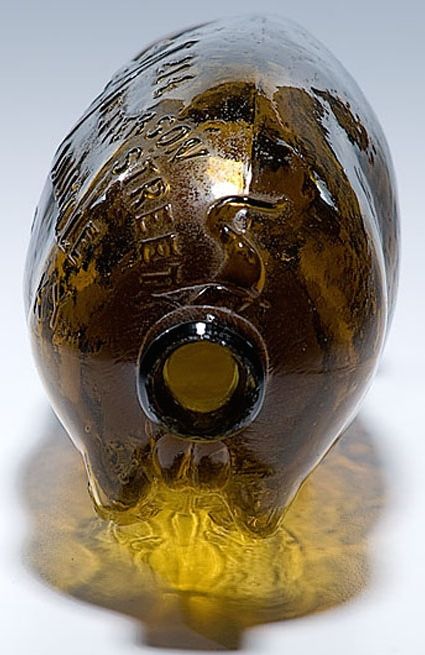


 The partnership appears to have been short-lived. Kagle & Duffy disappeared from Louisville directories after 1868. William Kagle is recorded as having gone back to bartending, this time at the H. S. McNutt Saloon, and he later became proprietor of the Delmonico Hotel. Meanwhile Duffy continued to run a saloon at 108 Fifth Street. He may have renamed it “Duffy’s Saloon,” the designation to be found on an Albany Slip stoneware jug with a “scratch” label shown here. Duffy remained at that location until about 1873 when he moved to 214 Jefferson Street, a major Louisville commercial thoroughfare. shown below. He called this new watering hole, the “Crescent Saloon.”

 Another mystery is why Duffy included the embossing of a rooster on the back of his pigs. The chanticleer appears to be crowing from the curve of a moon with the word “Crescent” inside. One answer that occurs to me is that at the time the rooster, not the donkey, was the symbol of the Democratic Party and that Duffy may have been making a political statement.
 Given what must have been his expense for both bottle and contents, what occasioned Duffy to provide these giveaway items? Louisville was full of saloons in that era and the competition for customer loyalty was fierce. The custom among their proprietors was to reward frequent faces along the bar with some token of appreciation. Duffy chose this fairly unusual method of expressing his gratitude.


