Wednesday, February 13, 2019

The Baker Boys and Swastika Whiskey

   
Sometime in the latter third of the 1800s, three sons of a veteran steamboat captain on the Ohio, Mississippi, and Missouri Rivers, determined to make distilling their career.  George Baker, William Jackson Baker and Richard Alexander (R.A.) Baker went on to found Baker Bros. Distillery in Franklin County, Kentucky, not far from Frankfort.  Then they chose a name for their whiskey that later would become a hated symbol of oppression and death:  the swastika.

The swastika -- until the Nazis appropriated it -- for ages had been considered a harbinger of good luck. An ancient symbol, the swastika dates back 3,000 years to India. It also is an Native American icon, with origins in prehistory.  Given its positive image, it is no wonder that in the early 20th Century organizations found it an appropriate symbol. Coca Cola used it as the shape for a watch fob and the Boy Scouts of America displayed it on the spine of their 1903 “Handy Book.” It also was the symbol for a Ladies Home Journal-sponsored girls' club.


Who among the brothers selected the swastika to represent the Baker flagship brand is unclear.   It may have been George, the first son, born in Marietta, Ohio, in 1850.  William, born in Carroll County, Missouri, arrived eight years later and Richard, the youngest, not until 1865.  Although Chester Zoeller in his book on Kentucky whiskey speculates that the Baker Brothers & Co. Distillery may have been founded as early as 1869, that date makes no sense as the boys would have been too young.  Moreover, when he retired from steamboats to farming in Missouri, their father was wealthy and able to send his sons to college, delaying their entry into commerce.

My guess is that, if built in 1869, the facility was under other ownership and only later purchased by the Bakers, possibly as late as the 1880s.  The distillery was located four miles east of Frankfort on the Georgetown Pike, one mile west of the junction of North and South Elkhorn Creek on the Frankfort and Cincinnati Railroad Line.  Although details are sketchy, the original Baker Bros. distillery likely was run by George and William.  Richard did not arrive in Frankfort until 1887 when he went to work for John D. Hinde, a wealthy Kentuckian and horse breeder, who owned and operated a 600 acre model farm near Frankfort.


Hinde and his son Thomas apparently helped the Baker boys with cash to rebuild and expand their distillery and as compensation Thomas Hinde was named president of the company.  Subsequently the Hindes moved permanently to Chicago, apparently leaving the Bakers to run the operation.  Richard became vice president and George the secretary-treasurer.  William’s role at this time is unclear.  For a time he may have been running a small distillery in Pulaski County, Kentucky.  

The Bakers also were having personal lives.  George married Mary Chase Donahue in 1889.  They had one child.  In 1911 at Frankfort Richard married Irma Labrot, daughter of Leopold and Louise Welch Labrot.   Her father was the owner of the Labrot-Graham distillery.  Richard and Irma’s union appears to have produced no children.  No record exists of William marrying.

The name of the distillery changed several times, from Baker Brothers to Swastika Distillery to Kentucky Sour Mash & Rye Distillery (1903-1905) to the name by which it became best known, the Frankfort Distillery Company.  By that time the distillery was capable of mashing 700 bushels a day and had four bonded warehouses, as shown on the 1910 Sanborn insurance map here.  By 1912 the daily mashing capacity had been increased to 1,250 bushels.

The company’s flagship brand continued to be Swastika Whiskey, available in half-pints, pints and quarts.  Over the years the distillery issued a variety of other brand names, among them:  “Baker,” "Baker Bourbon,” "Baker Rye,” “Coronet,” "Elkhorn Mills,” "Gallant Knight,” "Kerry Patch,” "Old Chief,” "Old Woodpecker,” Shandon Bells,” and “Victoria.”  Of these in 1906 the company trademarked only Baker, Elkhorn Mills, Kerry Patch and Shandon Bells. Interestingly, Swastika Whiskey was not among them.


In 1913, George Baker died, age 63.  He was buried in the Frankfort Cemetery.  After his death, William took his place as secretary-treasurer of the distillery, continuing in that post until he died in 1918.  With the death of his father-in-law in 1915, Richard with wife Irma also controlled the Labrot-Graham Distillery, twelve miles from Frankfort in Woodford County.  This facility was a successor to the venerable Old Oscar Pepper Distillery, founded in 1817. [See my posts on these distilleries, January 21 and 24, 2017].

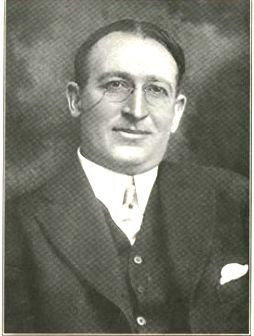
Operating two major Kentucky distilleries brought Richard Baker considerable recognition in the whiskey trade.  He is shown here in the only photograph I could find, one taken from a passport application. When National Prohibition was enacted in 1920, Baker’s distillery was one of only six in the United States authorized to sell spirits through pharmacies for medicinal purposes. 


In 1922 Frankfort Distilleries Inc. was sold to  Paul Jones & Co. The new owners kept the name in order to retain the liquor permit.  [See my post on Paul Jones,  Sept 4, 2014.]  As shown here on a 1923 letterhead the offices were transferred to East Main Street (“Whiskey Row”) in Louisville. Richard Baker died in October 1940 at the age of 75 and was interred in the Frankfort Cemetery adjacent to his two brothers.  His grave is shown here.

Although the Frankfort distillery survived National Prohibition, Swastika brand whiskey did not.  By the time of Repeal, Hitler had begun his rise in Germany with the symbol emblazoned on everything from posters to postage stamps.  After the war when the Holocaust was fully understood, the swastika as a good luck symbol had disappeared forever— and with it, except for bottle collectors, any vestige of Swastika Whiskey.

Notes:  Details of the Bakers’ activities in the Kentucky whiskey trade are fragmentary and difficult to track.  While I have tried to cobble together an accurate narrative, the “holes” are evident.  It is my hope some watchful descendant will see this post and help me fill in details about this whiskey producing family.  In addition to Zoeller’s book, “Bourbon in Kentucky,” a key reference was a biography of Richard Baker in the “History of Kentucky,” by Kerr, Connelly and Coulter, dated 1922.




Saturday, February 9, 2019

George Fayle Saw Opportunity in the Nevada Desert


Born and raised in Los Angeles, George Arthur Fayle rejected big city life in favor of barren desert lands in Southwestern Nevada where he helped found two towns and a saloon that he appropriately named “Pioneer.”  Since Fayle’s untimely death in 1918 his establishment has become famous as the oldest working saloon in Nevada. Fayle is shown here in his youth.

Fayle’s parents had come to California from afar.  According to the 1880 census, his father, also George, was born in Ireland, likely County Mullingar, and his mother, Clara, hailed from Maine.  Born in February 1881 George was the couple’s first child, born when his father, a clerk, was 28 years old and his mother, 22.  He spent his early years in Los Angeles and was educated in its schools.  

When he was just 20 years old Fayle married Jean Henderson, a step that marked a sharp change in his life.  With Jean he headed out of the big city for a small isolated California mining town located in the Calico Mountains of the Mojave Desert. 

George Fayle with Team Hauling Ore

There he found work hauling ore from the silver strikes.  What Jean thought of this change has gone unrecorded, described as a mate who, “…Through the years of married life [was] a devoted and helpful wife, sharing in his struggles and cheering him through the dark places.”   The couple’s first son, George Junior, was born in Calico.


In 1904 family fortunes changed.  George’s uncle, Samuel Yount asked Fayle to come to work with him in a small settlement in the Nevada desert called Goodsprings Junction. “…Who would, of choice, want to live there?” queried one puzzled writer.  Fayle saw an opportunity, however, and moved his wife and newborn to Nevada.  Shown above, except for the railroad station, Goodsprings Junction came to be owned by the firm of Yount & Fayle, including a hotel and boarding house, general store, feed stables and camp yard.  Fayle became postmaster and renamed the place “Jean” after his wife.

Yount & Fayle became a highly profitable enterprise.  Eight miles across a mountain range was the town of Goodsprings, Nevada, shown left.  It was the home of the Yellow Pine mine that was producing prodigious amounts of zinc and lead ores. Yount was a major stockholder and secretary of the mine. Seventy tons of ore were shipped daily via a specially built railway from Goodsprings and off-loaded at Jean. From there it was distributed to smelting facilities across the West via the San Pedro, Los Angeles and Salt Lake Railroad.

The Salt Lake Mining Review of March 1912 described George Fayle, calling him “…One of those pushing, energetic, and affable California boys whom it is always a pleasure to meet….and a rising man.”  We have a description from his draft registration for World War One.  Fayle was described as of medium height, “stout,” gray eyes, brown hair and at 36 years old a receding hairline. 

In 1912,  Fayle moved his family, now including a second son, Leonard Ray, and a daughter, Jean Nevada, across the mountains to Goodsprings.   With financial help from Yount, who already owned a general store there, George already had established a tent store for miners and begun an ore hauling business.  He then became a partner in Yount’s store.

Upon relocating in Goodsprings, Fayle built a saloon.  Not the usual ramshackle building, this watering hole featured interior and exterior walls of stamped tin plates manufactured by Sears Roebuck.  The bar was similarly impressive, crafted by the Brunswick Company of Maine in the 1860s, featuring a large mirror and a brass footrail.   It was shipped from Rhyolite, Nevada, from a defunct saloon in a soon-to-be “ghost town.”  Fayle called his establishment the “Pioneer Saloon,” shown right flanked by a crowd of his clientele.  He began shipping in whiskey by the barrel, decanting it into ceramic jugs, like the one shown here, and selling it to retail customers.  Note that the jug bears the year 1915. 

Running the saloon, however, was not without incident.  In July 1915, during a poker game at the Pioneer, a miner named Paul Coski was caught cheating.  When the dealer, Joe Armstrong, ordered him to leave, Coski refused and the dealer pulled a gun.  The two men scuffled.  Armstrong fired, hitting Coski several times and killing him.  Errant bullets pierced the tin walls of the Pioneer where the holes are still visible.  The coroner ruled Coski’s death as justifiable homicide.  One did not cheat at cards at the Pioneer Saloon.

Meanwhile, with ore increasingly plentiful, Goodsprings was growing, reaching a population of about 1,000 in 1915 — larger than Las Vegas.  The following year Fayle built a hotel, shown here. It was among the most luxurious in Nevada, providing 20 guest rooms, electric lights, hot and cold running water, steam heat, and a restaurant that claimed fine dining. Advertised as the “finest hotel in the west,” the Fayle Hotel opened with a grand ball on May 13, 1916. The hotel and restaurant initially were so successful that Las Vegas residents made the forty mile trip south to Goodsprings.  According to at least one historian, Fayle’s hotel not only served such clientele, but also provided a place where the “soiled angels” of the West could meet with their miner and prospector customers.

Fayle’s hotel, however, appears to have caused a financial break with Sam Yount.  The uncle objected to its construction, predicting that the hostelry could not survive financially.  When Fayle pressed ahead anyway, their partnership of eleven years came to an end.  Convinced that Goodsprings would be a success, George subsequently built the Fayle Department Store.  For a time his investments paid off and, according to one author, “finally reached the proportions of the most important business of southern Nevada.”


Understanding that mining was the key to Goodsprings economy, Fayle also invested in mines in the Yellow Pine District.  According to his obituary in the Las Vegas Age,  Fayle assisted prospectors who were attempting to make money from their claims:  “He handled the marketing and settlement for thousands of tons of ore for the miners and was foremost in every good work of a public nature.”  

Fayle’s public service included six years as an elected member of the Clark County Board and from 1916 to 1918 its chairman.  Of his performance in office, the newspaper said: “…His strict integrity, his unflagging energy, his boundless generosity in the expenditure of his own time, money, and efforts for the benefit of the county have been invaluable.”

Tragically, in 1918 Fayle fell victim to the Spanish Flu epidemic that was sweeping the U.S.  Contracting the disease in December, for several days he seemed to be recovering but then developed pneumonia and no medical response was effective.  His funeral services were held in the dining room of the Fayle Hotel, the ritual being that of the Fraternal Order of Elks, of which he had been a member, as indicated on his gravestone.  

The 37-year-old asked that he be buried in Goodsprings at the local desert cemetery at a spot that looked out on the mountain and the valley.  A photo of the cemetery shows the Fayle plot at left marked by the largest monument.

Jean Fayle, recognized as a pioneering figure in her own right, stepped in to manage the family’s business interests.  Shown here with sons, George, left, and Leonard, she indicated that she would continue in that role until the boys had completed their education and were able to assume running the businesses.  With the passage of time the Fayles sold the Pioneer Saloon. It continued to operate, with time out for National Prohibition, even as Goodsprings after World War One saw mining profits slump and the population plummet to fewer than 100 residents.  Jean died in 1950 and was buried next to her husband in Greenspring.


Today the Pioneer Saloon is a tourist stop, seven miles off Interstate 15, a  highway that stretches north-south across the entire Western United States.  A stop in Goodsprings yields the story of the 1915 shooting and other incidents occurring there over the generations.  A historical marker tells briefly of the contribution of George Fayle, shown here in maturity, who for a time was instrumental to making a town bloom in the Nevada desert.

Note:  Several references were particularly helpful in researching this post.  They include:  The Pioneer Saloon website; The Salt Lake Mining Review of March 1912; Legends of America website:  “Goodsprings Nevada — Still Kicking in the Desert Dust”; and George Fayle’s obituary in the Las Vegas Age of December 14, 1918.  Four of the photographs used here, including the two portraits of George Fayle come from the University of Nevada Los Vegas archive of dozens of photos of the Fayle and related families.  A treasure trove. I was directed to them by a great grandchild of George and Jean Fayle who contacted me without revealing a name.  I am hopeful that Anon. will come forward so I can give due credit for this amazing (to  me) addition of relevant photos. 


Thursday, February 7, 2019

Whiskey Men and Bootlegging

Foreword:  When  alcohol prohibition was imposed in states and in the Nation distillers and whiskey dealers often were prepared.   Some shipped their liquor abroad.  Others sold it at steep discounts to private customers.  Some, however, found themselves still owning large supplies and nowhere to go with them. A handful of those whiskey men (and at least one woman) were spurred to take illegal action, known generally as “bootlegging.”  As will be seen, such efforts seldom were successful.  


 J. T. Doores of Bowling Green, Kentucky, shown above,as a youth was so captivated by a prohibitionist preacher that he took a formal pledge to foreswear alcohol.  Within seven years Doores not only had recanted, he was running a whiskey wholesale business that brought him considerable wealth and political clout in Kentucky.


In 1916 Doores’ Warren County like other localities in Kentucky went “dry.” In a crack down on what local law enforcement called “bootlegging,” police attention was drawn to the former liquor dealer in December 1917.  Doores was arrested and hauled into court for having carried from Louisville to Bowling Green several gallon jugs and some pint flasks of whiskey, concealing them in four suitcases.  The authorities charged that the whiskey in his possession was to be sold.  His arrest made headlines throughout the American Midwest. The Cincinnati Enquirer opined:  “Doores probably is the most prominent man who yet has been arrested in Kentucky on a charge of peddling liquor into a dry burg.”  

I have been unable to find the disposition of the charges against Doores.  In those days individuals with considerably less political clout, even if found guilty, often were left off with a slap on the wrist and a small fine.  We can assume that was the worst that might have befallen Doores.


When his father died in 1904 and left him in control of the family distillery in Tell City, Indiana, William Krogman was well prepared to succeed in the whiskey trade.   As “dry” forces closed in on the production and sale of alcohol, however, Krogman’s markets slowly dried up along with profits.  Finally, the advent of National Prohibition caused the distillery to shut down completely.  

Krogman found the situation difficult to accept.  Sealed by federal order, his warehouses were full of aging whiskey.   The temptation proved to be too strong for William.  With four others, including two former Tell City town marshals and an ex-sheriff of Perry County, Krogman hatched a plot to rob the his distillery warehouse.  They carried it out in August 1921.  In short order Krogman and his cohorts were identified by federal authorities and arrested.   

Summoned into Federal Court in Indianapolis, Krogman and his four accomplices were charged with conspiracy.  As the presumed ringleader, Krogman’s bail was set at $3,000 (equivalent to $65,000 today.)  The others paid lesser amounts.  I am unable to find the outcome of the arrests, but in many cases such offenses were treated leniently even by the U.S. courts and the perpetrators let off with fines.  The rationale could reasonably have been that Krogman was only trying to purloin liquor that actually was his.  William continued to own the Krogman properties during the “dry” years but died in 1832 and never saw the Repeal of the 18th Amendment.


Having inherited operation of a successful Anderson County, Kentucky, distillery Mary Dowling was not about to let National Prohibition interfere with her liquor trade.  Her illegal business worked until 1924 when revenue agents set a trap for her.  She was operating both out of her home and from an office next to two distillery warehouses, supposedly sealed, in which large quantities of liquor were stored.  Federal agents arrived with two “turncoat” bootleggers in their automobiles, men who had done business with Mary in the past. The agents watched as the bootleggers entered the house and bought out two sacks of whiskey, each containing a dozen bottles.  They waited until the sacks were placed in one of the autos, then searched and seized them, as their stool -pigeons reputedly ‘fessed up.  The “sting” had worked. The agents then entered the Dowling home with search warrants.  

In the basement they found and seized 478 sacks, each holding 12 quarts of whiskey, exactly like the ones deposited in the bootlegger’s car.  They confiscated the liquor and arrested members of the Dowling family, including three of Mary’s sons. As a court record later narrated, she contended that the whiskey had been there before Prohibition and was “to be for the use of family and guests, whom she entertained on a large scale.”  

The Dowlings were prosecuted for a conspiracy to possess, transport, and sell intoxicating liquors in violation of the National Prohibition Act. There ensued three years of court cases both in Kentucky and Federal courts as Mary through her attorneys contended that the search warrant was flawed, criminal charges should be dropped, and the seized liquor returned.  An initial trial was adjourned when she became sick.  The indictment was renewed by the government in 1925 and this time the Mary and her sons were convicted.   Then fate intervened.  Upon an appeal of the conviction to the U.S. Sixth Court of Appeals, it was found that the stenographer who had taken the record of the earlier trial had died and no one could read his notes. That was enough for the Circuit Court and they threw out the convictions.  

Meanwhile Mary Dowling had hatched a new -- and more successful -- business plan.  About 1926 she hired Joseph Beam, one of Kentucky’s premier distillers but now out of work, to dismantle her distillery, transport the pieces to Juarez, Mexico, reassemble it there, and resume making whiskey.  Mexico had no prohibition so liquor production was completely legal.  Her whiskey was sold to American  tourists who were allowed to bring it over the border.  In addition, a significant amount found its way onto the U.S. market, allegedly for “medicinal use.”  No one seemed to know how it got here.  But Mary did.

Note:  Longer articles on each of these three individuals may be found on this blog:   J. T. Doores, January 26, 2015;  William Krogman, December 6, 2014, and Mary Dowling, January 22, 2014.


Friday, February 1, 2019

This Yankee Put Peoria on the Distilling Map

       
The stern and rugged visage at right is that of Almiran Smith Cole, a New England Yankee who in 1835 uprooted his family from their Massachusetts home, loaded a wagon with sale goods and set out for to a settlement on the Illinois River called Peoria.  Arriving two months later, Cole subsequently founded the town’s first whiskey distillery, giving rise to an industry there that eventually return hundreds of millions in taxes to the U.S. Government and made the Yankee entrepreneur a very wealthy man.

When Cole left New England he was breaking with a family heritage of centuries.  He was descended from Hugh Cole who emigrated from England to Plymouth, Massachusetts, about 1654.  Four generations later, Almiran was born in 1805 in Cheshire, Berkshire County, Massachusetts.  Of his education and early life details are scant but it would appear that as a youth Cole was engaged in the mercantile trades.  

When he was 28 years old in January 1833, he married 21-year-old Chloe Brown, descended from a longtime New England family, in Pownell, Vermont. Their marriage produced nine children only two of whom lived into middle age. Two years after they wed, Cole decided that his fortune lay westward.  Packing supplies and a cargo of trade goods, in September 1835 he and Chloe set out from Lanesboro, Massachusetts, driving horses and a wagon across the Appalachian mountains and into the Midwest.  The trip took the family sixty days.


Shown above as it looked upon their arrival, Peoria was the oldest white settlement in Illinois and only recently had incorporated as a village.  Cole saw opportunity in its accessibility by road and water and decided to settle there.  Off-loading his trade goods, he opened a store on Main Street, the main commercial avenue.  Although a canny entrepreneur, Almiran seems to have been restless in his business efforts.  Two years after establishing his general store, he sold out to one of his clerks and moved in an entirely new direction.

Cole became a steamboat captain. He bought a steamer, named the “Frontier,” and ran it as a passenger packet between LaSalle, Illinois, and St. Louis.  One of the first boats of its kind to ply the Illinois River, it has been cited as “intimately associated with the history of Peoria.”  Shown here is a photo of steamer traffic on the Illinois.  This foray onto the water brought Cole a lifelong sobriquet of “Captain.”  Within several years, however, the Yankee tired of this occupation, sold the steamer, and returned to the mercantile business, erecting a new building for his store.

By 1844, he had once again gotten restless, sold the store, and erected the first distillery in the history of Peoria, one capable of mashing fifty bushels of grain a day.  It was an inspired move.  By this time Peoria was experiencing considerable growth and would incorporate as a city in 1845.  Saloons were proliferating. Supplies of corn and other grains were abundant and easily accessed.  With Cole leading the way, distilling proliferated.  In 1850, 5,685 barrels of whiskey were recorded from Peoria.  By 1859 distilling was the major manufacturing interests there, with hundreds of thousands of dollars invested.  Six distilleries and two alcohol works were in operation.


With Almiran Cole as the pioneer, Peoria would become the whiskey capital of the world.  No place on earth, according to the historians, produced as much bourbon and rye as that flowing from Peoria distilleries.  In 1885, for example, more than 18 million gallons of whiskey were produced in the city. So great was the revenue from the whiskey tax paid to Washington that Peoria’s share was larger than any other city in America.  Shown above is a steamboat with a sign proclaiming that Peoria had paid $3.5 million in taxes.

Meanwhile, Cole had become dissatisfied with his first distillery after two plus years and sold it as a prelude to building a much larger plant at the location shown here  A large spring on the property provided water for the distillery and the river behind allowed shipping the finished products.  With his own hands Cole is said to have done much of the excavation for the foundation and preparation of the timbers for the four story framework.  The cost was $38,000 ($836,000 equivalent today).  In Drown's "History of Peoria," issued in 1851, Cole’s distillery was referenced as one of the largest buildings in the Mississippi Valley. It was capable of mashing 1,600 bushels daily.  

In 1862, Cole again tired of making whiskey and sold his distillery to three silent partners, none of them apparently with experience in the industry.  At that point he moved to his farm in East Peoria where he had built a stately home for Chloe and his children.  He supervised the farm work and looked after his extensive real estate interests, financed by profits from his distilling ventures.  His estate is said to have encompassed large tracks of land between East Peoria and Pekin,Illinois. The 1860 federal census ask people about their net worth.  Cole claimed a total of $310,000 in assets, roughly equivalent today to $7 million.

Throughout his career in Peoria Cole had engaged in financing public benefits.  In 1848, with a charter from the Illinois Legislature, he built the first bridge across the Illinois River.   After the first bridge was carried away by ice floes before it could be opened, he built a second, called “Cole’s Bridge.”   Shown here, it opened in October 1849 as hundreds of gleeful Peoria residents promenaded across.  Cole also built a toll road at the eastern exit of the span to settlements on the other side, including one village named for him — Coleville.  

A toll booth sat near the Peoria shore taking five cents for a pedestrian, 20 cents for a single horse and 25 cents for a two-horse rig.  Business was good but problems continued.  The year after the bridge opened the local newspaper reported that:  “The steamer Planter hit the bridge…weakening the structure….A large drove of cattle were driven onto the span….The leaders stopped on the draw and caused it to tilt, dumping the entire herd into the river except for one….”  Cole continued to control the bridge but in 1886 at age 81 sold the span and the toll road to the City of Peoria for a reported $30,000.  It became a free bridge.

At age 86, Almiran died in December 1891.  He was buried in Peoria's Springdale Cemetery in the circular Cole family plot shown above.  There he joined Chloe who had died nine years earlier and some of their children who pre-deceased him.  He has not been forgotten in Peoria.  Among local landmarks is Almiran Street, Cole Hollow, and Cole Hollow Road, shown left. 

Moreover, the city employs an Almiran Cole “impersonator,” shown here, to regale tourists about this founding father and his deeds.  The audience is told that from Cole’s first whisky-making facility in 1844 until National Prohibition in 1920, Peoria was home to no fewer than 74 distilleries.  The New England Yankee had shown the way.

Note:  Several references were key in composing this vignette.  They are:  Historic Encyclopedia of Illinois and History of Peoria County, 1902,  transcribed by Danni Hopkins;  The History of Peoria County, Illinois, 1880;  Centennial History of East Peoria, Daniel A. LaKemper, editor, 1984