Monday, March 14, 2022

Whiskey Men Murder Mysteries


Foreword:  Presented here are three cases involving violent deaths that involve individuals involved in the liquor trade.  In two instances, the “whiskey men” were suspects.  In the third, he may well have been the victim.  In each story no definitive conclusions are possible about what really happened.  These are mysterious deaths that remain mysteries.


On Saturday night, October 7, 1882, in Waupaca, Wisconsin, Henry C. Mead, shown here, was brutally murdered in his small local bank, with money and records taken from an open safe.  The case went unsolved for years.  A decade later, acting on a tip, the Waupaca district attorney brought charges against a group of friends, including Sam L. Stout, who ran a saloon not far from the scene.


The theory of the crime was that a group of conspirators had gathered in Stout’s saloon, likely with the intention of rendering Mead unconscious and raiding his vault of money, but perhaps more important, evidence of their indebtedness.  Entering though a window in the rear, they had clubbed the banker from behind, but failed to knock him out.  As Mead rose he recognized his assailants.  Now in peril of discovery, an intruder who had brought a shotgun fired point blank at the banker’s head, killing him instantly and creating the gory scene.  They then emptied the vault.  


When asked if he had killed Mead, Stout denied it categorically.  He knew the two men arrested with him, but denied he had ever met Mead.  In an effort to sway the jury to conviction, the prosecution had the banker’s skull dug up and shown in the courtroom where it caused a sensation.  As shown here in a photo, held by the district attorney, the entire front of Mead’s face was missing.  As the press had a field day, the trial dragged on in summer heat for six week.  In the end the prosecution had only circumstantial evidence and dubious witnesses.  It look the jury of local merchants and farmers only 24 minutes to declare the defendants not guilty.  Stout went free and continued to operate his saloon until his death in 1907.


For years afterward speculation about who had killed Banker Mead was rampant in Waupaca and elsewhere in Wisconsin.  In 1929, a story in the Milwaukee Journal sought to bring an end to speculation.  It  reported that a former sheriff, since deceased, in 1907 had obtained a deathbed confession from one of the three men, a confession later confirmed by the daughter of another one of the accused.  Since the only one to die in that timeframe was Sam Stout, the finger of guilt pointed squarely at him.  That story too was hearsay, however, not proof.  To this day Banker Mead’s murder remains unsolved.


The whiskey jug shown here bears the name of H.T. Hessig, a  distillery owner and physician in Paducah, Kentucky, whose wife died in June 1905 of mysterious causes. The couple were known to have marital problems including physical altercations.  Suspicion immediately fell on Dr. Hessig.


Dr. Hessig had married, apparently for the first time, about the age of 45.  His bride was Ida Ethel Levan, a woman about 21 years old.  It was not long before Hessig and his wife began “fussing,” to use the words of their housekeeper. Elita Towie.  At an inquest, Ms. Towie related that she witnessed one altercation “…In which they fought from the library into the kitchen…Mrs. Hessig ending the quarrel with two blows on the doctor with a poker.”  The couple also had been in police court more than once for domestic disturbances.


On the morning of June 13, 1905, Ida Ethel Hessig was found dead in her bedroom. She had been discovered there by her doctor husband who was alone at the time.  The circumstances were deemed suspicious although no toxicology analysis was done on Ida Ethel’s body.  Dr. Hessig insisted his wife had died as the result of an epileptic seizure.  A coroner’s jury was empaneled.  Ms. Towie told the jurors that Ida Ethel had confided to her that she was afraid Dr. Hessig might attempt to hurt her once he found out she was determined to get a divorce.  She also was asking a large alimony settlement that likely was part of the financial troubles driving her husband to declare bankruptcy.  Ida Ethel’s family also contributed incriminating testimony.


The initial decision of the jury, according to the Paducah Sun, was “somewhat disagreeable to Dr. Hessig.”  His lawyer later in the day, however, was able to persuade jury members to amend the language. In the end they exonerated the physician completely from any connection to Ida Ethel’s death.  Case closed. Dr.  Hessig went back to the practice of medicine and soon after remarried.  His new bride was about 17 years old.   Many locals remained convinced the doctor had gotten away with murder.  Had he?


Our third mystery also is set in Paducah.  On a Sunday afternoon in June 1913, Solomon H. “Sol” Dreyfuss was found dead of gunshot wounds lying in his office at the liquor house of Dreyfuss & Weil.  His hand was near a pistol he kept in his desk.  The family claimed an accident; onlookers suspected suicide.  No formal investigation ensued.  Dreyfuss’s death certificate simply gave the cause as “gunshot wounds…manner unknown.”  Puzzling questions remained.  Suicide takes one shot, Dreyfuss had been shot twice — each one potentially causing instant death.  One shot entered the liquor dealer’s right temple.  The other bullet pierced his skull back of the right ear.  Looking at available evidence years later, Paducah police concluded Dreyfus was victim of a homicide.  But who shot him and why?


Dreyfuss earlier had stirred considerable national controversy.  A popular muckraking American journalist Will Irwin, writing in Collier’s Weekly of May 16, 1908, blamed some liquor dealers for suggesting that their gin possessed the properties of aphrodisiacs. “The gin was cheap, its labels bore lascivious suggestions and were decorated with highly indecent portraiture of white women.”  Such liquor, he implied, could drive men to rape and murder.  He singled out for special attention Dreyfuss & Weil’s “Devil’s Island Endurance Gin.” 


Sol’s personal and business life, however, offered no real clues to his death.  Observers noted that Dreyfuss' liquor store had been broken into several times in the months preceding his death, usually on weekends.  Substantial amounts of liquor had been stolen.  Had Sol surprised burglars who wrested his gun from him and shot him with it?  


No such speculation seems immediately to have followed his death. Fingerprints were not lifted from the gun, the office was not searched for clues, no interrogations were conducted, and no official police report was filed.  The family’s insistence that Sol’s death was an accident was accepted by authorities and the case closed.  That two shots had been fired seemed to concern no one.  Sol Dreyfuss was given a quick funeral and buried in Temple Israel Cemetery in nearby Lone Oak, Kentucky.  The mystery of his death remains.


Note:  More extensive posts on each of these ”whiskey men” may be found elsewhere on this site:  Sam Stout, June 20, 2021;  Dr. H. T. Hessig, January 8, 2021, and Sol Dreyfuss,  June 6, 2021.


Thursday, March 10, 2022

Ed Kolb: A Liquor Dealer and His Wrestling Life

Shown here is a studio-posed photograph of Edward A. Kolb in a wrestling hold with his eldest son, Harry.  A successful San Francisco liquor dealer,  Kolb as a young man was renowned in California as a champion West Coast wrestler.  As Kolb entered middle age, however, he began to wrestle mentally with the burdens of fame, fortune and family.  That bout he did not win.

Edward Kolb was born in Monroe, Wisconsin, in September 1863, the son of Emma and Abtaham Kolb.  His father, an immigrant from Baden-Wurttemberg, Germany, moved to San Francisco about 1869.  There the boy early was introduced to the German Turnverein athletics where he demonstrated superior ability at gymnastics but soon caught wider attention as a highly talented wrestler.


In those days wrestling styles were classified two ways:  Greco-Roman, the Olympic style, dictates that the legs may not be used in any way to obtain a fall, and no holds may be taken below the waist.  Catch-as-catch-can is free style wrestling in which nearly all holds and tactics are permitted in both upright and ground wrestling.  Rules forbid only actions that may injure an opponent, such as strangling, kicking, gouging, and hitting with a closed fist.  Kolb was a master at both styles. He held the Pacific Coast Middle-Weight Amateur Championship from 1885 until 1890.  


Perhaps Kolb’s most notable victory occurred in 1888 was when he met the heavyweight champion of the West Coast, a wrestler named Pritchard.  After tussling for two hours without either man gaining a fall, the match was postponed for a month.  At the rematch, Kolb won in two straight falls.  Another well-publicized win was in April 1990 when he defeated Al Lean, leading to Kolb being crowned overall champion of the West Coast. 


Honored as Referee

That victory was not without controversy.  An investigation into wrestling practices by California officials heard testimony from a wrestler named Gus Ungerman who claimed he knew enough about cheating in amateur wrestling “to fill a book.”  He told investigators that he thought the Kolb-Lean match was a “fake,” implying that Lean threw it.  Whether it was this allegation or for other reasons, Kolb’s active career in wrestling ended soon after, but he continued as a respected referee.


In the meantime Kolb’s life had taken a new turn.  In San Francisco he met 19-year-old Emma Catherine Denhard, the daughter of Wilhelmina and John Denhard.  Shown here, Emma, had been born in New York City and brought to San Francisco by her parents as a child.  Ed and Emma were married there in July 1888.  The couple would have five children over the next 13 years:  Harry, born in 1889; Emma, 1891; Edward Otto, 1893, Alfred, 1894, and Claire, 1903.  All five would have long lives.


The same year as his marriage to Emma, Kolb teamed with her brother, Herman Denhard, to open a liquor store.  Ed had learned the whiskey and wine trade working in the storage cellars of Kohler & Van Bergen [see post on Van Bergen, Nov. 1, 2020].  As shown by the trade card above, Kolb & Denhard featured a wide range of imported and domestic wines, liquors and mineral waters at their 422 Montgomery Street address, shown below.  That is Kolb standing at the left side of the photo, staring into the camera.  


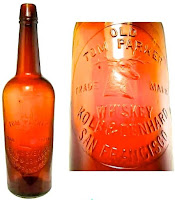
The partners were also “rectifying” their own proprietary brands, that is, blending “raw” whiskeys to achieve a desired taste, color and smoothness.  Their house labels were  "Old Tom Parker,” “Non-Pareil,” and “Old Joe Tracy.”  San Francisco liquor stores vied with each other to produce whiskey bottles with fancy designs in the glass embossing of their bottles.  Kolb & Denhard’s may have been the most elegant.  The bottles bore several different representations of deer. My supposition is that Kolb was behind the images. His passion for deer hunting, mostly occurring in the Mendocino hills of central California, was given considerable newspaper coverage.


By all accounts the Kolb & Denard liquor house was a rousing success.  So much did his business thrive that when Kohler & Van Bergen left their original premises, Kolb, said to be fulfilling a youthful ambition, moved to that location.  Said the San Francisco Call newspaper of of Kolb:  “He…built up a big business by his untiring energy and by his big warmhearted manner.”


Kolb’s home life seems to have been pleasant, surrounded by his young family.  The photo above from the late 1990s shows Ed playing cards with Emma.  From the pile of chips in from of him and the few facing Emma, Ed seems to be winning.  It is a domestic scene of a couple enjoying a comfortable evening at home.  Yet things were beginning to go wrong.


A first indication of trouble may have been in April 1902 when Kolb & Denhard posted a dissolution of partnership by mutual consent when Herman Denhard withdrew from the liquor house partnership.  Kolb took over all assets, assumed liabilities and continued the business at the same 417-419 Montgomery address.  What prompted this move after 14 successful years doing business together?  Denhard apparently did not leave because of better opportunities.  San Francisco directories indicate that afterward he had no employment for several years until 1905. That year Denhard was recorded working as a desk clerk at the California Hotel.  Kolb wasted no time in changing the company name to E. A. Kolb Co. Inc.  An embossed amber whiskey bears that name.


In 1903, according to press accounts, Kolb:  “…suffered a nervous collapse, brought on by too close application to business.  Although he abandoned the active life to which he had been accustomed,the rest did not bring him the wished for relief.”  With his liquor business now being carried out by associates, Kolb sought respite in the quiet of the family’s country house in Palo Alto, 33 miles south of San Francisco.  Nothing, however, seemed to ease his mental torment. 


Kolb died in Palo Alto on January 22, 1904.  Although the possibility of suicide was not even hinted, his passing was totally unexpected.  After months of concern about his mental wellbeing family and friends were said to be “inexpressibly shocked at his untimely death.”  Edward Kolb was only 40.  He left behind his widow and five children, the oldest fourteen, the youngest a baby of ten months.  Kolb’s body was returned to San Francisco by train for burial in Colma’s Cypress Lawn Cemetery. The wrestling champion apparently had met an opponent he could not overcome — his own mind.


Notes:  I was drawn to the story of Edward Kolb by seeing examples of his  company’s whiskey bottles from the Ken Schwartz collection in the “Virtual Museum” of the Federation of Historical Bottle Collectors (FOHBC).  That led me to other sources, including Kolb’s extensive obituary in the San Francisco Call of Jan. 23, 1904.  Several online sources filled in the whiskey man’s stellar wrestling career.


Sunday, March 6, 2022

Perley Fitch and His Pharma of Perils


We can excuse A. Perley Fitch for abandoning his first name for the odd-sounding “Perley.”  After all, he was baptized “Amasa,” a label anyone might want to shuck.  But can we forgive him for using his role as a trusted Concord, New Hampshire, pharmacy owner to make and merchandise nostrums containing dangerous substances and claim without proof they would cure serious diseases?


Perhaps the least troubling of his products was his whiskey.  An important element in the physician’s black bag of that time, whiskey was used in a variety of ways.  Like other pharmacists, Perley obliged with his own proprietary brand.  Shown below, he called it “Morrill’s Old Rye.”  My assumption is that he named it for Vermont Senator Justin Smith Morrill (1810-1898), a prominent ally of Abraham  Lincoln and author of the Morrill Land Grant College Act, legislation that revolutionized the American system of higher education.


Perley was born in Enfield, New Hampshire, in 1843, the son of Eunice Sargent and Asa Fitch, a farmer.  One of eight children, with limited education, he went to work at age 14 for a Concord pharmaceutical firm.  After learning the trade there, in 1861 with a partner he started a firm called Fitch & Underhill.  When that drug store closed five years later, he became a junior member of Eastman & Fitch, druggists.  In 1882, Perley bought out Eastman and henceforth ran the operation himself, incorporating in 1914.


By that time Perley was heavily into selling his nostrums.  He credited his most prominent remedy to the recipe of a deceased Concord physician, Dr, A. H. Crosby,  an advocate of frontier medicine.  Doc Crosby is quoted saying: “Many of the indigenous plants were very easily gathered, and were so carefully prepared that not even the extracts, tinctures, and elixirs of the same plants from the hands of the manufacturing pharmacists equaled them in therapeutic effect.”  When Crosby died without commercially exploiting his formula, Perley moved in,  He called the potion “Fitchmul.”


Ingredients listed in a company ad shown here indicate the potential perils of Fitchmul.   Chloric ether is a substance created by dissolving chloroform in alcohol.  It is considered habit-forming and a narcotic.  Hydrocyanic acid, also known as prussic acid, is a compound in which “cyanide” is the key element.  It is considered extremely poisonous.  Even small concentrations of hydrocyanic acid if inhaled, can cause headache, dizziness, feeling of suffocation, and nausea.  Tartrate of antimony  is used to induce vomiting and was used by the Romans in their bacchanalias.  Fitch’s 1907 patent application for Fitchmul indicates yet another ingredient called Venetian turpentine,  a product used to dilute oil paint.  One Internet entry says:  “The solvent is highly toxic. Turpentine weakens the paint film as well as our health.”  Finally, Fitchmul was just under 12% alcohol, about the same as red wine.


What was this mixture of ingredients meant to accomplish?  As seen in the ad here, among its uses Fitchmul was “curative of Bronco-Pneumonia,”  valuable in the treatment of acute or chronic bronchitis, and a cough remedy.  Then, amazingly, attention is directed by the ad below the beltline to the urethra, the tube that carries urine from the bladder.  Fitchmul is claimed to treat urethritis, an inflammation caused by an infection, sometimes linked to sexually transmitted gonorrhoea.   This litany of cures was embellished by “puff” pieces in pseudo-medical magazines.  In a 1904 edition of “Therapeutics” a Dr. William L. Allen of New York reveals the wonders he achieved with Fitchmul in curing advanced tuberculosis and ministering to a five year old girl with pneumonia:  “Treated with nothing but Fitchmul the child made a complete recovery.”


While Fitchmul was the flagship of Perley’s fleet of remedies, he issued a number of others.   PAN-ZIN-OID may have been among the more oddly named concoctions.  It was composed of bicarbonate of soda, ginger, and two enzymes, pepsin and pancreatin, all aimed at aiding digestion and curbing stomach problems including “borborygmus.”  For those readers as ignorant of that malady as I was, borborygmus is the rumbling or gurgling noises made by the movement of fluid and gas through the intestines. 


The success of Fitchmul and his other patent medicines caused Perley to outgrow the space available at his drug store on Concord’s Main Street where  24 clerks reputedly toiled to keep up with orders from all over the country.  In 1913 he leased the triangular-shaped Optima Building as a separate location where he claimed: “Fitchmul remedies are manufactured in fine modern laboratories.”  Having gained a national customer base, Perley was growing rich.  


In the mid 1860s, Perley had married Annie A. Colby, like himself born and educated in New Hampshire.  Their only child, a boy, died shortly after birth.  When the Fitchmul company incorporated in 1914, Perley made Annie one of four directors.  The couple lived in a comfortable home at 138 School Street in Concord.  A photograph from the New Hampshire Historical Society above shows the couple sitting on the front porch. The Fitches also kept a rustic cottage on New Hampshire’s Sunapee Lake, 35 miles northwest of Concord.  Perley owned five steamboats on the lake as owner and general manager of the Woodsum Steamboat Company.


Even in his early 70s, Perley Fitch continued to be engaged personally in both retail sales and the manufacture of his line of medicinal products.  As he aged, however, he began to be troubled by heart problems.  In October 1917, he was felled by a heart attack and died at the age of 75.  He was buried in Concord’s Blossom Hill Cemetery in Annie’s family plot.  His gravestone is marked only by his initials.


Despite the Food and Drug Laws ushered in with the 20th Century, the Fitchmul Company continued to thrive, apparently adjusting its recipes and advertising to meet every new government requirement.  Only in 1931 can I find the company in legal problems when it was hauled before a U.S. District Court for selling a nostrum called “Elder Hook’s Healing Balm.”  This product, said authorities, was misbranded and “false and fraudulent since it contained no ingredient or combination of ingredients capable of producing the effects claimed.”  No one from Fitchmul contested the finding and 69 packages of balm were destroyed.  


The company moved from Concord to Manchester, New Hampshire, in 1950.  In 1967, the A. Perley Fitch Company was acquired by Gilman Brothers, a Boston drug firm.  Shown here is a pre-1967 bottle and box of Fitchmul. The actual age is difficult to assess.  The bottle with box recently sold at auction to a collector of  medicinals for $69.  


Note:  This post was drawn from a variety of sources.  The most important was a biography that appeared about Perley Fitch in a 1915 issue of the Granite Monthly, a  local Concord magazine.  Special thanks to Peter Samuelson of  Intervale, New Hampshire, and his fellow collectors, Joe Shaw and Ray Trottier, for their help with photographs of Fitch bottles.


Wednesday, March 2, 2022

The High-Flying Sottiles of Charleston SC


Shown above are the five Sottile (sah-tilly) brothers with their two sisters.  No, these immigrants from Sicily were not circus performers.  A family biography put it this way:  “Through their hard work, determination and entrepreneurial skills…Giovanni, Nicholas, Santo, Albert and James achieved high esteem, affluence and prosperity in their various business ventures and civic efforts in Charleston.”Their launching pad in South Carolina, as indicated by the illustration above, was selling whiskey.

As the eldest and first to come to America, Giovanni (aka “John”) Sottile was the “founding brother.”  As each siblng reached maturity, four would follow him:  Nicholas in 1890, Santo, 1891, Albert, circa 1897, and James, 1899.  After landing in New York City, Giovanni, shown here, had gone straight to South Carolina, to become an accountant for a phosphate mining company.  After several years, he left that job and settled in Charleston and entered the liquor trade.  With brother Nicholas in May 1895 he opened a bar and food stand called the Jetty House on nearby Sullivan’s Island.  That enterprise evolved into a liquor and beer enterprise located at a complex called the Vendue Range, near the Charleston waterfront. Called G. Sottile & Bro. it was a success and brought considerable wealth to the family.


Giovanni and later his brothers, understanding Charleston’s potential for growth,  intelligently used their money to buy real estate in and around the city. Because of Giovanni’s prominence, in 1899 the Italian government appointed him as Italy’s honorary consul for North and South Carolina.  From his experience with the mining company Giovanni was aware of the harsh treatment often meted out to Italian workers and he took up their cause.  According to a report:  “One sick worker who could not return to work was shot dead for disobeying a work order. Sottile appealed to South Carolina Governor McSweeney and investigations ensued. This was the first of three exploitation incidents that Sottile was involved in investigating for possible prosecution.”


At a model farm Giovanni bought about 20 miles from  Charleston, he actively gave employment to Italian immigrants.  He also had purchased a spacious four story house brick house in Charleston from which he managed his consular activities and entertained Italian dignitaries and local politicians.  His childhood sweetheart, Carmela Restivo, whom he had returned to Italy to marry, proved a gracious hostess.  In 1909 Giovanni’s service earned him a knighthood from the King of Italy.   Unfortunately, at the height of his career, Giovanni died unexpectedly at home in 1913.  Only 46, he left a widow and four minor children.  With his brothers and their families in attendance he was buried in Charleston’s St. Lawrence Cemetery.


Nicholas Sottile, the second brother to arrive from Sicily, continued Giovanni’s legacy of entrepreneurship and public service.  As some point he left the family liquor house at the Vendue to own and operate the Washington Square Cafe,  a popular Charleston eatery and saloon, strategically placed across from the Hibernian Hall between Broad and Queen Streets.  As South Carolina was going “dry,” Nicholas apparently determined that the crockery offered more opportunity and established the China and Glass Emporium on King Street and an automobile paint shop.


Nicholas also was active in local affairs, serving as a Charleston alderman and later a member of the board of trustees of Charleston High School.  As the father of eight children he apparently had a strong appreciation of the value of education.  Retired as he reached 60 years, Nicholas died unexpectedly of a heart attack in November 1928.   Commending this Sottile as “ever active in politics and the general life of the community,”  Charleston’s mayor ordered the flag flown at half staff over city hall in Nicholas’ honor.  He was buried in St. Lawrence Cemetery near Giovanni.


Meanwhile the Sottile liquor house at the Venue, now called Sottile Brothers, had continued without Giovanni or Nicholas. In charge were Santo and Albert Sottile, with the youngest brother, James, employed there.  Shown above is a company letterhead from 1904 advertising their primary brand, “Old Quaker Rye.”  This was the product of the Corning Distillery of Peoria, Illinois, and a premier national brand. [See post on Corning January 26, 2016].


As prohibitionary pressures increased, Santo Sottile, shown here, shifted his focus.  In the 1910 census he gave his occupation as “wine merchant.”  By 1914, at the same location he was listed as president of the “Interstate Distributing Company” advertised as “general brokers.”  It is not clear whether the outfit was dealing in wine or spirits.  As many other whiskey men did as prohibition prevailed, Santo moved into the automotive field, listed as running a garage and “The People’s Tire Service.”  Subsequent directory listings recorded him as a Charleston Cadillac dealer.  Married and the father of six children, Santo died at the age of 61 and was buried in St. Lawrence Cemetery.


Prohibition also had moved Albert (aka “Alberto”) Sottile, shown here, out of the liquor trade.  In rapid fashion he earned recognition as “Charleston’s “great entertainment impresario” a man who “understood the value of visual delights,” according to a July 2019 article in the College of Charleston Magazine.  Albert was the 1908 founder and president of the Pastime Amusement Company, heading it for 52 years.  During that time, the magazine reported:   “Mr. Sottile oversaw a dazzling stable of properties punctuating downtown Charleston, including the Garden Theatre, the Riviera and the American on King Street; the Arcade on Liberty Street; and the Victory on Society Street. Most showed first-run films…while others also presented touring vaudeville shows.”


Shown above is the Sottile Theater, now part of the college campus.  It is reported that during intermissions at this theatre while the 16 millimeter reels were changed, Albert would entertain the audience by singing Italian songs, accompanied by a large pipe organ he had imported from Italy.   Like his brothers, Albert was a family man with a wife and one daughter.  He housed them in the large frame mansion at 11 College St., also now part of the campus.  Albert died in 1960 at the age of the age of 82.  His burial site is not identified.


Although James (aka “Frank”) Sottile was the youngest of the brothers and the last to arrive in America, he proved to be a fast learner.  Employed at the Sottile Brothers liquor house through 1907, by the 1910 census, he listed his occupation as an independent broker, unspecified as to what he might have been brokering.  Three years later, still under 30 years old, James would be listed in city directories as president of a Charleston company that manufactured “sashes, doors, blinds and general millwork,” vice president of Albert’s amusement company, and president of the Charleston-Isle of Palms Traction Company.  In 1914, with the exception of a few lots,  James became sole owner of Isle of Palms, a seashore resort island near Charleston.  As shown below, he constructed a spacious beach pavilion and a Ferris wheel on the property.  He made his headquarters at the Charleston hotel, above, a venue he also came to own.


But Charleston was not enough to satisfy James’ ambitions.  Married and with three children, he looked to Florida as a place for profitable investment.  While always considering the South Carolina city home, he and his family maintained a residence in Miami. James’ principal investment was a 30,000 acre property near Florida City known popularly as Sottile Farms.  After investing heavily in digging drainage canals and establishing roads, he leased farm plots to Italian-American farmers employing a tenant system used in Sicily.  Assisted by his sons, James gradually built up holdings of over 5,000 acres of citrus groves and 10,000 head of cattle on 30,000 acres of pasture. He eventually owned nine Florida banks.


Said one South Florida newspaper report: “ Not long after the arrival of James Sottile on the scene Florida City morphed into an Italian community…The new farmers were very industrious and sacrificing and later prospered greatly.  Sottile was also very generous, donating land for the State Farmers’ Market, farm worker housing… and the land for Homestead’s Bayfront Park.”  Giovanni’s legacy lived on.  


By the time of his death in 1964 at age 77, James was accounted one of the richest men in America.  His body was carried from Florida back to Charleston where he was buried at St. Lawrence Cemetery not far from his brothers.  Subsequent generations of Sottiles have carried on the family tradition of creative entrepreneurship, public service and concern for those less fortunate.  They have placed a plaque with the names of the family members who immigrated to the United States on the “American Immigrant Wall of Honor” at Ellis Island and hold regular reunions.  Importantly, descendants have given due respect to what generated the initial financial impetus for Sottile achievements: Selling whiskey.  The image that opens this post was the cover of a family reunion brochure.


Note:  Given their achievements, the Sottiles deserve book-length treatment, perhaps generated by the College of Charleston.  Led to the brothers as “whiskey men” by the picture that opens this story, I found considerable material on genealogical sites and in newspaper articles, including obituaries. The family website offered photos. Unable to find a photo of James Sottile, I am hopeful a descendant will see this post and provide one.