Saturday, January 10, 2015

Col. E. H. Taylor Jr.: The Face and Signature of Kentucky Bourbon

Although much has been written about Edmund Haynes Taylor, Jr. by generations of authors, I prefer to think of him as the face and signature of Kentucky bourbon, a place in whiskey history that was achieved by his engagement in crucial legal and political struggles.
Depicted here, Taylor was born in 1930 near Fulton, Kentucky.  A fourth generation Kentuckian, he was a descendant of two American presidents, James Madison and Zachary Taylor.  When his father died when he was five years old, he was sent to Louisiana to live with his great uncle Zachary, the future Mexican War hero and Chief Executive. Zachary gave the boy a good classical education.  In the early 1850s Taylor returned Lexington.  There he resided with his uncle, Edmond Haynes Taylor, a local banker, and “Jr.” was added to the young man’s name to distinguish him from his uncle. 

Working successfully in his uncle’s bank, he now had the steady income to marry.  His bride in December, 1851,  was Fanny Johnson of Lexington, shown here, described in her obituary as “a very handsome woman.”  They would have seven children among them three boys, all of whom would figure significantly in their father’s whiskey interests.  Thirty-one years old when the Civil War broke out, Taylor avoided service in either army and instead traded in cotton, working with both sides, reputedly tolerated because of strong political contacts North and South. (The “Colonel” was strictly an honorific.)

Not originally a distiller, it was Taylor’s banking sense that there was money to be made in selling whiskey.  Not just any whiskey as many Kentucky distillers featured, but a quality product.  Accordingly after the war he spent much of 1866 touring Europe being educated in the latest distilling techniques, including the importance of keeping the liquids in copper kettles. Upon his return to the United States in 1867 he opened his first distillery, “The Hermitage."


Two years later he bought an old distillery near Frankfort, Kentucky, and completely renovated it, installing all copper stills and innovative steam-heated warehouses that controlled the temperatures during whiskey aging. The distillery, shown above, also featured state-of-the art grain equipment, a more efficient sour mash technique, and modernized buildings.  He called this facility “Old-Fashioned Copper,” or “O.F.C.,” as depicted above on a saloon sign.  Although he operated successfully for more than a decade, a combination of factors brought Taylor close to bankruptcy in the late 1870s and forced him to sell control of his distillery to the St. Louis Liquor firm of Gregory and Stagg.  Although he stayed on as manager, Taylor clashed with the new owners who wished to increase profits by cutting the quality of the whiskey.   In 1884, he cut his ties with the distillery and George Stagg became the manager.


Before long Taylor was back in the whiskey business.  Moving a few miles away to a creek on the south side of Frankfort, he built a spectacular distillery modeled on a German Rhenish castle.  A shown here on a postcard, it featured thick limestone walls, crenellated battlements, medieval turrets, interior sunken gardens and luxury appointments.  He called his firm, E. H. Taylor & Sons and the distillery “Old Taylor.”  The sons, as shown in a letterhead, were J. Swigert and Kenner.  A third son,  Edmund W.,  would join the business later.


The elder Taylor had become the face and signature of this enterprise for a reason.  After Stagg and his partners had taken over the original Taylor distilleries they had kept his name because of his stellar reputation for bourbon.  When the Taylors opened their new facility, Stagg sued to stop them using their name on their whiskey.   Over the next months, a legal battle was waged that ended in the Kentucky Supreme Court with a victory for the Taylors.  They could continue to use their family name for their whiskey — but Stagg’s “Taylor” products were still on the market.  Thus the emphasis on the Colonel’s face and signature to proclaim the “genuine” bourbon.  Shown here is a 1903 ad in the Wine and Spirit Bulletin included both and an excerpt from the court decision.  All to make the point:  “There is but one Old Taylor distillery in Kentucky…There is but one Old Taylor whiskey distilled in KY.”

This message, complete with signature and face were repeated countless times on labels of Old Taylor bourbon.  They were under-glaze printed on tall ceramic jugs and featured on company giveaway items, including watch fobs and paperweights.  As a result, Taylor became one of the most recognized faces and signatures in America.

Having won the legal battle with Stagg, the combative Taylor took up a new cause.  One factor that had led to his earlier near bankruptcy was having to pay a hefty federal tax on whatever came out of the still immediately after distillation.   Convinced that a better system of taxation was necessary, he began to lobby for new legislation.   In this struggle, he was immensely aided by his political pedigree and friends.  In 1871, Taylor had been elected as mayor of Frankfort, a position he held for 16 years, reputedly a good and much esteemed leader.  Among his political allies was John G. Carlisle who the same year had been elected lieutenant governor of Kentucky.  When Carlisle eventually became Secretary of the Treasury, the two collaborated to push   
 through Congress the “Bottled-in Bond-Act of 1897,” a law that still stands.

Although the Bottled-in-Bond Act was aimed at creating a standard of quality in bourbon whiskey, the system also was connected to the tax laws, providing the key incentive for distilleries to participate.  They were allowed to delay payment of the excise tax on stored whiskey until the aging process was complete and the whiskey transferred for sale.  Supervision of the warehouses and transactions was given to Treasury agents assigned to control access to “bonded” warehouses at the distilleries.  E. H. Taylor & Sons were quick to advertise their adherence to the new law in ads and a bar sign, bearing that very familiar face, that declared:  “Bottled under U.S. Government Supervision….”

Taylor was not finished in his advocacy.  He added his voice and prestige to those who were pushing for a strong Pure Food and Drug Act.   Although most of the advocates for this legislation were reacting to the quack medicines of the time,  Taylor was motivated differently.  Like other quality whiskey producers he abhorred the “rectified” (blended and compounded) whiskey of his time, much of which was adulterated.  Those blends, he contended, should be labeled “imitation whiskey.”  When the Act was passed in 1906,  Taylor found an ally in Dr. Harvey W. Wiley, who was chief enforcer of the pure food laws.

This time, however, neither Taylor nor Wiley was able to force through their desired interpretation of blended whiskey.  Fought over for years, the issue finally reached the desk of then President William Howard Taft.  Taft in a Solomon-like decision determined that “whiskey was whiskey” and although blends should be distinguished from straight whiskey in labeling, they were not an imitation.  That ruling has prevailed to the present day.  
For all his political clout and savvy, however, Taylor could not hold back the tide of the Temperance Movement.  With the coming of National Prohibition, he and his sons were forced to shut down the Old Taylor Distillery.  At the time the father’s net worth was estimated at $2.5 million, 20 times that in today’s dollar.  Three years later, on January 19, 1923, Taylor died and was laid to rest at Frankfort Cemetery.  Beside him was his late wife, Fanny, who had died a quarter century earlier after a long illness.

The death of Col. Edmund H. Taylor Jr. occasioned headlines across the United States, many of them carrying a wire service obituary that read in part:  “Mr. Taylor’s name was known around the globe, for he had given it to “Old Taylor” whiskey, made in his distillery, pronounced by expert distillers the finest plant of its kind in the world.”   To this one might add that by the time of his death Taylor truly had become the face and signature of Kentucky bourbon.

Note:  The information for this vignette came from a variety of sources, among them an article by Clay Risen that appeared in the Virginia Quarterly Review of October 28, 2013.


Wednesday, January 7, 2015

Alex Young: To Philly Just to Learn Distilling


Note:  As the past, when a short biography of a whiskey man already has been written that would make my attempt redundant, I have posted it in my blog, giving due credit.  This time recognition belongs to Robin Preston, the genius behind the www.pre-pro.com website.  He has combined material about Young from several 19th Century documents with personal communications with a descendant to give us a picture of this energetic Irish immigrant.  With only light editing Robin’s article is reprinted here.


Alexander Young (b. Aug. 26, 1798) was a native of County Derry, Ireland. He arrived in the U.S. on July 15, 1821. He already had some knowledge of the malt distillery business, but desirous to learn the art of extracting whiskey from raw grain, he went into J. W. Dower's (Dover's?) distillery on the Schuylkill River, between Race and Vine streets in Philadelphia. He paid $50 in cash for this instruction, plus his services for many months. After working in a subordinate position for one year, he had saved money sufficient to purchase a small still, and commenced business for himself. The location was reported to be at 5th & Alaska (Alaska was renamed Kanter Street in 1897)
After a year, Young went into partnership with John Maitland, and for two years they produced a very pure and excellent kind of "malt whiskey." They also distilled New England rum from molasses. They were the first firm that discovered the process by which an immense increase of spirit was obtained from the grain, producing 14 quarts of whiskey from 56 pounds of grain.
In 1825 there stood at the corner of 4th and South Sts a large building used as a theatre ("Old South St Theatre", formerly "The Apollo"), but as the population moved towards the western and northern part of the city, it was closed and rented to Pat Lyons, another distinguished Irishman, who used it for a hay press. In the fall of 1825, John Maitland bought the building and converted it for use as a distillery at a cost of $20,000. [Shown above] With Young as foreman, they continued their former business on a larger scale. They continued in this way for 12 years, making important discoveries and improvements in the business.
In 1837, John Maitland's son, William J. Maitland, replaced his father as partner Young's partner, and the business continued together until the death of Maitland, in 1847. Although successful, the business had not paid enough to make the deceased partner a man of wealth. Upon the death of his partner, Young bought out the establishment for $20,000 (the sum which John Maitland had originally spent on it). Young at once began to enlarge and improve the facility, spending in a few years over $60,000 on the building and machinery, and adding every improvement and extension that could add to the value of the establishment or the facilities for the business. He had an artesian well dug on the premises to provide 70 gallons per minute of pure water for distilling purposes.
By 1864, the distillery was reported to be producing 380,000 gallons of whiskey annually. As of September 1, 1862, 5,000 barrels whiskey were in storage, valued at $200,000. The company used the brand names “Y.P.M.” (Young’s Pure Malt), “Young’s Blue Grass,” and “Young’s Masterpiece.” 
In December 1882, Ernest Hexamer, a Philadelphia-based insurance surveyor, drew plans of the distillery and noted various details of its operations. [Shown below.] He noted that it employed 8-10 men and that the facility included three warehouses.  A free warehouse was located between Charles and 4th Sts. (four story plus basement, made of brick with a tin roof) and housed 5,000 barrels. The two bonded warehouses were in the basements of other buildings. The distillery basement held 800 barrels, the malt-house basement held 1,000.  The still had a capacity of 600 gallons and was made of wood, heated by steam.


Alexander Young died in November 1884 and the distillery was left in the hands of his sons for the next three years. In 1887 a corporation was formed to run the plant. It consisted of Lewis T. Young (President, Alexander's youngest son), Richard Young, (VP), Wilson Young (Secretary and Treasurer, Alexander's elder son), James P. Young and Mrs. Lavinia T. Davison.
Hexamer resurveyed the property in 1891. The principal changes in the last ten years included the addition of a new copper still (capacity 400 gallons) and a large bonded warehouse on Charles St. It held 7,000 barrels in racks, a four-story plus basement brick building with a tin roof.[Shown below.]


The new bonded warehouse had been approved at a meeting of the board of managers in October, 1889. It required that the company buy the properties (shown as dwellings and stores on the 1882 survey) of Mr Richard Young at 614 Charles St and Mr Lewis T. Young at 618-6222 Charles St. The same meeting resolved that the president, secretary and treasurer be authorized and empowered to build a new still (1500 gallons), worm tub and all the necessary appliances.

The board approved construction of the new warehouse at a special meeting held in February, 1890. Here they resolved to "accept the contract of George P. Payne & Co. for $22,399 to erect a new storehouse on Charles Street (west side), according to the plans and specifications of Geo W. and W. S. Hewitt, Architect.”  The addition of the new still meant that by 1891, the plant was producing 7,500 barrels 
per annum, with a daily grain consumption of 300 bushels.


The company ceased listings in Philadelphia directories in 1921, a vicim of Prohibition.  In the 1950s the company's flagship brand, Young's Special American Blended Whiskey was purchased by Kasseer Distillers Product Corp at 3rd and Luzerne Streets in Philadelphia.  The Young plant was closed and the brand bottled by Kasser until October 1989.  The brand was then sold to Laird & Co. of Scobeyville, New Jersey. [An example of a post-pro bottle is shown above together with a Philadelphia billboard ad.]
Postscript:  In addition to the illustrations provided with Robin’s article, I have added pictures of Young’s YPM Whiskey bottles. 


Sunday, January 4, 2015

Three Generations of Distilling Clemmers Knew War and Rebellion

                
George David Ludwick Clemmer was born in Western Pennsylvania in 1770 and early in life turned to distilling for his livelihood.  He became caught up in the Whiskey Rebellion of 1791-1794 and seemingly concluded that Virginia offered a healthier climate for his pursuits.  As a result three generations of Clemmers gave their name to a whiskey that commanded a national audience, according to family lore, while the Clemmers survived through the tumult of the Civil War and Reconstruction.

The Whiskey Rebellion was an insurrection that began in 1791 when a tax was placed on all distilled spirits, popularly known as a “whiskey tax.”  Farmers on the western frontier of America, for whom distilling was a profitable way of disposing of surplus grain and corn, resisted and in 1794 attacked the home of a tax collector.  When President George Washington, shown below, rode out at the head of an army of 13,000 militiamen, the rebellion collapsed.


Apparently believing that Western Virginia and Kentucky offered distillers a better opportunity, a number of those farmer/distillers left Pennsylvania and migrated South.  George Clemmer was among them.  The trip was a fairly easy one.  The migrants followed the Great Wagon Road, that wound from Lancaster, through Gettysburg, down the Shenandoah Valley and through the Blue Ridge Mountains to Rockingham County, Virginia, and on south.

Arriving in Rockingham County in the late 1790s, Clemmer decided to stay.  In 1799, in St. John’s Lutheran Church there, he married Mary Elizabeth “Betsy” Kinzer, the daughter of Christian Kinzer.  George may have known Betsy back in Pennsylvania where she was born and arranged for her to come to Virginia.  Their marriage would produce 10 children, the foundation of a Clemmer clan that today can claim thousands of descendants.

About 1800, finding an available piece of land to his liking, George Clemmer moved to adjoining Augusta County, locating just off the Great Wagon Road, also known as the Valley Turnpike, just south of the village of Middlebrook, Virginia.  His choice was a good one.  The county was a good early transportation center, along with a wagon road, the Parkersburg Turnpike linked the area to the Ohio River.  By 1854 the Virginia Central Railroad reached Staunton, the county seat, providing access to Richmond, the capital, for goods and passengers.

George immediately again began distilling.  An 1885 account, calling him a pioneer in the business, described the activity:  “He began in a very limited way, the distilling being done in the house in which he lived.”  Eventually Clemmer would be among sixteen known distillers operating in Augusta county.  He showed up in both the 1810 and the 1820 censuses when only the head of a household was enumerated. 

About the age of 65, George apparently gave up farming and distilling, in 1835 turning his property over to his son, David Fishburne (or Fishborn) Clemmer.  Born in 1821, D. F., as he was known, was the youngest of the Clemmer children.  Why the estate of the founding father would be bestowed on the last of five sons is not clear.  It may be that he had showed the most interest in the distilling trade.   About 1841, D. F. married Mildred Jane Kinzer, likely a blood relative of his mother.  They would raise a family of seven children.  The first generation of Clemmers, however, was dying out.  Betsy died in 1845.  George lived on another sixteen years, living with another son and his family until 1861 when he too passed and was buried beside her in the cemetery at St. John’s Church, the place where they had married.  His weathered gravestone is shown here.

The Clemmer Distillery flourished under D.F.’s direction.  According to family tradition, the whiskey became a top seller in the miners’ camps of California during the great “Gold Rush” of the 1850s.  By the following decade, the Clemmers once again were to know rebellion and war.  In May 1861 Augusta County residents overwhelmingly voted in favor of secession.  Five youths named Clemmer from the county, cousins all, would be engaged in the Civil War, most of them enlisting in April 1861 in Company D of the 5th Virginia Regiment.  Among them was George L. Clemmer, the son of D.F. Clemmer.  The boy seems never to have seen battle, however, being furloughed for illness and missing the Battle of First Manassas in July of that year.  After a brief return to duty he was discharged in January 1862, apparently for persistent illness, and died several years later.  The 5th Virginia experienced heavy combat during the Civil War and other Clemmers are recorded as having been wounded or made captive.

Moreover, the war raged heavily in Augusta County and environs as the Confederate and Union forces moved up and down the Shenandoah Valley in constant pitched battles.  Staunton was frequent target, changing hands several times.  Augusta County farms were ravaged, stripped of livestock and grain by both sides.  In March 1865 Union General Philip H. Sheridan, shown right, captured Staunton and destroyed both Confederate government and civilian property.  The next month the South surrendered and peace returned to a devastated land.

Out of the chaos and destruction D. F. Clemmer was able to resurrect the whiskey brand that bore his family name.  In 1879, for example, he ran an ad in the Rockingham Register, recommending that the public could procure Clemmer whiskey, both retail and wholesale, from John Wallace, a saloonkeeper and liquor dealer in Harrisonburg.  Said the ad:  “If you want the genuine Clemmer, go to him, as he gets his whiskey direct from our warehouse.”   Wallace returned the favor, advertising on his trade cards for his “The Boss Saloon and Whiskey Store” that Clemmer Whiskey was a specialty.  Known as “Windy John” — apparently because of his loquacious nature — Wallace also had a taste for the risqué.   The flip side of his trade card was a “mechanical” scene of bathing beauties in states of undress.
D. F. Clemmer operated the distillery and farm up until his death in February 1882.  His wife, Mildred, had passed a year earlier.  They were buried together in the Mount Herman Lutheran Church Cemetery in Newport, Augusta County.  His monument, an obelisk is shown here.  Once again the youngest son inherited the property.  He was Jacob Frank Clemmer, born in 1852, too young to have been enlisted by the Confederacy.  Moreover, by 1882 both his elder brothers had died.  A year after receiving his inheritance, J. Frank, as he was known, married a local girl 13 years his junior.  She was Mary Preston Hogshead.  Their union would produce five children, four boys and a girl.  
Shown below is an artist’s view in 1884 of the Clemmer residence and distillery that J. Frank inherited .  It was an extensive operation and the whiskey produced there had merited a national reputation for quality.   Aged three years, “Clemmer’s Fine Old Rye” was advertised as “thick and drinks like nectar.”  A quart could be obtained for 40 cents.  It was particularly prized in Virginia where it was frequently on the menu of festive occasions.  An account of a fraternity banquet at Lexington, Virginia, in 1896 mentions it prominently — the only whiskey served that night.  At a later epicurean feast being hosted by a prominent Virginia gentleman, Colonel Adams, “…drinks were made of fine old Clemmer whiskey, five years old, oily and fragrant.”  When one guest seemed too long in telling a story, the Colonel admonished him to cut it short “so as to proceed with the drinking.”


Although J. Frank Clemmer proved to be as able as his father and grandfather in the liquor trade,  prohibition was closing in on the distilling industry.  In 1917 Virginia voted to ban sales of alcohol. That was followed by National Prohibition in 1920. The Clemmers were forced to shut down their distillery.  In June 1920, J. Frank, the last of the Clemmer distillers, died at the age of 68 and was buried in Thornrose Cemetery in Staunton. His gravestone is shown here.   His wife, Mary, joined him there the same year. 


With their founding father a refugee from the Whiskey Rebellion, the Clemmers had kept their distillery operating for 117 years amid the strife of the Civil War and its aftermath, bringing it into the 20th Century with a reputation for quality and an appreciative customer base in Virginia and beyond.  The Clemmers, as things turned out, could survive rebellion and war but not the forces of “Dry.”


Thursday, January 1, 2015

The Rugers of Houston and Their Bar of Seashells

An 1894 directory of Houston, Texas, businesses, advised visitors to the city to pay a call at  Charles C. “Charlie” Rugers' establishment at 1105 Congress Avenue in order to view the bar at the rear, calling it “particularly striking and remarkable” for its decoration of  “sea shells and marine curiosities.”  Tourists were further advised that as they view the wonders of this maritime tableau: “…They will be able to refresh the inner man with good stuff, which cheers but need not inebriate.”
This saloon and liquor dealership had been established in 1872 or 1873 by Charlie’s father, C. W. Rugers.  Shown right, the elder Rugers had been born in 1840 in Schiedam, Netherlands, of Dutch parentage.  As a youth he emigrated to the United States, settling in Louisiana.  By 1865, he was married to Catherine Oswald, who herself had come as a young girl from Germany.  Their three children were all born in Louisiana, Charles C. about 1866; Julia, 1868; and Cornelius, 1869.

C. W. Rugers, who likely had been in the grocery liquor trade in Louisiana, had made a calculated  decision to relocate to Houston. The city was on the rise. In 1869 the Ship Channel Company had been formed to improve Houston as a port, destined eventually to be the busiest in the U.S. in foreign tonnage. Local businessmen had invested heavily to expand the railroad network joining Houston to other large regional cities.  Despite Civil War social unrest in Texas, people were flocking to town looking for new opportunities. The map below shows Houston as it looked when the Rugers arrived.
  

C. W.’s first stop was working for the grocery house of Henning & Co., but he eventually set up a grocery of his own next door in the Gray Building.  The local press enthused:  “The sample of choice celery he sent us would tempt an invalid to eat.  He intends to keeping on hand, all winter, stocks of celery just as large and white, and we know he will sell them quickly.”   Within a few years, the elder Rugers decided that hawking celery was not the best path to riches and converted his establishment entirely to selling alcoholic beverages.  In 1880 he told the census taker that his occupation was “liquor merchant.”

Not content with operating a successful saloon and whiskey dealership,  C. W. Rugers became active and well-known in the Houston community.  He was one of the city’s first volunteer firefighters, attached to Liberty Department No. 2.  He rose to be foreman of the company and later its representative to the central fireman’s body.   Associating himself with his wife’s nationality he also was a leader in German social activities and was a director of the Volksfest Association that annually sponsored Houston’s German Day celebration.  
When Charlie, shown left, grew to maturity, his father took him into the business.  A contemporary biography signaled that the son had not had an easy transition from a boy to a businessman:  “At a tender age he had duties thrust upon him that gave him experience that few young men encounter.  He has has had a ‘rough road’ to travel on the highway of life, but out of it he stands today strong and robust, ready to meet any future adversities that may be lying in wait for him.

When this commentary was published, Charlie was in his twenty-second year of running the liquor business.  At the age of 27 in 1893, he had been handed sole proprietorship by his father, who seemingly was pursuing other business interests.  For example, In 1905 C. W. Rugers was among a group of Houston area businessmen who incorporated the Seabrook Oil Company to pump and refine Texas oil.  The 1910 census found all the Rugers living together in Houston’s Second Ward, including C.W., age 73; Catherine, 67;  and Charlie, still a bachelor at 44.

That same year C.W. died.  Shortly after, Charlie changed the name of the firm to “Chas. C. Rugers, Importer and Dealer in Wines, Liquors and Cordials,” with an address at 1105 Congress Street.  His store was 22 by 70 feet and rose two stories, a building that gave him ample space to stock large quantities of spirits.  He apparently also was mixing up his own brand of whiskey and selling it in bottles bearing his embossing, several of which are shown here.  A puff piece on Rugers’ establishment asserted: “The house caters to a large family trade and to supplying wines and liquors for medicinal purposes.”  The Rugers also dabbled in patent medicine, advertising in a 1905 Galveston newspaper for a nostrum that claimed to be “…The only remedy for woman’s ills sold by druggists that is not full of ‘booze’ — poor whiskey or bad alcohol.”


As for the shell bar, it is not clear whose idea, father or son or other, it was.  From a recent Houston Chronicle newspaper article it would appear, however, that the town historically has been slightly batty over shells:   “You don’t have to go far to collect sea shells, which have washed up all over town.  And they aren’t just for nautical decor….They’re everywhere….Some people are so passionate about shells that they display them like works of art.”   The Rugers used theirs to decorate a bar, indicating that their liquor store also sheltered a saloon.   The bar can be seen in the somewhat fuzzy newspaper photo above.  A sharp eye can make out starfish, conchs, scallops and other seaside flotsam that faced the drinkers.   Shown here too is a bar token from the Owl Club at virtually the same address as the Rugers establishment.  Although I have not been able directly to connect the two, a relationship seems highly likely.

   
Although Charlie seems to have avoided marital ties throughout his life, he followed his father’s example and was an enthusiastic volunteer firefighter.  He was a member of the Siebert No. 19 Company, appropriately formed in 1894 by a man named Siebert.  It was the last volunteer group organized in the “Old Department,” before paid fire service in Houston.  The company featured a non-motorized hose wagon that had to be rolled by hand to the fires.  “Strong and robust” as Charlie was said to be, that activity still was a strain and he may not have been displeased when Siebert No. 19 was disbanded.  Apparently Charlie was not the civic leader his father was.  His 1915 biography cited him only as holding “fellowship in several benevolent orders.”

Although his biographer opined that Charlie was ready to meet any adversaries lying in wait for him,  prohibitionary forces would prove even stronger and more robust.  The “Drys” were a force in Texas politics beginning even before the Civil War.  By 1895, 53 of 239 counties were dry and another 79 were partly dry under local option.  The battle continued into the 20th Century and in 1919 Texas voters approved a statewide prohibition law.  He was forced to shut down the business his father had founded almost a half century earlier.  Charlie never saw Repeal, dying in May 1928.

Of that vaunted Houston tourist attraction, where a customer could be struck by its “shellacious” wonders at the same time that he had the “inner man” refreshed,  the fate of the Rugers bar remains unknown. 

Note: The information for this post came from a variety of sources. Principal among them were the 1894 “The Industrial Advantages of Houston, Texas, and Environs,” and “Fire Fighters of Houston, 1838 to 1915.”


Friday, December 12, 2014

Amandus Fenkhausen: Christmas and Whiskey in “Frisco”

        
On a rainy, chilly day in December in the late 1850s, a San Francisco saloonkeeper named Amandus Fenkhausen looked out at the dismal scene on Kearney Street outside his saloon.  He called his wife to the front window.   The roadway was a rutted, muddy mess and the buildings along it were surrounded by mud and pools of standing water as the rain pelted down.  It was a sorry and depressing sight.

Amandus and Wilhemina had come across the Western plains with their first  child to California together with other early settlers, among whom were many of their German countrymen.  As a recent account put it, the Fenkhausens had embarked on a new life “in the desert of sand dunes that later was to become San Francisco. They had high hopes and strong in their hearts was the love of the fireside.”  Recalling how the Christmas was so festively celebrated in their former home in Hamburg, Germany, the couple began reciting the many traditions that surrounded the holiday.  Among them were the Christmas tree or as the Germans sing it: “O Tannenbaum”

Spurred to action by these remembrances of childhood, the Fenkhausen set to work.  Fetching small branches of fir that had been destined for the fireplace, they fashioned a small Christmas tree and decorated it with ornaments they had brought from the Old Country.  They set candles on it and placed the illuminated tree in the show window of their liquor store.  As a result Fenkhausen, an immigrant wine and whiskey dealer, and his wife,  are accounted as the first to introduce the custom of the Christmas tree to San Francisco.  Today hundreds of lighted trees are a local tradition that draw thousands of tourists to the California city each holiday season.  The Fenkhausens clearly started something.

But Amadeus must be remembered for more than his Christmas tree.  He was among San Francisco's most successful whiskey men, a gent who left behind many colorful reminders of his enterprise.  Born in Hamburg, Germany, in 1925, Fenkhausen had married the sweetheart of his youth, Wilhelmina, the daughter of a liquor dealer named Johann Frisch.  Bringing along their first child, Caesar, the couple had come to America sometime in the early to mid-1850s, making the arduous overland trip to the West. The 1860 census found the family living in the Second District of San Francisco. The Fenkhausen family now included a daughter, Camina, and a second son, Rudolph.  A third son, Walter, later would be born.  Amandus gave his occupation to the census taker as “wine merchant.”

Fenkhausen’s saloon apparently was a successful enterprise and about 1861, according to one author, he established a wholesale liquor business at 322 Montgomery Street.  With success, by 1865 when his enterprise first showed up in city directories, he had moved to 809 Montgomery, between Jackson and Pacific.  He was billing himself as an “Importer and Wholesale Dealer in Wines and Liquors.”  He also advertised as the local “depot” for “Star of the Union Stomach Bitters,” sold in an amber bottle with an embossed star. His whiskey bottles showed a bear, as at left.

Within two years he had relocated again to the northwest corner of Sansome & Jackson Streets.  He used the occasion for an 1867 ad announcing that he “Respectfully informs his numerous friends that he has removed from No. 609 Montgomery street to the more convenient and larger building.”  After remaining at that address for about three years, he took on C. P. Gerichten as a partner in 1869. Subsequently known as Fenkhausen & Gerichten, the firm moved to 221 California Street, doing business at that location until 1874 when the partners sold the business.  Before long, however,  Amandus was back selling whiskey, his liquor house now located on the northwest corner of Front and Sacramento.
  
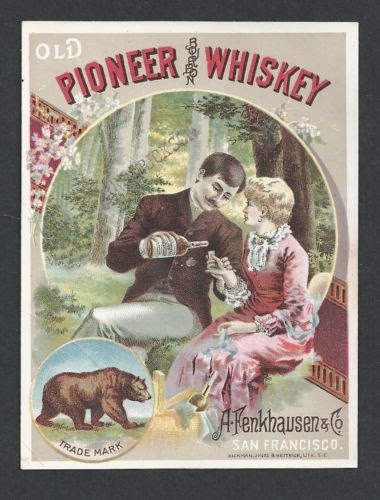
Throughout all these changes of address and ownership, the clear implication is that Fenkhausen was the top dog.  Unlike many other whiskey wholesalers, he featured only a small number of liquors in his inventory, many of them whiskeys that he was blending and compounding on his premises and attaching his own labels.  Among his brands were A.A.A. Eureka,”  Gold Drop XXX,” “Tennessee White Rye” and “Old Pioneer Whiskey.”The latter two were his flagship brands.
Fenkhausen advertised both vigorously.  One of his ads for Old Pioneer Whiskey sparked some controversy when it appeared on a chromolithographed trade card. Shown here, it depicted a young dandy pouring out a glass of whiskey for an adoring young woman in a wooded scene.  It gave the impression that an assignation of some kind might be in the offing.  Even in rowdy San Francisco the image to some seemed risqué.  Other Fenkhausen trade cards were more discrete, including one of a girl dancing with a shorter boy.  (But they do seem a bit close together for the pre-pubescence set.)   Note that both cards have the company trademark California grizzly bear.  

The company’s Tennessee White Rye Whiskey ads featured a comely young woman dressed in a Spanish shawl and carrying a fan.  This image appeared on trade cards and in Fenkhausen’s ads.  His pitch for this whiskey was its medicinal value.  The ad shown here calls it a tonic “recommended by physicians.”  A similar ad from 1886 goes into detail about Tennessee White Rye describing it as:  “A pleasant beverage recommended by Physicians as a pure and healthybeverage, free from all injurious substance.” The same ad noted helpfully, however, that the whiskey was for sale in all “first-class” saloons as well as with druggists  To make sure those saloon owners would use his liquor, Fenkhausen provided them with mirrored sign that trumpeted the brand.

By 1879, Amadeus had taken on another partner, Herman Braunschweiger, and once again the business name was changed to reflect addition.  The change occasioned still another move, this time to 414 Front Street where an 1880 San Francisco business directory found the partners.  Son Rudolph Fenkhausen now was working in the firm as a bookkeeper.  He resided at home with his parents at 1123 Sutter.  Also living with them was Caesar Fenkhausen, listed as a clerk for Abrams & Carroll, a wholesale grocer.  

In 1882, Braunschweiger struck out on his own and the business name reverted to A. Fenkhausen & Company.  For the next four years Amadeus ran his liquor operation alone, bringing Rudolph into its management.  His health declined, however, and in March 1886, Amandus died, age only 62.  While his family grieved by his graveside, he was interred in the Laurel Hill Cemetery, shown here. The cemetery was one of San Francisco’s oldest, known for its prestigious burials, including civic and military leaders, inventors, artists, and eleven U.S. senators.  And, we can add, at least one notable whiskey man.


Rudolph took over the operation of the A. Fenkhausen & Co., moving the business one last time in 1892 to 705 Front Street. Two years later the company Amadeus had built disappeared from local directories.  It was followed in 1895, however, by a new liquor business at 5-7 Drumm named R. Fenkhausen & Co.  My supposition is that this establishment was Rudolph striking out on his own.  It appears to have been very short-lived.

The end of the Fenkhausen name on liquor establishments in San Francisco, however, cannot erase from local memory that soggy pre-Christmas day when Amadeus and Amanda Fenkhausen put the their hand-fashioned Christmas tree in the window of their saloon to light up the dark night.  The Fenkhausens clearly knew how to keep Christmas and spread its joy to others. Wrote one newspaper:  “Passersby stopped, stared and gathered to celebrate.  The tree brought cheer to all lonely men far from home.” 


Wednesday, December 10, 2014

The Bernheim Brothers and the Origins of I. W. Harper Whiskey


        At the doorway of  Schenley Industries Distillery in Louisville, Kentucky, is an elegant bronze  plaque flanked by a sign reading:

“Bernheim Distilling Company
—as tribute to a man and his family who pioneered
the whiskey industry in America.”

Isaac Wolfe Bernheim, a German-Jewish immigrant, arrived in the United States soon after the Civil War with only four dollars in his pocket. He is shown below as a youth and in his elder years.  By founding a whiskey business, Bernheim had “realized the American dream” by the time of his death 55 years later, making millions and giving his adopted country one of its best known brands of whiskey:  “I. W. Harper.”

Bernheim was born in Schmieheim, Baden-Wurttenberg, Germany, in 1848, the son of Leon and Fanny (Dreyfuss) Bernheim.  His father was a merchant.  At the age of 19, he emigrated to the U.S., arriving in New York in April of 1867.   Following a family tradition, Bernheim first worked as a peddler, selling clothing from a horse drawn cart, traveling around Pennsylvania.  He ultimately settled in Paducah, Kentucky, where he worked as a bookkeeper and later a salesman for a liquor wholesale firm.  His salary of $40 a month allowed him save enough to bring his younger brother, Bernard to America in 1870.  

Two years later the pair opened their own whiskey wholesale business in Paducah, calling it Bernheim Bros.  They put their life savings, said to be $1,200, to help fund the start-up.  N. M . Uri, Bernheim’s brother-in-law, joined in 1875, and the name of the firm was changed to Bernheim Bros. and Uri.  At that point the partners in the wholesale liquor trade and like many wholesalers, mixing and blending raw whiskeys to achieve a particular taste.  In 1879, Bernheim Bros. took the step that would bring fame to their name:  They registered the “I. W. Harper” name.

As widely recognized, the “I. W.” was derived from Isaac Wolfe’s own name. But there is no consensus on how the partners happened on the “Harper.”  Some think it was derived from Harper’s Ferry, West Virginia.  Others believe it was taken from F. B. Harper, the surname of a famous Kentucky horse breeder.  Still others believe it was “borrowed” from the Harper & Delaney Distillery located near Paducah.  In any case, it is agreed that Isaac wanted a American sounding name for his flagship brand. 

The Bernheims were among the first distillers to see the advertising advantages of winning medals at World’s Fairs and other international expositions.  In many such event just showing up with a display was enough to insure a medal.  Their first medal for I. W. Harper came in 1885 at the World’s Industrial and Cotton Exposition in New Orleans.  They issued a ceramic whiskey container to mark the occasion.  Many other such recognitions would follow.

In 1888, the Bernheims and Uri moved their firm to Louisville, likely in order to be closer to the center of Kentucky distilling and to insure themselves of a steady flow of product for their blends.  In order better to secure that supply the company in 1890 acquired an interest in the Pleasure Ridge Park Distillery, seven miles southwest of Louisville, a facility that had been founded in the 1870s by F. G. Paine.  Initially this distillery had a relatively small output, producing only about 500 barrels of whiskey a year.  In June 1891 N. M. Uri, left the partnership and began his own successful liquor wholesale house.  (See my post of August 2, 2012 on Uri.)  The company name reverted back to Bernheim Bros. Co. 

The Bernheims continued to buy out the original owners and by 1896 had acquired full ownership of the distillery and were producing I. W. Harper and other house brands there.  Isaac was president of the corporation.  That same year, however, the Pleasure Ridge Park Distillery was destroyed by fire, leaving the firm with  $1 million tax bill on the bonded whiskey that had been stored in its warehouses.  The result was 18 months of litigation until the government dropped its claim.


Rather than rebuild Pleasure Ridge Park, the Bernheims sold the property and built their own distillery in the town of Shively, just south of Louisville on Bernheim Lane and the Illinois Pike.  Known to the Feds as Registered Distillery #9 in the Fifth District of Kentucky, it had mashing capacity of 600 bushels a day and warehouse capacity for 61,000 barrels.  The plant is shown above on an illustration inside an acorn, a familiar symbol for the Bernheims.  Around the nut is the inscription:  “Tall Oaks from Little Acorns Grow.”  The motto suggests how far Isaac and his brother had come in their trade. 

By placing ads for their whiskeys in national publications and using other advertising devices, the Bernheims captured a nationwide clientele for I. W. Harper and other brands.  They made particular use of colorful chromolithographed trade cards, some with patriotic themes, some with risqué implications.  To a degree virtually unheard of in the liquor trade, Isaac and his brother also emphasized the use of giveaway items.  They included wall signs, some on reverse painted glass, others on vitrolite;  back of the bar bottles, often with deeply etched gold lettering; shot glasses,  and bar side tea kettles.  Of the kettles, the numbers and variety provide enough for an entire post (See my bottlesboozeandbackstories.blogspot.com for June 23, 2012.)  In total the Bernheims left present day collectors a treasure trove of artifacts.

Indicating how tall that tall oak had grown, in 1903 the company incorporated as Bernheim Distilling Co. with $2 million in capital (equivalent to $50 million today).  They continued their expansion in 1906 buying the smaller Warwick Distillery (RD #1, 8th Dist. of KY), located on Silver Creek and Lancaster Pike in Madison County.  It is recorded with an original mashing capacity of 300 bushels a day and storage for 400 barrels.  Under the Bernheims the mashing capacity doubled and the warehouses expanded to hold 9,200 barrels.  The brothers eventually also held ownership in the Mayfield Distillery (RD #229, 5th Dist. of KY), in Larue County.  It could mash 700 bushel of grain a day and warehouse 37,000 barrels.  The Bernheims were being well supplied with product.
During this period the brothers were also getting a reputation for their philanthropy.  In 1901 they gave the city of Louisville a statue of Thomas Jefferson that now stands in front of the Jefferson County Courthouse.  It cost them $60,000 ($1.5 million today).  Recalling their heritage they gave generously to Jewish causes, including the Louisville’s Jewish Hospital and the Y.M.H.A.  But they show similar generosity to the Little Sisters of the Poor, the German Protestant Altenheim, and the Colored Orphans Home.  Their greatest gift, for which they continue to be remembered, was the donation of 14,000 acres of parkland in Bullitt County, Kentucky.  It is known today as Bernheim Forest.


By 1909 the Bernheims largely had divested themselves of their distilleries, selling both the Bernheim and the Warwick plants to an organization of local businessmen called the United American Company.  In 1911 the Bernheim Bros. Shively distillery burned but was rebuilt, expanding the mashing capacity to 1,600 bushels per day.  In 1915 Isaac Bernheim at the age of 67 retired from business, eventually moving to California.  Bernard died in 1925 and was buried in Louisville’s Temple Cemetery, a tall statue marking his grave.  Isaac lived until he was 95, dying in Santa Monica.  His body originally was interred at Cave Hill Cemetery in Louisville but moved in 1956 to Bernheim Forest where an elaborate memorial, shown below, marks his grave and that of his wife.

Both men witnessed the coming of National Prohibition when both the Bernheim Bros. and Warwick plants were partially dismounted and the property sold.  But Bernheim Distilling Co., under its new owners, operated as a medicinal whiskey distributor.  In 1934 with Repeal, the Canadian Schenley Co. purchased the I.W. Harper brand, ultimately becoming the property of the present-day United Distillers.  As a result, I. W. Harper bottles still beckon from the liquor store shelf to whiskey buyers.  But only, I am told, in foreign markets.