Sunday, July 12, 2015

T. F. Mackmiller Survived and Thrived in the North Woods

Clearly imbued with an entrepreneurial spirit, Theodore Francis (T.F.) Mackmiller made an odd choice of where to set up in business — a small crossroads village in Northern Wisconsin’s Bayfield County, a county thick with trees, thin on people, characterized by Indian reservations and small mining operations.  The name of the town was Iron River. 
Mackmiller was born in Dodge County in southeastern Wisconsin, a farming region lying roughly between the capital at Madison and the Milwaukee metropolis.  He was the son of Friedrich and Friedricke Schallert Mackmiller, both immigrants from Germany.  The date of Theodore’s birth on his gravestone is 1861, but census records give various dates.  Upon attaining adulthood, he married Alvena Dorothea, who like him had been born in Wisconsin of German immigrant parents.  They would have one child, Lillian, born in 1888.
By the time of her birth, the Mackmillers were already established in Iron River, the main street shown above.  Theodore was recorded in 1886 as running the “City Meat Market” there, residing above the store with his small family.  He must have seen some future promise despite the town having just a few hundred residents in a sparsely populated region with only timber and mining to provide substantial employment.

Iron River was not completely isolated, however, located at the crossroads of two major highways, one heading west toward Duluth, Minnesota, and the other linking destinations south.  This also was the age of railroad building and the area history is replete with efforts, most of them failed, to link the county to the outside world by rail.  Some of the lines were the Bayfield Harbor and Great Western Railroad; the Bayfield, Superior and Minneapolis Railway;  and the Bayfield Transfer Railway.
At what point Mackmiller abandoned selling ham hocks and bacon to the residents of Iron River is not clear.  By the early 1900s, however, he was fully engaged in selling whiskey.  A 1905 Wisconsin State census recorded his occupation as “wholesale liquor.”  He had recognized that the market for whiskey among the thirsty miners — and perhaps among the Native-Americans — had triggered a significant increase in saloons in Iron River and other Bayfield County towns.  He advertised he could supply them with liquor by the barrel or large ceramic jugs that they could decant into their own containers for sales over the bar or at retail.

Evidence is that Mackmiller also was “rectifying” whiskey, that is, blending and mixing raw product to achieve a particular color and taste appropriate for his proprietary brands, “Iron River Club Old Rye Whiskey,” and “Eagle Mountain Rye.”  The former label was advertised on his letterhead from 1910, shown above.   The latter was incised on a silver teapot that would have been given to saloons and restaurants carrying his brands. 

One writer has suggested that Mackmiller got his start in Iron River as “a retail cola merchant” and observed:  “It was a tough way to earn a living, but he was successful….”  Mine is a different opinion.  I believe Mackmiller began with a butcher shop but left that occupation to begin his much documented wholesale liquor business.  In selling whiskey he found significant financial success.  One indication is the mark on the base of the Eagle Mountain teapot.  It was made by the Homan Manufacturing Company of Cincinnati —a name it adopted about 1905 — that advertised itself as a premier maker of “Electro Silver and Nickel Ware.”  Etched as it was, this was an expensive item to be given away to customers.  Only an affluent whiskey dealer could afford to do so.  

Mackmiller’s newly won wealth also encouraged him to branch out into new activities.  He opened a bottling factory in Iron River and called it “T. F. Mackmiller Iron River Bottling Works.”  This or similar wording was embossed on each of his bottles.   Shown throughout this post, they ranged from green quarts with hand-finished crown tops to aqua hutches with wire and ceramic closures.  Mackmiller also was quick to see the advantage of the savings involved in the automatic bottling making machine.  A clear half-pint, shown right, has the Owens diamond on it and the number “1” embossed on the base.   

Apparently without stinting his liquor trade, Mackmiller vigorously was marketing his bottled soft drinks and mineral waters.  The Appleton, Wisconsin, newspaper reported in 1906 that he had just returned from a two-month trip to far off Oregon “looking after business interests.”  In 1910 Mackmiller was reported by the same publication as embarking on a business trip to Chicago.  One indication that he was selling his bottled goods widely was his registering names with the government, something he had never done for his whiskeys.  The Patent and Trademark Office recorded that he successfully filed in March 1903 to trademark the name “Pheasant Brand Splits” for his brand of mineral water.

Wisconsin stayed “wet” until the imposition of National Prohibition in 1920.  That allowed Mackmiller as late as 1919 to advertise in an Iron River directory:  ”Family Wines, Whiskies and Brandies, Reasonable Prices and Best Quality.”   Although within a year he was forced to close his liquor business, Mackmiller could rely on his non-alcoholic beverage sales to sustain him.  By now he also was the president of the Iron River Telephone Company.  The 1920 census found the family living in Iron River.  With Theodore and his wife was their daughter Lillian and an eleven-year-old grandson.

At the age of 73 and retired when Prohibition was rescinded, Mackmiller rejected returning to the liquor trade that had made his fortune.   He continued to live in Iron River during his declining years with Alvena, who died in 1941.  She was buried in the Iron River City Cemetery.    Although he had been afflicted with “rheumatism” through much of his life, Theodore lived another four years before dying in October, 1945, at the age of 84.  He was buried next to his wife; his gravestone is shown here.
Today Iron River has the same small town look that it had in Mackmiller’s day.  According to the most recent census figures, there were 1,059 people in town and 485 households.  Having driven through Iron River on U.S. Highway 2 on the way to Duluth some years ago, I can attest to its somewhat sleepy character.  The many embossed bottles carrying the name of T. F. Mackmiller and Iron River, help us remember that at the beginning of the last century an enterprising whiskey man helped to put the town on the map.

Note:  All the images of Mackmiller bottles are from the excellent website of a Wisconsin resident who calls himself “Mr. Bottles” and displays pictures of bottles from throughout the Badger State.  He has done a service for his state that might well be emulated in other places.  


Wednesday, July 8, 2015

Butterflies and Whiskey: The Life of Edward L. Graef

                        
In 1906, Edward Louis Graef gifted the Brooklyn Institute of Arts and Sciences with two examples of the rare butterfly shown above.  It is called the “Morpho Hecuba,” perhaps because the differences between the butterfly underside, left, and its top.   Over his lifetime Graef, shown right, would donate some 10,000 individual butterflies, representing some 80 species, to the museum.  All the while he was distinguishing himself in the New York business world as a successful liquor dealer.
Graef’s parents had come to the United States in 1847 or 1848 from a town in Germany known as Aachen.  They had uprooted their family of six, the youngest of whom was Edward, then about seven years old, and relocated in that part of Brooklyn know as Yellow Hook and later Bay Ridge.  Graef’s father, Henry A. Graef, established a floral shop.  Henry had a strong interest in botany, making a collection of local plants, and engendered in Edward a love for the natural world.   While attending school in 1854 as a teenager, Graef became interested in insects and began making a collection along with classroom chums.  Like many amateur entomologists of the time, he largely confined his acquisitions to butterflies and moths, known to scientists as “Lepidoptera.

In a article written later in his life, Edward described in some detail how he took a boyhood hobby into an adult passion.  Along the way he met a Professor Schaupp, a lepidopterist whom he described as “pleasant, cordial, and overflowing with good nature and humor.  We soon became greatly interested in each other as well as in insects.”  Their habit was to meet other like minded collectors in saloons:  “As a sine qua non we had a complement of beers,” Graef recalled.  He admitted being fuzzy sometimes on details of who attended.  Nevertheless, out of those boozy encounters he and Schaupp were responsible for founding the Brooklyn Entomological Society.

Meanwhile, Edward was tasked with earning a living and had taken to the whiskey trade.  Perhaps with financial help from their father, he and an older brother, Anthony, began a liquor business at 40 Court Street, a busy commercial avenue in downtown Brooklyn.  They claimed 1858 as the date of origin. That would have made Edward only about 17 at the start.  The brothers called the firm “H.A. Graef’s Sons, Importers and Dealers in Wines, Liquors and Havana Cigars.”  The ad shown here dates from 1876, two years after their father died.

Like many whiskey men of their time, the brothers Graef emphasized the health-giving properties of their products.  One ad stated:  “We make a specialty of fine Wines and Liquors for medical use, and would refer as to the purity of our goods to the leading Physicians of Brooklyn.”  Another ad asked “Is Your Blood Thin?” and touted their Norton Seedling Virginia Wine as unrivaled as a “blood maker.”
When Anthony, who died in 1914, departed the business sometime after 1906, the name was changed to “H. A. Graef’s Son.”  Likely needing additional space as the liquor business grew, Edward moved the company — as shown on a letterhead —  to 58 Court St., not far from the Kings County Courthouse.  The new quarters were a four-story building that provided considerable space for storing wine and liquor.  The structure may well have afforded Graef an opportunity for “rectifying” his own whiskey, that is, mixing and blending raw product bought from Pennsylvania, Maryland or Kentucky distilleries to achieve desired taste and color.

Graef also was showing considerable sensitivity to the bottles in which he merchandised his liquor.  Shown here is a particularly interesting deep green glass container bearing the name of his firm and the initials “N.Y.”  It is in the shape of a canteen, the one shown here in two views bearing a rope handle that may not be original.  Canteens in ceramic, metal, and rarely glass were popular souvenir items from national and state meetings of the G.A.R., the organization of Union veterans that was a political powerhouse at the time.  Another bottle, this one with a single handle, identifying it as a flask, had a similar look and color.  Shown below are other Graef bottle offerings:  one a quart bottle with an unusual swirl pattern in the amber glass and the other a “slug plate” that identified Graef’s as a Brooklyn-based company.
Meanwhile Graef was having a personal life.  Although a 1876 Brooklyn directory recorded the brothers living together as bachelors at 170 Bergen Street, by 1883 Edward had found a bride.  She was Minna, a woman recorded by the census as much as 19 years younger than Edward. She had been born in New York of German immigrant parents.  Edward and Minnie would have a family of three daughters, Nellie, Grace and Ethel.  The 1900 Census found them living in Brooklyn along with two servant girls.  Graef’s occupation was recorded as “wholesale liquor.”
Neither the pressure of business nor family life could divert Graef from his passion for butterflies.  In 1876 he helped establish the Brooklyn Entomological Society’s periodic scientific publication, The Bulletin.   In 1914 he contributed an article to that journal recounting his many encounters and friendships with other insect enthusiasts over several decades, ending with this assertion:  “…You will pardon my proud assumption when I state that the entomologists of Brooklyn, through the Brooklyn Entomological Society have done more good work than any other body of men in any city or in the world.”

In return for Graef’s enthusiasm and support, his fellow scientists, both professional and amateur, named newly identified butterflies and moths in his name. They include one entire genus of a moth — Graefia — and at least seven species, including melicleptria graefiana, annemoria graefiaria, and acanthophora graefi.

Graef’s own collection, one that included insects from the United States as well as overseas came to more than 10,000 items.  In 1900, apparently because of the press of his liquor business, he donated the entirety to the Brooklyn Museum.  Among the specimens was the strikingly attractive but rare moth, anthoscharis ausonides, shown above.   With his gift and other donations and purchases, the museum attained recognition for having the largest Lepidoptera collection in the Nation.  In recognition of Graef’s contribution he was appointed Honorary Curator of Lepidoptera of the Brooklyn Museum and elected a patron of the Brooklyn Institute of Arts and Sciences.  

After some 50 years in the liquor trade,  Graef, perhaps spurred by the onset of Prohibition around the country, shut down his business.  The 1920 Federal census found him retired and living in Brooklyn with Minna, a married daughter and her husband, and a granddaughter. Graef would live only two more years, dying in February, 1922. He was 80 years old.  With his widow, three married daughters and their husbands, and seven grandchildren at his graveside, Graef was buried in Brooklyn’s Greenwood Cemetery.


Edward Graef’s notable success as a liquor and wine dealer got slim mention in his obituaries, the emphasis being on his having fostered entomology in Brooklyn and made its museum world famous for its butterfly and moth collection.  Perhaps the last word about this remarkable man should come from the Bulletin of the Brooklyn Entomological Society, a publication Graef helped to found.  Its remembrance of him said:  “…By all who knew him, whether old or young, he will be remembered as a kind and jovial man, always ready to cheer and to help where assistance was needed.”


Saturday, July 4, 2015

The Commanding Kortlander Liquor Clan of Grand Rapids

Henry Kortlander got the whole thing started.  He had arrived in Grand Rapids, the second largest city in Michigan, as a barrel maker and father of five sons.  All of Henry’s boys entered the whiskey trade, creating over time at least five liquor dealerships bearing the Kortlander name and dominating that business in Grand Rapids for almost fifty years.

Father Kortlander, accounted an “old settler” in his newspaper obituary, was born in Germany and learned the cooper’s trade there.  In 1825, he married a local girl, Cecilia Walpole, and they began a family that eventually would number five boys and a girl.   Exactly when the Kortlanders arrived in the United States is unclear.  Moreover, one source says the family settled first in New York State, another says in Maumee, Indiana.  It is agreed by all that around 1865, the Kortlanders had arrived in Grand Rapids where Henry began manufacturing barrels. 

Why all five of his sons decided on careers as whiskey men is somewhat of a mystery.  The first in the trade was William Kortlander who was born in Germany and had accompanied his parents to America as a youngster.  By the time the family arrived in Grand Rapid, William was 18, likely finding employment with one of the local liquor dealers.  Only four years later, in 1869, he founded his own wholesale liquor establishment at with a partner, H. B. Grady.  Sometime later Grady departed the scene but until 1884 the company name remained the same.
The firm initially was located at 69 Canal Street, moving to 105 Monroe St. when William was able to finance the purchase of a larger brick building in 1873.  The structure was three stories and allowed the him to function as a “rectifier,” that is, buying raw whiskey and blending it for taste and color in the upper floors of his establishment.  Among William’s proprietary brands were “Valley City,” “New Hope,”  “Gold Metal,” and “K & G’s Hand Made.”  I can find no evidence of his having trademarked any of the names.  William also featured well-known Kentucky brands like “Old Crow,” “Hermitage,” and “H.W. Clay.”  The firm was reputed to hold in its storage bays about $40,000 (equivalent to $1 million today)  in aging bonded Kentucky whiskey.  By 1880  William had hired two of his younger brothers, Adolph and George.

There can be no doubt about William Kortlander’s rapidly growing wealth.  In 1872 he had married a local girl named Mary Nagle, and began a family that quickly grew to four children under six years old.   In 1879 he built them a mansion at 113 Sheldon Street where the census taker found the family in 1880, along with two servant girls.  With something of an artistic bent himself, William also was buying paintings and his home featured an art gallery, including several pictures by the popular marine artist William Torgerson.  An 1881 biography of William offered:  “This gallery of paintings is the finest in the city and Mr. Kortlander is constantly adding to their number.”   

Kortlander & Grady’s final move was to 34-36 North Ionia, the building shown above right. It was a general purpose, four-story commercial building, constructed around 1890 to house William’s growing wine and liquor business.  By 1884, however, the firm had disappeared from Grand Rapids business directories and William, as will be seen, had moved on to another liquor enterprise.  
Meanwhile, in 1881, Henry Kortlander’s eldest son, Theodore, was establishing his own liquor distributorship.  Adolph, leaving his employment with Kortlander & Grady, joined his brother in the enterprise. They called the company “Kortlander Brothers.”   As their logo above indicates, their firm was a wholesale dealer in Kentucky bourbon and rye as well as Pennsylvania and other Eastern rye whiskeys.  Among them were "Brighton Club,” “Guckenheimer,” "Kentucky Club,”M V Monarch", “Mellwood,” "Old Crow,” and “Sovereign.”  Others, shown here, were “Hermitage” and “Ridgewood Whiskeys,” the latter distilled in New York State.  As indicated on two giveaway shot glasses, Kortlander Bros. had two locations over its thirty-five years in business, at 112-114 Canal from 1882 to 1911, and 332-334 Monroe, until 1917.
  
Also striking out on their own were two younger Kortlander brothers, Joseph and George, the latter who earlier had been working for Kortlander & Grady.  Circa 1882 these two attempted to set up their own liquor firm.  Called J & G Kortlander, the company was listed for a single year in Grand Rapids business directories, located at 68 Canal Street, and then disappeared.  The following year the names of both Joseph and George appeared on the letterhead of Kortlander Bros.

In a 1891 history of Grand Rapids, the author commented that by 1874 the number of wholesale liquor dealers in the city had increased to “upward of a dozen.” That number subsequently had been cut in half, however, by a stringent new tax law.   Of the few dealerships remaining, three were named Kortlander:   Kortlander Bros., Kortlander & Grady, and a newly established wholesale liquor house called Kortlander and Murphy, located in the Livingston Block at 174-176 Fulton Street. 
That enterprise was William Kortlander embarking on a new venture with William H. Murphy.  It is represented here by a bail jug that gives the company address as Paris, Kentucky.   That Bourbon County town was the center of several distilleries, none of them identified as belonging to Kortlander or Murphy.  It is likely that the partners had financial interests but not outright ownership in one or more of Paris whiskey makers in order to insure supplies for their rectifying operations.
 
The fifth Kortlander-named liquor outfit to show up in Grand Rapids directories appeared in 1900, called The Kortlander Company. A wholesale house like the others, it apparently was in business for the next 17 years at four different addresses on Fulton Street.  In a notice shown here it advertised as direct importers of Kentucky whiskey and claimed that it could provide “California wines in car lots.”  So far I have been unable to determine who among the Kortlander clan was responsible for its management.

The coming of statewide Prohibition in Michigan in 1918 shut down all the Kortlander liquor outlets. Founding father Henry Kortlander had died in 1901 at 88, hailed as “one of Grand Rapids’ oldest residents.”  Theodore passed in 1929, the victim of heart disease, and was buried with a large monument in St. Andrews Catholic Cemetery, shown here.  I have been unable to find the date of William’s death or the place of his interment.
For almost 50 years the Kortlander clan had been a commanding force in liquor sales in Grand Rapid, lower Michigan, and by mail order sales in the wider United States.   The five brothers, working through different companies over time, had set a standard for family success in the liquor trade.


Tuesday, June 30, 2015

A Singing Frog Was No Help to J. P. Haddox


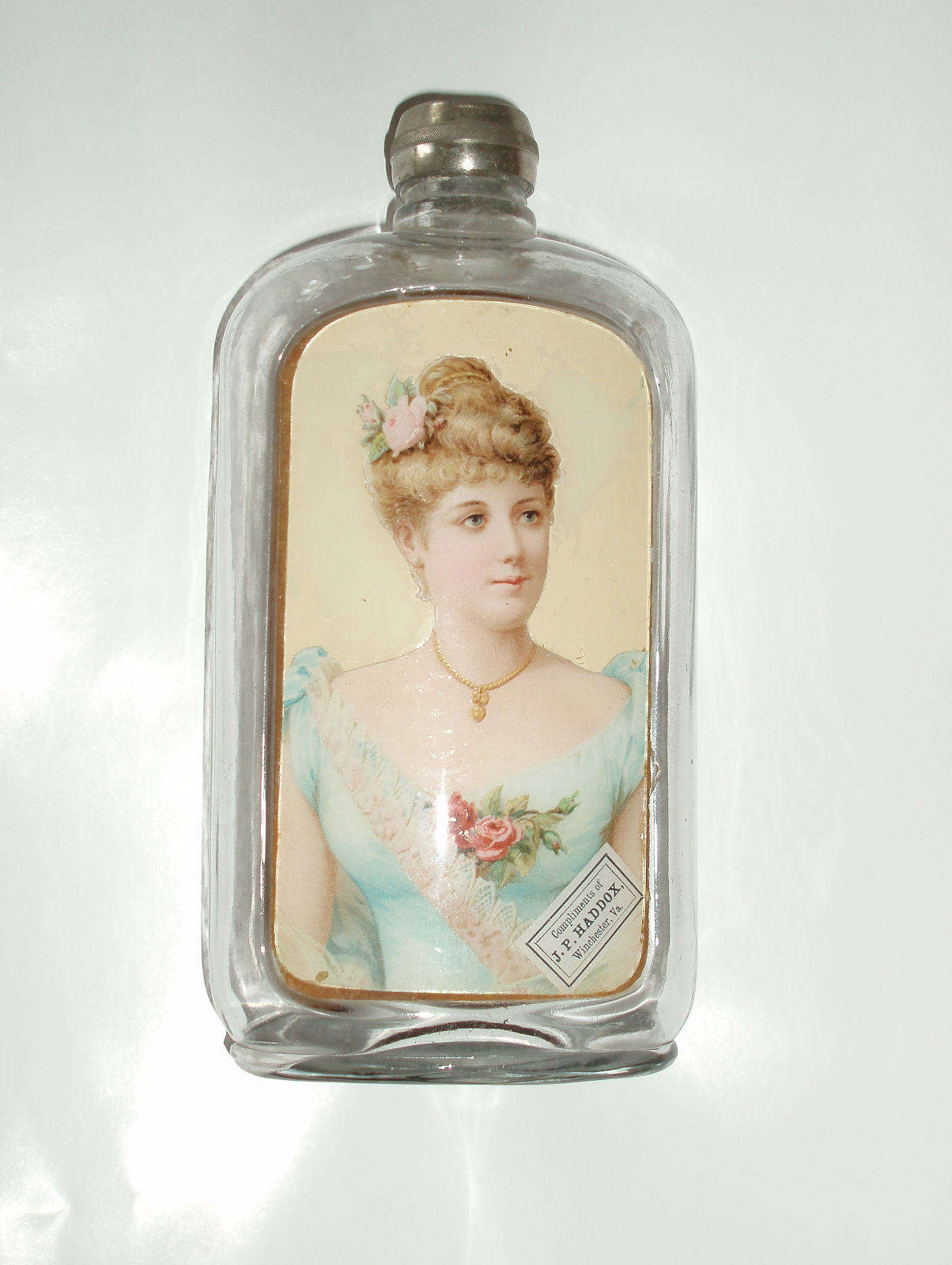
J. P. Haddox, who put his picture on the “label under glass” pocket flask at left was a leading liquor dealer in Winchester, Virginia.  With a reputation as a successful businessman and civic leader, he was elected chair of the Democratic Party in his home town and the captain — head man —of a local volunteer fire company.  About 1898, however, Haddox decided to invest in a brewery and within a decade his economic house came crashing down despite a testimonial to his beer that involved a singing frog.

A native son of Winchester, Haddox was born in 1853 into a family of longtime Virginians.  Throughout his life he seems to have been known by multiple names.  Written out in full it was John Perry Haddox, but other versions in public records identified him variously as John P. Haddox, J. Perry Haddox and J.P. Haddox.  We can assume that he received his education in the elementary and perhaps secondary schools of Winchester.  About 1874, at the age of 22 he married a local girl, Annie E. Buckley and began a family.
Haddox appears to have been well established in his liquor business by the 1890s, ran a retail

establishment called the Moon One Price Cash Clothing Store on Main Street,   and was moving up the social/political ranks of Winchester.  His election as captain of the Friendship Fire Company not only meant recognition of his ability and enthusiasm as a firefighter but carried a great deal of social prestige.  
He became Grand Master of the local chapter of Old Fellows.  Moreover, like many Southern whiskey men his political views were “wet” and Democratic Party oriented.   Elected chair of the Winchester Democrats, Haddox was wheeling and dealing in local and state politics.  A 1899 news article reported him heavily involved in organizing a convention in Winchester to select Senatorial candidates.
Symbols of his prosperity in the liquor trade were the quality of his give-away items to special customers.   Although his advertising corkscrew could be had for pennies, the picture flask shown above and a second label under glass giveaway of a winsome lass both were pricey items.  Note too the silver plated match safe, shown below.  It bears the inscription, “Compliments of J. P. Haddox, leader in fine wines, liquors and bottler of the Belvidere Brewing Co.’s high grade lager beer.”  The silver-plated safe, sometimes called a “vesta,” is dated 1898 and would have been relatively expensive to produce.

That was the fateful year that Haddox expanded from selling whiskey into making beer.  A bottling factory for carbonated beverages had begun in the 1880s in Harper’s Ferry, West Virginia, a 30 mile drive over the Blue Ridge Mountains from Winchester.  At the outset the company was a very small operation, occupying only a single building and employing only a few workers, most of them said to be poorly paid.  With the decision of the local owners to expand into brewing beer in the mid-1890s, the facilities were expanded considerably, resulting in considerable debt.  When the brewery failed to be profitable, bankruptcy loomed.

Obviously sensing an opportunity, in 1898 Haddox and two Winchester brothers named Savage purchased the brewery property for a bargain basement $4,000 and began to make a beer they called “Belvidere,” a name they registered with the Federal Patent and Trademark office. As shown here they packaged their brew in both clear and amber bottles, some with porcelain closures.  In addition to paper labels their bottles were embossed with the name of the company.
Enter the singing frog.  As shown left, one of the brewery’s customers in Harrisonburg, Virginia, named W. H. Willis, the manager of the Kernstown Showroom a local saloon, took out an ad in the Harrisonburg paper to extoll the virtues of Belvidere Beer.  Terming the beer “delightful” and claiming no hurt could come from  it, he proclaimed:  “But if even a frog drinks it, it will make him sing — for joy!”  Mr. Willis apparently knew something about frogs to elicit this glowing testimonial. 
 
Haddox and his partners, after buying the Harpers Ferry property, spent lavishly on refurbishing the brewery and re-building a customer base — both expensive.  Before long it became clear to them that the Belvidere Brewery was continuing to be a losing proposition and that nothing could be done to remedy the situation.  In 1907 the partners decided to sell the brewery buildings and property.  How much was realized in the sale were not disclosed but indications are that losses were involved.

The economic drain of the brewery may well to have brought down Haddox’s Winchester clothing business. The 1908 photograph shown here tells the story:  “J. P. Haddox store to be sold without reserve…to retire from business.”  Haddox’s entire stock, pegged at worth $20,000, was to be disposed of and the store had been put into the hands of a New York salvage firm.

Earlier Haddox had suffered another painful blow.  Annie, his wife and the mother of their five children died at the young age of 44 in January 1899.  She was buried in Mount Hebron Cemetery in Winchester with this inscription on her tomb:  “In after time we’ll meet her.  Her children will rise up and call her blessed.  We love her.”  The family heartbreak was echoed a year later when Haddox, his occupation given as “liquor dealer,” was listed as a 47 year old widower.  He subsequently was remarried to Mariam V. Redmond, a woman who had a daughter by an earlier marriage when they wed.

Only 55 years old when he announced retirement from business, Haddox in subsequent years faded from public records.  He was out of the liquor business when Virginia went “dry” in 1916 and lived long enough to witness one daughter, Mary Agnes, die in 1933.  Three years later, in July 1936, John Perry Haddox himself died, age 83.   Another daughter, Edmonia, would pass away the same year.   Haddox lies in a crypt next to wife Annie in Mt. Hebron Cemetery, Winchester. A chain of three links decorates his plaque.  His inscription is from a poem by Nancy Priest Wakefield (1838-1915):  “I shall know the loved who have gone before;  And joyfully sweet will the meeting be;   When over the river, the peaceful river;  The Angel of Death will carry me.”   Strangely, the plaque omits Haddox’ date of death.


Note:  Since I first profiled J. P. Haddox several weeks ago, I was contacted by Brenda Creech,


Saturday, June 27, 2015

Milwaukee’s Henry Figge Was a “Travelin’ Man”

 When Henry Figge died at the age of eighty, his 1933 Milwaukee Journal obituary emphasized his career as a liquor dealer but also reflected aspects of his rambling nature.  Figge had been a “travelin’ man” throughout much of his working life.  Moreover, during his declining years, when most elders prefer to stay in place, he had abjured any real home and preferred constant travel.
Figge was born in Germany in 1853.  Of his early life, little is known, but he emigrated to the United States in 1871 at the age of 19, possibly one of the many youths seeking to avoid mandatory service in the Prussian army.  He early settled in Milwaukee, a city with a large German population where the German language was spoken in business, churches, and in every day society.  From early on Henry seems to have had a talent for the whiskey trade, going to work for the Wm. Bergenthal Co. as a traveling salesman. [See my post on Bergenthal, September 2014.]   Figge’s travels took him throughout Wisconsin and Upper Michigan, as well as neighboring Illinois and Minnesota.

So successful “on the road” was he that Bergenthal eventually made Figge a vice president of his firm, as evident here on an 1890 advertisement.  In the 1900 federal census Henry gave his occupation as a “traveler” selling liquor and wines.  He was living 470 South Eighth Street with his wife of some nine years, Ida J. Figge.  She had been born in Wisconsin of German parentage and was ten years his junior.  With them was their only child, son Alfred, born in 1884.

From his boss Figge learned the process of “rectifying” whiskey, that is, combining and blending raw whiskeys to achieved desired color, taste and alcohol content.  But Bergenthal was a difficult sort, famed for his violent temper.  By 1903 Figge clearly was fed up with his boss and struck out on his own.  With a partner, E.J. Doyle, he opened a wholesale liquor house at 353 East Water Street.  Even then Figge was not through with Bergenthal, suing him in 1906 for money he contended was illegally siphoned from the firm and of which Figge demanded a share.  He lost the suit.
The Figge-Doyle Company soon enough met with its own success. It featured a number of proprietary brands, including “Custom House,” “Foster,” “Gopher State,” “Home Aid,”  “Luster,” and “Turnpike.”   Unlike much of his competition,  Figge went to the considerable trouble and expense of registering each of these proprietary brands for federal trademarks:  Foster in 1905; Custom House in 1906; Gopher, Home Aid, and Luster in 1907, and Turnpike in 1908.

The firm issued its whiskeys in both amber and clear bottles, flasks and quarts, usually with the name “Figge-Doyle” and “Milwaukee” embossed on the front.  This embossing often would be hidden underneath one of the well-designed company paper labels.  Particularly notable was the label for Custom House Rye, below, that featured the very elegant building.  Dating from 1855, it had been constructed by the U.S Department of the Treasury after the design of the noted architect Ammi Burnham Young.  The building still stands. The use of the Milwaukee landmark may indicate that Figge saw his principal market as the city and its environs.

Figge seems to have had a constant yen for movement and change.  By 1912 he had broken with Taylor and had gone into to the liquor business with his brother, Gustave, under the firm name Figge Brothers.  The new firm was located at 97 Wisconsin Avenue, a few steps from Lake Michigan.  The company sales offices were on the first floor of the Railway Exchanged Building, shown here.  Built at the corner of Broadway and Wisconsin, this tall structure, shown below right, was the cornerstone of Milwaukee’s East Side commercial district and a prime location for a liquor distributorship. Henry’s old firm, now at 329-332 West Water Street, retained the name of Figge-Doyle even after he had departed.  My assumption is that Figge’s name commanded considerable respect in Milwaukee and the new management made a business decision not to change it.
Throughout this period Figge also was achieving a reputation as a dog fancier.  The 1905 Field Dog Stud Book lists him as owning a champion beagle named “Foster Rye,” likely named by him for rye whiskey.  The dog had been bred by F. J. Figge of Ossian, Iowa, likely a relative.  Registered as a “black, white and tan,” Foster Rye had a long pedigree.  Its sire was “Bellman”, out of “Florist” and “Bashful”;  its dam was “Staley’s Rubber” out of “Staley" and “Sailor’s Ranney.”

Seemingly ever restless, Figge, now with considerable wealth, retired from the liquor trade entirely in 1914 and bought a large farm on Cold Spring Road in Milwaukee County not far from the village of Hales Corners.  There he raised prize-winning Poland China hogs.  In 1926, perhaps tiring of farming, he sold his holdings and moved back to Milwaukee.  The cause given was his wife’s health but the move also may have reflected his restless nature. A few months later Ida Figge died and was buried in Milwaukee’s Catholic Calvary Cemetery.

His wife’s passing turned Figge into a perpetual vagabond.  According to his obituary, after
her death he never maintained a permanent residence:  “He visited relatives and traveled,” according to the Milwaukee Journal.  In August 1933 while visiting relatives in Milwaukee, Henry was stricken and taken to St. Mary's Hospital by ambulance.  He died later that day.  With his son, Alfred, and grandson, Henry Jr., at the graveside, Figge, age 80, was laid to rest beside Ida.  A monument marks their graves.

While his newspaper obituary identified Henry Figge as a “retired wholesale liquor distributor,”  I think of him as a man who sailed from his German homeland to America, traveled Wisconsin and neighboring states as a salesman, ventured into and then out of three Milwaukee liquor firms, moved on to raise pigs — only to abandoned that occupation, and in his elder years kept no fixed address, roaming from place to place.  “I’m a Travelin’ Man” is the title of a vintage country tune.  It might have been Henry Figge’s theme song.