Showing posts with label Shamrock Pure Rye. Show all posts

Sunday, April 23, 2023

Caught in “The Whiskey Ring” II

 Foreword:   When U.S. agents under the direction of Treasury Secretary  Benjamin Bristow in May 1875 swooped down on the giant multi-city racket to defraud the federal government of millions in liquor revenues, called “The Whiskey Ring,” they arrested 86 government officials and 152 distillers and whiskey dealers.  Among them were three whiskey men whose outcomes following their arrests differed significantly.


Caught cheating the government of revenues on his whiskey, St. Louis distiller Louis Teuscher in 1875 pleaded guilty and began assisting the prosecution.  Asked  under oath how he ran his distillery, Teuscher, a German immigrant, replied “Vell sometimes straight but most times crooked.”  His candid remark provided a brief moment of levity during the high-profile trials of the Whisky Ring.


Known for his “Good Times Bourbon,” Teuscher formally was accused of removing 10,000 gallons of whiskey from his distillery: “…On which said spirits the internal revenue tax of 70 cents…imposed by law upon each and every proof gallon…had not been first paid.”  By so doing he had defrauded the government to the tune of $7,000, equivalent to about $154,000 today.  His illegal whiskey was hidden in a building on the distillery premises, unknown to federal inspectors.  There fraudulent tax stamps were applied.
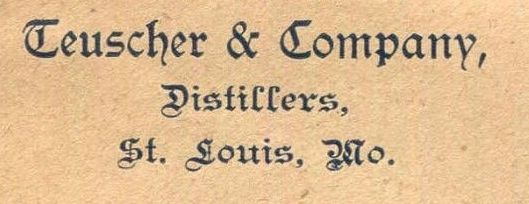


Teuscher pleaded guilty and turned state’s evidence.  The distiller testified for the prosecution in the trial of the kingpin of the Whiskey Ring, Orville P. Babcock, Civil War general and personal secretary and confidant of President Grant.  According to the memoirs of former Ring prosecutor David Patterson Dyer, the government treated cooperative distillers like Teuscher as “victims of rapacious officials, or at worst, as having the lesser guilt….”  


The German-born distiller did not go unpunished.  Federal agents confiscated his distillery and whiskey stocks and took all or part of a $50,000 surety bond held by the Internal Revenue Service that allowed him to make whiskey.   Originally indicted on felony charges, those were dropped for Teuscher when he agreed to cooperate.  He pleaded guilty to two misdemeanors and was sentenced to one day in jail and a $1,000 fine.  Although he spent the designated day in jail, Teuscher apparently balked at paying the $1,000 fine, likely on the grounds that he already had suffered sufficient financial losses for his folly in joining the Ring.  In the end the presiding judge blamed mistakes in sentencing Teuscher and discharged him without requiring he pay the fine.

*****

William Bergenthal was well known for his ferocious temper.  The Milwaukee, Wisconsin, distiller and liquor dealer, it is said, once physically threw a deputy sheriff out of his office who had come to collect a bill because the lawman made a remark impugning his honesty.  Bergenthal would have been well advised to do the same when Federal revenue officers came looking for bribes.  He did not and thereby became implicated in the Whiskey Ring.


Apparently by pointing the finger at his brother August and another employee Bergenthal himself was spared prosecution.  The pair were held for four months in the Milwaukee County jail for ““misrepresenting the company’s alcohol tax records.”  So popular were these “fall guys” in captivity, however, that the sheriff  complained regular business was being affected by “the tramp, tramp, tramp of the friends of the prisoners.”


William Bergenthal was far from being off the hook.  In 1876 a U.S. District Attorney brought a case in Federal Circuit Court that implicated Bergenthal and two friends with conspiring with Chicago gang members to steal incriminating Whiskey Ring-related documents held by Federal authorities.  To carry out this heist the crooks allegedly had demanded $50,000 from the trio.  If the government had been able to make the case, it was only a matter of time until Bergenthal and his colleagues would be on trial.  A friendly judge, however, dismissed the indictment, ruling that the theft had never gotten beyond the discussion phase and that “some act must actually be done” to constitute a conspiracy.


Bergenthal subsequently was hauled into court by his jailed brother.  Whether August was angry at having to take the rap for the tax cheating or other reasons, the brothers had parted ways with August working elsewhere in the whiskey trade.  He still had a substantial financial interest in William Bergenthal Co., however, and sued for a right to examine the books.  When a lower court agreed that August must have access, Bergenthal appealed the decision to the Wisconsin Supreme Court and lost a second time.


Fans of the movie version of Anne Rice’s “Interview with the Vampire” will recognize at right the New Orleans above-ground tomb of her blood-sucking hero, Lestat.  When visiting Lafayette Cemetery #1, tourists often seek out the cast-iron crypt and wonder who actually is interred there.  It is Otto Henry Karstendieck, a liquor dealer whose life held its own vicissitudes.


After making large profits from his liquor trade during Union Army occupation  of New Orleans during the Civil War,  the customer base for Karstendiek & Company dwindled sharply in the post conflict period.  President Grant had appointed his wife’s brother-in -law, Col. James B. Case, as collector of customs for the New Orleans port.  Case was quick to see financial possibilities of skimming off illicit cash from liquor taxes.  He recruited a handful of New Orleans distillers and dealers to assist him in the scheme.  Otto Karstendiek joined the Whiskey Ring.


When the scheme came to abrupt halt,  Karstendiek was arrested.  Otto and his co-conspirators did not come to trial for almost a full year after the raid.  In the interim the German whiskey man had suffered a heartbreaking loss.  His wife died in September 1875, leaving him with six motherless children.  At his trial Otto and five of his co-conspirators were found guilty. The prisoners were fined from $1,000 to $6,000 and sentenced to prison variably from six to sixteen months.  Otto was assessed $1000 and given maximum prison time.


All six were sent to the State Penitentiary at Moundsville, West Virginia, shown here, more than 1,000 miles from Otto’s New Orleans home. He was anguished at serving time so far from his children, now being looked after by relatives. While at Moundsville he brought a case before the U.S. Supreme Court arguing that the decision to send him out of Louisiana was not authorized by law and should be voided.  The Supremes did not agree.  Otto spent a full sixteen months in prison a long way from his little ones.


The stories of these three culprits demonstrate the sweep of the conspiracy, from Milwaukee in the Upper Midwest to St. Louis in the Midlands and Deep South New Orleans.  It also exposes the wide variety of penalties inflicted on those whose folly was joining the Whiskey Ring.


Note:  More complete profiles of each of these men may be found elsewhere on this blog:   Louis Teuscher, April 15, 2019;  William Bergenthal, September 1, 2014, and Otto Karstendiek, August 25, 2021.  An earlier post on three others caught in the Whiskey Ring may be found here at October 29, 2019.


Friday, September 14, 2018

Whiskey Men Rough on Authority

                  
Foreword:   Having provided two recent posts on whiskey men who were heavily engaged in building up their communities, I think it appropriate here to feature three who defied authority in states from North Carolina to Wisconsin to Iowa.   Although the three are linked by their clear distain for government controls and the officials designated to enforce them, each had his own way of dealing with them.

“Old Nick.”  It is a common term for the Satan, the Devil, Beelzebub, or what ever you call the evil spirit.  Nicholas Glenn Williams, a North Carolina whiskey man, not only ran a distillery business called the “Old Nick Williams Company,” but demonstrated repeatedly during his life, that he truly had the “Old Nick” in him and indeed was capable of “raising Hell.”

Established in the distilling business at Panther Creek plantation, shown below, Williams was constantly harassed by temperance forces in North Carolina, for a time outsmarting them..  Early in the 1900s he got crosswise with the Federal Government by failing to pay his liquor taxes.  The story is that during a visit to nearby Winston-Salem, North Carolina, Williams was confronted by a  revenue officer who accused him of tax evasion.  A powerfully built man, Williams is said to have pulled the official out of the Federal Building and onto the street where he beat him with a buggy whip.  So potent was Nick’s political clout that he was never charged or arrested for the assault.

  
As everyone knows, however, the Feds are not easily discouraged.  Williams was hauled into Federal Court for failure to pay his rectifier tax. In addition to distilling spirits he also was rectifying (blending) them for sale.  Already paying a stiff federal tax on each gallon of whiskey he was distilling, the law directed him to pay the government to blend them, a levy he and other rectifiers bitterly resented.   Found guilty. Williams was ordered to pay a fine of $5,000, more than twenty times that amount in today’s dollar, and assessed court  costs.  

Ever the stubborn rebel,  Williams fought the decision, claiming that the original Federal Circuit Court had erred in setting the payment date and thus nulled the verdict.  He claimed to owe nothing. First heard in Federal Appeals Court, the case eventually made its way to the United States Supreme Court. That body in 1905, rendered a decision that, in effect, told Old Nick to pay up.  

Soon after, Williams was out of the whiskey trade.  In 1908 North Carolina by a substantial vote of the populace banned all alcohol production and sales.  The Williams distillery was forced to close.  Some of his work force moved on to Kentucky, reportedly taking the stills with them.  Panther Creek reverted purely to farming.  In the 1910 census, Williams would list his occupation as running a horse farm.  He was 45 years old.  

William Bergenthal was well known for his ferocious temper.  The Milwaukee, Wisconsin, distiller and liquor dealer, it is said, once physically threw a deputy sheriff out of his office who had come to collect a bill because the lawman made a remark impugning his honesty.  Bergenthal would have been well advised to do the same when corrupt Federal revenue officers came looking for bribes.  He did not and thus became implicated in the giant 1870s criminal conspiracy known as “The Whiskey Ring.”  

When Milwaukee distillers found that Chicago whiskey was selling in town for $1.15 a gallon, they quickly understood that the Illinois distillers were not paying the tax but paying off the tax collectors.  Some Milwaukee whiskey manufacturers, including William Bergenthal, were enticed by crooked revenue agents to join them.  

In 1875 the Department of the Treasury conducted a series of raids in Midwestern cities, arresting distillers and liquor wholesalers.  Bergenthal was among them.  Apparently taking the fall for William was his brother August who, with another company employee, spent four months in the Milwaukee County Jail for “misrepresenting the company’s alcohol tax records.” 

William Bergenthal himself was far from being off the hook.  In 1876 the U.S. District Attorney brought an indictment into Federal Circuit Court in which the Milwaukee distiller was cited as a material witness.  The government charged that he had met with a group of co-conspirators two month after the raids to plot with them the theft and destruction of incriminating documents that were believed held by Federal authorities in Chicago.  For this heist the alleged thieves demanded $50,000, the present day equivalent of $12.5 million.  

If the government had been able to prevail in this case, it was only a matter of time until Bergenthal and other colleagues would be in the dock.  The Court, however, ruled that the theft had never gotten beyond the discussion phase and that “some act must actually be done” to constitute a conspiracy.  While far from exonerated, Bergenthal continued to be a major figure in Milwaukee business circles until his death in 1909.

To suggest that Kinsey “Stormy” Jordan was a complicated character is an understatement.  The famous Prohibitionist preacher, Billy Sunday, hailed him “as the only liquor owner who told the truth about booze.”  On the other hand, Jordan was described by another anti-alcohol zealot as “a man, known the State and nation over for his shameless, law-defying wickedness….”  Stormy’s reputation spread far beyond Ottumwa, Iowa, and rendered him the subject of national attention and controversy.


Gaining the respect of Prohibitionist Billy Sunday, shown here, for calling his saloon “The Road to Hell,” Jordan prospered in his Ottumwa drinking establishment.  Despite the Iowa legislature voting the state “dry” in 1881, he filed a suit in Federal Court and continued to run his saloon.  Local authorities regularly jailed him only to have sympathetic judges let him go.  With his releases and the continued operation of his saloon — Stormy’s defiance made headlines across America.  

Almost overnight Jordan became a national figure, attacked by some, lauded by others.  Appleton’s Magazine opined:  “Let us not do injustice to “Stormy” Jordan, in some ways the most picturesque figure that emerged from the dust of the fight and the most irreconcilable fighter of them all….Jordan kept his place wide open day and night, paying penalties, fighting, and gaining national fame as a consequence.”  Jordan continued to run his establishment for years in Ottumwa, shown below, as the only operating saloon in Iowa, while his case toiled through the federal judicial system all the way the way to the United States Supreme Court.  


After the Supremes decided against him, however, Jordan decided on a drastically different course.  According to the Ottumwa Courier, he called the newspaper to say he would succumb to the inevitable and quit the saloon business.  Perhaps remembering his salute from Billy Sunday, Stormy Jordan became a traveling Methodist evangelist. Reported the Wines and Spirits Journal:  “His appeals now to his old associates are eloquent and hundreds are flocking to hear him.”  

Each of these whiskey men were notable for their defiance of law and government officials —  two of them employing bodily violence. Yet all three managed to avoid any prolonged incarceration for thumbing their noses at authority and, as they aged, each of them settled down to less contentious occupations.

Notes:  More complete vignettes on each of these whiskey men may be found elsewhere on this website:   Nick Williams, October 4, 2013, William Bergenthal, September 1, 2014, and “Stormy” Jordan, March 30, 2017.