Wednesday, January 15, 2014

Frank Fettic and “The Oldest Thirst Parlor in Nevada”

Why a Canadian youth of German immigrant parents would choose to settle in one of the most remote hamlets in America and buy a saloon remains unknown.  That is exactly what Frank Fettic did when in 1884 he bought a Genoa bar, a drinking establishment that became known as “The Oldest Thirst Parlor in Nevada.”

Even in the latter part of the 1800s,  Genoa (pronounced “ge-no-a) defined the meaning of a frontier town.  Located not far from the California border and Lake Tahoe, the community  was founded in 1850 as a trading post on the Emigrant Trail to California.  Mormon pilgrims found it a convenient stopping place and called it “Mormon Station.”  The original Mormon settlers left in 1857 when they were recalled by Brigham Young to Utah to join the conflict there with non-Morman settlers.  Shortly after, the town was renamed “Genoa” possibly a local joke since the dryland location was so unlike the Italian city.  A  sketch by H.V.A. von Beckh during a U.S. military expedition through the region shows a scattering of wooden buildings nestled along the east side of the Sierra Nevada mountains.

Despite its remote location,  Genoa was home to Nevada’s first hotel,  court, and newspaper.  In another first the town was the location of the state’s first saloon, the one Fettic bought.  The initial owner was Al Livingston who constructed his “thirst parlor” building of brick and called it “Livingston’s Exchange.”  As the only place to get a drink of alcohol for miles around,  Livingston’s saloon, shown here in an artist’s sketch, did a healthy business.  Notice the hitching post out front.

Meanwhile Frank Fettic, shown above, was growing to maturity.  He had been born circa 1846 (census data differs) to parents who had come to North America from Germany.  At the age of 15 he left Canada in 1863 for the United States,  eventually finding his way to Nevada and Genoa.   There in 1884, he bought Livingston’s place and changed its name to “Fettic’s Exchange.”  Now a mature 38 years old, Fettic apparently had achieved considerable experience in running a drinking establishment.  Announcing that his was a “gentleman’s saloon” he is said to have allowed no drunkenness or fighting.   His establishment, Fettic declared in an ad, was “kept in first-class style in every particular way, serving fine wines, liquors, and cigars.” In another forum he emphasized that he “would be pleased to have all my old friends call, and they would be treated in a most cordial manner.”

Fettic’s saloon was classy.  Its bar featured a mirror that came to be named “The Diamond Dust Mirror,”  because of reputed bits of diamond dust that had been imbedded in the glass.  The mirror had been manufactured in Glasgow, Scotland, and shipped around Cape Horn to San Francisco.  Subsequently it was brought across the mountains by covered wagon to Genoa.  The ceiling of the place featured fancy medallions and red oil lamps that eventually were converted to electricity.  Frank’s place definitely was a cut above the usual Western saloon

As one of the few watering holes in the region,  Fettic’s Exchange proved very popular.  Legend had it that two American presidents,  Ulysses S. Grant and Theodore Roosevelt stopped there for libations during travels through the West,  Grant in 1879 and Roosevelt in 1903.  Both reputed Genoa stops, according to a Nevada newsman, were spurious.  Although as an ex-president Grant with wife and son visited Nevada at the end of a world tour,  following a speech in Reno,the party boarded a special train bound for Omaha, Nebraska, and then headed back to the Grant home in Galena, Illinois. They never got near Genoa.  Roosevelt visited a number of Western towns during his Presidential tour and his itinerary took him closer to Genoa, but no evidence exists that he stopped there and visited Fettic’s saloon.

An American celebrity who probably did drop in on Fettic’s place was Samuel Clemens,  better known as Mark Twain, who adopted that “nom de plume” while a reporter for the “Territorial Enterprise,” a newspaper that originally was founded in Genoa but later moved down the road to Virginia City, a boom town with more population and more potential.  A careful review of Twain’s writing likely would reveal a visit to Genoa and as a man who like his drink, a stop at Fettic’s Exchange.

Meanwhile its owner was having a personal life.  In 1880 Frank had married Cerissa,  a woman about 16 years his junior.   Over ensuing years they would go on to have six children,  four boys and two girls.   Fettic continued to operate his saloon for at least a quarter century.   He shows up in the 1900 and 1910 U.S. census forms with his occupation listed as “saloon keeper.”  That latter year Fettic’s Exchange had a close call when flames tore through Genoa, destroying the original fort, station and hotel.  Although the famed Diamond Mirror had to be evacuated from the building,  his structure survived the fire.

As he aged,  Frank counted on assistance from other family members to help in the bar.  A photo from 1929 shows him at 81 standing with Cerissa and their grown children in Genoa.   The senior Fettic would live another four years, dying in 1933.  He was buried in the Genoa Cemetery, shown here, in the shadow of the mountains in which he had lived for so long.   By that time saloon had been closed by National Prohibition.

As shown on a plaque,  the original building survived and subsequently has had a series of owners, the most recent of whom has called the revived drinking establishment “The Old Genoa Bar.”   Since the end of Prohibition a number of film stars making movies in Genoa or in the vicinity have “bellied up” to Fettic’s old bar.  They reputedly include Clark Gable, Carole Lombard, Clint Eastwood and Walter Mathau.  John Wayne is said to have rented the Genoa Bar for three days while filming his movie, “The Shootist.”  Subsequently the establishment featured a 16-ounce John Wayne Bloody Mary with such ingredients as bacon-infused vodka, bacon salt on the rim of the glass, and peperoncini.

Perhaps the most famous artifact to be left behind in the saloon occurred in the 1960s.  Here is the story as it is told in Genoa lore: “...Raquel Welch visited the bar and noticed the hundreds of bras hanging from the ceiling and asked the bartender why they were on display. The bartender told Welch the bras had been left by patrons over the years. After Welch had a few drinks, the bartender politely asked Welch if she would leave her bra hanging from the ceiling. The catch, Welch demanded, was all the other bras had to be taken down so that only her bra could be displayed in the bar forever. The bartender agreed.”   Shown here, the bra  is left of the elk’s head.

More than a century and a half after its founding,  this Nevada saloon, shown as it looks today, is still serving drinks to customers and reveling in its reputation as Nevada’s “oldest thirst parlor.”  Frank Fettic as he lies in the burying ground just outside of town surely must be proud.


Saturday, January 11, 2014

Fred Schiek Bought “Good Taste” to Minneapolis

 As a boy growing up in an impoverished German town,  Frederick Schiek probably never dreamed that one day he would be hailed in the United States not only for the quality of  cuisine in his Minneapolis restaurant but also for the excellence of design on the labels of the whiskey he bottled and sold.

Schiek was born in 1836 in Sinsheim, Germany, established as a city about 1192.  Throughout history it had been a rather poor town, affected heavily by the wars that raged over its environs from the 16th to the 18th Centuries.  It is not clear how much education Schiek received but as soon as he was able, at age 16 in 1852,  he took a ship to America. As a boy in Germany he likely had been engaged in brewing and upon arriving in New York he was employed in both the brewery and grocery trades.   Shown above as a young man,  Schiek was married in 1857 to Barbara Kehr, like himself an immigrant from Germany.

A year later the couple moved to Iowa, a state with a substantial German population and located in Center Township, Allamakee County.  The area lies along the Mississippi River at Iowa’s extreme northeast.  There Fred, as he became known, purchased 75 acres of land which he farmed until 1862.  Apparently tiring quickly of working the land, in 1862 he and his family moved to nearby Lansing, a Mississippi river town of about 1,000 population.  There he opened a saloon.  After twelve years of success in the liquor trade Schiek expanded his building in 1874, adding a stock of groceries and other provisions.  With business success came other recognition as townspeople elected him to both the Lansing School Board and the City Council.

During this period, the Schieks also were busy raising their family.  They had five children. The eldest was Louis, born in 1861.  Then came four girls,  Carolina, 1863; Mathilda, 1866; Louise, 1873, and Emilie, 1875.  Also living with them was Barbara’s younger brother who worked as a clerk in Schiek’s store.   Then in the late 1870s or early 1880s (dates differ),  Fred pull up stakes in Lansing and relocated his family and business up the river to Minneapolis. 


While the reason may have been an ambition to succeed on a larger stage, Iowa’s continual flirtation with Prohibition must have been a contributing factor.  The Hawkeye State started to go “dry” early, passing restrictive laws on alcohol in 1847, just a year after statehood.  Legislators successfully added an amendment to the state constitution in 1882, making all manufacture and sale of alcoholic beverages illegal within the state.  The Iowa Supreme Court quickly declared the amendment unconstitutional the following year but other Prohibition legislation quickly followed.


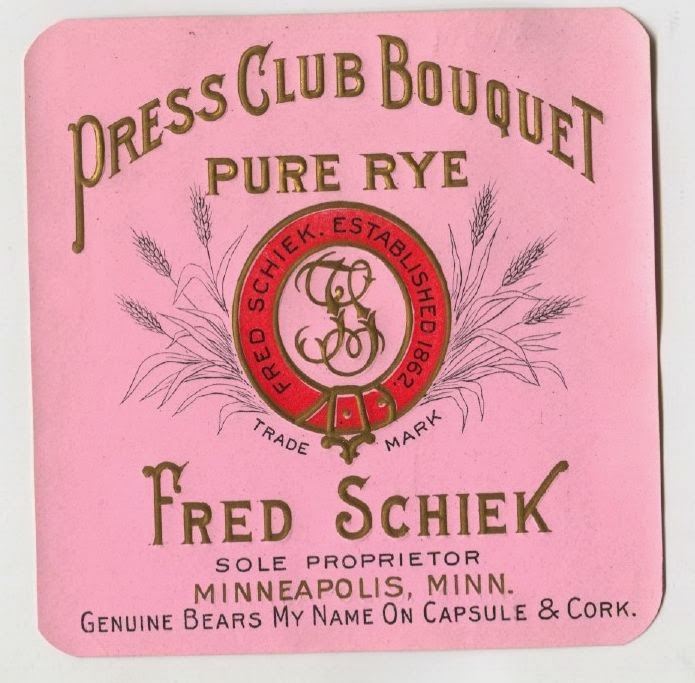
After arriving in Minneapolis, Schiek opened a retail liquor store, with a separate saloon nearby, both located on Washington Street.  There he began to import name brand whiskeys from their distillers in bulk and then bottling them with his personal labels for retail sale.  He also was buying raw whiskey, blending and compounding it in his facilities and producing unique labels for those house brands. The labels of Schiek’s designing, demonstrated an artistic taste unusual in the whiskey trade.


Among the national brands Schiek bottled were “Lotus Club,” “Finch’s Golden Wedding,”  “Gaines’ Hermitage Rye, “ “Gibson’s XXXX,” and “Guckenheimers Pure Rye.”  Principal among his own brands were “Press Club Bouquet Pure Rye,” and “Mount Hosmer Bourbon.”  The latter name was a reference back to Schiek’s life in Iowa.  Mount Hosmer was a bluff at the Mississippi River that looms 450 feet above downtown Lansing.  Fred saw it as an appropriate name for his flagship whiskey.

With the success of his liquor trade,  Schiek moved into the restaurant business. In 1887 he opened an eatery at 45-37 South Third Street, one of the major thoroughfares of Minneapolis.  A photo caught the cafe sign as a well-attended circus parade marched down the avenue.  

Here is a description of Schiek’s restaurant interior from a local publication:  “Sumptuous Victorian interiors sparkled with beveled glass, carved fretwork, intricate tile, and ornate plasterwork.  Dark and moody by design, the fanciful environment enveloped diners while they contemplated an extraordinary dinner menu or an equally long and and diverse list of after-theater and midnight snack offerings.”  There were two entrances to Schiek’s.  One opened onto the main dining room; a side entry was for ladies only.  A shy woman could proceed down a long corridor leading to the rear of the restaurant, thus shielding her from being ogled upon entry.


The elegance of the restaurant is captured in a photograph from archives of the Library of Congress, shown here.  Note the elegant carved bar, the mirrored alcoves and the statuary both behind and on the bar itself.  Moreover, Schiek’s food  was reported to be of exceptional quality.   In short,  this was not a typical Minneapolis saloon.  It was “Schiek’s Cafe,” another example of the German immigrant’s good taste brought to the Twin Cities.

The 1900 U.S. Census found the mastermind of this elegance, now age 63, residing with wife Barbara in a fashionable section of Minneapolis.  Son Louis, still a bachelor, was engaged in the business with with his father and living at home, along with two as-yet unmarried daughters.  Although Schiek’s last name is misspelled on the census form, his occupation is correctly given as “restaurant and liquors.”  He had never ceased to be in the retail whiskey business despite the success of his cafe.


Four years later,  Fred Schiek died in April, 1904, a few days shy of his 68th birthday.  Surrounded by grieving members of his family he was buried in Lakewood Cemetery, Hennepin County, Minnesota.  His son Louis, thoroughly schooled in the family businesses, continued to manage the restaurant and liquor sales after his father’s passing. When National Prohibition put a stop to all alcohol sales Schiek’s establishment became strictly an eatery. The restaurant has continued to this present day although locations and cuisine have changed over the years.

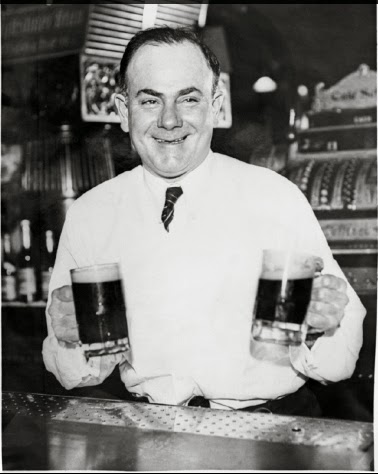
A photograph taken on January 1,1934, features a happy bartender at the Schiek Cafe. The man is serving up steins of beer on the stroke of midnight, the moment that the repeal of Prohibition became official.  It had been 14 years between drinks. Fred Schiek, a man who brought style and “good taste” to Minneapolis, would have savored the deliciousness of this historic moment.


Wednesday, January 8, 2014

Joe Bignon and Big Minnie in the Bird Cage

In 1886,  Joseph W. (“Joe”) Bignon and his wife, “Big Minnie, ” reopened the Bird Cage Theater in Tombstone, Arizona, and created a legendary saloon that provided entertainment, women and whiskey to the overwhelmingly male population of the boom town.  It marked the culmination of Bignon’s long and colorful life.

According to a contemporary biography, Bignon, shown here in maturity, was born in 1851 in Montreal, Canada, the son of French immigrant parents.  Determined to become an actor, he ran away from home at the age of 12 and joined a minstrel show where he learned to sing and dance while traveling throughout Canada and the United States.  Eventually he joined the Grant Brother’s troupe that introduced country clog dancing.  When he was barely out of his teens,  Bignon, who also had management ambitions,  added “impresario” to his credentials.  During the early 1870s he operated several music halls saloons in the American Midwest.

Bignon left those pursuits to return to entertaining by joining a traveling show called The Australian Circus.  After a stint there, he jumped to Doc Hager’s Great Paris Circus and Zoological Aggregation,  a group that toured less-populous frontier towns in Michigan, Minnesota, North Dakota and Ontario.  He abandoned life on the road to buying a partnership in a Sheboygan, Wisconsin, saloon.  His biographer wrote:  “Joe has ever been of a restless nature and no matter how well he is prospering, when the desire to satisfy his roving disposition comes on, everything is sacrificed to that end....”


Having traveled over most of the midsection of North America by the age of 28, Bignon determined to make a new start by going West to the Arizona Territory.  In 1879  he found his way to Tombstone, a silver mining boom town of 3,000 people, later made famous by the shoot out at the OK Corral.   Allen Street, the main drag, is shown as it looked in about 1880.  Bignon opened a theater/saloon there but soon decamped for San Francisco to manage another theater.  He left that job for several more circus tours.  It was likely on one of those that he met his future wife, Matilda Quigley. She was a six foot tall, 230 pound dancer whom Joe called “Big Minnie.” Born in England about 1852, she is said to have  “dazzled” audiences by prancing around the stage in pink tights.

During Joe’s absence from Tombstone,  a local entrepreneur named William J. “Billy” Hutchinson had hatched a plan to build a new variety theater and saloon.  Constructed of adobe over wood,  the structure, shown here, at last was opened in 1881. He called the establishment “The Bird Cage.”   After an initial period of success,  an economic downtown likely caused by falling silver prices,  caused Hutchinson to sell the property to San Francisco interests who shut it down.   Sensing an opportunity,  Bignon and his hefty bride returned to Tombstone and reopened The Bird Cage in 1886.  In addition to entertaining, Big Minnie, shown here,  also was said to have been a bouncer at the establishment.

The focal point of Bignon’s “palace” was the highly polished bar at one end.  Shown here in a latter day, the bar boasted two large crystal and brass lamps, a large mirror, and space for a wide variety of whiskeys, wines and other liquor.  Throughout a raucous evening the liquor stock was replenished with supplies from a storeroom below the stage.  At one side of the bar was a hoist-like contraption by which drinks could be sent to the boxes above the theater.
 
The partition that separated the barroom from the theater held its own attraction, shown here. It held a huge painting of “Fatima,” a well-known West Coast belly dancer who had graced the Bird Cage stage with her bare-breasted presence in 1882.  The stage was small, only about 15 feet wide, 10 feet high and 15 feet deep. Still it was enough for the songs, sketches, acrobats and dances that comprised an evening’s program.  The mental image of Big Minnie swinging her 230 pounds in pink tights around that tiny space is fascinating.

Along two sides of the theater was a one-level balcony that jutted from the wall and seemed to be suspended. It was divided into separate small rooms.  One writer has described the purpose of those rooms at the Bird Cage:  "The smoke-filled establishment was named, with heavy frontier humor, for the 12 tiny balcony boxes where soiled doves plied their trade behind curtains. When uncaged, the painted ladies pursued less profitable sidelines such as shilling drinks and dancing with drunken cowboys, hardhanded miners, and nimble-fingered gamblers and gunmen."  The scene is alleged to have inspired the writing of the well-known 19th Century ballad, “She’s Only a Bird in a Gilded Cage.”


In reality what Canadian Joe and Big Minnie were running, in addition to a theater and saloon, was a bordello.  A $25 Bird Cage token exists, reputedly from this era, that guarantees:  “Square and Honest Gambling, The Best Liquors and Wine, Always Many Lovely Fancy Women,  Acclaimed the Best Sporting House in the Southwest.”  The flip side of the coin promises that it is “Good in Trade Toward All Favors of the House.  Our Fancy Women Will Fulfill Any Wish.”  It is signed by Joe Bignon.   Wyatt Earp, the famous sheriff of Tombstone is said to have carried one of these coins around in his pocket as a lucky piece.

In addition to running this wide open establishment  where, accurately or not, gunfights sometimes were reported, Bignon may also have been mixing and compounding his own brand of whiskey.  Shown here is a saloon sign for “Moon Castle Whiskey” that noted that the liquor was being served at Tombstone’s Own Bird Cage Theatre.  I can find no reference to this brand in the usual sources and conclude that Moon Castle was Bignon’s house brand.  The picture of the European castle beside a river in the moonlight suggests a level of sophistication that, despite his lack of formal education, may have resulted from the Canadian’s broad experience with people and places.

Meanwhile, Tombstone’s silver-based economy was faltering.  Despite Joe and Minnie’s best efforts to keep the whiskey flowing and provide varieties of entertainment, the dismal financial conditions in that part of the Arizona Territory had doomed their enterprise. Suddenly news came of a gold strike by a man named Pearce in Cochise County, Arizona, at what would become the Commonwealth Mine. In 1892, the childless couple literally “pulled up stakes” and joined a number of Tombstone residents who were already in the new gold camp.  After selling the Bird Cage Theatre they dismantled their wooden Tombstone house, loaded it on a freight wagon, and moved it through South Pass, and reassembled it at the foot of Six Mile Hill at the Pearce mining camp.

In Pearce, now considered an Arizona “ghost town,” the enterprising Bignon set up a saloon, the first in the area.  Known in reference sources variously as the “Pioneer,” or “Palace” this establishment, hailed for being “lavish” in its appointments, opened its doors in 1896.   It advertised that it offered faro, roulette and “the finest spirits.”  Although nothing was said about prostitution,  one suspects that at least some of the Birds in the Cage followed the Bignons through South Pass to the gold fields.

With miners flush with money as his customers,  Bignon flourished in Pearce.  In 1900, however,  Matilda “Big Minnie,” died.  Buried in Pearce  Cemetery, her blue granite tombstone has a fancy sculptured design.  Her first name, however, appears to have been misspelled.  Although the elegance of her grave marker bespeaks close affection by Bignon, within a year he had remarried.  Her name was Ellen McGrogan (on her death certificate “McGregery), from Patterson, New Jersey, and the daughter of John McGrogan, an Irish immigrant.  Ellen was younger by 13 years than Joe.   The 1910 U.S. Census taker found them living in Pearce.  Bignon's occupation was given as “saloonkeeper.”

Although the coming of National Prohibition shut down Bignon’s establishment in Pearce, the couple continued to live there the remainder of their lives, even as the population ran out along with the gold.  Joe died in 1925 at the advanced age of 85 and is buried near Minnie in the Pearce Cemetery.  Her gravestone is shown here, foreground; Joe’s is the black slab behind.  Second wife Ellen also is believed to be buried in the same cemetery but no marker has been found for her.

The odyssey of Joe Bignon’s life was the stuff of fiction.  Beginning at the age of 12 and encompassing 73 years, his days and nights presented constant challenges to give his audiences and customers what they wanted.  In 1888 “The Cricket,”  a 19th Century general interest magazine did a feature on Bignon.  It provided a summary that seems appropriate to repeat here:  “There are few managers...who are more enterprising and successful than Joe Bignon, and the fallacy of saying ‘that a rolling stone gathers no moss”  was never better shown than in his case.”

Note:  Much of the information for this post came from the April 1935 issue of the Arizona Historical Review, published by the University of Arizona.  The article by C. E. Willson, entitled “From Variety Theater to Coffee Shoppe,” also described the fate of the Bird Cage after the Bignons departed. More recently the Bird Cage has been restored as a tourist attraction in Tombstone.  Photos are from that restoration.


Saturday, January 4, 2014

Solomon Klinordlinger Hit a Home Run in Pittsburgh

Beginning in Civil War times Solomon Klinordlinger for years had a profitable but modest wholesale liquor business. Then he named a whiskey brand after the emerging Pittsburgh Pirates baseball team and hit a merchandising home run.  A man with a baseball bat in his hand, shown here, paved the way to Klinordlinger’s fame and fortune.

Like many successful whiskey men,  Klinordlinger was an immigrant.  He was born in the town of Bayern, Germany, in 1834, the third in a line of five Klinordlinger sons. At the age of about 15 he accompanied an older brother, Abraham, and two younger siblings, Nathan and Max, to the United States.  The 1860 U.S. Census found Solomon and his brothers living together in Pittsburgh with Abraham’s wife and child.   The older brother was listed as a merchant, probably involved in the liquor trade, and indicated significant assets to the census taker.  Solomon apparently was working for Abraham.

By 1865 Solomon was financially secure enough himself to marry.  His bride was Fanny Bierman, daughter of Feist Bierman, who like her husband had been born in Bayern, Germany.  It is unlikely that they had been childhood sweethearts reunited after some absence because she was 10 years his junior. The new couple made their home in Pittsburgh.  Over time their union produced four children, daughters Minnie, Laura and Carrie, and a son, Sidney.

In time Klinordlinger struck out on his own.  Although he claimed that S. Klinordlinger & Co. harked back to 1860, his firm first showed up in local business directories in 1872.  His early location in Pittsburgh’s Diamond Square indicated strong financial underpinning to the enterprise.  Diamond Square, a prestige location, was home to the city’s first courthouse and jail (1775) and its first newspaper (1786),  and today is known as “Market Square.”  The Klinordlinger firm billed itself as “Wholesale Dealers in Pure Rye Whiskey and Importers of Brandy, Gin and Wines.”  Solomon also was a “rectifier,” blending and compounding whiskey obtained from other sources.  As shown here, he initially sold his products in large ceramic jugs decorated in cobalt, many of them holding two or more gallons.

His business grew steadily over time.  In a barely disguised ad, The Pittsburgh and Allegheny Illustrated Review  of 1889 declared:  “Mr. Klinordlinger...has established a trade which today ranks him as one of the leading merchants in this line. His business is chiefly done in the States of Pennsylvania, Ohio, Maryland and West Virginia, and is thoroughly canvassed by his salesmen. He carries a large stock of pure rye whiskies, free and in bond; also a large line of brandies, gins, wines, etc., which are of the best quality. Special attention is paid to mail orders, and the firm would be pleased to receive from any dealer a trial order, and are confident of their ability to convince him of their superiority in supplying his wants.”

Despite these indications of success, Klinordlinger was facing stiff competition. In the latter years of the 1880s,  no fewer than 41 wholesale wine and liquor dealers were operating in the Pittsburgh area, including one run by his brother, Abraham.  All were vying to sell to 70 retail dealers, and more important, 1,400 saloons.  Those wholesalers all were seeking a healthy slice of the estimated $6,100,000 in annual Pittsburgh liquor sales --  in today’s dollar, more than $91 million.

Meanwhile a home town baseball team named the “Alleghenies” had joined the newly formed National League and on pulling out of their earlier league had been denounced by the competition as “piratical.”  Making sport of the accusation and obviously noting the alliteration with Pittsburgh, the team officially changed its name to “The Pirates.”  At the same time the newly ordained Pirates were showing great baseball prowess and gaining huge fan support.  Winning season followed winning season.  The Pirates were the National League champions in 1901 and 1902 and played in the first World Series in 1903, losing to the Boston Americans. In 1909 the team won the World Series against the Detroit Tigers.

Klinordlinger was not just cheering the Pirates from the grandstand. With the wisdom of his namesake Solomon foresaw the potential for baseball in the Steel City.  Capitalizing in on the team’s immense popularity he named a whiskey brand after them, calling it “Pirate Club Pure Rye Whiskey.”  The picture on the label showed a strapping man with a large mustache and a baseball bat in hand with “Pittsburg” prominent on his chest.  Sol merchandised the brand in three sizes of bottle, shown here, from a clear quart to an amber flask to a two ounce “nip.”  He also issued shot glasses with an etched picture of the player.  Those were given to favorite customers in retail stores and saloons that carried Pirate Club whiskey. About this same time he took on a partner and the name “Klinordlinger & Wallace” appeared on some items.

About 1892 the company was relocated from Diamond Square to 966-968 Liberty Avenue, its address for the remainder of its days.  In addition to Pirate Club, Klinordlinger featured other proprietary brands such as “Happy Moments,”  “Monongahela Golden Rye,” “Watch Dog” “Sensation” and “Toll Gate.”  He never bother to trademark any of his brands, not even Pirate Club Rye, despite a local competitor issuing a “Pittsburgh Club” label.  To favored customers the company issued shot glasses and an "American brilliant" back of the bar bottle with the owners names etched in.

The 1900 Census found Solomon, age 65, living at 1336 Pennsylvania Avenue in Pittsburgh. With him were his wife Fanny and their daughter Carrie with her husband Henry Weiskoff and a granddaughter.  Also part of the family group was son Sidney Klinordlinger, unmarried at 28, who had been brought at an early age into the family business. As his father aged, the son  increasingly took over the management of the firm.  That may explain why the 1900 census listed Sidney’s occupation as “liquor merchant” and Solomon’s only as “agent-liquor.”

With Solomon’s full retirement about 1912  Sydney took full ownership of the liquor wholesale company and changed its name once again, this time to S. S. Klinordlinger.  By 1917, however, the firm had shut down and Sidney was running a clothing store.  The reason for terminating may have been that mail order markets had been curtailed by an act of Congress in 1913, and other nearby states like Ohio and West Virginia had gone “dry.”

The elder Klinordlingers aged gracefully, surrounded by their family and friends. Recorded by a local Jewish periodical, the couple celebrated their 50th wedding anniversary in 1915 at the Almanac Hotel in Atlantic City, New Jersey, in the presence of all their children and grandchildren.  The renewal of their vows was blessed by Rabbi Arnhold, now 86 years old, who apparently had officiated at their original nuptials.  By now Solomon and Fanny were living with another daughter and her husband in their Pittsburgh home.


Solomon died at the age of 84 in September 1918 and was buried in Pittsburgh’s West View Cemetery, shown here.   He went to his grave knowing, as one latter day observer put it, that he had “...brewed some of the finest spirits in Western Pennsylvania from the 1880s through the early 1900s...Perhaps tastiest to all Steel City sports folks...Pirate Club.”   In Pittsburgh Klinordlinger clearly had hit a home run.


Wednesday, January 1, 2014

Herman Toser Provided “Gemuetlichkeit” in Its Truest Form

Gemuetlichkeit, a German word best expressed in English as “a friendly good time,” was the goal of Milwaukee’s myriad beer gardens, taverns, sample rooms and saloons in the 19th and early 20th Century.   Herman Toser,  a immigrant from Germany, understood the concept thoroughly and brought it to a wine cellar that bore his name. 

A photo from the establishment shows a routund gentleman at left contemplating a wine glass.  Herman F. Toser is sitting with a friend testing the flavor of sherry drawn from a barrel behind them.  They are seated in a establishment appropriately called Herman Toser’s Weinstube.  Established in 1872 it was a highly popular place for the business and professional men of Milwaukee to gather, especially those of German ancestry. Located on Milwaukee’s East Side at the corner of Mason and Water Streets, as shown here, it was accessed by walking off the street to a downward staircase and into a cellar filled with dozens of wine barrels.

Upon arrival the thirsty customer was surrounded by steins, tapestries and other cultural artifacts of the Old Country.  The main attraction in Toser’s Weinstube was a huge hand-carved sign that hanged over the manager’s station.  Carved out of three pieces of oak, the plaque, shown here, originally was used to cover a cask holding 36 gallons of wine.  The carving depicted four men, two standing, one sitting and one slumped onto the floor, all drinking freely amidst a bas relief of vines, leaves and grapes.  A dog is sitting on the floor silently and patiently observing the intoxicating effects. An inscription at the top says:  “Wine Office, Herman Toser.”

There was no bar in the cellar, only a series of tables and chairs for visitors to sit and enjoy the fine wines Herman imported from Germany, as well as hearty sandwiches of ham and corned beef served on thick slices of rye bread.  All around, groups of customers chatted or played cards, possibly “Sheepshead,”  a form of bridge brought from the Fatherland.  When the cask cover, furniture, steins and other relics were donated in 1958 to the Milwaukee Historical Society, the organization’s historian expressed great enthusiasm for the place.  He proclaimed that Toser’s Weinstube had provided “Gemuetlichkeit  in its truest form.”


Toser was born in Germany in1833 but at an early age emigrated in 1854 from his homeland to the United States, settling in Milwaukee with its large German population.  There, at the age of 21,Toser married a woman of about the same age, also an immigrant from Germany whom he may have known back home.  Her name, as given in census records, was Phellippina, affectionately known as “Phene.”  The 1860 Census found the couple living in Milwaukee with three children, Elizabeth, age 6;  Lena, age 4; and Herman, still an infant.  Toser’s occupation was given as “merchant.”

That same year Herman launched another spirits-related enterprise.  It was a wholesale and retail liquor dealership, with attached saloon.  There he sold various types of  liquors and wines, both imported and domestic.  For the first five years Toser had a partner in this company, known as Toser & Arend.  It was located at 424-426 East Water Street not far from the Milwaukee River that runs through the city’s  downtown.  By 1871, Arend had left the organization and Toser,  apparently needing larger quarters, had moved to 275 East Water,  his address for the next eight years.  Over the life of his firm he would move twice more, both times within the 400 block of East Water, an avenue that boasted a number of liquor dealers.

A late 1800s photo shown here captures the activity outside the ground floor of Toser’s three story store and office building.  The front door is surrounded by liquor barrels, both full and empty, while a drayman rides off to deliver whisky to saloons all over Milwaukee.  The loungers in the doorway may be employees or gents just heading in to buy a jug or bottle or to order one from the bartender inside.  A Milwaukee journalist later described the experience of entering Herman Toser’s Wines and Liquors.  Once inside, he said, the thirsty customer reached the bar “by a long walk between hogsheads of whiskey and wine.”  Toser also was advertising vigorously.  A stock trade card showed a winsome Spanish or Italian lass balancing a large jardoniere of wine on her shoulder.   In an age when California had yet to discover good wine, Toser emphasized European imported vintages.

Toser also was selling some of the best brands of whiskey from Kentucky and other sources.  Shown here is a fancy jug with gold lettering in which he was merchandising “Old Crow,” at that time a premier brand.  In addition to selling good whiskey, he and his employees were busy mixing up their own liquor on the upper floors of his building.  Toser was a “rectifier,” that is, someone blending and compounding whiskey to achieve a distinctive taste.  Then the spirits were bottled and a proprietary label slapped on them and sold as house brands.  Among Toser’s offerings were   "Old Abe Rye,” "Old Waveland,”  "Tosco Club,” and “Pelican.”  The last was the only brand for which the Toser Co. bothered to obtain a trademark,  registering the name in 1907.

Because Herman’s had lived through the American Civil War,  it would be natural to assume that he named Old Abe Rye after the martyred President, Abraham Lincoln.  Not so. The brand name referred to an American bald eagle named for Lincoln.  The bird, known as “Old Abe” was tamed by the 8th Wisconsin Infantry during the conflict.  This aggressive raptor accompanied the troops into action and was reputed to have attacked Confederates from the air.  Twice wounded and reviled by the Johnny Rebs as “that damnedYankee buzzard,”  Old Abe survived the war and died of old age in Wisconsin in 1881.  With an eagle depicted on the label, Toser was taking advantage of the bird’s fame in marketing his whiskey.

In addition to his whiskey brands, Toser also was mixing and merchandising his own brand of bitters, a  highly alcoholic potion that also claimed to have medicinal values.  He called it “Monopole Bitters.” Shown here is a decanter embossed on the back with the name.  It is a very rare bottle today with reputedly only a couple of known examples.  Made by the glass house of William Frank & Sons of Pittsburg, whose mark it bears, this graceful, deep red decanter was, by my reckoning, a back-of-the-bar bottle,  given to special saloon customers.    Most bartenders stocked at least one brand of bitters for those drinkers who who were “feeling poorly” and needed a remedy.

Toser could fix you up sacramentally as well as medicinally. he advertised heavily in a Roman Catholic publications, selling altar wines. He had enlisted the assistance of a Benedictine abbot named Nepomucene Jaeger to help plug the product.  The prelate, from St. Prokopius Abbey near Chicago,  was quoted from a letter he purportedly spontaneously wrote the company. Abbot Nepomucene enthused: For a pure wine, which has not been treated but has ‘made itself’ I heartily recommend yours,” 

With the success of his enterprises and growing wealth, Toser found time for recreation. A local newspaper reported in1888 that he and his wife and a daughter had embarked on an ship for Europe.  One assumes he visited his German homeland and arranged for wine shipments.  The 1900 U.S. Census found Toser, age 67, living with his wife at 220 Eleventh Street, just west of Milwaukee’s downtown  His occupation was given as “wholesale merchant - wine.” 

As his son, Herman, came to maturity, he was taken into the business and gradually assumed more of the management chores.  In 1907 Toser died at the age of 74.  Surrounded by family and friends, he was buried in Section 33 of Forest Home Cemetery, an expansive graveyard on the southern edge of Milwaukee.  The company he had founded continued to operate, apparently under his son’s management, until 1918 when it was shut down, apparently by the forces of Prohibition.  By 1922, the young Herman Toser was listed in business directories as a distributor of truck tires.

Given the number of instances in which both contemporary and subsquent scribes have waxed nostalgic over the joys and comforts of Toser’s Wine Cellar, it must have been an extraordinary “watering hole” in a town full of good ones.  Throughout its existence under the watchful eye of its owner,  his establishment had been a gathering place not only for the leaders of the German community, but many other business and professional men of Milwaukee.  For 37 years Herman Toser had proved, indeed, that he could provide “Gemuetlichkeit” in its truest form.