Wednesday, February 18, 2015

William Tarr: The Rise and Fall of a “Money King of the Blue Grass"

William Tarr was well known in his home state of Kentucky as a astute businessman, someone who had parlayed profits from a watermelon patch, mule trading, and farming into making whiskey before the Civil War, and subsequently made a highly successful distillery and real estate investments.  In 1882 a biographer termed him “one of the money kings of the Blue Grass region.”  All that changed, however, when Tarr fell in love with railroads. 
Tarr’s roots were deep in Kentucky.  His grandfather, Charles Tarr, was born on the Eastern Shore of Maryland, and migrated about 1790 as a newlywed with his wife to Nicholas County, Kentucky.  A farmer, Charles is said to have become one of the prominent men of the region.  Although he later decamped for Illinois, one son, John B. Tarr, remained, married Milly Turner, and raised a family of five sons and two daughters.  Among the sons was William, born in June 1825.  The Tarr family was not wealthy and a biographer noted of William: “He began life as a poor boy….”

The youthful Tarr’s first enterprise was raising and selling watermelons.  From there he graduated to mule trading, an activity that gave him sufficient money to farming on rented land with his brother.  After a few years working the soil with evident success, the two parted ways.  Tarr went into business for himself, making whiskey on a small scale.  With the profits from that enterprise in the early 1860s he invested in what became known as the Chicken Cock Distillery in East Paris, Kentucky.  He became a partner in 1863 and operated the distillery until 1868 when he sold his share in favor of new opportunities, primarily in land speculation.

During the 1860s, Tarr also was having a personal life.  He married a Kentucky- born woman named Sarah Fisher, the daughter of W.W. and Sarah (Garth) Fisher.  She was known by her middle name “Findlay,” the only one on her gravestone.  The couple would have two sons, Thompson, born in 1866 and Fisher, born in 1870. 

The whiskey-making opportunity that presented itself to Tarr was the Ashland Distillery in Lexington, Kentucky.  It had been established in 1865 by Turner, Clay & Co., a business that included Horace Turner, Samuel Clay and Thomas Mitchell.   The facility was located on Manchester Street (Frankfort Pike) between Cox and Perry and was the first to obtain a Federal Register distillery license (RD #1, 7th District) in Lexington.  Its products were marketed as “Ashland Whiskey.”  Identified by the logo shown above, the firm produced about 30 barrels of whiskey a day, slightly less than its 37 barrel capacity.  The partners also completed a bonded warehouse, one said to be “fireproof.”

The distillery seemed to have struggled financially from the outset and after Turner’s death in 1871, the partnership dissolved.  Tarr with Thomas Megibben, a Lexington dry goods merchant, acquired it and restarted production.  They continued to produce the Ashland label and introduced a new brand, initially called “Wm. Tarr Whiskey” and later “Old Tarr.”   Both brands were produced in bourbon and rye versions. Another Tarr whiskey label was Belle of Marion,
shown below.

The decade of the 70s brought two setbacks to Tarr.  In 1873, his wife, Sarah, died, still a very young woman, leaving William with two small boys to raise.   Perhaps to give his children a mother, three years later he married a second time.  His new bride was Mary Fisher, a sister to his first wife and a woman 34 years his junior.  They would have three children of their own:  James born in 1877;  William Orr, 1878; and Mary Best, 1880. 
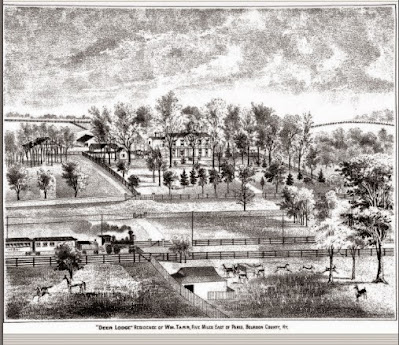
 

For this growing family he built what was described as “one of the most beautiful homes in Bourbon County, having provided it with all the modern conveniences and tasteful designs, and a large and commodious park well stocked with deer.”  Shown here in a contemporary illustration, the Tarr home had originated as a smaller Federal style building but William greatly enlarged it to accommodate extensive Italianate features.  The main entry way was made of  Flemish-bond brickwork, an expensive and labor intensive addition.

Tarr’s second setback of the 70s was a raging fire in 1879 that destroyed his distillery.  Not only was it largely of wooden construction but Lexington did not have a waterworks to provide a supply of water to fight the conflagration.  The structures burned quickly and out of control.  The disaster apparently triggered a company reorganization.  Tarr remained the president, with three partners.  He owned 40%, Megibben another 40%, and the remaining 20% split between Sam Clay, a company salesman, and a plant manager who was Megibben’s son-in-law.   Under this arrangement the distillery and warehouses were rebuilt at the cost of $75,000 ($1.8 million today), this time in brick with fire proof slate or metal roofs.


Tarr’s distillery, shown above rebuilt, was a “state of the art” facility on eleven acres.  The floor space covered 25,000 square feet and included 14 fermentation tubs, each with a capacity of 9,500 gallons.  The primary mash tub held 10,000 gallons, with 400 smaller mash tubs of 101 gallons each.   In lieu of refrigeration, the small tubs allowed a faster cooling process.  By 1882 thirty-five workers were employed to produced about 45 barrels of whiskey daily, mashing 300 bushels of corn and 120 bushels of rye and barley malt.  Corn was purchased from local farmers but rye and barley malt came by train from the West on a siding running into the facility.  Barrels of whiskey were transported out by rail.  Water for the distillery was supplied from a nearby spring, at first under a lease and later purchased outright by Tarr.  Pumps supplied 200,000 gallons of fresh limestone water daily through a system of pipes.  Annual whiskey production grew to six thousand barrels, valued at $150,000 ($3.1 million today).  Some 18,000 barrels were kept in bonded storage.  Old Tarr was advertised as "always true."

As the head of this distilling giant, Tarr was lionized for his entrepreneurial genius.  One biographer extolled him as “…A man of great business tact and ability, his large and increasing business interests extending throughout the country.”   In 1882 another observer opined:  “…He has become one of the money kings of the Blue Grass.”   Yet even then the seeds of destruction for this “up from the bootstraps”  entrepreneur were being sown.  William Tarr, ever the speculator, fell in love with railroads.  The extent of his fascination can be seen in the illustration of his estate above.  The train depicted there was running on a right-of-way the “Money King” had donated in sight of his mansion windows.

Even before the Civil War a railroad from Lexington southeast through the coalfield of Kentucky and onto Virginia had been proposed.  After the war speculation in railroads was rampant and Tarr was not immune.  With his distillery partner Megibben he formed the Kentucky Union Railroad Company in 1872 with Kentucky and out of state investors. Shown below is a $1,000 bond certificate issued by the company.  

From the beginning the railroad was vexed by problems.  The construction relied on convicts for labor.  Maltreated, some died and were laid in unmarked graves.  Other escaped during winter months, reputedly to seek warmth and proper clothing.  The project also required the erection of a 500-foot trestle over a river.  Financial problems and a shortage of steel caused delays into 1884.  When completed, the railroad cost almost $1 million ($25 million today) and had been funded largely by undercapitalized distillers, with Tarr the lead investor.  Unable to gain additional financing, he and his partners in 1886 were forced to sell the railroad at a ruinous 50% loss.

The decline of Tarr’s fortunes seem to have triggered another reorganization of the Ashland Distillery.  By 1888 Sam Clay had departed and his share was obtained by Thompson Tarr, William’s eldest son.  By 1890 Megibben had died and Tarr purchased his interest and installed Thompson as company vice president.  Now the Tarrs owned the Ashland distillery almost in its entirety.  Always aggressive, William in 1892 purchased the nearby Lexington Distillery to acquire 10,000 barrels of bourbon in storage.  He then demolished the plant and moved the whiskey to his own warehouses.   

Although this activity might indicate continued strength of Tarr’s enterprises, he had been weaken financially by the railroad debacle.  Furthermore, he had endorsed notes for family and friends who defaulted during the national “Panic of 1893,”, leaving him with judgments ranging from $200 to $8,000.  As as way out, Tarr invited into the management members of the Stoll family of Lexington who controlled a number of distilleries in central Kentucky.  In January 1897 Tarr issued $50,000 in bonds as a last ditch effort to save his distillery.  In May of that year, the end came.  He declared bankruptcy and all assets were assigned to the Stolls.  Those included 10,000 barrels of Tarr’s bourbon and his distillery.   The latter was sold at auction in 1899, purchased by a straw bidder for the Kentucky Distilling & Warehouse Co., widely known as “The Whiskey Trust.”

His reputation as a canny businessman in tatters, in 1898 Tarr retired to his farm with his wife, Mary.  He was 73 years old and still owned considerable tracts of land in Bourbon County and Eastern Kentucky.   The receivership played out for some 14 years, ending only in 1911 when Tarr’s debts were finally settled.  The lengthy process was a continuing reminder to everyone of how far he had fallen.  A year later Tarr was dead, 86 years old.  He was buried in a Paris, Kentucky, cemetery with a cement headstone, adorned with a rose.  It marks his name and dates of birth and death.  Both of his wives are buried near him.  The notice of his death in a Lexington newspaper identified him pointedly asformerly one of the most widely known distillers of the United States.”
 

The William Tarr Distillery and associated brand name were retained for a time by subsequent ownerships but the plant finally was closed down by National Prohibition.  One night in March 1920, a masked gang of thieves raided the warehouses at the distillery.  Overpowering two guards, they took 96 cases of bonded whiskey valued at $20,000 from the government-controlled facility.  To safeguard the remaining whiskey it was removed to one of the U.S. “concentration warehouses.”  Today the only vestige of Tarr’s distillery is one warehouse, now serving as a Lexington bar.  As shown below, the family mansion now stands abandoned and sadly has been allowed to fall into disrepair.


Sunday, February 15, 2015

Freiberg & Workum Were “The Biggest Fish in a Very Large Pond”

In the six decades before National Prohibition,  Cincinnati, the self-styled “Queen City,” was the center of America’s whiskey trade.  The Ohio River town boasted hundreds of distilleries, whiskey “rectifiers,”  wholesale and retail liquor dealers, brokers and more than 2,000 saloons.  As many as 40,000 Cincinnatians were engaged in the alcoholic beverage industry.  The industry there paid in taxes one-sixth of the entire internal revenue of the United States.  At the pinnacle of this soaring commerce sat brothers-in-law, Julius Freiberg and Levi J. Workum.

The clear driving force of the pair was Freiberg, born in Neu Leiningen, Germany, in 1823.  At the age of 24, he immigrated to the United States in 1847, settling first in Williamstown, Kentucky, where he ran a general store for several years.  In those days liquor was a staple of such enterprises and Freiberg soon became acquainted with leading Kentucky distillers and their products.  After a few months, he decided that the future lay in selling whiskey not whisk brooms and 1852 he moved to Cincinnati.  There he initially was a whiskey broker, credited with bringing the first commercial quantities of bourbon out of Kentucky.  In 1855 he partnered with his future brother-in-law, Levi Workum, to establish a wholesale liquor business.  A year later he married “Duffie” Workum, reputed to be the first Jewish child born west of the Allegheny Mountains.  Two years later their first son, J. (Jacob) Walter Freiberg, was born.


The first location for Freiberg & Workum was a small store at 20 Sycamore Street,  where the company remained until 1858 when larger quarters were required and the partners moved across the street to 13-15 Sycamore.  Like many wholesalers, the partners were looking for an assured supply of whiskey for their liquor dealership and in 1857, after a brief time in business, they bought a newly completed distillery in Lynchburg, Highland County, Ohio.  Their first label was “J. A. Bowen Whiskey,” named for the builder.

At the outset the Lynchburg Distillery was small, capable of mashing only 100 bushels a day, but over ensuing decades, as shown above, it was expanded to a capacity of 3,000 bushels a day, with a storage capacity of more than 100,000 barrels.  Seen sitting on a few are some of their distillery employees.  As their distillery expanded, Freiberg & Workum introduced new brands, including “Lynchburg Rye,” “Lynchburg Extra Fine Whiskey,” “Highland Pure Rye,” and later, “Clinton Whiskey.”  The company advertised all these labels vigorously, including full page ads in national publications.

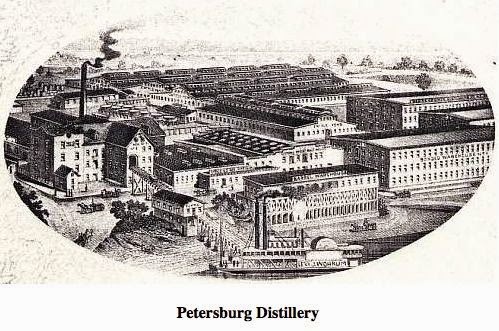
Freiberg & Workum became so successful that in 1867 the company purchased the Boone County Distillery at Petersburg, Kentucky.  Located on the Ohio River not far from Cincinnati, this was a huge facility boasting a mashing capacity of 4,000 bushels per day and storage for 60,000 barrels.  As early as 1860 the distillery is reputed to have produced an amazing 1.125 million gallons of whiskey.  


Author Michael E. Becher, commenting on this purchase, has described its impact: “…Freiberg and Workum were the biggest fish in a very large pond.  By 1880, the Petersburg distillery was making more whiskey than any other distillery in the state of Kentucky.  That year, the distillery was worth $250,000 ($6.25 million today) and produced 975,820 gallons of whisky.  By comparison, the nine distilleries in famed Bourbon County produced only 433,263 gallons of whiskey.  By 1887 the Petersburg Distilleries annual capacity had ballooned to 4 million gallons.”  

In 1869, again needing more space for their burgeoning trade, the firm’s office and store was moved  to 28-30 Main Street where it remained for 27 years.   Meanwhile, important corporate changes were taking place.  After Levi Workum died in July 1883, Julius Freiberg reorganized the firm.  He took as directors his two sons, J. Walter and Maurice J. Freiberg, as well as Levi’s two sons, Jephtha L. and Ezekiel L. Workum.   

Julius Workum also was making a name for himself in political, and religious activities in Cincinnati.  In 1873, for example, he was selected as one of the city’s representatives to the Ohio Constitutional Convention.  He also was active in Jewish affairs, serving as president of the Bene Israel (Orthodox) congregation for 25 years.  He also was active with Reform movements, working with Rabbi Wise when he founded the Union of American Hebrew Congregations (UAHC) in 1873 and the Hebrew Union College two years later.  Julius served as an officer of the UAHC and its president from 1889 to 1903. He helped found and support a number of Jewish charitable organizations.

In 1895 Freiberg & Workum made its final office move to 216-218 East Front Street.  This was a large building with a 52-foot frontage, running 200 feet deep and five stories high.  As shown on the illustration here, it had a private siding for  loading and unloading freight cars.  The complex had a re-distilling and rectifying facility immediately in the rear and included departments for making barrels and bottling and storing whiskey.  The premises held up to 3,000 barrels of blended whiskey, kept at a steady temperature of 85 degrees Fahrenheit.  In 1897 the firm also opened a branch office in Chicago to serve the upper Midwest and coordinate sales to Western states.

These new quarters allowed Freiberg & Workum greatly to expand the number of brands they merchandised.  Among them were: “Admiration,””American Union Club,” "Bonanza Pass,” "Eagle Gin,” “Eureka,” "F. & W,” "Fitz Lee,” “Hyperion,” "J. N. Blakemore,” ”Juneau Club Rye,” "Livingston Club", "Lynchburg", "Melrose",,"O.K. Kentucky Cabinet”, ”Cabinet Rye,” ”Old Fort-Nine", "Old Kentucky Home,””R. N. Wickliffe,” "Roanoke Pure Virginia Rye,” "Saint Jacobs,” "W. T. Snyder,” “Waldorf,”and "Zenith."  Another well known brand they featured was “Cyrus Noble.”  Noble had been a distiller with Crown Distillers of San Francisco and originated the brand there.  According to one account, Noble later went to Cincinnati as a “taster and blender” for Freiberg & Workum and the name went with him.  In any case the Cincinnati firm began issuing Cyrus Noble whiskey in 1896 and trademarked it in 1906.
 

Freiberg & Workum’s success might also have resulted from their many giveaway items to select customers, including shot glass and letter openers.  Their wall signs given to saloons and restaurants featuring their brands were particular notable.   One shown here advertises Highland Rye, depicting the loser of a political bet being made to tow the winner down a busy street to the delight of onlookers.  A second,below right, was keyed to the railroad club car, showing two gents and a waiter with two bottles of Cabinet Rye.

In 1904, recognizing that it also needed to have supplies of “spirits,”  that is, pure grain alcohol, for its blending and other purposes, Freiberg and Workum joined several other distillers in building at Terre Haute, Indiana, a facility called the Commercial Distillery.  They advertised it as “…the most modern, best equipped and largest spirits distillery in the country.”   It would operate under this name until National Prohibition arrived in 1920. 
Julius Freiberg died in 1905 and was buried in a Jewish cemetery near Cincinnati.  His sons carried on the business for him with J. Walter Freiberg as the president.   In 1909 the son sold the Boone County, Petersburg Distillery to the Whiskey Trust.  The new owners reportedly operated it for some years, then sold off all the stored whiskey and eventually dismantled the buildings.  The Lynchburg Distillery in Ohio continued to operate under Freiberg & Workum Co. management.

As the 1900s progressed prohibition campaigns were fast shrinking Freiberg & Workum’s markets for liquor.  Localities and states one by one were voting to ban alcohol.  With Congressional passage of the Webb-Kenyon Act in 1913, the company’s express mail trade into “dry” areas eventually was ended.  When Ohio voted for statewide prohibition in 1918 the beginning of the end was evident for the 63-year-old firm.  Federal records show, however,  that J. Walter Freiberg was still making withdrawals from the company warehouses under government supervision as late as 1920.  He died a year later. 

Thus was concluded one of the swiftest rises in the history of the American liquor industry.  In just 12 years, from 1855 to 1867, and despite the intervening Civil War,  the brothers-in-law had gone from running from a small liquor store on a back street in Cincinnati to being the largest producers and merchandisers of whiskey in Ohio and Kentucky.   As long as the country stayed “wet,”  Freiberg & Workum was “the biggest fish.”  With the triumph of the “drys,” however, the company became “a fish out of water.”  Correction:  “...Out of whiskey.”


Thursday, February 12, 2015

The Twin Passions of John Atherton: Whiskey and Education


John McDougal Atherton was a native-born Kentuckian with two obvious passions in his life, making good whiskey and promoting quality education for the people of Kentucky.  He is remembered well in the state for the latter but, sadly, his whiskey history — the occupation that fueled his philanthropy — has been forgotten or ignored.
Atherton, shown here as a young man, was born in LaRue County in 1841, the son of Peter and Elizabeth Atherton.  His father had been born in Fauquier County, Virginia, and received a land grant for a thousand acres in Kentucky (then part of Virginia).  It is said that Peter swan the Ohio River at Louisville pushing all his earthly possessions before him in a sugar trough.  His land was along the banks of the Rolling Fork River at the confluence with Knob Creek, about 50 miles south of Louisville, not far from the birthplace of Abraham Lincoln.

From 1800 to 1830 Peter built and operated a log distillery on the west bank of Knob Creek.  When John Atherton was only three years old, his father died, willing him the larger part of the land conveyed in the original grant.  John’s inheritance included a large plantation house that his father had constructed on the property.  The widowed Elizabeth subsequently married a man named Marshall Key who seems to have provided John with a loving and supportive stepfather.

The young man attended elementary school in Bardstown, Kentucky, and then Georgetown College.   This was a small, private Christian liberal arts school, the first Baptist college west of the Allegheny Mountains.  Although Atherton is said to have been forced to withdraw from Georgetown because of bad health, the experience helped shape his life.  He met a professor there named Johnathan E. Farnam with whom he reputedly developed a close friendship.  More important Atherton met Farnam’s daughter, Maria, who would become his wife.

In 1861 John’s health returned sufficiently for him to enter the Louisville School of Law and to read for the law.  The same year, age 21, he married Maria, age 20.  They would have one son, Peter Lee, born in 1862.   The next five years are not recorded but the assumption can be made that Atherton was tending to his bequest and perhaps learning the business of making whiskey.  There is no indication he was actively engaged with either side in the Civil War, which was roiling Kentucky during those years.


After the conclusion of the war, in 1867 with financial help from Marshal Key, Atherton, 26 years old, built a new distillery on the bank of Knob Creek and gave it his own name. Shown here, this plant was capable of mashing one hundred bushels a day to make about seven barrels of what was known as “sweet mash” whiskey.  It was just young man’s first move.  In 1869 he purchased an interest in a small distillery owned by a man named Thompson and the next year bought him out entirely.  Atherton moved this facility to the east bank of Knob Creek, across from his first distillery.  He put a cousin, Alexander Mayfield, in charge of this plant, calling it the Mayfield Distillery.  It distilled what is known as “sour mash” whiskey.   As a harbinger of the philanthropic efforts in his future, the distiller created a village to house his workers for both plants, calling it “Athertonville.”

Blest with water from Knob Creek that was said to be“about as nearly perfect as could be found for the manufacture of fine beverage whiskey,”  the sales of both Atherton and Mayfield whiskey grew rapidly.  Shown here are bottles of each.  Atherton reinvested the profits to build three miles of tracks to the rail head at New Haven, Kentucky, both to bring in needed raw materials and to ship out the finished product in barrels and wooden cases of bottles to all parts of the United States.  Success also allowed the J. M. Atherton Company from 1880 to 1882 to build two other distilleries at Athertonville, known as the “Windsor” and the “Clifton.”  The addition of their capacity permitted Atherton to increase the number of brands from the original two to some ten, including “Old Indian River Rye” and “Carter Whiskey.”   According to reports, at the end of 1881 the company had on its books orders for 55,000 barrels of its several brands and made and delivered more than 47,000 barrels between July 1, 1881 and June 30, 1882.  The sesquicentennial History of Kentucky observed:  Thus the quality of the product caused the site, the enterprise and the brands to take on a national scope, becoming the largest single plant in the country for the manufacturing, warehousing and distribution of fine beverage whiskey for which Kentucky became so famous.”

With the success of his whiskey enterprise came indications that John Atherton was seeking new horizons.  From an early age he had been interested in politics, serving in the Kentucky General Assembly from 1869 to 1871 and subsequently elected for several years to the post of Democratic State Central Committee Chairman. In 1873 he was a presidential elector from Kentucky where the electoral votes had gone to Horace Greeley, who lost and then died before the counting.  Atherton also was a founding director of the Kentucky Distillers Association and an officer of the National Protective Association, an organization that opposed constitutional Prohibition.
About 1882 this enterprising whiskey man made major changes in his operation.  He moved the J. M. Atherton Co. business offices to Louisville, at 125 Main Street. For himself and his wife, he also built a home, shown below, at 2542 Ransdell in the fashionable Cherokee Triangle area of Louisville.  He moved his son, Peter Lee, into the direct operation of the distilleries as a vice president and general manager.   Atherton himself began to devote more and more time to his real estate and financial investments.  He owned significant property in downtown Louisville and because of his holdings, described by one observer as “vast,”  he was a board member of the National Bank of Kentucky and the Lincoln Bank & Trust Company as well as of the Louisville Gas Company and the Louisville & Nashville Railroad (L&N).


In February 1899, Atherton sold his four distilleries and his brand names to the Kentucky Distillers and Warehouse Company, popularly known as “The Whiskey Trust.”  By this time the properties had a total production capacity of about 350 barrels of whiskey per eight-hour day and warehouses that could hold approximately 200,000 barrels.  The reasons for Atherton selling out are unclear.  Other interests may have been taking the bulk of his time; or his son may have wanted to move on from running the distilleries; or the specter of Prohibition was looming ever larger, or perhaps the Trust made him an offer he just could not refuse.

By shucking off the distilleries, Atherton also had more time for his other passion:  Education.   Even as a young man planning Athertonville he had built a schoolhouse at the top of a hill near the town.  It appears to be the three-story building behind the distillery in the illustration above.  The children of his employees received instruction there during the week and on weekends the building was used for Sunday School and prayer meetings.  In 1884 Atherton  was appointed as a member of a largely ineffectual Louisville school committee.  There he fought for reforms that ended an antiquated system of school trustees in favor of a unified  system that put management under a non-political Board of Education. Later he served as chairman of the  Board of Trade committee that helped vet candidates for the revamped Board.

Nor did Atherton forget the academic institution that had given him a mentor and a wife.  In 1893 he donated $30,000 ($750,000 equivalent today) to Georgetown College.  The money created the Atherton-Farnam chair of natural science, done in tribute to his father-in-law, Dr. J.D. Farnam who had taught him science and for his wife, Maria.  

In 1921, setting aside a rule forbidding the naming of a school after a living person, the Louisville Board of Education decided to give Atherton’s name to a proposed new girl’s high school on Morton Avenue at Rubel.  The Board then sent the octogenarian the following message: "The Board of Education honored itself as well as you in naming the girls' high school about to be built 'Atherton High School for Girls.' In wishing you a happy New Year it desires to record itself appreciative of the years of hard and successful work which you have given to public school education in Louisville and the State of Kentucky."

Shown here in old age with his grandson, the son of Peter Lee, John Atherton enjoyed a long life, filled with civic honors.   Less enjoyable was observing the fate of his distilleries and Athertonville.  Although the Trust continued to operate the plants and distribute Atherton brands, when Prohibition arrived,150,000 barrels aging in the warehouses he had built were removed to the government’s “concentration” warehouses in Louisville.  Then the property was sold and all the machinery and equipment were dismantled.  Athertonville disappeared and the distillery buildings were allowed to run down and were put to other uses, as shown left.  Those developments obviously brought heartache to their founder.


Atherton lived to be 91 years old, dying in 1932.   His wife, Maria, had died 14 years earlier.  The couple are buried together in Section 13, Lot 110, of Louisville’s Cave Cemetery, where many prominent Kentucky whiskey men are interred.  His grave marker is shown above.  Other reminders of Atherton’s legacy remain.  His home still stands in Louisville as does the school that bears his name. Now coed and simply Atherton High School, its website contains his picture and a biography.  That write-up elucidates in some detail his business and civic accomplishments.  Unfortunately the article ignores completely that John Atherton for a time ran the largest whiskey-making operation in Kentucky. 


Sunday, February 8, 2015

Did Schimpf and Reichle Own “The Longest Bar in the World”?

          
Who knows if it really was the longest bar in the world?   Arthur L. Schimpf and August Reichle who owned and operated the Atlantic Saloon claimed it was.  So did their customers in Butte, Montana, some of whom attested that the bar stretched from street to street, crossed an alley, reached 250 feet long and sometimes required the attentions of fifteen to twenty bartenders.   Could Schimpf and Reichle have been right?

The partners came to Butte via different routes.  August Reichle was born in Stuttgart, Germany, in 1862, one of six children of Andrew Reichle and his wife, Elizabeth.  His father died when August was 12, likely forcing him to find early employment, possibly in a restaurant   He subsequently immigrated to the United States in 1920, initially living in Pennsylvania.   Nine years younger than Reichle, Arthur Schimpf was born in 1871 of German immigrant parents.  His father, Adolph Schimpf, was a Cleveland, Ohio, saloonkeeper.  The 1880 census found the Schimpf family there, including August’s two younger siblings.

By 1884, Reichle had moved west to Butte, a town founded as a mining camp in the late 1800s when silver, gold and later copper were discovered in the vicinity. The Anaconda Copper Mine, shown left, became the largest in North America.  Butte became the most populous city for hundreds of miles around.  The prospect for employment attracted mine workers from a wide range of European countries, the Middle East, Mexico, and even China.  Some called Butte “Ireland’s Fifth Province.” Neighborhoods had names like Dublin Gulch and Corktown, and a quarter of the 50,000 residents were Irish – a higher percentage than any other city in America, including Boston. 

A local historian explained its rowdy reputation:  “The influx of miners gave Butte a reputation as a wide-open town where any vice was obtainable. The city's famous saloon and red-light district, called the "Line" or "The Copper Block", was centered on Mercury Street….The red-light district brought miners and other men from all over the region and was open until 1982 as one of the last such urban districts in the U.S.”

Into this milieu in 1884 stepped August Reichle. At age 24 he opened a saloon and eatery in the Lizzie Block, corner of Park and Main Streets. He call it “The Sump.”  His establishment had a definite mining character:  The Lizzie was the name of a major mine in Butte, a sump is the bottom of a mine shaft, and his establishment was in the basement -- underground.  A year later Schimpf arrived in Butte from Cleveland after a brief sojourn in Helena, Montana, where he apparently met his future wife.  His early activities in Butte are not recorded.  With his saloon heritage he may well have gone to work at “The Sump.”  
Both men, it should be noted, married in 1891.  Riechle’s bride was Eugenia Ritter, 26, a German immigrant who had been living in Helena with her family.  The couple would go on to have two children.  Schimpf, only 20 years old, married an 18-year-old girl named Bertha, born in Montana, also of German ancestry.  In the 1900 census Schimpf’s family recorded four children, two boys and two girls.


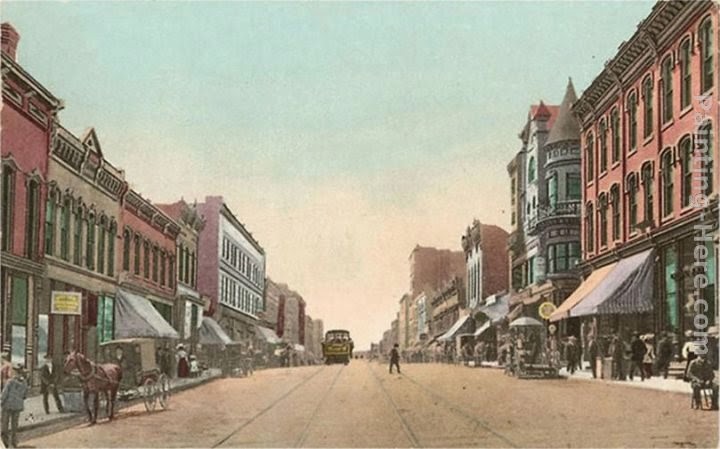
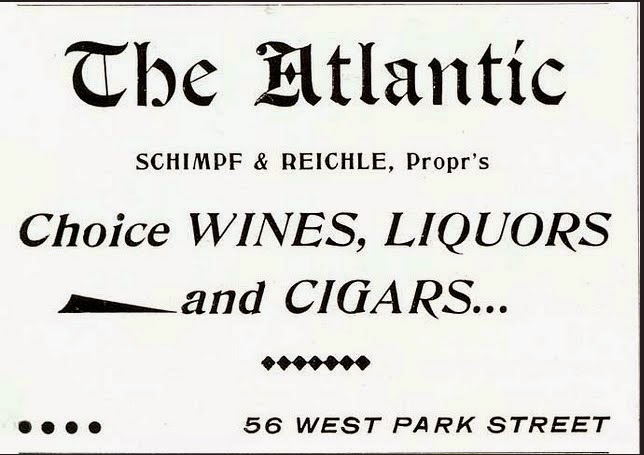
In 1895 Schimpf and Reichle partnered to open a enormous new saloon, one they called the Atlantic, located at 56 West Park Street. Shown above, Park was a busy commercial avenue in Butte and a prime location for a drinking establishment.   The partners advertised their establishment in the local press as providing “Choice Wines, Liquors and Cigars.” In a town filled with saloons, Schimpf & Reichle tried to make theirs stand out by creating “the longest bar in the world.”  The fuzzy newspaper photo that introduced this post shows part of the structure.  The Butte bar scene below shows another portion.
Observers attested to the extraordinary length of the Atlantic Saloon bar.  A correspondent to Collier’s magazine described how the “bar bridged the alley and extended unbroken from street to street, the longest bar in the world.”  Another Butte resident attested:  “It ran from Park Street to Galina Street…The goddam thing must have been 250 feet long.”  He added that the proprietors were very generous with their free lunches, including hot dogs, soup and even sample beers in three inch high glasses.  Schimpf and Reichle also were lavish with giveaway items like mini-jugs.

In time and with growing wealth the partners could afford large homes.  Hundreds of residences were erected on Butte's West Side during a building boom beginning about 1888 as the municipality progressed from a ramshackle mining camp of log cabins to an urban metropolis built from fortunes founded on mining.  The Reichles lived at 1107 West Mercury Street, far from the red light district in Butte.  In 1908 Schimpf bought a lot at 414 West Granite Street and built a house that still stands in Butte, part of the historic district.  Unusual among many  Victorian-style mansions, as shown below, it is a yellow Mission Style house with a stucco exterior, heavy square columns at the front and a distinctive roof pediment.

The partners ran the Atlantic saloon successfully for 23 years. When Montana voted to go dry on Dec. 31, 1918 — two years before National Prohibition — the Butte Evening News reported on the effects:  “…Liquor cannot be legally procured in Montana for love or money, not even sacramental wine…Meantime a saloon in Butte is as good as a copper mine.”   The paper went on to describe the intense business before the deadline occurring at the Atlantic Saloon and its acclaimed “longest bar in the world.”  A score of sweating Atlantic bartenders were serving between 3,000 and 4,000 patrons a day, according to the Evening News.  The paper  observed: “A man must almost fight to get a foothold on the rail.”  
Whatever the temporary spurt in business may have meant to Schimpf & Reichle, they were too wise not to know that it was the beginning of the end of their enterprise.  After Montana went dry the two dissolved their partnership and went their separate ways.  Schimpf initially relocated to Los Angeles but apparently not finding it to his liking, returned to Montana and built a home not far from Butte on Flathead Lake, shown below. He died there in March 1935 at the age of 64.
Reichle initially remained in Butte. The 1920 census found him there engaged in running a (dry) cafe and an ice and gas supply business.  With him were Eugenia and three of his children.  By the 1930 census, however, he had decamped to Los Angeles and was living there, apparently retired, with his wife and an unmarried daughter.  According to press accounts, from time to time Reichle returned to Butte to visit friends.  The 1940 census recorded him at his California home, age 78; Eugenia was still by his side.  According to a kinsman, he died in Los Angeles in October 1954 at the age of 92.
Was Schimpf & Reichle’s bar the world’s longest?   Through the years bars all over the planet have made that claim.  I have had a drink at the celebrated “Long Bar” of the Raffles Hotel in Singapore, but it was not 250 feet in length.  I am prepared to believe that with a reputed 15 to 20 bartenders serving customers behind a single counter stretching an entire block, the Atlantic saloon, at least in its time, may well have boasted the longest bar in America and possibly even the entire globe. 


Wednesday, February 4, 2015

The Benjamins: Jewish Whiskey Men in the Deep South

 
The “Deep South” does not get any deeper than Natchez, Mississippi, but any expected intolerance toward non-Christians and those involved in the liquor trade did not extend to the Benjamins,  father and son Jewish liquor dealers, both of whom rose to prominence in their Mississippi River town.  

As Prof. Marni Davis indicates in her book “Jews and Booze,”  Natchez appears to have been particularly appreciative of Jewish merchants in the business of selling alcohol.   She notes that liquor dealer and wholesale grocer Isaac Lowenberg was elected mayor of Natchez and Jewish saloonkeeper Cassius Tillman once served as sheriff.

The first Benjamin to enter this environment was Samuel Lewis (known as S.L.) Benjamin.  His welcome may well have been facilitated by his having served as a Confederate soldier in the Civil War.  S.L. was born in 1838 in Alsace-Loraine, then part of Germany, the son of Abraham and Sara (Ullman) Benjamin.  At 17 he left home on a sailing vessel that landed at New Orleans.  Almost immediately he headed to Natchez where his mother’s brother, Jacob Ullman, and family lived.  In the 1855 census, Jacob is listed as “merchant” and S.L. likely went to work for him.  Upon arrival in Natchez,  S. L. soon sent for and married his first cousin, Bettie Netter, the daughter of his mother’s sister.  


It was not long before S.L. became convinced with the rightness of the Southern Cause.  In 1862, leaving his bride,  he joined the Confederate Army and sent was up the Mississippi to help garrison a site called Grand Gulf, just downriver from Vicksburg, Mississippi, and a potential landing place for Grant’s Army marching on that key location.   Although a Union attack by sea on Grand Gulf, shown above, largely failed, S.L. Benjamin is recorded as having been captured during the battle and sent to a prison camp.  Although part of a prisoner exchange before the war was over, he apparently went back to Natchez and did not resume fighting. 

Upon returning home, S.L. and wife, Bettie, immediately set about having a family.  The first born was Phillip Ullman (known as P.U.) Benjamin in 1864, to be following rapid succession by Jesse, Beulah, Lillie, Leon, Helen, Flora and Hortence.  During this same period S. L. was establishing himself as as a wholesale dealer in liquor and cigars located in a store on Main Street in Natchez, shown here as it looked in the late 1800s.  In time the company would move to its own building on South Commerce Street.

In his 1983 history, “Jews in Early Mississippi,”  Author Leo Turitz extolls “the spirit and mind” of S.L. Benjamin, noting his keen interest in Jewish literature, his ability to draw and paint, and his historical interest in keeping careful records of Jewish congregational meetings and of gravesites in the “Old Jewish Cemetery.”   

Turitz also recounts a story that despite S.L. having fought for the Confederacy his treatment of blacks diverged from his Natchez fellow residents:“…S. L. and a local physician were walking together…A black man came toward them and stepped off the sidewalk and tipped his hat, saying ‘How do, Doctor; how do, Mr. Benjamin. In response Mr. Benjamin tipped his hat saying, ‘How do, George.’  The doctor turned to S. L. saying sharply, ‘ Mr. Benjamin, I do declare!  I never did see a white man tip his hat to a neg-rah!  Never saw such a thing in my life!’  To which S.L. replied blandly, ‘I just wanted to show I have as good manners as he has.’”

About the same time that S.L. relocated to Commerce Street,  his eldest son, P. U. Benjamin joined the business.  Their company had become the local agents for national brands such James E. Pepper and Harper whiskeys and Pabst Milwaukee beer.  Benjamin ads indicated that in addition to selling liquor, the company also dealt in “corks, playing cards and bar fixtures.”
 
In time the father largely retired from the liquor trade.  His eldest son seems to have take over its management in the late 1800s and eventually changed the name to P.U. Benjamin & Co.  The direction of the firm also changed, from selling largely to local saloons it turned to advertising vigorously for mail order sales from those Mississippi counties that had become “dry” under local option laws.  As one Benjamin ad openly stated:  “”Special attention given to orders from Prohibition Places.”  Mississippi, perhaps because of the overwhelming presence of Southern Baptists, was prohibition “central.”  Under local option laws, countries across the state one by one had gone “dry.”  But liquor from “wet” counties could still be imported by railroad express. So brisk and lucrative was the trade that the Benjamins would prepay express charges on all liquor orders of more than $3.00. 

Their ads also suggested that the Benjamins in their larger space on Commerce Street were “rectifying,” that is, blending and compounding their own whiskey on premises.  These they sold in jugs of varying sizes, advertising “P. U. Benjamin, Liquor Dealer, Natchez, Miss.” in letters not to be missed. The ceramics varied in size, from multi-gallon containers to smaller jugs with bail handles, as shown here.  Their ads indicated that they packaged their whiskeys in bottles of various sizes “to suit the demand." As shown here they included quart and pint flasks.  

As the Benjamin whiskey dealership was growing, so was the reputation of P.U. Benjamin in Natchez.  By 1905 he had risen to the position of chairman of the Natchez Fire Committee, responsible for an annual expenditure of $6,000 and in at least nominal charge of five paid part-time firefighters and 291 volunteers.  A Democrat as were most pro-Confederacy southerners, P.U. was an active participant in local politics.  His acumen was rewarded when he was elected secretary of the Natchez Party Committee, responsible for overseeing Mississippi laws in the validating of all candidates for local offices.   When William Howard Taft visited Natchez in 1909, despite being a Democrat,  P. U. Benjamin was made an official of the huge civic welcome given the President of the United States.

By the time of Taft’s visit, Mississippi in 1908 had voted to go completely “dry,”  virtually in lock step with Georgia, Tennessee and North Carolina.   Those states all were widely accused of the hypocrisy of  “voting dry and drinking wet.”  One Mississippi politician reportedly said that his state would remain dry “as long as its citizens can stagger to the polls to vote.” Indeed, Mississippi was the last to embrace repeal of the Constitutional Amendment that inaugurated National Prohibition and it ended total state prohibition only in 1966.  

The 1910 Census found the Benjamins in Ward 3 of Natchez. The family truly was an “extended” one.  S.L. and his wife, Bettie, were living with an unmarried daughter, Lily, and a married daughter, Helen, her husband, Moritz Kleisdorff, and their two children.  Household ages ranged from 71 to 4 years.  P.U., still a bachelor at 46, rounded out the clan.  With their liquor business terminated, father and son both listed their occupations as “merchants- tobacco.” 
 

Samuel died in 1918 at the age of 79 and was buried in the same cemetery where he had so scrupulously recorded the gravestones.  Bettie lies next to him with a scroll-like monument to mark the spot.  Phillip would follow his father to the grave only four years later, at 58 years, and was given a more more contemporary headstone featuring a deer’s head.   

One reviewer of Turitz's book who commented on early Jews in Mississippi might have been referencing the Benjamins of Natchez: “These Jews left a heritage of major business concerns….Their interest in religion, education, and the arts enriched towns and communities with schools, temples, and opera houses….The lasting influence of these men and women remains indelibly in the towns where they lived and worked.”