Saturday, November 19, 2016

William McRoberts: A Story in Five F’s

Escaping a brutal famine in Ireland, bringing slaves to freedom, experiencing two family tragedies while rising to become among America’s most notable distillers, while experiencing disastrous fires, and subsequently facing financial struggles, William McRoberts lived the kind of story from which novels are made.  


Famine: McRoberts was born in 1824 in Dundonald, County Down, now Northern Ireland, the bucolic village shown above located not far from Belfast.  His parents were William McRoberts Sr., the son of John McRoberts and Margaret McLean, and Anna Moore, a daughter of Robin Moore.  The family home was at Ballyoran.  Shown right, the McRoberts house was a substantial ivy-covered residence bespeaking some affluence.  Surrounded by six brothers and sisters, William likely knew a relatively tranquil childhood.

That picture changed abruptly in the 1840s while McRoberts was still in his teens.  The failure of the potato crop, the primary food staple of the Irish people, caused widespread starvation, death, and massive migration from the Emerald Isle.  The McRoberts family is said to have scattered over the world to Canada, the U.S. and Australia.  William was among those who came to America, likely aboard one of the so-called “famine ships,” that crammed hundreds of people into cramped spaces for a rough two-weeks on the Atlantic.  He eventually found his way to Cincinnati.

Freedom:  When McRoberts next surfaced in the public record he was working for a Cincinnati wholesale liquor house known as Boyle, Miller & Company.  Steven S. Boyle, like McRoberts, was an immigrant from Ireland. About 1853 he gave young William a job as a “drayman,” driving a horse-drawn wagon.  In this role McRoberts became a cog in the “Underground Railroad,” smuggling escaping slaves to freedom in the North and safety in Canada.

A key to freedom was crossing the border of slave states; the Ohio River was a major objective.  By the first decades of the 1800s, every state in the North had legally abolished slavery, including border states like Ohio, Indiana and Illinois.  Ohio had the most active escape network with around 3,000 miles of routes used by runaways.  It also was the closest state to Canada with only about 250 miles from the Kentucky border to Lake Erie and safety.

People who guided slaves from place to place were called “conductors.”  McRoberts was a conductor with excellent opportunities. Among his duties was traveling by horse and wagon over the Ohio River to nearby distilleries in Kentucky, bringing barrels of whiskey back to Cincinnati.  Somewhere on his return McRoberts would halt his team and another conductor would help him load a slave, or perhaps two, into whiskey barrels that he would then cart back across the river and offload at Boyle Miller.  After dark, the escapees would be spirited up to another “station” likely at Auburn Hills, Ohio, on the way to Canada.

What was McRoberts motivation?  My first assumption is that Steven Boyle was aware of the gambit and approved.  Both men were taking a risk. Boyle could have had his wagon, horses and cargo confiscated.  McRoberts would have faced fines, jail, and possible physical harm if caught.    William’s wife, Mary Harriet Conway, may have been an abolitionist influence. He had married her in Cincinnati in 1850, a Presbyterian minister presiding.  Recorded as Boyle’s drayman from 1853 to 1859, McRoberts had the opportunity to assist dozens of escapees until the outbreak of the Civil War that eventually ended the need for the “Railroad.”

Family:  The 1860 census found William, with his Irish-born wife, Mary Harriet Conway, living in Cincinnati with four children, three girls and a boy, ages 9 to 1; a fifth child, a boy, would be born later that year.  With them was William Conway, 14, attending school, a younger brother of Mary Harriet.  William’s occupation was given in the census as “clerk,” having been raised by Boyle to a position inside his whiskey operation.  By the following year, the obviously talented McRoberts had been moved up to foreman. He also must have been investing in the distillery.  Upon Boyle’s death in 1865 McRoberts became its principal owner in partnership with Hamilton Miller.

When the Civil War ended McRoberts wasted no time in expanding his distilling activities.  He built a second distillery near Latonia Station, on the Louisville Short Line & Kentucky Central Railroads, located about four miles south of Cincinnati.  Known on Federal rolls as RD #2, 6th District of Kentucky, McRoberts designated this plant the Willow Run Distillery. Much later he installed his son-in-law, Thomas Hewitt, as the manager. Under the leadership of McRoberts, who has been described as a “master distiller,” the fortunes of Boyle, Miller continued to rise.

Amid all this success, there was tragedy.  In January 1864 the McRoberts’ youngest daughter, Harriet only five years old, died of burns and was buried in Sec. 46, Lot 23, Spring Grove Cemetery.  Not long after, the date uncertain, Mary Harriet herself died, her burial place still unidentified.  This left William with four children under the age of 16 to care for.  Seemingly looking for a mother for his brood, he remarried in 1866.

McRoberts’ second wife was Ellen “Ella” Barker, the daughter of a highly privileged family from Peoria, Illinois.  Nineteen years younger than her husband, Ella had been sent to the exclusive Maplewood School for young ladies in Pittsfield, Massachusetts, and was accustomed to spending summers at a seaside cottage near Boston.  William may have met her through her father, Gardner Thurston Barker, a well-established Peoria distiller.  After the marriage Barker made McRoberts a partner in his company.  The couple would have two children of their own, both boys.  When his eldest son from Harriet Conway, Gavinus, came of age, William brought him into the distillery business.

In 1867  McRoberts bought seven acres on Grandin Road in the Walnut Hills area of Cincinnati.  There for $30,000 ($750,000 today) he built a large home for Ella and the children on what would become known as Cincinnati’s “Millionaires Row.”  As can be seen above, it was a spacious dwelling with a large wrap-around porch, doric columns and a mansard roof, forming a very attractive residential dwelling. 

Fire:  Fire was an ever present problem for liquor enterprises.  While McRoberts was still working as a drayman, a serious fire broke out at Boyle’s Wholesale Liquors, located at 53 East Second Street, recorded by the Cincinnati Firefighters Diary.  The loss from this blaze was set at $150,000, equivalent to more than $3.5 million today and three firefighters were hurt.  Without any real proof, it occurs to me that this fire could have been set.  Southern sympathizers called “Copperheads” were rife in Cincinnati and, if they had known about the company help to escaping slaves, might well have torched the building.

Just after Christmas 1867, with McRoberts in charge, fire visited the premises of the distillery, destroying the plant.  Its storage areas held 9,000 barrels of highly inflammable whiskey that fueled a fire so intense that the stone walls of the building crumbled.  The Spencer House hotel at the rear was seriously threatened but saved by fire crews. One firefighter was injured. The loss to McRoberts and his partner was set at $450,000, equivalent to more than $9 million today.  Although insurance paid $200,000, the remainder came from the owners’ pockets. 

Undeterred by this setback,  McRoberts immediately began to rebuild.  Only a few months later a newsman from the Cincinnati National Union visited the site and reported that:  “This establishment has, Phoenix-like, arisen from its ashes and is again in full blast and in complete running order.”  Introduced to McRoberts, who possibly escorted him through the distillery, the journalist was shown a enormous still in operation, the first of three scheduled to be installed.  He reported that the stills would make Boyle, Miller “the most extensive distillery in the United States.”

The reporter paid particular attention to the problem of fire:  “Although this portion of the building cannot be said to fire proof, extra and unusual precautions have been taken in its erection against probable fire.”  Among these were pipes in the walls extending from the first to fourth floors,a few feet apart. The ideas was that flames would be drawn through them like chimneys and escape at the top without injury to the walls.

Financial Struggles:  Those precautions proved unavailing.  In 1869 Boyle, Miller suffered a second major fire, again with great monetary loss.  This time McRoberts lacked the resources to rebuild.  He sought to recoup from the Federal government the amount he already had paid in taxes for the now destroyed whiskey, but was refused.  Prior to passage of the Bottled-in-Bond Act of 1897, distillers were taxed on product immediately after it was put in barrels and stored for aging.   Such taxes were a principal sources of federal revenue until a national income tax was imposed in 1913.  Eventually McRoberts sued in Federal Court for a refund.

Authorities were highly skeptical about claims from distillers experiencing fires.  In some cases, owners had been known clandestinely to cart their barrels to a new location, torch their plant, and ask for a refund on taxes paid.  While no such suspicion fell on McRoberts, the situation could lead to high tension.  In 1870 a Federal liquor gauger/inspector named Mohan had a confrontation with McRoberts, attacked him with a knife and was arrested.

Meanwhile, the Northern Irish immigrant was struggling financially.  By 1871, McRoberts’ partnership with Hamilton Miller had been dissolved and Boyle, Miller & Co. ceased being listed Cincinnati directories.  The same year he sold his Walnut Hill mansion and an indeterminate amount of acreage for what appears to  have been a “bargain basement” price,  With a partner named Todd, he retreated to Boyle’s former location at 53-55 East Second Street, running both a liquor store and a second enterprise, W. McRoberts & Co., listed as manufacturers of coloring and flavoring for liquors.  All the while he was paying lawyers in a vain attempt to retrieve his whiskey tax.

According to a descendant, during this period of financial struggle, Ella McRoberts began to spend more and more time in Peoria with her parents.  At some point she left for good, taking her two sons with her.  Whatever the emotional toll of this desertion, it pales with the suffering McRoberts met in July 1875.  While boarding a train he lost his footing and fell under the car.  The wheels passed over his leg and abdomen in what appeared to be a fatal accident.  McRoberts, however, survived almost five months with his injuries, dying at his home on McMillan Street in January 1876 at the age of 52.

His funeral was held at home, arranged by Thomas Hewitt and a friend and liquor dealer, Edmund Amann,   The Members of the Walnut Hills Knights of Pythias held a special ceremony in honor of their brother member the same day at their Castle Hall.
While his family and friends gathered at his graveside McRoberts was laid to rest in Section 46, Lot 23, of Spring Grove Cemetery not far from his daughter Harriet.  The family monument is shown here.

It is unclear whether Ella returned to Cincinnati for his funeral.  McRobert’s obituary makes no mention of her.  She continued to live in Peoria for the rest of her life, never remarrying, raising her sons and being active in community affairs until she died in 1923 and was buried near her parents.  With William’s death the family settled the long-running dispute with the federal government over the tax issue.

Within the space of a single vignette, it is scarcely possible to reflect the full character of an individual.  The years between McRobert’s arrival in the U.S. and working for Boyle in Cincinnati are largely a blank.  There are no clues to how William worked his way up from drayman to owner in just six years, or clues to his evident business sense and entrepreneurship.  It is unclear whether his financial struggles of the 1870s should be laid to the aftermath of the fire, to effects of the Panic of 1873, or to some other cause.  What we know of McRoberts, particularly his audacity and courage in helping escaping slaves, makes us want to know more.

Note:  This post was researched from a wide number of resources.  A vignette on the Amanns of Cincinnati can be found on May 6, 2017.


Tuesday, November 15, 2016

Was Boston’s Reuben Ring a Bad Actor?

Born into a well-known family of actors, Reuben Ring chose to sell whiskey for a living rather than perform on a stage.  Perhaps he had talent but lacked the necessary passion for the limelight. On the other hand, there were government authorities from Maine to Minnesota who strongly might contend that Ring’s business practices proved that he was, in truth, a bad actor.

Born in Boston in 1840 Ring sprang from a long line of ancestors famed in the British Isles as Shakespearean players.  His great grandfather, Charles Fisher, shown here playing Falstaff, came to the United States before the Civil War and journeyed with theatrical caravans as far west as the Mississippi River.  Fisher was married to Josephine Bowen, a noted American actress.  When he died in 1911 the New York Times headline read: DEATH OF CHARLES FISHER; HIS RECORD IS A LONG CHAPTER IN OUR STAGE HISTORY. HE DIED IN THIS CITY YESTERDAY IN THE SEVENTY-FIFTH YEAR OF HIS AGE -- HIS HONORABLE THEATRICAL CAREER -- PARTS HE PLAYED.


Reuben’s father was James H. Ring.  While not boasting so distinguished a career as Fisher, his mother’s father, James H. was a well-known comedian and actor who played for years with the Boston Museum acting company, so called because its early performances were held in the quarters, of the Boston Museum.  Shown above is a photo of a performance.  As the troupe’s leading comedian that may be James at far left.
The acting “bug” apparently never bit Reuben.  Although, as we shall see, the tradition carried on with later generations, this Ring sought other career paths.  When he registered for the Civil War draft in 1863, he gave his occupation as “clerk.” The 1870 census found him still living at home with his parents, a 30-year-old bachelor.  His occupation then was given as “gas pipe salesman.”  

At some subsequent point Ring went to work for a liquor firm that had been established on Elm Street in Boston before the Civil War.  The founder was Seth E. Pecker who featured a brand he called “Custom House Gin,”  a reference to the Boston landmark.  He is remembered for having sold his liquor in cobalt decorated jugs that today fetch fancy prices.  One is shown here.

By 1862 Pecker had moved to larger quarters at 39 and 41 Commercial Street.  There he hired as a manager, Frank O. Dame, turning the liquor house over to him by 1869.  Dame changed the business name to his own.  While staying at the Commercial Street address, he continued to sell Custom House Gin, and added proprietary whiskey brands “Club Old Bourbon”  and “Club A.A.” bourbon and rye.  

At some point, Dame hired Reuben Ring who by 1890 was spokesman for the firm.  Ring was quoted in Bonfort’s, a whiskey trade paper, commenting on the year just past at Dame’s liquor store and saying: “…In some respects it was the best year the house ever had.”  This prosperity was reflected in the larger Boston economic scene, the city shown here as it looked in 1890.  By now almost 50 years old and still a bachelor, Reuben married in 1891.  His bride was Annie C., a woman about his age who had a married son, Harry Delano.  The 1900 census found the Delanos living with the Rings.

By 1896, Frank Dame had exited the scene and Ring became the sole proprietor of the Commercial Street liquor house.  Reuben Ring and Co. continued to feature the two proprietary brands, as indicated by illustrations from the company letterhead. He also was pursuing aggressive business methods that were not always appreciated by local authorities.  Maine officially had gone “dry”  not long after the Civil War but individuals could order booze from out of state for personal consumption, but re-sale was illegal.  Despite that, many liquor retailers continued to operate there “sub rosa”.

In 1906 Reuben Ring & Company sent a shipment of liquor to Lewiston, Maine, via the Boston & Maine Railroad, the principal carrier of alcohol from New England suppliers into Maine.  The consignee was one “John Cram,” a fictitious name designed to trick authorities as to its true destination.  Somehow the train car in which the whiskey sat was moved from track to track, making retrieval difficult for the mysterious “Mr. Cram.”  After a little more than an hour had passed, local authorities, who had been tipped off, moved in and confiscated the liquor.  In a case entitled “State v. Intoxicating Liquors,”  the Supreme Court of Maine subsequently ruled that the seizure was illegal and returned the shipment to Ring.  Despite the railing of Maine newspapers against “Boston rum-sellers,”  Ring continued sending booze into the state.

The following year a physician and political figure named George L. Crocket wrote a lightly fictionalized account of what he intended to be an expose of the way liquor was dealt in Maine.  One character was called “Windy Bill,”  described as a teetotaler and Democratic Party operative.  While having a role in liquor enforcement,  Windy Bill “…all this time has been the soliciting agent for one of the wealthiest and largest liquor firms in Boston."  Crocket subsequently identified the firm as Reuben Ring & Company.  I can find no evidence of Ring retaliating.

Windy Bill is characterized as dealing with illicit Maine liquor dealers and putting all his orders through to Ring in Boston.  Custom House Gin sold for $3.25 a gallon, Club AA for $3.50, and Club Old Bourbon for $3.50.   One Crocket character remarks that in Maine a gallon of any of that hard stuff would cost six dollars. Windy Bill hints that the differential is a political payoff and he is in on the boodle.  Although nothing is alleged  about Ring getting kickbacks, the Maine monopoly obviously was lucrative enough.  

Although Minnesota was a markedly “wet” state, Ring managed to trigger an investigation there.  In 1908 the Hennepin County Attorney cross-examined officials of a local firm called Twin Cities Express Company, suspecting that it had been used as a conduit for the Boston dealer’s liquor without paying the required taxes.  As revealed in an interrogation of an employee, the express company owed a big debt to Ring.   Moreover, an agent of Ring’s named Reed had been inserted as treasurer of the firm and handled all the cash.  The County Attorney asked:  “What did your business with Ruben Ring Co. amount to?”  The reply:  “About $200 every two weeks.”  That would be equivalent today to $5,000.  It is not clear that any charges resulted from this investigation.

Was Reuben Ring a bad actor?  Lewiston enforcement officials would say so. Dr. Crockett would likely agree, as might the Minnesota county attorney.  The Boston dealer’s aggressive methods of selling his whiskey seems to have crossed the boundary of propriety in several places and at several times.  Yet in his home town, others would have demurred. In 1908, while still under investigation in Minneapolis, Reuben was appointed a Boston justice of the peace.  Earlier he had been made a director of the Fourth National Bank, a financial institution boasting $7,000,000 in deposits.

Although the Ring stage tradition seems to have skipped Reuben, his younger brother James produced a new generation of performers.  The most famous was a daughter, Blanche Ring.  Shown here, she was a singer and actress on Broadway and in Hollywood movies, active from 1887 until 1945.  She is remember for introducing such popular songs as “Come Josephine in My Flying Machine,”  “I’ve Got Rings on My Fingers,” and “Yip-I-Addy-I-Aye.”  

Blanche’s brother, Cyril Ring, had a career as an actor from 1921 to 1951.  By the time of his final appearance he had appeared in more than 350 films.  His most famous role was as a foil for the Marx brothers in their 1929 “Coconuts.” He is shown here in a still from that film with Harpo Marx.  Cyril also was the first husband of actress Charlotte Greenwood.

Two other nieces of Reuben Ring had theater ties.  Julie Ring, right, became a stage actress and married a British actor named Al Sutherland.  Their son, A. Edward Sutherland played in 37 films early in his career, beginning as a Keystone Cop in Tillie's Punctured Romance (1914), that starred Charlie Chaplin. Sunderland later turned to directing. Another niece, Frances Ring, married a popular stage and silent screen star named Thomas Meighan.  Thus was the Ring family thespian tradition carried on. 

As for Reuben Ring, the 1920 census found him living on Boston’s Commonwealth Avenue, a widower, with the stepson and his wife.  At 80 years old he was still listing his occupation as “liquor, wholesale.”  He died the same year and was buried in Mayflower Cemetery in Duxbury, Massachusets.  With National Prohibition now a fact, this was a last gasp for his enterprise.  His company and his brands disappeared forever.  But Ring, true to his nature as a “bad actor” clearly had never thrown in the towel to the “drys.”

Note:  I am indebted to an alert reader who gives his name as "Grif" for providing me in December 2020 with the information on Reuben Ring's place of interment.  Unfortunately there is no photo of his headstone on "Find a Grave."


Friday, November 11, 2016

The Great Booze Rush and Kaufmann Bros. of Toledo

In February of 1919, a judge struck down a Michigan prohibitionary law triggering a immense exodus of Detroiters sixty miles south to still “wet” Toledo, Ohio, to buy whiskey.  This event became known widely as “The Great Booze Rush.”  Among those ready for the thirsty Michiganders were Kaufmann Bros. & Co., well-established Toledo liquor merchants.

In February 1919, the Great Booze Rush made headlines across America. Michigan had been particularly draconian in enforcing its “dry” laws, typified by the photo here of a raid on an illegal still in downtown Detroit.   A Michigan law, pushed hard by Automaker Henry Ford, also had allowed authorities to confiscate liquor found in private homes.  When the Michigan Supreme Court found the law unconstitutional, the door was open for residents to buy liquor in nearby Ohio, free of search and seizure while bringing it back into the Wolverine State.  Although Ohio also had voted to go “dry,” the new law had yet to go into effect and Toledo, 60 miles from Detroit, was awash in booze.
As the Literary Digest magazine of March 15 put it:  “For several days of license, thousands of men and women packed interurban and railway cars, express wagons, motor-cars, and everything on wheels, for the purpose of carrying liquor in suitcases and valises….The sixty odd miles of road between Detroit and Toledo — the Dixie Highway, nicknamed ‘Avenue de Booze” were jammed with thousands of automobiles.”  Most of them, of course, had been made by Henry Ford. 
 

A photo indicates the kind of resulting traffic jams.  Prices for liquor in some Toledo stores is said to have doubled.  Again from the Literary Digest:  “…We are told, there was fear in the breasts of certain residents of that city that the stock would be so depleted as to be insufficient for the three remaining months of Ohio’s wetness. The rush continued.”

Among the destinations for the thirsty Michiganders was Kaufmann Bros. & Co. liquor house on Huron Street, established in 1895 by Nathan, Emil and Herman Kaufmann, all immigrants from Baden-Wurttemberg, Germany.   They were the sons of Herman “Herz” and Mina Rosenthal Kaufmann.   Nathan was the eldest, born in 1854, followed by Emil in 1856.  Herman was born in April 1863, seven months after their father at a young 42 years had suddenly died.

This family tragedy impelled Mina Kaufman with her three sons and two daughters, Marie and Rosa, to leave Germany for the United States.  The 1870 Census shows the Kaufmans living with the family of Joseph Rosenthal, Mina’s brother, in Washington, D.C., where Rosenthal owned a boot and shoe store.  Mina’s children, including Nathan, 17, were in school.   By the 1880 census, Nathan was living with his sister, Marie, in Toledo as boarders with the family of Albert Rosenthal, another brother of his mother, who was a wholesale liquor dealer.  Nathan, now 26, was working for him as a clerk.  

In 1892, Nathan returned to Washington, D.C., to be married.  His bride was Mary B. Baar, known as “Mollie.”  She had been born in the District of German immigrant parents Felix and Pauline (Meyenberg) Baar and and was nine years younger than Nathan.  The following year Mollie gave birth to a girl they called Hermine.  In 1896, a boy, Allan Lewis, followed.

Albert Rosenthal had six daughters and no sons to take over his Toledo liquor business and by the late 1880s had moved Nathan into a management position.  When Rosenthal retired from the liquor business at 120 Summit Street about 1894, he sold Nathan the store.  Nathan promptly asked his brothers, Emil and Herman, to join him in founding an enterprise that would bear the Kaufmann name.

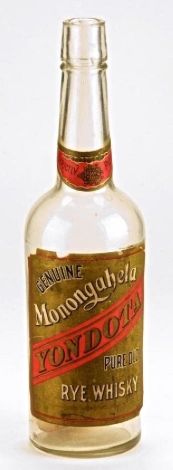
In addition to being wholesale liquor dealers, the Kaufmanns were “rectifiers,” that is, blending and mixing whiskeys to achieve specific taste and colors.  They issued a variety of proprietary brands that included:  "Bristol", "Claymore", "Esmond", "Holy Tree Gin,” "Log House,” "Lotus Club Rye,” "Port Industry,” "Pure 100 Special,” “Old Ringold,” “Ringold,” and “Yondota.”  They trademarked Lotus Club in 1893;   Claymore, Port Industry and Old Ringold in 1905 and Esmond and Yondota in 1906.   

This emphasis on trademarking indicated a interest in marketing their brands outside of the immediate area and throughout the Midwest.  Evidence of sales afar are in the colorful label shown here of Lotus Club Rye being sold by Fred Schiek a Minneapolis liquor dealer cum restauranteur in the pre-Prohibition era.  [See my post on Schiek, January 2014.]

The brothers’ flagship label was Lotus Club, a brand upon which they lavished particular attention.  Several variations of fancy jugs are known in which the Kaufmann’s marketed this whiskey.   Those containers were purchased from the Fulper Company of Flemington, New Jersey, a pottery that used a firing process to apply the hand-painted flowers and gold lettering and trim.  These were more expensive than traditional ceramic or glass containers and often were specialty items for the Christmas season. 

In keeping with the tradition of whiskey wholesalers and rectifiers, Kaufmann Bros. issued advertising items to saloons, restaurants and other drinking establishments carrying their whiskeys.  Shot glasses were a particularly favored gifting item by Toledo liquor dealers.  Shown through this post are a variety of shots, marketing Ringold, Old Ringold, and Yondota Rye whiskey. 

The 1900 Census found Nathan and his family living in Toledo, their household also involving an uncle, Isaac Rosenthal, who was working in the liquor store.  Both brothers had married, Emil in 1892.  His wife was Marie, and the couple had two children, Harry, born in 1887, and Albert, born in 1890.   Herman married a woman named Rosa.  No children were listed for this couple.

Meanwhile, the brothers were operating a very successful liquor house. Unlike Cincinnati where whiskey-making and selling was a major industry, Toledo had no major distillery and only seven or eight whiskey rectifying and  bottling wholesalers.  Summit Street, however, was a center for the liquor trade.  A Sanborn fire insurance map shows 120 Summit surrounded by at least three other whiskey sales establishments.
 
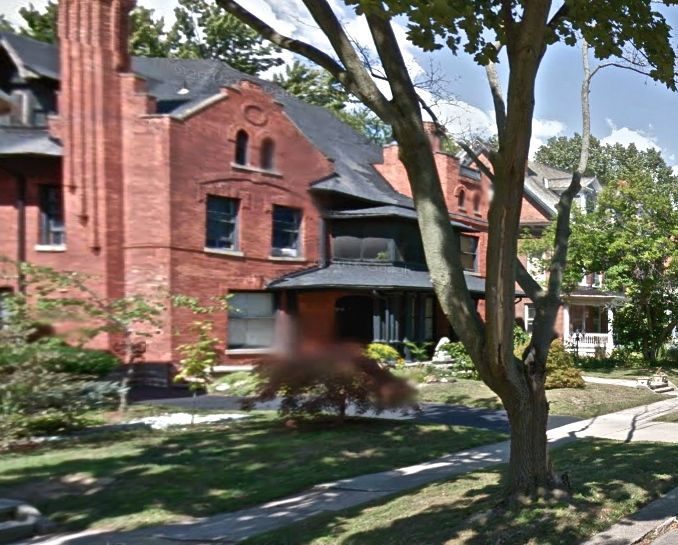
Needing larger quarters for their rectifying operation and wholesale sales, the Kaufmanns moved their operation from Summit to 129-131 St. Clair Street about 1900 and eventually to 130-132 Huron Avenue, the final address.  From their profits, Nathan was able to buy Mollie and his children a large home in Toledo’s “Old West End” at 2114 Scottwood Avenue.  Shown above,  Nathan’s home was his castle, with a mansard roof, turret windows and imposing chimneys giving it a fortress-like aspect.  The 1910 census found him living there with wife Mollie, their two minor children, Mollie’s mother and sister, and two female servants.

Unfortunately Nathan did not have much longer to live.  While still engaged in the liquor trade, in August 1912, only 58 years old, he died.  With his extended family grieving at the graveside, he was interred in Section 13 of Toledo’s Woodlawn Cemetery.  One publication, noting Nathan’s death, called him a “communal worker and merchant.”

Emil and Herman proceeded on with Kaufmann Bros., operating much as their brother had before them, but with the added challenges of facing prohibitionary forces.  It was those brothers who welcomed the Detroiters during the 1919 Great Booze Rush.  While it must have been gratifying to sell great quantities of their liquor stock, the experience must have been bitter-sweet for them, knowing that within weeks they too would be forced to stop liquor sales and shut down Kaufmann Bros. when Ohio also went “dry.” Lotus Club and their other brands would disappear.


Emil died in 1920 at the age of 64 just as National Prohibition was being introduced.  Herman lived to see the entire 14 years of the “Great Experiment,” dying just as Repeal was voted in 1934.  He was 71.  The three brothers are buried near each other in Woodlawn Cemetery.  A family monument marks the place.   

Meanwhile, the Great Booze Rush had become part of  American whiskey history and lore.  It took only three days for Federal and State authorities to re-impose legal and administrative control over the importation of liquor from Ohio to Michigan.  The long  parade of cars on the Dixie Highway ended just a quickly as it had begun.  Said the Literary Digest:   “This last carnival of booze-running drove the last nail in John Barleycorn’s coffin….” 


Monday, November 7, 2016

George Carragan, the Money Man of Cook & Bernheimer

The Cook & Bernheimer Company was a New York City liquor wholesaler that distributed its whiskey in the United States from 1863 until 1917 and the coming of National Prohibition.  The firm boasted branch offices from coast to coast.  It marketed dozens of national brands, controlled the production from several distilleries, and made the first American investments in Scotch whiskey.   Behind this liquor behemoth was George B. Carragan, a New Jersey grocer turned financier.

Carragan represented a major change that occurred in the liquor trade late in the 19th Century.  New York money men became increasingly aware of profits to be made selling whiskey and financial opportunities for themselves.  Paris, Allen, about whom I have written in several prior posts, was one such investor, targeting distilleries.  Carragan invested in a liquor distributor, a firm that traced its origins back to the Civil War and eventually boasted a nationwide customer base. While not owning distilleries outright, through contracts Cook & Bernheimer insured a steady supply of product by purchasing the total output of distilleries. 

The “money man,” George Carragan, was born in Saratoga Springs, New York, in March 1844, the son of James and Mary Vanderwerker Carragan, a surname of Welsh origin. He was their third child and second son.  His maternal great-great-grandfather was Rip Van Dam, one of the early members of the New York Colonial Council and subsequently Governor of New York.  His father was a farmer and George grew up on a farm.

 After being educated in the public schools of Saratoga Springs, Carragan moved to Bayonne, New Jersey, apparently more interested in city life than agriculture.  There he eventually opened a grocery store in a building owned by an uncle.  It was described as a "general dispensary of  groceries, clothes, tobacco, farm utensils, drugs, paints, wet goods [read liquor] and every conceivable kind of merchandise needed by the farmer or fisherman.”  

Calling his mercantile enterprise Geo. Carragan & Co (later, George Carragan & Bro.) within two years he had built his own store several blocks away on 31st Street. It was a frame structure with a mansard roof that the Bayonne Herald hailed as an “ornament to the city.”  The newspaper went on to call the store “the grand emporium of Bayonne.”   George made use of the floors above the grocery, renting out two floors to the fledgling municipal government of Bayonne.

During this period, Carragan married.  His wife was Margaret Vreeland, a member of an old and well known New Jersey family. They would have one daughter, Ella.  While making Bayonne his home for the rest of his life, Carragan was expanding his horizons to New York City, nine miles away.  He went to work as an sales manager for the Big Apple-based Shieffelin Drug Company, over time becoming a manager and major investor in the company.  

By 1900 Carragan had built a reputation as New York financier.  He was the “financial head” of August Kress & Co., importer of grocer specialties; headed the wholesale commission house of R. B. Poucher & Co; and co-owned Carragan & Tilson, a New York company that manufactured badges, rubber stamps, stencils, and seals.  Back in Bayonne he was a founder and director of the Mechanics Trust Company and later the First National Bank.  Said his biographer:  “These various business associations indicate in a small measure Mr. Carragan’s ability and success as a financier.”

When Carragan engaged with Cook & Bernheimer is not clear.  Founded in 1863, the company had been in business for a number of years before he became involved, investing in it and becoming president. I have been unable to find information about Cook but Meyer Bernheimer, perhaps a son of the founder, was listed as a officer in 1910.   Carragan apparently was on board by the late 1890s when the company had a burst of energy, operating from a large building at 144-150 Franklin St. in Manhattan, shown right, and opening offices around the country: Chicago on Wabash Avenue in 1897, a year later in Cincinnati, San Francisco and Terre Haute, Indiana.  In 1900 Cook & Bernheimer took a gold medal for whiskey at the Paris Exposition.

By this time the liquor house was merchandising a blizzard of brands, including  “Diadem,” "Hoffman House,” “Gold Lion Old Whiskey,” “Joke,”, "Lenox", "Long & Short,” "M. V.,” “Manhattan,” "Mantoue's Upper Crust Rye,” “Monarch,” “Old Private Stock Rye,” ”Monongahela A,” “Navahoe,” "Old Berkshire,” "Old Woodburn,” ”Province,” and "St. Anthony” whiskeys as well as multiple gins.  Cook & Bernheimer’s flagship was “Old Valley Whiskey,” first registered with the government in 1872 and when trademark laws were strengthened again in 1905.  Liquor labels and other artifacts are shown throughout this post.
Cook & Bernheimer also had obtained an exclusive contract to bottle and distribute Mt. Vernon Whiskey distilled by the Hannis Company of Baltimore and Philadelphia, outbidding a Baltimore grocer and liquor dealer named George W. Torrey [See my post of October 2013].  This national brand was easily recognizable for its square bottle.  The company also commanded all or part of the output of other U.S. distillers in Pennsylvania, New York, and Maryland.  In 1905 Cook & Bernheimer took control of the Dalwhinnie Distillery in the Scottish Highlands, marking the very first U.S. investment in the Scotch whiskey industry.
The Scottish adventure ended in 1920 with the imposition of National Prohibition when all legal sales of alcoholic beverages in the U.S. were forced to cease.  After more than a half century of successful operation this juggernaut among liquor houses closed its doors for good.  George Carragan lived on another five years, dying at the age of 81 at his residence at 39 East 33rd Street in Bayonne.  The cause given was septic poisoning.  With Margaret grieving at his gravesite he was interred at the Bayview-New York Bay Cemetery in Jersey City.  His widow joined him there five years later.  Their monument is shown here.
The last word I will leave to Cornelius Burnham Harvey who in his 1900 tome, Genealogical History of Hudson and Bergen Counties, New Jersey, had this to say about George Carragan: “He has been eminently successful, and through his efforts has built up a reputation for integrity and uprightness of character which is recognized by all who know him.”


Thursday, November 3, 2016

Joseph Leopold Brought Seven Belles to Belleville


Pity Joseph Leopold of Belleville, Illinois.  Each time his wife was pregnant, he hoped for a boy, a son and heir to inherit his thriving whiskey business.  Time after time, however, the doctor would emerge from the delivery room to announce:  “Its a girl!”  In the final tally the Leopolds would have seven daughters — seven belles in Belleville.  No sons.


The benignly smiling gentleman shown here, Leopold was born in Belleville in 1859, the son of Joseph Sr. and Philippine Rosche Leopold.  Both his parents were immigrants and early residents of the town, his father, a hotel keeper from Alsace-Lorraine; his mother a native of Bavaria.  Joseph Jr.  was educated in local schools and in the 1880 census listed working as a delivery clerk. That occupation was not to be his life.  While still a very young man he partnered with his brother Edward in a wholesale liquor house.  They called it “Joseph Leopold & Bro.”  

In addition to being their home town, the brothers had picked a good location for their business.  By 1870 an estimated 90% of Belleville’s population was either German born or of German descent.  Many were Roman Catholics, Lutherans and other denominations not adverse to alcoholic beverages.  Moreover, after the Civil War Belleville became a manufacturing center producing nails, printing presses, agricultural equipment, iron castings and stoves, becoming known as “The Stove Capital of the World.”  The largest town in Illinois south of Springfield, a port on the Mississippi River, and the seat of St. Clair County with its many productive coal mines, Belleville was thriving economically.  In other words, it was a good place to open a liquor dealership.

According to contemporary reports, the Leopolds’ enterprise grew rapidly, said to be doing business “on a large scale,” importing more than 80 different kinds of liquor, wine and cordials, as well selling American brands.  They also supplied customers with their own labeled whiskey, likely brought in by the barrel from Kentucky and decanted into jugs of three, four and five gallons.  Most ceramics featured an under-glaze label with an Albany slip top and Bristol glaze body and the motto, “Fine KY. Whiskies.” 


Several variations of labels can be noted on the examples shown here and below. Those containers would have been sold to saloons, restaurants and other establishments.  For retail customers the Leopolds featured a proprietary brand called “Camp Springs Whiskey,”  likely a blend, and “Blooming Valley Pure Rye.”  They never bothered to trademark either name.
In October 1883, at the age of 25, Joseph married.  His bride was Margaret, called “Maggie,” Rhein, the daughter of Frederick and Charlotte (Nenninger) Rhein. Maggie was a member of a well-established local pioneer family.  Her grandfather, Fred Rhein, a native of Rheinpflaz, Germany, came to the United States in 1839 and settled on a farm outside Belleville where he became known as a stock-raiser and dealer.  This farm of nearly 1,000 acres remained in the Rhein family. 
It can be assumed that like most men Joseph Leopold was keen to have a son.  If their business was successful as Leopold’s was, whiskey men were anxious to pass the enterprise on to a male heir.  The history of the trade is replete with stories of sons, as soon as they reached 18 or so, being brought in by a father as a clerk or salesman and taught the business with the expectation of the next generation ultimately taking command.  We can imagine Leopold’s sense of expectation with Maggie’s first pregnancy in 1886.  “Its a girl,” announced the doctor, however, and Elsa joined the family.

The next year August brought Meta to the fold and in September 1889, Alvina.  Three years later the three girls were joined by a fourth, Ophelia, and in 1893, a fifth,  Anie.  As Leopold likely grew more and more desperate for a boy child, he kept hearing, perhaps even in his dreams, “It’s a girl.”  Accordingly, number six, Anita, was born in January 1896 and Marguerite, the last, in March 1898.  The Leopolds had given Belleville a family of seven daughters.  Whatever disappointment Joseph may have felt must soon have been assuaged by the attention girls traditionally lavish on their fathers.  He reciprocated by providing them with a beautiful, spacious home at 112 North Pennsylvania Avenue in Belleville, shown below.

Leopold’s sorrow over not producing a son may also have been lessened by the rise of the “dry” forces in America.  The Temperance Movement in Illinois had its start around 1833 and grew stronger over the years.  By early in the 20th Century, the General Assembly had passed a local option law, allowing cities and counties to ban alcohol.  While Belleville stayed “wet,” surrounding areas were affected and as a result Leopold found his customer base gradually shrinking.  When National Prohibition took hold in 1920, he was forced to shut down Joseph Leopold & Bro. forever.

Although Leopold lived long enough to see Repeal, by that time he was 75 years old and retired.  His brother and partner, Edward, had died in 1929.  Joseph was living in the family home with Maggie.  One daughter had died and others were married, providing him with grandchildren and even two great grandchildren upon whom to dote.  Maggie died in 1939.  Joseph himself had been in failing health, but continued to be active.  His obituary of June 13, 1940, told the story:  “Joseph Leopold, 80-year-old prominent retired wholesale liquor dealer died suddenly of a heart attack at 1:30 o’clock this morning in his home….”

His funeral was held at his home, with the Rev. B. J. Koehler,  pastor of St. Paul’s Evangelical Church, officiating.  With an escort from his fellow members of the Belleville Lodge of the Benevolent and Protective Order of Elks, he was carried to Walnut Hill Cemetery where he joined his wife at  Annex 9, Block 8.  Among those gathered at graveside were six of the seven “belles” Joseph and Maggie Leopold had presented to Belleville.