Tuesday, March 5, 2019

The Schmidt Liquor House Was All About Family


In 1899, a commercial review of the Pittsburgh area enthused about the liquor business of George W. Schmidt, one that had been founded by his father: “…It has come to a golden epoch in its history as a progressive house in Western Pennsylvania.”  Not many years later, however, Schmidt, shown here, was filing for bankruptcy having diverted today’s dollar equivalent of almost $1.2 million from the corporation to other purposes.  Those with the most to lose, however, did not care:  They were family.

The Schmidt liquor interests long had been a family affair.  William Schmidt had established the business in 1836 at 409 Penn Avenue in an area called Bayardstown.  In those days liquor and wine had to be shipped into Pittsburgh via sailing vessels to New Orleans and then brought upriver on the Mississippi and Ohio Rivers.  With the construction of the Pennsylvania Canal network it became possible to receive shipments by canal boat from New York and Philadelphia.  According to the review:  “The journey from the wine cellars of Europe to this city then consumed from four to six months, while at the present time by steamer and the use of cable, it requires about fourteen days for the filling of an order.”

William ran the Schmidt liquor enterprise until 1854 when management was taken over by his son, Joseph, who is recorded as having run it until 1865.  At that point a second son, George, just 19 years old, took charge. He is shown above in a portrait done when he was about 35. He had been married the year before the painting. His bride, Ellen, a Pennsylvania woman of Irish Ancestry. was fourteen years younger, according to census records.  The couple would have nine children over the next twenty years, one of whom died in infancy.  

Upon George’s accession to the liquor trade, he took a partner, William J. Friday, an older Pittsburgh local with a background as a distiller and wholesale liquor dealer.  Their collaboration over the ensuing years proved to be highly profitable. After several moves to larger quarters, they took over a building at 384 & 386 Penn Streets.  This three story structure provided the partners with ample room to store rye and bourbon whiskeys and additionally allowed them to “rectify,” that is, blend, their own brands on premises, including “1855 Pure Rye,” “McKim’s 1860,” and “Old Columbia.”

The need for more space continued to press the partners and in 1885 Schmidt determined to build a new building to house the enterprise.  Accompanied by considerable hoopla, the company opened there on May 24th, 1886.  The Pittsburgh Press headlined: "Formal opening of the Schmidt Building," "Colossal Establishment," "A Triumph of Architectural Art Blended with Mercantile Enterprise."   Shown here, the building was located on Pittsburgh’s principal business street, Fifth Avenue.   It was eight stories high.  The cellar, first floor and a connecting four-story warehouse in the rear were occupied by the liquor house.

The upper stories were divided into some ninety offices.  The Press story called the building Schmidt’s “cherished dream” and:  “…The finest structure in the land devoted to the wholesale wine, liquor and cigar business….It has been erected at great expense and in the most thorough manner, with the sole purpose of making a superior office building and perfect in all its appointments.”

A decade after the move, however, the partnership of Schmidt and Friday broke up.  William Friday opened his own wine, liquor and cigar sales at 630-633 Smithfield.  What precipitated the split is not clear but given the subsequent money problems that embroiled Schmidt, it may well have involved differences over financial management of the firm. 

With Friday gone, a new letterhead was rolled out for the business. Moreover,  the owner’s son,  George W. Jr., was now working for his father, being trained in the liquor trade and groomed for management.  This period saw the liquor house issue its blended whiskies in large ceramic jugs with Schmidt’s name stenciled on them and the emergence of a new brand, “Fine Old Rye Whiskey,” shown right with its elaborate paper label.  The company was advertising itself as “The largest and most complete Wine and Liquor House in the United States.”

With the departure of Friday, the company also incorporated.
Directors all were members of George’s family, including Ellen J., his wife; Mary Ann, his daughter; George Jr., and Mary Fuherer, his married sister.  The liquor house was capitalized at $150,000.  Among the assets was the Fifth Avenue building, on which a large mortgage was owing and $35,000 in whiskey stocks in warehouses.  Shortly thereafter, however, business began to turn sour apparently forcing Schmidt to draw money to pay creditors out of the corporation to the tune of $52,213 (equiv. to almost $1.2 million today).  Eventually the situation led to his filing for bankruptcy.

These withdrawals might have gone unremarked as the bankruptcy proceeded had it not been for J. F. Erny, a cashier at Pittsburgh’s German American Savings and Deposit Bank who saw a chance to make a quick buck.  He enticed the bank to sell its 50 shares of liquor company stock to him for $100, then sued Schmidt and the other directors — the family members — claiming the $5,000 face value on the certificate.  Erny’s case centered on the money Schmidt had taken out of the corporation, an act he characterized as fraudulent.

The Supreme Court of Pennsylvania dismissed Erny’s case.  The judges noted that Schmidt’s withdrawals were part of his effort to save his business and only a minor amount had gone to “private purposes.”  Moreover, the owner had kept strict accounts of the withdrawals and their rationale, and that the directors (family members) were completely in favor of his efforts.  Erny had bought the shares two years after the bankruptcy, the court pointed out, and had no cause for complaint.  It charged him and fellow plaintiffs court costs.

Nevertheless, the bankruptcy proved extremely costly to Schmidt.  The building that he had so carefully designed and that once bore his name had to be sold.  Stocks of aged whiskey that he owned were required to be sold at a fraction of their value to pay off creditors.  With his family still behind him, however, George persevered.  He moved to a smaller space in the Bessemer Building on Duquesne Way at Sixth (Federal) Street, shown here, and continued in the whiskey trade.  

In April 1905 another blow fell on the Schmidt family.  The eldest son and heir apparent to the liquor business, George Jr., died, only 30 years old.  He was a veteran, having served as with Company H of the Pennsylvania Voluntary Infantry in World War One.  A younger son, Erhard, was taken into the business and eventually raised to the position of vice president. 

Schmidt continued the business strategies that once had proved so successful. To match the competition for liquor sales in Pittsburgh, he issued shot glasses with his Bessemer Building address.  For 1918 Christmas holidays he issued an attractive painting under glass flask featuring a comely young woman.  It may have been farewell gesture because within months he had closed down the George W. Schmidt Co. and retired from the liquor trade.

This whiskey man lived another twelve years, until 1930 — long enough to see National Prohibition imposed but not repealed.  Age 86 and plagued in his latter years with a chronic heart condition, Schmidt was interred in Pittsburgh’s at the family plot in Section N of St. Mary’s Cemetery.  George’s grave is adjacent to his son.  His wife, Ellen, would join him there nine years later.

The Schmidt liquor house, despite taking blows, survived from 1832 to 1918.   From the founder, William, down through Joseph and on to George, the House of Schmidt experienced the Civil War, several 19th Century financial panics, and most traumatic of all, a bankruptcy.   A twenty year run usually meant success for a liquor house.  The Schmidts’ enterprise survived for 82. The reasons for its longevity were rooted in the fabric of the Schmidt clan.  It truly was all about family.

Note:  The material for this post was gathered from numerous references, with the principal one — and the source of all quotations —  the "Pittsburgh and Allegheny Illustrated Review: Historical, Biographical and Commercial,” published by J M Elstner & Co., Pittsburgh, PA., in 1889.


Friday, March 1, 2019

Geekie Knew How to Make Lady’s Blush

     
“Often times the weary traveler desired a somewhat stronger potion than mineral water, he could stop in the establishment of Charles W. Geekie’s at Number 123 Baltimore Commons (street) and purchase a decanter of “Lady’s Blush” to satisfy his thirst.”  — From a historical guidebook to Baltimore.

The Geekie family harbored an inventive streak and Charles’ claim to fame lay in a cocktail he contrived in his saloon and billiards parlor.  He dubbed it “Lady’s Blush.”  It was an alcoholic drink whose main ingredient was creme de noyaux, which, translated from the French, means “cream of pits.”

The liqueur is well named.  Although almond flavored, creme de noyaux is made from the kernels within the pits of apricots, peaches and sometimes cherries.  Those kernels also contain elements of hydrocyanic acid, better known as cyanide, a deadly poison.  Although cyanide was not present in dangerous amounts in Geekie’s “Lady’s Blush,” if bottles of creme de noyaux are left for years in a cellar all the cyanide can float to the top with fatal results for the first imbiber.  Nonetheless, some have attributed medicinal benefits to the liqueur.

The assumption is that Geekie was well aware of the dangers and benefits.  Born in Scotland in 1819,  at the age of 18 Charles emigrated with his father from his homeland to the United States, settling initially in northern New York.  Shown here as a youth, Geekie early demonstrated a wanderlust, recorded as working in hotels in New York, St. Louis, New Orleans, and Chicago over the next 22 years. 

At the age of 40 in April 1859 the peripatetic Scotman was wed in Philadelphia to 19-year-old Mary Pauline Shaw, a Pennsylvania native.  His marriage and the birth of a daughter not long after seems to have curbed his travels. The couple would go on to have 12 children over the next 26 years.  

Geekie settled his family in Baltimore about 1860.  He had saved enough money to open a liquor business at 123 W. Baltimore Street, the avenue shown above.  Says the Baltimore guidebook:  “During the 1860’s, Master Geekie operated his billiard saloon and sold liquors wholesale and retail where travelers to our fair city could seek both recreation in a game or two of billiards along with a drink to calm their trembling nerves.” 


That drink might have been a “Lady’s Blush” since Geekie provided multiple incentives, issuing tokens in both brass, above, and a zinc amalgam known as “German silver” that provided five cents toward purchase of the libation.  For favored customers he also provided an official looking paper token good for a 25 cents toward a Lady’s Blush or “fruit cobbler” or rum cooler.  Mixed drinks were Charles’ speciality.

Still exhibiting his restlessness, after 16 years promoting Lady’s Blush and about the time of the birth of his seventh child, Geekie quit his liquor business, pulled up stakes and moved his family to Kent County on Maryland’s Eastern Shore.  There he took up raising livestock.  He and Mary may have decided that the fresh breezes and open spaces of farm life was more salubrious for his children than the city air of Baltimore.  Two more children were born there.

The record is scanty about Geekie’s experience with livestock.  He is listed as having bought a prize cow named Rosa Shepherd from W. Shirley but nothing further.  Nor was this agricultural stint to take his attention very long.  Within six years Geekie had returned to Baltimore and the whiskey trade, opening a new saloon and liquor house.  For two years he did business at 6 South Charles St. and then apparently needing more space in 1884 moved to 3 North Liberty.  Meanwhile he was grooming two sons, Frederick (“Fred”), and Charles Junior in the whiskey trade.


In April 1892, Mary Geekie, age 52, died, her youngest child still only six years old.  Although her husband continued to run his business, he too died in October of the same year, age 72.  Fred and Charles Jr. continued to run the saloon and liquor sales, changing the company name to Charles Geekie’s Sons, as shown above on a letterhead.  

In the meantime, Charles Jr., was carrying on the family tradition of invention.  Just as his father had given the world the Lady’s Blush cocktail, this Geekie owned patents for mechanical devices he had invented.  Perhaps the most interesting was a contrivance for sealing a bottle to prevent its contents being tapped by an interloper.  It was just the thing in which a saloonkeeper like Geekie might have had a personal interest.  Shown here, his stopper seems unduly complicated, involving a perforated tube, a second tube as a valve cage, a third tube as a valve, and a cork at the mouth.  While the Geekies might have employed the device in their Baltimore establishment, there is no indication of commercial production.

In 1914, Fred died, leaving Charles Jr. to run the Geekie enterprises.  As the coming of National Prohibition became more and more evident, the son shut down the business for good.  With the demise of the firm came the end of the elder Geekie’s celebrated libation.  The cocktail recipe seems to have disappeared along with Charles W. Geekie Sons Company.  Today, as shown above, Bols still makes the deep red “creme de noyeux,”  but it gives no instructions on how to make “Lady’s Blush.”


Monday, February 25, 2019

“White Beaver” and His Alcoholic Nostrums


Forward:  It may be a stretch to call Dr. Frank Powell, aka “White Beaver,” a whiskey man—but only slightly.  A medical school graduate, comrade of Buffalo Bill, Western hero of dime novels, and inventor of patent medicines, Powell was peddling nostrums, more alcoholic than most whiskeys.  Moreover, his story is so bizarre as to merit telling.

Many a boy, fetching the dime novel hidden in the corn crib, thrilled to the adventures of “White Beaver” as in story after story the hero overcame all odds to best his evil enemies.  White Beaver, in reality Dr. Frank Powell, found one adversary too strong:  It was the federal Food and Drug Agency that declared fraudulent the heavily alcoholic patent medicines that the doctor had invented and sold.

Born in a Kentucky log cabin in 1845, David Frank Powell was the son of a physician of Scottish descent and a mother who was half Seneca Indian.  When his father died at an early age, his mother took him and his brothers to live in New York State during the Civil War.  During the postwar period, the Powells moved to Chicago where Frank went to work as a drug clerk and then on to Nebraska.  In 1868 he entered medical school at Louisville University in Kentucky graduating at the head of his class.

While in Nebraska, Powell had met Buffalo Bill Cody, Wild Bill Hickok, and other figures of the old West.  After graduation he went back to the state and was named to a government post as surgeon in the Department of the Platte and later made Medicine Chief of the Winnebago Indians.  According to legend, Frank got his name, “White Beaver” from riding into the camp of a hostile group of Indians, in order to inoculate the residents against small pox.  Others say he got it by rescuing a Sioux princess.  Regardless, he embraced the title, let his hair grow long, and began to polish his legend.

During this period he also had become reacquainted with Buffalo Bill.  An excellent marksman, Powell from time to time provided Cody’s touring show not only as a doctor but also a sharpshooter.  Shown here is a photo of the two (Frank right) as they looked in their touring days.  With his Indian nickname, his time in the West, and his association with Buffalo Bill Cody,  Frank Powell was a natural for dime novel fiction, a boom business in the late 1800s and early 1900s.  The stories were about his “daring do” against a string of fictional adversaries.  

Powell is depicted here on the cover of Beadle’s Dime Library, on the trail of evil-doers.  Among his titles were “White Beaver, the Indian Medicine Chief: the Romantic and Adventurous Life of Dr. Frank Powell;” “The Wizard Brothers, or, White Beaver’s Red Trail,” that also featured Powell’s brothers; “Buffalo Bill’s Sharpshooters, or, the Surgeon Scout to the Rescue;” “Buffalo Bill’s Swoop, a Buffalo Bill and Surgeon Frank Powell Adventure.”   Although some stories  were attributed to him as author it is doubtful that he wrote any.

In fact, much of the time Powell was working as a small town doctor in placid LaCrosse, Wisconsin.  By now divorced and remarried, he also was putting his energies into mixing up and marketing a series of patent medicines.  This was an era when Indian remedies were very popular with the American public and Dr. Powell was quick to jump on the bandwagon.  Buffalo Bill helped him by investing in manufacturing the nostrums.  

Best known of these concoctions was “White Beaver Cough Cream.  The cough cream was described as:  “A soothing compound of lung healing root and herb juices, an unrivaled remedy for the cure of coughs, colds, croup, pleurisy, bronchitis, and all other diseases of lungs or bronchial tubes.”  Fifty cents would buy a generous helping of the cream in an apothecary type glass jar with a removable top.  Smaller amounts came in clear embossed flask-shaped containers.  

In his advertising Powell often used testimonials.  W. G. Smith of Mahias, Michigan, opined on the cough cream:  “I consider it the Best Cough Medicine in the Country.”  N. F. Wetmore, a M.D. from North Freedom, Wisconsin, hailed it for “excellent satisfaction.”   Another potion was “White Beaver’s Wonder Worker” said to “instantly relieve either internal or external pain.”  A third product Powell dubbed “Yosemite Yarrow.”

Although for a time the remedies sold well, with Frank regularly visiting Milwaukee and other larger cities in Wisconsin and neighboring states to push his merchandise.  With the passage of the Food and Drugs Act in 1906, however, Federal authorities were on White Beaver’s trail.  In 1915, the United States Attorney for the Western District of Wisconsin filed suit in federal court alleging that both White Beaver’s Cough Cream and Wonder Worker were in violation of the pure foods statute.  Analysis by the Bureau of Chemistry showed that the cough cream contained morphine, chloroform, creosote, ammonium chloride, and methyl slicylate.   It also contained alcohol, one estimate putting the strength at 82% (164 proof).  The cough mediciine was declared misbranded by claiming that it was “a remedy for croup, pleurisy and all other diseases of the lungs and air passages and effective as a lung healer in consumption when, in truth and in fact, it was not,” according to Federal officials.

White Beaver’s Wonder Worker came in for similar harsh treatment.  In liquid form, it proved to be just under 75% alcohol, that is, 150 proof — putting it among the strongest alcoholic liquors on the market.  In addition, it contained 1.70 grams of chloroform, and .09 gram of morphine and traces of camphor, capsicum, oil of turpentine and free ammonia.  This concoction was not a cure for the many ailments claimed in its advertising, including cholera infantum, fever and ague, and “summer complaints of children.”  The company admitted guilt, paid a $300 fine, and White Beaver’s products disappeared.

Meanwhile Powell had complemented his doctoring with politics, winning two elections for mayor of LaCrosse and unsuccessfully running for governor of Wisconsin.  His campaigning involved handing out a card with his portrait, one without the long hair and leather garments, shown here.  It did,however, contain a reminder that the candidate was White Beaver.  Eventually Powell’s entrepreneur sights shifted Westward, taking him into lumber, mining and other ventures, likely with Buffalo Bill in tow.  He was on such a business trip to California in May 1906 when he died on a train near El Paso, Texas, at the age of 61. 

Even White Beaver’s going was the stuff of legends.  Powell reportedly had asked that he be cremated and his ashes be spread at Red Butte, Wyoming, shown here.   According to a biographer, the friends transporting his remains got drunk and failed to notice that his ashes were leaking out of a pack on their mule.  By the time the funeral cortege got to Red Butte, Powell's ashes were spread across a wide swath of the West.  


Thursday, February 21, 2019

Whiskey Men and Fire

       
Foreword:  Fire was a constant plague of pre-Prohibition distillers and others dealing with liquor.   The alcohol in whiskey is highly combustible.  An ethanol-water solution that contains 40% alcohol by volume will catch fire if heated to 79 degrees Farenheit and an ignition source is applied to it. This is called its flash point. The flash point of whiskey, therefore, is just about room temperature.  Because open flames were common in pre-Pro distilleries, the threat of fire was ever present.  From among a number of conflagrations that might have been chosen as examples, I have selected three of the most disastrous.

William C. Patterson, a wealthy Philadelphia businessman, neither made nor sold liquor.  His role was in providing storage for whiskey as it aged from Pennsylvania distilleries that entrusted their product to him for safe and sanitary keeping.  To that end, on Front Street above Lombard, he had erected a structure known as Patterson’s Bonded Warehouse.   It comprised eight buildings, all but one seven stories high and 220 by 135 feet.  Each was supposed to be completely fireproof, and built without connection with the others, and therefore supposed to be safe from total destruction by fire.

On the night of August 4, 1869, however, one wall of a building facing Lombard Street collapsed, reputedly because of excessive weight from 25,000 liquor barrels on the floors.  Stored whiskey went down with the ruins and in a few moments a violent explosion occurred, scattering timbers, bricks and flames.  Firemen appeared to have isolated the damage and it was thought other sections of the warehouse could be saved.  Then a second building exploded in fire and soon the entire facility was engulfed.  The front page of the Harpers Weekly of August 21,1869, shown above, told the story. 


When the smoke cleared the entire warehouse complex lay in ruins.  Although no lives had been lost, the monetary loss was placed at $5,000,000 — more than 20 times that in today’s dollar.  Of that amount only $2,299,000 of the lost whiskey was covered by insurance.  The bottom line for Patterson was the personal responsibility to make good all uncovered losses.  The cost is said to have swept away most the wealth he had amassed earlier.  Said his obituary in the Philadelphia Inquirer: “From this blow his fortunes never entirely recovered, but as he had borne prosperity without being spoiled by it, so he met adversity with a calm front and an equal mind.”  

Being a close neighbor to a pre-Prohibition distillery was, at best, a mixed blessing.  It provided employment but put its surroundings at peril from explosions and fires.  A case in point was the distillery owned by George W. Robson Sr. near Newport, Kentucky, located in a small settlement on the Licking River called “Finchtown,” shown on a map here.  Because the massive plant, below, whose flagship brand was “Old 76,” provided residents with steady employment,  Finchtown was the picture of a thriving community. 


On September 4, 1888, residents got a rude awakening when an explosion rocked the community.  Around 10 p.m. as a night watchman was making his rounds on the third floor of the distillery, he was flattened by a blast from a still.  The force of the explosion collapsed the south wall of the distillery onto a boiler shed.  The watchman suffered severe burns but survived.  No other injuries were reported.  Robson quickly rebuilt with fireproofing in mind.  He issued a statement that cited how much his improvements had decreased fire insurance rates on whiskey held in its warehouses.  The danger of another fire was seen as low by insurers.

That is, until January 24, 1907.  About 9 p.m. that day, a watchman came across a blaze, one that quickly spread out of control into the community.  As the flames raged, a popular saloon and the Finchtown drug store were consumed.  The fierce conflagration moved rapidly toward the warehouses that were at maximum capacity with aging whiskey.  As the flames engulfed the storage areas, the barrels are said to have exploded like rockets in the night sky.  Once again Robeson rebuilt.  This time the people of Finchtown had had enough and many moved away.  The town ceased to appear in area directories and in 1938 the area was annexed to Newport.  

No American distiller before or since has ever been faced with the death and destruction that plagued Franklin T. Corning during an period of just over five years when three major disasters in succession ravaged his Peoria, Illinois, distillery, below.  As one writer described it, Corning faced “torrents of fire.” 


The first disaster occurred in October, 1903 when a huge steel tank used for cooking the mash exploded, hurling it through the north wall of the distillery and landing 250 feet away.  The entire north wall of the distillery was blown down and other walls badly damaged.  Bricks and other debris were propelled throughout the distillery complex.  More important, seven workmen were killed.  Two in the cooker room died instantly in the explosion;  three others, badly scalded by steam, died in the ambulance or later in the hospital, and later two others were found dead amidst the rubble.

Although Corning quickly rebuilt, he could not ward off disaster.  On the afternoon of a warm June day tragedy struck Franklin Corning a second time. Fire was seen billowing out of control from an 11-story warehouse containing some 30,000 barrels of aging whiskey.  The fire touched off explosions that caused the warehouse to collapse. The flames spread rapidly to adjacent buildings. An observer captured the scene:  “Torrents of blazing whiskey that were a foot deep spread quickly through gullies in the street and towards the river.  The burning spirits also spilled into the sewers….The flood of fire continued on its destructive course until it reached the stockyards.  Three thousand head of cattle in their pens were suffocated from the smoke and surrounding buildings that were completed a few months before were burned as well.”  This time fifteen men, including a worker who was visiting from another Peoria distillery, lost their lives in the fires and explosions. 


Although Franklin Corning must have been weighed down psychologically by the death of twenty-two workmen during the past eight months, the owner almost immediately announced plans to rebuild a second time.  Within a year the distillery once more was in full operation. Despite his efforts, however, Corning was not through with fire.  In April 1908 a blaze began on the fourth floor of a six-story mill building and spread to adjacent four-story elevators, engine and cooperage rooms, and threatened to engulf an eight story tower containing 125,000 gallons of whiskey.  By quick action Corning this time was able to save substantial whiskey from the flames.  As a result an original damage estimate of $750,000 ($18 million equiv.) was considerably reduced to $187,000 ($4.7 million).  Unlike the two previous disasters, this time no lives were lost.  A third time Corning repaired the damage and continued his distilling.  After overcoming those “torrents of fire,” Corning remained a well-recognized and regarded Peoria “whisky baron” until his death in 1915.

Note:  Longer posts on each of the three disaster prone whiskey men treated here can be found elsewhere on this blog:   William C. Patterson, January 7, 2018; George W.  Robson Sr., September 23, 2017; and Franklin T. Corning, January 26, 2016.


Sunday, February 17, 2019

Keeping Up with the Joneses in Liberty, Mo.


With a population of under 1,000, Liberty, Missouri, would seem an unlikely place to build a distillery.  Undaunted, James Jones, shown right, and his wife, Amelia, had the vision to settle there before the Civil War and begin making whiskey.  Although their output was relatively small, the Jones Distillery is reported to have enjoyed a trade throughout the West and a life span of at least a half century.

James was born in Kentucky in 1824;  Amelia (nee Barkley), born in 1828, was a native of Pennsylvania.  Each gravitated to Missouri, marrying on March 28, 1844 in St. Louis.  There is no record of children from their union.  The 1860 census found them living in Liberty where James’ occupation was given as “merchant tailor.”  Living with them apparently were two relatives of Amelia and two tailors working for James.

Although the exact date of their opening the A. M. Jones Distillery, named for Amelia, is uncertain, but a letterhead appears to date it to the 1860s.  That dating would coincide with the coming of railroads to Liberty.  In 1867 the Hannibal & St. Joseph (later the Chicago, Burlington, & Quincy) made Liberty a stop on the line from Kansas City to Cameron, Missouri, the station shown here.  In 1868, the Wabash, St. Louis, and Pacific Railroad passed through the southern part of Liberty. 

The need to cultivate a wider territory for their whiskey was essential for the Jones.  Although Missouri was assuredly “wet,”  Liberty had been settled by Methodists, Presbyterians and Evangelicals, all of whom were against the consumption of alcohol. Carry Nation, the famous ax-swinging prohibitionist had attended a lady’s seminary there.  Murray Road, on which the distillery stood, was named for a local judge who was a leading Missouri “dry” and is said to have “hated his road having a distillery on it.”  Seemingly cautious about his occupation, Jones told the 1870 census taker that he was a farmer.


The distillery itself is reported originally to have been three log cabins that were joined to form the building.  A 10,000 gallon spring supplied water.  Outbuildings included two ice houses and a barrel plant. Two photographs, circa 1880, from the Liberty Historical Society show the distillery complex.  The buildings were frame with what appear to be metal roofs.


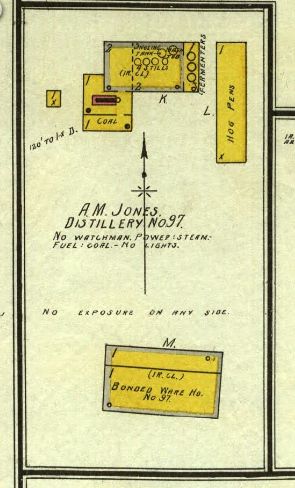
A Sanborn insurance map of the property indicates how simple the operation was. The process was fueled by coal.  There was no electricity and no watchman.  The plant boasted just a single warehouse.  As the map of the property indicates, the couple were raising pigs, feeding them the spent mash from the whiskey-making process.  The Joneses also kept cows on the property, also to be given residuals from the distilling. 

Despite the size of their town, the modest size of their distillery, and the disapproval of neighbors, the Joneses persevered in making what was almost certainly quality whiskey.  One observer has commented that they “shipped whiskey throughout the West.”   Since they had a cooperage on premises, some of their product clearly was shipped in large quantities.  For retail sales the Joneses relied on glass.   Shown here in several shades of amber are embossed “lady’s leg” bottles.  These might also have had a paper label proclaiming “Liberty Springs Whiskey,”  the flagship brand of James and Amelia.


Having succeeded in guiding the fortunes of the A. M. Jones Distillery through most of three decades, James sicken and, at age 70, died in 1891.  He was buried in Liberty’s Fairview Cemetery,  Block 39, Lot 11.  A large monument marks the gravesite.  James’ plaque bears the inscription, “Gone but not forgotten.”

Amelia, who had been a business partner of her husband throughout the operation of the distillery, appears to have taken over the reins of management. One of her initiatives was in 1893 to open a sales office in the Boston Building of Kansas City, shown here.  Down the road 14 miles from Liberty, Kansas City was a hub for the Atchison, Topeka and Santa Fe railroad, providing the Jones distillery with markets for its whiskey as far away as Los Angeles and San Francisco.

Five years later in 1896, however, Amelia too passed away at age 68.  She was buried next to James in the family plot.  Because there apparently were no children to inherit the distillery, ownership fell to other hands, principally those of Abraham Rosenberger, a successful Kansas City liquor dealer.  While assuming the titles of distillery president and treasurer, Rosenberger was careful to keep the name and tradition of the Joneses in his advertising materials, as indicated by a letterhead.

When the “Bottled in Bond” legislation was enacted by Congress in 1897, Rosenberger was quick to register the A. M. Jones Distillery.  It became unit No. 97 within Missouri’s Sixth District.  Federal records show transactions under the Act beginning in 1898 and extending through 1914.  

The Kansas City whiskey man also was responsible for issuing shot glasses bearing the registration number.  These would have been given to favored customers — saloons, restaurants, and hotels — selling Jones whiskey, including a second flagship brand, “Jones Old Storage Bourbon.”

The distillery appears to have ceased operation after 1914 and a number of the buildings are recorded having been torn down after 1920.  The home that James and Amelia shared on the distillery site has been maintained although renovated and expanded.  Efforts have been made to include the site on the National Register of Historic Places.  Despite its “dry” proclivities, Liberty had been good to James and Amelia.