Foreword: In the last post citing comparative whiskey men, the subject was those who most notably contributed their wealth to the cause of education. Other distillers, distributors and saloonkeepers lavished their philanthropy and often their personal attention on improving the health care for people in their communities. In brief vignettes here are told the stories of three who made significant contributions to that cause.
 Philip Engs, whose liquor business survived more than 100 years, recognized the public needs of a burgeoning, pre-industrial New York City and answered with his time and money, among a host of causes, to provide public health care The picture right is based on a portrait given posthumously by his family to the City of New York to honor Engs, truly a “first responder” to the needs of his fellow New Yorkers.
Beginning in 1808, Engs not only carried on a vigorous wholesale liquor trade, he also was operating as a “rectifier,” that is, blending raw whiskeys to achieve a particular taste and color. His efforts met with quick success. As he rose in wealth and influence, Engs increasingly was becoming involved in the civic affairs of a rapidly expanding metropolis where the unmet needs of the populace, particularly the poor, were a growing concern. In December 1817 Engs was among what he called “a number of philanthropic gentlemen” who met at a New York hospital to consider the causes of poverty and adopt efforts to remedy them, including creation of an alms house to provide shelter and health care for the indigent and a community medical dispensary. Philip Engs would play a pivotal role in both those efforts.

In 1834, Engs was named one of five Commissioners of the Alms House. Their job was to supervise those sanctuaries and provide general relief to poor people living outside them. Shown above is a drawing of the largest of the facilities, located on Blackwell’s Island, now Roosevelt Island, in the East River. The commissioners also had responsibilities for medical care and those duties may have propelled Engs into still another philanthropic effort.
 The Northern Dispensary, shown here still standing, was erected in Greenwich Village just off Christopher Street in 1831 for the purpose of providing medical and hospital care for the indigent. The dispensary was designed to serve 40,000 people living between Spring and 21st Streets and from Broadway to the Hudson River. A dispensary annual report of 1832 listed 3,296 patients treated. Edgar Allan Poe is recorded as having obtained medicine there for a winter cold in 1837, but many patients were treated right in their own homes. In 1834, Engs was named Commissioner of Supplies for the dispensary, responsible for seeing that it had necessary medicines and other supplies.
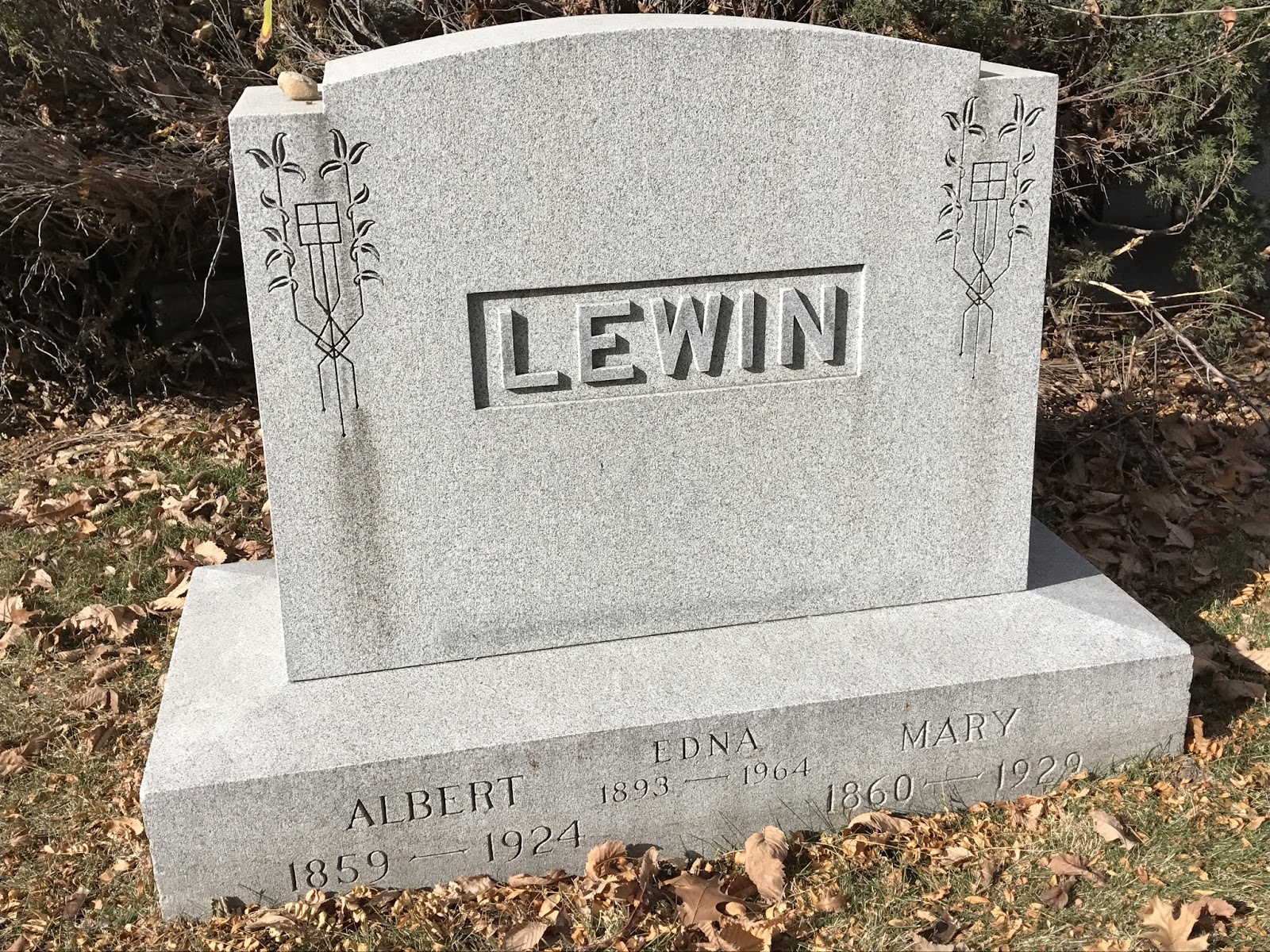
In 1859, a time of significant unrest in Germany, two boys, Lesser Levy and Albert Lewin, were born. Each emigrated to the United States, settling in Denver where their fortunes intertwined in a liquor business known as the Levy & Lewin Mercantile Company. With diverging personal interests, each man earned a measure of local fame: Lewin was a showman; Levy a humanitarian.
 Levy’s initial contribution was triggered in 1899 when a wave of Romanian Jews, victims of harsh laws in their homeland, fled to the U.S. The American Jewish community immediately made efforts to aid those refugees settle into American society, find them employment and social services, including health care, and dispersed them to other parts of the country to relieve the burden on East Coast relief agencies. Obviously moved by pictures of the homeless Romanians, Lesser Levy served as the chairman and leader of the Denver relief organization from 1901 to 1907. In this way he helped re-settle 2,791 Jewish refugees in Colorado.
  Levy also volunteered for the Local Board of Managers for the National Jewish Hospital for Consumptives in Denver. The need was felt for such a hospital where the mile high altitude and clear air was seen as therapeutic for those suffering from tuberculosis. At the time, no medical institution in Denver would admit penniless consumptives, and many poor victims of the disease lived and died on the city's streets. Organized in 1890, the hospital project took nine years to realize. Financial support was nationwide and some of Denver’s best physicians donated their services. Patients arrived from all across the country, many of them non-Jews. The hospital motto, as shown on the postcard view above, was: “For the poor only—None who enter pay—None who can pay may enter.” Levy was among those welcoming the first patients.
 Perhaps the most unlikely whiskey man to have made a contribution to health care was Robert E. Garner. Raised on a farm in nearby Georgia, he found his way to Anniston, Alabama, during the latter part of the 19th Century. He became known as “Daddy” Garner there and created a saloon he called the “Peerless,” Shown left, it has been revived by his modern counterparts and now is accounted the oldest such establishment in Alabama.
 During his lifetime Garner provided one of the fanciest watering holes in Alabama. Built in Classic Revival Gothic style, the Peerless featured a massive mirror-backed mahogany bar, shown below. It had been purchased at the 1904 St. Louis World’s Fair and moved by Garner to the Peerless in 1906. He also bought old church pews, had them sawed in two and fashioned customer booths from them.
But that was the only thing “churchy” about the Peerless. Garner set aside the entire second floor of the Peerless for a brothel. There were four rooms, each with its own ornamented fireplace, and a fifth bedroom in a loft accessed by a ladder. It is something of a mystery how Garner earned the nickname “Daddy.” No record exists of a marriage or any children. It occurs to me that the ladies upstairs might have bestowed that name on him as the boss male of the Peerless Saloon — and it stuck.
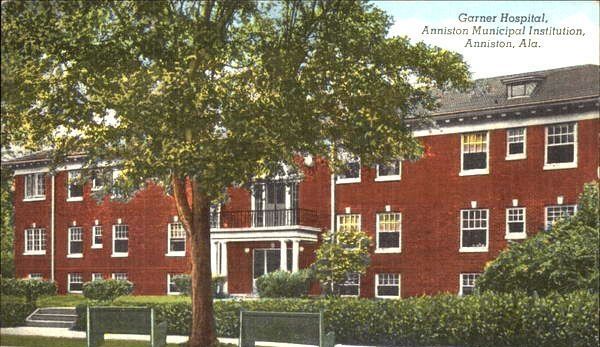
Nor was Garner above flouting the law in other ways. After Alabama passed statewide prohibition against making or selling liquor in 1915, he is said to have bootlegged whiskey through the Peerless. At his death in 1919, however, Robert Garner belied his reputation as the “outlaw” proprietor of a rowdy saloon and bawdy house. Never having married and with no children as heirs, he left his considerable fortune to the creation of a new Aniston hospital, the existing structure having become outdated. Using the saloonkeeper’s money, city fathers built a new health care institution and named it Garner Hospital, shown above. After many years of service as the municipal hospital, the building now serves as a nursing home.
Each of these three whiskey men in his own way contributed to the health and welfare of his community, deserving to be recognized in his own time — and ours — as a humanitarian.
Note: Longer vignettes on each of these three men can be found on this blog. They are: Philip Engs, January 7, 2017; Levi Levy, May 13,2018, and Robert “Daddy” Garner, July 2, 2017.