Showing posts with label motto jugs. Show all posts

Monday, November 26, 2012

Luke Kearney Knew How to “Keep Christmas”


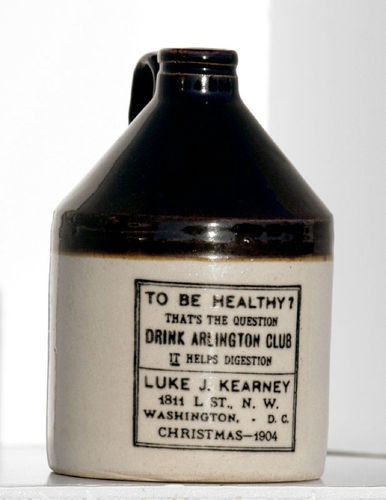
A District of Columbia saloonkeeper, named Luke J.Kearney, was notable for giving away to favored customers at Christmas time small jugs of whiskey.  While other whiskey distributors and tavern keepers sometimes gave customers favors at Christmas and New Years. Kearney’s giveaways are distinctive. Virtually all are two-toned stoneware mini-jugs about 5 and 1/2 inches high. More important, each year had a new slogan -- something for the drinking public to ponder while draining the modest contents of the jug.

The earliest seems to have been issued in 1900. Its under glaze label read: “You are not left...Not by a Jug Full"...Compliments of...Luke J. Kearney... Christmas 1900.” This was followed in 1901 by “Another Jug Full...  Compliments Of...” In 1902, Kearney used the slogan: “While we live - let’s live.” Later ceramics would add his address at 1811 L Street in the District of Columbia.

The next year the Washingtonian employed a personal motto: “Well I’ll be Jugged...Here’s Another Jug with Compliments of Luke J. Kearney.”  The 1904 version was “If You Try Me Once, You Will Try Me Again.” . It appears that Luke also issued a second version in 1904.  It contains a verse that says:
“To Be Healthy? That’s the Question; Drink Arlington Club; It Aids Digestion.”

Although I have yet to identify a giveaway for 1905,  Kearney issued two items in 1906.  One bore the enigmatic motto, “As I Go Up the Hill of Prosperity, May I Never Meet a Friend. “  The second 1906 stoneware is a squared jug with the simple question: “Is Everybody 
Happy?...Christmas 1906...Luke J. Kearney.” The 1907 issue reads “Another Jug Added to What You Have Makes Another Jug More.”

After 1907 the jugs apparently ceased, although Kearney continued to sell whiskey in embossed glass bottles.  He also gave out shot glasses advertising Arlington Club Whiskey,  a brand registered to the Hellman Distilling Co. of St. Louis.  Kearney’s saloon continued to be listed in local business directories until by Act of Congress the District went dry in 1917.


Luke Kearney was the product of an Irish Catholic family whose parents had emigrated to the U.S., before his birth.  His father, also named Luke,   found a job as a watchman in federal service, working for 50 years.  He and his wife, Mary, had a family of six children. Among them was our Luke, born in 1868.  The family lived at 3331 O Street in Georgetown.

The source and length of Kearney’s education and early business career is shrouded in time, but the 1900 Census found him, age 32, living at 1811 L Street, above his saloon.  He was married to a woman named Catherine with whom he had three children. In 1906, Catherine died, leaving Luke to raise Mary, 8; Luke Jr., 6, and Frank, 3.  Kearney does not appear to have remarried.  His parents may have helped him with the parenting for a time but his father died in 1916 and mother in 1917.

Kearney brushed with celebrity in 1903 when he accepted a check from a customer drawn on the Riggs Bank by Harry K. Thaw.  Thaw was the young socialite who later murdered famous architect Stanford White over the showgirl, Evelyn Nesbit, “The Girl in the Red Velvet Swing.” A sensation of its time, the incident has spawned a number of books and more than one motion picture. Thaw may have been a customer in Luke’s L Street saloon.  In 1915, Kearney was reported to own a baseball club in DC.

Kearney died in 1933, at the age of 65.  He is buried with his wife Catherine, his parents and other family members in Holy Rood Cemetery situated just above Georgetown.  It is a predominantly Irish Catholic graveyard associated with the Jesuit parish of Holy Trinity Church.  Most of the burials took place from the mid 19th century into the early years of the 20th.  Today the cemetery is in very sad repair.   Numerous gravestones have been destroyed or overturned.

Sanborn fire maps of the time show Kearney's 1811 L Street saloon as a two story brick building 25 feet wide and extending rearward almost one-half block to an alley. There was an empty lot on the east side, possibly for hitching horses.  Today the address itself has vanished between a large office building at 1801 L St. and a restaurant and bakery at 1819.  The street is shown as it looks today.

When the Holiday Season comes upon us, we should remember Luke  Kearney, to quote Charles Dickens, as “a man who knew how to keep Christmas.” and, as appropriate, let’s salute Luke’s memory by taking a nip from a jug of our own.


Saturday, September 29, 2012

For Frank Detrick the Motto was the Message

J. (for Jacob) Frank Detrick, the founder of the Detrick Distilling Company of Dayton, Ohio,  clearly was interested in providing advice both about life and about drinking.  Detrick began his business about 1885 grinding wheat and corn under the name Detrick Milling Company. It was located in Tippacanoe City (now Tipp City), a town of about 6,000 a few miles north of Dayton.   With excess grain able to be fermented, it was almost a natural move to distilling and by 1897, the company was renamed the Detrick Milling and Distilling Co.  


Frank the founder showed a real genius for marketing --  with mottos always in the fore. He put them on his jugs,  postcards and brochures.  Detrick’s  pre-Pro distillery issued a dozen different motto jugs.  They are almost uniformly four 1/2 inches high and 2 1/2 inches in diameter.   The containers are heavy stoneware with Albany slip tops and Bristol white glaze bottoms. No mark identifies the pottery.  As shown here,  they come in two styles.   Both say “motto jug” but the older has larger type, often in uneven lines.  The new style keep things within a rectangular label.   They are part of a set of 11,  which can be divided into three categories:  downright philosophical,  pep talks, and slogans keyed to the whiskey contents.

In his promotional literature, Detrick gave each different jug a number.  By his own ordering system,  they are:
1.  “As I go up the hill of prosperity, may I never meet a friend.”
2.  “Eat, drink and be merry”  (Fig. 8)
3.  “While we live, let us live” (Fig. 9)
4.   “May fortune forever smile on you.”
5.   “To err is human, to forgive divine” (Fig. 10)
6.   “There is always more where I come from”
(Fig. 11)
7.   “I am always welcome wherever I go”
8.   “A friend in need is a friend indeed”
9.   “When you see me you will always smile” (Fig. 12)
10.  “If you try me once, you will try me again”
11.  “Drink, weary pilgrim,  for tomorrow you die”
12.   “Rye on toast (Try it -Its on the inside of our toast jug)”


“Toast jug” was another name Frank Detrick gave to his small ceramics.  In an era before the idea of “collectibles” was invented,  he was promoting these jugs as souvenirs.  In a company brochure he described them this way:  “They make very acceptable ornaments for your library,  den or dining room.  Besides each jug is filled with the celebrated Detrick’s Special Selected Whiskey -- enough for five or six good drinks.” (Author’s note -- not really.) Detrick provided these stoneware containers to mail order customers for buying full-sized bottles of his whiskey,  rock and rye, brandy and other alcoholic products.   If a customer ordered one gallon of liquor he received one motto jug as a bonus;  three gallons and he could choose four.


Detrick used other media for getting his message across. Shown here is a Detrick marketing postcard showing a camel carrying a bottle of whiskey and carrying this message:  “A camel can go seven days without a drink....But who wants to be a camel?”  A 1909 Detrick ad states:  “Quality not quantity our motto.”  Another slogan was “Fine old whiskey for medicinal use.”  Detrick’s love of snappy sayings was also evident in a booklet he issued to advertise his products.  Under the heading,  “toasts worth knowing,”  he served up,  among others, the following:

    “Here’s to our wives and sweethearts!  May they never meet!”
    “Here’s to the happiest hours of my life.  Spent in the arms of another man’s wife.   My mother!”
    “He who loves not wine, women and song, remains a fool his whole life long.”
    “Let’s have wine and women, mirth and laughter;  sermons and soda water the day after.”


Most of Detrick’s business was done through mail orders not only in Ohio but throughout the United States.  Detrick also gave away other merchandise to favored customers including a series of shot glasses and as a sales gimmick distributed an “introductory sale certificate” worth fifty cents in merchandise.   He signed it “J. F. Detrick, President and Gen’l Mgr.”


The Detrick Distilling Co. retail store and mail order department was located at 313-315 East First Street,  shown here. By 1908, he was shipping from 35 S. Ludlow Street. The company also had a branch in Chattanooga, Tennessee, listed in the 1912 and 1913 directories at 225 East Eleventh Street.  With the onset of Prohibition, Detrick returned to milling under the name of the Detrick Grain and Mercantile Company.

As for Detrick’s personal life, from U.S. Census data it appears that he was born in Ohio about 1856.   In 1885 at the age of 29 he married a woman named Mary (also recorded as Marietta), who like Frank was a native of Ohio.  The 1900 census found them living in Tipp City, without any children present.  Frank gave his occupation simply as “grain dealer,” with no mention of whiskey.  The 1920 census found the family in Miami, Ohio.  Frank, then 64, was listed as a “retired grain dealer.”