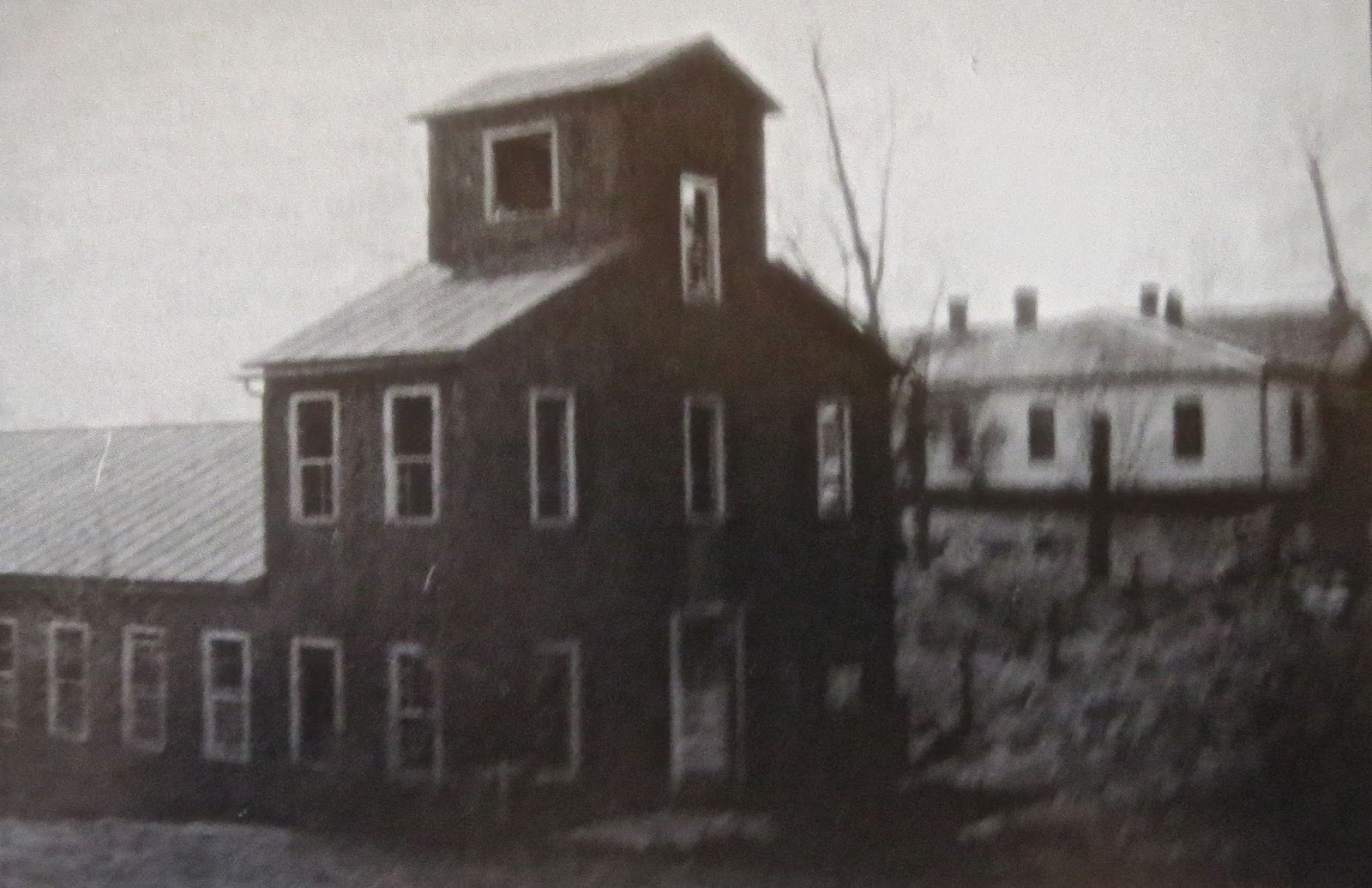
Showing posts sorted by date for query keller. Sort by relevance Show all posts

Saturday, November 19, 2022

When the Whiskey Trust (Not Really) “Went Bust”

 In August 1918 the monopolistic attempt to corner the market on American whiskey sales known as the Kentucky Distilleries & Warehouse Company came to a crossroads. This expression of a Whiskey Trust held a stranglehold on whiskey manufacturing in Kentucky.  More recently, however, the combine had experienced problems related to increased economic and social pressures. From its headquarters in Louisville’s Stark Building, Trust officials held what at first glance appeared to be a “fire sale” of 17 Kentucky distilleries among the many it owned or controlled.  Hostile press accounts cheered that the auction signaled the demise of the syndicate. But did it?

The Trust distilleries “on the auction block” included producers of well-known Kentucky bourbon brands.  Among them were five, each facility captured in an illustration below. 


Keller Company, Cynthiana, KY:  Established as early as 1840 by Abraham Keller, this distillery, operated under his management for two decades, brought him fame throughout Kentucky and beyond.  Although Keller sold the facility before the out break of the Civil War, subsequent owners kept his name on the company.  Acquired by the Trust in 1902, its executives continued to market A. Keller whiskeys. By 1910 they had expanded the distillery, shown below,  to increase mashing capacity to 450 bushels a day and warehouse capacity to capacity to more than 30,000 barrels.


W.H. McBrayer, Lawrenceville, Ky.  William Harrison McBrayer, called Judge McBrayer, is credited with being among the handful of Kentucky distillers who raised the quality and image of the state’s whiskey to international renown.  His Cedar Creek brand was called:  “The whiskey that made the crowned heads of Europe turn from Scotch to bourbon.”  In 1900 McBrayer heirs sold the distillery to the Trust.  By then, as shown below, it had three ironclad warehouses and a number of outbuildings.


J. M. Atherton Co., Knob Creek, Ky. After the conclusion of the Civil War, John Atherton, 26 years old, built a new distillery on the bank of Knob Creek and gave it his own name. Shown below, this plant was capable of processing one hundred bushels a day to make about seven barrels of what was known as “sweet mash” whiskey.  In 1869 he purchased an interest in a small distillery owned by a man named Thompson and the next year bought him out entirely.  Atherton moved this facility to the east bank of Knob Creek, across from his first distillery, calling it the Mayfield Distillery.  As a harbinger of the philanthropic efforts in his future, Atherton created homes, a school and a church for his workers at both plants, calling the complex “Athertonville.”


T. J. McGibben, Cynthiana, Ky.  During the 1850s, McGibben brought a distillery he called “Edgewater” and named his flagship brands “Edgewater Sour Mash Whiskey” and “Edgewater Rye.” As sole owner, Megibben lost no time in improving and enlarging the distillery.   It was expanded over time into a large complex, featuring five warehouses with the capacity to hold 25,000 barrels of aging whiskey.   McGibben’s whiskey was one of the Kentucky brands featured at the 1893 Columbian World’s Fair in Chicago.  Subsequently a Kentucky publication boasted that Edgewater Whiskey “is to be found in nearly every first-class hotel and bar in this country.”


Wiley Searcy, Anderson County Ky.  In 1886 Searcy is recorded as having purchased a distillery that had been established in Anderson County in 1818   When Searcy bought it, according to insurance records,  the distillery was of frame construction with a metal or slate roof. The property included two bonded warehouses.  The Captain wasted no time in advertising his “Old Joe” brand of whiskey.    His product contained “no jug yeast,” he claimed and was “The best whisky that can be made.”


These were just five of the many Kentucky distilleries acquired by the Trust over time and shut down, leaving scores of distillery workers without jobs, in the syndicate’s effort to corner American whiskey production.  By 1918, however, the Trust had suffered a number of setbacks.  Its efforts at gobbling up the rye distilleries of Pennsylvania and Maryland failed.  A strong backlash among distillers and whiskey blenders led to new competition.  The WWI ban on alcohol sales for beverages threatened production.  Last, but by no means least, prohibitionary forces had dried up markets in many states and localities.   


The “fire sale” approach by the Trust, however, was deceptive.  As the terms of sale advertised in the Louisville Courier Journal clearly stated:  ”There will be reserved from sale all distilled spirits now in bond on any of said premises.”  In addition to continuing to owning that whiskey the Trust retained the right to bottle and market it under established brand names, apparently in perpetuity.  In effect, the Trust was selling its liabilities — shuttered distilleries — while keeping the assets — the stored whiskey — for itself.  Moreover, the longer that whiskey aged, the more valuable it became.   


The Eastern financiers behind the effort to monopolize the whiskey market further refocused their efforts in March 1919 by incorporating the Kentucky Distilling and Warehouse Company and other holdings into the Distillers Security Corporation.  That entity owned or controlled 13 active plants located in Peoria and Pekin, Illinois; Louisville, Baltimore and New Orleans.  Other distilleries were converted to manufacture “cereal products, food and feed products, syrups, alcohol, yeast, vinegar, glace fruits, fruit butters, malt, etc.”    Management was under the aegis of another new entity, the U.S. Food Products Corporation.   


Yet another Trust subsidiary was organized explicitly to sell whiskey abroad called  the “Trans-Oceanic Commercial Corporation” with offices at 25 Broadway, New York City.  It was incorporated at $1,000,000 to “carry on an export business in whiskies, spirits, alcohol and other products.”  The canny “money men” guiding the fortunes of the Trust believed that impending National Prohibition might offer them better opportunities by selling liquor overseas.  


Those machinations have been described in detail by Laura Field, a Philadelphia-based whiskey specialist, who has reviewed the tangled story of the Trust in detail.  She notes:  “The Kentucky Distillers and Warehouse Co. was well positioned after Prohibition as the largest holder of aged whiskey stocks in Kentucky. The Whiskey Trust created their own consolidation warehouses to bring as much of their assets into nine warehouse locations in Kentucky.”  


The U.S. Food Products Company and the Kentucky Distilleries and Warehouse Company were merged in 1924 by the New York money men to become National Distillers.  Field relates:  “In 1933, when Repeal became imminent, National Distillers began to buy up any remaining/available aged whiskey stocks in the United States. Two Pennsylvania distillery locations with large rye whiskey stocks remaining were purchased….”  Rye supplies earlier denied the syndicate now had come under control of this Trust clone.  By 1934,  National Distillers had cornered about half of all the Nation’s aged whiskey just as National Prohibition ended.


Field believes that the history of the Whiskey Trust’s was “riddled with corruption.”  Its tortured history bears her out.  The 1918 sale that shut many of the most prestigious Kentucky distilleries resulted in attracting only a single bid, one submitted by a Trust “insider” group of investors.  Reviewing that outcome the New York World  commented:   “The Whiskey Trust’s plan of reorganization is as unlawful as a burglary.”  Indeed!


Notes:  To learn more about Laura Field, shown here, check out her personal blog, Dram Devotees.  She has done excellent research into areas of whiskey production both historical and contemporary.  Earlier posts on each of the five distillers featured above may be found elsewhere on this website:    Keller, Aug. 1, 2017; McBrayer, Oct. 2, 2011;  Atherton, Feb. 12, 2015; McGibben, Sept. 26, 2015; and Searcy, June 22, 2013.


Monday, September 14, 2020

John Horting and His “$5,000 Surprise”

Foreword:  This is just to announce that since my last post this blog has achieved more than 1,000,000 hits.  My thanks to all who made this possible.

   
Trying to make a living for himself and his family in Lancaster, Pennsylvania, around the turn of the 20th Century,  John C. Horting,  liquor dealer and distiller, concocted a highly alcoholic remedy, he called “Ash Tonic Bitters,” claimed to cure a wide range of diseases and complaints.  He market it in a green bottle with a distinctive label. There was nothing to predict, however, that in 2020 the bottle would sell for $5,000 plus a 21% auctioneer premium. Horting's “surprise” had one bitters bottle collector exclaiming “Hoochie Mama!”

The label of Ash Tonic Bitters, shown here in detail, has a Grecian motif.  A half-nude muscular young man wearing laurel wreath and carrying a staff contemplates bowl of liquid while a comely girl in a long robe offers a refill from a pitcher in her right hand.  There is little in this picture to suggest the claims Horting made on the rear label: “…Sure cure for Dysepsia, Liver Complaint, Kidney Disorders….An infallible remedy against Fever…Colic, Cholera Morbus…Costiveness [constipation].  Ash Tonic Bitters further claimed to “…Enliven the spirits of invalids of either sex….”  The label, in both English and German, recommended that a full wine glass of the tonic be taken three times a day before meals.  Highly alcoholic, Ash Tonic might have had patients “buzzed” all day long.

The reason for this bottle fetching so outlandish a price is its rarity.  In the world of bitters collectors Ash Tonic is a previously unrecorded, possibly one-of-a-kind bottle.  The reason well may be because Hortling did not emboss the glass of his bottles with any identification.  His containers were less expensive that way, of course, but when the paper label was washed away or the bottle disposed in an outhouse, there is no way of identifying contents or manufacturer. 


Who was John Horting?  Information about his early life and education are scanty.  He was born in February 1861 in Lancaster, Pennsylvania, the son of John Cornelius and Josephine Houghey Hortling, who were respectively 21 and 19 at his birth.  He had one sister.   According to the 1870 federal census, his father was a clerk in a Lancaster store.  Perhaps as early as 1871, however, John Sr. opened a wine and liquor store at 246 North Queen St., the major Lancaster commercial thoroughfare shown above.  

It would appear that as John Jr. reached maturity, he went to work in his father’s liquor store.  After John Sr.’s death in 1888, young Horting took over the liquor house, partnering for a time with John W. Keller in a partnership called Keller & Horting.  A  bottle-shaped corkscrew bears that company name.  By 1899 Keller had departed, leaving Horting the sole proprietor of the liquor house.  Meanwhile, John had taken a bride, a native-born Pennsylvanian woman named Mary Alice. They would have one child, John M., born in 1888.

Although Horting continued to operate the liquor business he had inherited with success, he did not hit his stride until 1904 when he bought the Rome Distillery, located near Lilitz, Pennsylvania, about 14 miles northwest of Lancaster.  This distillery dated its founding to 1815 and had had multiple owners.  One of them, possibly the owner who sold, was D.D. Burkholder who advertised in 1883 “double distilled rye whiskey” and a willingness to exchange his whiskey for good rye grain.

Although one account claims that Horting proceeded to tear down the original distillery and installed all new equipment, the new owner claimed in the ad shown above only to have “entirely renovated and remodeled” the facility.  His distillery, shown here, included a four story warehouse with the stillhouse adjacent.  Horting and his small family moved to Lilitz, likely living at the distillery.  Meanwhile he maintained a separate store and salesroom at 142 North Queen Street in Lancaster.

Owning a distillery allowed Hortling an assured supply of whiskey and enabled him to move into high gear.  He issued a series of proprietary brands.  They included labels that bore his name, as the two bottles shown here.  So far as can be determined, while his containers might be clear or amber, none were embossed, with only their paper labels to identify them.

Hortling trademarked only one label.  In March 1890 he filed an application with the federal government for the exclusive use of the brand, “Colonial.”  He attested that the name had been in his use since August 1896.  He bottled the whiskey in amber quarts and flasks as “pure rye.”  The quart bore the portrait of man in a tricorn headgear, presumably a colonist.  Hortling also featured “Ridge Springs Rye."

Still another brand referenced his location, called “Lilitz Springs Straight Rye Whiskey.”  Hortling was supplying this and other brands at wholesale to saloons, restaurants and hotels in the vicinity of Lancaster.  Like other successful wholesalers he also was giving away advertising shot glasses and fancy back-of-the-bar bottles to his customers. 


Still another label was an evident knock-off of Warner’s 
“Safe” Cure, a whiskey he called “Hortling Safe.”  Judging from the crate in which he shipped it, Horting’s Safe” came in quart and half pint sizes.  While not impossible, because the owner apparently used bottles without embossing, it is highly unlikely Pennsylvania diggers will unearth any identifiable Hortling bottles.  The Ash Tonic Bitters bottle is likely to remain a rarity.

Horting personally ran the Rome Distillery for a dozen years, before turning it over to other management and moving back to Lancaster, where he apparently for a time operated a brewery.  With the coming of National Prohibition, all his activities halted.  The 1920 census found John and wife Mary living at 18 East James Street in Lancaster.  His occupation was given as “none.”  In August 1924, Hortling died at the age of 64.  The cause given was an unspecific “complication of disease.”  His funeral was conducted from his home with burial at Lancaster’s Greenwood Cemetery.  An unusual monument marks his grave.

John Horting’s “surprise” undoubtedly would be astonishing to the whiskey man himself if he returned.  He had sold Ash Tonic for a dollar or so. The bottle and label were there just to convey the contents.  Soon everyone would know that his cure-all was complete nonsense and, in fact, illegally labeled.  Nevertheless, his bitters bottle fetched more than $5,000 at a 2020 auction. In 1890 that was almost four times the average annual family income.  Might Horting conclude that the 21st Century was proving just as gullible as the 19th? 

Notes:  This post was drawn from a variety of sources.  After seeing other Hortling bottles on the Internet, I read Ferd Meyer’s Peach Ridge post where he discussed the astonishing sale of the Ash Tonic Bitters and exclaimed “Hoochie Mama.”  That led me to Lowell Wenger director of the Lititz Historical Foundation (LHF) who in turn referred me to Cory Van Brookhoven, president of LHF and an authority on Lancaster area distilling.  Both were helpful in documenting Horting’s Rome Distillery period, including providing a photo of the facility before it was torn down.  Unfortunately, no photo of Hortling himself has come to light.
                                            *****
Subsequently both Cory and Lowell have noted corrections that needed to be made in the text. Again thanks to them.


Friday, November 29, 2019

Arizona’s John Keller and His Fashion Saloon


In 1903, the New York Sun proclaimed Jerome, Arizona, to be "the wickedest town in the West.”  As the proprietor of the Fashion Saloon, Johannes “John” Keller knew that his establishment, advertised as “The Leading Sporting House in Northern Arizona,” was an important element in that reputation.  There is no reason to believe Keller cared.

Shown here in a passport photo about age 40, Keller was born in Oberlengingen, Wurttenburg, Germany, in 1880.  When he was just thirteen, likely with family members, he came to the United States, embarking from Bremen, Germany, aboard the steamship Darmstadt, shown below.   Keller seems almost immediately to have headed for the Arizona Territory, settling for a time in Prescott, a town noted for its “Whiskey Row.”  He may have learned the saloon keeping in one of those drinking establishments.


What would have brought the German youth to Jerome is unclear.  The 1890s had been important decade for what heretofore had been a small mining camp at the edge of a low mountain called Cleopatra Hill.  Eastern money men, seeing a future in copper mining, built a small smelter there and constructed wagon roads connecting it to larger Arizona towns and a railroad junction. 

Shown here as it looked in 1893, Jerome’s population grew from about 250 in 1890 to more than 2,500 by 1900.  By then its United Verde Mine had become the leading producer of copper in the Arizona Territory, employing about 800 men, and was one of the largest mines in the world.  Experts have attested that the copper deposits of Jerome were among the richest ever found, with an estimated value of $1 billion.

By 1900 Jerome boasted a post office, a school, a public library, churches and a downtown with telephone service and electric lights.  Holding a population that was 4/5ths male, the town’s fleshpots were thriving.  Saloons, gambling parlors and prostitutes proliferated, the last, as shown here, openly plying their trade on the streets.  Looking at Jerome from 2,400 miles away the New York Sun declared it “the wickedest town in the West.”

Meanwhile, Keller, aware that fires had ravaged Jerome and its wooden buildings repeatedly in the past, set out to construct in brick the most elegant drinking and gambling establishment the Territory had ever seen.  As testimony to its construction, the building, shown here at far left in a photo, still stands today. 

When it opened in the late 1890s, Keller christened it “The Fashion Saloon.”  It featured fancy chandeliers and eleven different games of chance, including stud poker, roulette, faro, craps and monte, a card game of Spanish origin.  In the rear was a stage for musical and dance performances; the basement held a beer and lunch hall with separate rooms for couples and families.  Elements of the Fashion Saloon’s interior have been reconstructed at the original site by the local historical society.


In addition to selling drinks over the bar Keller apparently was retailing whiskey received by the barrel via the railroads and bottled in his own establishment.  He  sold the liquor in ceramic jugs or glass containers.  Half-pint jugs bearing the name “Fashion Saloon” have drawn considerable collector interest. 

The jugs feature both medium and dark brown tops and an underglaze label.  Those containers would have been given away to special customers, possibly at holidays.  Free in their own day, today these jugs command fancy prices.  As shown below, the Jerome museum also contains a variety of old glass bottles found around the town but I have been unable to establish any belonging to the Fashion.


After running the Fashion for about 25 years, Keller was forced to shut the doors on his saloon and gambling hall in 1915 when Arizona, with women allowed to vote, passed laws prohibiting the making or sale of alcohol. He soon fetched up as the manager of the Connor Hotel.  Built by a local businessman in 1898, the hotel for a time was the height of luxury. Originally designed with 20 rooms upstairs, the lodging house also offered a barroom, card rooms, and billiard tables on the first floor. Rooms rented for $1.00 per night.


Under Keller’s management the Connor continued to enjoy a reputation as one of the finer hotels in the boom-and-bust mining towns of the West. The hotel had its own bus for delivering guests to and from the train depot and was full to capacity much of the time. It was one of the earliest buildings in Jerome to be fully wired for electricity, and each room had a call bell for service. Keller and his wife lived there.

Because he seemed always to avoid the Federal census taker, little is known about Keller’s personal life.  He was married and his wife appears with him in a 1924 passport photo.  Her name and other details about her background, possible children, and other details remain to be filled in.  In the post-Prohibition years, Keller made several trips to Europe, recorded on passport applications.  In 1919 he returned to Germany to see his aging father.  In 1922, ostensibly on business, his itinerary included Germany, France and England.  In 1924, taking his wife with him, the couple visited the same three countries, adding Switzerland, Holland and Belgium.  This time the objective stated was “travel and business.”  On the application, Keller reassumed his original given name, “Johannes.”

Meanwhile the fortunes of Jerome were beginning to reverse.  Fires continued to ravage the largely clapboard downtown and periodically had to be rebuilt.   One observer has noted:  “In 1918 underground mining phased out after uncontrollable fires erupted in the 88 miles of tunnels under the town. Open pit mining brought dynamiting. The hills rattled and buildings cracked... the surface began to shift and sections of the business district slid downward.”  Among the damage, the town jail slid 225 feet and ended up across the road from its original site.

Despite these setbacks, Jerome today is not a ghost town, still boasting a population of about 450 and offering a number of attractions to visiting tourists.  Keller’s “Leading Sporting House in Northern Arizona” today is the Jerome Historical Society Museum, containing artifacts of the mining town’s heyday. The Connor Hotel once again is open for business, offering a “Western lodging experience.”

Note:  So far I have been unable to ascertain much about Johannes Keller’s private life or his date of death and place of interment.  My hope is that, as has happened with some frequency in the past, a sharp-eyed reader will see this post and provide additional information about this extraordinary saloonkeeper.


Tuesday, August 1, 2017

Abraham Keller and Whiskey for the Ages


Credited with being among the first Kentucky distillers, the names of Evan Williams and Elijah Craig have continued to grace bourbon bottles down to this very day.  The name of Abraham Keller, another Kentucky distilling pioneer, was seen on whiskey labels for eighty years but the brand, sadly, was swept away by National Prohibition, with only token remembrance today.

Records indicate that Keller was born on May 4, 1809, in Pennsylvania and as a youngster brought with his family to Kentucky.  His father, also Abraham, may have started a small distillery there.  The young Abraham, first came to public notice in 1840 when he bought a property in Harrison County located about one mile southwest of Cynthiana, Kentucky, on the South Fork of the Licking River.  

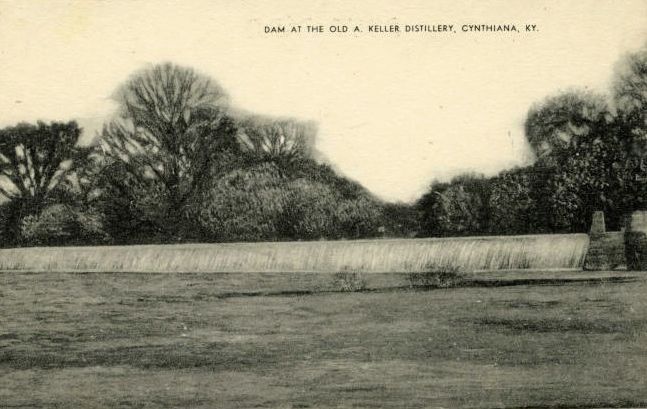
A man named Lamb previously had owned the property and placed a dam on the South Licking in order to turn a water wheel to provide power for a flour mill he operated. The dam is shown right.  Lamb was grinding flour and cornmeal, hauling it to nearby Maysville and shipping by flatboat to New Orleans.  Apparently uninterested pursuing that trade, Keller converted the flour mill into a distillery.   Taking as a partner a member of the Shawhan distilling family, Keller produced a whiskey under the brand name “Old A. Keller.”  Below is a later, highly imaginative drawing of what Keller’s early distillery might have looked like.

For the next twenty years, Keller watched as the quality of his whiskey brought it attention throughout Northeastern Kentucky and beyond.  The profits were important to feed and clo his rapidly growing family.  In 1832, at the age of 23 Abraham had married Polly Ann Miller, the daughter of Hugh and Mary (Ewalt) Miller.  The couple would go on to have ten living children.  To house this growing brood, Abraham bought 169 acres of good farm land located at the intersection of Cynthiana and Lair’s Road where he built a large house.  Polly named it “Pleasant Home.”

After two decades of successful distilling, Keller sold the property in 1861.  He may have been prompted by the war clouds gathering on the horizon.  Indeed, Cynthiana was the site for two battles during the Civil War, one of them at a bridge that Keller had built over the South Licking.  There members of the 171st Ohio Infantry fought a force led by Brig. Gen. John H. Morgan, who headed a cavalry troop known as “Morgan’s Raiders.”  They captured about 1,300 Yankee prisoners but were forced to release them when the Union Army sent reinforcements and caused the Confederates to retreat.  The engagement, became known as the Battle of Keller’s Bridge.

Keller sold his distillery to J. A. Cook who ran the facility for the next five years, maintaining the A. Keller brand.  Shown here is a photo of the distillery as it  looked at the time.  In 1863, Cook sold a half interest in the facility to Thomas A. Ashbrook, changing the company name to Cook & Ashbrook.  When Cook died in 1873, his share was bought by Ashbrook’s sons, Felix G. and Samuel J. The Ashbrooks recognized the “celebrated” reputation of the A. Keller brand and advertised as above.

When Thomas Ashbrook died, his sons took over running the distillery.  By the mid-1880s the plant was mashing 160 bushels a day and had a bonded warehouse capable of aging 3,000 barrels.  Operating it as The A. Keller Company, Distiller, the brothers sold several brands nationwide bearing the founder’s name.  They included “Old A. Keller,” “Keller’s 67,” “Keller’s Imperial” and “Keller’s Superior” bourbon and rye.  Two examples of Keller labeled glass bottles, quart and flask size, are shown here.

The Wine and Spirits Journal in 1891 noted that: “Cynthiana is the birth-place of old “A. Keller,” one of the most widely-known and easiest-selling brands coming from Kentucky to New York and Boston and in the East.”  The trade publication further explained that the major East Coast distributor for the brand for many years had been and was continuing to be the highly capable P.W. Engs & Sons. [See my post on Engs, Jan. , 2017.]

In 1884 Felix Ashbrook died and was interred in Cythiania’s Battlefield Cemetery.  In the same burying grounds in Section G, Lot 8, lay Abraham Keller who had passed in 1867.  The Keller family erected a large plinth to mark the site.  It carried a plaque memorializing him and his wife Polly who joined him there in 1895.

Despite the death of his father and brother, Samuel Ashbrook continued to expand the A. Keller Distillery, erecting a new warehouse with capacity for 12,000 barrels of whiskey.  The new building shows up in another idealized depiction of the Cythiana facility that can be dated after 1897, the year of the Bottle-in-Bond Act, because of the designation that the warehouse was bonded.  In 1902 under pressure from the Kentucky Distilleries & Warehouse Co., e.g. the Whiskey Trust,  Ashbrook sold out to the conglomerate.

Recognizing the marketing power of the brand name, Trust executives continued to market A. Keller whiskeys.  By 1910 they had expanded the distillery to increase mashing capacity to about 450 bushels per day and warehouse capacity to well over 30,000 barrels.  A photograph here exists from that time that provided a  realistic look at the facility.  The automobile visible in the picture dates it from the late 1910s.

Although the Trust continued to market the Keller brand, the name of the distillery was changed at least once more to the G. G. White Distillery.   White was a former clerk in a Bourbon County distillery who received an inheritance of several thousand dollars when the owner died.  He began to invest in whiskey-making properties and subsequently allied himself with the Trust, who put him in charge of the Cynthiana facility.  The plant operated until the advent of National Prohibition and closed..  

That ended an eighty-year run for the distillery that Abraham Keller founded in 1840 and the effective termination of the Keller brand name.   While Evan Williams and Elijah Craig continue to be remembered because of the whiskeys that bear their name, Abraham Keller, equally a pioneer Kentucky distiller, remains in obscurity.  Except, however, in Cynthiana where one can buy what is described as a “unique  bourbon (or whiskey, depending on what your drinkin’)” shot glass inscribed  "Old A. Keller."   Etched by a local craftsman, the glass memento includes a “keepsake” card that tells the history of the distillery.  Sold in packs of four, a single Keller shot glass costs $18.00.

Note:  Some information for this post on Keller came from the book, “Bourbon in Kentucky, A History of Distilleries in Kentucky”  by Chester Zoeller, published in 2010 by Butler Books, Louisville.