Saturday, February 15, 2014

Moses Weinberger Parlayed Bananas into Saloon Fame


In 1889 a Kansas grocer headed for the newly opened Oklahoma Territory to seek his fortune.   It came to him initially through the sale of bananas to homesteaders and later when he started the first legal saloon in the Territory. His name was Moses (Mose) Weinberger and today he is counted by some among “Oklahoma State Greats.”

We know a great deal about Weinberger, the central figure in the photo above, because of an interview he gave in August 1937 as part of a program by the Works Progress Administration (WPA).   He told his interviewer of his birth in 1859 into a poor Orthodox Jewish farm family in Hungary.  In search of a better life he left his little village when he was 18 and took the steamship “Fresia,” to New York City.  He settled there for several years, working as a butcher.  Then he made the mistake of returning to Hungary, at the time under Austrian rule, to visit his parents.  Over his protest about now being an American, he promptly was conscripted into the Austrian Army.   Biding his time for six months until eligible for a furlough, Weinberger did not stop until he was back in New York City.  He immediately applied for U.S. citizenship.

In 1885, still looking for better opportunities, Weinberger headed to Kansas, farming at first and then moving to Wichita where he began merchandising fruit and later meat.  He also married a woman named Rose and started a family that eventually would include three sons.  When Moses heard that the Oklahoma Territory was to be opened for homesteading, he saw further opportunity by heading farther west.  On the morning of April 22, 1889, as the Oklahoma Land Rush was off in a cloud of dust,  Moses took a train from Wichita to Guthrie station, about a three hour trip.  Between noon and 6 p.m. on that date about 10,000 people descended on a once dusty railroad stop and by day’s end Guthrie was the largest town in the Oklahoma Territory.

Upon arrival Moses staked a claim to two lots in town, close to Cottonwood Creek on West Harrison Street, and pitched an improvised tent on them using a canvas wagon cover.  A provident man, he had bought two large sticks of bologna with him for his meals.  As shown here, hundreds of people stood in long lines in front of the Guthrie land office to stake their claims.  They had little or no food and dared not to leave the line to eat.  Many had virtually no money to spend for meals. Harpers Weekly had sent Correspondent William Willard Howard to Guthrie.  On May 18, 1889, he reported:  “During the first three days food was nearly as hard to get as water. Dusty ham sandwiches sold on the streets as high as twenty-five cents each, while in the restaurants a plate of pork and beans was valued at seventy-five cents. Few men were well enough provided with funds to buy themselves a hearty meal.”  Weinberger sized up the situation and immediately wired the Bryan Brothers Fruit Company of Wichita for boxes of bananas.  They came the next day by train and Moses went up and down the lines selling bananas at two for five cents.


With the proceeds he hired a team of mules and a wagon and during the following months peddled fruit all over town. In time he built a two room house on his lots and moved his family down from Wichita.  As time elapsed Weinberger abandoned the banana trade and went into the booming real estate business in Guthrie which had become the provisional capitol of Oklahoma. The short-story writer O. Henry characterized the region’s bursting energy,  writing that “when the Oklahoma country was in the middle of its first bloom, Guthrie was rising in the middle of it like a lump of self-rising dough.”  As shown here, it was still a Wild West town, but with a catch:  Because of its close proximity to Indian territory,  liquor sales were illegal although bootleg whiskey was common.

In June, 1891, Moses heard a rumor that it might be possible to obtain a license from the Federal Government to sell liquor in Oklahoma.  Although he never before had run a saloon he made application  and got it from Leavenworth, Kansas.  He quickly opened the first legal drinking establishment in the Oklahoma Territory.  As related by his 1937 interviewer, the following ensued: He fixed it up just like an ordinary saloon and began selling liquor openly.  He had put his license up on the wall with a piece of newspaper on it.  After a few days the officers came to raid him .  They said, “You can’t do this , Mose.”  “Why not?” he asked,. “Uncle Sam says I can,” and reached up and pulled off the newspaper so they could see his license.

The word soon got out that selling liquor could be legal.  Within two months there were 44 licensed saloons in Guthrie.  In time Weinberger would own an interest in seven of them,  the principal one known as “The Same Old Moses.”  It is the drinking establishment shown at the opening of this article.  Moses is standing between two of his bartenders, Mack O’Brien (left) and Ike Reed at the 211 West Harrison Avenue address.


The name of the saloon merits another story, as Weinberger recounted it to his interviewer:
On day he was on the street and met a fellow whom he had known in Wichita.  “Well if it ain’t the same old Moses,” was his greeting.  Mr. Weinberger took the man from Wichita  into the saloon and treated him.  Later Mr. Weinberger got to thinking about this expression and next day had a sign painter letter it on the window. “The Same Old Moses.”
  

Weinberger showed a sense of humor by inviting the saloon-buster Carry (Carrie) A. Nation into his place to give a temperance speech. The hatchet-swinging, whiskey-hating matron had settled in Guthrie after being run out of Kansas and was publishing her newsletter there.   Her likely motivation was to impact the Oklahoma state constitution to outlaw alcohol.   Weinberger made one stipulation, no ax swinging in his establishment.  Carry kept her promise until the end of her speech then did a “hachetation” on Moses’ mahogany bar, removing a chunk of it.  She was promptly removed from the premises and Weinberger hung a sign over the saloon that read:  “All Nations welcomed except Carry.”  The damaged spot reputedly became the place his patrons banged their empty beer mugs when they wanted another round.


Weinberger proved to be a genial barkeeper, providing regular customers with bar tokens good for five cents in trade, similar to the one shown here.  He also advertised in the local newspapers.  In addition to selling liquor over the bar he was retailing a number of nationally known brand whiskeys like McBrayer, Old Oscar Pepper and Guckenheimer Rye.  He also was featuring major beer lines such as Budweiser, Blue Ribbon and Bohemian.  “The success of my business,”  Moses asserted in a 1901 ad, “is due to honorable methods and quality of goods.”

But no amount of honorable methods or quality goods could stem the “Dry” tide in Oklahoma.   Carry Nation would have the last laugh as Prohibition forces focused their efforts there. The State’s Constitution upon adoption in 1907 banned all sales of alcohol within its borders.   Overnight Weinberger and his fellow publicans were forced out of 
business.  Moses sold his saloon equipment and shipped it out of state but later said the sale hardly brought enough to pay the freight.

Before Oklahoma’s prohibition, Weinberger had tried other occupations, none of which seem to pan out.  When some Indian lands were opened for homesteading, he had staked a claim near the town of Chandler and settled his family on it.  He rode out from Guthrie weekly to see how they were doing.  Dogged by floods, rattlesnakes, sickness among the children, and a distraught wife, Moses eventually gave up the claim and moved his family back to town.   His attempts to find oil ended first with a dry hole and then a drilling effort that he said:  “Instead of oil we got salt water.

With the demise of his liquor trade,  Weinberger went into the transfer business, loading materiel and supplies on carts from railroad cars and hauling them to construction and other sites in Guthrie.  Although the transfer business proved considerably less lucrative than alcohol, the company gave employment to family members.  A Guthrie business directory for 1907-1908 shows several of his sons and their spouses working for the Weinberger Transfer Company, located at 501-509 Oklahoma Avenue. 


Always sensitive to the needs of the Jewish community in Guthrie,  Moses permitted its members to hold religious services in one of his buildings free of charge and for several years  a congregation did observe the high holy days there.   But the dream of a permanent place of Jewish worship in Guthrie was dashed when in 1910 a statewide referendum moved the capital to Oklahoma City.  Not only was Guthrie’s economy devastated but the blame fell on Jewish businessmen.   Seen here is an inflammatory headline in the Guthrie Daily Leader of November 1, 1912.  As a result of local enmity,  most Jews moved out.

Moses stayed.  His last business venture was a ladies’ ready-to-wear and men’s apparel store.  Business proved to be slack and he lost a considerable amount of money.   Regardless of that business setback and racial slurs, Moses was proud to have been an original settler of Guthrie and adamantly refused to leave.  The 1940 U.S. census found him living on West Oklahoma Avenue with several of his children.   He was eighty years old and died later that year.   He was buried in Guthrie’s Summit View Cemetery, Section 1, Block 4, Lot 12.   Interred near him are his wife Rose and several of their children.   Theirs are the only Jewish graves in the cemetery.

Although Weinberger is gone, his memory is enshrined in a marker on the spot of the “Same Old Moses Saloon,”  It reproduces the picture of the proprietor and his bartenders and tells the story in brief of Weinberger’s bananas, his saloons, his bout with Carry Nation, and the coming of prohibition.   His fame also is acknowledged in a history book used in Oklahoma  schools.  On a list of  “State Greats,” the name of Moses Weinberger can be found in the company of Humorist Will Rogers and Athlete Jim Thorpe.  His claim to fame:  “Opened first legal saloon in Oklahoma.”  Yes, Moses did -- and he started with bananas.

Note:  Much of this vignette was derived from a 1937 interview of Moses Weinberger by Ruth W. Moon for the Indian-Pioneer History Project, a WPA-sponsored effort to capture the stories of people about living in pre-statehood Oklahoma.  The full text is available on the Internet though the auspices of the University of Oklahoma Library.


Thursday, February 13, 2014

Charles Gove Went From Pops and Hops to Schnapps

The road taken by Charles S. Gove of Boston to become a whiskey man began as a manufacturer of soda pop,  proceeded through the beer trade, and then progressed to blending and compounding strong liquors,  “schnapps,” as they are sometimes called.  Gove’s success can be measured in part by the number of artifacts he left behind for collectors.  


Gove was born in Hampton Fall, Rockingham County, New Hampshire into a Yankee farming family.  The 1850 census found him, age 19, living on a farm there with his father, Ezekiel, and his mother, Mary.  Rounding out the household was a sister, Mary, age 16.  Ten years later a Charles S. Gove was recorded working as a teamster in Boston.  He was married to a woman named Olive and had an infant daughter.  Five years later, however, Charles is recorded as a partner in Comstock, Gove & Company and living in a Boston boarding house.

Charles had teamed with Hiram M. Comstock, another New England Yankee, who was about the same age.  Together they formed a company to manufacture soda water.  Shown here is a colorful trade card from the firm that depicts the tanks for making their soda and mineral waters.  The partners also were selling porter, ale & cider at their 30 Canal Street address.   By 1872 the partners had opened a second location at 27 Merrimac Street.  Among the containers in which they sold their “pop,” as shown here, were both stoneware and embossed glass bottles.   In the 1880 census, Gove’s occupation was given as “soda dealer.”

After Comstock’s early death in 1883,  Gove took over the firm and changed the name to the Charles S. Gove & Co.  His advertising featured a fancy monogram of his name.   His containers of this period included codd patent bottles for his soda water production and beer bottles embossed with his name.   Gove had moved  into the beer business,  but strictly as a bottler not a brewer.  He was buying beer from other sources and labeling as his own.  The bottle shown here is a clear champagne-style pint that advertises Gove’s sparkling lager.    The next step for Gove, taken early in the 1900s, was to become a whiskey “rectifier.”  Although he called himself a distiller, he actually was blending and compounding whiskey obtained from other sources.   As shown on a two gallon jug here, the Charles S. Gove Company was now a wholesale liquor house.  The Boston address was 78 and 80 Merrimac Street, at the corner of Pitt Street.  Among Gove’s proprietary brands were “Fernbrook Rye,”  “Hendrick’s Club,” “Forrest Club,” and “$1,000 Pure Straight.”   Apparently not fearing competition over the names, he bothered to trademark only “$1,000 Pure Straight.”  In 1903 he incorporated his company for the first time.

Like many whiskey wholesalers,  Gove featured a number of give away items.  One of the shot glasses he provided to bartenders at saloons featuring his liquor is particularly striking in its fancy etching.   On it are three barrels, each of them bearing the name of one of his brands.  Today Gove is most noted for the mini-jugs he gave away to retail customers.  Each held several swallows of liquid or as one jug was labeled, “samples of our fine whiskey.”   Several examples of Gove’s mini-jugs, which numbered as many as a dozen varieties, are featured here.

While Gove’s move from soft drinks to beer and on to whiskey was proceeding,  his personal life was turning somewhat mysterious.  In the 1880 U.S. census, age 49, he was  living in Cambridge, Massachusetts, and listed as a “widower.”  In his household was a daughter, Gertrude, age 11, and Mary Hazeltine, 51,  who was listed as both the housekeeper and Gove’s sister-in-law.   By the 1900 census Gove had been remarried for  more than a decade.  His wife’s name was Julia A. Gove.  She was younger than he by some 23 years, born in Vermont, and apparently a widow with a daughter by a prior marriage. The couple lived on fashionable Warland Street in Cambridge.  A local newspaper in May 1913 noted that the Goves had left Cambridge for their summer home at Lake Mascoma in New Hampshire and would be there until the fall.

At this point Gove would have been 82 years old and clearly had turned over the reins of management of his firm to younger hands.  But he could not escape labor troubles.  In 1911 The Gove Company was among Boston brewers and bottlers who refused to sign a new contract for their workers with the International Union, United Brewery Workers, and their locals.  The union fomented a strike that included picketing and violence against workers crossing the picket line.  Seemingly most galling to Gove and others was a union publicity campaign to drive away their customers.  In a complaint filed under his name with the Massachusetts State Department of Labor, Gove alleged a conspiracy by the union:   “...By displaying on wagons, to be driven through the streets, certain false, malicious, and libelous cards, unless said company signed a new contract with increased rates of wages....”    He asked for and was granted an injunction against those tactics.

Gove died in March 1916 at the advanced age of 86.  The firm that he founded and bore his name disappeared from Boston business directories the very next year.  His wife Julia, after several years of bad health died in Gainesville, Florida in 1920.  My research has failed to disclose their final resting place.

Among whiskey men,  Charles Gove is not an particularly extraordinary figure.  He was not a pioneer. He was not an immigrant who made it in America by dint of relentless effort.  He did not establish a whiskey empire or even a brand name that survived National Prohibition.   What sets Gove apart is his path to the liquor trade, beginning with the fizz of soda pop, progressing to the hops and barley of beer, and finally arriving at the corn and rye of schnapps whiskey.   Just as impressive, he seemingly was a success at each step.


Monday, February 10, 2014

Isaac Rosskam Embraced His Heritage

In a recent book Author Marni Davis remarks on the the Star of David featured on the trade trade cards and other advertising of the Rosskam, Gerstley & Co., a whiskey wholesaler of Philadelphia.   She wonders if its use was a direct reference to Judaism.  Isaac Rosskam, shown here,  could have set her mind at rest.  Throughout his life Rosskam was a committed adherent of his Hebrew heritage.  He willed the current equivalent of four hundred thousand dollars to Jewish causes when he died. He also left a legacy of back of the bar bottles that will never be equaled.

Isaac was born in November 1837 in Ichenhausen, Germany,  a town of about 8,000 situated on the river Günz in the Bavarian district of Günzburg.  His father was Ulrich Rosskam and mother Edele (from Adelheit) Gerstle.  He grew up in Ichenhausen, was educated there, and eventually immigrated to the United States.  He settled in New York State, apparently finding employment in the liquor trade.  In Elmira about 1864 he married Bertha Gerstley, the daughter of Hirsch and Sophia Gerstley, who also hailed from Ichenhausen.   She was five years younger. Their first son,  Leon, was born in 1865 in New York State. 


Within the next two years, the Rosskams moved to Pennsylvania and settled in Philadelphia.  There two other sons were born,  Joseph in 1867 and William in 1872.  In 1869 the firm of Rosskam, Gerstley & Co. “Fine Old Whiskeys,”  made its first appearance in the business directories of Philadelphia.  A trade card, shown here, featured the “Star of David.”  Isaac’s partner was Henry Gerstley,  also an immigrant from Ichenhausen and likely a close relative of Bertha Rosskam.    The company was first located at 336 North Third Street but within a year had moved to larger quarters at 402 North Third, where it would stay until 1876.

Reflecting the rapid and impressive growth of its business volume,  company in that year moved to two new buildings,  one of five stories advertised “Rye & Bourbon Whiskies” on the storefront.  The other at 133 and 135 Dock street of six stories proclaimed “Old Rye Whiskies.”  The buildings were shown on the company letterhead.  It also featured the Star of David.  Both locations allowed the firm adequate space to undertake “rectify,” that is, to compound and blend whiskey bought from multiple sources to achieve tastes determined to have broad public appeal.

Rosskam, Gerstley & Co. featured a multitude of brands including "American Rye,” "Faust's Own,” "Geo. M Walker V.O.P. Blend,.” "H. A. Rogers,” "Keystone Malt,” "Keystone Monogram,” "Metropolitan.” "No. 6 Monogram,” "Old Emperor,” "Old Keystone.” "Old  "Pat Hand,” "Philadelphia Club", "Quaker City Monogram,” "R. G. & Co.,” "R. G. & Co. Monogram,” "R. G. & Co. Special Reserve,” "The Register,” "Three Lilies,”, and "Top of the Morning."

Rosskam and his partner trademarked as proprietary a number of its brand names.  Those included Top of the Morning, filed in 1893;  Pat Hand and Philly Club in 1905, and Quaker City in 1906.   The firm also registered the signature “Rosskam, Gerstley &  Company” in script as shown on the trade card.  The company’s flagship brand was “Old Saratoga,” sometimes given as just “Saratoga,” trademarked in 1890, 1895 and again in 1897.  As shown here, this brand was sold principally in bottles.

As their business grew the partners branched out into other cities. In 1870 the partners opened an office in Cleveland at 100 River Street.  About 1882 they located an outlet  in Chicago at 79 Dearborn Avenue, one of the Windy City’s premier commercial locations.  That was followed a year later by their establishing a branch  at 38 Broadway in New York City.   This proliferation of outlets indicated the kind of vigorous national customer base Rosskam, Gerstley & Company had built over time.

Meanwhile Isaac having a family life.  The 1880 Census found the Rosskams living in Philadelphia with their three children, Leon, 15;  Joseph, 12; and William, 8.  Leon had been born in New York,  the other boys in Pennsylvania.   Isaac's age was given as 37 and his occupation as “liquor dealer.”  Eventually it would be the youngest son, William, who would join his father in the whiskey trade.

Because Philadelphia was loaded with distillers, rectifiers, and wholesalers, Rosskam had to combat stiff competition for the business of  restaurants, bars and saloons to stock his liquor.  He also had to appeal to members of the drinking public to request his brands from their bartenders.  One way of advertising was to provide giveaway items that contained the name of a Rosskam, Gerstley product.   Among the company’s gifted items was a color lithographed serving tray for Old Saratoga, showing dogs playing poker, always a popular subject.  But where Rosskam made his mark was in his supply of elegant back of the bar bottles.  They included bottles in fancy molded glass with stoppers,  ornate gold lettering, and in one case a metal or pewter body.  I have counted at least 21 varieties of Rosskam, Gerstley & Co. bar bottles.  A number of them are illustrated throughout this post.

Throughout its existence, Rosskam. Gerstley & Co. used the “Star of David,” as its logo and in its advertising. It is a symbol with special meaning for the Jewish people, as a generally recognized symbol of Jewish identity and Judaism.   In her highly informative book, “Jews and Booze :  Becoming American in the Age of Prohibition,” Marni Davis on page 21 remarks on the use of the pentagram star by the liquor firm.  She notes correctly that alchemists and medieval brewers also used the symbol.  For example, it notably was employed by Mennonite brewers in the U.S.  Ms. Davis goes on to say:  “Of these nineteenth century American alcohol producers, only Isaac Rosskam and the Gerstley family were Jewish.  It is unknown if they incorporated the star into their letterhead design because of its religious significance, or because it was a commercial practice for their trade.”

The answer to Ms. Davis’s quandary is clear.  Isaac Rosskam embraced and was proud of his Jewish heritage.  Throughout his business career he was cited in Jewish publications as being among the most active in “congregational and society” affairs in Philadelphia.  From 1879 until 1889 he was the president of the city’s Hebrew Education Society, responsible for a  religious school with upward of a hundred students located in North Philadelphia and a second school with sixty students in Port Richmond.   Moreover Rosskam’s will left the equivalent in current dollars of more than $400,000 to Jewish charities including the National Jewish Hospital for Consumptives in Denver;  the Theological Seminary of America in New York; the Free Hospital for Poor Consumptives in White Haven, Pennsylvania; United Hebrew Charities, and the Hebrew Educational Society.   Yes, Ms. Davis, Isaac’s use of the Star of David was an intentional expression of his religiosity.  The company even trademarked its use.

At the turn of the Century, things changed at Rosskam, Gerstley.  In 1899, Henry Gerstley died, age 61 at his residence.  Cause of death was not given.   As Isaac aged he turned over the reins of management to his son, William.  A 1900 Philadelphia business directory lists the younger Rosskam as president of the firm.   In 1904 Isaac died, age about 70.  The place of his demise is uncertain.  One source gave it as Frankfurt, Germany, where he might have been on a holiday.  Another source said he died in Philadelphia.  It was agreed that he left a large estate.  Although the company continued to prosper for a time under William Rosskam,  eventually it was forced to shut down by the enactment of National Prohibition.

We remember Isaac Rosskam today for his forthright commitment to his Jewish ancestry, a certainty about his heritage that was affirmed by his use of the Star of David in his letterhead and advertising.  We remember him too for the rich legacy of elegant  back of the bar bottles the Rosskam, Gerstley Co. left for future collectors, all of which have attained antique status of 100 years.

Note:  The reason that the number and variety of Rosskam, Gerstley back of the bar bottles will never be trumped is that such decanters were rendered illegal under the same law that repealed Prohibition in 1934.  Although the bottles were meant to hold the kind of liquor advertised on the front, all too often unscrupulous saloon owners or barkeepers would substitute inferior, sometimes dangerous, products in them.  Today all liquor poured at a bar must come directly from an initally sealed, labeled bottle and it is against the law to refill any bottle.  As a result, the last back of the bar bottle manufactured dates only to 1919.


Friday, February 7, 2014

Henry Naylon and Thwarting "The Whiskey Trust”

In 1917 Moody’s list of “Industrial and Miscellaneous Corporations” included a organization known as the New York and Kentucky Company “incorporated under the laws of New York State for prosecuting a general distilling and wholesale business in cologne, spirits, alcohol, whiskey, medicinal preparations, etc.”     Henry M. Naylon of Buffalo, New York, was listed as both president and chairman of the board.   Moody’s failed to mention what the liquor industry knew:  Naylon was leading the backlash to the notorious Whiskey Trust -- and succeeding.

Twenty years earlier as number of Midwest distillers had turned their plants over to a board of trustees who were to control the liquor trade through the kind of monopolistic cartel that had developed in oil, sugar, steel, beef and other commodities.  Officially named the “Distillers and Cattle Feeders Trust,” it was popularly known as "The Whiskey Trust.”  The organization, based in Peoria, Illinois, gathered in more than 80 distilleries, often using tactics like dynamite to convince holdouts.  Most of the plants the Trust procured were shut down. The idea was to control supplies and drive up whiskey prices.

That tactic did not sit well with other American distillers who feared being muscled out of the market.  This antipathy was strongest in New York and Kentucky.  In 1900 Walter B. Duffy, owner of two distilleries in Rochester, New York, organized a group of three major Kentucky distilleries and five New York alcohol manufacturers into a stock company.  The idea was strength in numbers to prevent the Whiskey Trust from threatening them.  A chief Duffy ally in this gambit was Henry Naylon.

Naylon like Duffy was a native of Rochester. He was born 1870 into a family of native New Yorkers with ancestral origins in Ireland.  Little of Naylon’s early life is recorded but at least one account indicates that he may have been involved in real estate as a young man.  That pursuit may have led him into the field of distilling.   In the late 1800s the Federal Government had, in effect, shut down several small distilleries in Western New York.  Naylon apparently saw an opportunity,  moved to Buffalo, bought three plants and about 1897 consolidated their production under the name, The Erie Distilling Company.

Naylon’s first business address was on Genesee near Ellicott but by 1900 he had moved to a spacious five-story building at 141 Seneca Street, shown here.  The address also appeared on a cobalt jug produced for him by the Lyons Stoneware Company of Lyons, New York.  Naylon’s company adopted a number of proprietary brand names for its whiskeys, none of which the owner bothered to trademark.   They included  “Clover Dry Gin,” “Lafayette  Special,” “Maryland Flower,” “Orange Blossom,”  “Society Cocktails,”   and “Yankee Club.”   His flagship label was “Erie Club Whiskey,” advertised as “It Is the Best!”  As many whiskey men, Naylon gifted favored customers,  saloons and public houses featuring his brands.  He furnished them with advertising wares such as shot glasses and serving trays featuring Erie Club.   For retail customers he provided inexpensive, celluloid-backed pocket mirrors. 

Naylon also was having a personal life.  In 1881 he married Ellen (called Nellie) A. Corcoran.   Like himself, his wife was native-born New Yorker.   The 1900 Census found them living in Buffalo with three children,  William, 7; Loretta, 5, and Ethel, 4.  Henry would take William into his liquor business as the boy matured.

Meanwhile the New York and Kentucky Company, with main offices in Rochester, was thriving while it defied the infamous Whiskey Trust.  The capital stock of the company consisted of $1,000,000 in preferred stock and $1,000,000 in common stock,  about 25 times that in  2014 dollars.  It was paying dividends of 7% on the preferred stock and 6% on common.  Moody’s listed the assets as “real estate and appurtenances (conservatively valued at upwards of $850,000), fixtures, machinery, brands and good will of said concerns, all absolutely free from mortgage, debt or other liability.”  

One major liability was Walter Duffy,  president  and organizer of the combine.  Duffy ran one of the most notorious whiskey operations in the country, criticized for his outrageous advertising,  blasted in the press for shoddy products, and hounded by Federal and state officials for selling his liquor as medicine. [See my post on Duffy, May 1911.]  Duffy’s leadership of the New York and Kentucky Company particularly incurred the wrath of Col. E. H. Taylor Jr., considered the Kentucky high priest of straight bourbon.  Taylor earlier had lost distilleries through debt to George Stagg, a Kentuckian who was part of  the New York and Kentucky Co.  Even though a court had ruled 1894 that Taylor’s name could no longer be used in connection with his former distilleries, the ban was ignored by Duffy.

Outraged that someone whom he considered to be so disreputable had come to control his previously owned and prized whiskey operations,  Col. Taylor minced no words:  There are people who do not know the difference between a jumping-jack and a jackass, and a composite photograph of the two would look so much like him that his nearest friends would call it an excellent portrait of Mr. Walter B. Duffy, President of the "New York and Kentucky Company," owner and great promulgator of  “Duffy's Malt Whiskey.”

When Duffy died in 1911, the directors took no time in naming Naylon the president and chairman of the board, likely because of his good business reputation.  Henry’s son, William, also was named to the board and eventually would be moved up to the position of corporate secretary.  At the same time Naylon was branching out into other enterprises.  He was president of Naylon Securities Company and a founding director of the Lafayette National Bank of Buffalo, a member of the Federal Reserve System.  He also was a power on the Buffalo political scene and eventually became chair of the Erie County Democratic Party.


During this same period Naylon found his own liquor business in need of expansion and in 1915 he moved to an eight-story building at 154-156 Eagle Street.  As shown on his letterhead of that period, not only was he featuring his own brands but had become the sole agent for such national and regional labels as “O.F.C. Whiskey,” “Carlisle,”  “McGinnis Rye,” “Walnut Hill,” “Seneca Chief,” and “Burke Hollow.”  Naylon’s new quarters were very up-to-date, featuring both telephone exchanges and solid-tire trucks to make deliveries.  Naylon issued jugs with the new address.


Increasingly Naylon was being heard as a spokesman for the liquor industry.  In a 1916 letter to the Brewer’s Journal, he opined that the lack of revenues from whiskey taxes was shifting the burden of taxation to real estate and incomes.  “Many of the Prohibition States are bankrupt today because the fanatics fear that if their controlled legislatures increase taxation upon citizens who have ignorantly assented to the destruction of lawful revenue, the whole fabric of deception will tumble down,” he wrote.   He predicted that politicians kowtowing to the Prohibition “fanatics” would lose their jobs if taxation was visibly shifted.

In 1903 Naylon bought a house, shown left, at 361 Pennsylvania Avenue in Buffalo.  It had been designed and built in 1875 by an internationally known Philadelphia architect named Richard A. Waite who had made it his own home for many years.  As Naylon’s millions accrued, however, the family decided a much larger and fancier house was required.  The result was the mansion below on Buffalo’s then fashionable North Street.  Son William, a bachelor, continued  to live his with parents as part of the household.

Under Naylon’s leadership, the New York and Kentucky Company continued to pay dividends to its stockholders.  Meanwhile its despised rival, the “Distillers & Cattle Feeders Trust,” was falling apart, reputedly because of its weight of debt and reputation for violence.  As fast as the Trust shut down distilleries they sprang up elsewhere.  Price fixing in the whiskey industry had proved to be elusive.  In place of the Whiskey Trust a number of smaller, more regional combinations emerged.  Meanwhile Naylon’s organization rolled on until its operations and those of its distilleries, including the Erie Distilling Company, were forced to shut down by National Prohibition.

Naylon emerged unfazed.  He began to devote himself full-time to real estate, in which he previously had been an investor. His real estate empire grew extensively, with properties located throughout Buffalo and across New York State.   The 1930 census found him, now age 60, living in his mansion with wife Nellie and son William.  Naylon gave his occupation as “capitalist-real estate.”   William was listed as “salesman - real estate.”  The family was out of the whiskey business for good.

Henry Naylon died at age 69 in June 1939 and was buried in Mount Olivet Cemetery located in the town of Tonawanda,  a cemetery of the Catholic Diocese of Buffalo. Both Nellie and William had preceded Naylon in death, both passing in 1935.  The Naylons lie together in a striking mausoleum, a hewed granite structure that today stands tall and solid in the graveyard.  Meanwhile the Naylon mansion on North Street long since has been demolished to make way for new development.


Monday, February 3, 2014

Marching Along with Sig & Sol -- the Freibergs

Whiskey wholesalers were famous for their giveaway items to saloon stocking their liquor and other favored customers, including back of the bar bottles and pitchers, tip trays, shot glasses, and bar games.  Brothers Solomon and Sigmund Freiberg of Cincinnati provided all of those items in profusion but added one more gift:  Music, a stirring march dedicated to their flagship brand whiskey.

Shown here is the sheet music for the “Gannymede ‘76’ March,” published in 1903. It was written by Gus. W. Bernard, a songwriter and composer at the turn of the 20th Century whose marches and dance tunes are said to found in several university libraries.  Other than that reference Gus does not seem to have been a major force in American music. The cover of the  music presents a very dramatic picture.  It shows a figure being carried into the heavens by a giant bird.  The sheet lists the publishers as Sig and Sol Freiberg.

Sig, shown here in a  contemporary cartoon, was the elder of the brothers, born in 1866.  Sol was four years younger, born in 1870. Their father,  Henry Freiberg was a native of Renish Bavaria and there married their mother, Amalia Loeb.  Not long after their marriage the couple emigrated to the United States, settling in Cincinnati, the home of many German immigrants.  Although Henry had experience in distilling as well as in leather tanning, he preferred the latter trade and and founded one of the first tanning businesses in the city.  One author has called it “the famous old tannery on Livingston Street.”

Although their father had disdained distilling, his sons would embrace it.  Born in Cincinnati both Sig and Sol were reared and educated there. They both entered the liquor business during their teen years working for Cincinnati liquor interests and advancing into management  positions.  The 1900 U.S. Census found Sig, listed as a “liquor merchant,” living with his wife Stella (sometimes given as Estella) in the home of his in-laws,  Henry and Helena Marks,  and with two of Stella’s siblings.   Although at that point the Freibergs had been married for 12 years, they had no children.   The  same census found Sol Freiberg, also listed as a “liquor merchant,” living in Cincinnati with his wife,  Helen, and their five-year-old son, Henry.  Shown right, Sol too was residing in the home of in-laws,  Bernard and Dora Kahn.  By that time both men likely were  working with a relative, Julius Freilberg.


About 1898 the brothers decided to break out on their own.  They joined forces and finances to create their own liquor business at  58 Main Street under the name S. & S. Freiberg.  They remained at that location for the next six years, moving to larger quarters at 424-426 West Fourth Street in 1906.  There they occupied an entire six-story building, shown here, and provided employment for some 50 people.  A 1912 account described what Sig and Sol had accomplished:   “Theirs is one of the largest and most substantial concerns of its kind in Cincinnati....It has grown phenomenally through their own efforts and their trade now extends over the entire United States, selling to large dealers.”

The brothers also owned an interest in the Peacock Distillery located in Paris, Bourbon County, Kentucky.  It was reputed to have been founded in 1840, making it one of the state’s oldest.  Insurance records indicate that the distillery was built of stone with a metal or slate roof.  There were two ironclad warehouses, one located 500 feet north of the still and a second adjacent.  The former was a fully government bonded warehouse and the latter partially bonded.  

The Freibergs were also rectifying whiskey at their Cincinnati address and selling it both at wholesale and retail under a blizzard of brand names.   Their labels included:  "Beach Grove,” "Carnation,” "Chevalier,” "Claymont", "Fairview", "Fresno Club",  "Hollerding", "J. M. Watson,"J. Walter,” "Liederkranz,” "Louisiana 1803 Purchase,”  "Loyal Club,” "Mac Laren,” "Maratime Club.” Millview,” "New Era, "Old Malvern Export,” "Old Manchester,” "Pike Mountain,” "Rocky Ford,” "Spearhead, " "St. Louis World's Fair Celebration,” "Teakwood,” "Three Ribbons,” and "Walnut Grove."  Canny about protecting their proprietary rights, the brothers registered a dozen of these brands with the Federal Government in 1905.   Mac Laren was trademarked in 1906 and Old Malvern Export in 1911.

Far and away the flagship brand for S. & S. Freiberg was Old Gannymede ‘76.’ In Greek  mythology Ganymede (note the different spelling) was a handsome young shepherd who caught the eye of the god, Zeus, who promptly send down a giant eagle to carry him off to Mount Olympus. His was the picture on the front of the sheet music.  On Olympus with Zeus the youth became “an immortal” and served as a cup bearer to the Greek gods.  While there is no evidence that Ganymede served up rye whiskey to his clients, the fact that he was the bearer of spirituous drink probably made his name and image appropriate for the Freibergs’ whiskey.

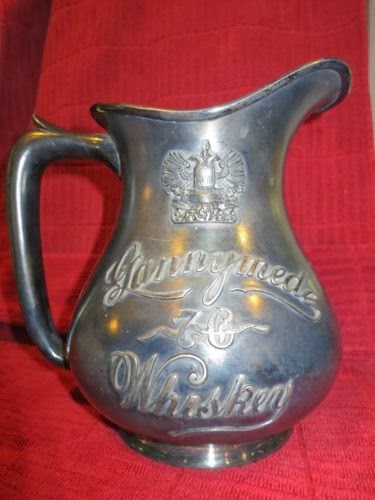
They certainly made the most of the name, advertising and merchandising the brand widely.  It also was featured on the brothers’ giveaway items to favored customers such as saloons and restaurants carrying their whiskey.  Among them were back-of-the-bar bottles bearing the Gannymede label, of which two are shown above.  Banned after the end of Prohibition because adulterated liquor could easily be substituted, the idea was for these vessels to hold the whiskey being advertised.  Silver-plated water pitchers were also poplar items behind the bar, holding water or cold tea.  The Freibergs served up one of the most elegant of those.  More standard in the liquor trade were glasses and the brothers gave away those in both shot glass and drinking glass size.
 

Bar games were also a popular staple in saloons.  The Freibergs provided at least four such to clients featuring their brands, including two dice game (good for shaking for drinks), a roulette wheel and a “Shuffle ‘Em” BB drop.  Note that two of the games advertised Gannymede Pure Rye.  So did a colorfully lithographed serving tray.  As with many Gannymede items, the tray featured a two-headed eagle in a Germanic-looking coat of arms.  It may have symbolize the two brothers united in a single purpose or, a stretch, the eagle that fetched up Ganymede.

As the brothers advanced in business, they became active in philanthropic and civic affairs.
Both men were known for their charitable giving to Jewish and other causes. Sigmund Freiberg was active in public health matters in Cincinnati for many years, particularly in the fight against tuberculosis, a scourge of that era.  He was a founder of the Cincinnati Anti-Tuberculosis League and served on its board of directors continuously for more than 25 years.  In 1924 the city’s mayor appointed Sig to a ten year term on the Board of Health and following that term, which apparently had been distinguished, reappointed him to another ten year term.  Sol Freiberg was a member of the Civic and Commercial Clubs and the Cincinnati Improvement Association. When the Cincinnati Reds baseball team celebrated its 50th Anniversary in 1936 both Freibergs were selected to the “Old Timers’ Committee” for the celebration.

During the 20th Century, the Freiberg’s business interests changed drastically.  In the early 1900s they sold their stake in the Peacock Distillery to the “Whiskey Trust,” which initially expanded the facility and then abandoned it.  The coming of Prohibition in Ohio and the Nation shut down their liquor business in 1918 and terminated with it was the Gannymede Rye brand. The 1920 U.S. Census indicated that, as some other whiskey men did, the Freibergs shifted their enterprise into non-alcoholic beverages and groceries.  Sig was listed as president of a “food products company” and Sol as its manager.  This endeavor apparently was not successful because the 1930 census found the brothers running a retail furniture store in Cincinnati. 

Throughout their lives the Freibergs enjoyed travel.  A 1912 biography recorded that the brothers had toured Europe and traveled extensively through the United States.  Their touring apparently was lifelong.  The American Israelite publication of 1937 reported that Mr. and Mrs. Sigmund Freiberg and Mr. and Mrs. Sol H. Freiberg with their son Dr. Henry Freiberg would sail August 14th on the S.S. Vulcania from New York on a cruise and tour, “visiting the Azores; Lisbon, Portugal; Algiers, Africa; Palmero, Sicily; Athens, Greece; Ragusa, Jugoslavia. They will disembark at Venice, Italy, to motor through the Dolomites and Switzerland, returning by motor through Italy to Rome.  The entire party will be at the Excelsior Hotel, Rome, Italy Sept. 14th-21st.”   Once in Rome Sig and Stella celebrated their golden wedding anniversary.

My research has not revealed the dates of death for the Freiberg brothers nor their burial sites.  As they marched through life to the sweet music of Gannymede “76,”  the brothers had created a liquor business of national scope, contributed significantly to the civic weal of Cincinnati, and provided an array of attractive artifacts by which to be remembered.  A contemporary biography averred that both Sig and Sol were “gentlemen of liberal culture, broad-minded and intelligent.”   Their lives and works make that a fitting epitaph.