Thursday, June 11, 2015

The Chapeze Brothers Were Authors of the “Old Charter”


Recently I took a tour of Gen. George C. Marshall’s house in Leesburg, Virginia, on the anniversary of the end of World War Two in Europe.  The docent asked me to analyze the whiskey bottles on Marshall’s liquor shelf.  Prominent were two vintage bottles of “Old Charter,”  and my thoughts were cast back to an even earlier day when Adam and Benjamin Chapeze created and named that famous Kentucky bourbon.  
Turning back the clock allows us to flesh out the Chapeze story.  When the Marquis de LaFayette left France in 1777, among his companions he brought a young physician named Henri Chapiers, whose name was anglicized to Henry Chapeze.  After serving as a surgeon in the Revolutionary War, this Frenchman married an Irish woman and eventually brought his family to Bardstown, Kentucky, where he built large home, shown left.


His eldest son, Benjamin began his career driving a team of horses and a wagon, but his natural talent soon took him into the study of law.  In 1812 he married Elizabeth Shepherd, the daughter of an early pioneer for whom Shepherdsville, seat of Bullitt County, Kentucky, is named.  In 1815 this Chapeze was admitted to the bar at Shepherdsville and was said to be known as “remarkable for great integrity.”  After a successful career he died in 1839 while conducting the defense in a murder case.   Benjamin and Elizabeth produced a family of ten children, of whom two were Adam Shepherd and Benjamin Jr., our whiskey men.

When their father died, Adam was 19 and Ben Jr. was 17.  Newly minted as “men in the family,” the brothers took over farming their father’s lands along Long Lick Creek.  As they toiled successfully there for a decade as bachelors, they likely were hatching ideas for maximizing returns on the grains they harvested.  The incentive may have come in 1849 when Adam, now 29, met and married a Vermont native named Mariah Louise Smith who had come to the area to be with her sister, a local school teacher.  They would have a family of five girls and one boy.   Ben remained a bachelor all his life.

Two events help to bring the brothers’ dreams to reality.  In 1854 they obtained full title to the land with the death of their mother.  Subsequently, the Louisville & Nashville Railroad built a spur line to what became known as Chapeze Station, crossing not far from their land.  The map of Bullitt Country above shows the locations.  The railroad made transport to many parts of the United States possible.  Moreover, the Long Lick Creek Valley not only was good for growing corn, it also featured limestone springs and wells to provide pure, sparkling water for whiskey.  With the Civil War and attendant unrest in Kentucky likely impeding their plans, after the war the Chapeze brothers in 1867 joined the ranks of American farmer-distillers, a group of entrepreneurs who dominated the liquor trade of the times.

Unlike other farmer-distillers who were content with mostly local sales, however, the Chapezes had a larger vision.  While Adam stayed at home and managed the day-to-day operations of the distillery, brother Ben, unencumbered by family, roved neighboring regions promoting whiskey sales.  Their plant was capable of mashing 260 bushels a day and featured two frame warehouses holding 3,100 barrels.   Their flagship brand, reputedly issued in 1874, was “Old Charter.”  It is generally believed that the whiskey was named for the Charter Oak of Connecticut honoring the centennial of the American Revolution.  The charter, hidden in the Hartford tree from the British king’s henchman, is believed to be the world’s first written constitution.

Adam Chapeze died in September 1881, a relatively young 60 years old. He and Ben both had been baptized into the Catholic Church by the reigning bishop as young boys after their father, Benjamin Senior, had become reconciled with his religion.  As a result Adam was buried from St. Joseph Catholic Church in Bardstown and interred in the church cemetery.  Ben Jr. carried on without him, continuing to expand the distillery and the customer base for Old Charter bourbon.


As shown above, eventually the Chapeze distillery, largely of frame construction, had expanded to four warehouses, three of which were still in use.  Insurance underwriter records from 1892 indicate that one warehouse with a shingle roof was located 100 feet west of the still.  A second, also frame and south of the still, was being used for to store spent mash for animal feed.  The third and newest was the distillery’s only bonded storage.  It was of iron-clad construction and located east of the still. 
 
Sometime during Ben Jr.’s decade-long direction of the Chapeze distillery, he had assigned the responsibility for merchandising his whiskey to Wright & Taylor Co..  This was a Louisville wholesale house established in 1886 and operated by John J. Wright and Marion E. Taylor.  They were well-known successful Kentucky whiskey men, with brands that included “Pride of Louisville,” “Cane Spring,” “Ky Taylor,” and “Old Logan.”
As Ben Jr.’s health began to fail, he eventually sold the Chapeze distillery to Wright & Taylor, still doing business under that name although in the early 1890s, Marion Taylor had purchased John Wright’s interest in the company.  The sale seemingly occurred after 1892 when the distillery was still registered to A & B Chapeze but before 1895.  Under the auspices of Marion Taylor the Chapeze distillery continued to expand capacity.  By 1910 mashing capacity had increased to 400 bushels daily and storage for 36,000 barrels of aging bourbon.  Mashing capacity was increased to 600 bushels and by 1913 to 1,000 bushels daily.  Trademarked by Wright & Taylor in 1907, Old Charter now commanded a national audience.  Although National Prohibition in 1919 curtailed production and sales, Taylor for a time during the “dry” era was able to sell Old Charter as “medicinal whiskey,”  available with a prescription.

With Repeal, Schenley Distillers bought the “Old Charter” brand name.  The distillery itself had been purchased in 1823 by James Chapeze Hagan, a grandson of Adam Chapeze.  Although the flagship brand was gone, a family member was back in charge.  Hagan formed the Kentucky Valley Distilling Company, RD #18, and operated under that name.  After rebuilding the physical plant founded by his Chapeze ancestors, he featured the brands “Old Stave” and “Kentucky Valley.”  Later in the 1930s the Old Tyme Distillery bought the distillery to produce its newly acquired “Green River” label.  During World War II Schenley bought the plant and largely used the warehouse for storage.  Since that time the buildings, still standing as shown here, have been used as warehouses and the Chapeze offices have been restored.


As for post-Repeal Old Charter — including the bottles I found in Gen. Marshall’s cupboard — the brand name and recipe was bought by the Bernheims (the ad at top) who eventually sold it to Schenley, and then became the property of United Distillers when it bought Schenley.  From there the Old Charter gravitated to Diago as part of a merger and thence to Sazerac, which currently makes the whiskey at its Buffalo Trace Distillery.  As a result, the bourbon originated by the Chapeze brothers can be bought even today, even though the formula has undergone several changes.

Nor have the Chapezes themselves been forgotten.  Grandfather Henry’s house in Bardstown is on the historical register and available for weddings and receptions.  In Sheperdsville a street has been christened “Chapeze Lane.”  And finally, at what once was Chapeze Station (now Limestone Springs)  a Bill Murray movie, “Stripes,” was filmed at the site of the restored Chapeze distillery.  The scenes shot there were supposed to be in Czechoslovakia. 


Sunday, June 7, 2015

Joe Matteucci’s Whiskey Built a Northwest Grocery Empire

When Joe Matteucci opened his first small store in Black Eagle, near Great Falls, Montana, in 1893, he probably never imaged that his small beginnings would blossom into a grocery and drug chain with stores not only throughout Montana, but in Wyoming, Idaho and Washington as well.  A great part of his success was his emphasis on selling whiskey.
Black Eagle got its name when Capt. Meriwether Lewis arrived at the Great Falls of the Missouri River and noticed an eagle’s nest on an island in the midst of the cascade.  The spot is near where the Boston & Montana Consolidated Copper and Mining Company constructed its refining works on the North Side of the river in 1891,as shown above.  When the smelter was completed, employment opportunities drew hundreds of immigrant workers and their families.

Those folks were Matteucci’s intended customers.  He had been born in Italy in 1857. In 1881 at the age of 24, he emigrated to the United States.  The number of Matteuccis in local cemeteries indicates that he already may have had relatives in that area.   Like many Italians Joe was drawn toward the grocery trade but soon learned that the most lucrative part of that business was selling whiskey.

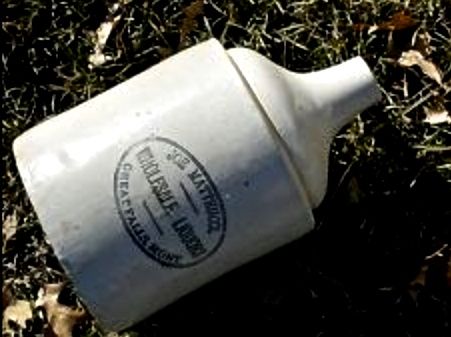
Throughout this vignette are the ceramic whiskey jugs in which he bottled his liquor.  Because Great Falls had good railroad access, he was getting bulk shipments from distilleries in other parts of the country,  most likely Kentucky and Missouri.  Then he was decanting them into stoneware jugs ranging in size from half-gallons to gallons and as much as three gallons.  They ranged from all white “Bristol glaze” containers to two-toned with “Albany slip” brown tops.  All carried a similar underglaze oval label with “M. Matteucci” and “Great Falls.”

While the smaller jugs would have been sold to retail customers to take home, the larger containers, such as the three gallon jug shown here were meant for the saloons and restaurants of the Montana town, to be emptied by their proprietors into smaller glass bottles for back of the bar use.

The year 1893, was a big one for Joe Matteucci not just for opening his first store, but for the immigration of his future wife, Emilia, into the United States and her arrival in Montana.  Theirs may have been an arranged marriage.  At 22 years of age Emilia was ten years younger than Joe.   They would have a family of three children,  two boys, Paul and James, and a girl, Helen. 

Almost from the beginning Matteucci seems to have been a successful businessman. In addition to “Joe Matteucci Wholesale Liquors,  he opened a drinking establishment in Great Falls under the name “Joe Matteucci Saloon.” issuing tokens with that name worth ten cents each and probably good for one drink at his bar.  He demonstrated an uncanny knack for knowing how to treat his customers, regardless of their origins.  His profits, fueled by his liquor sales, allowed Matteucci to expand his mercantile operations into selling pharmaceuticals.


Eventually he opened new stores in Montana selling both groceries and drugs.   Until 1920 and National Prohibition his whiskey sales remained a major profit center for all these ventures since many people bought liquor from their druggists.

Unlike other whiskey men, however,Matteucci was not hit particularly hard by the shutdown of his saloon and liquor sales.  By 1920 he had a burgeoning grocery and drugstore trade to rely on.  He could afford to send son, Paul, anointed as his successor, to Gonzaga University in Washington and Santa Clara University in California.  He could also afford the time to be active in the local Christopher Colombo Society, a fraternal organization that provided mutual aid for Italian immigrants, including support to programs that aided the impoverished and disadvantaged.

In 1938 Emilia died and was buried in Mount Olivet Cemetery in Great Falls.   The 1940 census found Matteucci, now 78, living with his son Paul, and Paul’s wife, Jane Johnson, and their twin sons, Ed and Terry.  Paul was now in charge of the Matteucci drugstore and supermarket chain under the name Super Save Stores.   An account from 1955 Missoula Montana noted Super Save as one of the largest groceries in Missoula, Montana.  

With the many changes occurring in the grocery trade, Paul Matteucci  in 1966 sold off the grocery part of the business and the stores became part of the IGA chain.  He continued on as the chairman of the board of the drug store chain.   It was renamed Super Fair and a 1973 ad shows Paul as chairman with two other Matteuccis, likely cousins, in management positions.  In 1981 the drug chain, now doing business in four states, was renamed Drug Fair Northwest.  In subsequent years that name disappeared inside the mergers that occurred in the drug trade.

Meanwhile, the immigrant who had built the chain died in 1940.  Joe Matteucci was laid to rest beside his wife, Emilia, in the Mount Olivet Cemetery.  The Christofo Colombo Society of Great Falls put a plaque in front of the family monument.  It shows two hands shaking, a fitting tribute to a man who came to the America as a youth and through his skill at welcoming customers to his business establishments carved out a supermarket and drugstore empire throughout the Northwest.  


Wednesday, June 3, 2015

Marcus Conroy: A Winner in Stamford Connecticut

In Wikipedia terms, consider this post a “stub.”  It an incomplete story about a Stamford Connecticut saloonkeeper upon whom I stumbled in trying to research the background of the paperweight shown above with the initials “M. M. Conroy.”

The instant I saw it at a recent bottle show, my instinct was — “This weight was made for a whiskey man.”  It was just a hunch, but my purchase turned out to be a provident one.  Marcus Conroy was a co-proprietor with a man named Kelly in an establishment called the “Pearl Wine Room” in Stamford Connecticut.  This information came from a very helpful librarian at the Stamford Public Library who sent me two newspaper pages with references but had no other information on Marcus.

In addition to running their saloon at the corner of Manhattan and Atlantic Streets,  Conroy and Kelly were retailers and dealers in ales, wines and liquors, as well as selling cigars.  They would deliver these goods to a customer’s place of business free of charge.They also claimed to be sole agents in Stamford for Ringler’s Extra Lager Beer.  This brewery had been founded in 1872 in New York City by George Ringler, a German immigrant.  Located in the heart of Manhattan’s brewery district, by 1900 it grew to be the third largest in the Big Apple.

An 1889 article in the Stamford Advocate newspaper reported that Marcus Conroy, identified as co-proprietor of Conroy and Kelly, had applied to the Fairfield County Commissioners for a license to open a second saloon on Stamford’s Main Street.  The hearing took place in the Borough Court Room and the three commissioners did not render an immediate verdict, it appears, since the story concluded:  “We have not yet heard what the decision was.”

Although I cannot be sure Conroy won his license, he was a winner when it came to the Louisiana State Lottery.   Despite the name, the lottery was run by a private corporation in New Orleans during the mid-19th century and  for a time was the only legal lottery in the United States.  Although the operation had a dubious reputation as a swindle and source of corruption, it was able to sell its semi-annual lottery tickets all over the United States.  Shown here are the front and back of a typical ticket from the Louisiana State Lottery.  
Conroy apparently regularly played the Louisiana State Lottery, one that gave the numbers of the winning tickets to its agents across America who then would notify the purchasers.  For the June drawing in New Orleans, Marcus had purchased one fortieth portion of Ticket No. 50843 for $1 dollar.  The ticket turned out to be the grand prize winner of $600,000 (equivalent to $15 million today).  Conroy’s share was, by my reckoning, worth about $375,000 in current dollars.  As a major winner, his name appeared in newspapers across America.

Here we take a turn into fantasy.  My speculation is that Conroy was so delighted with this windfall that he decided to finance a flamboyant paperweight bearing his name and address, possibly for gifting to friends and favored customers of his whiskey trade.  To create such an object he turned to Whitall Tatum & Co., a Millville, New Jersey, glassworks that made a wide assortment of bottles and other glass items, including paperweights.  Its sprawling factory is shown below.

Beginning in the early 1860s, while the Civil War raged, Whitall Tatum began making a line of paperweights.  In time the company developed a cadre of paperweight makers considered the best in the Nation.  The undisputed master of the craft was Ralph A. Barber, an immigrant from England whose father was also a glassblower.   Sometime in the 1890’s Barber, shown right, joined Whitall-Tatum and began to make paperweights.  His creations were recognized  almost from the start as the pinnacle of artistry in the craft.   

Although Barber did not sign many of his items, the Conroy weight almost certainly was among his creations.  Two bits of evidence exist:  First, the bottom of the weight carries a Whitall Tatum mark.  Second, a very similar weight bearing the inscription “Kizzie Pepper, Millville, N.J.” currently resides in the collection of the New Jersey State Museum in Trenton.  Show below, its resemblance to the Conroy paperweight is striking.  

Some controversy has surrounded who made the Kizzie Pepper weight, but Clarence Newell in his book, Old Glass Paperweights of Southern New Jersey (1989),  goes to great lengths to attribute the object to the hands of Ralph Barber.  He noted that the Barbers lived right next door to the Pepper family in the 200 block of South Fourth Street in Millville.    Newell concluded:  “…Barber’s generous nature was such that it would have been entirely in character for him to make a weight and give it to a neighbor.”
From this evidence I conclude that Conroy’s elegant weight in red, white, yellow and blue, with bars of brightly colored “candy cane” stripes was the work of this famous American paperweight maker.  My guess is that the Stamford saloon keeper was using his new fortune to reward himself and his friends with a token of his lottery success.

As indicated earlier, this vignette is a stub and in need of considerable additional material about Marcus Conway.  I am hopeful that some kinfolk of his will see this post and provide missing information about the man and his life.


Saturday, May 23, 2015

George Simmonds Put Nabobs on Frisco’s Nob Hill

Although calling someone a “nabob” has differing meanings,  George Simmonds, arriving in San Francisco in 1877, pictured the gent as an Oriental potentate on the labels of his flagship whiskey.   Simmonds' liquor proved popular and soon found its way to the city’s most exclusive areas, including Nob Hill, where the Nabob Whiskey could be found sitting on the sideboards in mansions of the rich.
Although personal information about Simmonds is scant, he is recorded by some sources as having come to California from Boston where he had been in the whiskey trade.   My search of census data for him there, however, does not reveal anyone by that name.  Moreover, an 1879 ad identified him as “G. Simmonds of Kentucky.”   Upon arrival in San Francisco, his age uncertain, George seems immediately to have established a liquor company indicating both experience in the trade and sufficient money to obtain a store and stock it with whiskey and other spirits.  He located the business on Montgomery Street, shown below as it looked about that time.
About the time Simmonds arrived on the West Coast, he also was a patented inventor.  In March 1877 he applied for and received a patent on “a new and useful improvement on Chamber and Nursery Lamps.”  It was a light without a wick that was held in a metal or glass bowl filled with a non-explosive oil.  A small upright tube was at the center that rose above the reservoir of oil.  A upper opening of the tube was ignited and would remain lighted as the oil rose through the tub until the whole quantity of oil was consumed.  Simmonds thought so much of this invention that his 1878 San Francisco business listing was “Nabob Whiskey and Patent Night Light.”  Perhaps because the lights did not sell, by the next year the night light reference was gone.

This invention with its application to nurseries may indicate that Simmonds had a family, but there is little evidence to support that idea.  He seems to to have avoided the federal census takers during his lifetime.  He moved his personal residence frequently, according to directories dwelling at 1719 Howard Street in 1878, 614 O’Farrell in 1880, both likely boarding houses.

From the first, as well, Simmonds seems to have been rectifying whiskey, that is, blending and compounding raw whiskeys to achieve certain smoothness and taste.  He was bottling it, putting on his own labels and selling it.    Likely needing more space for his operations, he had moved his business to 217 Front Street by 1880.  After three years at that location he moved again to 429 Battery, the address on the letterhead above. 

In 1882 Simmons trademarked the name “Nabob” for his brand of whiskey.  In his federal application he asserted that the word had been “arbitrarily selected.”   Well maybe.  Given the images that appeared on Simmond’s labels and bottles, Nabob was an important part of his merchandising strategy.   The picture above depicts a large bearded man in a turban and robe, with a hookah pipe and glass in hand.  He is being served a bottle of Nabob Whiskey by a servant in a distinctly Moorish setting.   
Simmonds had chosen the original meaning of the word, a deputy governor or viceroy of the Mughal Empire rule in India.  These were men who lived in comfort and splendor while oppressing the locals.   Subsequently the British adopted the term for a conspicuously wealthy Englishman who returned from India with riches gained through corrupt trade.  In our own time disgraced Vice President Agnew condemned vocal opponents of  the Vietnam War as “nattering nabobs of negativism.” 
The Simmond’s company advertised heavily in West Coast publications.  Its ads emphasized that Nabob was the “purest and best” for medicinal purposes, claiming that it had been recommended by Dr. H. C. Louderback of St. Louis “in all cases of nervousness, weakness, debility, dyspepsia, indigestion, etc.”     Simmonds also provided a testimonial from “the eminent” Dr.  S. Dana Hayes, state assayer for Massachusetts.  Hayes opined:  “The sample marked “Nabob Whiskey,” received from you, has been analyzed with the following results:  It is of selected alcoholic strength and free from added flavoring oils, acids, metals, or other deleterious substances.  This whiskey is pure, of superior quality, and suitable for dietic and medicinal purposes.”
The image of the nabob was found on Simmonds’ ads, labels and even embossed on the amber glass quarts that held his whiskey.  Found frequently by bottle diggers, many are believed to have been made by the San Francisco Pacific Glass Works (1876-1901).  The images may differ slightly on these quarts.   Below are two Nabob whiskeys, probably bottled at various times and from different batches of containers.  In each of the embossings the position of the nabob and the servant differ in relation to the other.  In addition, the figure of the nabob varies from bottle to bottle.


At some point marketing for Simmond’s Nabob Whiskey on the West Coast was farmed out to the F. Mandlebaum Company of 312 Sacramento Street, near Front, in San Francisco. Moreover, by 1881 Simmonds had taken a partner, Ami Vignier, and the firm became Vignier & Simmonds, located at the Battery address and still featuring Nabob Whiskey.   Vignier had been involved in the liquor business since 1868 in San Francisco but his merger with Simmonds was short-lived.  Within several years, Vignier had departed the partnership and opened a store two blocks away from Simmonds on Battery that operated until 1914.

On other Simmonds’ bottles, as shown below, the figure of the nabob disappeared completely and just the name of the whiskey was embossed.  He also employed other images to advertise Nabob whiskey.   Shown here is a trade card in which a young man in medieval dress has doffed his hat to a young woman carrying a cane.  The caption mysteriously reads: If you had drunk Simmonds’ Nabob Whisky, I wouldn’t have cared.”   George’s other house brands included "Iroquois Whiskey,"  "Simmonds’ Choice,"  "Simmonds’ OPS," and "Cream of the Valley Gin."  

By 1887, San Francisco business directories were recording that George Simmonds & Co. was being run by other individuals.  Among them was Philip Simmonds, his relationship to George unknown.  Another was Albert Dallemand, a whiskey man with interests in both San Francisco and Chicago. [See my post on Dallemand, September 2012.]  The company was now listed as located at 215-217 California Street.  By 1889 the Simmonds Company had disappeared completely from San Francisco directories.

I surmise that George Simmonds died in 1896 or 1897 but my attempts to confirm his death and locate his final resting place have been fruitless.   Given the many elaborately embossed bottles Simmonds left behind, it is hard to believe that his total career in San Francisco was barely ten years.  It is a tribute to his business genius that he was able to make his whiskey a best seller in so short a time and establish his Nabob brand on the liquor shelves of his adopted city, even reaching to the fancy houses of the American nabobs on Nob Hill.

Note:  When stymied about components of the personal histories of whiskey men featured here, I frequently seek help from descendants to fill in the blanks.  Frequently in the past relatives have stepped forward to provide information and often relevant photographs.  Such are always welcome as are suggested corrections.  I am hopeful of someone stepping forward and fleshing out the details of George Simmonds’ life.


Wednesday, May 20, 2015

Boston’s John Doane Issued His Own Moose Call

 Many whiskey men have used animals as the symbols of their spirits, everything from dogs and bears to ducks and eagles.   Boston’s John S. Doane, shown right, was fixated on the moose for his liquor, employing two bull moose on virtually every advertisement and label of every bottle he sold.  In effect, he issued his personal “moose call” and the customers came running.

By the time John Doane was born in 1842, however, the last moose had been extirpated from Massachusetts more than a century earlier, the victim of hunting and habitat loss.  Doane’s birthplace was Wellfleet, Mass., a town about half way down Cape Cod.  It had its beginnings because of whaling, fishing, and rich oyster beds.  As a boy John would have seen the ships come and go from Wellfleet’s harbor.  With the decline of whaling all the schooners had departed by 1900.

Doane came from an old New England family, his ancestors having arrived during colonial times from England.  His father was Hezekiah Doane, son of Henry and Abigail Holbrook Doane.  His mother was Catherine Jenkins Smith, the daughter of John and Ruth Witherell Smith.  Both of John’s parents had been born in Wellfleet.   He was the eldest of five children, with one brother and three sisters.  
Having reached his maturity in the 1860s, Doane was eligible for Federal service in the Civil War.   History records two Private John Doanes in the Union Army, but an obituary for our man indicates his having joined in 1862.   That would make his unit the Massachusetts 8th Battery Light Artillery.  It was organized at North Cambridge for six months service in June 1862.   Employed initially in guard duty around Washington, D.C., the regiment saw limited action at the battles of first Bull Run, South Mountain, and Antietam, the latter shown above.  The unit later was returned to guard functions.  The 8th, almost unbelievably, suffered only one enlisted man killed and 10 felled by disease before the regiment finished its short enlistment period in November 1862 and was mustered out.

Although some of Doane’s comrades likely re-enlisted in other newly forming units, no evidence exists that he continued as a fighting man, possibly having seen enough of the carnage to desire to stay out of “harm’s way.”  Nonetheless, after the Civil War he was an active member of the Grand Army of the Republic (GAR), the politically powerful Union veterans organization.

In 1869 he married a Massachusetts-born woman named Sarah.   At the time he was 27 and she was 24.  The 1870 U.S. Census found them living in Ward Two of Boston.  As yet there were no children.  Doane’s occupation was given as proprietor of an “oyster house,” likely a saloon.

Doane next surfaced in Boston as owner of the “John S. Doane Co., Importers, Wholesale Dealers and Jobbers in Foreign and Domestic Wines and Liquors,”  located at 149 & 151 Blackstone Street.  Although Boston business directories first listed the firm several years later, Doane claimed an 1866 founding date for his enterprise.  Almost immediately upon opening his doors he adopted the bull moose as the symbol and brand of his whiskeys and wines. 
 
The choice may have signaled his vision about the ultimate size of his business.  Moose are the largest mammal in the United States.  A bull moose can weigh anywhere from 600 to 1,000 pounds.  They stand up to six feet at the shoulder.  Moose antlers are also spectacular, spreading at times six feet from end to end. Although the animal was gone from Massachusetts,   Doane clearly was thinking big when he chose two bull moose as his symbol.  It was his version of a “moose call.”   
In addition to the activities listed on his letterhead, Doane was a “rectifier,” that is, he was buying whiskeys from a variety of distillers, then blending and compounding them to achieve taste and smoothness.   He then was merchandising them with his own labels — virtually all of them bearing the images of moose.  His brands included "Doane's X X X X,” "Doanes 149,” "Fairy Grotto Rye,” "Long Life Malt,” "Old Dimple Rye,” "Old J. S. D.,” and "Sandy Camp Rye."  

He sold these whiskeys in large ceramic containers to his wholesale customers, but had a line of retail products ranging from flasks to quarts.  Shown here, his whiskey was sold in clear and amber bottles, apparently not embossed but carrying distinctive paper labels.  A Doane price list indicates that his house brands were low cost liquors, ranging from 75 cents to a dollar a quart.  He also sold a range of more pricey national brands, likely an attempt to foster a mail order customer base.
In Boston Doane found himself challenged by stiff competition.  For example, a 1906 city directory listed no fewer than 107 businesses listed as wholesale liquor dealers.  Taking a familiar route to gaining favor with his customers,  he offered shot glasses to saloons and barrooms that carried his liquor.  His glasses were distinctive by the two etched moose.  More unusual was a thermometer giveaway with temperature commentaries including “steam heat,” at 78 degrees, “blood heat,” at 98 and “fever heat” at 110.  

At some point Doane, obviously successful in the liquor trade, opened a second location at 12-14 Endicott Street in Boston.  The addresses on his labels were appropriately altered to reflect the second outlet.  One is shown left on a Doane wine bottle.  Through all Doane’s years in business, the moose remained linked with the motto:  “Fide et Fiducia.”  Although the Latin meaning of both words varies, my interpretation is “Faithful and Trustworthy.”  My assumption is that this applied to the whiskey as well as to the animals. 

The 1900 Federal Census found the John and Sarah Doane boarding on Dudley Street in Boston, a residential hostelry known as the Hotel Gladstone.  Doane’s occupation was recorded as “wholesale wine and spirits.”  Five years later, John died and his funeral was held at the Gladstone.  He was buried in Woodlawn Cemetery, shown below, located in Middlesex County, Massachusetts.  With his death and the coming of National Prohibition, his liquor dealership went out of business never to be revived.

Moose, by contrast, have done well.  The State Division of Wildlife in a recent bulletin announced that the animals have returned to Massachusetts.  Populations have been increasing steadily in New England states as the end of hunting and detrimental forest practices have facilitated higher reproduction and survival rates.  Consequently the moose have reintroduced themselves into northern and central portions of Massachusetts.  Among the places where they frequently are sighted is Middlesex County.  I fancy that they are there looking for John Doane’s resting place to pay homage to him for the many years he kept their portraits in front of the American drinking public.


Sunday, May 17, 2015

The Many Faces of Billy O’Hern — Minneapolis Saloonkeeper

The genial smile of the man at right, the one wearing the jaunty straw skimmer hat and bow tie, is Billy O’Hern who ran a saloon, pool room, and retail liquor, beer and tobacco emporium on on Cedar Avenue in Minneapolis.  Although facts about O’Hern’s personal life are scant, he clearly liked having his picture on his advertising materials and by tracking them it is possible to trace this whiskey man’s progress through life.

Although O’Hern apparently avoided U.S. census takers throughout his life, the Minnesota State Census caught up with him in 1905, in Ward Eleven of Minneapolis.  He was living over his saloon.  To the interviewer Billy revealed that he had been born in Minnesota in 1875 and that his father had emigrated from Ireland and that his mother was Canadian born.  He was not married and, to my knowledge, remained a bachelor all his life.

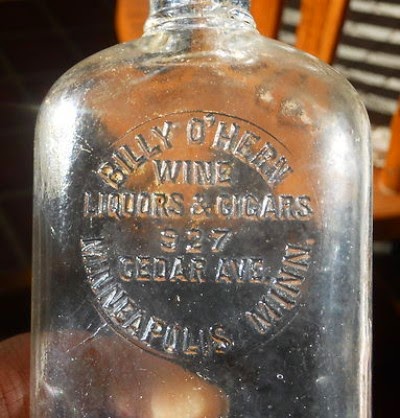
Of O’Hern’s early life, my research revealed nothing.  He emerged into the public record in 1902 when, with another Irishman named John P. Collins, Billy opened a saloon at 927 Cedar.  He was 27 years old at the time.   After about a year Collins departed the partnership and Billy continued on at the same address.   As the trade card picture above would imply, at this stage of his career, O’Hern was playing the role of genial host. He was selling his whiskey in glass pint flasks as well as in larger containers;  most had “Billy O’Hern” embossed on them.

The generous saloonkeeper image was evident in the gifts O’Hern was bestowing on regular customers.  Among them was a small beer stein, ceramic with a metal top.  Probably made in Germany especially to his order and shipped to Minnesota, the stein was an expensive gift, bestowed by the saloonkeeper on favored customers during the 1910 Holiday Season.  Less costly was a beer mug that included the verse “To the Auto:  May We Hear It Toot in Time to Scoot.”  His name also appeared in red Celtic lettering.  Another mug, not shown here, contained the motto: “Your Money is Your Best Friend” and indicated that the ceramic was a 1909 present from Billy.

Fast forward a few years and a subsequent trade card.  This older Billy has discarded the straw skimmer and genial smile.  He has on a bowler hat and a skeptical look.  Has something occurred to disrupt the geniality of this publican?

Move to the next O’Hern trade card.  The message is just the same as the earlier trade cards but a different image of Billy has emerged.  Gone is the bowler hat and bow tie.  Now O’Hern is wearing a fedora, a four-in-hand tie, a suit and a vest.  The look is rounded off by a watch fob and a dark goatee.  This is a wealthy and well-turned-out publican, showing off his prosperity.  The trade card indicated he can afford two phone companies.

O’Hern throughout this time was giving out bar tokens of at least three varieties, as shown here.  These tokens, while they might be taken as symbols of Billy’s generosity, also might indicate considerable shrewdness.  If someone bought a round of drinks for a group, the bartender would give a token or two to those patrons already having a drink and collect the full sum from the round-buyer.  The owner would collect immediately, and the drinkers would have tokens for later use that frequently were lost or forgotten.  As the token cost less to produce than the value of the drink, there could be a significant profit to the bar owner. 

Moving on another few years into the 1910-1920 period, we find a major change has taken place in O’Hern’s aspect.  No longer is he “Billy,” but now “Wm. F.”  Here his face appears on a tip tray.  The goatee and hat are gone.  No smile.  This O’Hern now has the look of a slightly overweight, self-satisfied businessman.   

We can conclude that this visage is a later one because the rival phone companies, as often happened, have morphed into a single utility.  Not only has Billy — excuse me, William — changed his look, he has altered the embossing on his bottles of whiskey.  It now read “William F. O’Hern Wines, Liquors & Cigars.”

The final trade card shown here carries its own surprises.  Here an older looking William is sporting a mustache and has an additional line of goods.  While he is still dealing in wines, liquors and cigars, he is also selling dogs.  Pitt bull terriers were his specialty and, he advertised, “always on sale.”  O’Hern, the owner of “Bullrat” and “Slim,”  apparently had become an impresario of dog-fighting.  This blood sport was legal in Minnesota at the time and even today, according to state authorities, goes on illegally.

Although O’Hern was still selling whiskey and beer when the final card was issued, National Prohibition could not have been far off and the alcohol trade made illegal.  Closing down the bar and shutting off the spigots, O’Hern still had his restaurant, pool room and cigars to sustain him financially.  One report has him serving soft drinks to his customers during the 14 “dry” years.  

Then this Minneapolis saloonkeeper fades into the mists of history — no census reports, no death notice, no gravestone to place him in time.  Because he liked to have his picture taken, however,  we can trace Billy O’Hern, as few other whiskey men,  for almost two decades of his rapidly evolving life -- and looks.