Tuesday, March 8, 2016

R.H. Cate Danced “The Prohibition Hop” for Two Decades


Richard Hamilton Cate, accounted “one of the soundest thinkers” in the whiskey trade, had to be as  nimble as Fred Astaire as he placed and then re-placed his liquor enterprises across Tennessee and Kentucky, as each state by local or statewide action created “dry” zones.  Cate’s fancy steps might be described as “The Prohibition Hop.”

Cate was born in 1863 in Blountville, a small town in extreme northeastern Tennessee and the seat of Sullivan County.   Both parents, Gideon and Mary Cate, were natives of the state and likely hardscrabble farmers.   The son later told a U.S. census taker that he had had only a sixth grade education.  Having gone to work when he was barely in his teens, Cate’s sound thinking could be traced to the “school of hard knocks” rather than book learning.  The 1880 census found Richard living with his parents at age 17, his occupation given as “clerk in store.”

Upon reaching his majority and likely seeking greater opportunities, in the early 1880s Cate moved to Knoxville, about a hundred miles west and south of Blountville.  Not long after he met and married Harriet J. “Hattie” Farrington, the daughter of James and Malinda Laudenback Farrington, an Ohio-born woman some seven years older than Richard.  The couple would know tragedy as their first child, named for his father, and another son, Milton, both died in infancy.

During this period, my assumption is that Cate was working in one of the many liquor establishments operating in Knoxville.  He first surfaced in local business directories in 1897 at the age of 34 engaged as a partner in a liquor business called Housely, Cate & Company, located at 308 Gay South.  By 1900 Housely had departed and Cate had a new partner named Bennett and an address at 302 Gay South.  With in few months Bennett had departed and the name of the business became R.H. Cate & Co.
Cate’s initial efforts were as a wholesale liquor dealer who featured a number of proprietary brands, likely “rectified,” — blended and mixed — in his Gay Street facilities.  Like many rectifiers, Cate almost certainly was having trouble getting supplies of raw whiskey for his blending activities.  By 1902, he was claiming ownership of the “Freestone Distillery,” likely his name for a plant designated in government annuals as RD #100 in Tennessee District 2.  He claimed in ads that this facility was “located in a valley on our farm.  The water we use in distilling is the finest in the world.”  Among Cate’s brands were “Free Stone,”  “Freestone Old Corn” and “Freestone Tennessee” and “Cate’s 1888.”
From Kentucky distiller H. A. Thierman, who had trademarked the names in 1902, Cate bought the rights to “Belle of Jefferson,” “Indian Hill” and “Mayflower” whiskeys, likely as part of a investment in all or part of a Louisville distillery (RD #360) that from 1866 to about 1900 bore Thierman’s name.  Subsequently Cate re-named the facility as the Rugby Distillery.  Shown above, this property included four warehouses, all were brick with fireproof metal or slate roofs and had interior heating up to 80 degrees.  The spent mash was being fed to cattle who had a separate barn on the premises.  By 1910 the Rugby Distillery had a mashing capacity of for 1,000 bushels and had added three warehouses with a capacity for 75,000 barrels.
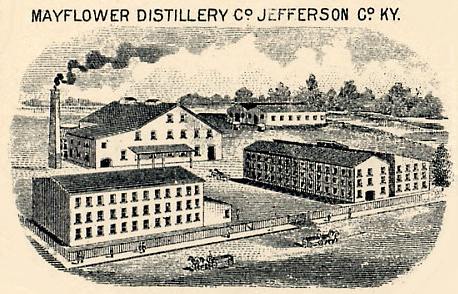
Cate also claimed ownership of another distillery previously held by Thierman. Shown above, this plant was located in Jefferson County, Kentucky and known by various names, including Mayflower Distillery (RD #350). This was a smaller plant, with the distillery itself of frame construction and three brick or iron-clad warehouses with fireproof roofs.  Here too cattle pens were on the site.  Federal records indicate that while Cate might have had important financial interests or contracts with both these distilleries, he was not operating them directly. 

During this period, Cate was marketing his products in glass containers.  Like the Belle of Jefferson flask shown here, those bottles held interesting and well-designed labels and some had highly embossed glass.  Notable were his company’s flasks for Indian Hill Bourbon.  They featured two Native American figures with full feathered headdresses on a pebbled background and the whiskey name.  The lower half of the bottle contained a blank panel for a paper label.
Just as Cate’s Tennessee business was beginning to blossom and assured of a good supply of whiskey for his several brands, his problems began.  In 1904, his wife of 16 years,  Hattie, died.  With her grieving family around her she was interred in the Old Gray Cemetery in Knoxville.  About the same time, that city under local option voted to go dry.   For the first time — but not the last — Cate was faced with shutting down his enterprise or going elsewhere.  He chose the latter, moving his distribution center out of state to “wet” Louisville, nearer both distilleries in which he claimed an interest. Cate located 102 East Main Street, known locally as “Whiskey Row” because of the many liquor industry offices there.

Like many of his neighbors on Main Street, Cate was doing a brisk mail order business, much of it into localities and states that had gone “dry” but could not ban out-of-state express shipments of liquor.   Competing with other mail order liquor firms, he pre-paid express shipments, the smallest order being six quarts, shipped in wooden boxes.  A shipment was available upon payment of $5.00. Cate’s ads assured the public:   Our whiskies do not contain one drop of spirits or other injurious substances.  They are of delightful flavor, high in food properties and medicinal virtues.” 

The transplanted Tennessean seems rapidly to have made his mark in Louisville.  The Wines and Spirits Journal  noted that during his time in the city “Mr. R. H. Cate, the head of the firm, became very popular with his business associates…”  He had taken a lead in the industry efforts to fight off the forces of prohibition, the publication indicated and in so doing “proved himself to be one of the sound thinkers in our trade and demonstrated his willingness to bear his part of the burden in the work necessary for the protection of the trade’s interests.”

For unexplained reasons, however, in 1908 Cate decided to relocate his operations back to Tennessee, possibly out of loyalty to his home state.  Said to have had faith in the future of the liquor business there he moved to 815 Broad Street in Chattanooga where he already had a branch office.  As Tennessee county by county, town by town, banned alcohol sales Chattanooga had remained a bastion of “wetness.”  Cate issued a shot glass that referenced his new address.

This time Cate decided on a “fail-safe” and opened a second liquor house in Middlesboro, Kentucky.  His faith in his ability to continue to sell whiskey in Tennessee soon proved woefully mistaken.  In 1912 the entire state went “dry” and all those previously displaced whiskey men who had flocked to Chatanooga were forced to shut down.  

Not willing to quit the whiskey trade, however, Cate once more returned to Kentucky, this time to his Middlesboro outlet.  He likely had selected the town because two of his sons were already there, running a downtown saloon known as “The Palace,” shown here.  A city directory listed the saloon address as also harboring the R.H. Cate Sons Co., retail liquor store, with R. F. and R. H. Cate Jr. as the proprietors.

This Kentucky haven served as a distribution point for Cate whiskey for several years.  But prohibitionist forces also were on the march in Kentucky.  Middesboro  voted to go dry in September 1914.  That spelled the end of the saloons in town and with it the Cates lost a bastion for their liquor businesses.  Passage of the Webb-Kenyon Act by Congress eventually cut off Cate’s mail order sales.  Moreover, a 1913 flood in Louisville had ruined the Rugby Distillery.   As shown below, two walls of whiskey, aging in barrels, collapsed in the rushing water and the brick walls caved in.  Apparently realizing he was finished in the liquor trade, Cates surrendered to the prohibitionists, and turned to other pursuits.
By this time he had married again.  His second wife was Jane Emmons, a Michigan-born woman who was two years younger.  There is no record of children.   With the end of the liquor enterprises, the Cates moved back to Knoxville, where Richard had begun.  He was recorded in the 1920 U.S. census as the proprietor of his own business, selling oil leases.  The next time he appeared in the census, 1940, Cate had given up that pursuit and was running a tourist home with Jane at 609 West Cumberland Street in Knoxville.

Richard Hamilton Cate died in August 1945 at the age of 82.  Born before the Civil War he passed away just as World War Two was ending.  Like his first wife, Hattie, he was interred in Knoxville’s Old Gray Cemetery.  The Tennessee Index of Deaths and Burial identified him as “hotel manager - retired.”  

That designation does not do justice to the career of a man who for more than twenty years kept operating his liquor business in the face of daunting opposition. Demonstrating extraordinary resilience Cate had jumped from Tennessee to Kentucky, from Kentucky back to Tennessee, from Tennessee back to Kentucky, and likely very weary, finally from Kentucky back to Tennessee.  He showed that he was master of the dance I have called “The Prohibition Hop.”  In the end, of course, no amount of fancy footwork could prevent the inevitable.


.


Thursday, March 3, 2016

For Charles Kaier “Liquor then Beer” Held No Fear

There is a popular saying among the imbibing public: “Beer then liquor, never been sicker; liquor then beer, have no fear.”  Charles D. Kaier of Mahanoy City took that philosophy to heart, and built a highly successful Pennsylvania brewery out of riches he earned by selling whiskey.

Kaier, shown right, was a German immigrant, born in March 1939 to Andras and Cresentia (Wittmer) Kaier in Binnigen, Baden-Wurttemburg.  Christened “Anselm Troian,” he anglicized his name after coming to the United States at the age of 16 in 1854 with his blacksmith father, mother, and four siblings,  Their two-month journey took them through France where they boarded the ship, Valanden,  at Le Havre to sail to New York City.  Initially settling in Norristown, Pennsylvania, the Kaiers subsequently moved to St. Clair, Pennsylvania, where Charles became a baker’s apprentice.

Of age militarily when the Civil War broke out, Kaier, perhaps luckily, was quick to respond.  As a private he enlisted in Company H (“Wetherill’s Rifles”) of the Ninth Regiment of the Pennsylvania Volunteer Infantry.  Although the war dragged on for four bloody years, military leaders of the Union initially thought the Southern rebellion would be put down quickly.  Early enlistments accordingly were for 90 days.  As a result Kaier joined in April, 1861, and was honorably discharged by July of that year.   In the meantime, he had seen no combat, simply providing garrison duty in Washington, D.C. 
  
Although recruits were strongly urged to re-enlist, Kaier apparently had seen enough of military life and returned to civilian pursuits.  Now 22 years old,  he had the confidence to move to another town, Mahanoy City, Pennsylvania, and start his own liquor and beer business, an enterprise he called “Chas. D. Kaier Co.”  Part of Schuykill County, Mahanoy at the time was growing as a major center of anthracite coal production, with many thirsty miners to create a customer base.  The town, shown below, also was served by both the Lehigh Valley and Philadelphia & Reading railways, facilitating Kaier’s receiving whiskey supplies from the state’s distilleries and distributing his own products regionally.

Charles also found a wife not long after his military discharge.  In 1863 at St. Patrick’s Church in Pottsville, Pennsylvania, Charles married Margaret Curry, a 22-year-old schoolteacher whose Irish immigrant parents owned a hotel and restaurant in Pottsville. The Kaiers went on to raise six daughters and one son, Charles F., but tragically lost three others, all of whom died in childhood.

Kaier was buying whiskey by the barrel and likely “rectifying” it, that is, mixing and blending in his own facilities at 113 East Centre Street to achieve particular taste and color.  For his wholesale customers, he was providing these spirits in gallon or larger ceramic jugs. For retail customers, the whiskey was decanted into quart bottles and smaller flasks.  As shown on the letterhead above, Kaier featured several proprietary brands, “Honey-Brook Monongahela Rye,” “C.D. Kaier’s TOP 1880 Rye” and “Kaier’s Special ‘A’ Whiskey.” 

Initially, Kaier’s business chiefly was in whiskey, although he was a distributor for brewers.  With the growing wealth from his liquor business, he accrued sufficient capital to open his own brewery.  In 1880 he convinced his cousin, Franz Kaier, to leave Germany and become the brewmaster in the new beer-making facility he was building in Mahanoy City.  The earliest known photo of Kaier’s Brewery, with an inset of an advertising tip tray, depicts the plant as it looked during the 1880s.  
Meanwhile, Kaier was bringing his sons-in-law into the business.  Daughter Ella, the eldest, had married John B. Lieberman.  He became the brewery treasurer.  Daughter Josephine married Michael Haughney and he was appointed the company secretary.  A undated letter exists, to Kaier in Philadelphia from his daughter, Mary (known as “Mame”), who also was involved in corporate operations in Mahanoy City.  She informed him:  “Mike (likely Haughney) was in town all afternoon.  Everything is going on all right.  You need not be worried.”  Then she proceeded to tell him their Mahanoy bank account was $5,873.46 short.

Kaier’s growing wealth allowed him to move his family into a stunning mansion in Mahanoy City.  Located at 729 East Center Street and shown here, he is said to have “spared no expense increasing a home to incorporate all the grandeur and elegance associated with the Victorian Era.”  Now on a register of historical sites as an excellent example of Second Empire Victorian style, it functions today as a bed and breakfast. 

 As shown on the letterhead above, Kaier incorporated making beer and his liquor business into one corporate entity.  When he expanded the brewery in 1892, he moved whiskey rectifying to the third floor of the beer bottling department.  In time Kaier’s enterprises grew enormously.  An artist’s concept of the complex shows that perhaps encouraged by his wife’s parents, he had moved into the hospitality business with a three story Kaier Hotel. On the illustration note the stables at right where the horses for his brewery wagons were kept and at left the train spur right to his warehouses.
  
Growth, however,  was not without its incidents.  A plant superintendent and personal friend of Kaier’s named Philip Fuhrman, had accrued $25,000 in stock in the facility (equiv. $1 million today).  When he returned from an extended stay in Germany, Fuhrman professed shock and disappointment in what he alleged had been management lapses at the brewery in his absence.  He filed suit.  Unwilling to go to court, Kaier bought out the employee and fired him.   Moving to Shamokin, Pennsylvania, with his boodle of cash, Fuhrman and a partner started their own brewery in competition with Kaier.  Some speculated that had been Fuhrman’s objective all along.

Throughout his life, Kaier was known for a vision beyond business and family.  As one account says:  “Mr. Kaier gave  his time to charity and church work.”  It cited his membership in the Severn Post of the G.A.R., providing aid to returned Civil War veterans and their families, and, although not Irish, working with the Friendly Sons of St. Patrick in Philadelphia, providing assistance to Irish immigrants. Kaier also built and operated an opera house in Mahanoy.

As Kaier aged, his health declined.  He died in 1899 at the age of sixty.  With his  widow and children, and their families, gathered around the grave he was laid to rest at St. Fidelis Catholic Cemetery.  His monument is shown here.  After Charles’ death, management of the brewery and liquor establishment bypassed Lieberman and Haughney and fell to Kaier’s widow, Margaret, shown below, to the unmarried Mame, and to the only son, Charles F.  At the time only twenty, this Kaier later would become known as “Champagne Charlie” because of his extravagant and profligate lifestyle.  Despite being bypassed for ownership,  sons-in-law Lieberman and Haughney stayed on. 

From the beginning this new and inexperienced ownership group found it difficult to manage the multiple enterprises Charles Kaier had built.  The trio tried unsuccessfully to sell the brewery in 1900 — only a year after the founder’s death — and again in 1903.  In 1902, the family celebrated the 50th anniversary of Kaier’s original store on East Center Street, with the B.P.O.E. (Elks) decorating the storefront with bunting and flags as part of the observance. 
   
The trio were able to keep the beer and liquor enterprises afloat until 1913 when Mother Kaier died, leaving the company to Mame and Charles. Then all hell broke loose in the family with vicious court fights over her will.  Lieberman quit and moved his family to Allentown, Pennsylvania to work at his father’s brewery;  Haughney left to work as a salesman for a distillery.  By the time of National Prohibition, Mame and her husband had ousted her brother, Champagne Charlie, from ownership.  During the “dry” 14 years the company made soft drinks and, according to some accounts, bootleg beer.   After Repeal, the couple resumed making beer and the Chas. D. Kaier Co., eventually under other ownership, lasted an estimated 100 years.

That was the legacy of Charles Kaier, an immigrant from Germany with limited education who created a major brewery made possible by profits from his earlier and continuing liquor sales.  After finding nothing risky in whiskey Kaier definitely had had no fear in embarking on beer.

Note:  Some of the material for this post and the brewery photo came from an article by John C. Lieberman in the Jan.-Feb. 2002 issue of the American Breweriana Journal, entitled “Charles D. Kaier — American Success Story.” Other information was derived from the website of the Mahanoy Area Historical Society.


Monday, February 29, 2016

The D’Agostinos Spread Big Bottles Across America

Once upon a time during National Prohibition a family from Atlantic City succeeded in building eighty giant wine bottles across America, two of them shown here. They were the D’Agostinos, father, mother, and son, whose successful ventures into liquor, wine and tonics is remembered best by those huge concrete and plaster monuments, hailed by some as “architectural treasures,” with four bottles in New Jersey protected as historic landmarks. 

The progenitor of this American “Stonehenge” was Matteo D’Agostino.  Shown right, he was born in the Messina Province of the Island of Sicily, Italy, in 1871, into the family of Andrea D’Agostino.  At the age of 15 in 1886, Matteo emigrated to the United States settling in the vicinity of Atlantic City where he likely had relatives.  Five years later his future wife, Maria, came to this country.  Born the same year in Messina, she likely had known Matteo in the Old Country.  They married in 1992, the same year Matteo became a naturalized citizen.  Over the next fourteen years the couple would have seven children. Four of them appeared to have died in infancy or when very young.  Their second-born in 1895 was John Andrew, the son who one day would help spread D’Agostino bottles from coast to coast.

Matteo first appeared in local business directories in 1904 as the proprietor of the D’Agostino Hotel at 2230 Arctic Avenue in Atlantic City, an address that shortly after also became the headquarters of  D’Agostino’s Wines and Liquors.  The Sicilian immigrant had selected an excellent location for both a hostelry and alcohol sales.  Atlantic City, the boardwalk shown above, was at the pinnacle of its popularity as a tourist town, attractive for its ocean beach, its gambling, and its reputation for being “wide open” for all kinds of activities. both licit and not so.
D’Agostino appears to have featured only a single proprietary brand of whiskey, one he called “Atlantic County Club.”  He never bothered to trademark the label, but issued both a standard shot glass and a tonic shaped glass, shown left, advertising the brand.  

He also marketed a spiritous tonic called “Ferro-China Bisleri,” a reputed health giving beverage that had originated in Italy.  Its slogan translated from the Italian was “You want good health?  Drink Ferro-China Bisleri.”  This hype did not impress Food and Drug officials when in 1914 they seized 24 bottles of D’Agostino’s Bisleri bitters in New Jersey and condemned them.  The government claimed that they had been spiked with wood alcohol, a poison that can cause blindness and sometimes death.  The spiking appears to have been done by the Philadelphia supplier — not the D’Agostinos.

In time John D’Agostino had joined his father in the liquor trade.  The son proved to be an even more astute businessman than his father, particularly in the way of cultivating important friends, reputedly including Mafia figures.  His most important connection was to Enoch “Nucky” Johnson, the Atlantic City political figure and racketeer.  From 1914 to 1941 Johnson was the undisputed “boss” of the Republican political machine that controlled Atlantic City and its government.

It was likely with Johnson’s help — and almost certainly his approval — that the D’Agostinos with John in the forefront bought the Renault Winery in Atlantic City in 1919.  The winery dated from 1864, founded by Louis Renault who found the climate and soils around Atlantic City similar to his native France. Under his tutelage, the winery won prizes for its wine and became the largest distributor of champagne in the U.S.  

When the D’Agostinos took over the winery National Prohibition was immanent, a prospect that did not daunt the family.  Exploiting a loophole in the laws and with undoubted political influence, they were able to get a government permit to operate throughout the fourteen “dry” years, allowed to produce wines for “religious and medicinal” purposes.  Renault Wine Tonic at 40 proof became their chief product and was sold in drug stores nationwide.  All one needed was a doctor’s prescription.  The label “warned” not to chill the tonic as it would turn into wine.

The winery purchase took John D’Agostino on several business trips to France, one of them to the little village where Louis Renault was born.  In the town square where it had stood for 100 years was a giant concrete champagne bottle.  It gave John an idea:  Why not replicate such a bottle in the United States?  Not just in Atlantic City but 80 such bottles, advertising Renault from sea to shining sea.  For the job, he reached back to Italy and an artisan named Luigi Portaluppi.

Assisted by his son, Portaluppi began to work his way across America building giant concrete bottles as he went.  He would fashion a hollow base of chicken wire or mesh and cover it with a mixture of Portland cement, stone, sand and water.  The outside was plastered and painted with the Renault logo.  By the end of the 1930s, when champagne and other wine once again were legal, the Italian immigrant had reached Fresno, California, built the 80th bottle — and stopped.

Although these totems proved to be an attention getting way of advertising, they also created problems for the D’Agostinos.  When they contracted for the space with landowners, those individuals were expected to maintain the bottles, including paint when needed.  If, as inevitably happened, some giants were allowed to go into disrepair, the family ceased to pay any compensation.  Angry landowners were known to cover the advertising with plastic or even paint them over.

Nevertheless, the Renault Winery continued to thrive.  Meanwhile "Nucky"Johnson had been fined and sent to jail for tax evasion.  He was paroled after four years but his power in Atlantic City was at an end.  Indicating just how much the D’Agostinos owned Johnson, he and his young, former model wife were both hired to work for Renault, "Nucky" as a salesman.  The winery itself had become a major New Jersey tourist attraction, bringing thousands of visitors annually to the state.  Prosperity allowed the D’Agostinos to move to a large home on Atlantic City’s Bartram Street.  The house, shown here, was second from the beach.

Matteo and Maria, who had seen several children die young, suffered a even greater blow in 1948 when John D’Agostino was killed in an auto accident in Atlantic City.  A local newspaper reported: “It was one of the largest funeral corteges ever seen in the County and was attended by people in all walks of life. The pallbearers were a group of leading businessmen and politicians of Atlantic City with many high in the political and business life of the County acting as honorary pallbearers.”  After a funeral Mass at a local Catholic Church, as his aged parents looked on, John was buried in Oak Grove Cemetery of Atlantic County.

While Matteo was recorded as running a hotel in Atlantic City in the 1950 U.S. Census, his wife, Maria, is reputed to have taken the reins of management for the winery after John’s death.  Shown here, she would live until 1972, dying at the age of 101.  Her husband had preceded her in death, passing away in 1956, age 85.  The couple lie under a granite headstone that also covers the children they lost early, as well as John Andrew.

Since the passing of the D’Agostinos’ the giant Renault bottles have taken on an iconic status.  The State of New Jersey has declared the four that remain there to be protected historic landmarks.  D’Agostino’s bottles continue to stand in other parts of America, including Fresno, although the Atlantic City winery long since has been in other hands.  

Dr. Cecil Munsey, a now-deceased guru of the bottle collecting community, has declared them architectural treasures.  "Unfortunately, I don't think we'll ever go back to having giant champagne bottles or this kind of thing in general because cities no longer allow for such things in the building codes," Munsey has said, adding: "We are left to be fascinated with the examples we still have.”  

To those sentiments I would just note that these giant sculptures also remind us of the D’Agostinos whose hard work, foresight and — yes, political pull — made these memorable objects possible.


Thursday, February 25, 2016

The Winsteads: Kentucky Royalty in “Silk Velvet”

           
Col. A. S. Winstead named his flagship sour mash whiskey “Silk Velvet” because he asserted it was the smoothest whiskey on the market.  While that claim might be open to debate, there is no disputing that the brand, although in limited production, found a considerable customer base, allowing two generations of the Winstead family of Henderson, Kentucky, to live their lives as "whiskey barons."

Aaron Shelby Winstead was born in December, 1829, in Kentucky.  His father was Stephen Hall Winstead, 47, and his mother, Sarah Barnett, 31, both immigrants from North Carolina.  Aaron was one of eight children, with three brothers and four sisters.  During his early years, he apparently was involved in farming as had been his fore-bearers.  From the 1850 census it would appear that his father had died and Winstead was working the land. 

In 1856 at the age of 26, he married a woman with the unusual name of America T. Worsham of Daviess County, Kentucky, and his life took a new turn.  America was the twenty-one year old daughter of Elijah W. Worsham, a noted Kentucky whiskey-maker who had a distillery in Henderson, Kentucky, on the Ohio River across from Indiana.  

Winstead went to work for Worsham and from his father-in-law learned to make good whiskey.  When the Civil War broke out he registered in Kentucky under the Union’s draft process.  Although he was 35 and eligible for service he was married with two young children and in 1863 was given a Class 2 rating.  I can find no evidence he was ever called to serve, although for much of his life he was referred to as Colonel Winstead.  My assumption is that he was a “Kentucky Colonel,” a honor bestowed by the state’s governor on privileged citizens like whiskey barons.

In the summer or fall of 1880 Winstead exited Worsham’s employ and struck out on his own.  His motivation may have been his growing financial responsibilities, namely the births of three additional children.  Joining with a local named Bona Hill, he purchased the grounds and buildings of the Henderson Car Works, a manufacturer of railroad cars that had moved to a new and larger factory.  Under the name “Hill and Winstead.” the buildings were remodeled and repaired to create a distillery.  A small plant, the initial capacity was 20 barrels a day, although initially the operation seldom ran beyond half capacity. 

The first run of whiskey was made in the winter of 1880. The partners reveled in their success in making a quality product right from the start.  After tasting an initial batch Winstead was moved to say that they had created the smoothest whiskey on the market.  He promptly named it “Silk Velvet.”  It soon found a ready regional market.  Silk Velvet appears to have been the Colonel’s only brand.  He packaged it primarily in ceramic jugs, both quarts and smaller sizes.  Winstead seemingly had difficulties obtaining adequate containers;  the local press reported in 1904 that he was contemplating opening a pottery factory in Henderson.

By the mid-1880s the distillery was mashing 125 bushels a day and had two warehouses.  According to insurance records, the distillery was of brick and frame construction, with two frame warehouses.  One was 100 feet south of the still with a metal or slate roof and another was 275 feet southeast with a shingle roof. The mash residue from the distillery was being fed to cattle that apparently were housed on the grounds. With the success of their Silk Velvet brand, Winstead by the early 1890s was able to increase the mashing capacity to 250 bushels and a bonded warehouse was added.  The expanded distillery is shown above.

Inexplicably, by 1900 the mashing capacity had dropped back to about 130 bushels of grain daily.  The warehouses held some 4,000 barrels of aging whiskey. In 1906 the mashing numbers dropped further to just over 100 bushels daily.  At that point the warehouses held 5,000 barrels of whiskey.  Such reductions in production might be laid to any of several causes — a surfeit of whiskey in Kentucky with subsequent low prices, difficulty in obtaining adequate grain supplies, or perhaps a decision by the Colonel to emphasize the quality of Silk Velvet over quantity.

At some point Bona Hill departed the company and it became simply A.S. Winstead, recorded on the letterhead that opens this post.  Although Winstead does not appear to have gone national with his advertising, like some distillers he provided advertising shot glasses to saloonkeepers, bartenders and others using his whiskey.  Shown here, one touted Silk Velvet as The Finest Hand Made Sour Mash Whiskey in the World.”   Despite Col. Winstead’s emphasis on regional sales, word on the quality of his liquor made its way to other parts of the country.  Shown above is a jug of Silk Velvet that was sold by a B. F. Watson, a Texas liquor dealer. 

As A.S. Winstead aged, he brought his son, Elijah Worsham (E.W.) Winstead into the business, gradually turning the distillery over to him.  The Colonel died at the advanced age of 82 in June 1912, the cause given as “paralysis.”  His occupation was given as “retired distiller.”  He was buried in Henderson’s Fernwood Cemetery, with his gravestone shown here.

Although some reports have Elijah operating the distillery only briefly after his father’s death, the better evidence is that, having changed the name of the firm to “E.W. Winstead,” he continued to turn out Silk Velvet.  Additional proof of this continued production is a shot glass advertising that brand and bearing E.W.’s name.  Other evidence is a 1915 advertisement in which Silk Velvet is extolled as “Kentucky’s finest product, pure and undefiled.”  The ad also indicates that Winstead’s company had expanded its marketing range to points east of the Rocky Mountains and would pre-pay express orders received from such locations.

With the enactment of the Webb-Kenyon Act by Congress opportunities for mail order sales eventually dried up for the company and Elijah likely shut its doors sometime later in the decade.  E.W. Winstead died at the relatively young age of 52 in 1920 and was buried with his father and other family members at Fernwood Cemetery at the Winstead monument shown here.

Although the Colonel calling his whiskey “Silk Velvet” apparently was a spur of the moment decision, his and his son’s successful merchandising of the brand bespeaks the hard work of decades.  Although they never bothered to trademark the name, Silk Velvet provided the Winsteads with royal trappings  appropriate to Kentucky whiskey barons.  


Saturday, February 20, 2016

Who Was “Old Joel”? —David Feltenstein Knew

The nattily dressed young man shown above is David Feltenstein, a well-known and prosperous whiskey man in St. Joseph, Missouri.  In his hand is a bottle of his flagship brand, one he called “Old Joel,” whose label included the portrait of an elderly bearded gentleman.   Who was Old Joel?   Feltenstein knew, but few customers did.

Feltenstein had not always known the affluence he attained as a successful wholesale, retail, and mail order liquor dealer.  He was born about 1873 in New York City of Russian Jewish immigrant parents.  The family lived in on Manhattan’s lower East Side, the dwelling place for many newly arrived in America with little money.  Like many Jewish arrivals, David’s father was a peddler, selling merchandise on the street and going door to door.  Shown below is a Jewish peddler making a sale on a New York sidewalk.

From a 21st Century prospective, idea of peddling seems curious, if not downright demeaning,  Nevertheless, it was a normal way of life for many Jews from Russia and Central Europe.  The men who immigrated to America took up peddling almost as a matter of course, says one author, adding:  “A distinctive way of making a living, peddling required that the man–since in the United States women nearly never engaged in it—knock on doors, go up to the homes of each one of his customers, cross their thresholds, communicate with them in their own language and develop a pleasant enough manner to convince them to buy something. It necessitated that the would-be peddler learn enough of the local language or languages to be able to communicate with women and men often very different from him.”

The 1880 U.S.Census found the Feltensteins living in an apartment at 30 Essex Street, one of the avenues that defined the boundaries of the Lower East Side.  Their building likely resembled the tenements shown here.  The father and mother, both 43 years old, were raising a large family on a peddler’s income.  The oldest child was Betsy at 18 years, followed by Sarah,10.  Then came four boys, Isaac, 8;  David, 7;  Alexander, 6;  and Moses, 4. There also was an elder son, Abraham, and two children, Jacob and Hannah, born after 1880.  As he grew up, David almost certainly learned the value of hard work from his father, as well as frugality and personality traits to convince customers “to buy something.”  His father’s name, as you may have guessed, was Joel.

With his boyhood spent in what many considered the slums,  Feltenstein had only limited education, telling a census taker that he had left school to go to work after the eight grade. When he was about 20 years old David moved to St. Joseph, Missouri.  He likely made the move at the suggestion of Feltenstein relatives who already lived in the Missouri River town, a “jumping off point” for many heading West.  In St. Joseph at the age of 23 Feltenstein found a bride in Rae, also given as “Ray,”  herself the offspring of Russian Jewish parents.  She was 18 when they married.  The 1900 census found them living in St. Joseph’s Third Ward with one son, Harry, 2 years old.  Feltenstein’s occupation was given as “Merchant, D.S.,” likely meaning “distilled spirits.”

Exactly when Feltenstein founded his liquor dealership cannot be determined, but his business first showed up in St. Joseph directories in 1902, located at 315-319 Edmond Street.  That would be his location for the life of the company. In addition to naming his flagship whiskey “Old Joel,”  David demonstrated other ways of saluting his heritage.  Outside his establishment he kept a cart similar to those that peddlers would push though the streets of New York, crying out their wares.  The sides of the cart advertised “Old Joel Whiskey.”  Note too that outside his store Feltenstein had a line of barrels on the sidewalk, reminiscent of peddlers spreading out their products for passersby.
Feltenstein advertised his whiskey vigorously.  An 1910 ad emphasized that he packaged his brands in gallon glass jars.  These had been made possible by the invention of the Mike Owens bottling machine not long before.   He offered two brands, “Old Joel” at $4 a gallon and a cheaper “house” brand rye for $3.  He also was advertising as “The Old Reliable Mail Order Liquor House,” taking advantage of the many states and localities that had gone “dry” but could still receive interstate express deliveries of liquor.  In addition to his “Old Joel” proprietary label, Feltenstein offered a number of nationally known brands, like “Old McBrayer” “Guckenheimer Rye,” and “Old Oscar Pepper.”  A buyer ordering four quarts of liquor would receive it prepaid express.

Like other whiskey dealers of his time, Feltenstein issued giveaway items to favored customers like saloon owners and bartenders.  Two shot glasses shown here prominently advertised “Old Joel.”  Interestingly, the glasses indicated that D. Feltenstein was the “distributor” of the brand.  This reference may indicate that the company was not doing its own rectifying and bottling but relying on outside sources.  It also is interesting that Feltenstein never trademarked his “Old Joel” brand.
 
As Feltenstein’s wealth increased, so did his family size. In the 1910 census when he was 37, David and Rae’s children had increased to three, joining Harry, now 12, was Gerald, 8, and Edward, 3.  Their father determined to build them a new home.  Designed by Architect Rudolph Meyer, it was a two story brick and stone dwelling in the designated “Prairie Style.”  At the beginning of the 20th century, Frank Lloyd Wright had introduced this distinct new architecture, expressing the flat, sweeping prairie of the Midwest, created to meet Wright's objectives of a simplicity and integrity that combined comfort, utility and beauty,  Shown here and still standing, Feltenstein’s Missouri house was an excellent example of the style.  Moreover, it was a far cry from the tenement residence David had known as a boy.

Although Missouri did not ban alcohol sales until National Prohibition in 1920, as the 20th Century progressed, Feltenstein experienced the dwindling of his customer base.  Beginning 1913 the Webb-Kenyon Act eventually had cut off his ability to send mail-order booze into “dry” states and localities. Nevertheless,  he kept his liquor business going until 1918, then apparently went from “wet goods” into dry goods — selling ready-to-wear clothing and household items.  His liquor store later was torn down to create a bank parking lot.

Feltenstein died at the age of 68 in November 1941, listed on his death certificate as “retired merchant.”  The cause given was heart disease and an upper respiratory infection.  He was buried at the Ashland Mausoleum in St. Joseph.  His life literally had been one that went from rags to riches — but he never forgot the roots of his success.  The face and the name of his immigrant peddler father was ever with him on his bottles, his advertising and the large sign that graced his establishment.  They reminded David Feltenstein daily of his hard-scrabble childhood in a New York tenement ghetto and a father whose efforts made it possible for him and his family to live the American Dream.