Friday, October 13, 2017

Whiskey Men and Music, Music, Music

                            
Foreword:   Wherever a drinking establishment might be found, chances are the sounds of music would be cascading out the door.  In at least one case, as we shall see, the music had been created by the proprietor.  For others the music took several forms, including the formation of bands that achieved regional or local recognition.   This is the story of four “whiskey men” for whom music achieved unusual importance.

The son of a freed slave, Thomas “Million” Turpin learned the niceties of running a saloon from his father, “Honest John.”  Then Tom established the Rosebud Bar in St. Louis and made it the showplace for offbeat rhythms the world has come to know as “ragtime” music.

While working at his father’s St. Louis saloon, Tom began to entertain customers by playing the piano.  Largely self-taught since a boy, he had developed his own hard-thumping style that lent itself to the new syncopated rhythms that people were calling ragtime.  

Turpin also was writing music in this idiom, in 1897 becoming not only the first published St. Louis ragtime composer, but the first black composer with a published rag.  Called the “Harlem Rag” it proved to be successful and was issued in several editions.  It gave the youth the money to strike out on his own.

In 1900 Tom opened the Rosebud Cafe at 2220-2222 Market Street near downtown St. Louis — destined to become a legend.  The saloon, shown here, soon became the gathering place for black pianists during the height of ragtime popularity, hosting such well-known composers as Scott Joplin, Joe Jordan and Louis Chauvin.  Tom Turpin himself often was the star entertainer.  As he got older, he carried three hundred pounds or more on his six-foot frame.  His large stomach made it difficult to see the keyboard so that he often played standing up in front of a raised piano, banging out ragtime tunes in an inimitable style.  

Turpin also continued to write music.  Afterissuing “Bowery Buck” in 1901, he composed “A Ragtime Nightmare,” a tune based on a work by a black playwright.  He followed that up with “Buffalo Rag.”  Although he composed a number of other ragtime pieces, these are the ones by which Tom Turpin is best remembered today. Turpin died in August 1922 at the relatively young age of 50, the cause of death listed as “peritonitis” from a rupture of the abdominal wall.

Although New Orleans was known for its tolerance, John Henry Oelkers ran the kind of saloon that was anathema to many in the city.  The New Orleans Times-Picayune in a page one story on Thursday, September 27, 1883, informed its readers that: “…Oelkers, the keeper of a negro barrel house …is a young German, who sells whisky to negroes at his barrel house.”  Oelkers would have been familiar with the sounds emanating from his drinking establishment on South Rampart Street, music many called “barrelhouse.”

As indicated by the Times-Picayune story, Oelkers was running a particular type of New Orleans drinking establishment.  As  shown right, the wooden structure often was shed-like with a low ceiling and walls lined with barrels of whiskey and beer. Typically a piano stood on a raised platform in a corner of the room and much of the floor was open for dancing or other activities.  Often at the back of a barrel house were rooms where prostitutes to plied their trade.

Oelkers' and other barrel houses were contributing to the American music scene.  The vigorous and unpolished sounds coming from such saloons were making their mark on New Orleans and beyond.  Pounded out on a piano the music was characterized by an accented two-beat rhythm and became known as “barrelhouse” jazz.  

Through the “miracle” of recordings the music that began in saloons like Oeklers’ soon was being heard not just in New Orleans but across America.  Ma Rainey (1882-1936), shown here, was one of the first generation of blues singers to be heard on record.  Billed as “Mother of the Blues,” Rainey caught the barrel house wave, writing and recording “Barrel House Blues:”  

Although Oelker’s and  the other barrel houses eventually disappeared, the music that emerged from them remained vibrant and alive, even spreading worldwide in its appeal as contemporary audiences continued to value its rhythm and vigor. 

Dodge City, Kansas,  was known as the roughest, toughest, most lawless town in the West.  It was, that is, until Chalkley McArtor Beeson, shown left, came to run the famous Long Branch Saloon, shown below stayed to help bring law and order, and in the process organize a highly celebrated cowboy band that played at a Presidential inaugural.


Called “Chalk” all his life, Beeson was born in Salem, Ohio, in 1848.  His early career aspiration apparently was to be a musician and it was said of him that he was so talented that he could play any instrument in the orchestra,  In 1868 at the age of 19 he left home and moved to Denver where he found employment driving a stagecoach and working with a group of musicians.  At the same time he was gaining a reputation for his ability with firearms, eventually becoming sheriff of Dodge and helping to tame it.

Throughout his time in Dodge, Beeson had not forgotten his music.  He first created a small orchestra to play at his Long Branch Saloon for the clientele as they drank, one in which he played violin. The interior is shown here.  In 1879 he organized the Dodge City Cow-Boy Band, a brass ensemble of men dressed in cowboy regalia and carrying six guns along with their instruments, as shown below.  Beeson appears to be sitting at the far right.  The band played nightly outside his saloon.  


When in the summer of 1882 Beeson’s band received an invitation to enter a competition in Topeka, Dodge City cattle men, merchants and ordinary citizens came forward with funds to outfit the members and defray band travel expenses.  Organizers, however, disqualified the Dodge City musicians on the grounds that they were “professionals.”  But Chalk and his cowboys had the last laugh when the band was invited to Washington, D.C., in 1889 to march and play in the Presidential Inaugural parade for Benjamin Harrison.

Born in 1825, Luther Green King, shown left, was the fifth of John and Jemina’s King’s six sons. Upon his father’s death in 1858, he inherited an equal share in 217 acres, enough to begin a small farm. His father’s will also remanded to him and his brothers ownership of two slaves. Distilling may have been a natural step for Luther since he had manpower at his disposal and could easily buy rye grain from nearby growers. Along scenic Little Bennett Creek he built the only distillery ever known to exist in Montgomery County, Maryland, shown below.  King developed a thriving local business.


His first two wives having died, King at 74 married a 19-year-old great grandniece, Mary Lorena.  It was for her -- and probably at her strong urging -- Luther built the large new frame house he called “Trouble Enough Indeed.” We can speculate that this was a reference to problems of keeping a child bride happy.

Besides whiskey, the great passion in Luther King’s life was music. He lived at a time when many communities prided themselves on their brass band. Nearby Hyattstown bragged that its ensemble was “not to be excelled by any band in the county.” As a younger man Luther had learned to play the trombone and was a member of the Clarksburg Band. Subsequently he formed a musical group of his own called the Kings Valley Band. It included at least six other members of the extended King family.  A photo of the band taken in the early 1900s shows Luther, back row, fifth from left, clearly its oldest member.
For whiskey men, music could be a way of expressing themselves, or simply to provide entertainment for their saloon crowd.  Music also provided solace from the stress of daily life, whether it was caused by racial issues or pistol waving gunslingers or a sulky young bride.

Note:  For more details on each of these whiskey men, see the following:  Tom Turpin, May 2, 2017; John Oelkers, January 17, 2017; Chalk Beeson, August 17,  2014; and Luther King, November 9,m 2011.


Monday, October 9, 2017

Boston’ s Dr. Cushing Supplied Spiritous Medicine


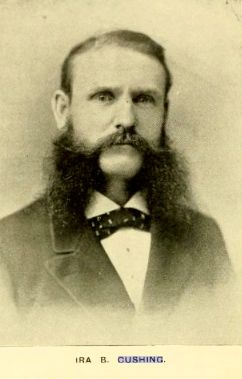
“The Cushing Medical Supply Company,” and its proprietor, Dr. Ira Barrows Cushing, shown right, in their very names carry a certain expectation of authenticity and trustworthiness.  That is, until one discovers that the “medicine” mainly supplied by Cushing was whiskey that he mixed up in his Boston headquarters, presumably using the “Cushing Process for Purifying Alcoholic Liquors,” that he invented and patented in 1892.

Shown below is the Rube Goldberg-like contraption that Cushing assembled for a “process of and apparatus for purifying and maturing liquors or distilled spirits.”  His  patent application explanation of how it worked ran to more than three highly technical and abstruse pages.  An example of his description: “My present invention consists in commingling a suitable quantity of oxygen gas with the atmospheric air employed for treating the liquor, whereby the air which is disseminated through the liquor is energized or rendered more active for the purpose of rapidly oxidizing the fusel-oils into their avoring-acids and the process of maturing the liquor thus accelerated and rendered more perfect than heretofore.”   Whatever the examiner understood of “atmospheric air,” “avoring acids,” and the rest, on November 1, 1892, the United States Patent Office issued Cushing Patent No. 485,984.


Ira Cushing’s road to this crowning achievement began on November 20, 1846, when he was born in Providence, Illinois.  His father, Caleb Cushing had been a retail grocer in Providence, Rhode Island, who with neighbors decided to buy land being offered by the Federal Government in Bureau County, Northwestern Illinois.  In May 1837, some 30 Rhode Island families, with household goods and provisions to last one year, made the trek, naming their town, Providence after the one they had left.  Caleb was accounted a pioneer “enduring…many hardships and privations” — almost dying in a snow storm.

Young Ira attended area schools until he was 16 and then was sent for two years to the English High School at Princeton, Illinois.  In 1864 he was recruited to Company F of the Illinois 146th Infantry, an outfit that saw no combat during the Civll War and solely was used to garrison locations around Illinois.  After ten months and the Confederate surrender, Cushing was mustered out of service in July 1865, likely going to work in his father’s store.

Through his mother, Malinda Peck (Burrows) Cushing, he was related to two well-known Eastern homeopathic physicians, Dr. Ira Barrows of Providence, R.I., and Dr. George Barrows of Taunton, Mass.  In 1869 at the age of 23, Ira was sent East to study medicine in the offices of his Uncle George.  From there he gravitated to the Hahnemann Medical College in Philadelphia, named for the founder of homeopathy, Samuel Hahnemann, who based his medicine on the claim that a substance that causes the symptoms of a disease in healthy people would cure similar symptoms in sick people.  Many consider this a quack theory.  Ira continued his studies at the New York Homeopathic College in 1871, graduating the following Spring and practicing as a doctor, first in Taunton and subsequently in Brookline, Massachusetts, a suburb of Boston.

On October 27,1874, at the age of 28, Cushing married a   Massachusetts woman eight years his junior.  She was Hanna Elizabeth Alden, born in Bridgwater, Plymouth County.  The couple would have three children, Ira May,  born in 1875; Maude, 1877; and Arthur, 1881.   Perhaps because of the financial pressures of a growing family  in 1882 Cushing founded the Cushing Medical Supply Co.  His letterhead showed a somewhat simplified version of the apparatus for the “Cushing Process.”   A major location was 580 Washington Street in Boston, shown right, with another outlet at 160-166 Canal Street.


Cushing’s enterprise offered a variety of proprietary whiskey brands, including "Boston Light,” "Cushing 100 Proof Whiskey,” "Cushing Highest Grade,” "Cushing Process Co. Bourbon Whiskey,” "Cushing Standard Rye,” "Cushing Straight,” "Essex Rye,” "Gold Standard,” "Home Brand,” "Old Buck,” "Old Colonial Rye,” "The Cushing Process Co. Pure Old Rye Whiskey,” and "Yachting Rye.”  The proprietor never bothered to trademark any of these brands.  He advertised them by issuing shot glasses to saloons and restaurants carrying his liquor. 

Cushing packaged his brands in clear or amber glass, from flasks and quarts to gallon size.  The bottles were embossed with paper labels, as indicated by examples shown throughout this post.  He continued to emphasize the importance of his “discovery” of the Cushing process.  According to a biographer: “It utilizes nature’s own means, and consists of forcing heated atmospheric air — which is first purified according to Professor Tyndall’s method of destroying germs of animalcule — through the liquors, thoroughly oxidizing the fusel oils and eliminating the poisons.”

Given the medical seriousness with which Cushing seemed to approach the merchandising of alcohol, it is somewhat startling come across a Christmas greeting that he supplied to customers containing several stanzas of verse, quoted here in part:

Each should receive for his daly strife
Something to smooth the rough edge of life.
Talk as you will, there is nothing quicker
To ease your care than a glass of liquor.
So Christmas day, we’ll drink from the glass
Which brings a cheer than naught can surpass.

Nor did Cushing shrink from offering other nostrums.   In a cookbook published by his wife circa 1900, the doctor advertised “PULMONINE for your cough” calling it Dr. Cushing’s great lung remedy and stomach corrector: “Unlike other medicines it will not disarrange the stomach and bowels.  Try it once and you never will be without it.”   He also featured a potentially addictive coca wine.  The company thrived, recording in 1905 the equivalent today of $15 million in assets.

Throughout his years selling alcoholic liquids from Boston, Cushing continued living in Brookline and working as a homeopathic doctor.  He is recorded as being the “examining surgeon” for several Boston area charitable organizations and a member of both the Boston Medical Society and the Gynecological Society.

At the age of 61, Cushing was diagnosed with an advanced stage of colon cancer.  An operation was quickly performed but with limited knowledge of infection at that time, sepsis subsequently occurred and on August 14, 1908, he died.  Taken from the Cushing home at 19 Harris Street, shown here, Cushing  was buried in Brookline’s Walnut Hills Cemetery.

The Cushing Medical Supply Company appears to have survived for three more years under different management but disappeared from Boston business directories about 1912.   An official notice from the State of Massachusetts included it among “certain delinquent corporations” that it required be dissolved by the first day of April.  After 29 years the brainchild of Dr. Ira B. Cushing was gone.  No evidence exists that any distillery or liquor house subsequently adopted the Cushing Process for making whiskey, suggesting that its reputed benefits were largely “atmospheric air.”

Labels:  Dr. Ira B. Cushing,  Cushing Medical Supply Co., Cushing Process, Essex Straight Rye, Cushing 100 Proof Straight Whiskey, homeopathic medicine


Thursday, October 5, 2017

A.R. Champney, Champion of “Liquid Force”


Arthur Russell Champney of Elyria, Ohio, shown left, was a beverage dealer given to hyperbole.  Take for example, his advertising for a whiskey brand, “Gold Dust Rye,” claiming to be the sole proprietor.  He advertised that his whiskey had been pronounced by expert judges (unnamed) “as the best” and prescribed by physicians (again unnamed) “in an article.”  His exaggerations, however, could land him in court, accused of fraud in the sale of stock for a soft drink he invented and called “Liquid Force.”
Champney was born in 1870 near Vermillion, Ohio, the son of farmer Lewis Champney and his wife, Mary Webster.  One of five children, the 1900 census found Arthur living on the family farm and attending school.  As he came of age, he soon abandoned the agricultural life and moved twenty miles east to Elyria working as a traveling salesman.  By the age of 22 he had married a woman two years younger named Catherine who was a native of Ohio. The 1900 census found them living in Elyria with three children, all girls — Bessie, Mabel, and Gertrude.  Eventually he would provide his family with a large home, shown here.

The wealth that made that house possible was the result of Champney having invented and begun to manufacture what he called a “non-intoxicating carbonated health-giving tonic.”  A natural born huckster, he called it  “Liquid Force,” claiming it to be “The World’s Greatest Health Drink.”

Liquid Force was sold in green glass bottles, likely manufactured in Ohio, that carried embossing for “The A.R. Champney Co., Elyria, Ohio, as shown here on a full bottle and in detail.  The label also bore the designation “Registered.”  In 1906 Champney had trademarked the name, “Liquid Force,” and the design of the printed label affixed to his bottles.   He never bothered to trademark Gold Dust Rye, possibly because a similarly named whiskey was being produced in Louisville by the Barkhouse Brothers.

Champney claimed that his tonic was highly successful almost from the outset.  So well known was Liquid Force, he claimed, that it needed no further advertising and was sold on its merits.  He held the “secret formula” for the beverage as well as the good will and trademark, valuing them at $150,000.  At least that is what he told — and sold — initial investors from the Elyria business community.

As described in court, in June 1908 a meeting of Champney with three investors and prospective officers was held in Cleveland where, according to those attending, the conversation that took place “was not very specific” but the very next month they met again and signed articles of incorporation for the Liquid Force Company that subsequently were filed with the Ohio secretary of state.  The stated purpose of the company was to manufacture and sell carbonated soft drinks, extracts and sirups —more specifically Liquid Force.

Capitalized at $250,000, the incorporation allowed Champney and his cronies to sell stock to the general public.  There followed a highly aggressive campaign to market the shares.  Champney claimed that Liquid Force had returned a 33% profit the previous year, netting his former company between $25,000 and $30,000 annually.  Among the presentations was an impressive artist’s drawing of the purported Liquid Force bottling plant, shown here.   The sales pitch proved highly persuasive to a number of people in Northern Ohio who put their money down to buy Liquid Force stock.    

Among those purchasing shares was a woman named Leonora A. Braun, who was impressed with Champney’s claims and invested $1,000.  When Liquid Force failed to pay a dividend of any kind and the value of her stock dropped to virtually nothing, Ms. Braun sued, claiming that she had been damaged by relying on statements that Champney and his colleagues knew to be false or had been made “recklessly, without knowledge of their truth or falsity.”  A jury in a Lorain County court sympathized with her story and found for Ms. Braun.   Appealed to a higher court, a judge refused to overturn the verdict.  While squarely blaming Champney for “false and fraudulent representations,” the judge held the other three officers just as financially liable.

Whether it was a result of these court cases or for another reason, not long afterward the Liquid Force Company was reorganized.  Champney was no longer among the officers, seemingly forced out of management of the firm he had started.  He retained, however, his Elyria liquor, wine, and beer business.   As the only listed wholesaler in town, he had some 32 saloons and cafes potentially to supply with liquor and dozens more drinking establishments in Lorain County.  Champney also was the sole area distributor of Crystal Rock beer, a popular product of the Kuebeler-Stang brewery in Sandusky, the bottles shown here.

Sometime during this period, Catherine Champney disappeared from the scene.  Since I can find no indication of her death, my speculation is that she divorced Arthur.  When Ohio went dry in 1917, Champney was still a relatively young 47.  Forced to shut down his liquor business, he listed his occupation as “retired.”  According to Ohio records, in 1919 he remarried. His second wife was Alma Hardy, 37, an Elyria resident, the daughter of Copes and Evaline Durkee Hardy.  After marrying in Detroit, the couple moved to Columbus, Ohio, where Champney returned to the occupation of “commercial traveler,” selling wholesale candy.  That marriage does not appear to have succeeded. By the early 1920s, Arthur was a free man again.

But not for long.  By 1925 in Columbus, he had met and married Hettie Haskew, a school teacher, who also likely had had a previous marriage.  Born in Monticello, Arkansas, the daughter of Charles and Elizabeth Denton Haskew, Hettie was 39 at the time of their nuptials, thirteen years younger than Champney.  She would be with him until his death at the age of 61 in Columbus and was responsible for taking his body back to Elyria where he was interred in Ridgelawn Cemetery.  None of his three wives are buried there.

By the time of Champney’s death the World’s Greatest Health Drink was just a distant memory.  “Liquid Force,”  the beverage Champney concocted and sold with the fervor of a born huckster — some might say “con man” — long since had disappeared from stores.


Sunday, October 1, 2017

C. H. Godwin: “Ambitious to Know Every Man” — and Sell Him Whiskey


At the age of 41, Charles H. Godwin in 1914 took a sharp turn in life.  Even assuming a new name, he threw himself into creating a mail order liquor house in Monroe, Louisiana. In an extraordinary merchandising flyer, Godwin, shown right, addressed himself to the public as someone “…Who has grown up with this country, who is ambitious to know every man up and down the road, and who backs with every resource at his command the truths of our motto ‘HAL-WIN LIQUORS ALWAYS SATISFY.’”

He was born Charles Henry Godwin on October 16, 1873, in Opelousas, Louisiana, the third child of John W. Godwin, a native of Alabama, and Lucy L. Mathews, born in Mississippi. His family called him “Hal.”  The family moved frequently during  Godwin’s early years, by 1880 settling in Rayville, Louisiana, a small town some 22 miles directly west of Monroe.  There Godwin would grow up, be educated, and find early employment in local businesses, likely ones that sold liquor.

In 1899 at the age of 25, Charles married Leila McCreight, 18 and a native of Louisiana.  They would raise a family of five children, two daughters and three sons.  With the financial needs of his growing family a likely factor, early in the 1900s he struck out on his own, under the name “C. H. Godwin.”  In 1905 he was recorded operating a grocery and saloon in Mer Rouge, a hamlet 30 miles north and a bit east of Monroe. 


This may have been a relatively short-lived enterprise since in 1907 he was engaged in Monroe, running the Iron Mountain Saloon, located at 519 Ouachita Avenue and later at 315 South Second Street.  According to one source, “Iron Mountain” did not refer to a geographical site but to the name of an railroad.  As shown here in a 1913 Monroe business directory, Godwin described himself as a “wholesale and retail dealer in wines, liquors and cigars.”  At some point he issued a mini-jug of whiskey to favored customers.

While operating this enterprise, however, Godwin saw another opportunity.  All around him Monroe liquor dealers were cashing in on the effects of the prohibition movement.  States in the South and West one by one had gone “dry.”  Under local option laws individual towns and counties even in “wet” states were banning alcohol sales.  It remained legal, however, to ship liquor interstate into those areas.  Moreover, the few Louisiana jurisdictions to vote themselves “dry” still could be reached with impunity.  Monroe, with good rail access to points around the compass, became a center of mail order liquor sales.  Complained an official of “dry” Shreveport:    “Such a farce is the law in this State that Monroe, La., alone, shipped 3,000,000 drinks into Shreveport last Christmas.”


Now calling himself C. Hal Godwin, the saloonkeeper made a pivot from selling drinks over the bar to seeking mail order sales through a company he called “Hal-Win Distilling Co..The Systematic Shipping House.”  It was a costly move.  He bought in an experienced supervisor named Bernard Seligman to run his office and shipping room.  Seligman, Godwin claimed, “gave up a position as the head of the largest Mail Order house in Virginia to associate himself with the house with the big future — HAL WIN DIST. CO.”

Godwin also had made a deal with the Bernheim Bros. Distillery in Louisville for whiskey, noting “…It has cost us tremendous money to make this new connection.”  The link with the noted Kentucky whiskey maker likely was something of a coup, giving C. Hal some advantage over his Monroe competition.  Shown throughout this post are examples of his ads pushing Bernheim’s brands, such as Old Continental Whiskey and the flagship I. W. Harper Rye.
Shaw’s Malt Whiskey was another Bernheim product, sold as for its medicinal value and advertised as “What the Doctor Ordered!  A Mild Stimulant & Tonic to Build up & Strengthen — to Enrich the Blood & Steady the Nerves.”  A Godwin illustration shows a physician ministering this “tonic and beverage,” one that “tastes like nectar,” to an elderly man and woman.  

Godwin also featured his own proprietary house brands, including “Hal-Win Green Label” and “Hal-Win Cream of Monroe.”  It is unclear whether he was receiving the whiskey for these blends directly from Bernheim Bros. or mixing them up in his own facility.  While Old Continental from the Louisville distillery cost $1.25 a quart, Green Label was $1.00 and Creme of Monroe 80 cents for the same quantity. Godwin never bothered to trademark either label but did issue advertising shot glasses for his brands.

In a long introductory flyer introducing his new company, Godwin summed up by noting that in addition to getting Bernheim’s whiskey and Seligman’s experience, a customer could count on “the constant personal interest and watchfulness of your old friend C. Hal Godwin….”  He concluded with the statement that opened this post, his ambition to meet every man “up and down the road.”

Although the quality of Godwin’s marketing materials clearly was superior to most of his day, a question remains of their results.  Although none of his materials are dated, he appears to have initiated his efforts about 1912, late in the game for selling whiskey by mail.  Congress shortly would make it illegal to sell liquor across state lines into “dry” states and localities.  Although most of Louisiana was predictably “wet,” even there as a result of local option more and more localities had banned alcohol.  Godwin also faced considerable established competition, including from other Monroe liquor dealers. [See my post on Rufus Webb, March 2014.]  Finally in 1913 he suffered a warehouse fire in which whiskey stocks worth the equivalent today of $250,000 were destroyed.

Whatever the immediate outcome, the Hal-Win Distilling Company was doomed to be short-lived as National Prohibition was approved in 1919 and the alcohol ban became the law all across the country.  Godwin was forced to shut down his mail order liquor house and his Iron Mountain Saloon.  Sometimes listed as Charles H. and sometimes as C. Hal, Godwin’s occupation subsequently was recorded as insurance salesman (1929) and as a director of an oil and gas company (1933).  His home was at 501 Pine Street, shown here.

Godwin died in Monroe in 1954 at the age of 80 and was buried there in Riverview Cemetery. His gravestone is shown here.  His wife, Leila, had preceded him there, dying in 1946.  Also interred near the couple was their son, Charles Hal Goodwin.  Enlisting in the U.S. Army in 1922, Charles Hal, 18, died in basic training during an influenza epidemic.