Friday, November 13, 2020

Cowboy Whiskey Men


Foreword:   Media heroes from comic books to motion pictures, the American cowboy is the iconic symbol of the Old West.  Likely beginning as young ranch hands, as they aged some cowpunchers looked for less taxing, more lucrative employment.  What naturally came to mind was the saloon and the whiskey trade.  Here are the brief accounts of three such cowboys, each of them with a unique story.                


In 1886 a 26 year old Missouri-born ranch hand rode his horse up to a South Dakota stage coach station that held a saloon. The next day he owned the place and thereupon was launched the career of Daniel P. Roberts, also known as “Devil Dan.” Little did he realize that the trajectory of his career also would make him part of a Presidential Inaugural.


When that wilderness station subsequently grew into the boom town of Belle Fourche, Roberts in 1905 opened a new drinking establishment on the main street that he called The Stand-Up Bar.  Robert’s saloon was a cut above the average. As the centerpiece of the house he bought an ornate Chicago-made Brunswick bar and saloon outfit, featuring an elegant cherry wood back and matching front counter.  


No sooner had Roberts opened the Stand Up Bar, however, than he was embarked on the trip of his life. A cowboy acquaintance of his had been one of Theodore Roosevelt’s Rough Riders. When Roosevelt was inaugurated as President in 1905 the man conceived the idea of having a cowboy section in the Inaugural parade, convinced the President-to-be, and recruited Dan. 


Shipping their horses by rail ahead of them, the cowboys, including future movie star Tom Mix, followed in their own railroad coaches, having a raucous time. In Washington, as shown here, Roberts and the others were reunited with their ponies and rode around streets of the Nation’s Capitol to exercise their mounts.

For the parade, security agents allowed the riders to carry pistols in their holsters as part as their costume, but the guns were unloaded. Riding eight abreast in the parade, they were cheered lustily by the waiting crowds. As they passed the reviewing stand President Roosevelt is said to have jumped up, clapped his hands and shouted: "That's bully!”  


Returning home, Roberts took up the role of saloonkeeper in earnest. Like other Western cow towns, Belle Fourche was a wild, wide open place. The main street was known as Saloon Street because of all the “watering holes” located there. Said one observer:  “The cowboys wanted to gamble, to drink and dance, and they wanted girls. The merchants of Belle Fourche saw that the cowboys had what they wanted.”  Among them was “Devil Dan” who operated the Stand Up Bar until South Dakota went “dry” in 1917.  


Shown below is a letterhead for the The Valley Saloon, a drinking establishment in the small but violence-ridden town of Saco, Montana.  It identifies the proprietor as a man named “Tom Dunn.”  In January 1897 the proprietor was writing to a wholesale liquor dealer to complain about shipping charges on his recent order.  But “Dunn” never existed nor would the saloon owner using that alias live beyond the following year. 


Tom Dunn was, in truth, Ed Starr, a member of several well known outlaw gangs.  According to Helen Huntington in her book, War on Powder River,  Starr was regarded as a “vicious nonentity” and “a killer for killing’s sake.”  When he arrived in Saco, shown here, Starr was on the lam from Wyoming, the cowboy gunslinger who had killed a United States marshal.  When he showed up in northern Montana, Starr/Dunn built a reputation as a skilled cattle broker and was appointed deputy livestock inspector for the region, reputedly compiling a good record.  


Old habits die hard, however, and in 1898 about nine miles from Saco Starr/Dunn, shown here, became involved in selling a string of horses, some of them apparently rustled.  In this scheme he had as a partner another notorious Western “bad man” named Henry Thompson, known as “Long Henry.”  When the time came for the two to settle accounts on the stolen animals, they could not agree on a division of the profits.  


The dispute led to gunplay.  Although Starr/Dunn wounded Thompson, he did not drop him. , Also an expert markman, Thompson almost simultaneously fired thee times.  The first bullet struck the cowboy saloonkeeper in the heart, killing him instantly.  The other two shots hit him in the body as he fell to the ground.  A Montana newspaper noted:  “Dunn was widely known as an expert with a gun and his friends could never understand his poor marksmanship on that occasion….[Dunn], probably, in getting off that first shot, lost the delicate balance which usually sent his bullets dead center.”   


The glass paperweight at left bears the photograph of a man riding a buffalo and bears the legend:  “Bob Yokum’s Buffalo, Pierre, S.D.”  It provides a window into the feats of a South Dakota saloonkeeper in training buffalo — the American bison — to pull a wagon or sleigh, be mounted and raced, and, most famously of all, engage in bullfighting in Mexico.  In his early  years, Yokum is said to have engaged in “the old ranching and cowboy life of the American West,” eventually becoming a United States marshal and later opening a saloon in Pierre.


Obsessed with training buffalo, Yokum after considerable effort taught them to draw a carriage.  Yokum’s next feat was training his buffalo being to be ridden.  The animals were said to “loathe” the saddling process and upon being mounted for the first time were known to buck fiercely trying to throw the rider.  With patience, the saloonkeeper was able to accustomed the shaggy beasts to a passenger, as shown above.  In addition, he was able to race them, both against other bison and against horses.  They were faster than the horses.


Yokum’s singular feat was introducing a bison into a Mexican bullring.  The idea was hatched during the winter of 1906-1907 to see which was the more dominant animal — a fighting bull (toro) or the American buffalo.   Loading one eight-year old male buffalo and one four-year old in a boxcar a group of South Dakota men that included Yokum headed to Mexico.  Yokum made sure there was plenty of alcohol in the baggage to make the trip a more pleasant experience.


After a seven day trip the group arrived in Juarez just in time for the afternoon show of four regular bullfights and as the finale the American buffalo vs. Mexican bull.  According to one account, the older buffalo, named Pierre, was released into the ring where it walked calmly to the middle:  “When the attendants released a red Mexican bull into the ring, he immediately spied the buffalo and charged. The bull aimed for the buffalo’s flank; but at the last second, the buffalo pivoted and the bull hit him head on…and was knocked back on his haunches.”  A second and third charge yielded the same result.  On the fourth attempt, the bull again hit the buffalo head, was stunned and fell to the ground.  Then the bull rose up, fled from the buffalo and tried to climb out of the ring.” 


Reveling in victory, Yokum, shown here, went back to his buffalo farm and to operating saloons in both Pierre and Ft. Pierre.  When the latter town under “local option” went dry about 1910, he reluctantly was forced to shut down one establishment.  The Pierre saloon was closed in 1917 when South Dakota voted in prohibition.


Note:  Longer vignettes on each of these cowboy whiskey men may be found on this website.  “Devil Dan” Roberts, April 18, 2012;  Tom Dunn/Ed Starr, March 5, 2020; and Bob Yokum, November 9, 2018.


Monday, November 9, 2020

“Boss” Joe Kelly — His Personal War on Prohibition


Joseph F.  “Joe” Kelly, beginning in the early 1900s, parlayed a saloon and a liquor store into wealth and political power in Baltimore’s predominantly Irish Tenth Ward.  When National Prohibition banned any further sale of alcohol, Kelly — backed by his constituents — took his war against enforcement of the “dry” laws into the streets.  It proved to be a fight he could not win.  Shown here is a picture that may be a young Joe Kelly.


Details of Kelly’s parentage, education and early career are scant.  Born in Ireland and brought to America as a child along with a brother and three sisters Kelly seems never to have been recorded in a U.S. Census.  He first surfaced in Baltimore directories about 1901 operating a saloon at 893 Greenmount Avenue, near the center of the Tenth Ward, shown below on a map.


Much of the Eighth Ward that had been populated by the Irish became the Tenth Ward just before the turn of the 20th century, when the boundaries of the city’s election districts were reconfigured. The new boundaries, that still exist today, were the rectangle bounded by E. Preston Street, N. Caroline Street, E. Monument Street and The Fallsway.  Once they arrived in Baltimore in force, the Irish were a power to be reckoned with, particularly in the bare-knuckle era of bossism and political clubs.


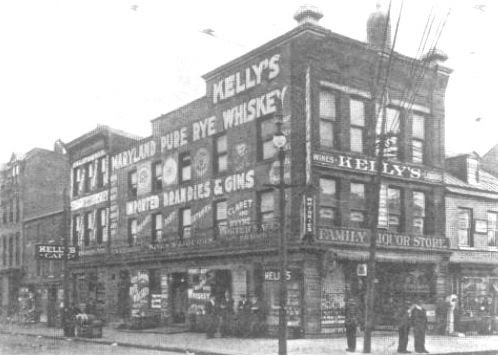
Kelly rose rapidly in this environment, his reputation as a genial and generous saloonkeeper thrusting him into political power.  He also succeeded as a businessman, opening a second saloon and a liquor house he called “The Family Liquor Store” at the corner of Hillen and Forrest Streets.  At this location he offered free games of pool upstairs, a popular option.  He also gave away advertising shot glasses to favored customers.


As can be seen from the 1911 photo of his building, signage was of particular importance to the Irishman.  Kelly’s building could be seen from a long way off because of the large wooden bottle on the roof. City records indicate that in April 1909 the Baltimore Board of Estimates turned down his request for a new sign.  One of the five Board members voting against it was poet and Baltimore native Edgar Allen Poe.  The reason given was that the sign was “dead” at a time when neon signs were lighting up Baltimore’s night sky.  Kelly caught on and months later returned with a proposal for an eight by four feet electric sign.  This time the sign was approved. 


Married to a woman named Isabelle, Kelly and his wife not appear to have had children.  Their first home was living adjacent to the Greenmount Avenue saloon.  As he prospered, Kelly was able to move the couple, likely with servants, into a mansion home at 1649 East North Avenue.  Shown below as it looks today, the building serves as the “Great Blacks in Wax Museum.”


In 1920 things changed abruptly for Kelly.  With the imposition of National Prohibition he was forced to shut down his Family Liquor Store and ostensibly convert his Greenmount Street saloon into a “near beer” and soft drink emporium.  The anti-“dry” environment in Baltimore, however, emboldened Kelly to continue to make, distribute and sell illicit alcohol, while local and state officials looked the other way and the general public applauded his efforts. 


In time federal prohibition agents became aware of Kelly’s activities.  On May 17, 1922, accompanied by (reluctant) local police, two squads of law enforcement officers stormed into Kelly’s establishment where they found bootleg liquor estimated at worth a half million dollars (equiv. to $7 million today).  The raid triggered a riot as some fifty sympathizers of Kelly, cheered on by a large crowd of spectators, attacked the officers with sticks, stones and bottles.  Reported the New York Times:  “The rioting, which caused casualties on both sides, was attended by spectacular events in which police ambulances, trucks, thirty taxicabs, four undertakers’ wagons, fire apparatus, electric railway trouble trucks…figured, together with knives and firecrackers.”


As soon as a vehicle was loaded with Kelly’s confiscated booze, a rioter would slash the tires.  “Kill ‘em, kill ‘em,” the crowd roared as agents carried out cases of whiskey.  Thoroughly frightened, the men retreated into the saloon, sheltered by Kelly until the melee subsided.  Later that night the barrels and cases of liquor were loaded on trucks and taken to a government warehouse.  The authorities announced that the raid had “struck at the heart of the illicit liquor traffic in Baltimore.”


It appears that Kelly was arrested on bootlegging charges, made bail, and was able to get continuances on his court appearances.  The Baltimore Sun in December 1922 reported that Kelly, claiming illness through his attorney, had failed to appear in Federal District Court on charges of prohibition law violations.

He subsequently was acquitted of possessing and selling liquor.  Claiming illegal search and seizure, Kelly later petitioned the court for the return of the whiskey and wine on the basis that it was pre-Prohibition stock and not bootleg alcohol.  He does not appear to have been successful.


Despite his ongoing entanglement with prohibition enforcement, Kelly continued to flout anti-alcohol laws, moving his operation to a warehouse on Baltimore’s Homewood Avenue.  Now having gained the close attention of federal agents, Kelly’s warehouse was put under constant surveillance.  On the night of January 29, 1923, two agents saw a large covered truck leave the warehouse at a high rate of speed and gave chase.  Not far from Kelly’s home, the driver and a passenger jumped out, tried to prevent a search of the truck, and promptly were arrested.  A Baltimore policeman given custody of the two men promptly let them escape.


The truckers alerted Kelly who, with a crowd, came to the scene.  He challenged the authority of the agents and attempted to detain them.  Surrounded by the crowd and pushed away from the truck, the agents were unable to stop a Kelly ally from jumping into the driver’s seat and driving off at a high rate of speed.  Driver and cargo were never found.   Although the contraband liquor was gone, federal authorities had Kelly and charged him with impeding prohibition agents in the  execution of their duties.  


At his trial in March, 1923, Kelly denied seizing and holding the agents during the get-away maintaining he was “merely a casual passerby.”  The jury did not buy his story, however, and found him guilty on three counts.  A Federal District judge imposed a fine of $250 and nine months imprisonment in the Baltimore city jail. Kelly and his lawyers appealed the decision to the U.S. Circuit Court citing a number of technicalities.  The court sustained the original verdict.  Kelly went to jail where he immediately was made librarian.


After serving most of his sentence, Kelly was released from jail just before the stroke of midnight.  Regardless of the late hour a large crowd of cheering supporters awaited him as he passed through the gates.  During the next few years, Kelly was able to maintain his status as a political power in municipal affairs, even extending his sway outside the Tenth Ward. He also became known for his philanthropy with generous contributions to the St. Vincent’s Male Orphan Asylum, Carmelite Monastery and other charities.


When Joe Kelly died in August 1930 a crowd estimated at 1,000, including both Democratic and Republican leaders, attended his funeral, held at St. John’s Catholic Church in the heart of the Irish boss’s Tenth Ward.  Floral offerings filled five wagons.  Forty-five automobiles were in the procession, preceded by a line of motorcycle police.  Another large gathering awaited at the church. Inside mourners heard the pastor extol Kelly as “a true politician, a wise business man and a kind and gentle friend.”  When it came to Prohibition, padre, maybe not so kind or gentle. 


Note:  Starting with an interest in Kelly’s shot glasses, led me to the New York Times report of the May 1921 mayhem and then to the larger story of how a Baltimore Irish saloonkeeper and political boss tried to escape National Prohibition, was successful for a while and then caught and jailed.  Most of the information came from news stories in the Times and Baltimore Sun.


Thursday, November 5, 2020

Tipsy Fish & the Neversink Distillery Four

On Christmas Day 1913, fish in the Schuykill River near Exeter Station, Pennsylvania, suddenly got gloriously drunk, according to onlookers who made easy catches of them.  Good luck for the anglers, however, was the result of severe damage at the nearby Neversink Distillery, a whiskey-making facility that occupied the energies of four men during almost six decades.


The Founder:  The Neversink had its origins in a distillery that Samuel Buch established at Eleventh and Muhlenberg Streets in Reading, Pennsylvania, about 1861.  For the next twenty years he operated at that location, advertising as a maker of “pure wheat, rye and malt whiskey.”  Company offices and his liquor store were located at 527 Penn Street, the building shown here as it looks today.


Born in Pennsylvania in 1915, Buch had entered the liquor trade some years earlier, perhaps to support a growing family.  At the age of 26 he had married a local girl of 18 named Elizabeth.  According to the 1860 census, the couple soon began a family of five children that eventually ranged in age from twenty down to one year.  Samuel prospered as a liquor dealer, showing an 1860 net worth of $800,000 in today’s dollar.  It was enough to allow him the finances to build his own distillery.   An 1881 Reading map depicted his plant as a leading Reading industry.  Buch’s flagship brands were “Redding Rye” and “Neversink Mountain Rye.”  The latter apparently took its name from the Neversink River, a 55-mile long tributary of the Delaware River in Southeastern New York. 


Some time in the early 1880s, Samuel looked around for more space for whisky-making.  He found it in a small town called Exeter Station about eight miles south of Reading.  Although the site had historical importance as the home of Mordecai Lincoln Jr., the great-great grandfather of Abraham Lincoln, Buch’s interest was the ease of transporting supplies of grain to his distillery.  Not only was Exeter Station, shown here, on a main railroad line, it had easy river access and a major highway running through it.  There Samuel built his new distillery.  The photo below appears to show the still house left and the warehouse right, the latter said capable of holding 12,000 barrels of aging whiskey.


The Soldier Son:  As soon as he reached his middle teens, Lemon Buch, Samuel’s firstborn, had been put to work as a clerk in the Redding liquor store.  That career was interrupted with the advent of the Civil War in 1861. Lemon would go on to compile an outstanding war record.  Four times during the conflict he enlisted with a new Pennsylvania army unit only to be honorably discharged at the end of the term of service.  He repeatedly re-enlisted in a matter of days.  Beginning as a humble private Lemon rose through the ranks to sergeant and then to first lieutenant.  Over the course of his service, he saw hot combat in such battles as Antietam, Gettysburg and Chancellorsville, the latter illustrated above.


Resigning his commission at the end of the war, Lemon returned to Reading where, with his younger brother, he took over the family liquor business, changing the name to L. & H. Buch, Importers and Wholesale Dealers in Wines and Liquors.  As shown on an 1886 letterhead, the company featured Neversink Mountain Rye as a specialty.


In time, Henry left and the Reading liquor house became simply Lemon Buch’s.
  The war hero son seemed to have a genius for merchandising, gifting his wholesale customers such as saloons and hotels die cut signs and advertising shot glasses featuring his proprietary brands.


The Developers:  Adolph H. Kretz and John H. Close bought the distillery in 1892.  Both were liquor dealers in the Reading area. Kretz, shown here in maturity, had been born in 1854 in that city, his father an immigrant tailor from Bavaria.  His father having died while he was still a youngster, Adolph early on was sent to work.  With capabilities as a builder as well as merchant he had prospered in Reading.  Close, the younger of the partners, was born in nearby Stonersville, Berks County, in 1863, the son of a local liquor dealer.  While still in his teens he took up the trade with his father and had prospered.


The partners renamed the Exeter Station facility the Neversink Distilling Co., Inc., and expanded its mashing  capacity to 434 bushels daily.  They also build a second warehouse, the interior shown here, able to hold 25,000 barrels of aging whiskey.  They commissioned an artist’s drawing of the distillery shown below that emphasized its access to rail transit, including what seems to be a railroad spur into the plant. 


Kretz and Close operated the distillery without incident for more than two decades until that fateful day in 1913.  Exeter Station/Lorane was rocked by an explosion at the Neversink Distillery.  According to reports the blast was caused by the formation of gases in the bottom of a large cauldron containing 12,500 gallons of mash in the process of fermenting.  The force of the explosion destroyed the vessel and smashed other equipment. Windows were blown out allowing a torrent of alcoholic mash to cascade out of the stillhouse. The wave flooded over the railroad tracks, coursed down the river bank, and poured into the Schuylkill River.


Because it was Christmas Day no one was in the building to be killed or injured. The only immediate casualties seem to have been fish.  As reported in the Reading Eagle:  “…The fish in the river are on a glorious drunk and people are catching them in large numbers along the river bank here and for miles below this point.”  A final irony:  The name “Neversink” is the corruption of an Algonquin Indian word meaning “mad river.”  The Schuylkill, indeed, had gone crazy.


Federal records of subsequent activity at the Neversink Distillery indicate that Kretz and Close repaired the damage and stayed in business until the onset of National Prohibition in 1920.  The distillery did not reopen after Repeal in 1934.  At the end Samuel, Lemon, Adolph and John had devoted themselves to the existence of the Neversink Distillery for a total of 59 years. 


Note:  Although the information and images have been drawn from multiple sources, essential to the story line was information provided on the Internet credited to George M. Meiser IX, whom I assume is or was a local Berks County historian.


Sunday, November 1, 2020

The Van Bergens & “The Holy Grail” of Western Whiskeys

 Shown here is just a  portion of a label-under-glass Gold Dust Whiskey “back of the bar bottle” that has been termed “The Holy Grail” of Western whiskey bottles. Some speculate this bottle may be one of a kind while knowing that at one time others certainly did exist.  The Van Bergens whose San Francisco liquor house issued the “Grail” circa 1880, would be stunned at the current value of a bottle that originally was given away.  If one were found it might well sell for five figures at auction.


The Van Bergens were among the earliest pioneers in liquor sales in San Francisco.  John Van Bergen, who had immigrated from Hanover, Germany, as a youth in the 1830s, and settled initially in New York, is recorded surfacing in San Francisco in 1851 selling liquor and other merchandise.  When a partner quit, John is said to have returned briefly to New York but returned to San Francisco the following year to open a wholesale liquor business he called “John Van Bergen & Co.”


Joining John on the West Coast was Nicholas Van Bergen, shown here. He was born in Hanover in August 1821, likely a younger brother. From a passport document we know that at the age of 17 Nicholas arrived in New York from Germany in the summer of 1838 aboard the steamship Isabella out of Bremerhaven.  Over the next decade, he established himself as a New York grocer and married.  His bride was Rebecca, also from Hanover and six years his junior.  Their first three children would be born in New York.  Five more would follow.


When John beckoned in 1856, Nicholas responded, bringing Rebecca and his young family across the continent to San Francisco.  Future events indicated that he would find the environment there more cordial than his brother.  By 1867 John was recorded in local business directories as having returned to live in Germany, presumably leaving management of the liquor business to Nicholas.  The latter soon found lifelong friends among leading citizens of San Francisco and gained a reputation as a canny businessman.


Nicholas pursued a marketing strategy somewhat different from his competition.  Rather than blending his own proprietary brands of whiskey, he bought the rights to established brands and sold them.  An initial key purchase in 1868 was the entire wholesale wine and liquor business of Taylor & Bendel, a specialty grocery, that owned the rights to “Dr. Hufeland’s Swiss Stomach Bitters,” a popular remedy that subsequently became property of the Van Bergens.


Shown above in quart size with a detail of the label is the nostrum attributed to Dr. Christoph Wilhelm Friedrich Hufeland (1762 -1836), a man famous as the most eminent physician of his time in Germany and the author of numerous scientific works.  The bitters were advertised as “unsurpassed for acting surely but gently on secretions of the kidneys, bowels, stomach and liver.”  I am doubtful that the Herr Doktor had anything to do with this highly alcoholic tonic except the appropriation of his name.


The bitters seemingly were a success for the Van Bergens and encouraged a move to acquire a brand of whiskey called “Gold Dust.” The brand had come from Kentucky, the name of a Morgan-Arabian trotter. A nationally famous horse after winning just three races, it is shown here in a Currier & Ives print.  Barkhouse Brothers, distillers of Louisville, who trademarked the name in January 1872, sold it in amber glass bottles embossed with a horse.


Seeing the brand as a natural for the San Francisco drinking public, the Van Bergens contracted with the Barkhouses to become the sole distributor for the bourbon on the West Coast.  Shown here is a “Gold Dust” bottle that includes the Van Bergen name as “agent.”  The brand proved so successful in California l that in 1880 they purchased all rights to the name and became sole proprietors.  They  used the same bottles style as the Barkhouse Brothers peening out the old name and adding their own.  


As shown right those glass containers came in both 
amber and aqua.  A number of variations exist in both colors, some more rare than others, sparking considerable interest in the collectors of Western whiskeys.  All are considered rare and fetch fancy prices when upon rare occasion they come up for sale.  Several years ago an aqua Gold Dust whiskey bottle sold for $38,000, a record. 


As a result, the highly elusive Van Bergen Gold Dust back-of-the bar bottle that opens this post is speculated to be even more valuable and the “Holy Grail.”  Some have seen it as “one of a kind” but the economics of creating a label under glass bottle would indicate that more were made by Nicholas Van Bergen, whose name was attached.  John Van Bergen in 1874 had sold his share of the company to his younger brother who, with a partner, wasted no time in changing the name to N. Van Bergen & Company, a name that also graced shot glasses advertising Gold Dust whiskey.


Not all of the Van Bergens’ selections may have proved profitable.  During the 1870s the company also gain the rights to Old Woodburn Whiskey, shown here.  This was a brand of the Cook & Bernheimer Company of New York City who trademarked the name in 1870. [See my post on this firm, Nov. 7, 2016].  The bottle is considered one of the most desirable of Western whiskeys since only three specimens, one shown here, are known.  Because the bottle is so rare some assume the brand did not do well on the West Coast and was produced by Van Bergens for just one or two years.


The mid-1870s were a period of several changes for the Van Bergens.  Not only was the liquor house now under the major ownership of Nicholas, he was joined in the business by his eldest son, John W. Van Bergen, destined to make his own mark as a San Francisco businessman.  Born in New York in May, 1853, John W. had come to California with his parents as a toddler.  Educated in local schools, he had begun his career working as a clerk for Rogers, Meyer & Company, a San Francisco mercantile house.  Only after Nicholas acceded to the head of the liquor business did John W. join the company.  With him came another employee, Fritz Habernicht, who had married his younger sister.  A brother, Charles T. Van Bergen also joined the staff as a clerk. 


Heading into the 1880s the focus of the business expanded to include imported wines and liquors.  As he aged, Nicholas increasingly turned over the business to John W. and spent time recreating with other San Francisco “pioneers.”  In an article memorializing Van Bergen and others, the San Francisco Call reported how one friend and Nicholas met daily to chat:  “Both had rounded out their allotted span of life and for an hour each day used to tell each other how this faculty was failing and the other was affected.”  Nicholas died on November 10, 1898 at the age of 77.  He was buried in Cypress Lawn Memorial Park in Colma, California, just outside San Francisco.


Shown above in a caricature from the 1912 book, “Men Who Made San Francisco,” John W. Van Bergen carried on the liquor house his uncle and father had founded 32 years earlier.  He also was a director in San Francisco financial institutions, among them the First National Bank and German Savings and Loan Society.  John W. was active politically as a California Republican and hailed as “one of the leading citizens of San Francisco.”  With John W.’s death in 1916 at age 64, the N. Bergen Company came to an end, disappearing from city directories, along with Gold Dust Whiskey.


Diggers in California seem regularly to unearth Van Bergen bottles.  Others have been found squirreled away in attics and basements.  Each new find sends a tremor of anticipation through the collector community.  Convinced as I am that the Gold Dust back-of-the-bar bottle was not “one of a kind,” I await news that a second or perhaps more examples of the Van Bergen's “Holy Grail” have surfaced and are for sale.


Note: This post has been drawn from a wide range of sources, as have been the images shown.  In addition to the references provided in the text, the genealogy and city directories available from ancestry.com were particularly valuable, as were information and images from the Western Whiskey Gazette website and the FOHBC Virtual Bottle Museum.  My appreciation to both.