Tuesday, April 12, 2022

How Mr. Duffy Outwitted Uncle Sam

SPECIAL NOTICE:  This post originally ran on May 30,2011 and was #9 in the series.  For reasons unknown it was erased from that slot but the text and photos were still available.  Thus it is being recreated here out of the normal order.
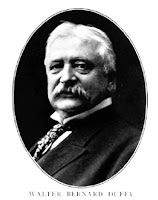
Walter B. Duffy,  seen here in maturity,  was a whiskey man who faced up against the forces of the U.S. government and actually outwitted them to his considerable financial advantage.  

Duffy’s story begins in Canada where he was born in 1840, about two years before his father Edmund emigrated to Rochester, New York, and opened a cider refining business.   It was a successful enterprise.  Edmund soon expanded into selling “wines, liquors, cordials and cigars.”  In an 1861 ad he also claimed to be a “rectifier” -- that is, a refiner and blender of whiskey.


The elder Duffy eventually brought young Walter into the business and left it to him when he died during the 1870s.   Walter in the meantime had served as an officer in the Union Army during the Civil War and had married in 1868.  Upon inheriting the company  he promptly expanded the business into other products. .  


The 1880s were a time when patent medicines began their meteoric rise in popularity by aggressive advertising and other ploys.   Many whiskey makers began to advertise their wares as being “for medicinal use”  without being specific as to the ills they were meant to remedy.   Duffy took a different approach.  He decided to straddle the divide between selling the 15 cent saloon shot and hawking his booze as a cure for specific diseases.   


Thus, early in the 1880s was born the Celebrated Duffy’s Malt Whiskey, which Walter advertised as the “greatest known heart tonic.”   He also claimed that his product could cure  consumption (tuberculosis), bronchitis,  dyspepsia (chronic indigestion), and even malaria.  to make his point, as shown here,  he supplied a dose spoon with his drink.


Despite a disastrous foray into the whiskey markets of Baltimore that ended in bankruptcy,  Duffy remained president of the Rochester Distilling Company  and continued to produce his purported anti-malaria liquor. The success of Duffy’s Malt Whiskey as a cure almost certainly helped solve Walter’s financial woes as he began to attract a national clientele.


Before long Duffy was looking once again to expand outside Rochester.  This time he headed west to Kentucky.  There, in 1887, George T. Stagg with other local whiskey men had incorporated the Stagg and O.F.C. (Old Fire Copper) distillery in a brand new facility at Frankfort. When Stagg retired because of ill health in 1890, Duffy purchased a majority interest.  In 1892 he was elected president of the corporation.  A 1898 letterhead, shown here,  depicted the Rochester rectifying plant and the Frankfort facility.


 With a guaranteed supply of Kentucky whiskey from Frankfort for his Rochester rectifying and blending facility,  Duffy introduced a number of other liquor brands,  among them Tromley Rye  and Seneca Chief. These were regional labels. The flagship brand remained Duffy’s Pure Malt Whiskey.  Its owner energetically marketed it to a wide audience, placing his advertising in national magazines and major newspapers all over America.


Duffy’s unsupported claim that “malt whiskey” really was medicine even convinced some Temperance advocates.   Duffy backed up his fiction by concocting a story that his remedy was made from a formula worked out fifty years earlier by “one of the World’s Greatest Chemists.”  The distiller featured a trade mark of a bearded scientist who apparently had discovered this wonder liquid.  Shown here on the back of a giveaway hand mirror and trademark the old gent appeared on many Duffy items.  Duffy insisted that his product was protected from infringement by “low grade impure whiskey” by “the Patented Bottle--Round, Amber Colored, and with Duffy blown into the glass.” 


Enter Washington, D.C. officialdom.  In order to help pay the expenses of the Spanish American War, Congress had passed a special tax on patent medicines.  On July 5, 1898, the Commissioner of Internal Revenue,  N.B. Scott, wrote to the local collector of revenues in Rochester ruling that:  “Duffy’s Pure Malt Whiskey, is by being advertised as a cure for consumption, dyspepsia, malaria, etc., liable to a stamp tax as a medicinal article....”   A background memo elaborated that although Duffy’s contained nothing but distilled spirits, it was a patent medicine “by the manner in which it is presented to the public.”   The ruling decreed a tax of two cents per bottle.   We can imagine Commissioner Scott laughing  about sticking it to Duffy as he signed the order.


The Feds did Duffy two enormous, if unintended, favors.   Estimates are that before it was repealed after the war,  the stamp tax cost the distiller about $40,000, not an inconsiderable sum.   At the same time, however, it exempted him from hundreds of thousands in federal and state liquor taxes and allowed him to advertise with some legitimacy as “the only whiskey recognized by the Government as medicine”  -- a claim that turned out to be worth millions.


Even Samuel Hopkins Adams, whose series of articles in Colliers Magazine in 1905-1906 led to the passage of the Pure Food and Drug Act,  admitted that Duffy was partially justified in his claim of Federal recognition of his whiskey as medicine.  Nevertheless, Adams took particular aim at Duffy’s product because of its claims to “cure” and its inferiority even as whiskey.   He also exposed as phony newspaper testimonials to its healing effects by purported clergymen and Temperance workers.  Adams’ revelations, however,  failed to dampen sales.


The first head of the Food and Drug Administration, Dr. Harvey W. Wylie  similarly sought to shut Duffy down. “I stated that Duffy's Malt Whisky was one of the most gigantic frauds of the age and a flagrant violation of the law, and that there was no necessity that we delay at all in the matter.”  After his pleas for prosecution were ignored for two years,  the doctor denounced the “determined efforts of my colleagues to protect Duffy’s Pure Malt Whisky from being molested either by seizure or bringing any criminal case against the maker.  Dr. Wylie left office in 1909 without ever having laid a glove on Duffy.


As a result of this soaring success, the formerly bankrupt Walter Duffy now was on his way to becoming a multimillionaire.  His first wife died in 1885 and in 1892 he married Loretta Putnam, a woman with an artistic bent and a taste for fine furnishings.  The couple resided in palatial mansion along Rochester’s fashionable section of Lake Avenue, shown here.  Lorettta filled it with a lavish assemblage of antiques and paintings.  When a few items went to  auction in 1913, the auctioneer’s catalogue exclaimed:  “What wealth!”


During the late 1800s and early 1900s,  Duffy became one of Rochester’s leading business figures.  He was president of the Flower City Bank and the German American Bank.  He also was a principal stockholder in a enterprise that owned hotels and theaters, including the Rochester Hotel, the National Theater in Rochester and the Schubert Theater in New York City.


At Duffy’s death, age 70 in 1911,  the New York Times, which earlier had highlighted his bankruptcy,  listed the myriad companies on which he held executive and director positions and hailed him as  “one of Rochester’s best known business men and financiers.”  Walter B. Duffy had gone to his grave as a man who had outwitted Uncle Sam and made it pay.


Monday, April 11, 2022

How the Nathans Battled and Beat “Mr. Dry”


Shown here is a painted metal structure of “Mr. Dry,” derived from a cartoonist’s vision of a figure who symbolized the forces of National Prohibition. Three generations of the Nathan family were locked in a continuous struggle against him in three American cities. They often lost.  Though their persistence, however, the Nathans at last were witness to the demise of Mr. Dry. 


The founding father was Julius Nathan, born in 1836 in Karlsruhe, Baden, Germany, the son of Josef and Victoria (Pohl) Nathan.  In 1855 at the age of 19, Julius immigrated to the United States and settled initially in Cincinnati.  Apparently destined for the whiskey trade, he and brothers Isidore, Emil, and Max founded a liquor house at 221 Walnut Street.  Subsequently, perhaps because of Southern sympathies, Julius relocated to Columbus, Mississippi.


When the Civil War broke out, Julius, although running a liquor business in Columbus, enlisted in the 15th Regiment of the Tennessee Infantry in Memphis where his future wife, Johanna Ehrman, lived.  His Confederate unit saw heavy fighting  at the Battles of Shiloh, shown below, and later Chicamaugua, among others.  Because the unit suffered heavy casualties throughout the war only a handful were left to surrender at Appomattox.  Among survivors was Julius.  Discharged as a sergeant, he returned to Columbus, married Johanna, and sired four children, three girls and a son whom he named Emil.


By his own account on a passport application Julius would spend the next 31 years in Columbus.  During that time he would bring Emil, shown here, into the business, first as a clerk, then as a traveling salesman, and finally by 1894 as president of what became “Emil Nathan & Company.”  Julius, possibly in declining health, stayed on, listed as a clerk.  A year later at the age of 26 Emil wed Clara L. Furth, 21 of Memphis.  Their marriage would produce two daughters and a son, Emil Junior, destined to be the third generation of Nathans fighting Prohibition.


Along the way, the Nathans were making close acquaintance with the devotees of Mr. Dry.  By the mid-1880s both the Woman’s Christian Temperance Union (WCTU) and the Anti-Saloon League had become major political forces in Mississippi.  Through local option laws the sale of alcohol became illegal or was highly limited in a majority of jurisdictions, including Lownes County and its county seat, Columbus. Julius who had put his life on the line for the Confederate states, now found Mississippi eager to deprive him and his family of their livelihood.


Perhaps because of Memphis ties to Johanna or its reputation as a thoroughly “wet” Tennessee river town, about 1896 the Nathans moved their liquor business there.  They located at 364 Front Street, moving to 404 Main Street in 1900.  In Memphis Emil featured a number of proprietary brands, including "Cotton Belt Rye,” "Cream of the Still,” "Old Carter X X X Rye,” "Old Modoc,” ”Red Hick,” and "Superior Tenn.”  Like other whiskey wholesalers, Emil issued advertising shot glasses to saloons, hotels and restaurants pouring his brands.


Emil soon would discover that the forces of Mr. Dry were hard at work in Tennessee.  In 1877 the legislature had passed what was called “The Four Mile Law” banning the sale of alcohol within a four mile radius of a public school. A number of Tennessee saloons were forced out of business.  For the next thirty years liquor sales were hobbled by local option votes but Memphis remained a haven for liquor sales.  After prohibitionists gained control of the Tennessee Republican Party in 1909, a statewide ban on alcohol sales became the law.  Mr. Dry had won another round.


In 1897 at the age of 60 Julius Nathan died and was buried in the Temple Israel Cemetery of Memphis.  It was solely up to Emil to decide what the family response should be to Mr. Dry.  He decided once again to relocate.  This time he settled on Missouri, a state determinedly “wet.”  About 1910 he moved Emil Nathan & Co. and his family to St. Louis.


While operating his wholesale liquor house there at 2018 Market Street, Emil recognized that “business as usual” would not suffice if National Prohibition was to be kept at bay.  He became a force in the Missouri Wholesale Liquor Dealers Association, serving as first vice president and later as president.  In 1914 he achieved national recognition as a member of the “Harmony Committee of Fifteen” a body representing the nation’s wholesale liquor dealers, retail liquor dealers, and brewers.  Disagreements among the three interests had weaken the response to Prohibition.  Meeting at the Willard Hotel, Washington, D.C., in April, 1914, the committee was able to agreed on a joint approach. Emil Nathan had established himself as a leading voice for the liquor trade. 


In the end, however, unity did nothing to stem the tide that passed the Volstead Act through Congress and a Constitutional Amendment that banned the making and sale of alcohol beginning January 1, 1920.  All America became woefully aware of Mr. Dry.  New York World illustrator Rollin Kerby gave him life in an editorial cartoon in mid-January 1920, as a tall, lean foreboding figure wearing a frock coat, stovepipe hat, and black gloves, carrying a black umbrella, and aggressively gloating over the ban on alcohol.  Reprinted widely, Mr. Dry quickly became the national symbol of despised Prohibition.


Forced to close the doors on his St. Louis liquor house after more than 50 years of Nathan family involvement in the whiskey trade, Emil refused to stop his campaign against the ban on alcohol.  Running an investment and liquor brokering company, and working closely with Emil Junior, Nathan continued a drumfire of opposition to the effects of Prohibition.  


When at last in 1934 Repeal was achieved, Emil Nathan stood as a leading spokesperson for America’s wholesale liquor dealers, articulating to Congress the trade’s positions on replacement liquor laws.  He continued to lead Missouri liquor dealers while Emil Junior served as the executive director of the National Wine and Spirits Wholesalers of America.  In the meantime Mr. Dry, now a figure of scorn throughout America was being hanged in effigy and depicted as a vagabond dressed in rags and carrying a sign reading:  “I am starving.”  


Six years after Repeal, on Emil Nathan’s 75th birthday, his family and friends honored him with a celebration and a program bearing his photo.  Inside were a series of song parodies, apparently written by one of his adult children, saluting his life.  One of them reads in part: “He’s sold gin that would fill  the ocean; Whiskey to fill up the sea.”  The parody that particularly caught my attention, printed below, conjures up National Prohibition and Repeal.  It brings to mind the Nathans’ struggle and eventual victory against the ban on alcohol epitomized by Mr. Dry.


Emil Nathan died in July 1951 at the advanced age of 84 and was buried in St. Louis County’s Valhalla Cemetery.  There he joined spouse Clara who had died at 62 in 1937.  Buried nearby is Emil Nathan Junior who died in 1967.


Note:  A variety of sources made this post possible, but special recognition goes  to Tom Spitzer who found Emil Nathan’s 75th birthday program among the effects of his father, Fred, an officer of the Wine and Spirits Wholesalers of America.  The program provided the photo of Emil and the parodies.


Thursday, April 7, 2022

James Crow Was Whiskey’s Prescribing Doctor


As the putative originator of “Old Crow” whiskey,  Dr. James Crow has been the subject of considerable distiller fabrications in the years since his death in 1856.  Fortunately we have an account of Crow’s life and accomplishments written about 42 years later by a respected Louisville journalist named Daniel Bowmar whose purpose was not to sell whiskey but to rectify “how completely the great Scotsman’s personality had become obliterated from the minds of men, even in the community where he lived and died.”  This post relies heavily on Bowmar’s article.


1780's Edinburgh 

Crow was born in a town about 20 miles outside Edinburgh, Scotland, in June 1787 (sometimes given as 1889), the son of William and Catherine (Early) Crow.  His family apparently could afford to send him to the prestigious University of Edinburgh. below. There he received a classical education, well grounded in theology and law, before moving on to the university’s medical college, considered one of the world finest.  In 1822 Crow earned a medical degree while demonstrating a particular aptitude for chemistry.


Described as a youth of “magnificent physique and attractive presence” Crow is list as five feet, nine inches, in height, blue-eyed and wearing no facial hair.  He also had an adventuresome streak. Shortly after graduation he headed for American shores.  His first stop was Philadelphia where Bowmar’s account says enigmatically:  “He did not succeed there.  Apparently Crow went bankrupt.


By the following fall Crow had moved west to Kentucky, settling in Frankfort.  There he met Col. Willis Field, a member of the Kentucky legislature and plantation owner.  He took an interest in the young Scotsman and invited him to stay at his home in Woodford County.  Like many farmers at that time, Field ran a small distillery on his land, operated with crude equipment and indifferent results.  After tasting the product, Crow, well aware of quality whiskey, took a strong interest in improving Field’s operation:  “…There was an element missing that Crow was quick to perceive.  He set himself to working out the problem.  The result of his experiments, which consumed many long weeks, was the first gallon of scientifically distilled sour-mash whiskey ever produced.”


Crow brought new apparatus to his distilling.   Among his innovations was introducing the two-column still that had been invented a few years earlier by Irishman Aeneas Cofffey.  Shown here in diagram format, this continuous distillation method allowed for the production of spirits with an alcoholic content greater than 90 percent. 


Shown below is a device that may have been invented by Crow.  It is a single chamber where the alcoholic content of distilled bourbon could be measured.  He employed litmus paper to test for acidity in the mash and a saccharimeter to ascertain sugar content, while thermometers and hydrometers were used to calculate temperatures and liquid density of the spirits.  Clay also insisted that no more than two-and one half gallons of whiskey should be produced from a single bushel of grain.


The fame of Crow’s whiskey spread rapidly as Fields was quick to send samples to the rich and famous of his acquaintance.  These included Kentuckian Henry Clay, who was Speaker of the House of Representatives.  According to Bowmar:  “Henry Clay smacked his lips over the sample and demanded to know who made it and where it came from.  He ordered a barrel of Clay whiskey to Washington the following winter….”  A century later the distillers of Old Crow would advertise with an illustration of a supposed meeting of Clay and Crow.


Daniel Webster also is said to have been an early enthusiast for Crow’s whiskey.  The New England political giant is said to have visited Crow in Kentucky after writing that his whiskey was “the finest in the world.”  This alleged meeting also was pictured in an Old Crow magazine ad of the 1960s.  One mistake stands out.  A sign identifies the location as “James Crow’s Distillery.”  No such place existed;  Crow always worked for other people.


Demand for Crow’s whiskey soon outgrew the limited facilities that Field’s plantation could provide and the distilling genius moved on.  He joined Oscar Pepper, a distiller at Glenn’s Creek, Kentucky, who already had a good reputation for his whiskey.  Crow enhanced it.  “When Crow took charge the whiskey made at the Pepper distillery had been selling for 12 1/2 cents a gallon.  He hadn’t been there long until the price doubled and none of the patrons objected to paying the increased rate.”


Crow worked for the Peppers from 1833 until 1855, with exceptions being 1837 and 1838, possibly because construction to expand the distillery, shown below,  was proceeding.  Crow’s deal was that he would be compensated by being given one-tenth of the production.  In 1855 the distillery produced 80 barrels from which Crow presumably drew eight.  In his admiration for the Scotsman, Oscar named one whiskey “Old Crow” and gave the distiller a house of his own on the property.


Although modest and retiring, Crow had a reputation as highly intelligent, able to discourse knowledgeably on many subjects with the leading men of Kentucky.  His knowledge of the poems of Robert Burns and ability to recite them at will was treated with awe.  Crow apparently continued to practice medicine, said to give medical aid to the poor without charge and willing to walk miles to relieve a suffering patient.


That said, Crow had an air of mystery about him.  Some onlookers thought that a man as talented, handsome and strong must have clandestine romantic adventures.  Yet his friends and neighbors were astounded when one day a Mrs. Crow and a daughter, Catherine, suddenly appeared from Scotland at the distillery.  Crow had never told anyone of their existence.  From their gravestones it is possible to extrapolate that Catherine was born in 1812 when her mother, Eliza, was 19 and Crow about 23.  They apparently had married while Crow was still a medical student.


Of Crow’s reaction to their arrival Bowmar commented:  “He alone manifested no surprise on their sudden appearance.  He provided a comfortable home, which he shared with them, and continued to go about his business as complacently as though nothing had occurred out of the ordinary routine.”   Continuing to live on in their Woodford County home after Crow’s death, both women established themselves as exceptionally gracious neighbors. 


Near the end of his life, Crow made one last employment move in the spring of 1856, working for a distiller named Anderson Johnson.   By this time, age 67, he was experiencing heart problems.  One morning while working in the mash room, he fell dead.  Buried initially on the property,  later the Scotsman’s remains were removed to a cemetery at Versailles, Kentucky.  Eliza would join him there five years later.  Their headstones are shown here.


The origins of the Crow brand started in the 1840s when James Crow marked his  share of barrels by chalking C-R-O-W on each of his barrel heads. He then scratched over the chalk with an iron hook, C-R-O-W, etching ownership of the whiskey that represented his future income. In the Pepper warehouse, the whiskey was known either as Pepper’s or Crow’s. They were, in fact, one and the same product.


The first recorded mention of Crow whiskey outside the distillery was a dealer order from Memphis in 1865, ten years after the doctor died. W. A. Gaines and his partners recognized the growing recognition and value of the Crow name when they leased the Old Oscar Pepper distillery early in 1867. They named the whiskey produced as Old Crow Sour Mash.  As James Crow had no living heirs, W. A. Gaines Company was able to appropriate the brand without initial challenge.  That changed rapidly as other distillers and wholesalers sought to capitalize on the Scotsman’s sterling reputation.   By 1900 more than 1,800 trademark infringement notices had been issued by the Gaines organization.  


Notes:  As earlier indicated, this post relies heavily on the account given by Daniel M. Bowmar, the longtime publisher of the of the Woodford Sun newspaper. Although undated, the article originally ran sometime between 1897 and 1899.  It was reprinted in a similarly undated publication called Black & White as a submission from a William Crow, relationship if any to James, unknown.  I fortunately have an original copy of that article.  All quotes in italics are from Bowmar’s article.


Sunday, April 3, 2022

Hawaii’s Macfarlanes Flourished the Royal Way

 At a pivotal time in Hawaiian history, four brothers named Macfarlane used their liquor company as a springboard to wealth and influence with the native Hawaiian royalty.  Their support for the “status quo” could not stem the tide of change, however, that would make the islands an American territory.  A red amber bottle of their whiskey serves to remind us of their lives and contributions.

The Macfarlane brothers were sons of Henry Richard (Scottish) and Eliza (English) Macfarlane, a couple who met in and married in New Zealand before becoming early settlers of Hawaii, arriving in the islands in 1846.  All but one of their children were born there.   George W. Macfarlane, shown here, would launch the family into the liquor trade in 1877 by joining a partnership with W. L. Green, Hawaiian Minister of Finance, to create the firm of Green, MacFarlane & Co.  Two years later George bought out Green and with his brother Henry R. Macfarlane started the firm of G.W. Macfarlane & Co.  Although advertised as “shipping, commission and general wholesale merchants,” the principal product was liquor.


By 1892, George had moved on, becoming the manager of the original Royal Hawaiian Hotel in Honolulu.  This early luxury hotel on Oahu, below, became a favorite “watering hole” for native Hawaiian royalty, including the heir apparent to the monarchy, Prince Kalakaua.  A man with a taste for strong drink, the prince was well accommodated at Macfarlane’s hotel.  When he became king, Kalakaua appointed George to his personal staff as a colonel, above left, and subsequently as a privy councilor, member of the House of Nobles, and ultimately king’s chamberlain.


As chamberlain, George was responsible representing the king to the national cabinet and for floating bonds for Hawaiian projects on the London exchange amounting to millions.  The bonds advanced government needs, sugar interests and the Hawaiian Street Railroad Company.  In 1899, he organized the first American Bank of Hawaii with help from British and American financing.  When King Kalakaua made a ‘round the world’ trip, George Macfarlane was close by his side, as shown here in a photograph.


Meanwhile Henry Macfarlane was running the family business, now strictly involved with alcohol-related sales and called Macfarlane & Company.  Henry appears to be the family member who was responsible for the amber whiskeys with the Macfarlane logo on the front.  As shown below they came in varying shades of amber.


By 1896, Henry had been joined by younger brothers Clarence W. Macfarlane and Edward C. Macfarlane.  Edward was listed as vice president; Clarence as a salesman and an agent for “Dr. Pottie’s Horse Medicine.”   After five years with Macfarlane & Co. Clarence moved on from liquor sales and horse remedies to running an electric light company.  He continued to be involved in family businesses that had evolved into saloons and hotels, including the Seaside Hotel that for a time Clarence managed.


Although recognized as a businessman, Clarence, shown here, became famous in Hawaii as a sportsman, organizing the first trans-Pacific yacht race.  In 1906  he took his yacht, “La Paloma” to the Pacific Coast, arriving in San Francisco a few days after the earthquake and fire. The trip to the coast was made in 28 days, while the return voyage, at racing speed, was accomplished in 14 days.  Today it is among the oldest of the world's classic ocean races.  Clarence also has been credited a the first white man to master the sports of surfboarding and outrigger canoeing.  He is memorialized in the Hawaii Sports Hall of Fame.


King Kalakaua, who was an alcoholic, became very ill on an 1891 trip to the United States.  George Macfarlane was with him in San Francisco’s Palace Hotel and is said to have sat at his bedside grasping the monarch’s hand as he died.  The new queen Liliuokalani, a sister of Kalakaua, removed Macfarlane as chamberlain and appointed another to the post.  But the Macfarlanes were not left out.


In the legislative election of 1890, Edward Macfarlane ran and was successfully elected to the House of Nobles, the upper house of the Legislature of the Kingdom of Hawaii, for a four-year term. He sat in the legislative assembly of 1890 during the reign of King Kalākaua and during the 1892–93 session under Queen Liliʻuokalani.  On September 12, 1892, Edward, shown left, became the head of the so-called “Macfarlane Cabinet.”  Considered a trusted advisor by  the queen, he was appointed Minister of Finance and formed his own cabinet.  After serving a mere five weeks, on October 17 he and his colleagues were voted out by the legislature for lack of confidence.  The queen, however, continued to consider Edward a trusted advisor.


Queen Lili’uokalani sought to restore power to the monarchy by abrogating the 1887 Constitution and adopting a new one. Her proposed 1893 Constitution would have increased native Hawaiian suffrage by reducing some property requirements and eliminated voting privileges extended to European and American residents. The queen’s initiative seems to have been broadly supported by the Hawaiian population, but triggered a reaction among powerful U.S. elements that led to her ousting and an American pineapple millionaire being named governor.


In this virtually bloodless “coup d’tat,” the Macfarlanes, true to their dedication to the Hawaiian royal family, stood with the queen. In the end their influence mattered little and it is to be wondered how vociferous they were in her defense given their many business and financial interests in Hawaii.  In addition to their liquor and hotel enterprises on Oahu the Macfarlanes were involved in sugar plantations on Maui, gas and electric utilities, and imports of machinery and fire equipment.


The Macfarlane’s support for the queen apparently was not a bar to their further advancement in Hawaii.  Clarence became active in the Democratic Party.  As a result, in 1920 he was appointed by the Wilson Administration as chairman of the Hawaiian Civil Service Commission.  George continued to prosper in business.  Henry operated Macfarlane & Co. until closed in 1918 by a decree of Woodrow Wilson related to World War I needs that banned liquor in Hawaii.  He went on to be Danish Consul for the islands.


Edward’s future was less fortunate.  For many years known as one of Hawaii’s wealthiest bachelors, he was 49 years old when he met Florence Ballinger, 22, a Chicago native while she was on an extended stay in Honolulu.  They fell in love and were married in San Francisco in February 1902.  The couple then set out for a honeymoon in Europe but had only reached Chicago before Edward became very ill, diagnosed as “pleuro-pneumonia,” and died.  His body was returned to Hawaii for burial.  A newspaper report commented:  “Mrs. Macfarlane goes back to a home crowded with wedding presents which have not even been acknowledged.” 


The four Macfarlane brothers are remembered today for the important roles they played in the history of Hawaii.   Their success as liquor merchants clearly was an essential factor in their rise to prominence in both business and politics.  Their links to alcohol, however, also helped bind them to an “ancien regime” whose days of ruling on the islands were numbered.


Note:   I was drawn to the story of the Macfarlane “whiskey men” of Hawaii by seeing an embossed bottle with their company logo.   Research soon disclosed that three of the four brothers merited their own entry, with photos, in Wikipedia.  Those biographies provided essential information.  Only Henry, who ran the liquor house, is absent a picture, an omission I am hopeful some alert reader will remedy.