Monday, June 17, 2024

John McGlinn Was a Philadelphia Multi-Tasker

To say that John McGlinn was a “multi-tasker” is something of an under estimation.  At his death in July 1926, this Irish immigrant was described in the press as president of the Philadelphia Brewing Co., president of the John McGlinn Distilling Company, president of the Baltimore Distilling Company, president of the Fairhill  Coal Company, president of the John McGlinn Building and Loan Company, vice-president of the Continental-Equitable Title and Trust Company, a director of the Integrity Title and Trust Company, and treasurer of the Catholic Standard & Times newspaper.  McGlinn’s career included being a principal in three successive Philadelphia liquor houses, where, according to an obituary, “the bulk of his estate was accumulated.

Tracking the McGlinn story from the arrival of an immigrant youth on these shores to riches and recognition as a major Philadelphia businessman is complicated by the plethora of other McGlinns seemingly involved in the local liquor trade.  In 1845 this John McGlinn was born in Ireland, likely County Donegal, the son of Annie Kennedy and John McGlinn.  His birth coincided with the onset of Great Irish Potato famine that found many Irish departing for foreign shores.  McGlinn, however, was 24 years old when he left Ireland for America and residence in Philadelphia, arriving in 1869.


His early occupations in the City of Brotherly Love have gone unrecorded but I speculate that he found work among McGlinn kinfolk who were active in the whiskey trade.  He first comes to public notice in 1875 when he opened a small liquor store at 200 Brown Street, moving almost immediately to 736 North Second Street. There it was reported McGlinn “engaged in the retail liquor business in a small way.”  Within several years he recognized that creating and wholesaling  whiskey was a considerably more lucrative path to riches and directed his energies there.

About the same time he met a fellow Irish immigrant, William Boyle, a man with similar ideas.  Beginning in the early 1880s, they created a partnership called “Boyle & McGlinn, Sole Proprietors,”  located at 145-147 South Second Street.Then they went looking for a name for a flagship brand.  They found it close at hand in a social organization that had been created by Philadelphia newsmen who met at the Bellevue-Stratford Hotel, a landmark building in center city Philadelphia, shown here.  They called the group “The Clover Club.”  Perhaps the name reminded Irish proprietors of the shamrocks of the “Auld Sod.” They registered the name as their trademark whiskey.

Boyle and McGlinn soon became known as prolific advertisers, aiming for both wholesale and retail customers with larger than usual ads in a variety of motifs but all featuring Clover Club Whiskey. “It is the best” became a familiar mantra in the partners’ efforts to make their flagship brand among Philadelphia most popular liquors.  An 1889 ad, top right, featured three and four leaf clovers.  By 1897 the slogan for Clover Club, lower right, had become “It is liquid velvet.”  The advertising blitz vaulted Boyle & McGlinn into the front ranks of Philadelphia liquor dealers.


As McGlinn was building the business, he was also having a personal life.  Five years after he had arrived in Philadelphia, he married a local woman named Jennie McGlenn.  Given the varied spellings of the name it is possible Jennie, seven years younger than her husband, was a distant relative.  Over the next sixteen years the couple would have six children, sons, William, John Jr. and Joseph;  daughters, Marie, Regina, and Helen. In the 1900 census the household also contained Glinn’s mother-in-law and two Irish housemaids.


Their success as a liquor house suggested to Boyle and McGlinn that they should expand into making beer and the Philadelphia Brewing Company was born.  Boyle was president and McGlinn secretary-treasurer.  As shown in the two ads above the two Irishmen gave their beers distinctly German names.  Shown here is of a squat ale bottle bearing the embossed names of the partners.


The beginning of the 20th Century would bring important changes — and sorrows — to the life of John McGlinn.  In August 1901, Boyle, died suddenly while vacationing at his summer home in Spring Lake, New Jersey.  His body was brought back to Philadelphia where his funeral Mass was celebrated by the Catholic bishop of the diocese.  Boyle’s death was followed a few months later when McGlinn’s wife Jennie also passed away. 


The Irishman proved resilient.  In 1905 at the age of 58, he remarried.  His bride was a local woman named Mary E. Morgan, 52.  He also renamed the business  that he and Boyle had fostered, calling it the John McGlinn Distilling Company.  Despite the new name, the liquor house had not suddenly gone into making its own whiskey.  Rather, he was buying supplies from Pennsylvania and other distilleries for “rectifying” (blending) into his house brands.  Shown here is a certificate of purchase by McGlinn of 25 barrels of whiskey from the Alexander Young Company of Philadelphia. (See post on Young, January 7, 2015.)

Over the next five years McGlinn blossomed into a man of many occupations.  While continuing to look over his liquor house and brewery he became engaged in the financial sector, becoming heavily involved in several of Philadelphia’s building and loan organizations as an investor and member of their corporate boards.  At home, McGlinn’s household continued large.  According to the 1910 census, in addition to second wife, Mary, his son, John Jr., was living there and working for the liquor business.  Also in residence were two adult daughters and a teenaged son.  Rounding out the residents were two Irish servant women and a Maryland-born butler.  McGlinn clearly was prospering.

The Philadelphia Brewery

Over ensuing years, the Irish immigrant, now a fully credentialed American capitalist, continued to direct the commercial affairs of the John McGlinn Distilling Company and the Philadelphia Brewery.  As he entered his 70s, however, McGlinn’s health began to fail.  The diagnosis was “fatty degeneration of the heart.”  He died on June 11, 1916, in Philadelphia, a city he had called home for almost a half century, and was buried in Holy Sepulchre Cemetery next to Jennie.  McGlinn’s obituary headline in the Philadelphia Evening Public Ledger read:  Well-Known Financier and  Liquor Dealer Dies.”


By this time two of his sons were prepared to take over the management of the family conglomerate.  William McGlinn became president of the McGlinn liquor interests and John Jr. was vice president.  With the coming of National Prohibition, the McGlinns shifted away from alcohol.  In 1925, John Jr. was listed in local directories as president of Continental-Equitable Title & Trust Company, Fairhill Ice Company and the Philadelphia Brewery, now producing soft drinks.  The liquor house that John McGlinn had created and nurtured was not revived by his sons with the repeal of Prohibition.  

Note:  This post was created from a wide range of Internet sources, with ancestry.com as the most important. 


Tuesday, June 11, 2024

Kids Selling Whiskey II

A prior post (August 13, 2023) dwelt upon the use of children’s images to merchandise liquor, a pre-Prohibition practice that would certainly never be countenanced in contemporary America.  The examples of kids selling whisky continue to come to attention on ephemera such as trade cards, postcards, calendars and advertisements.   Shown here are another ten such items, along with commentary about their origins.

Louis Sommer was a Chicago druggist who featured an “in your face” depiction of a child hawking liquor.  Of all the ads shown here, Sommer’s is the only one showing a youngster holding a bottle of whiskey in one hand and a half-full glass in the other, suggesting that the tyke might have had a nip or two.  Sommer, who also used the brand name “Jim Dandy Whiskey,”  is listed in business selling drugs and whiskey from 1904 until 1918 when likely closed down by prohibitionary pressures.  


The second child shown here, obviously is gifted in being able compose in English. She is advertising two brands from Applegate & Sons, a firm founded by a Kentucky colonel named C. L. Applegate.  The Colonel first forges onto the scene in 1876 when he and a brother, Edward, purchased land in the small town of Yelvington in Daviess County.  There about 1878 they constructed a distillery.  Information from insurance underwriter records compiled in 1892 suggest that the Applegate property included a two frame warehouses, both with metal or slate roofs. Warehouse "A" was 115 ft north of the still house, warehouse "B" was 107 ft south. The distillery itself was constructed similarly. The property also included cattle and a barn.


The golden haired terminally cute child shown next appears on a oval metal serving tray advertising The Jacob Pfeffer Co., Cincinnati OH. Brands on the tray include Zeno, Tippecanoe and Lenox.  Pfeffer who was in business from 1876 to 1918.  He advertised as a “rectifier and wholesale liquor dealer and dealer of imported and domestic brandies and wines.  Admitting that he was a “rectifier,”  that is, a blender and compounder of whiskies, set him apart from other  dealers who disliked admitting that they truly were not distillers.


The hooded child that follows is shown in a trade card by the seashore where despite the cold, she has been digging in the sand.  This item  is from Andrew M. Smith who was was born in Denmark, came to the U.S. as a merchant sailor, served in three different outfits in the Civil War, and moved West.  He opened the first California Wine Depot in Salt Lake City, Utah, then moved to Philadelphia where his enterprise failed.  He then set up in Minneapolis in 1886 and found success. Smith died in 1915 but his son, Arthur Mason Smith took over the business.  Smith’s company used the brand names, “Amsco,” “Fine Old U.S. Cabinet Rye,” “Flour City Rye,” “Golden Buck,”  “Harvester,” and “Pennant.”


A greeting card showing a small boy urinating in the snow to spell “Good Luck”  may have had a secondary message.  The Bonnie brothers, whiskey dealers of Louisville, Kentucky, initially were four.  After the eldest retired, Ernest Bonnie, the youngest and still in his 30s, wanted out.   The remaining two Bonnies bought him out for $70, 000, more than a million in today’s dollars.  For that compensation Ernest sold all interest in the business and in the brand names. Unlike his brother, however, Ernest had no intention of retiring from the whiskey trade. Taking two Bonnie Bros. employees with him, he shortly thereafter went into competition with his siblings using the name, E.S. Bonnie  Company and continued use of the Bonnie name.  I surmise this card was Ernest’s subtle way of “sticking it” to his brothers.


The next image of a tyke is that of a lad who apparently has had a successful effort at spear fishing or, alternatively, has stolen a barrel of dead fish.  It appeared on a trade card issued byL. R. Cain who advertised himself as a wholesale and retail dealer in wines, liquors and cigars in Decatur, Illinois.  His featured brand was Old Gum Springs Hand-Made Whisky.  Cain’s card indicates that he also was proprietor of a saloon.  He advertised “a good, substantial lunch every day.”


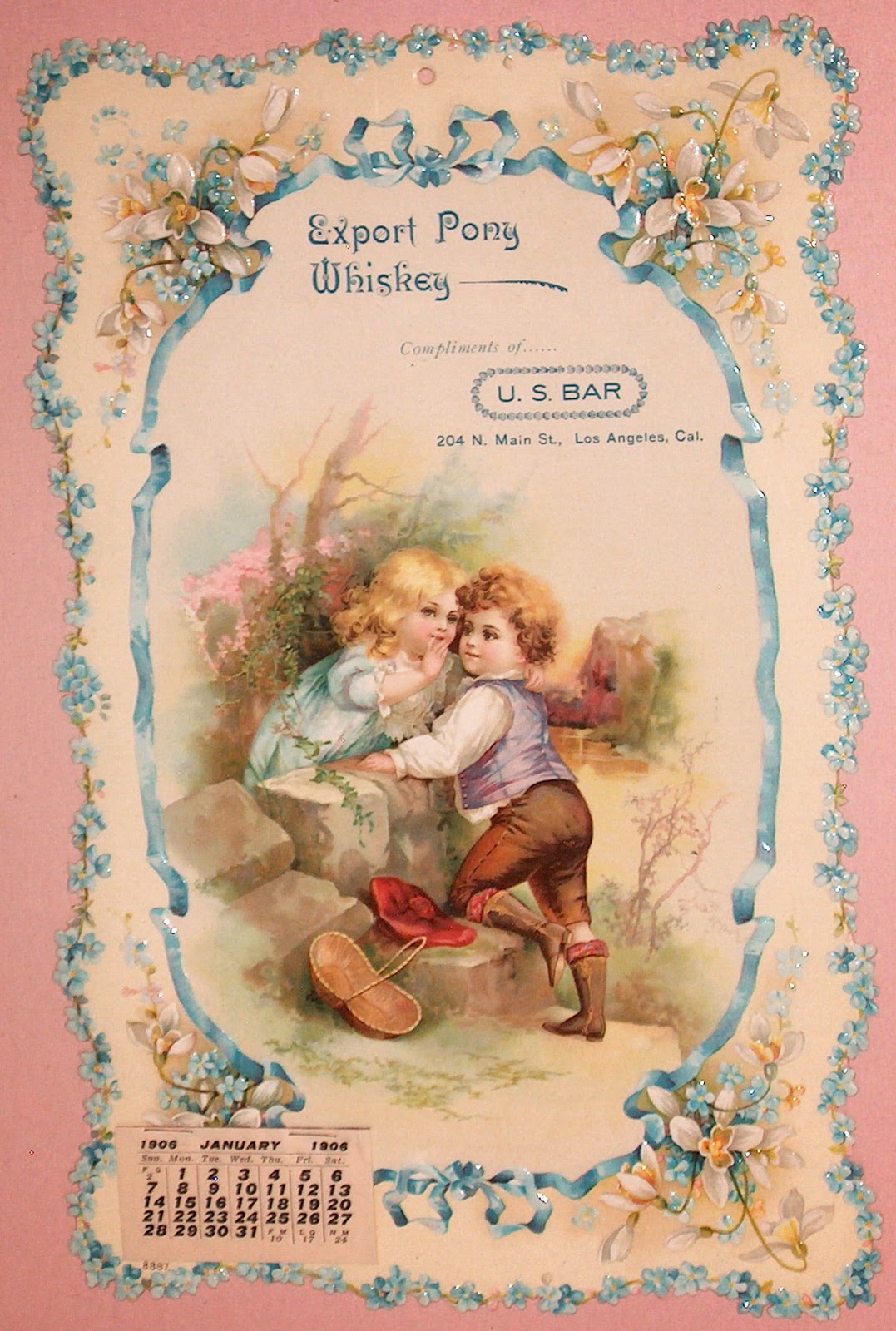
The three child images to follow feature two children, in each case a boy and girl, but in distinctly different modes.  The first, a 1906 calendar advertising Export Pony Whiskey, uses a design by Ellen Clapsaddle, a noted illustrator of children.  She is credited with more than 3,000 greeting cards and her images of children continue to be popular.  (See my post on her, March 2, 2012). Here she has given us two youngsters having a tete-a-tete across a stone fence.  This calendar was issued by the U.S. Bar, located in Los Angeles.


Old Maryland Dutch Whiskies issued a series of trade cards, often depicting children.  The company itself is something of a mystery, claiming to be located on Maryland’s Eastern Shore but failing to show up in any directories.  It is possible that the brand name came from a Baltimore rectifier who chose to remain anonymous.  Some of the assertions made on the card are novel.  They include: “When not taken immoderately, there will be an entire absence of Nervous Prostration.”   And “Emphatically ‘The Whiskey of our Daddies.’”


What are we to think of a card that shows two kids dress as adult, of whom the boy is throwing coins into a hat with no crown being held by a frog in a suit.  The trade card includes a poem that fails to help with an interpretation:  “Children cry, Papa’s dry, And wants some Sour Mash Rye.”   The flip side of the card advertised Schwartz & Malmbach’s “famous” whiskey as sold by J.E. Hughes, the proprietor of the Central Hotel in Shippensburg, Pennsylvania.  Hughes obviously ran a saloon along with the hotel and also asserted “Good Livery attached.”  Your horse was well cared for while you were drinking.


The last image is an 1897 ad from Green River Whiskey and shows the five children of a proud distilling father,  John McCulloch.  McCulloch, a former U.S. revenue agent, shucked his federal career when the opportunity arose for him to buy an Owensboro, Kentucky, distillery.  He built the whiskey into a well-recognized national brand.  Among his strategies was vigorous advertising.  These children are not from an artist’s imagination but portraits of real people. At left, the boy hugging the baby is his McCulloch’s eldest son, Wendall.  The baby is his brother, Charles.  Below them are two other brothers, on left is John Wellington, Jr. and on right, Hugh.  Standing at right is his daughter and the oldest child, Martine.  Several of his sons as adults followed him into the whiskey trade.


There they are, ten more examples of selling whiskey by using the images of children.  As unthinkable as it is in our age, the practice was common in the late 1800s and early 1900s, and apparently a successful merchandising strategy since it was so frequently used.


Notes:   More complete treatment of several of the “whiskey men” cited here may be found elsewhere on this website:   Applegate & Sons, July 21, 2012;  Jacob J. Pfeffer, December 15, 2015; A.M. Smith, May 19, 2013; E. S. Bonnie, April 29, 2014;  John McCulloch, April 1, 2014.


Saturday, June 8, 2024

Michael Cronan: “A Lad from the Old Sod”

 Foreword:  For years Steve Abbott has been an excellent historian of antique bottles whose many informative articles have graced the pages of collector magazines.  Although I have featured a number of guest authors on this website, I have never had a contribution from Steve.  Recently I was researching a story about Michael Cronan, a liquor dealer of Sacramento, California, when I encountered an article on Cronan that Steve published in the December 2018 issue of “Bottles & Extras” magazine.  His story offered an opportunity to recognize the many contributions Steve has made to whiskey history.   He graciously has allowed me to abridge and adapt his text for presentation here.

Michael Cronan

Michael Cronan, Sacramento whiskey and soda dealer, was too ill in the early fall of 1908 to attend the funeral of one of his best friends in San Francisco, so he sent his son Joseph in his stead.  San Francisco cemeteries are mostly at the edge of town in Colma, San Mateo County.  The horse drawn funeral proceeded through a drizzle along the dirt road, stopping at taverns, not necessarily saloons, every so often to water the horses and warm the mourners.


At the last stop, Malloy’s, the bereaved went inside for a final toast to the deceased friend.  Then, one of the sentimental Irishmen thought how unkind it was for the living to be having a drink inside a warm tavern while the deceased lay in a hearse out in the rain.  So the boys brought their friend in from the cold.  Not only did they bring him in, but they took him out of his coffin, stood him by the fireplace, and toasted him for the last time, hopefully with a glass of Irish dew.


This story was passed down by Joseph Cronin whose son “Bud,” passed it on to this writer.  It is a great story from an Irish family whose American origiins began with Mike’s birth in Caven County, Ireland, December 12, 1846.  Family history says that he probably came from a farm family and immigrated in the late 1860’s.  Mike worked in mills of some sort in the East, then worked his way to California, where he was employed on a railroad route headed to the Bay Area.  Somehow, and it seems to be true of other early immigrants, he came up with a substantial amount of cash., which the family says was about $10,000.  With this money in 1872 Mike bought his way into the Brooklyn Hotel at 85 Front Street (address pre-1880) Sacramento.


Within three years, he went into business with Hugh Casey, the son-in-law of Owen Casey, the proprietor of Eagle Soda works, and together Hugh and Mike morphed that business into Casey-Cronan at 50 Front Street (218 Front Street post 1880).  They were not only business partners, but best friends, Hugh being Mike’s best man at his wedding to Julia O’Brien in 1875.  At some point Hugh decided to go back to Ireland for a few years and Mike began his liquor dealership in 1887 at 230 K Street, a building earlier occupied by whiskey distributors Hall, Luhrs and Mazzini Bros., then Cronan, Cronan-Wissemann, and later George Wissemann.  The earliest ephemera for this budding  company is a forwarding card which would be sent to retailers when Mike would be in their vicinity for sales.  


By 1887 Mike had gone into business under his own name, M. Cronan.  Circa 1898 Mike decided to take an up-and-coming German businessman, George Wissemann, as a partner.  The merger of Irish and German immigrants did not last past 1900 when Wissemann stayed at the 230 K Street location and Mike, incorporated as Cronan & Company, moved to 323 K Street.  Upon splitting with Wissemann the company incorporated with Mike owning 365 shares, his wife Julia with 5 shares, his sister Anna Blanche with 5 shares and two investors, Thomas Kennedy and Thomas O’Neil with 12.5 shares each.  According to information passed through the family, Mike knew that national prohibition was coming and had already become law in some states. 


Sharing his risk and welcoming the investments of two other Irishmen (Kennedy and O’Brien) seemed prudent.  Plus Mike wanted day-to-day help running the business.  Apparently Mike did not keep an agreement with Kennedy who was paid a salary, but whose dividends in the company were not paid off in cash but used to pay off his investment in the company.  When Mike died and the estate was settled, Kennedy sued the estate for what he considered to be his share and won.


Michael Cronan’s part of the whiskey business came to an end on November 10, 1908, when, as the Sacramento Bee so delicately put it, Mike “dropped dead.” He was buried in St. Joseph’s Cemetery.  The company was worth between $50,000-$75,000, had a good credit rating, and paid good wages according to the Dunn credit rating reports.  The company continued until 1911 when Mike’s widow closed shop, moved to San Francisco, and tended to her business interests in Sacramento and elsewhere.


Michael Cronin’s life spanned his youth on an Irish farm, then in America as a mill and railroad worker, hotel owner, liquor dealer, property owner, and Sacramento businessman.  He was a true “Lad of the Old Sod,” who applied an immigrant’s ambition, risk, hard work, and left part of his legacy to those of us who collect bottle related objects and who try to preserve some of the history related to them.


Notes:  My thanks to Steve Abbott for allowing me to bring his narrative about Michael Cronin back to attention. Steve provides an informative story about a successful immigrant “whiskey man” that fits well with the purpose of this website. Most of the images shown here are from the original article.  Two other liquor dealers mention in Steve’s text have been featured in past posts on this website:  Hall, Luhrs, May 1, 2015, and George Wissemann, July 18, 2016.


Wednesday, June 5, 2024

John Baum, “Cyclone Carry,” & Leavenworth Liquor

John Daum

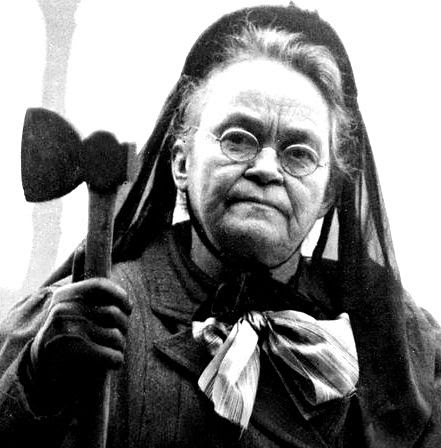
John Daum, immigrant, Civil War veteran, father of seven, and prosperous businessman of Leavenworth, Kansas, in 1881 faced a stark dilemma. Swayed by prohibitionist zealots like the hatchet-swinging Carrie “Carry” Nation, Kansas voters by 92,302 to 84,304 had prohibited all manufacture and sale of alcoholic beverages.  As a liquor dealer, Daum, shown here, was facing the devastating loss of his livelihood. What he did next took him into uncharted territory — and the Supreme Court of Kansas.


Daum’s story began in April 1840 with his birth in Hesse-Darmstadt.  His father was a blacksmith who taught him the trade.  In 1858 at age 19 the youth opted to emigrate to the United States and chose Saint Louis, a city with a large German population, as his destination.  There he found work as a hand in the engine rooms of steamboats that plied the rivers of mid-America.  In 1860, his ship docked for the winter on the Mississippi at Leavenworth, giving Daum considerable time to explore the city.


Founded in 1854 as the first community incorporated in the Kansas Territory,  Leavenworth, shown above, and its adjunct military installation, Fort Leavenworth, became animportant stop for thousands of pioneer wagons heading west to the Santa Fe and Oregon Trails.  The city bustled with activity providing supplies to the travelers.  Baum liked the place and vowed to come back.


With the onset of the Civil War, however, Baum returned to St. Louis where he joined  Union Army as a member of the First Missouri Light Artillery.   Each company served as an individual battery, often separated from the other batteries in the regiment, making it difficult to know exactly in which battles Baum was engaged.  He is said to have fought at  the Battle of Shiloh, shown here, and at sites in Kentucky and Tennessee.  Because the First Missouri was located behind the front lines, casualties were light — only one enlisted man and no officers killed at Shiloh.  Baum apparently emerged from the war unscathed. Honorably discharged in 1864 he headed to Leavenworth.


Baum’s first recorded employment there was with Carney & Fenlon, grocers who were specialists in stocking pioneer wagons, including supplying them with whiskey.  Thomas Carney was a former governor of Kansas and several times elected mayor of Leavenworth.  With partner Edward Fenlon, he had built one of the largest wholesale grocery houses in the Midlands, operating a four story building and cellar crammed with goods in downtown Leavenworth and a large warehouse adjacent to both the Mississippi River and the railroad.  Company sales extended to Colorado, Nebraska, Wyoming, Utah, Montana and New Mexico.  The partners saw something special in Union veteran Baum and raised him to stock manager.


Baum seemingly was drawn to the whiskey trade, however, and by 1866 had moved to employment as a clerk with A. McDonald & Company, a Leavenworth liquor store.  From that position,  about 1872 he moved to a partnership with a local named John Hannon to open a wholesale liquor house located at 113 North Fifth Street.  The partners called it Hannon & Baum. 


During this post-war period Baum was living the bachelor life, residing at Leavenworth’s Pennsylvania House hotel.  That was to change drastically about 1867 when he suddenly decamped to New York City to wed a woman named Mary German.  My guess is that their marriage occurred shortly after Mary arrived by ship in the U.S. from Germany.  Both about 27 years old, the couple may well have been childhood sweethearts.  


Returning to Leavenworth, Baum and Mary would have two children, William born in 1868 and Otto, 1871.  In fragile health Mary died in 1875, only 35 years old, leaving John to care for youngsters seven and four years old.  The following year, likely seeking a mother for his children, Baum married a second time.  She was 26, a local Leavenworth woman named Sophia Marie Endebrock, shown here.  Over the next nine years the couple would add four more sons and a daughter to the Baum household. 


Meanwhile, like a dark cloud on the horizon, Carrie Amelia Nation, aka “Cyclone Carry,” who became internationally famous as an American prohibitionist, moved to Kansas.  Although the state constitution prohibited alcohol sales, in many Kansas towns the law was ignored.  Saloons and liquor stores operated openly.  “Mrs. Nation launched a one-woman campaign against alcoholic spirits carrying a hatchet and a Bible. She prayed for fallen souls and left hatchet marks on bars.”


After demolishing a hotel bar in Wichita and destroying its liquor, Carrie roved Kansas smashing saloons and frequently being arrested.  Her visit to Leavenworth in 1901 was reasonably benign.  Leaving her hatchet behind, Carrie was given a police escort that kept close watch as she visited several sites, staying at the National Hotel.   As related by a city guidebook:  “…After being shown to her room.  , the saloon on the first floor was opened and did a brisk business, largely because of the many people who had turned out to see Cyclone Carry, as she was called by the newspapers.”  A postcard, showing the hotel, commemorated her visit to Leavenworth.


Although Carrie Nation’s trip to Leavenworth was uneventful, her prohibitionist activities were spurring state and local officials to enforce laws banning alcohol.  Baum faced an immediate deadline for shutting down his liquor business.  He did not hesitate to act.  The answer lay in a bridge over the Mississippi River to a location in Missouri called “Stillings.”  Not really a town, Stillings was a largely unpopulated geographical expression with a post office.  With several other Leavenworth liquor dealers, Baum moved his operation and supplies a few miles east to Stillings.


While continuing to live in Leavenworth and advertise in its newspapers, Baum was able to conduct his liquor business unimpeded in reliably “wet” Missouri.  Kansas residents had only to pick up the phone, dial 410, place an order, and within hours bottles or jugs of liquor would be delivered across state lines to their door.  U.S. courts generally had established that the Interstate Commerce Act (ICA) required unimpeded state-to-state trade, in effect undermining local and even state “dry” laws. Shown above and below are Baum jugs in several sizes marked with a Stillings logo.


Soon the forces of “dry” attempted to end the flow of alcohol from Stillings.  State authorities took Baum and four other liquor dealers to court, claiming violations of law.  After a lower Kansas court found for the defendants, the state’s attorney general and the Leavenworth county attorney appealed to the Supreme Court of Kansas.  The case was heard during July 1911.  The prosecution argued that the Stillings origin of liquor was a “subterfuge”  and that “certain wagons…with horses or mules hitched thereto and drivers thereon” were bringing liquor illicitly into Leavenworth.   This was not interstate commerce, the state contended, but “…Purely and simply…devices, shifts and subterfuges to avoid and violate the said prohibitory laws of said state of Kansas.”  


The Kansas Supreme Court disagreed.  The “whiskey express” over the Mississippi River was protected by the ICA.  The liquor traffic from Stillings continued. Two years later, however,  the Webb-Kenyon Act adopted by Congress exempted liquor from its provisions.  During the next four years, as the legislation was challenged in the courts, Baum could continue serving his customers.  Upheld by the U.S. Supreme Court in January 1917,  Webb-Kenyon, still on the books today, effectively ended the Stillings safe haven for Baum and the others.


Baum’s gambit apparently had minimal effect on his standing in Leavenworth where he was hailed as an early resident who “figured prominently in the expansion and growth of the city.”   Among his achievements was as a founding member and officer of the local GAR, an organization of Union Civil War veterans; an organizer and trustee of the Leavenworth Turnverein, a German athletic club, and a principle donor to building Turner Hall, below.  Baum also was reported to have “amassed considerable wealth and property.”


Baum took a particular interest in Leavenworth’s Greenwood Cemetery where he was buried following his death in 1935.  In his later years he kept the wooden gate to the cemetery locked as he reportedly “lovingly” cared for the burying grounds where rested his first wife, Mary, and other kinfolk.  Said to have feared that when he died “the property would spiral into ruin,” Baum proved to be prescient. Greenwood, among the first cemeteries in Kansas, was allowed to languish until 2022 when it was named to the roster of National Historical Places. Currently steps are being taken to restore the burying ground as a Leavenworth landmark.


A final word about Carrie Nation who returned to Leavenworth for a second time only in 1911.  Her saloon smashing days were over.  She was brought to a hospital in the city by a nephew and, very ill, died there five months later.  Ironically, Carrie, the prohibition zealot, subsequently was buried in reliably “wet” Missouri, while Baum, the liquor dealer, is buried in Kansas where “dry” restrictions today continue to be among the most stringent in America.


Note:  A number of resources were used in telling John Baum’s story.  The two most significant were his biographies in the March 1886 Leavenworth Times newspaper and a National Park Service document on Greenwood Cemetery.