Monday, August 14, 2017

Malcolm, Mencken and Monticello Rye

Malcolm Crichton and Henry (H. L.) Mencken, though they likely never met,  forged an enduring  bond between themselves because of Monticello Maryland Rye.  Crichton created it and Mencken, the “Sage of Baltimore” gave it national recognition by championing it as a superior brand of whiskey.

One of America’s best known wrlters,  Mencken claimed the family physician “believed and taught that a shot of Maryland whiskey was the best preventive of pneumonia in the R months.”   That directive was firmly held by Mencken’s father, Augustus, a cigar manufacturer.  When the senior Mencken sent out for whiskey he demanded Monticello.  

His famous son recounted:  “His…bill file shows that on December 27, 1893, he paid…$4 dollars for a gallon of Monticello whiskey….Before every meal, including breakfast, he ducked into the cupboard in the dining room and poured a substantial hooker of rye, and when he emerged he was always sucking in a great whiff of air to cool off his tonsils.  He regarded this appetizer as necessary to his well-being.  He said it was the best medicine he had ever found for toning up the stomach.”

The man responsible for this elixir was Malcolm Crichton (pronounced “Cri-ton”).  Born in Illinois about 1840, he was the son of Janet M. and William Crichton, a Scottish-born wholesale grocer who relocated the family to Maryland in 1848. His father appears to have been something of a taskmaster.  A Baltimore friend told an anecdote about Malcolm and his brother being driven to school by William:  “He wore riding breeches and held a fine whip in his hand.  I heard him tell [the schoolmaster] to keep his sons in order and not to spare the rod.  ‘Send for me,’ he added, shaking his whip, ‘if you need any help.’”
Malcolm began his career prior to and during the Civil War working for his father in the grain and fertilizer business on Baltimore’s waterfront.  An 1863 city directory listed Wm. Crichton & Son as grain, flour and guano dealers and commission merchants.  The father was also listed as president of the Corn and Flour Exchange.  After the war, Malcolm left his father’ employ and struck out on his own.  For someone familiar with grain it seemingly was only a short step to distilling.  At the age of 25 Crichton was recorded in city directories engaged in making whiskey at a site near Holliday and Bath Streets in Baltimore.  

In the meantime Crichton met and fell in love with Antoinette Kennedy, the daughter of John Kennedy of Hagerstown, Maryland, and through her mother related to the influential McPherson clan of Baltimore.  They married on June 15, 1865. The couple would have six children, William, Nettie, Malcolm, McPherson, James and Mary Elizabeth.  Two of them are shown here, reading one of several children’s books Antoinette wrote and published.


Clearly an enterprising young man, Crichton took over a defunct distillery once run by Joseph White.   He rebuilt the facility and began producing the whiskey he called “Monticello Rye.”  Baltimore already had its Mount Vernon Rye — named after George Washington’s home.  That may have inspired Crichton to appropriate the name of Thomas Jefferson’s home for his whiskey.  A serving tray and his ads fully exploited the connection.  Crichton also claimed in his advertising, without proof, that the date of origin for this brand was 1789 — half a century before his birth.

Calamity struck on July 24,1868.  That was the date of the Jones Falls Flood, Baltimore’s greatest natural disaster of the 19th Century.  The water rose to twelve feet downtown,  shown here in an artist’s depiction.  Among the casualties was the Monticello Distillery, washed away by the rushing waters.  Crichton lost little time before rebuilding, this time aided financially by Charles E. Dickey, the owner of a meter manufacturing company.

The location at 136 Holliday would be the home of the M. Crichton & Company plant for the next twenty years.  A Sanborn insurance map shows the extent of the facility on two sides of Holliday Street.  In 1880 Crichton moved his sales and management offices to 57 Second Street in Baltimore, later moving them to the Fireman’s Building at the northeast corner of South and Second Streets.

Jim Bready, the historian of Baltimore whiskey, has written that the rebuilt Monticello Distillery was not far from City Hall.  In summer when the windows were open, there being no air conditioning in those days, the aromas of the whiskey-making would waft through municipal offices — obviously fomenting thirst among the clerks.  Bready also noted that Mencken, like others of his time was fond of standing at the bar, the “Sage of Baltimore” said, to “toss the bartender for drinks.”  Monticello Distilling obliged the practice by issuing a token that could be flipped to see who paid.

 Before long, Crichton had built his distillery into one of Maryland’s largest, gauged by the taxable value of the spirits produced.  In 1900, for example, Malcolm’s facility produced a taxable $228,788 in product, roughly equivalent to $5.6 million today.   In Maryland he was second only to the Hannis and Sherwood distilleries.   Monticello Rye not only had a loyal customer base in Maryland but also reached liquor dealers such as Peter Welty in Wheeling, West Virginia, and Loeb-Lion-Felix in New Orleans. In 1881, likely concerned about brand infringement, Crichton trademarked the name. 

Unfortunately, Malcolm Crichton had little time to enjoy the success and prosperity his Monticello Rye had engendered, dying in 1890 at the early age of 50. The Baltimore Sun carried details of his demise: “About a year ago Mr. Crichton had an attack of erysipelas in the face. Under the care of Dr. Silas Baldwin, he recovered. Two weeks ago Mr. Crichton was attacked with erysipelas in the food and Dr. Baldwin was again summoned. Gangrene developed and at Dr. Baldwin’s request Dr. Alan P. Smith was made consulting physician. Shortly after 3 o’clock yesterday afternoon Mr. Crichton rose from his chair and attempted to walk across the room. He fell after making a few steps and soon died.”

Because of the artistic efforts of his son, James, we are fortunate to have a small portrait of Malcolm Crichton in middle age.  He seems not to have lost the intensity seen in the face of the younger Malcolm, shown above.  With his family gathered at his graveside, he was buried in Baltimore’s Green Mount Cemetery.

When Malcolm died, it appears that none of his sons were interested or equipped to take over for him.  The distillery was sold to Baltimore brothers, Bernard and Jacob B. Cahn.  Bernard earlier had been in the liquor business as a partner in Cahn, Belt Co. [See my post on this firm August 2013.]  The Cahns continued successfully to run the Monticello Distillery and market the brand for almost 30 years, until shut down by National Prohibition.  During Prohibition Monticello Rye was one of those whiskeys that could be bought for “medicinal purposes” with a prescription at drug stores.  With Repeal, the brand under new ownership continued to survive into the 1940s.


Shown here drinking a beer at the stroke of midnight ushering in 1934 and Repeal,  Henry Mencken was enthusiastic about the demise of National Prohibition. Later he came to see Repeal as something of a mixed blessing.  Now, Mencken raged in print, Monticello Rye cost $3 to $3.50 a quart — not the $4 a gallon his father had paid.





Friday, August 4, 2017

Whiskey Men Who Cheated

                        
Foreword:   This is the fifth in a series of posts that examines the activities of whiskey men who previously have been profiled on the blog, grouping them for analysis under various headings.  In this case the common thread in each story was a predilection for cheating.  Scams were aimed at investors, consumers, and the government.  In each case the old caution “crime does not pay”  was fulfilled — more or less.

The “Bad Boy” of Baltimore:  Throughout virtually his entire life, George Gambrill seems to have been embroiled in the courts.  When he was still 19 and a grain dealer, Gambrill was forced into bankruptcy, unable to pay a host of creditors.  Later he would claim that he had been drawn into the affairs of grain dealer relatives and being young and naive, made the fall guy.  Before long, however, George was back dealing in grain from an office in the posh Eutaw House, a downtown Baltimore hotel, shown here

For Gambrill it proved a short step from grain into distilling with Roxbury Rye as his flagship label.  An energetic marketer, he soon developed it into a nationally recognized brand.  But George continually found it difficult to play things straight.  His distillery manager, John Schooley,  hauled him into court in 1901 claiming that Gambrill had reneged on compensation for his work.  Gambrill’s bizarre defense was that he wasn’t really in the distilling business at all since Roxbury’s entire production had been promised to a New York City wholesaler and he claimed that outfit was running the distillery.  A jury saw his claim as ludicrous and found for Schooley. 

Gambrill continued having problems keeping on the right side of the law.  Still speculating in grain, he bet the wrong way on wheat prices, lost his shirt, and once again was unable to pay creditors.  This time the authorities suspected out and out fraud.  Gambrill was hauled into court in 1910, accused of putting up the same whiskey stocks as collateral for separate forfeited loans totaling $500,000. He was tried, found guilty and sentenced to four years in prison.

The whiskey man vigorously resisted going to jail, appealing his conviction.  A dozen years later, for murky reasons, he had not served even a day behind bars. Instead he was residing comfortably with his wife in their home.  Finally in 1922 a judge quashed the fraud conviction citing Gambrill’s failing health and advanced years (age 77).  That may have been the old fellow’s last con game:  George lived another eight years, dying in 1930 at the age of 85.

Spirits, Sex & Scams:  Alexander Bauer established a liquor house in Chicago about 1886 and soon decided that “sex sells.”  For example, he advertised his Dam-I-Ana Benedictine “Invigorator,”  an 19th Century version of Viagra, with nudes in erotic postures.  A trade card for another alcoholic tonic used a four-leaf clover to suggest an afternoon illicit tryst.  

Bauer’s emphasis on the prurient, however, paled against the outrageousness of his scams.  In 1897 Chicago law enforcement authorities conducted a raid on Bauer’s building at 142-148 Huron Street.  What they found was startling — cases of counterfeit liquor and a large stash of counterfeit labels.  Bauer was taking old bottles, some of them the genuine article with names blown in the glass, refilling them with his booze, slapping on a faux label and selling them as the real mccoy.  Among them was Hennessy Cognac.

Whatever fine Bauer was forced to pay for this scam, it proved to be no deterrent.   Instead, he set up a dummy company at the same address as the A. Bauer Company.  Rather than refilling real bottles and counterfeiting labels, this outfit was in the business of trademark rip-offs.  Soon the building on Chicago’s Huron Street was churning out look-alike labels of well-known alcoholic beverages. 
  
Predictably, the manufacturer owners of the trademarks struck back in 1902, hauling Bauer into U.S. District Court.  When the federal judge found Bauer guilty, he appealed.  The Appeals Court upheld the earlier ruling and the fines levied on Bauer.  The Chicago whiskey man subsequently reorganized the company, changing its name to the A. Bauer Distilling and Importing Company.  Despite its shady past, Bauer had the hutzpah to claim on his letterhead:  “For 20 years a square deal:  the cause of our phenomenal growth.”


In 1912 federal authorities, acting under the Food and Drug Act, hauled Bauer into court for adulterating and misbranding wines.  When the court agreed and fined Bauer, as before he appealed.  Once again he lost and was forced to pay a fine of $100 and court costs amounting to $73.06.  With such gentle financial slaps on the wrist when caught cheating, no wonder Bauer’s company continued to thrive.  Antics such as his, however, helped fuel the Prohibition movement that 
in 1920 shut down his liquor business for good.

A Forced Confession:  Compared to Bauer, Charles Klyman, also a Chicago whiskey dealer, was small potatoes.   By choosing the wrong opponent, however, he paid a much higher price for his scams.


Klyman first entered the public record in 1888 at the age of 28 when he began a wholesale liquor business.  After struggling along for five years, he changed the name of his company to “The Dr. Anker Bitters Company.”   Another bitters tonic, called Dr. Dunlap’s Anchor Bitters, had a national customer base  Although their label presentations, shown here, differed somewhat, a casual buyer might mistake one beverage for the other.  Given Klyman’s predilections, that likely was his intention.

By 1896, Klyman had resorted to putting counterfeit labels of well-known alcoholic brands on bottles, adding contents cooked up on site, and then selling them to retail outlets.  Law officers tumbled to the scheme when a few downtown Chicago stores were found selling brand name liquor at cut-rate prices.  A raid on Klyman’s premises yielded the evidence.  On the second floor of his Kinzie Street  establishment authorities caught employees washing off old labels, cleaning the bottles, filling them, and slapping on the deceptive labels.  Among whiskey knockoffs was Canadian Club.

Although Klyman faced criminal charges in Illinois, he now had an even more implacable foe in Hiram Walker, the man responsible for Canadian Club.  The distiller was especially aggressive in insuring that counterfeiting or tampering with  that whiskey was hazardous to anyone who tried.  Walker had detectives regularly patrol retail outlets looking for frauds on his brands.   He went hard after Klyman and brought him to his knees.

As his settlement, Walker forced Klyman to write out the “Confession” shown here.  Dated June 3, 1898, it appeared in all major Chicago newspapers and in selected trade publications.  In it Klyman accepted the two conditions Walker demanded:  1) That “in the public interest” he would plead guilty under the Illinois Trademark Act and take his punishment and 2)  That he would never again be “a party to the imitation of any goods whatever….”  The confession reveals Klyman begging for mercy, pleading that “my wife has appealed to you to take into consideration her unhappy position and that of our young children.”

As a Windy City businessman Klyman clearly was finished.  He closed down his liquor house and traded the shame of Chicago for the cold, snow and virtual anonymity of Buffalo, New York.  Although he attempted to open a liquor store there, it appears to have failed and by 1912 he was working as a traveling salesman.

Watering the Whiskey:  It must have seemed like the perfect scheme to Ralph Parilla, a Youngstown, Ohio saloonkeeper and liquor dealer who called his establishment the “Crab Creek Distilling Company.”  Closed down by prohibitionary laws,  Parilla plotted in 1919 to removed barrels of whiskey he owned from a government-guarded warehouse under the pretext of exporting them to Canada.  First, however, he would extract the whiskey from the barrels, substitute water, and truck the barrels over the border.  The whiskey he could bottle and sell. Then things went terribly, terribly wrong.


Shown here with his wife in happier days, Parilla had thousands of dollars tied up in barrels of whiskey languishing in a warehouse just outside Youngstown. Because of World War I prohibitionary laws, no legal way existed to get it out —except to export it.  The law allowed him, upon getting a federal permit, to withdraw the whiskey without paying taxes by giving a bond that he would forfeit if the whiskey were not within a prescribed time passed out of the U.S. through a designated exit point.  Thereupon, Parilla hatched the scheme to turn whiskey into water.

Parilla saw it a triple “killing.”  He would 1) retrieve his whiskey investment, 2) avoid the $6.60 per gallon federal tax, and 3) retain the liquor to bootleg later at inflated prices.  At first the plot seemed to go well.  Barrels were taken to two locations,  a farm owned by Parilla and a shuttered saloon in town.  Then things began to unravel.  The men removing the barrels from the warehouse had come to the notice of federal authorities as suspicious.  The next day the Feds popped into the shuttered saloon where they found a man with pump and hose, filling a whiskey barrel with water.  Then they went to Parilla’s farm, found more empty barrels and arrested him.

The gambit proved costly to Parilla and his co-conspirators.  They immediately forfeited their $30,000 bond.  Each was released only upon posting a personal bond of $10,000.  On trial in U.S. District court, Parilla and others were found guilty, appealed and lost again.  There is no indication anyone served jail time.  Parilla’s name and crime, however, was splashed all over newspapers in Ohio and beyond.  His subsequent activities are lost in the mist of history.  A photo exists of Ralph in middle age seemingly enjoying life.

Note:  This blog contains longer and more detailed posts on each of the four men profiled here.  They are:  George Gambrill, June 6, 2011;  Alexander Bauer, Feb. 2, 2012;  Charles Klyman, April 16, 2016, and Ralph Parilla, May 28, 2016. 


Tuesday, August 1, 2017

Abraham Keller and Whiskey for the Ages


Credited with being among the first Kentucky distillers, the names of Evan Williams and Elijah Craig have continued to grace bourbon bottles down to this very day.  The name of Abraham Keller, another Kentucky distilling pioneer, was seen on whiskey labels for eighty years but the brand, sadly, was swept away by National Prohibition, with only token remembrance today.

Records indicate that Keller was born on May 4, 1809, in Pennsylvania and as a youngster brought with his family to Kentucky.  His father, also Abraham, may have started a small distillery there.  The young Abraham, first came to public notice in 1840 when he bought a property in Harrison County located about one mile southwest of Cynthiana, Kentucky, on the South Fork of the Licking River.  

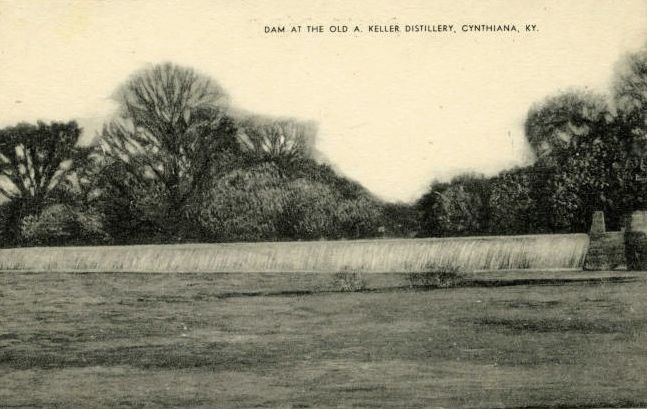
A man named Lamb previously had owned the property and placed a dam on the South Licking in order to turn a water wheel to provide power for a flour mill he operated. The dam is shown right.  Lamb was grinding flour and cornmeal, hauling it to nearby Maysville and shipping by flatboat to New Orleans.  Apparently uninterested pursuing that trade, Keller converted the flour mill into a distillery.   Taking as a partner a member of the Shawhan distilling family, Keller produced a whiskey under the brand name “Old A. Keller.”  Below is a later, highly imaginative drawing of what Keller’s early distillery might have looked like.

For the next twenty years, Keller watched as the quality of his whiskey brought it attention throughout Northeastern Kentucky and beyond.  The profits were important to feed and clo his rapidly growing family.  In 1832, at the age of 23 Abraham had married Polly Ann Miller, the daughter of Hugh and Mary (Ewalt) Miller.  The couple would go on to have ten living children.  To house this growing brood, Abraham bought 169 acres of good farm land located at the intersection of Cynthiana and Lair’s Road where he built a large house.  Polly named it “Pleasant Home.”

After two decades of successful distilling, Keller sold the property in 1861.  He may have been prompted by the war clouds gathering on the horizon.  Indeed, Cynthiana was the site for two battles during the Civil War, one of them at a bridge that Keller had built over the South Licking.  There members of the 171st Ohio Infantry fought a force led by Brig. Gen. John H. Morgan, who headed a cavalry troop known as “Morgan’s Raiders.”  They captured about 1,300 Yankee prisoners but were forced to release them when the Union Army sent reinforcements and caused the Confederates to retreat.  The engagement, became known as the Battle of Keller’s Bridge.

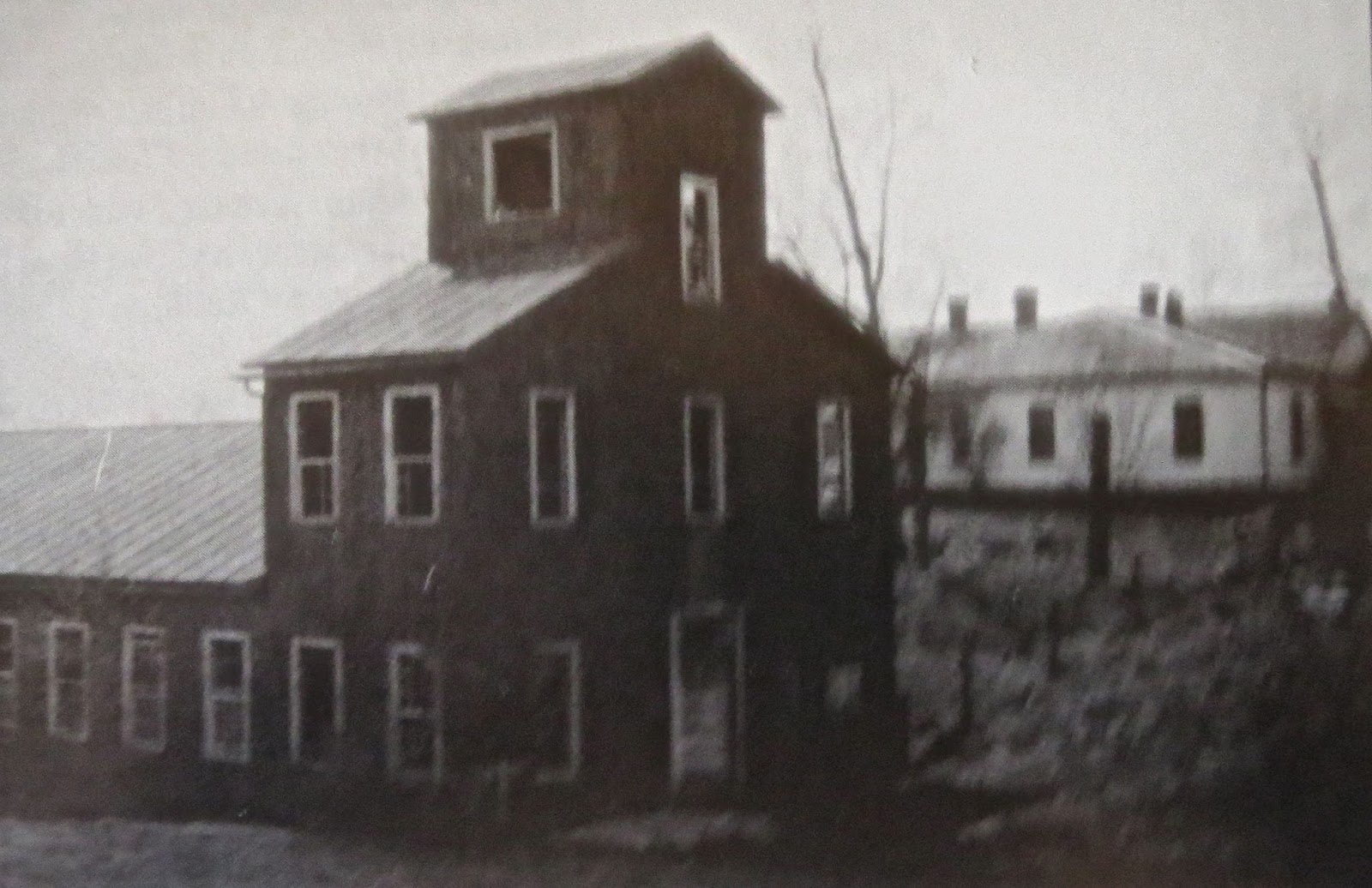
Keller sold his distillery to J. A. Cook who ran the facility for the next five years, maintaining the A. Keller brand.  Shown here is a photo of the distillery as it  looked at the time.  In 1863, Cook sold a half interest in the facility to Thomas A. Ashbrook, changing the company name to Cook & Ashbrook.  When Cook died in 1873, his share was bought by Ashbrook’s sons, Felix G. and Samuel J. The Ashbrooks recognized the “celebrated” reputation of the A. Keller brand and advertised as above.

When Thomas Ashbrook died, his sons took over running the distillery.  By the mid-1880s the plant was mashing 160 bushels a day and had a bonded warehouse capable of aging 3,000 barrels.  Operating it as The A. Keller Company, Distiller, the brothers sold several brands nationwide bearing the founder’s name.  They included “Old A. Keller,” “Keller’s 67,” “Keller’s Imperial” and “Keller’s Superior” bourbon and rye.  Two examples of Keller labeled glass bottles, quart and flask size, are shown here.

The Wine and Spirits Journal in 1891 noted that: “Cynthiana is the birth-place of old “A. Keller,” one of the most widely-known and easiest-selling brands coming from Kentucky to New York and Boston and in the East.”  The trade publication further explained that the major East Coast distributor for the brand for many years had been and was continuing to be the highly capable P.W. Engs & Sons. [See my post on Engs, Jan. , 2017.]

In 1884 Felix Ashbrook died and was interred in Cythiania’s Battlefield Cemetery.  In the same burying grounds in Section G, Lot 8, lay Abraham Keller who had passed in 1867.  The Keller family erected a large plinth to mark the site.  It carried a plaque memorializing him and his wife Polly who joined him there in 1895.

Despite the death of his father and brother, Samuel Ashbrook continued to expand the A. Keller Distillery, erecting a new warehouse with capacity for 12,000 barrels of whiskey.  The new building shows up in another idealized depiction of the Cythiana facility that can be dated after 1897, the year of the Bottle-in-Bond Act, because of the designation that the warehouse was bonded.  In 1902 under pressure from the Kentucky Distilleries & Warehouse Co., e.g. the Whiskey Trust,  Ashbrook sold out to the conglomerate.

Recognizing the marketing power of the brand name, Trust executives continued to market A. Keller whiskeys.  By 1910 they had expanded the distillery to increase mashing capacity to about 450 bushels per day and warehouse capacity to well over 30,000 barrels.  A photograph here exists from that time that provided a  realistic look at the facility.  The automobile visible in the picture dates it from the late 1910s.

Although the Trust continued to market the Keller brand, the name of the distillery was changed at least once more to the G. G. White Distillery.   White was a former clerk in a Bourbon County distillery who received an inheritance of several thousand dollars when the owner died.  He began to invest in whiskey-making properties and subsequently allied himself with the Trust, who put him in charge of the Cynthiana facility.  The plant operated until the advent of National Prohibition and closed..  

That ended an eighty-year run for the distillery that Abraham Keller founded in 1840 and the effective termination of the Keller brand name.   While Evan Williams and Elijah Craig continue to be remembered because of the whiskeys that bear their name, Abraham Keller, equally a pioneer Kentucky distiller, remains in obscurity.  Except, however, in Cynthiana where one can buy what is described as a “unique  bourbon (or whiskey, depending on what your drinkin’)” shot glass inscribed  "Old A. Keller."   Etched by a local craftsman, the glass memento includes a “keepsake” card that tells the history of the distillery.  Sold in packs of four, a single Keller shot glass costs $18.00.

Note:  Some information for this post on Keller came from the book, “Bourbon in Kentucky, A History of Distilleries in Kentucky”  by Chester Zoeller, published in 2010 by Butler Books, Louisville.


Saturday, July 29, 2017

John Freeman’s Hot Times in Hot Springs

           
Excitement was running high in Hot Springs, Arkansas, on January 10, 1910, with the anticipated visit of former president, Theodore Roosevelt, to town for a ceremony and speech.  At John Freeman’s Barrelhouse & Saloon on Ouachita Avenue a trio of soldiers from Company L, Fourth Infantry, from Fort Roots near Little Rock, shown below, had gathered, anticipating their role as honor guard in a reception committee.  Among them was Edward L. Haley, a Mississippian, son of a widow, and described as “the most peaceable man in the company.”

Haley and his buddies were drinking beer in Freeman’s saloon when two civilians whom they did not know entered and the soldiers, apparently in the high spirits of the occasion, invited them to join their party.  The civilians subsequently left without paying for their drinks.   When the soldiers got up to leave, Freeman’s bartender, George Kilgore, told them to pay for those drinks.  When Haley disagreed, Kilgore took out a hand gun from behind the bar. In the argument that ensued, he shot and killed Haley.

Violence of this nature was not uncommon in Hot Springs. Kilgore had shot and killed another man in Freeman’s saloon ten years earlier.  The town was a popular hangout for outlaw gangs from Oklahoma and other notorious gunmen.  Later Al Capone and other gangsters would make it their “vacation” home.
How this murder in his saloon affected John Wesley Freeman, a deputy sheriff, former postmaster, and leading citizen, has gone unrecorded.  The incident serves to introduce an Arkansas whiskey man whose enterprise helped shape a unique community where 47 "hot springs" gush forth nearly a million gallons of 143 degree water every day.  In an effort to conserve this natural resource, President Andrew Jackson in 1832 made the springs the first federal reservation, encompassing the area surrounding the city of Hot Springs. 

Freeman was born in South Carolina of native Carolinians.  The exact date is in question.  According to the 1900 census, it was 1862.  His tombstone indicates 1857.  Of his early years little has been recorded.   One account says Freeman came to Hot Springs in its early days to buy cattle.   At the time he is reported to have been running a large cattle ranch near Buckville,  a hamlet of 100 souls located twenty-two miles northwest of Hot Springs and the center of a cotton and corn farming area.  Freeman also ran a general store in Buckville.

Although the town later would be moved to another location to make way for a dam project,  Freeman had long since decamped to Hot Springs, where, it was said, he had “a firm faith in the town’s future.”  He moved his mercantile business there, opened a wagon yard and stable, and by 1894 had started a saloon.  He recognized that the thousands of tourist who thronged the city by day to “take the waters”  might work up a thirst for something stronger at nightfall.   By 1903 three Freeman saloons were operating simultaneously in Hot Springs, the barrel house previously cited,  Freeman’s Plateau Saloon at 700 Central Avenue and a larger drinking establishment at 650-654 Central Avenue called Freeman’s Wellington Bar & Barrel House. 

Freeman installed his brother James as the manager and buyer for the three liquor concerns.  The close location of the three drinking establishments made it possible for one man successfully to supervise them all.  Noted one observer:  “For although they are not without competition, and in close proximity, it is a well known fact that they enjoy a lions’ share of the trade.”

Most whiskey sold off the premises was contained in pottery jugs and bore the name “Freeman Bros.”  A variety of those ceramic containers is shown throughout this post.  They included Albany slip beehive “scratch” jugs and two-toned shoulder jugs with stenciled labels, some in cobalt blue.  This jug trade was described as the “largest in town, while the best families in the city keep their telephones a-ringing.”  In 1903 Freeman snagged the area franchise for Miller Beer.

Meanwhile the South Carolina transplant was having a personal life.  Early the 1880s he had married a woman named Amanda and together they had a family of five children, sons Robert, Walter and James W. ; daughters Myrtle and Vera.  Eventually both Walter and James would work for their father, James as manager of what the family called “The Tennessee Wagon Yard.”

A hot time in Hot Springs meant more than boiling water and violence.  Fires were the bane of the community.  On February 26,1905, a fire started after midnight in the Grand Central Hotel on Chapel Street. For six hours the conflagration raged.  Before this fire burned itself out, it had consumed 40 square blocks, including the homes of more than 2,000 residents. Also gone was the court house, jail, and three hotels.  At least five people were killed in one of the greatest fire disasters to hit an American city.

Freeman’s properties were not spared.  The Freeman Mercantile Co. and one of  his Ouachita Avenue saloons were destroyed.  His wagon yard and stables were consumed but the press reported that some horses and vehicles had been saved.   Although the burned out parts of Hot Springs were quickly rebuilt, Freeman was reduced to running two saloons.   

Moreover, time was running out for the family.   James Freeman died in December 1909 at the age of 43.  By that time John was a widower, living with his children, Amanda having died earlier.   His days also were numbered, dying in April of the next year at the age of 53.  John Freeman today lies buried in Hot Springs’ Greenwood Cemetery.  His headstone is shown here. Sadly, his son James, age 25, died later the same year.

The Freeman enterprises — saloons, store and wagon yard — subsequently disappeared from Hot Springs directories.  Today we have only Freeman’s jugs to remember a man hailed for his business successes, of whom it was said:  “Habits of industry, the determination to be thoroughly conversant with all the details of his affairs, and above all, the strict adherence to to sound business principles, has placed him where he is today….” 

As for the outcome of George Kilgore’s shooting of soldier Edward Haley in Freeman’s saloon, I have not been able to find further information.  Teddy Roosevelt visited Hot Springs as expected and was the honored guest at the fairgrounds.  The photo below shows him at the event, looking toward the military honor guard at left, standing at attention.  He may have known that it was missing one young soldier that day. 

Note:  Many of the details of John W. Freeman’s life are from The Goodspeed Biographical & Historical Memoirs of Western Arkansas, published by the Southern Publishing Company in 1891.