Monday, October 12, 2020

Whiskey Men in Dangerous Towns

Foreword:   Many saloonkeeper in towns in the “Old West” were accustomed to the sounds of gunfighting.  Often those shots were fired in drunken altercations that may have begun in other saloons and tumbled into theirs.  Most proprietors were able to keep safely out of the way, as with the three publicans briefly profiled here, living in Kansas, Colorado and Texas towns where lawlessness often made for exciting times. 

Known as among the wildest of Wild West communities, Dodge City, Kansas, had a reputation for frequent murders and casual justice.  Neither seemed to deter Henry Sturm, a immigrant saloon keeper and liquor dealer, who faced off in Dodge against formidable opponents —  a gun-toting gang led by Bat Masterson.


A Kansas newspaper in the 1870s reported: “Kansas has but one Dodge City, with broad expanse of territory sufficiently vast for an empire; we have only room for one Dodge City; Dodge, a synonym for all that is wild, reckless, and violent; Hell on the Plains.” 


Despite these challenges, Sturm prospered.  A year after his arrival he bought the Occidental Saloon, shown below as reconstructed as part of the “Old Dodge” exhibit.  Sturm advertised…”A pint, a keg, or barrel of the very best, old Irish, hot Scotch, six year old hand made sour mash Kentucky copper distilled bourbon or old Holland gin.” 


Accustomed to the usual level of Dodge City violence, Sturm’s sternest test came during what was known as “The Saloon War of 1883.”  The conflict began when authorities arrested three women singers at Luke Short’s Long Branch Saloon. When things escalated, Short was banished from Dodge.   Quick with a gun himself, Short was backed by gunslingers like Bat Masterson, shown here, described at the time as “one of the most dangerous men in the West.”  Repairing to Topeka, Kansas, Short and Masterson assembled a gang of gunslingers with the purpose of returning to Dodge and getting revenge.


Sturm put himself on the line, signing an anti-gang telegram on May 13, 1883, to a reluctant Kansas governor, George Washington Glick, asking for state troops.  The saloonkeeper also signed an anti-gang article sent to the Topeka Daily Capital newspaper.  When Masterson and Short threatened to bring their rowdies to Dodge by train, the local sheriff enlisted local guns, including Sturm’s.  High tension gripped the town for days.  In the end, the issues were negotiated and no shots fired. The stalwartness of Sturm and his companions had paid off.


If it is true that every bottle has a story behind it, then the details behind the liquor jug shown left suggests enough material for a novel.   It would document an epic struggle between miners and mine owners in Colorado that involved armed intimidation, “stalag” conditions, shootings, and even murder.  Saloonkeeper Charles Niccoli was in the thick of it all.


Niccoli was born in 1858 in Poings, Italy.  Christened “Pasquale,” he became Charles (or “Charley”) upon arrival about 1884 in the United States, moving eventually to the coal fields of Colorado where he ran a saloon at Hastings. Most Colorado miners lived in these company towns, renting company houses, buying food and supplies in company stories and drinking at saloons controlled by the company.  


Charles Niccoli’s ability to rent the saloon building shown left with sign was predicated on his playing along with Victor-American Fuel Company.  This included not objecting to paying the operator each month a per capita sum that might range from 25 to 40 cents for each person whose name appeared upon the company payroll.  By paying off, Niccoli was allowed to enjoy exclusive saloon business in the camps.


Repeated violence in the Colorado coal fields in which protesting miners were murdered, led to Congressional hearings.  One witness told of being privy to a killing by strikebreakers at a Victor-American mine.  When he tried to accompany the body of the dead miner, he was told to “go home and go to sleep.”  Thoroughly frightened, he went to Niccoli’s saloon.  Niccoli was there and the miner asked him who the victim was.  The saloonkeeper scolded him:  “Nobody got shot…You can work—you go out—and you believe nobody got shot.”  Niccoli clearly was in Victor-American’s pocket.


The violence later spilled over into Niccoli’s own family.  In October 1915, seven coal miners, armed with guns and knives, stormed into his Delagua saloon.  A pitched battle ensued in which one man was killed and Charles’ brother, Frank Niccoli was stabbed with a butcher knife.  According to a newspaper account:  “His assailant after inflicting three wounds left the weapon in Niccoli’s back.”  When Charles removed it, Frank fainted but lived.


After Colorado in 1917 adopted a ban on the sale of alcohol of any kind throughout the state Niccoli was forced exit the saloon trade and seek other employment.  By that time he had accumulated considerable wealth from selling whiskey to the miners and owned substantial real estate in Colorado.  In the 1920 census Charles Niccoli. was recorded as owner/operator of a stock ranch and by 1930 as retired.


Daniel “Dan” Breen, shown here, was born in 1866 in a small Ohio town into a family of modest resources, Trained as a railroad telegrapher, Breen “followed the telegraph lines” west to San Antonio, Texas, a town still experiencing violent times.  There he was befriended by a local saloon and gambling kingpin, learned the whiskey business and opened his own saloon on Houston Avenue, a major thoroughfare.  As seen here from a postcard, Breen’s saloon was an upscale place, boasting tile floors, overhead fans in the days before air conditioning, and an ornate bar.


Breen’s very simple business card advertised “wine, liquors, and cigars.” The flip side of the card held a verse with a stanza that would prove prophetic:


“Cutoff in the prime of a useful life,”

The headlines glibly say, —

Or “snatched by the grim reaper”

He has crossed the great highway,

They bury him deep, while a few friends weep,

And the world moves on with a sigh.


San Antonio had not yet seen the end of reckless violence. It would erupt in Dan Breen’s saloon on the night of August 18, 1910.  Dennis Chapin, a wealthy Texas politician and developer who had a town named after him, held a grudge against Oscar J. Roundtree, a former Texas Ranger with a good record. When Chapin invited Roundtree over for a drink, the two had a heated argument over what the newspapers called “old troubles.”  


Drawing his eight-shot 45-caliber Colt, Chapin fired at Roundtree five times.  One bullet hole was found in the ceiling of Breen’s saloon, two in the walls, one in a rear screen door, and one squarely in the center of Rountree’s forehead that tore through his brain and exited back of his right ear.  Roundtree died at the San Antonio hospital the following morning.  Later examination found that he had a pistol in his back pocket but had not had an opportunity to draw it. 


Chapin was arrested but released from jail on bond.  At his trial, without any proof, Chapin claimed Roundtree had come to San Antonio to murder him and that he had shot him in self defense. Perhaps awed by his wealth, the jury believed him and after deliberating only 20 minutes voted acquittal.  Chapin. however, did not go unpunished.  His political career was at an end and his reputation plummeted.  The residents of Chapin regretted naming their town for him and officially changed it to Edinburg.


The Ohio native’s reaction to the violence committed in his saloon has gone unrecorded.  Breen operated his saloon until about 1917 when it disappeared from San Antonio directories.  It might have been the result of the tightening noose of prohibition in Texas or an effect of declining health.


Note:  Longer posts on each of these men appear on this site:  Henry Sturm, June 15, 2017;  Charles Niccoli, February 2, 2018, and Dan Breen, May 18, 2019


Thursday, October 8, 2020

L. M. Thompson’s Outcry Over “Bone Dry”


Above is a 1917 advertisement sent by the Thompson Straight Whiskey Company of Louisville, Kentucky to its mail order customers all over the United States.  It sounded the alarm of its proprietor, Livingston Mims Thompson, to a recently passed act of Congress that in effect outlawed the importation of whiskey into otherwise “dry” states and localities, even if state laws permitted it. The provision was known as the Reed “Bone Dry” Law.


Even states that outlawed the making and sales of alcoholic beverages within their borders had left loopholes that allowed resident to buy liquor in “wet” states and have it delivered to them in their homes.  This facet of the liquor trade, roundly deplored by prohibitionists, meant that the drinking public could order for their personal use any quantity of whiskey in “dry” Kansas, Maine, Oklahoma, North Dakota, Georgia, Arkansas, Tennessee, Oregon, Colorado and Virginia.  Other dry states put some restrictions on quantities.  Mississippi imbibers could import only a single gallon but as often as desired;  Alabama and South Carolina, twelve gallons annually;  Washington nine gallons annually, and North Carolina six gallons annually. 


Whiskey men catering to this trade organized as the National Association of Mail-Order Liquor Dealers.  At their 1916 annual meeting in Louisville the principal speaker was distiller R. E. Wathen.  The Kentuckian provided an energetic pep talk. “Yours is a practically new avenue of trade, brought into existence by abandonment of another avenue of supply between producer and consumer. …Your line of work is to carry to millions in local option territory through a perfectly legal channel a product that they have a perfectly legal right to have.”


Among those listening intently to Wathen’s words of encouragement was young Livingston Thompson,who would be elected at the meeting as the second vice president of the organization.  Born in 1885 in Georgia to a locally-born father and a Mississippi-born mother, Thompson had come late to the liquor business, moving to Louisville and opening his company in 1910 at the age of 25.  The 1910 census found him there, living with his wife of five years, Helen; their four-year-old daughter, Mary, and a servant woman.


Thompson's reputation rose rapidly in the fast-paced world of Louisville liquor.  He established himself on famed “Whiskey Row,” occupying 111 Main Street, a four story brick building characterized by Renaissance Revival-arched windows  and vertical cast iron columns. 


 The space provided by these quarters allowed him to issue a number of brands for his mail order trade.  They included "Country Club,” “Forelock,”"Lucky Stone,” "Old Kentucky,” "Old Medicinal Corn,” "Old Mountain Corn,” "Thompson Old Reserve,” "Thompson Select,” "Thompson Straight,” "Very Old Special,” and "White Bird Gin.” “Thompson Select” was his flagship label.  The owner never bothered to register any of his brands with the federal government.


Not that Thompson was antagonistic to Washington, D.C., His advertising consistently emphasized that he was fervent believer in the Bottle-in-Bond Act that helped regulate the quality of whiskey.  A company folding trade card depicted Uncle Sam peering through a door at a “The Fakir at Work” who was busy mixing up phony whiskey using a variety of fluids, including “cologne spirits.”  Uncle Sam, shown involved in “Catching the Fakir,” states:  “The label must tell the truth, so always read carefully the label.”


Thompson’s labels provided considerable reading.  Shown here is a bottle of Thompson’s Select Straight Kentucky Whiskey with its wordy label.  Another screed was affixed to the back. The price list Thompson sent his customers listed a wide range of prices for his whiskey, with “Select Straight” topping out at $10.50 for four quarts.  In today’s dollar that would be the equivalent of almost $60 a bottle, very expensive whiskey for the times.  Money may have been no object for those in “parched lands” who could afford good liquor.


The mail order liquor business proved highly successful for Thompson.  He was able to open a branch in Chattanooga, Tennessee.  More important his growing wealth allowed him about 1914 to buy into a distillery. It was the Old Kentucky Distillery in Jefferson County, known in federal records as RD#354, 5th district.  Shown here, this facility had been established sometime before 1880 and knew several owners until sold to Dick Meschendorf in 1892 who changed its name to The Old Kentucky.


Insurance records from that year indicate that the distillery was of frame construction with three warehouses, two of brick with metal or slate roofs and the third ironclad with a similar roof.  Animal pens, where cattle were being fed on  spent mash, were located 115 feet downwind of the still-house.  Records indicate that Thompson was drawing most or all of his whiskey from this facility.


The young proprietor’s success was to be short-lived.  In his 1916 talk to the mail-order liquor dealers an overly-optimistic R. E. Wathen had remarked:  “Not yet has the wrath of the would-be wrecker of that other avenue of trade been turned on you with full force.”  But even as he spoke the Anti-Saloon League had fixed in its gunsights on the mail order liquor trade and the state liquor law loopholes that made it possible.  As an ally they had Senator James A. Reed of Missouri.  Shown right, Democrat Reed had been born in Ohio, moved in maturity to Kansas City to practice law, became its mayor and later a Missouri senator.  A fierce opponent of alcohol, Reed authored the “Bone Dry” Amendment that became law in 1917.


This legislation represented a revolutionary reversal of Congressional policies.  Overturning the right of each state to set policies for the importation of liquor, the Reed Amendment dictated a Federal mandate. States that banned the making or sale of intoxicants but permitted their importation and receipt for personal use found their laws nullified. The Reed Amendment forbid any such imports except for sacramental, medicinal, or scientific purposes — potentially cutting off booze for recreational drinking in the comfort of home for millions of Americans.


Thompson in Louisville was quick to recognize the dagger that had been thrust into the mail order liquor trade.  Although the law had been passed in March 1917, perhaps recognizing the disruption it would cause, Congress delayed its implementation until July 1.  That gave Thompson time to warn his customers of the impending doom.  He issued the statement below, declaring that:  “Our business these many years has been principally selling direct to consumers in local option and prohibition States.  The Reed “Bone Dry” Law…took the main part of this territory….”  He still had a stock of Genuine Old Kentucky whiskey to sell, but warned but he likely would make no effort to produce more, presumably because of the impending loss of his customer base.


The young liquor dealer was not misleading his customers.  The last Louisville business directory entry for the Thompson Straight Whiskey Company was 1918. In the short span of a decade he had made himself one of Louisville’s leading whiskey men, recognized as a genius at the mail order trade, only to be brought low by the Prohibition lobby and Senator Reed.  Two years later Livingston Thompson was dead at the age of 35, cause of death unrecorded. His gravestone is shown here. 


Note:  This post has been gathered from a wide range of sources, including the Wine & Spirits Bulletin of July 1916 that reported the speech by R.E. Wathen.  A “guest-written” piece on the Wathens was posted on this website on August 1, 2020.  A vignette on Dick Meschendorf appeared here on February 5, 2013.


Sunday, October 4, 2020

Chandler & Rudd: Partners Riven by Alcohol


It is not an uncommon story for partnerships to be broken up by liquor.  It is one of the most-cited reasons for divorce in America.  But for the well-known Cleveland grocery store called Chandler & Rudd, it was a different story.  That partnership dissolved not because of drinking alcohol, but because of a disagreement on selling it.


In 1864 in the waning years of the Civil War, a grocery specializing in imported foods opened on Euclid Avenue on the south side of Cleveland’s Public Square.  Called the Jones-Potter Company, among its original employees was William Rudd. In 1868 Rudd with partner George Chandler bought out the original owners and changed the name to Chandler & Rudd, beginning a 145 year run for the grocery.


The partners concentrated on fine imported foods, selling French peas, German pickles and English kippered herring.  On their shelves one could find such delicacies as cinnamon from Vietnam, marmalade from Scotland, anchovies from Portugal, and cheeses from all over the world. The Cleveland “carriage trade” took to the grocery enthusiastically.  So much so that the partners in 1889 opened a second store on at 6000 Euclid Avenue in the Willson area, show above. It was followed by third on Euclid in the wealthy suburb of Fairmont Heights.


The larger space allowed Chandler & Rudd to add a bakery. The company also pioneered in the use of taking telephone orders and delivering to customers wherever they lived in the Cleveland area.  Their staff, was known for accommodating any desire.  One said:  We cater to Cleveland’s upper-income families.  They want the best and we supply it to them.”


Like most specialty grocery stores, Chandler & Rudd sold wines and whiskey to their customers.  The photo of the grocery staff  reveal behind them display cases filled with row after row of whiskey and wine bottles. The partners were selling whiskey, likely blended on their own premises, in ceramic jugs.  Shown below are quart (left) and a half gallon containers.  The label listed the three locations and bore the name “Rudd.” 


It was “Rudd’s Whiskey” and William Rudd, shown here, was having misgivings about selling alcohol.  The Temperance Movement had taken shape in the wake of the Civil War with Ohio as a particular “hot spot” for prohibition.  Legions of women were regularly visiting saloons and stores selling liquor and conducting “kneel ins” and praying.  They could count a number of successes as proprietors exited the liquor trade.  Whether it was his family’s importuning or his religious denomination turning against alcohol, Rudd, a sunday school teacher, demanded that the store stop selling wine and whiskey, particularly with his name written in capital letters on the bottles and jugs.


Chandler strongly disagreed, noting that for more than two decades their specialty grocery business had profited handsomely from whiskey and wine. Liquor was a large reason that their enterprise grew to three stores.  Chandler insisted  that the company continue to sell booze. As a result, in 1894, after 26 years of success, Rudd and  Chandler went their separate ways.  Alcohol had led to another bitter divorce.


While keeping the well-recognized name of Chandler & Rudd, in partnership with his brother, William continued in business, taking the Willson and Fairmont stores.   Things changed.  Chandler apparently fancied advertising trade cards that featured attractive women with some bosom evident.  Rudd, on the other hand, was drawn to precious scenes of children.  


Now William’s name was gone from liquor and “candy was dandy.”  Among offerings was Rudd’s Melt-O-Mints, advertised as “mints for the every day.” That slogan highlighted the fact that much of the grocery’s candy was expensive and given at Christmas in the baskets that were a company specialty.


In 1914 the Willson store burned.  Rudd’s brother-in-law was John D. Rockefeller who loaned him the money to rebuild.  By 1934 Chandler & Rudd had nine branch stores, from Lakewood to Shaker Heights.  The Rudd family sold the chain in 1960 to Fred Marino, a produce manager. The Marino family managed the grocery until 2009 when competition in the food business caused Fred Marino Jr. to close the doors permanently after 145 years.


Meanwhile Chandler had not abandoned specialty groceries nor the liquor trade.  He retained ownership of the original downtown store and advertised as the G. C. Chandler Company, Importers and Grocers.  Chandler was president and his son, George N., was secretary and treasurer.  The grocery offerings were still the fancy foods that Clevelanders desired and, of course, he continued to sell whiskey and wine.  Chandler’s enterprise did not endure as long as Rudd’s.  It seems to have disappeared from city directories after 1900.


In almost every divorce there is a winner and a loser.  Given the anti-alcohol fervor that had gripped Ohio, it would appear that Rudd came out on top.  Of course, it never hurts to have John D. Rockefeller as your brother-in-law.


Wednesday, September 30, 2020

Fate Entwined Seattle’s Luna Park & Weixel’s Liquor


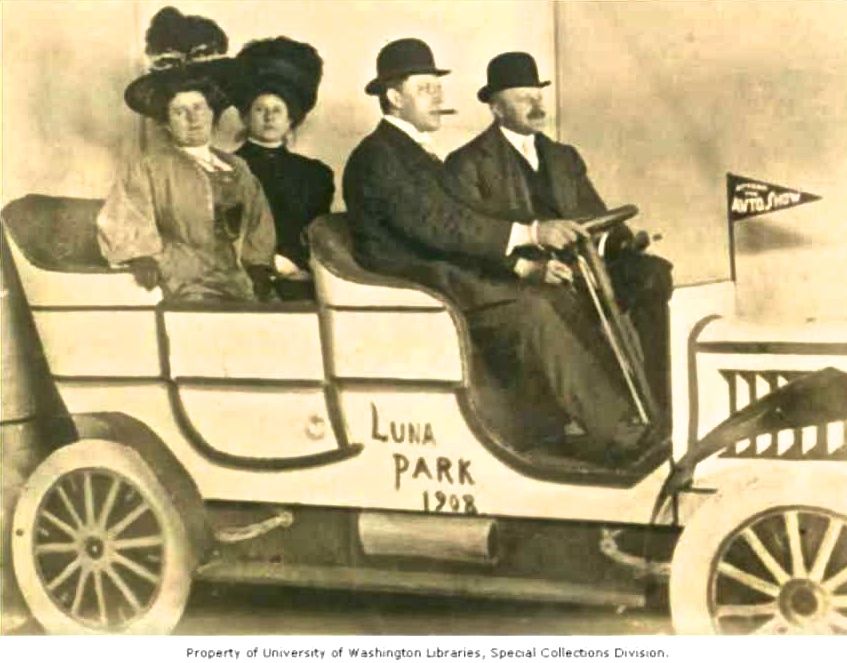
Above is a 1908 photograph of two couples photographed at Seattle’s Luna Park, an amusement venue billed as “The Coney Island of the West.”  Sitting in the front passenger seat in a bowler hat is Simon Weixel, proprietor of the Keystone Liquor Company.  Little did anyone realize at the time that within five years both Luna Park and Weixel’s business would be shut, their fates inexorably linked.


Simon Weixel was born in Germany about 1865, educated in the good German schools.   Details about his early life are scanty but at the age of 25 in 1890 he left his native land for America, settling in Seattle.  By 1894 he had a found a wife, Jane “Jennie” Barmon, born in Detroit of German immigrant parents.   At time of their wedding, Simon was 29 and Jessie 17.  They would have one child, Bessie Buttercup, born in 1895.


My assumption is that shortly after arriving in Seattle, Weixel went to work for one of the many liquor houses in the city.  The 1900 census listed his occupation as “liquor merchant.”  By 1902, according to Seattle business directories, he had founded own establishment, naming it “The Keystone Liquor Company.” Advertising as “wholesale and family trade,” Weixel featured quality Kentucky brands, including Old Crow, Hermitage and McBrayer whiskeys.


The German immigrant had selected an ideal spot to locate his liquor business at the Colonial Hotel, the address 1123 First Avenue, at Seneca Street in downtown Seattle.  As shown left, his enterprise was nestled in a ground floor corner of the Colonial, perhaps the city’s premier hostelry.  Designed by one of the Seattle’s foremost early architects, during the Yukon Gold Rush, this was the preferred hotel before rushing off to seek a fortune. As one writer has said:  “Outside the tradition of the grand hotel, it catered specifically to men of modest means who favored its inexpensive rooms and easy access to the port.” 


Weixel seems to have been immediately successful at that location.  As sales of established whiskeys rang his cash registers he was able to offer his customers “house brands,” likely “rectified” (blended) in a back room from barrels shipped in by railroad from Eastern States. The whiskeys would be mixed to achieve the taste, smoothness and color he had learned were favored by his customers.  His flagship proprietary brands, ones Weixel never bothered to trademark, were “Transport Rye’ and “Keystone Rye.” The former was sold with a colorful well designed label that featured Seattle as a port city.  In the background right can be seen the towers of Luna Park.


As Weixel was climbing up the economic ladder, an amusement park hailed as the “Coney Island of the West” in 1906 was being constructed on a Pacific Ocean site along the shores of Alki Beach at a northern point of Elliott Bay.  Charles I.D. Looff, the Eastern moneybags developer, along with fascinated Seattle residents, watched as workers drove pilings into the tidal flats and a Coney Island-like amusement park arose. 


Shown above, when it open as Luna Park in 1907 the site included a figure eight roller coaster, a classic carousel, chute-the-chutes, other thrill rides and a water slide, along with a host of games. It soon would add a salt water natatorium, with fresh and saltwater swimming pools, and a dance hall for evening guests. As one newspaper put it, Luna Park was “an amusement park the likes of which had not been seen before in the Northwest.”


Another feature of Luna Park that did not escape notice was an enormous drinking pavilion, with a bar that was deemed the longest in the Northwest and the best stocked in the Seattle area.  My assumption is that as a wholesale liquor dealer Weixel was a major supplier and perhaps THE major supplier of alcohol to Luna Park.  Standing behind the regiment of bartenders likely could be found the quart bottles of Keystone Whiskey shown here.  As the aproned barmen poured individual drinks for eager customers they may well have used shot glasses Weixel provided to the saloons, restaurants, hotels and other drinking establishments using his liquor


The artifacts bring us to the photograph that opens this vignette.  Weixel’s success had attracted the attention of one of America’s most notable liquor barons, Jack Danciger [See my post on Danciger, June 26, 2012.]  Shown here, Danciger, aided by family members had grown a liquor house impressively in Kansas City.  He was selling his “rectified” whiskey to dealers over a wide region of the West. My assumption is that Weixel was among his customers.


With Danciger was his wife, the former Queenie Bailey, in her own right a writer, cartoonist and songwriter.  She is seated behind her husband with Jennie Weixel.  My assumption is that Weixel did not take the visiting couple to Luna Park just to experience the amusements but to show Danciger the long bar and the ample opportunities to sell whiskey.


No one in the party could know in 1908 that the availability of alcohol would lead to the downfall of both Keystone Liquor and Luna Park. Liquor at Luna Park sparked a public outcry from prohibitionists who alleged drunkenness and wanton behavior there.  In early 1911 the Seattle Post Intelligencer reported: “(At) Sunday night dances at Luna Park ... girls hardly 14 years old, mere children in appearance, mingled with the older, more dissipated patrons and sat in the dark corners drinking beer, smoking cigarettes and singing.” Additionally, the park manager was found to be part owner of a 500-room Seattle brothel.


The forces of “dry” and “moralism” pounced.  Beset with scandal, muckraking and outcries against “boozers from Seattle,” Luna Park was forced to shut down in 1913 after a short life of six years.  With it went the glittering lights on Elliott Bay, the sounds of the calliope, and “the longest bar on the bay.”  The desolate site eventually saw its amusements and rides sold or torn down.  Only the natatorium remained open until torched by an arsonist in 1931.


Not only had Weixel lost a potential major customer for his liquor, he now faced a prohibition movement triumphant and energized by its victory over Luna Park.  In November 1914, following vigorous Anti-Saloon League lobbying, the voters of Washington approved a statewide ordinance that prohibited the manufacture and sale of liquor statewide.  The vote was  189,840 for, 171,208 against.  Although Seattle and other major cities had voted against it, the referendum won handily.


Forced to close Keystone Liquor in January 1916 after more than15 years of successful business, Simon Weixel was made clear his intense displeasure with this turn of events.  As shown here in an iconic photograph, the proprietor plastered his the front windows of his store with four large signs, all bearing the same message:  “We’ve Got Ours, Come In And Get Yours Before It Is To Late.”  The photo seems to symbolize the pain of loss associated with prohibition everywhere.


Still relatively young at 51 when the blow fell, Weixel appears to have moved onto other occupations.  A 1920 Seattle directory lists him as the owner of the Coast Drug company and manager of the Atlas Candy Company.  By the 1930 census, Weixel, now 65, was selling life insurance.  At some point the couple moved to Los Angeles, perhaps to be closer to their married daughter.  Living long enough to see National Prohibition repealed, Simon died in 1937 at the age of 72.  Jane “Jennie” followed him to the grave in 1964.  Their columbarium plaque is shown here.

Note:  This vignette was drawn from a wide range of resources, spurred on by coming across the photo of the two couples in the automobile that opens the post. The Colonial Hotel is still standing and now on the National Register of Historical Sites.  The storefront where Weixel once sold whiskey is now devoted  to hairdressing supplies.


Saturday, September 26, 2020

Whiskey Men as Mid-Sized City Mayors


Foreword:  I am constantly amazed at the contributions made by so many pre-Prohibition distillers, liquor dealers, and drinking establishment proprietors to their communities.   Pilloried by the “drys” as forces of evil, many devoted time, energy and resources to improving the quality of life their cities and towns.  Sometimes their good works were recognized by their fellow citizens and they were raised to political office.  Briefly told here are the stories of three whiskey men who served as mayors led smaller cities. 

Alexandria was a Virginia town with  strong Confederate sympathies that greatly resented federal occupation during the Civil War. That animosity failed to deter a New Jersey lad of twenty-three who arrived in 1862 to sell whiskey to thirsty Union troops. Despite this problematic start, he became Alexandria’s mayor and a leading citizen while founding a liquor business that prospered until the advent of Prohibition. His name was Emanuel Ethelbert (“E.E.”) Downham, seen here in maturity. 

Downham’s liquor business was on the lower end of Alexandria’s King Street. Whether he truly was a distiller, making whiskey directly from grain on his premises, is open to question. More likely he was a “rectifier,” someone who bought raw whiskey or grain alcohol from others, refined it, mixed it to taste, added color and flavor, bottled and labeled it.  


In 1867, in the wake of the Civil War, the Alexandria City Council, seeking to raise additional revenues, put a series of taxes on alcoholic beverages imported into the City from outside the state, thus discriminating in favor of Virginia-made products. When the young upstart Downham refused to pay the tax, the Alexandria City Council sued him and won.


That incident seemed to stimulate Downham’s interest in politics. In 1874 Downham sought and won election from Alexandria’s Third Ward to the same City Council he had sued seven years earlier. He served there for two terms before seeking office on the Board of Aldermen and was elected there for five two-year terms. Following the sudden death of Alexandria’s mayor at Christmas 1887, the Board met to select an interim mayor from among their number. On the sixth ballot, Downham was chosen. He was reelected in his own right in 1890, serving a total of four years, during which he championed a number ambitious projects. Downham died in 1921 at the age of 82.


The “rags to riches” story is common in American folklore. But a man with the improbable name of Guido Marx followed a “refugee to riches” road as a whiskey and wine merchant that led him eventually to becoming the mayor of Toledo, Ohio.

Marx was a revolutionary fighting for German political rights against Prussian authoritarianism. The Revolution of 1848 was crushed.  As participants were being arrested and executed, he fled to the United States, part of a German refugee group known in history as the “Forty-Eighters.”  Settling in Toledo,  Marx tried several occupations until 1860 when he bought a partnership in a whiskey “rectifying” and wholesale liquor business -- the oldest and largest in Toledo. It had been founded in 1850 by another German immigrant, Rudolph Brand. After Brand’s death five years later, Marx took over the firm.


 Becoming wealthy and well-known, the former revolutionary began his American political career in 1869 when he was elected to the Toledo City Council. He subsequently was elected to the Ohio Legislature in 1871 and reelected in 1873.

In 1875, Marx was elected Mayor of Toledo, serving as the city’s first chief executive of Jewish heritage. It was a time of great mercantile and industrial expansion in that Lake Erie port. Guido was in the forefront of efforts to bring business and jobs to Toledo, retiring from politics in 1877 to become U.S. Ambassador to Chile.


Following that assignment Marx returned to Toledo.  He continued to be appointed to local posts: Ironically for a former revolutionary, he served for six years on Toledo’s Police Board. In 1884 he became a member of the Board of Trustees of the University of Toledo. Afflicted by a kidney disease, he died in 1899 at the age of 72 and is buried in Toledo’s Woodland Cemetery. 


It may be a stretch to call Dr. Frank Powell, aka “White Beaver,” a whiskey man—but only slightly.  A medical school graduate, comrade of Buffalo Bill, Western hero of dime novels, and inventor of patent medicines, Powell sold potions containing more alcohol than most whiskeys.


In the 1860s Dr. Powell was named as a surgeon in the Department of the Platte and later made medical director for the Winnebago Indians.  According to legend, Frank got his name, “White Beaver” from riding into the camp of a hostile group of Indians, in order to inoculate the residents against small pox.  Others say he got it by rescuing a Sioux princess.  Regardless, he embraced the title, let his hair grow long, and began to polish his legend. 


With his Indian nickname, his time in the West, and his association with Buffalo Bill Cody,  Powell was a natural for dime novel fiction, a boom business in the late 1800s and early 1900s.  The stories were about his “daring do” against a string of fictional adversaries.  


In reality, much of the time Powell was working as a small town doctor in LaCrosse, Wisconsin. He also was putting his energies into mixing up and marketing a series of highly alcoholic patent medicines.  This was an era when Indian remedies were very popular with the American public and Dr. Powell was quick to jump on the bandwagon. Best known of these concoctions was “White Beaver Cough Cream,”  described as:  “A soothing compound of lung healing root and herb juices, an unrivaled remedy for the cure of coughs, colds, croup, pleurisy, bronchitis, and all other diseases of lungs or bronchial tubes.”


His nostrums made him rich and launched Powell into politics.  He won two elections for mayor of LaCrosse, a placid Wisconsin town located along the Mississippi River, serving at a time when the city, largest on Wisconsin’s western border, was gaining recognition as a medical and educational center.  His local success spurred him to run to become the Badger State governor in 1888.  His campaigning involved handing out a card with his portrait, one without the long hair and leather garments.  Nevertheless “White Beaver” remained part of his signature.  Powell died in 1906 at the age of 61 on a business trip to the Far West.


Note:  Longer biographies of each of these “whiskey men” mayors are posted on this site:  E.E. Downham, May 26, 2011; Guido Marx, May 21, 1911; and Dr. Frank Powell, February 25, 2019.