Wednesday, November 9, 2011

Luther Green King and "Trouble Enough Indeed"

Just inside the Montgomery County, Maryland, line Luther Green King cooked up his rye whiskey. Luther, shown here, was the son of John Duckett King, an early settler and large landowner in the northern section of the county. This pioneer family gave its name to the community of King’s Valley and to Kingstead Road. 

The elder King, born in 1798, and his wife, Jemina Miles, shown here, had 13 children, most of whom lived to maturity and had large families of their own. Maryland historians assert that more than 10,000 people living today can trace their ancestry to this couple.

Born in 1825, Luther was the fifth of John and Jemina’s six sons. Upon his father’s death in 1858, he inherited an equal share in 217 acres, enough to begin a small farm. His father’s will also remanded to him and his brothers ownership of two slaves. Distilling may have been a natural step for Luther since he had manpower at his disposal and could easily buy rye grain from nearby growers. Along scenic Little Bennett Creek he built the only distillery ever known to exist in Montgomery County.


The distillery, shown above, was a three story wooden structure, with an office for making sales and a loading dock where horse-drawn wagons could carry away barrels of whiskey. It was a modest operation, distilling in close conjunction with Luther’s farming interests. The clientele likely was a local one. Collectors of Maryland whiskeys aver that they do not know of a labelled King-made whiskey bottle or jug. This suggests that Luther sold his stock to saloon-keepers who doled it out a drink at a time or filled containers brought in by their customers.  Nonetheless, Maryland rye was the drink of choice for most of King’s neighbors and trade probably was brisk. .

For much of his distilling career, King and his family lived in a modest log cabin near the business. His house was just three bays by one bay with a small front porch and a foundation of local field stone. . His first wife was Tabitha Browning, whom he married in 1848. They had one child, Homer. Tabita died in 1873. Not long after he married Mary Howe. With her death a few years later, he married again in 1899 when he was 74. Wife Number Three was 19 years old and his great-niece, Mary Lorena King, who may be the child in the picture shown here.

It was for Mary Lorena -- and probably at her strong urging -- Luther built the large new frame house he called “Trouble Enough Indeed.” We can speculate that this was a either a reference to the frequency with which Luther King had become a widower or to the traumas of keeping a child bride happy. The house, shown here, incorporated the original log structure. It was three stories, 1,880 square feet and sat on 4.88 acres.


Besides whiskey, the great passion in Luther King’s life was music. He lived at a time when many communities prided themselves on their brass band. Nearby Hyattstown bragged that its ensemble was “not to be excelled by any band in the county.” As a younger man Luther had learned to play the trombone and was a member of the Clarksburg Band.  Subsequently he formed a musical group of his own called the Kings Valley Band. It included at least six other members of the extended King family. A photo of the band taken in the early 1900s shows Luther, back row, fifth from left, clearly its oldest member.

The spacious new home was not the only sign of King’s growing prosperity. He was also buying land for farming purposes and came to own 176 acres, 70 acres of it fertile farm land. It appears his wealth primarily was generated by the distillery. At his death in 1909, age 84, Luther left a substantial estate. The principal item was 49,000 gallons of whiskey in bond -- worth a fortune -- representing five years of product (1904-1909). King willed “Trouble Enough Indeed” to his widow, Mary Lorena, who later remarried. He gave the land on which the distillery sat to his brother John and the distillery itself to his grandson John R. Lewis. He also left his heirs 19 new whiskey barrels, 50 bushels of malt, and 90 bushels of rye.

With Luther King’s passing, whiskey production appears to have ceased almost immediately. We can speculate that the family was unwilling or unable to continue the operation. Today the distillery site is covered over with scrub trees, vines and weeds, at the southeastern edge of Little Bennett Regional Park. The only indication that it ever existed is a historical marker erected by the county at the site.


Saturday, November 5, 2011

Joseph Spang: Boston's Master at Dropping Names

Although Joseph Spang was a relatively older immigrant to the United States, he wasted no time in understanding that a good American name could be a strong asset in selling whiskey. In quick succession he appropriated the Boston Tea Party, Ulysses S. Grant, Mark Twain, and eventually Paul Revere to give legitimacy to his liquor business. He even ventured abroad to appropriate the name of Queen Wilhelmina of Netherlands for his booze. 

Spang was born in Trier, Germany, in 1842, the son of Joseph and Maria (Binsen) Spang. While still in his teens, he joined the Prussian army and seemingly reveled in military life. He is shown here in uniform with his rifle. During his period of service Prussia was engaged in almost constant conflicts and Joseph was said to have been part of the Kaiser’s special forces. He received a number of decorations for his valor in battle. Military service, however, did not deter him at age 25 from marrying Katherine Kolf and, although away from home for extended periods, from fathering four sons. 

In 1880 after serving 25 years in the Prussian army Spang was discharged. Almost immediately he scooped up Katherine and his boys and emigrated to the United States, settling in Boston. Spang’s initial few years in America have left little record. He clearly had a talent for commerce and worked hard to succeed. There is evidence he spent time employed in a beer bottling operation, as well as in food and hotel enterprises. 

From indications of Spang family wealth it can be assumed that he prospered over his first dozen years in America, well enough to start his own business. In 1892 Joseph Spang & Co. first showed up in Boston business directories, operating on Washington Street. Spang ran a liquor dealership, one in which he featured his own brands and began dropping names. 

A featured brand was “Tea Party,” a favorite subject in Boston. The label shows a ship from which Colonials were throwing bales into the ocean. More questionable was his naming of a whiskey “Grant ‘63,” referencing Ulysses S. Grant in the year Grant took over as commander of the Federal armies during the Civil War. Although a number of whiskey brands had been named for Civil War generals on both sides, no one previously had touched Grant. His reputation for alcoholism apparently had led whiskey men away from claiming him on their labels. 


Years later, Spang, perhaps because he was not fully aware of Grant’s reputation, forged ahead with the brand as his flagship. Moreover, he featured a logo of the General (later President) on horseback. Grant, known to be an excellent horseman, was pictured by Spang on the bottle label and giveaways such as a tip tray and a shot glass. 


The firm also handed out blotters that featured a smiling black bellhop delivering a bottle of Grant ‘63 along with two glasses and the message: “The Perfect Whiskey.” This item additionally dropped the name of Mark Twain, America’s most famous author of the time, and included an observation by Twain on Prohibition. Earlier Spang had circulated a brochure containing Twain’s complete satirical anti-Temperance screed. He also named a whiskey for Revolutionary War hero Paul Revere. When the young Dutch princess, Wilhelmina, ascended to the throne of the Netherlands and caught the world’s imagination, Spang capitalized on her celebrity by naming a whiskey after her. 

 Spang also featured other brands, including: "589,” "Bay State,” "Deep Water Spring,” "Dr. Seymour's Malt,” "Feldt.” "Jaunting Car,” "Old Minden,” "Old Schedule,” "Ould Andy Scotch," P. Q.,” "Spang's P. Q.,” and "Spang's Pure Food.”  Although his firm featured giveaway shot glasses for some labels, it failed to register any of these brands with the Federal Government for trademark protection. 


The photo below shows Spang wealthy, well fed and relaxed in the midst of his family during the mid-1890s. Sitting is the man himself, wife Katherine, and standing, from left, sons Joseph P., Frank, John and Clem. Note that all the males are wearing gold watch chains, symbolic of their financial well-being. In 1904 at the age of 62, Joseph Spang died and is buried in Boston's New Calvary Cemetery. 

With his father's death, Joseph P. Spang, standing at left in the photo above, became head of the family and the manager of the liquor business. He soon ran into trouble. In 1907 the firm was charged by the Massachusetts Board of Health with food adulteration, accused of adding cane sugar to maple syrup. The charges were not prosecuted. In 1909 the same Board charged the Spangs with adulterating their whiskey by adding water. This time Joseph P. was found guilty and paid a fine. Once again in 1913, the Massachusetts Agricultural Extension Station accused the firm among a group of brewers for adulterating beer. 

With State officials constantly looking over his shoulder, Joseph P. may not have been too concerned when National Prohibition shut down his alcoholic trade. Perhaps sensing the tide, he already had turned to real estate development. He built Fieldston-on-the-Atlantic, a beach resort near Boston. It was a holiday venue with restaurants, rides, and a ballroom at which top U.S. bands performed. 


 Joseph P.'s son, Joseph P. Spang Jr. would go on to become one of America’s most recognized business leaders of the 1950s and 60s, credited with making Gillette Safety Razor a major company through its sports sponsorship. After his successful career identifying his whiskey with famous events and individuals, Grandfather Joseph Spang would have appreciated his grandson becoming a name to drop.


Friday, October 28, 2011

Melky Miller of Maryland, Distiller of Accident

The farmer-distiller was a familiar figure in the 19th Century state of Maryland. These were canny individuals with working farms who determined that the “value added” of turning their corn, wheat and rye into alcohol rather than selling to the local grain merchants made good sense. With good roads and ready markets in Washington and Baltimore, they founded distilleries and whiskey brands that often bore their names.  Notable among them was Melky Miller, shown here driving a sleigh. Melky was born in 1833, christened either “Melchior” or “Melchoir” Mueller -- his baptismal certificate gives the first spelling and his tombstone the second. 


In 1838 his family moved to what is now Garrett County, Maryland, then part of Allegheny County, and settled in a town with the highly improbable name of Accident. Located near Deep Creek Lake in the northern county, the town can trace its unusual name, according to historians, to the mid-1700s when two independent groups of surveyors each identified it as prime land and an a subsequent owner wished to commemorate the happy “accident.” Its downtown is shown here in the early 1900s. 


The Muellers were industrious people and good farmers. They prospered in Accident. It is not clear when Melky anglicized his name to Miller; the practice was a common one particularly for German immigrants seeking to assimilate into American society. Little is known about Melky’s early life. As an adult, he married a woman named Barbara, eight years his junior, and together they raised a family, including three sons. 

Melky might have gone through life unremarked had he not bought a farm in 1875 along a tributary of South Branch Bear Creek, just southeast of Accident. He was 42. According to a family history, he also bought a small distillery owned by Joel Miller in the Cove area of Garrett County and moved the equipment to his farm. Melky possessed sufficient wealth from farming to afford the investment in whiskey production. He himself knew little about distilling. A canny entrepreneur, Melky initially hired professionals to operate the business. His three sons -- William, John, and Charles -- learned the art of making whiskey from these hirelings and in time replaced them.


The firm also was noted for the artistic design of both the jugs and the bottles in which it marketed its products. It also featured giveaways like shot glasses and corkscrews. Melky’s name was prominently displayed on all whiskey labels and merchandising items. In 1902 Melchior sold the distillery to his sons. Reflecting the new owners, the company changed its name to M.J. Millers Sons Distillery. William continued as distiller, while John and Charles established wholesale and retail whiskey businesses in nearby Westernport, Maryland. The firm also warehoused its products in that town. 


His boys had an evident genius for business and soon built Melky Miller’s Maryland Rye Whiskey into a highly respected local and regional brand. Although production was relatively small -- only 29 bushels of grain processed daily according to Federal records -- the quality of the company’s whiskey was high. For example, Melky’s product adhered to the Federal “bottled-in-bond” requirements. 


Barbara Miller died in 1913 when she was 72, two years before Melky passed away in 1915 at the age of 82. They are buried in the cemetery next to Zion Lutheran Church in Accident. Their sons continued to operate the distillery until 1919 when Prohibition closed their doors, never to reopen. 

In 1920 all bonded whiskey in the Accident warehouses was transferred to a Federal facility in Cumberland. The distillery itself was closed and left to decay. In Accident the foundations for the bonded warehouses of the distillery can still be seen 200 feet south of Miller Road, a quarter mile east of the Brethren Church Road intersection. The abandoned structures reportedly were destroyed by fire in 1971. The Garrett County Historical Society has erected a sign memorializing the site. In effect, the “National Accident” called Prohibition had come to Accident, Maryland.


Tuesday, October 25, 2011

David Sachs Hooked a Puritan on Hard Liquor

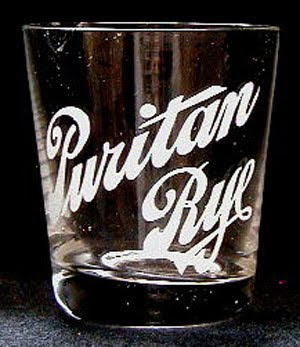
When David Sachs set up his whiskey business in Louisville, Kentucky, in 1872, two causes were beginning to make themselves felt in American society: the campaign for Temperance and the championing of unadulterated food and drink. Possibly with those in mind, Sachs named his flagship brand, “Puritan Rye” and featured the image of a Puritan elder on the label. He likely saw the name as suggesting both moderation and purity.

To a later generation, accustomed to thinking of the Puritans as a stern, humorless people, shunning all kinds of entertainment and alcohol, this capture of the their image to advertise whiskey may seem questionable. Puritans, however, were not opposed to drinking. One Puritan document deplored depriving anyone of the “lawfull comfort alloweth to all men by the use of wine.”

The young Sachs probably had only slim knowledge of the religious company that called themselves Puritans. Born in Germany in 1827 Sachs arrived on U.S. shores sometime in the 1840s. Married to a German-born woman named Hannah Weil, he settled initially in Springfield, Illinois. In that city were born two sons, Morris D. and Edward, and a daughter, Julia. We can assume Sachs was engaged in the liquor trade in Springfield.


By the 1870s, David was living in Louisville, a center for the American whiskey industry, and the head of his own firm. His first address was on Market Street. Five years later his whiskey business, called David Sachs & Co., moved to Main Street and subsequently to addresses on Third Road below Main. In 1884, he took his two boys into the business and re-named it David Sachs & Sons.

The company letterheads, that varied from time to time, consistently branded the Sachs as distillers. While this was not unusual, at most they were “rectifiers,” blenders of various kinds of whiskeys to achieve a more palatable taste.   
It also was common for such outfits to contract for the entire production of a Kentucky distillery for a year or more and then to appropriate the distillery name. Sachs & Sons over the years claimed to be the proprietors of the Oakland Distillery in Henderson County and later the Saxon Distillery of Marion County, both in Kentucky.


The company produced myriad brands including "Alfalfa", "C. O. D.", "Cape May", "Delmonico", "Famous Nottingham", "May Port", "Old David", "Ramona", "Saxon", and "Tanglewood.” "Tosca Rye” was introduced after the 1900 highly successful debut of the Puccini opera. 


 The featured label, however, always was Puritan Rye. Bearing the slogan, “It’s All Right,” the whiskey was sold nationwide in barrels and in bottles, including a ceramic canteen produced by the Thuemler Co. of Pittsburgh. The brand also featured giveaway items such as back of the bar bottles, highball and shot glasses. Even a racy trade card was used to advertise the Puritan brand.


Symbolic of the success of the company was its 1896 move into “Whiskey Row” 
in the 100 block of Main Street., Louisville. There resided some of the most prestigious whiskey distillers and recifiers in the United States. That address for David Sachs & Sons meant the family had arrived in the top echelon of the whiskey trade. Its Whiskey Row offices are shown here.


The Sachs family were very active in community and religious affairs in Louisville. The entire family was recognized for its generosity to Hebrew causes. Edward for many years was president of the Federation of Jewish Charities. He also was active with the local chapter of the National Child Labor Committee, a group devoted to ending child labor in the United States. The wife of Morris Sach was a noted donor to the Louisville Free Library, an organization that made books available to less well off families.

In 1898 David Sachs died, age 71. Morris and Edward continued to operate David Sachs & Sons for the next 11 years. During this period Samuel Haas, who had married Julia Sachs, was taken into the firm as an officer. In 1906 Congress passed the Pure Food and Drug Act, validating the “pure” theme of Puritan Rye. But the Sachs' Puritan had little or no effect on the rising tide of Prohibition and the company was forced to close its doors in 1919.


Indicative of the closeness of the Sachs family is the grouping of graves around a monument in Louisville’s Temple Cemetery. In close proximity can be found David and Hannah, daughter Julia and husband Samuel Haas, Morris Sachs and his wife, Edward Sachs and his wife and daughter. Just as they worked together in life, they rest together in death.


Saturday, October 22, 2011

Sam'l Klein Risked the Risque'

In the pre-Prohibition era only adult males frequented saloons. Many drinking establishments, without fear of offending women, featured a nude or other suggestive picture, usually somewhere over the bar. Whiskey men were quick to recognize the merchandising possibilities in this custom. A few marketed their liquor by use of, let us say, “racy” images. Key among them was Samuel H. Klein, called Sam’l, of Klein Brothers in Cincinnati, Ohio. 


To advertise his "Harvard Rye" brand, for example, he provided a bar picture showing two university lads dressed in cap and gown, presumably from Harvard University, sporting with two ladies in what appears to be a house of ill repute. The image found its way into a number of saloons, one shown here often centered over the bar. 

The image of the rowdy college boy also appeared on Klein Bros. bottles. So identified was Klein with Harvard Rye that when a cartoonist caricatured him it was with a scholar’s mortarboard and a book in hand, sitting on a keg of the whiskey. 

For his Spring Lake brand, Klein could get even more daring. He had copied and distributed for bar use a painting of two courtesans, nude from the waist up, dueling in a Paris park. This picture first appeared in the French Salon of 1884, painted by a well-known and popular Parisian artist named Emile Antoine Bayard (1837-1891). Bayard called it “An Affair of Honor.” The image caused a sensation wherever shown and became a favorite of the saloon crowd. 


With a brother, Klein founded his firm about 1875 at 340 Walnut Street. Soon the volume of business caused the firm to move to larger quarters at 49 Vine Street. Further expansion forced a move to a building at 17 Sycamore St.   About the same time Sam’l took Elias Hyman as a partner and the firm became Klein Bros. & Hyman. The partners did a vigorous business, eventually opening their own distillery in Kentucky. Their brands gained regional and even national attention, including "Keystone Rye,"  "Spring Lake Rye, " "Lynchburg Rye," "McBride," and "Independence" whiskeys. The partnership lasted about ten years. After the partners dissolved it in 1897, Sam’l set up again as Klein Bros., located at 121 Sycamore in Cincinnati. 


Throughout his career as a leading American “whiskey man,” Klein demonstrated an extraordinary flair for merchandising. In addition to his creative use of advertising, Sam’l employed the artistic genius of Liverpool Ohio’s KT&K Pottery to produce ceramic containers for his Spring Lake and other whiskeys. He also marketed his Keystone Rye in Fulper Pottery “fancy” jugs. In the process he was responsible for some America’s most attractive whiskey jugs. Attractive shot glasses also were part of Klein’s legacy. 


Sam’l died in 1914, widely mourned as an Ohio business leader and philanthropist. He left the whiskey business to family members, his last testament envisioning that the firm he founded would exist well into the 20th Century. But that was not to be. Five years after his death, Klein Bros. Company suspended operations because of Prohibition and never reopened. Today the memory of Samuel H. Klein is kept alive by a family foundation in Cincinnati that honors his name. We also can remember him for the flamboyance of his merchandising techniques, as well as his willingness to risk -- for his time-- being just a little bit risque’.


Tuesday, October 18, 2011

Pfeiffer Bros. of Louisville: Spirits Were in the Family

When Edward T. and Cornelius (Cal) J. Pfeiffer, the latter shown here, set up their liquor organization in Louisville Kentucky in 1902, they were doing what came naturally: Members of the Pfeiffer family had been involved with spirits of one type or another since 1867. That was the year their father, Martin, and his brother purchased the Green Street Lager Brewery. Martin followed it up a decade later by opening a saloon in that city.

By 1886, Ed (age 23) and Cal (only 15) were listed as bartenders at the Martin Pfeiffer Saloon. From there the brothers’ careers diverged for a time. Cal went to work for a wholesale whiskey dealer named J. Simons & Co. After several years of experience as a salesman, he and Ed founded Pfeiffer Bros. in 1896 as a new whiskey operation in the Louisville hotbed of distillers, rectifiers, and dealers. At first they ran their business from their home at 903 E. Jefferson St. where they still lived with their sister.


Once their liquor firm was underway they opened an downtown office at 733 E. Broadway and then at 128 Second St. With success came the need for further expansion; Pfeiffer Bros. in 1902 moved to 226 W. Main, one block down from Louisville’s famed “Whiskey Row.” Although their letterhead proclaims them as distillers, they were almost certainly “rectifiers,” an outfit that blended whiskey from various distilleries, bottled it, slapped on a label, and sold it to saloons and the public. Among Pfeiffer Bros. brands were "Dixie Belle", "Hayfield", "Lou Dale", "Noxall", "Old Cornelius", "Old J.B.T.", "Silas Moore", and "Tom Hudson."

.
Besides their own brands the brothers also sold other whiskeys and offered port wine, sherry, cognac, and peppermint, blackberry and apricot brandies. Ed ran the day to day operation while Cal roved through Kentucky and other states making sales. As proof of the rough and tumble times that still existed in the West, Cal was said always to have carried two pistols during his travels.


Despite their busy lives, the brothers found time to marry. The 1900 census found Edward with wife Johanna, whom he had wed in 1893, and three small children at home. He gave his occupation as liquor dealer. Cal was married in 1895 to his wife, Katie. The census records him with a boy and girl at home.


Amid strong competition, the brothers did well, drawing product from, among others, the Tom Moore Distillery at Bardstown, and, shown above, depicting that distillery as their own on their letterhead. They also provided their labels with attractive, tasteful designs. For featured brands like Silas Moore the brothers also gave away saloon mirrors and tip trays. One tray, produced by Vienna Art Plates on a 1905 patent, featured a man sitting at a table with a whiskey bottle. The label could be changed by the Pfeiffers to any one of four of of their brands.


In 1904, the Pfeiffer Brothers exhibited at the St. Louis World’s Fair and Louisiana Purchase Exposition as part of a Kentucky contingent. They were awarded a gold medal for their Old J.B.T. blended whiskey by the Fair’s Department of Agriculture. The medal, shown below, became a source of great pride and an additional marketing tool. It was perhaps no coincidence that Tom Moore, a close associate of the Pfeiffers, was one of the jurors. It may even have been his whiskey.


A subsequent address change for Pfeiffer Bros. occurred in 1909 when they moved a few doors down Main Street to #216 where the business continued to flourish. In 1918, at the relatively young age of 55, Edward died. Afterward the company, apparently with Cal in charge, made a last move to Suite 903 in the Liberty Building. With the advent of Prohibition in 1920 Pfeiffer Bros. closed down forever. At that point Cal would have been 49 years old. He no doubt went on to other pursuits.

But not even the ensuing “dry” 14 years could bring a end to the Pfeiffer family involvement with alcoholic beverages. After Repeal Cal’s son spent most of his life working in the whiskey trade. The following generation dabbled in whiskey merchandising and also made cordials and wine. A fifth generation, still in business, operates a winery in Lanesville, Kentucky. That makes five generation of Pfeiffers who have traded in spirits.

Note: Most of the information and images for this post have been derived from the Pfeiffer-Schwartzel Family website. That site recounts in detail the whiskey operations but provides sparse personal details about the brothers themselves. Those items have come from census data.