Wednesday, September 4, 2013

The Rosenfields Were “The Sunny Brook Boys”

The Rosenfield Brothers were the sons of an immigrant jeweler who moved his family from state to state, city to city, until they found a home in Chicago and eventually gained recognition as among America’s foremost distillers.  Because of their flagship whiskey, Morris Rosenfield and brothers Lewis and Joseph claimed fame and fortune as the Sunny Brook Boys.

The Rosenfields’ father, Sampson, often called “Sam,” had been born in Wurttemburg, Germany, about 1825.  Mother Rebecca also hailed from Wurttemburg.  Sam, who worked  as a jeweler, had emigrated in 1850. Since Rebecca would only have been 14 at that time, it is likely they married after Sam had settled in the U.S., circa 1853.   The 1870 census found the Rosenfields in Rock Island, Illinois.  They had been moving around.  Morris, 16, recorded his birthplace as Ohio.  The birthplace of Lewis, 11, would be variously given over the years as Kentucky or Minnesota.  Joseph, only a baby, had been born in Illinois.   Ten years later the family had fetch up in St. Louis, Missouri,  Rebecca had died and Sam had retired at age 55.  Both Morris, 26, and Louis, 21, were working as clothing salesmen.  As yet there was no hint of what was to come.

During the following decade the family made one last move, east from St. Louis across Illinois to Chicago.  In 1891 Morris and Louis established a wholesale liquor firm they called Rosenfield Bros. & Company, with Morris as head of the operation.   Almost immediately the brothers launched the Sunny Brook brand of whiskey and within a year were selling it nationally.  Initially they drew their whiskey stocks from J.B. Wathen & Bro. Company in Louisville and also had a financial stake in the J. G. Mattingly & Bro. distillery in the same city.

As with other major whiskey distributors, they soon found maintaining steady, quality supplies of liquor required direct ownership of distilleries.  During ensuing years they purchased two Louisville distilleries that had been operating under the same roof.  One, known officially as RD #5 became the Sunny Brook Distillery and the other,  RD #297,  was  the Willow Creek Distillery.  The Rosenfields reputedly paid $1 million for the facilities.  At the time the two plants were mashing 3,400 bushels of grain daily and had fifteen warehouses with a aging capacity
Sunny Brook warehouse interior

for 200,000 barrels.  The Rosenfields featured the distilleries, both exterior and interior,  on promotional materials.

Now with a greatly enhanced and assured supply of product,  the brothers issued a variety of brands in addition to Sunny Brook.  The labels included “Associated Bourbon,”   “Bellwood,” “Brightwood,”  “Equality,”  “Gladstone,” “Kentucky Comfort,” “Royal Blue,” “Sun Beam,” and “Willow Creek.”   But it was Sunny Brook Whiskey that was merchandised most vigorously by the brothers, who displayed a definite genius for advertising.  The form of their genial “Inspector,” with his blue uniform and white mustache, became a familiar figure to the American drinking public.  He was a fixture on their ads, fancy back of the bar bottles, and giveaway shot glasses.

The Rosenfields were generous with these giveaway items,  particularly to saloons and other establishments stocking their labels.  Among the most interesting was a bar sign that featured a bevy of young women, three of them quite nude, enjoying a swim, perhaps in Willow Creek, but clearly downstream from the Rosenfields’ distillery, visible in the distance.  A second sign, while it also shows the distillery has a distinctly different (not erotic) look.  It depicts an bearded elderly man with a young girl at his knee, with the slogan:  “Age and Purity,” reflecting the growing emphasis in the liquor trade on purity,  a subtle reference to the Pure Food and Drug Act.  The medicinal qualities of whiskey was the theme of another giveaway, a trade card in the shape of a whiskey flask that when opened revealed a “corn plaster,” a cloth coated with an adhesive substance and used to cover cuts or scratches.  The health theme also was echoed on a Sunny Brook wall mounted match holder and striker.


The Rosenfields moved aggressively to expand their Sunny Brook facility by adding extensively to both the still house and warehouses.  By 1904 they claimed to be the largest producers of whiskey in the world.  They declared their distilling capacity had been expanded to 20,000 gallons daily and their warehouse capacity to 10 million gallons.  After several business moves in Chicago, the Rosenfields established their main offices at 174 Randolph Street and opened a New York City office in the Gerken Building at Chambers Street and West Broadway.  For a time they also had a Philadelphia branch office at the city’s Bourse.  Along the way the Rosenfields were also picking up awards.  At the St. Louis Exposition and World’s Fair Sunny Brook Whiskey was given both a gold medal and grand prize.

Meanwhile the Rosenfield brothers were leading personal lives.  The 1910 census found Morris, now 55, living on Province Avenue in Chicago, his occupation given as “manufacturer-distillery.”  With him was his wife,  Tillie (in a later census given as Lillie).  She like Morris was the offspring of immigrant parents from Germany.  Ten years junior to Morris, she had been born in Illinois.  With them were three living children,  one son and two daughters.  As an indication of how wealthy Morris had become with his liquor interests, the family could afford six live-in servants, four women and two men.  Meanwhile,  Louis had been living in a hotel at 3009 Michigan Avenue with wife, Julia, and one son and servants.  His occupation was given as “distiller.” Father Sam at age 75 was living in Chicago with a daughter and her husband.

Throughout the early part of 20th Century the liquor trade continued to be lucrative for the Rosenfields.  In September of 1913,  according to a historian, the Sunny Brook distillery shipped 37 full boxcars containing 1,745 barrels of whiskey.  That would translate into  69,293 gallons or more than 840,000 bottles of Rosenfield liquid goods.  Much of this trade,  directly or indirectly, was going into areas of the country that increasingly were going dry but where mail orders were still legal.   The Webb-Kenyon Act passed by Congress the same year, however, eventually would put an end to that traffic.

Their business hit hard by that law and other moves toward National Prohibition, the Rosenfields’ enterprise began to falter.  A corporate consolidation was effected in 1914 during which all the brothers’ business properties were incorporated under the umbrella of the Sunny Brook Distillery Co.  Morris was named president;  Joseph, now grown to maturity, became corporate secretary.  Apparently nothing helped.  As fast as the Rosenfields had risen, their fall was just as rapid.   By 1917 the company was in bankruptcy.   When the distillery came up for auction that year, the winning bidder was Louis Rosenfield, apparently unwilling to let go of the family legacy.  For a property once valued at millions, he paid $55,000.  Not long after, however, National Prohibition shut down the Sunny Brook Distillery.

During Prohibition the Kentucky distillery was used as “concentration” warehouse, where stored whiskey was consolidated, kept and bottled for “medicinal use” under the watchful eye of the federal government.   After the death of Louis in the early 1930s, his widow Julia Rosenfield in 1933 sold the distillery for $600,000.   The purchasers were the National Distilling Company,  an offshoot of the infamous “Whiskey Trust.”  This sale was ironic since the Rosenfields frequently had emphasized in their ads their independence of “trusts or any combination.”  National Distilling operated the Sunny Brook Distillery and marketed Sunny Brook Whiskey until about 1975, at which time the plant and warehouses were closed and the buildings ultimately torn down.

Thus ended the saga of Rosenfield Brothers, who rose like a rocket to national prominence as distillers and just quickly as left the scene.  In their wake remain thousands of glass quarts and flasks, back-of-the-bar bottles, saloon signs, shot glasses, match safes, trade cards,  advertisements, and other trinkets to remind us of the heyday of the amazing Sunny Brook Boys.




Sunday, September 1, 2013

Patrick Bowlin: A Half-Century in Saint Paul Whiskey


For 50 of his 76 years of life,  Patrick Bowlin was engaged in keeping the thirsty people of St. Paul and greater Minnesota well supplied with highly palatable liquor.  That he did so with panache and style made this Irish immigrant stand out among his peers and hailed at his death for ranking among the city’s best businessmen.

Bowlin was born in County Tipperary, Ireland, in 1847.  His birth occurred just before his parents,  Jeremiah and Anne (Chasen) Bowlin, headed for America in 1849.  Patrick’s early years were spent in Boston, the landing spot for many Irish.  In 1857, the family moved to St. Paul when Jeremiah got a job as a contractor for the railroad.  Patrick attended the city’s Cathedral School and took night
Bowlin's Jackson St. Hdqrs
courses in business.   While still in his teens he found employment as a bookkeeper with Grigg’s Brothers, wholesale grocers. They also were   blenders and compounders of liquor and featured their own house whiskey brands.

Bowlin’s years with Grigg’s Brothers apparently convinced him that future prosperity lay in whiskey, not groceries.  After the Griggs firm terminated in September, 1869,  at the age of 22 Patrick struck out on his own.   With another Irishman as a partner, he became the senior member of Bowlin & Flanagan, advertised as wholesale liquor dealers. The U.S. census found him, age 23, in 1870, listing his occupation as a “liquor merchant.”  At the time Bowlin was living with his mother, father and three sisters, ages from 4 to 20 years.  Two years later he would leave home,  marrying a woman named Josephine Bevan in April 1872.  They soon began a family and had four children:  William, born 1874; Anna (Nannie), 1877;  Frank, 1878, and Josephine, 1884.


After a run of 14 years Flanagan left the firm in 1883 and was replaced by another local Irishman.  Located 314 Sibley, the business became Bowlin & McGeehan.   That arrangement lasted another 21 years, indicating continued
business success. That period, however, was one of personal heartache for Bowlin.  In 1884, possibly in childbirth,  Josephine died,  34 years old, leaving him with four children to raise.  Her gravestone reads “Beloved Wife of P. J. Bowlin.”  Patrick never remarried.   More sadness awaited.  Father Jeremiah died in 1888 followed by Mother Anna.  A crowning blow came in 1886 when son William, whom Bowlin probably hoped would be his inheritor,  died at the age of 22.

But Patrick persevered.   After McGeehan’s exit about 1904 he continued on alone and the liquor business became P. J. Bowlin & Co.  The change seemed to unloose all Patrick’s creativity.  He featured a variety of brands, including "Anchor Rock & Rye,” "Camp Nelson,” "Capitol Club,” "Friars,” "Gopher
Gin," Hazel Grove,” "Humbolt Rye,” "Simpson,” "Stronghold,” and "White Rose."  He also featured a bitters nostrum he called “Digestine. ”Shown below is a embossed glass bottle of that beverage.

Unlike many other whiskey purveyors,  Bowlin was quick to trademark his brands, two in 1905 and six in 1906. That would prove to be important later.  Bowlin believed in attractive packaging for his products. He reached out to the New York State pottery known as Whites-Utica for a highly decorated jug, shown above, that now is avidly collected.  More usually he contained his liquor in glass bottles with attractive labels.  He also issued back of the bar bottles for several of his brands, including three for Hazel Grove Bourbon.


By this time,  in addition to his customer base in Minnesota, Bowlin was conducting a vigorous mail order business.  Some of these express orders were going to areas that were “dry” as a result of state or locals laws.  Those sales would prove
problematic.  In 1906 he brought suit against an Iowa customer named Brandenburg who had been shipped liquor and refused to pay on the rather unusual grounds that he (Brandenburg) had intended the liquor he received to be for resale, but such resales were against the law in Iowa and thus his contract with Bowlin was void.  The court not surprisingly found against Brandenburg.  Shortly thereafter a client in North Dakota attempted to “stiff” the Bowlin firm by refusing to pay for liquor delivered,  claiming the paperwork was faulty.  Again the courts found for the St. Paul business.

With his growing wealth from the whiskey trade in 1892,  Bowlin commissioned a well known Minnesota architect, Clarence H. Johnson, Sr., to construct a mansion for him on St. Paul’s Summit Avenue,  already the site of millionaire housing. The following year Patrick moved his three living children there along with his sister, Annie Smith, her young son, Harold,  and servants.  The Bowlin house was a majestic building with a commodious porch,  turret roof and spacious grounds  


Bowlin's Summit Street Home

Bowlin also was branching out into real estate, about 1912 forming a company called  Bowlin Realty.  By his death he would own extensive business properties in St. Paul.  As he aged, he also took son Frank into the wholesale liquor trade and in 1914 reincorporated as P. J. Bowlin & Son.  Three years later, however, the curbing of mail order whiskey by Congress and the tightening noose of Prohibition caused Bowlin, now 70 years old, to sell to the Kelly-Steinmetz Liquor Company, a Minneapolis competitor, his liquor business and goodwill, including his trademarked liquor brands. The value of his trademarks was proved when another firm’s subsequent claim to the “Camp Nelson” brand name was denied by authorities.

Despite his age,  Bowlin did not retire.  A 1920 St. Paul city directory indicated that Patrick remained as president of the Bowlin Realty Company.  Living with him on Summit Avenue was his unmarried daughter, Nannie.  In addition to caring for her father, she was the secretary of the real estate firm.   The housekeeper, Annie Smith, was still part of the household as was her now-grown son, Harold, a salesman.   Living down the street on Summit was son Frank, an executive in Bowlin Realty.

In February 1923 death came to Patrick Bowlin at age 76.  He was buried in Calvary Cemetery,  St. Paul’s Catholic burial site.  He was laid next to his beloved Josephine.  Interred near them are other family members including Bowlin’s mother, father, and son William.  Bowlin Realty survived in
ensuing years with Frank as president.   The family would live in the Summit Avenue home until the 1930s.  The mansion was torn down in 1938. 

A St. Paul newspaper declared in his Bowlin’s obituary:  “He usually was successful in whatever he was associated with, and he long ranked among the substantial and enterprising businessmen of the city." The author might have added that Patrick had spent a half century selling good liquor to the residents of St. Paul, the state of Minnesota, and locales beyond.


Note:   The idea for featuring Patrick Bowlin on this blog came from my reading a short biography contained in the book, Bottles, Breweriana and Advertising Jugs of Minnesota 1850-1920 by Ron Feldhaus, a 1987 bottle publication that has become a classic.  Some of the information contained here was from that source.


Wednesday, August 28, 2013

Patrick Lynch and the Signs of His Times

When I was a youngster,  the Ohio countryside was dotted with barns and sheds with large ads painted on their sides for Mail Pouch Tobacco.  Although faded now, those ads can still be seen.  Patrick Lynch, a whiskey dealer of St. Louis, Missouri, much earlier saw the merchandising value of putting his messages in big formats on the sides of buildings and, in his pre-Prohibition time, prospered greatly from those signs.

Lynch was born in Ireland in 1828 and immigrated to the United States as a young man.  He first entered the public record in the 1860 census.  It found him living in the Third Ward of St. Louis with his wife,  Anna.  She was approximately nine years his junior and had been born in Ohio of Irish immigrant parents.  At that time the Lynches had one child,  age three. Patrick’s occupation was given as “salesman,”  likely for one of the many liquor stores extant in the city.  In 1862, at the age of 34, he joined forces with Charles A. Mantz,  a well-connected former St. Louis city official and businessman who also may have run a liquor store. The partners founded wholesale liquor dealerships at two locations, 39 South Main Street and 11th South Commercial.   In 1867,  Mantz & Lynch Co. moved to 110 South Main Street.

After a decade in business together Lynch’s partnership with Mantz was terminated in 1872 and the Irishman struck out on his own.   His flagship brand of whiskey was “Old Lynch Rye,” likely compounded and blended in his own facility.  He set out to advertise it as widely as possible.  One result is shown here, painted large on the slatted frame sides of Ernest L. Bader’s Saloon, located at 7200 North Broadway in St. Louis.  Lynch’s slogan for his rye blend was “The True Whiskey.”  Note that his ad appeared on two sides of the building and, if you look closely, it is also was painted on the door behind the two gents standing out front.


Lynch also spread his signage throughout Eastern Missouri and into Illinois  A “ghost sign” advertising Old Lynch Rye and Links Bar was found and photographed in Carlinville, a town of 6,000 about 50 miles north of St. Louis.  Further away was Irondale,  Missouri,  a village tucked in the Ozark Mountains about 70 miles south of St. Louis.   The town was established as a stop on the St. Louis, Iron Mountain & Southern Railway about 1858.   The Depot Saloon, now an abandoned building, faced the tracks with an  Old Lynch Rye sign directed so that thirsty travelers would know where to head for a quick snort.  Shown right, the ad now has been badly faded by time.

Ironton, Missouri, not to be confused with Irondale nearby, is the county seat of Iron County and adjacent to some of the highest peaks in the Ozark chain,  an region known as Arcadia Valley.  When a saloonkeeper of the town, agreed to stock Old Lynch Rye,  Patrick obliged him with a signboard covering the entire front of the establishment.  A local photographer took the picture and furnished it as a postcard.  The next image is from an illustration that appeared as an ad in a 1905 St. Louis newspaper.  It depicted a billboard within a country scene in which an Old Lynch Rye sign appeared as three slats nailed to a tree trunk.  On the right, off in the distance, was a barn with Old Lynch Rye painted large on the side.  Note that in just one ad Lynch has managed to cram multiple signs.


The three-slats-on-a-tree-trunk motif was closely identified with Lynch’s flagship brand.  He included the same image on labels of Old Lynch Rye and also on shot glasses. Like others in his trade, Lynch was prolific in his giveaway items.  They included shot glasses, tokens good in trade, and for saloons stocking his whiskey, a wall mounted match holder with a striker.  For the Louisiana Purchase Exposition of 1904 in St. Louis, he issued a brochure that he called “A Complete Guide” to that World’s Fair.

Meanwhile Patrick had been getting on in his personal life.  The family shows up in the 1880 census where Lynch’s occupation was listed as “liquor merchant.”  He and Anna now had a tribe of five children, three girls and two boys, ranging in age from 21 to 6 years.  They had moved from the Third to the fancier Fifth Ward of St. Louis.  They had one young Irish girl as a servant in the household.

Widespread signage and other creative merchandising techniques paid off in prestige as well as financial gain for Lynch.  By 1885  he was not only selling his own brands, but was the wholesale representative of some of the best known Kentucky distilleries,  including E. H. Taylor Co. of Frankfort;  W. S. Hume of Silver Creek;  Burnham, Bennett Warwick of Madison County,  and J.S. Taylor of Franklin County.  Lynch also was importing wines and cognac from famous French houses.   Another specialty was California grape wine used for sacramental purposes by area churches.  An 1885 publication called “The Industries of St. Louis,” said of Lynch & Company” “...This house has resources that make it a sterling one in the trade of this vicinity.”

Success also seems to have kept Lynch and his business constantly on the move.  From 1878 until 1881, his store was located at 307 North Second Street.  The following year he moved to 303 N. Main Street,  at the southwest corner of its intersection with Olive Street.  From there Lynch & Company relocated to 206 South Fourth Street for two years (1888-1900) and then to 23 South Fourth, advertised as a block south of the Court House (1901-1909) and then on to St. Charles Street (1910-1915) .   Its last location was at 423 North Fourth Street in 1916. The following year the company disappeared forever from  St. Louis business directories.


At this point Patrick Lynch would have been 88 years old.  Missouri was not a state that had enacted prohibition laws before the national ban on alcohol.  Thus the termination may have been dictated by his age or even death.  In business for 54 years,  Lynch & Company had been hailed in the St. Louis history referenced earlier.  The author described Lynch’s firm as   “A house of high character;  against it, in all the long years during which it has flourished, not the breath of suspicion has been heard.  Its management is a fine sample of that old-fashioned integrity and courtesy....”

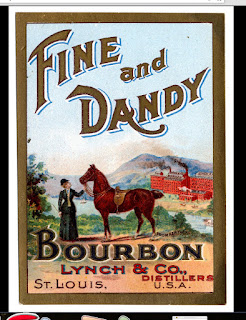
From the perspective of today these many years later, we recognize that many pre-Prohibition whiskey men largely disappeared from view without a trace when the ban on alcohol sales shut their premises.   By contrast, we can remember Patrick Lynch by the signs of his times,  some now faint and fading but still legible and still in our midst.  Below is a Lynch 
label worth adding for its visual value.


Note: I have had a thoughtful email from Robert Oswald who owns the building in Carlinville, Missouri, that bears the sign shown above.  He says he can't believe how well the sign is preserved.  Patrick Lynch undoubtedly would be proud to know that.


Friday, August 23, 2013

Michael Bosak Claimed He Was “The Richest Slovak in America”

The function of a “breaker boy” in mining was to break coal into pieces and sort those pieces into categories of nearly uniform size, a process known as “breaking."  He also chipped away any impurities that might be clinging to the coal.  It was hard, low-paying labor.  How Michael Bosak went from breaker boy in a Pennsylvania mine to proclaiming himself “The Richest Slovak in America”  is a whiskey man’s tale.

Bosak was born in 1870 in Saris, a town then a part of the Austro-Hungarian Empire but now part of the Slovak Republic.   He emigrated to the United States about 1887.  As many Eastern European immigrants did, he settled in the anthracite-rich region of Northeastern Pennsylvania and went to work in a mine at Hazelton as a breaker boy to make a living.  Finding the work unrewarding on many counts, he eventually shifted employment and worked for several Slovak liquor merchants in the area, taking orders and delivering merchandise.  Frugal in his habits, Bosak saved sufficient money to open his own liquor store in Hazelton during the 1890s.  When it prospered he opened a saloon called Glinsky’s Tavern in nearby Olyphant and subsequently a branch in Scranton, Pennsylvania on Lackawanna Avenue.

           
The Scranton branch was so successful that it outpaced the Slovak’s other outlets and became his headquarters for his operation, as shown here in an illustration.  He termed his business “importers
and wholesale liquor dealers.”  That designation omitted that he was also a “rectifier,”  that is, compounding whiskeys or adding neutral spirits to them, putting on his own label and merchandising them.   Unlike other rectifiers who issued a blizzard of brands, Bosak stuck to two:  “Old Dole Spring Rye,” and “Old Cold Spring Rye.”  He merchandised both vigorously to good effect,  selling them in quart and flask-sized bottles with attractive labels.   He issued shot glasses for each.

In the meantime Bosak was having a personal life.   He married when he was in his early twenties to another Slovak immigrant named Susanna, still in her teens.  The 1910 census found him, age 40, living in Scranton with his wife and four children, two boys and two girls ranging in age from 19 to a baby under a year.  Although listed in the census as “proprietor-wholesale liquor,” Bosak already was branching out in his business interests.

As an outgrowth of his liquor business,  he founded the Bosak Manufacturing Co. about 1894. It turned out bottles of Bosak’s Horke Vino,  a wine-based nostrum that was alleged to be a remedy for a variety of ailments, including constipation and loss of appetite.  Presumably the potion was taken from an old Slovak recipe in Bosak’s possession.  During a period
when other liquor was subject to a special tax, he was able to claim its medicinal value and thus avoid the levy, a fact that he displayed prominently in his advertising and on his labels.  He issued a fancy etched dose glass for Horke Vino, a product that proved to be a potent money maker.

Bosak’s wealth allowed him to pursue other business interests.
  Early on he moved into banking.  The force of his personality led other Slovak immigrants to trust him and seek his help in purchasing steamship tickets, exchanging foreign currency, and making small loans.   Bosak established a private bank in 1897 which grew into Bosak State Bank by 1915.  He organized numerous financial institutions in Northeastern Pennsylvania and was president of the Miners Savings Bank of Olyphant and the Pennsylvania Bank and Trust Company of Wilkes-Barre.   in 1915 he established the Bosak State Bank in Scranton. His operations reaped such a financial bonanza, that about 1920 Bosak proclaimed he was the  "richest Slovak in America.”  His signature could be found on U.S. backed bank notes. His mansion was featured on a Scranton post card.


Despite his business success, Bosak never forgot the place of his birth.  During World War One he organized collections to help the Slovak residents who were suffering from wartime conditions.   The government was exhausted by the war and could not take care of its people,  many of whom were refugees and prisoners of war.  From all over America concerned citizens sent new and used clothing, as well as money through Bosak who made the necessary arrangements for their transfer to Eastern Europe.  A Slovak newspaper hailed his efforts, saying “Oh, how they rejoice that their brothers in distant America remember them.”

At the conclusion of the war and the final break-up of the Austro-Hungarian state,  strong efforts were made to create a new country called Czechoslovakia.  Czech and Slovak leaders,  including Bosak,
met in Pittsburgh in May of 1818 and agreed to cooperate in setting up a new nation for their peoples in the northern provinces of Austria.  The agreement they formulated after a two day meeting in the Moose Temple became known as the “Pittsburgh Pact.”  As a moving force and early signatory behind the agreement,  Bosak became a celebrity among the Slovaks.  He also is credited with building schools and churches in both the U.S. and Slovakia.

At home, however, Bosak was facing problems with U.S. officialdom.  In 1913, he was hauled into court by the State of Pennsylvania who accused him of  misbranding vodka.  He was found guilty by a District Court and fined.  About the same time the Internal Revenue Service began taking a hard look at Horke Vino.  Its officials
decided that the amount of alcohol it contained and its dubious medicinal value required it be consider liquor and subject to full tax.  The American Medical Association’s publication “Nostrums and Quackery” attacked Horke Vino as “booze medicine.”

A few years later the imposition of National Prohibition shut down Bosak’s liquor business entirely.   Shown here is the Bosak State Bank. Comparing it with the illustration of the building housing his liquor empire you find they were one and the same.  From “booze to banking” apparently was an easy transition.  Bosak also took the step of claiming a trademark for Horke Vino, under the category of “chemical, medicines and pharmaceutical preparations.” Despite the trademark, as Prohibition progressed, the IRS began to take increasing interest in Horke Vino as liquor in another guise.  Whatever the reason, Michael found it expedient to sell the Bosak Manufacturing Co.  The name was changed by the new ownership to the Gold Seal Manufacturing Co. 


The ultimate blow to Bosak’s business empire came in 1929 and the dawn of the Great Depression.  His banks faltered and finally in 1931, failed and closed.   His earning of a lifetime virtually were wiped out.   Bosak was 61 years old.  He would live another six years, dying on February 18, 1937.   Although gone, he has been far from forgotten.  Two of his descendants memorialized him in a book called “Michael Bosak: An American Banker from Saris.” In 1999 on the 130th Anniversary of his birth, the Michael Bosak Society came into existence.   The main aim of the Society, in addition to keeping alive Bosak’s contributions and legacy, is organizing a yearly competition for business and economics students in Slovakian secondary schools. They vie to win a monetary prize in Bosak’s name.


Wednesday, August 21, 2013

Martin Casey: An Irish Whiskey Man in the Wild West

Being in the whiskey trade in Forth Worth, Texas, could be dangerous business in the late 1800s.  It was a rowdy town attracting cowboys, gunmen, highway robbers, card sharps,  con men, and shady ladies.   Martin Casey, an Irish immigrant who supplied the saloons with liquor but apparently largely stayed out of them, survived and prospered.

Casey was born in the Emerald Isle in about 1853.  I have not been able to establish his immigration date but he showed up in Forth Worth in the 1880 census,  age 27, when the town looked just about the same as the map shown below.  Today it is the 16th largest city in the United States with a population in excess of 700,000.  In those days a critic claimed that was such a drowsy place that he saw a panther asleep next to the courthouse -- the largest building shown on the map.  When the railroad reached Fort Worth a year later,  a boom was created that ushered in several decades of growth and attendant violence.  The citizenry adopted the name “Panther City” for their wild and woolly town.

Fort Worth in 1876

Recognizing the large and growing thirsty Fort Worth clientele, Casey appears to have engaged in the liquor trade beginning in the late 1870s.  The 1880 census listed him as “wholesale dealer - whiskey.”  His business partner was a transplanted New Englander named Charles J. Swasey.  Swasey was five years Casey’s elder, a man who had arrived in town after serving on a ship hunting whales in the Pacific Ocean off California.   Sharing living quarters in downtown Fort Worth for a time, the pair called their company Casey & Swasey.  They sold both liquor and cigars.
Old Kentucky Club quart

The partners initially located on Houston Street where they featured a number of whiskey brands that they were blending and compounding on the premises using stocks drawn from distilleries in Kentucky and elsewhere.   Taking a brand name from Fort Worth’s designation as “Panther City,” the firm featured “Panther Club Whiskey” and  “Panther Club Gin,” as well as “Top of the Morning,” and “Casco” whiskeys.  They also billed themselves as sole proprietors of “Kentucky Comfort Whiskey.”

Among their clients undoubtedly was the White Elephant Saloon on Fort Worth’s Main Street.  Famous in its time for the opportunities it provided for drinking, dining and gambling, it was the scene of Forth Worth’s most notorious shoot out.  In February 1887, Luke Short, the manager of the saloon, gunned down on Main Street in front of the White Elephant a drunken ex-marshal who had come looking to kill him.  It could be dangerous being a whiskey man in Forth Worth.

Main Street, Fort Worth, 1880s

After some years in business together,  Casey and Swasey apparently sold out to a Jewish immigrant named Sam Levy, who had come to the United States with his parents about 1872 and early settled in Forth Worth.   The new owner kept the name Casey-Swasey and put an emphasis on wholesaling cigars throughout Texas and the Southwest.  Charles Swasey stayed on with Levy as a vice president of the firm.  Meanwhile Martin Casey about 1896 struck out on his own,  locating his liquor dealership on Houston Street at the corner of West Fifth, the first of three locations his business occupied on that avenue.  He called his enterprise Martin Casey & Co.

Casey christened his flagship whiskey brand, “Martin’s Best”  and advertised it heavily.  Shown here is an ad that appeared prominently on the back cover of a 1901-1902 Fort Worth City Directory.  He also advertised in local publications like the Texas Mining & Trade Journal and other area weeklies.   Like many successful whiskey men, Casey also provided advertising giveaway items to favored customers,  especially saloon owners and barkeeper stocking his products. Among the gifts was an attractive match safe.  Although safes were commonly bestowed by liquor wholesalers,  Casey’s was unusual by being shaped like a hip flask.

Panther Club flask
Martin Casey apparently never married.  The 1900 census found him living alone in a room over 208 West 6th Street.   His relationship with the other firm that bore his name is unclear.  They appeared one after the other in Forth Worth city directories.  Martin Casey & Co was listed as selling wholesale liquor and cigars.   Casey-Swasey was recorded as wholesaling liquor, wines and cigars and as agents for Schlitz beer.   Were they competing for the same customer base or working compatibly?  The answer is not clear.

Both companies, however, would have been deeply interested in the outcome of a “shootout” that was occurring in the more civilized environment of the courts over the use of the brand name,  “Kentucky Comfort.”   In 1883 Casey & Swasey had procured through the Boldrick-Callaghan distillery of Calvary, Kentucky, the right to use the words “Kentucky Comfort” in connection with the words “Casey & Swasey, Sole Proprietors.” The name was branded into fifty barrels of whiskey by the distillery and shipped to them in Fort Worth.  A photo of the Boldrick-Callaghan operation shows barrels being loaded to go to the railhead.  That may be Frank Callaghan, shown front left with the vest.

The Casey & Swasey purchase seemed to mean little to the Appeals Court of Kentucky when Rosenfield Bros. of Chicago and Louisville claimed an equal right to use “Kentucky Comfort” on their labels.  The Rosenfields alleged that they had widely advertised the brand and its value “has come in large part from the moneys expended in such advertisements.”  They also claimed to sell from three to five thousand barrels a year of “Kentucky Comfort”   In 1898 the court found for the Rosenfields.  Both companies, it ruled, could use  the brand name.

The Texas whiskey men were not prepared to settle.  They took their appeal to the Federal Commissioner of Patents.  In 1906, he reviewed the record and, in effect, dismissed utterly the decision of the Kentucky judges,  saying that the “judgment of the court was neither pleaded nor proved.”   The Commissioner thereupon dismissed the claim by the Rosenfields that they had as good a right to the trademark as Casey and Swasey.  He ruled it remained solely the property of the Fort Worth firm.

Meanwhile Martin Casey was having considerable success.  “Martin’s Best” whiskey was selling to the White Elephant and to its competitor for the “carriage trade,” Joseph J. Wheat’s fancy Stag Saloon at 702 Main Street.  The brand also had a market throughout Texas,  advertised by major liquor retailers such as L. Craddock & Co., a Dallas firm that billed itself as “the Largest
Bar at the Stag Saloon
Mail Order Whiskey House in the South.”   Unfortunately the long term trend in Texas was working against Casey.   Not only was Fort Worth becoming more civilized with diminished hard drinking, the Temperance Movement was gaining strength.  Increasingly strictures were being put on saloons and drink sales all over the Lone Star State.

In the meantime Casey had branched out into another enterprise.  In 1902 he and a partner had received the franchise from City Hall to build a telephone exchange in Forth Worth.  Not surprisingly, they called it the Fort Worth Telephone Company. The company had 900 subscribers, according to the Forth Worth Historical Society.  A few years later this telephone company was purchased by Southern Bell. Casey’s other business ventures probably made it easier for him to shut down his liquor business in 1916 as Prohibition forces loomed.  Levy's Martin-Swasey Co. was terminated the same year.  Both closings were indications that, for better or worse, the “Wild West” was being tamed.

Note:  I first “met” Martin Casey through a one-line reference in a book called “Legendary Watering Holes:  The Saloons That Made Texas Famous.” by several authors and published by Texas A&M University Press in 2004.  It caused me to pursue Casey’s story and I am happy I did.  It reveal the career of whiskey man who traded Ireland for Texas at a wild time, avoided trouble and definitely made his mark.

Note #2:  In January 2018, Ken Cromer, a Texas based collector of Texas whiskeys and shot glasses, was in touch with me to say that he had in his collection several Casey & Swasey items, including the two bottles and the shot glass shown above.  He graciously has allowed me to use his photos to upgrade this post, one that earlier had no images of bottles from of the Forth Worth-based liquor house.  They add a new dimension to the story and I am grateful to Ken for his help.