Wednesday, November 20, 2013

Ben Tillman and the South Carolina State Dispensary

"Pitchfork Ben" Tillman
When South Carolina has produced few, if any, notable whiskey men, why bring to attention Benjamin Ryan Tillman, noted for being a Southern racist politician?  Because Tillman, also known as “Pitchfork Ben,” was a major reason for the lack of such personalities. He engineered the only instance in American history that a state required all liquor sold within its borders to be bottled and dispensed through its own state-run facilities.

Today many states, including my home Commonwealth of Virginia, control liquor sales by employing state-run stores.  But many different brands of spirits grace the selves.  Tillman’s level of control went considerably beyond that.  Under his regime only one brand of beer, wine or whiskey could be sold in South Carolina and it had to be sold in a bottle authorized by the state.  The dispensing organization officially was called the “South Carolina State Dispensary.”  Many state residents referred to it as “Ben Tillman’s Baby.”

Tillman, of English descent, was born in August 1847 in Edgefield County in southeastern South Carolina not far from the Georgia line.  Although he showed early promise as a student, he left school at age 17 at the outbreak of the Civil War to join the Confederate Army.   Six days after enlisting, however, he suffered an infection that eventually required his left eye be removed.  As a result, he never fought for the Stars and Bars.

Nevertheless, he remained passionate for the Southern cause.  In 1876, Tillman came to statewide attention as the “Commander” of Edgefield County’s Sweetwater Sabre Club, a paramilitary unit dedicated to terrorizing Reconstruction officeholders, many of them African-Americans.  A biographer told the story: "The 29-year-old Tillman, with his red-shirted troopers, participated in the Hamburg Riot on July 8, an occasion marked by the murder of a number of black militiamen who had conducted a celebratory parade through the mostly black town of Hamburg, South Carolina, four days earlier. As Tillman himself would later put it, "The leading white men of Edgefield" had decided "to seize the first opportunity that the Negroes might offer them to provoke a riot and teach the Negroes a lesson" by "having the whites demonstrate their superiority by killing as many of them as was justifiable." None of the perpetrators of the Hamburg murders were ever brought to justice."

Instrumental in helping restoring “white supremacy” in South Carolina, Tillman also has been credited with bringing more modern farm practices into the state.  He fostered agricultural education and led an organization called the South Carolina Farmers Association that helped catapult him into the governorship in 1890. Although he is given credit for establishing Clemson University, he also was behind a constitutional convention that disenfranchised the state’s blacks and instituted the Jim Crow laws.

Tillman also was pivotal on the issue of whiskey.  Prohibition forces were knocking at the door in South Carolina.  One prohibition bill in 1889 had only narrowly failed in 1889 in the South Carolina House and a second in 1990 passed there only to be defeated in the State Senate.  South Carolina stood on the threshold of going completely “dry.”  Enter Tillman backed by his farmer coalition.  He proposed a halfway solution.  The saloons would close along with all liquor dealerships but whiskey, wine and beer would still be available everywhere through a state dispensary system.

Just before Christmas in 1892, compliant legislators voted to establish the scheme, in part because some recognized the significant revenues (and possible opportunities for graft) it would generate when the only liquor that could be legally sold in South Carolina had to be purchased through a government bureaucracy.  The monopoly was all-encompassing.  Wholesale and retail sales of alcohol were controlled by a state board that at the outset consisted of Tillman, his attorney general and the state controller.  The Dispensary was led by a commissioner who was appointed by Tillman.  From the outset the Governor gave preference to buying supplies from local brewers and distillers, keenly aware that his farmer supporters were selling significant amounts of grain to them.  As shown here on a label, however, the Dispensary frequently had to go outside the state for supplies to thoroughly “wet” states like Maryland.

The South Carolina State Dispensary initially featured a single design on the jugs and bottles in which it sold its liquor.  It featured a palmetto tree, the state symbol.  The tree appeared on the label of ceramic jugs and on the embossing of glass bottles.  For the latter the tree had two crossed logs at the bottom of the trunk. They bore a resemblance to the crossed stripes on the Confederate battle flag.

Although South Carolina took no special pains to make containers attractive -- after all, they had no competition -- dispensary bottles have been avidly collected for their design and color as well as their historical significance.  Because of differences among glass manufacturers and small design nuances a number of varieties exist. Bottle collectors have provided highly detailed comparisons among various styles.  Prices for rarer items have risen steeply in recent years.

The palmetto design was featured for seven years, from 1893 to 1900.  A change was made reputedly because Prohibitionists objected to having such a prominent state symbol embossed on liquor containers.  The tree is part of the South Carolina flag.  The palmetto was replaced by an intertwining monogram of the letters “S,” “C,” and “D.”  Those too have been sought by collectors, although lacking the distinctiveness of the earlier versions.

Awash in money, the dispensary became so potent a political machine that it alarmed Progressive-era reformers as well as preachers and their flocks who wanted to ban alcohol completely.  There also were allegations of corruption.  The South Carolina Legislature  in 1904 passed a law that in effect gave counties the option to go “dry” and opt out of the dispensary system.  That was followed by a law in 1907 that abolished the State Dispensary entirely.  Jurisdictions wishing to remain “wet” were allowed to keep their county dispensaries.

By this time Tillman had moved onto the U.S. Senate.  He would be reelected three more times, holding the seat from 1895 to his death in 1918.  Known for his bombastic speeches on the Senate floor, he gained the nickname, “Pitchfork Ben,” after an 1896 address in which he announced his determination to go to Washington and stick a pitchfork into the rump of President Grover Cleveland -- a sizable target.  The South Carolina senator subsequently was barred from the White House.

In 1916 South Carolina voted the state completely “dry.”  The remaining country dispensaries, grown prosperous by their monopoly sales, were shut down.  That event marked the end of Tillman’s unique experiment in regulating the liquor trade though complete state control. It would also proved to be the last time any state would require that all forms of alcohol sold within its borders had to be bottled by its own officials and dispensed through its own stores.

Benjamin Ryan Tillman is buried in Ebenezer Cemetery at Trenton, Edgefield County, South Carolina.  His gravestone marks his service as Governor of South Carolina, United States Senator, Senate Chairman of the Committee on Naval Affairs during World War One, and commends his record as “a life of service and achievements.”  Nowhere, does it mention that one of those achievements was the creation of the South Carolina State Dispensary, “Ben’s Baby.”


Friday, November 15, 2013

Texas Rangers and “The Favorite Saloon”

Ernest Schwethelm
For decades the men of the Schwethelm (pronounced “Sweet-helm”) family were virtually synonymous with the Texas Rangers. A background as a lawman subsequently gave Ernest Schwethelm important credentials for running saloons in the wild and violent Texas Hill Country.  Even a fellow Texas Ranger might find his demise in one of Schwethelm’s drinking establishments.

Ernest’s father, Henry Schwethelm, was born in Dusseldorf, Germany but at an early age with his family emigrated to Texas.  At 17 Henry joined Captain L. H. Nelson’s Texas Ranger Company stationed in San Antonio.  He moved on to serve with Capt. John W. Sansom’s company, headquartered in Kerrville, the seat of Kerr County. Both were named for James Kerr, a major in the Texas Revolution.

During the Civil War Henry, like many of this fellow Germans, was favorable to the Union.   He participated in an armed clash along the Nueces River with Confederate troops.  Many German Unionists died and the skirmish became known in Texas lore as “the Nueces Massacre.” Schwethelm is accounted one of two known survivors. Eventually he reached New Orleans and enlisted as a Union soldier.

Returning to Kerr County after the war’s end, Henry was reunited with his wife, Emilie Stieler of D’Hanis Texas, whom he had married in 1862.  For a time he settled down to the life of a  rancher.   Ernest, born in 1865, was the second of three Schwethelm sons. A few months after the war Reconstruction-era Texas Governor E. J. Davis appointed Henry as captain of his own
The Ranch Saloon
Texas Ranger company patrolling western Kerr County against cattle thieves.  Henry’s assignment ended eleven years later when his company was disbanded and he returned to full time ranching.

In time two of his sons would be recorded serving with the Texas Rangers,  including Ernest who is shown above at a San Antonio reunion of the Capt. J. H. Callahan Rangers.  During the late 1800s Ernest with a partner came to own and operate saloons in Kerrville.   Among his drinking establishments were the Ranch Saloon, located at the corner of Water and Earl Garrett streets, and The Favorite
The Favorite Saloon
Saloon at 709 Water.   Both were sturdy Italianate style buildings made of cut limestone and designed by the subsequently famous Texas architect, Alfred Giles.

The Ranch Saloon had a reputation for being a rowdy place and reputedly was the site of the murder of a Texas Ranger.  He was Tom Carson,  a tough, bad-tempered, and somewhat mysterious character.  About 1880, he was recorded as part of a small Ranger scouting party in the Fort Davis area looking for the perpetrators of a series of robberies.   Near del Norte they came across a gang of thieves carrying their loot toward Mexico.  In the firefight that ensued, a shot cut Carson’s hat brim and another passed under his leg, cutting his stirrup and wounding his horse.  Unfazed, he wounded one of the robbers and aided the killing and capturing of the band.  Carson reportedly was shot and killed in the Ranch Saloon in April 1893.  Details about the event and Carson’s assailant are sketchy.

No such violence was attached to Schwethelm’s Favorite Saloon. In addition to being a “watering hole” for thirsty ranchers and cowboys, this establishment also included a rectifying operation, taking a variety of whiskeys, blending them to taste, and selling them in gallon jugs like the one shown here.  Note that the label advertises that “mail orders a specialty.”  This indicates that Earnest was selling his whiskey via the post office or railroad express to the increasing number of “dry” counties around Texas.  As a place where whiskey also could be bought across the bar, the saloon issued metal tokens good for trade.

A major customer base  for both the Ranch and Favorite Saloons was produced by the ranch hands supplying the wool and fleece market that operated in Kerrville.  An early settler described the scene:  “The saloon belonged to Ernest Schwethelm....There was an open area, an entrance to the camp yard between the buildings and the river.  Here the freighters came in with the covered wagons full of wool and mohair....It was also convenient to the two large saloons downtown.” 

Wagons Heading to Kerrville


Meanwhile Ernest Schwethelm was having a personal life.  Married in the early 1890s, the 1910 Census found him living in Kerrville with his wife, Mary (Gruen), and two daughters.  They were Emilie, 15, and Mathilde, 13.  In March 1912 the aging Captain Henry Schwethelm and wife Emilie,  celebrated their 50th wedding anniversary.  A photo shows the couple seated beside a table on which sit gifts and mementoes.  Behind them are ranged their three sons.  Ernest is the one in the middle.  Captain Henry died in 1924;  Emilie in 1933.

In 1912, perhaps because of its reputation for mayhem, Ernest and his partner sold the Ranch Saloon but continued to operate The Favorite Saloon.  Prohibition forces, however, were closing in on the Texas liquor trade.  Temperance forces in 1908 and 1911 tried for a statewide prohibition law but lost the referendum by a close margin. At the same time, under “local option,” the number of dry counties surrounding Kerrville was increasing. All of North Texas was dry.  Only areas with relatively large concentrations of Germans, like Kerrville, or of Latinos continued to permit the liquor trade.  In 1913 the passage of the Webb-Kenyon Act by the U.S. Congress forbid mail order sales into “dry” areas, thereby eventually cutting off that business for Schwethelm.  In 1919 Texas voted a statewide ban on alcohol
The Saloon as Drug Store
and a year later National Prohibition went into effect.  The Favorite Saloon was summarily closed.

The subsequent life of the Schwethelms is not recorded in later Kerr County census data. Earnest died in 1935 and is buried in Glen Rest Cemetery, Kerrville, with his wife along side and his parents nearby.  The Favorite Saloon subsequently was turned to other uses.  A 1920s photo shows it on Kerrville's Water Street,  second building from the right, employed as a drug store.  A sign that likely once said “Saloon” now said “Soda.”  Today both the Favorite Saloon and Ranch Saloon buildings have been restored.  They are part of the Kerrville Historical District and standing reminders of a Texas Ranger veteran named Schwethelm who knew how to run a Texas saloon.


Thursday, November 14, 2013

The Polymath Who Set His Mind on Whiskey

According to the dictionary, a “polymath” is an individual whose expertise spans a significant number of different subject areas, allowing the individual to solve specific problems.  Leonardo Di Vinci frequently is given as an example.  Donald D. Cattanach of  Pawtucket, Rhode Island, shown here, had a lot in common with Leonardo.  In addition, he was a whiskey man.

Like Leonardo, Cattanach was a skilled artist and an inventor in many fields.  He was born in 1835 in the Highlands of Scotland into an old and distinguished family.  According to a 1897 biography, through his father, Duncan, he was a lineal descendant of “The Cattanach,” a Scottish chieftain also known as the “Cat of the Mountain.”  His mother, Mary, was a descendant of Macdonald, a chief of Clan Glengarry who fought the British at Culloden and was executed for his trouble.

Because his Scottish family had some wealth they were able to send Donald to London for his education.  He attended a military school there where he excelled as a swordsman.  He also became skilled in several branches of chemistry.  Before leaving England he invented a continuous process for the manufacture of the ingredients for gunpowder.  After arriving in the United States in 1855, he sold the invention to a Georgia manufacturer.  Moving to Pawtucket  he then began the manufacture of hydrofluoric acid for the embossing and decorating of glass.  He linked that endeavor to his artistic interests. 

His 1897 biography states:    "For a number of years Mr. Cattanach carried on the largest decorative business in New England. He decorated several of the churches in Pawtucket and Providence and in other towns of the state. Many private dwellings also bear testimony to his artistic ability. The designs and colors were his own, and the latter possess a durability not achieved by any one else."  Shown here are two photos of a stained glass window Cattanach designed and executed for the mansion of Rhode Island Governor Lippitt about 1865.  In the 1870 U.S. Census, the Scotsman gave his occupation as “decorative painter.”

The same census found him married. In 1859, after four years in the United States, Cattanach wed Agnes Lick, a twin daughter of Hugh and Mary (Drown) Lick.  Agnes’ father was a prominent cotton manufacturer and later a Pawtucket businessman.  The family was Scottish and she was accounted a relative of Gilbert Stuart, the portraitist of George Washington.  The 1870 census found the Cattanachs with six children in their home, three boys and three girls, ages ranging from nine to one year.

Cattanach never stopped inventing.  Among his innovations was an improved furnace that reputedly would give the same amount of heat with one third of the coal required by ordinary furnaces.  It also consumed its own smoke, something environmentalists today would applaud.  He also was working on processes for refining and treating oils and in May, 1876, with other investors he spearheaded a new company in Rhode Island called the “Chattan Oil and Paint Works” for the manufacture of paints and varnishes. The 1800 Census listed his occupation as “oil merchant.”  As his sons matured, he took them into his operations.  By 1897 three of them, John L., Hugh L., and Donald C., were engaged with their father in the management of the Cattanach laboratories and works located at the Ingrahamville area of Pawtucket

Ever the restless inventor, in 1885 Cattanach took an initial step into the liquor trade when the U.S. Patent and Trademark Office awarded him two new patents.  One was for an “apparatus for the manufacture and distillation of alcohol, hydrocarbons, and acetic acid, and for aging and refining liquors.” The illustration he submitted with the application, shown here, is not as elegant as Leonardo’s drawings but presumably more practical. The second patent was for the process involved in using the distilling apparatus.   More than a decade would elapse, however, before Cattanach opened his own distillery.  Perhaps unable to sell his system to others successfully, he determined to employ it himself.

Recognizing that he would need sales expertise in his operation, Cattanach engaged as a partner a man named Edward R. Dawley. In 1895 together they created a corporation they called the Beverage Hill Road (B.H.R.) Distilling Company, capitalizing it at $100,000. Cattanach was president;  Dawley was secretary and treasurer. Dawley also was a principal in the Hunt's Remedy Company of nearby Providence, Rhode Island. The office address of the whiskey enterprise was the same as the Hunt's firm, one that hawked a patent medicine called “Hunt’s Remedy.”  That nostrum was merchandised as “The best kidney and liver medicine....Never known to fail.”  It was advertised as curing virtually every disease known to man, from dropsy and diabetes to dyspepsia and hemorrhoids.


This kind of hyperbole was transferred to B.H.R’s whiskey which they named “Heather Blossom,” obviously a reference to Cattanach’s Scottish roots.  Under the same name B.H.R. also sold brandy and wine. The partners advertised widely, with only slightly veiled medical claims.  An ad, headed “Queen Victoria,” posited that other spirits were “...injurious, especially to ladies, elderly people, dyspeptics and invalids” because of acids and alkalines.  Only Heather Blossom was pure.  Clearly citing Cattanach’s inventions, the ad claimed that their liquor was made by an entirely original process and contained no fusel oil or other poison.  In an 1895 Boston Evening Transcript ad the ingredient “amyl” was singled out “to cause evil effects and create an appetite for strong drink.”  No amyl, it was claimed, would be found in Heather Blossom products..

Another ad was more explicit about Cattanach’s innovations.  It read: “The B.H.R. Distilling Co. calls attention to their Heather Blossom pure malt Whiskeys, Brandies, Wines, etc., which through its new system of distillation by phyisco-chemical means, are rendered chemically pure, and are of reliable and uniform quality and adapted to the requirements of the Medical Faculty in its demand for a pure and nutritive stimulant.”  The ad contain a testimonial letter purportedly from a professor of chemistry at Boston University attesting to the purity of the product.   The Atlantic Medical Weekly, reporting on the 1896 meeting of the Rhode Island Medical Assn., commented on the large display for Heather Blossom Whiskey.  It noted that representatives of B. H. R. Distilling had called on more than 5,000 physicians promoting the whiskey.

Cattanach and Dawley also went all-out to design a distinctive bottle for Heather Blossom and early patented the design.  Each size had a slightly different look.  The quart bottle carried the name and the B.H.R. logo.  The back was a guarantee of a full quart and a admonition against refilling, a common gambit of crooked bartenders.  The front  and back of the pint bottle was similar.  The company also gave out free samples from time to time. The lettering on those smaller containers was modified.  The back contained the warning that it was not to be sold.  Heather Blossom bottles ranged in colors ranging from yellow to reddish amber and in both light and dark shades.

Things did not go well for the Beverage Hill Road enterprise.  Perhaps the Cattanach distilling process gave an off taste to Heather Blossom and other B.H.R. products.  Whatever the reason,  the evidence is that only three years after it opened the company summarily shut down.  Dawley quit the distillery but remained with Hunt’s Remedy Co.  Cattanach may have had some hope of to keeping on.  Rhode Island tax records shown that, as lessee in 1890 he paid taxes of on the Beverage Hill Road property of $147.51.  Heather Blossom Whiskey, however, disappeared forever.

The 1900 census found Donald Cattanach, age 62, living in Pawtucket with his wife, Agnes.  Living with them were two sons John, 36, and Donald, 29, and a daughter, Mary, 38, as well as Agnes’ sister.  Where Cattanach’s occupation was written on the census form, it subsequently was scratched out, possibly indicating that he had retired.  Shown here is a photo of the Cattanachs, Donald and Agnes, taken in 1909 on their 50th wedding anniversary.  This aging polymath -- Rhode Island’s Leonardo Di Vinci -- could look back on a life of artistry and inventiveness yet contemplate just why his foray into the whiskey trade, an effort that once looked so promising, ended so quickly and completely. 

The Cattanach at 50 Years Wed

Note:  The bottle illustrations and some of the information for this article came from the website of the Little Rhody Bottle Club.   Their members are some of the more avid collectors of Heather Blossom bottles.  The color photograph of Cattanach’s window and of the 50th anniversary couple are from the website of Maude Dexter, a descendant.


Wednesday, November 6, 2013

Christopher Sandheger: Germany’s Gift to Cincinnati


Experienced in the liquor trade from an early age in Germany, Christopher Sandheger,  shown here about 1868 in the midst of his family, has been credited as instrumental in Cincinnati’s rise as a center of the U.S. whiskey industry and lauded as a highly valuable citizen. After his death the Cincinnati Chamber of Commerce published an extended tribute to him that said in part:  “Personally he was a man of genial and lovable character, and his friendships were many and enduring.

Born in 1833 in Herzebrock, Sandheger as a teenager went to work for the Hagedorn Distillery in Rheda, Germany.  It is likely that the Hagedorn was making and selling as “schnapps,” (a German word that covers a multitude of spirits) a liquor also called “korn,” a beverage that was distilled from fermented rye but also could be made from barley or wheat.  Clear and about 32 percent alcohol, it was a cheap and very popular drink among Germans. Working with Hagedorn, Sandheger likely learned the art of blending and compounding liquor.

At age 21 in 1854 Sandheger left Germany for America, accompanied by his younger brother, Joseph.  They settled comfortably in Cincinnati, a city with a large and growing German-American community.   According to a biography he worked in an accounting office for several years before taking a job with a Cincinnati liquor firm.  Frugal like many of his countrymen, Sandheger had accrued enough cash  by 1857 to begin his own liquor enterprise with a fellow German immigrant, Louis Hudepohl of the famous brewery family.

Almost immediately the partners ran into trouble. They were “rectifying” whiskey, that is, blending several kinds to achieve a particular taste, as Christopher had learned in Germany.  That practice incurred a special Federal tax, bitterly opposed by rectifiers. For a time Sandheger and Hudepohl blithely avoided paying it.  Apprehended by Federal authorities in 1858, by law they could have had their property confiscated.  Although the story of their arrest made the Cincinnati newspapers, the business survived, apparently because the partners promptly paid up.

That same year of the tax problem Christopher took a wife.  She was Bertha Heinzmann who had been his sweetheart in Germany and later followed him to Cincinnati.  They would have two daughters,  Christine born in 1860 and Ella born in 1862.  (As an indication of Sandheger’s closeness to the Hagedorn distilling family, both girls eventually returned to Germany and married sons of the distiller.)  The 1860 census found the young couple living in Cincinnati’s 5th Ward, a predominantly German neighborhood, near several recorded saloon owners and bartenders.  Sandheger, then 27, was listed as a “liquor merchant.”  Brother Joseph was living with the family.

In 1860,  Hudepohl left the firm and Sandheger continued on his own, located in a four story building at 21-27 West Court Street, between Main and Walnut Streets.  One contemporary article recounted those early years: "Sandheger conducted business on a small scale, but he enjoyed such popularity because of his honesty and customer service that in 1868 he found it necessary to enlarge his cramped quarters. He tore down and rebuilt portions of the building one at a time until by 1874 all parts of the original structure had disappeared."

The first floor of the building, shown here, housed the rectifying equipment with huge vats for blending the raw whiskey and the barrels in which it was aged.  The second floor held the warehouse and offices.  The upper floors held “thousands of barrels of rye and bourbon whiskey” as well as other offices and a private apartment for the owner.   The same article asserted: “According to public records, the Sandheger business is one of the largest of its kind in German hands.”

C. Sandheger Co. advertised itself as “distillers, rectifiers and importers.”  The company featured a number of its own brands, including “Stone Lick Bourbon,” “Old Sandheger Club Bourbon.” “Old Jumper Rye,”  “Federal Rye,” Sandheger Dry Gin,” “Sandheger Stomach Bitters, and “Sandheger Peach and Honey.”  The firm’s flagship brand was “Old Still Rye."  Of all his labels, Sandheger appears to have trademarked only Old Still Rye and Stone Lick Bourbon, both in 1905.

Although Sandheger advertised himself as a distiller, the claim apparently referred to his financial interests in outside whiskey-making operations.   It was a common practice of liquor wholesalers of the era to invest in existing distilleries to assure supplies of raw whiskey from which to blend their rectified brands. He partnered for a time with a man named Caleb Dodsworth who first operated a distillery on Ludlow Avenue in the Cumminsville area of Cincinnati and later moved his operations to Carthage, Ohio.  Sandheger also held stock in the Federal Distilling Company of Baltimore. 

In addition to his “house” brands Sandheger also was buying name brand whiskey from distilleries, principally in Kentucky and selling it in his own fancy jugs. Shown here is his ceramic container with gold lettering for “Old Tub” Sour Mash Whiskey, the product of the D. M. Beam distillery of Bardstown, Nelson County.  Another Sandheger jug of a similar decor advertised Thos. Moore’s Pennsylvania Rye.  (See my post on Moore, May 2012.)

Like other Cincinnati whiskey men,  Sandheger was generous with giveaway items to favored customers.  For his Old Still brand, he gifted shot glasses and for Sandheger’s Peach and Honey, a label under glass, wicker covered back-of-the-bar bottle.   He also provided practical items.  Among them were several kinds of bartender knives that included not only cutting edges but a corkscrew.  The two shown here both are dated 1900 and came with a protective pouch.  He also gave away a cash box to be used in saloons.  It had a handle, a locking mechanism and brass plaque on the top that had a picture of his headquarters.  It likely was an illustration of the 123-129 East Court Street site to which Sandheger had moved his company in 1896.  This building was five stories high and the rectifying operation was located behind to a separate 20 foot by 80 foot structure.


Meanwhile, in their personal life,  the Sandhegers continued to live in Cincinnati and were recorded there in the 1880 census.  Brother Joseph had left to marry and was working as a grocer.  Their daughters now living in Germany, the couple had living with them Henry Sandheger, age 15.   According to family members he was a nephew of Christopher’s from Germany and his full name was Gerhard Henry, also known as “Big Henry.” In time the young man would become a salesman for C. Sandheger & Co.

With his business success and gracious personality, Christopher gained recognition as a vigorous and welcome participant in Cincinnati business circles.  For 30 years he was an active member of the Chamber of Commerce and served for many years as the treasurer of the Ohio Wine and Spirits Association.  He also was an officer of the Sun Mutual Insurance Company.  Another contribution was his planning and financing the construction of  an architecturally significant apartment building. Located on Cincinnati’s Court Street it was known as Courtland Flats, acclaimed as the second Renaissance Revival building in downtown Cincinnati.  Shown here as it looks today, Courtland Flats is on the National Register of Historical Places.

In 1902 tragedy struck the Sandheger family when the younger daughter, Ella, died in Germany at the age of 40, leaving a husband and daughter named Bertha. In his will, written subsequently,  Christopher provided for his wife and the six children of his elder daughter, Christine, and lesser amounts to other relatives.  The residual part of his estate, a significant amount, was willed to Christine, and, Bertha, the motherless granddaughter.

When Christopher Sandheger died in 1906, his worth was estimated by the Cincinnati press as more than $1 million, at least twenty times that in current dollars.  The cause of death was listed as “cerebral thrombosis.”  Although he was 73 years old, the death certificate mistakenly recorded his age as 43. The address given was his Court Street office although the couple some years before had moved to Bellevue, Kentucky. Chris Sandheger was buried on Garden Lane, Section 73, Lot 189, Space 1, of Cincinnati’s Spring Grove Cemetery.  Always frugal although a millionaire, he left only $100 for a monument for his grave.

For the next decade the liquor empire Sandheger had built was operated by family members,  initially under the name “Estate of Chris Sandheger.”  Later it would revert back to the C. Sandheger Co.  Piecing together records,  it appears that the managers were Christopher’s nephew, Henry (Gerhard Henry) Sandheger who served at least for a time as president of the firm, and John (Johannes) Quack.
Quack was a German who had married one of Sandheger’s granddaughters and likely had experience with the Hagedorn liquor interests.  The pair were recorded in 1908 trademarking a Sandheger whiskey brand.

Christopher’s successors continued his tradition of attractive giveaway items to favored customers.  Shown here is a colorful 1910 calendar of a comely Indian maiden.  During this period the firm is recorded as regularly drawing liquor for rectifying purposes from the warehouses of the Rolling Fork Distillery in Marion County, Kentucky.  With the coming of statewide Prohibition in Ohio in 1916, the C. Sandheger Co. was forced to shut down and was not revived with Repeal fourteen years later. The Court Street headquarters was demolished in 1934. The Cincinnati Post newspaper offices subsequently located at the Sandheger site.

A fitting final tribute to this German-born whiskey man, so instrumental in Cincinnati’s emergence as a center of the U.S. liquor industry, can be found in the 1906 memorial written by his former colleagues in the Cincinnati Chamber of Commerce.  It reads: “Christopher Sandheger, the successful merchant, has gone from the scene of his usefulness,  but his many acts of liberality and charity and of commercial generosity, of the kind which so often helped others to help themselves along the highway of endeavor, will live in the hearts of his legions of friends.”

Note:  Credit for significant information included here goes to Ms. Bobbi Lambert, a great, great grandniece of Christopher Sandheger.  She was very helpful in searching through family records to fill in blank places in this story.  She also provided the interesting family photo of the Sandhegers that opens the vignette. 


Friday, November 1, 2013

The Five Caseys and How They Grew...Scranton

                               
Brothers five, the Caseys, had arrived serially from Ireland, but with the financial push given to them by their liquor business, together they played an important role in the business development of Scranton, Pennsylvania.  Their story tells a great deal about how America has benefited from its immigrants.

The Casey brothers were born in County Sligo, Ireland, the son of James and Catherine (Gilbin) Casey.  The father was a farmer all his life and the son of a farmer.  The Caseys had 11 children, two of whom died in infancy.   Five of them, all boys, came to America. The first to arrive were Lawrence, and Timothy Casey, ages 18 and 16 respectively, who emigrated to these shores about 1870 and settled in Lackawanna County (Scranton).  They may have been drawn to that locale by the presence of a relative,  M. Gilbin, who with a partner had been involved in the local liquor trade since about 1861.

After several years working for Gilben & Madden the Caseys took over the liquor business about 1876 when the principals retired.  Their efforts bore rapid success as their wholesale and retail whiskey trade extended throughout Lackawanna County and to adjacent counties.  They moved into a four story building at  216 Lackawanna  Avenue, shown here.  The structure was 50 feet tall and 100 feet long. The first floor was devoted to the sales and accounting departments,  the second for case goods,  the third a bottling operation, and the fourth storage for jugs. The building had an elevator and two cellars providing storage for wines and liquors.

This headquarters also allowed space for the brothers to blend their own brands of whiskey, among them "Casey's Malt, “Triumph Whiskey", and "Triumph Brand Rye.”  Their flagship label was one they called “Green Valley Rye.”  A contemporary account said of the Caseys:  “...Their house is second in importance to no establishment in the same trade in this part of Pennsylvania and their business grows with the constantly growing business of Scranton....No house in the business has a higher reputation for honorable dealing than Casey Brothers.

Before long Lawrence and Timothy were joined by a younger brother,  Andrew J. Casey.  He was put to work as a salesman and clerk in the firm.  The 1880 U.S. Census found the three brothers, all single, all in their twenties, boarding together on Franklin Avenue.  About 1882 they would be joined by a fourth brother,  Patrick (P.J.) Casey and before long, a fifth sibling,  James J. Casey.   All of them in one way or another would be involved with Casey Brothers Wholesale and Retail Liquors.

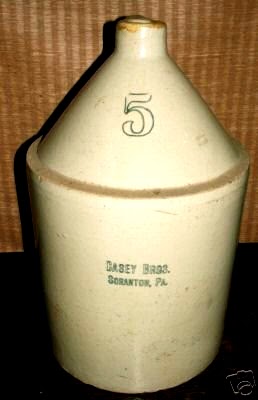
The firm in those days used ceramic containers for much of its product.  Early jugs had rounded shoulders and the company name impressed in the clay body as shown here.  With the introduction of shoulder jugs by the Robinson Ransbottom Pottery of Roseville, Ohio, in the late 1800s,  Casey Brothers adopted them for its products.  Shown here are the company jugs in half-gallon, one gallon and three gallon sizes, all with the distinctive Robinson Ransbottom crown pottery mark on the bodies.  Casey jugs could run as large as five gallons.

Tragedy struck the Casey family twice in the next few years.  Lawrence, the eldest, died in December 1884.  According to census figures he would only have been 32 years old.  Timothy Casey similarly died in his early thirties, passing in 1888.  With the founding brothers gone, Patrick and Andrew picked up the management reins of Casey Brothers and continued its growth and prosperity.  Brother James was a longtime traveling salesman for the company. The brothers widely advertised their Green Valley Rye, claiming “38 years of unbroken popularity.”  They also provided giveaway items to favored customers including celluloid covered match safes.

The interests of Patrick and Andrew expanded considerably beyond the liquor trade.  In addition to being involved in the management of Casey Brothers, Andrew was treasurer of the Casey & Kelly Brewing Company and Patrick was its secretary.  With William Kelly the brothers had helped to found the brewery in 1891.  They bought the Meadow Brook building and remodeled it for the manufacture of ale and porter, with a capacity of fifty thousand barrels a year.  In 1895 they erected a larger brewery with a capacity of one hundred thousand barrels annually.  It boasted a state of the art ice machine, boiler and engine room.

Andrew Casey became a member of the Scranton Board of Trade and a director of the Merchants and Mechanics Bank.  He also was active in Democratic politics and was an at-large delegate from Pennsylvania to the 1920 national convention that first brought (losing) vice presidential nominee,  Franklin D. Roosevelt, to national attention. Brother Patrick was secretary/treasurer and managing partner of Casey Brothers.  He also served as Secretary of the Casey & Kelly Brewing Co., and was a large stockholder in the Merchants and Mechanics Bank.  He also had financial interests in the Scranton Traction Company,  Consumers’ Ice Company and  Scranton Illuminating, Heat, and Power Company.   Like his brother, he was a Democrat and also belonged to the Benevolent and Protective Order of Elks.

Patrick and Andrew together also had major real estate holdings in Scranton.  They owned prime property at the corner of Wyoming and Lackawanna Avenues, cited as “the most valuable location in the city.”  In addition they owned residential property on Jefferson Avenue and additional commercial property on Lackawanna Avenue. 


Family ties were strong for the Caseys.  On several occasions they paid for their aging parents to cross the Atlantic to visit them.  One can imagine how proud the elder Caseys must had been to see what their sons had accomplished in America.  In 1891 Patrick visited his old home in Ireland to see his parents and spent three months abroad.   Several years later he would make a six month trip to Ireland, England, Scotland and the European continent.

Meanwhile, Patrick was also having a personal life. In 1894 He married Angela O’Malley, a Scranton native and the daughter of a foreman for the Delaware, Lackawanna and Western Company.  The 1900 Federal Census found him living on Clay Street in Scranton with Angela and their three children,  ages four to one.  The family had three live-in servants.  Over time Patrick and Angela would have six more children, for a total of seven boys and two girls.

The major accomplishment of Patrick and Andrew Casey was yet to come.  The Scranton newspaper of August 26, 1909 recorded the scene:  “...Two men scampered up the embankment at the corner of Lackawanna and Adams avenues. Like boys out for a play their ragged faces bore happy smiles. Suddenly one of them took a pick in his hands and with a hefty swing sunk the shiny steel into the earth, clean up to the handle. Then without waste of words and a grin the younger of the two sank a shovel into the loosened earth and turned it over. The other man tried the shovel too and in an instant it was all over, ground was broken for the Casey Grand Hotel, and the men were P.J. and A.J. Casey, who are building it."

The 11-story Casey Grand was to become Scranton’s most famous and prestigious address.  At its opening in January 1911 the local press gushed that everything was modern to the point of perfection, artistically beautiful, and luxurious.  Boasting  250 rooms  it was the largest hotel in northwestern Pennsylvania.  One article noted:  “The Hotel Casey stands today completed, an imposing monument to the courage of two men, Andrew J. and Patrick J. Casey, who, with their own resources reared at the corner of Lackawanna and Adams avenue, one of the most magnificent hotels in the country.”

With the coming of Prohibition,  the Casey Brothers liquor and beer interests, that had fueled the family business empire,  were force to terminate.  Now highly diversified and with the Casey Grand Hotel providing a revenue stream Andrew and Patrick did not suffer as badly as did other whiskey men.   The hotel, a stopping place for the rich and famous for decades, stood for more than 90 years.  It was demolished in 2001.

The ultimate fate of the remaining Casey brothers, my research has failed to uncover.  Suffice to say that they were hailed upon their demise for their contribution to the development of Scranton as a business center.  The five Caseys and their liquor trade had proven to be an integral part of the growth of their adopted town.