Saturday, August 9, 2014

The Grahams: From Reapers to Rye in Rockford


Freeman Graham II and his sons were part of an era in American history, embodied in Thomas Edison, during which a knowledge of how machines worked and the inventive genius to improve them could be a way of upward mobility.   With their technical and executive know-how the Grahams moved from agricultural implements to success in making whiskey in Rockford, Illinois.

Born in Simsbury, Hartford County, Connecticut in 1806,  Freeman Graham was the youngest of ten children of Freeman I and Hannah May Graham.  When the son was only 11 years old his father, age 35, committed suicide, leaving him, his mother and siblings to fend for themselves.  Although the youth received some education, early on he was forced to find employment.  For seven years he was apprenticed as a workman making cotton and woolen machines.  As his skill came to be recognized, Graham began to climb the industrial ladder, working in Litchfield and Hartford, Connecticut.

It was in Hartford that he met and in 1832, at age 26, married Julia Driggs.  She was Connecticut-born of Scotch ancestry, a woman eight years his junior.  They became the parents of seven children, two of whom, girls, died young.  Of the five remaining four were sons, Byron, Freeman III, Julius and David, and a daughter Julia.   Despite his lack of formal education, Graham was beginning to attract notice for his intelligence and judgment.   His neighbors elected him both as  a justice of the peace and to the Connecticut Legislature.


His reputation was also extending beyond New England.  In 1854, the Chicago owner of a large ironworks in Beloit, Wisconsin, asked Graham to take charge of his plant.  By now age 49, Freeman II uprooted his family and moved West.  After about a year in Beloit, he received an offer of a larger salary as the sole manager of Emerson, Talcott & Co. of Rockford.  He accepted and by doing so made a good decision on both a location and a employer.


The third largest city in Illinois, Rockford, shown here from the perspective of the Rock River, was booming.  Strategically located between Chicago and Galena and served by multiple railroad lines, the town was experiencing considerable industrial development, notably in heavy machinery, tools, and agricultural equipment.  A major Rockford manufacturer was Emerson, Talcott & Co., manufacturer of the Manny Reaper.  This implement had been developed by John Henry Manny, a young Illinois farmer, who began making them in earnest in 1855, survived a lawsuit from the McCormick Reaper company, and then died of a stomach illness at the age of 30.   The company appears to have reached out to Graham to fill the gap caused by Manny’s death.


According to a contemporary biography, Graham soon became recognized in Rockville as “an enterprising and progressive business man.”  Principal among his activities was establishing the first distillery in Rockville, which also was the first sour mash whiskey distillery in Illinois. He called called it the Graham Distilling Company.   Shown here is a illustration of the facility.  Smoke pours from a chimney on the distillery building, while the warehouse on right has been constructed to resemble a medieval castle.


When it came to building a Rockford home for his family about 1857, however, Graham hewed to a more modest New England look.  Shown here, the home is just down the road from the distillery and now on the National Register of Historic Places. Its architecture is described as “Transitional Italianate/Greek Revival style.”

As his sons matured, Freeman II one by one brought them into his enterprises.  In time those would include the Rockford Cotton Mills, described as “a flourishing enterprise.”  That firm manufactured carpet warp, cotton towels, cotton batten and “seamless stockings.”  The Grahams also eventually owned woolen factories and paper mills in Rock Island, Illinois, and Dubuque, Iowa.  Even at age 85, Freeman II was described as still owning the distillery and taking close interest in his family’s enterprises:  “Mr. Graham is quite active, retains the use of his intellectual and physical faculties,  has never used eyeglasses, and retains that sanguine and buoyant spirit characteristic of youth.”

At the age of 90 Freeman Graham died in 1906.  In his will he left his house to his daughter and the distillery to sons Byron, Freeman III and Julius.  Although he had begun his career in the reaper business, Byron Graham was involved with the distillery virtually from its beginning.  He headed its management after his father’s retirement and about 1901 changed the company name to Graham Bros. Distillery.  The market for Graham rye and  sour mash whiskeys continued to grow.  By 1891 the company was grossing the current equivalent of $7.5 million annually and employing 45 workers.   By 1907 Graham Bros. had opened a retail outlet in Chicago.  Like many whiskey men of the time they issued shot glasses to favored customers, such as the one shown here.


By this time Byron Graham, born in 1838, himself was aging.  In 1863 he had married Mary L. Hiatt, a California-born woman who had come to Rockford as a teenager to go to preparatory school.  Closely following her graduation, she wed him. They had two sons, Robert and Harry H. The latter, as he matured, showed a special talent for the liquor business and trained himself in whiskey making.  A 1915 ad for Graham’s Sour Mash, showing a Colonial couple tippling, listed Byron Graham as president of the company and Harry H. as vice president and distiller.  Others of the management team were in Chicago, located in the Marquette Building.


Although other Graham enterprises carried on,  the Graham Bros. Distillery was shut, never to reopen, by the coming of National Prohibition in 1919   Byron died in 1922 and was buried in Rockford’s Greenwood Cemetery not far from his father, mother, and other close family members.  The Graham plot is marked by a  plinth with a cross mounted on a large sphere.  Although the distillery has long vanished from its site, the house that Freeman Graham built and its landscaped garden and grounds are now a Rockford museum and historic landmark.  This landmark continues to testify to the technical skills and entrepreneurial genius of Freeman II and the Grahams.


Saturday, August 2, 2014

George Curry’s Story: From Saloon to State House

No figure looms larger in the early history of New Mexico than George Curry, a transplant from Louisiana who ran an early saloon in the territory but ultimately became the governor and then a congressman.   Along the way Curry, shown here as a young man, met Billy the Kid, Bat Masterson and other notorious Western figures.  He became a Teddy Roosevelt Rough Rider and later served in the American occupation of the Philippines.

Fortunately Curry described his colorful life in an “as told to” autobiography but it is an account that gave few details about his career as a whiskey man.  His saloon still stands in Lincoln Station, New Mexico, and continues to bear his name.  The story here will recount Curry’s early days and provide details of his rise to political power and influence.

Curry was born in April 1861 at Greenwood Plantation in West Feliciana Parish, Louisiana, the eldest of four sons of George Alexander and Clara Madden Curry.  His father, a Confederate officer, was the manager of Greenwood, shown here in an illustration from the autobiography, and had his own farm nearby.  After the war the senior Curry became an early leader of the Klu Klux Klan and was slain by alleged “carpetbaggers” as George, a boy of nine, looked on. After the father’s death the family moved onto their own farm and “fared very well” for two years.  In the spring of 1873, however, the property was inundated by a massive flood that killed most of the livestock and drove the Curry family off the land.

Ever restless, Curry continued to move West. By 1884, at the age of 23, he became engaged in territorial politics as a delegate to a Democratic convention called to nominate a candidate for New Mexico’s delegate to the U.S. Congress and elect delegates to the convention that nominated GroverCleveland.  Once bitten the political “bug” would never leave him.

Two years later Curry was in Lincoln Station, part of theNew Mexico Territory, shown here about 1900.  There he was working for a wealthy merchant named Dolan, whose stock included hard liquor.  There he met Jack Thornton, a Dolan clerk, who struck out on his own in 1887 and asked Curry to partner with him in a saloon, hotel and livery stable.  Already experienced in Las Vegas, New Mexico, with running a hotel, restaurant and bar, handling as he said, "everything from dishwashing and bookkeeping," Curry agreed and paid his share by borrowing $1,000 from a friend. The resulting establishment, shown below, became known as the Thornton-Curry Saloon and more recently as simply the Curry Saloon.  It is on the National Register of Historic Places.
With Thornton running the livery stable and his wife the hotel, managing the saloon apparently became Curry’s principal occupation although his autobiography is vague on the point.  He reported that the business turned out to be a success.   Lincoln as the county seat was growing rapidly.   The spring and fall terms of the territorial district court brought many transients needing room and board.  Moreover, ranching and mining in the area was prospering.   There was a steady demand for the partners’ whiskey.  A photograph of the interior of the saloon shows the bar and a billiards table.  A sign at the rear says "Club Room," likely the location of the card games.
Despite the prosperity of their enterprise the partners sold out after several years of operation.   The proximate cause was politics.  Some of Curry’s friends had suggested he run for political office and he was interested.  “Thornton was opposed to mixing business with politics, and was probably right,” Curry said. “In July, 1888, we had a satisfactory offer for the hotel and bar and sold out, Thornton retaining the livery stable….”
Curry thereupon began his political career.  The Lincoln County Democrat convention in 1888 was a contentious affair among vying factions.  Although Curry was a popular choice for county clerk, his election was not assured until a number of delegates,including George himself, had adjourned to Mickey Cronin’s bar, and the remaining Democrats unanimously selected him.  This was just the first of many elective and appointed positions he would hold.
That same year George wed Miss Rebecca Hughes, the daughter of a prosperous Lincoln County rancher. They were married in the Catholic church in Lincoln.  He built his bride a three room house in Lincoln and there their first son was born.  They named him Frank Thornton Curry.  He was followed by two more sons, Charles Ernest and George Clifford.
Curry was frequently absent from home.  When the Spanish American War broke out in 1898, the governor of New Mexico was authorized to raise four companies of cavalry.  Curry recruited one company and was appointed its captain. His company, along with other Western recruits became the regiment commanded by Colonel Theodore Roosevelt that became known as the “Rough Riders.”  During the training he became a friend and confidant of Roosevelt but eventually was denied by the flip of a coin the chance to see action in Cuba and participate in the famous charge up San Juan Hill.  Instead he remained in the U.S. to provide logistical support to the Riders.
Almost immediately after the war Curry volunteered to go to the Philippines to help put down a revolt by locals against American occupation following departure of the defeated Spanish.  Concerned about the likely prolonged absence of her husband, Rebecca Curry at that point obtained an uncontested divorce.  George’s success during two years of combat in the Philippines led to his appointment as governor of several provinces and eventually chief of police of Manila. When now President Roosevelt was looking to appoint a governor for New Mexico, he chose Curry who is said to have accepted only upon Roosevelt’s promise to fight for full statehood for New Mexico. 

Moving from the Democratic Party to the Republican,  Curry proved to be an effective territorial governor of New Mexico and was able to see statehood achieved in1910, after years of struggle in which he played a major role.  Perhaps out of gratitude for his years of service the people of New Mexico elected him to the U.S. Congress where he served one term.
While Curry’s career in war and politics was marked with success he was less favored in marriage and business.  Married a second time, his new wife found his Western lifestyle too taxing and as George put it:   “We reached an amicable settlement of our affairs and she returned to her home in Pennsylvania.”  One observer has noted that despite Curry’s executive abilities and success in public office, his “adventures in business were for the most part unsuccessful,” but largely because of circumstances beyond his control. 

One of those ventures marked a return to the hotel and saloon trade when in 1916 he bought the Park Hotel in Sorocco, New Mexico, a landmark from Territorial days.  While in the process of selling the property in order to head a potentially lucrative oil enterprise in Venezuela, a drunken patron shattered his ankle with a gunshot, closing that opportunity.  Shown above in his later years Curry in 1945 was appointed State Historian of New Mexico. He died two years later in 1947 at the age of 86.  His tombstone is shown here.


Note:  Much of the information for this post came from the book, George Curry,1861-1947, an Autobiography, published by the University of New Mexico Press in 1958.  The editor was Horace Brand Henning, who knew Curry well and added a foreword.  A paperback reprint was issued in 1995.  The line drawings and portrait of Curry are from the book and by Artist Sam Smith.


Thursday, July 24, 2014

William Perkins: Looking for Gold, Found It in Minnesota


William L. Perkins was an Easterner, born in Oxford, New York, in 1929 and raised in New York City.  At the age of 20  he decided that “The Big Apple” was not a place to make his fortune.  Instead he headed for California and the Gold Rush in 1849, taking the perilous trip “sailing before the mast,” as one biographer put it,  around South America and north to to San Francisco.  Although there is no evidence of his striking gold, Perkins stayed in California for 21 years, likely working in the mercantile trades.

It was in California that Perkins met Sarah Peabody. They married in 1859 and their union produced three children,  Mabel V.,  William L. and Lena A.  Meanwhile, Sarah’s brother, George Peabody, with a partner named Maurice Lyons, had established a small liquor store in St, Paul, Minnesota.   Peabody, Lyons & Co.
was lightly capitalized at the outset  and located in a small (20 by 40 feet) two-story stone building on St. Paul’s Third Street.  As the business met with success the quarters were expanded by adding another forty feet.

In 1872, likely because of the declining health of Sarah, the Perkins family pulled up stakes in California and moved to St. Paul.  This time they were able to make the trip by train.  By that time the first transcontinental railroad had been built across the western half of America and onto the East.  The lines stretched 1,776 miles.  Their route took the Perkins family to Chicago and then north to Minnesota.  Although the trip took more than a week, it was much shorter than the 100-plus days required for sailing  "round the Horn."

Once in St. Paul Perkins bought out Peabody’s interest in the liquor dealership and became part of the management.  He proved to have a flair for the whiskey trade and his contacts in California apparently provided an advantage with that state’s wine and brandy makers.  Operating now as Perkins, Lyons & Co., the business continued to flourish.  Needing more room and a better address, the partners moved to 319 Robert Street, about the year 1900.  It is the St. Paul thoroughfare shown above.  This store occupied a much larger building, one 25 by 150 feet and four stories tall.

According to a contemporary publication the new quarters allowed the partners to keep “as compete and full stock as can be found in any city in the West.”  The account continued: "Messrs. Perkins, Lyons and Company carry from fifteen hundred to three thousand barrels in bond, of different ages, all for the purpose of keeping their stock in St. Paul always up to the standard. The firm of Perkins, Lyons and company keep all the time three salesmen on the road, and port of the time four, who visit pretty much every town in northern Wisconsin, Minnesota and Dakota territory, monthly; their sales amounting to from $250,000 to $300,000 yearly, requiring a capital of about $100,000, now, to do the business, thus showing quite an increase in this particular line of business during the last twenty years in St. Paul."


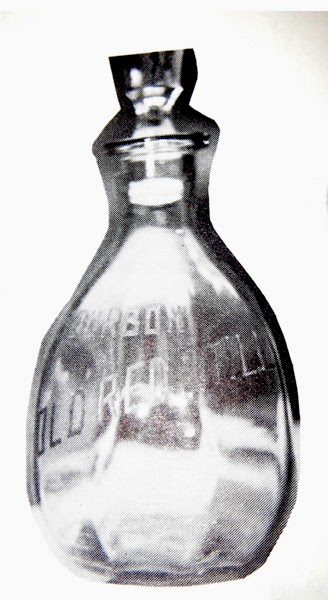
About 1886, Maurice Lyons bowed out of the firm, selling his interest to Perkins.  The change in management was reflected in a change of name.  The enterprise subsequently became known as W. L. Perkins & Co.   The firm’s flagship brand was “Old Red Still,”  as shown here with its characteristic red and black label.   Perkins provided his customers with a variety of bottle shapes and sizes for Old Red Still, including back of the bar bottles.  Another major Perkins brand was “Non-Pareil.”  He registered the name in 1907
and was allowed its use, even though the brand earlier had been registered by a New York company.  He also issued a back of the back decanter for Non-Pareil Whiskey, as well as the five cent token shown below.

My personal favorite among Perkins’ glassware is a small decanter with a bulbous base and flaring mouth.  It was made expressly for use on passenger trains.  As shown here, it bore a paper collar that said “Made Expressly for the Dining Car Service of.....By W. L. Perkins & Co, St. Paul, Minn.”  A blank was left in the middle of the label for the railroad to add its name or logo.  My assumption is that it held a quantity  of whiskey or wine.

As William L. Perkins, Jr.,  reached maturity,  his father brought him into the firm.  Junior had been born in San Francisco but had achieved his education in the Midwest, boarding at the Shattuck Military School in Faribault, Minnesota, and later attending Griswold College in Davenport, Iowa, both institutions affiliated with the Episcopal Church.  Junior finished his education about 1887 and went to work for his father learning the whiskey trade. Upon the boy reaching the age of 23 and showing promise as a businessman, Perkins in 1991 made him a full partner.  With his future assured, the son shortly after got married in St. Paul to Leocaldio Ryan. (Her first name in Spanish means “numerology.”)

Father and son continued to expand their business during the 1900s.  A 1907 publication reported that they now were marketing their liquor over a wide territory in the Northwest and employed seven traveling salesmen who were constantly on the road.  Their mercantile staff had similarly expanded to twenty-two employees working at the Robert Street facility and at a branch office in Minneapolis.  The Perkins firm boasted it had been designated as the Northwestern agents for Old Crow and one of five national representatives of the John Gibson line of whiskeys.

Father and son Perkins also were gaining attention for their civic and social activities.  Both were members of Masonic orders,  identified as Republicans (though said to be voting independent in local elections) and active Episcopalians.  In addition Junior was a member of the St. Paul Lodge No. 59 of the Elks,  the Commercial Club and the Jobbers Union. These whiskey men had, as one author put it, “gained place prominent among the representative merchants and wholesale dealers of Minnesota.”

Along the way the family knew sorrow.  Sarah Peabody Perkins, wife and mother, died about 1892.  The effort to find a more healthful climate for her in the clear air of Minnesota had failed and her condition gradually had deteriorated.  Although mourning her loss, her survivors continued to operate their wholesale liquor business.  In St. Paul directories William was listed president and treasurer, Junior as corporate secretary.   In 1919 with business curtailed as a result of the advent of National Prohibition,  the W. L. Perkins Company moved to 339 E. Seventh Street,  its final address.  It closed shortly after, never to reopen.

Note:  Two principal sources provided the information for this vignette on William Perkins and his family: 1) THE BOOK OF MINNESOTANS; a Biographical Dictionary of Leading Living Men of the State of Minnesota. 1907. By: Albert N. Marquis, and 2) A History of Ramsey County and the City of St. Paul, 1826-1917, by George E. Warner.  That the Perkinses figured in both is additional testimony to the reputation father and son had achieved, finding gold, not in California, but in Minnesota. Three bottle illustrations are from the Ron Feldhaus book, Bottles, Breweriana and Advertising Jugs of Minnesota, 1850-1920.


.


Monday, July 21, 2014

Charles Nelson and the Green Brier Distillery

Foreword:  As noted in the past, when I find substantial biographical material already written about a prominent whiskey man, it is my practice to use it, not reinvent what is reasonably comprehensive.  So it is with Charles Nelson, shown here, a Tennessee whiskey distiller and dealer with a substantial record of accomplishment.   In this case, the biography was written by Nelson’s great-great-great grandsons, Andy and Charlie Nelson, who in 2012 began bottling a whiskey they said was from their ancestor’s recipes.  On their website they told this story about Nelson and his Green Brier Distillery:

Charles Nelson was born July 4, 1835 in Hagenow, a small town in the Mecklenburg-Schwerin state of northern Germany. He was the eldest of six children whose father, John Philip Nelson, owned a soap and candle factory. When Charles was 15, his father decided he wanted to move his family to America for a better life. He sold his soap and candle factory, converted all of the family’s earthly possessions to gold and had special clothing made to hold that gold on his person during the journey.  In late October of 1850, he gathered his family and boarded the SS Helena Sloman to set sail for America.

As fate would have it, on November 19 of that year, intense storms and gale force winds sent many of the nearly 180 passengers overboard. John Philip Nelson was one of those unfortunate souls and weighed down by the family fortune, he sank directly to the bottom of the Atlantic Ocean. Luckily, the rest of the family arrived safely in New York, but with only the clothes on their backs, and 15 year-old Charles found himself man of the house.

Penniless yet determined, Charles and his brother began doing the only thing they knew how to do: make soap and candles. After saving some money, the Nelson family moved west, settling in Cincinnati, Ohio. It was there that Charles, merely 17 years of age, entered the butcher business and acquainted himself with a number of fellow craftsmen who educated him in the art of producing and selling distilled spirits, particularly whiskey.


Several years later, just before the start of the Civil War, Charles set out for Nashville seeking a fresh start and another American dream took tenuous root. He opened a new grocery store built on the foundation of his three best-selling products: coffee, meat and whiskey. These products quickly built Charles a reputation that went unmatched in Nashville’s merchant circles. His honesty and fair dealings brought about great prosperity for his business as well as an elevated social status in the community. Very quickly, Charles realized that the demand for his whiskey far exceeded his supply, revealing to him the opportunity to focus solely on whiskey.

....As for Charles, he bought the distillery [shown here] that was making his whiskey in Greenbrier, TN, and a patent for improved distillation, and expanded the production capacity in order to keep up with demand. With this expansion, Nelson was not only creating more jobs, he was making a name for Tennessee Whiskey. By 1885, there were hundreds of whiskey distilleries in Tennessee, but only a handful was producing significant volume. The three most notable were Cascade (now George Dickel), Jack Daniel’s, and Charles Nelson’s Green Brier Distillery. That year, Charles Nelson sold nearly 380,000 gallons of Nelson’s Green Brier Tennessee Whiskey in markets ranging from Jacksonville, FL to San Francisco, CA to Paris, France, while Jack Daniel’s production capacity was just 23,000 gallons. 


In addition to the volume he sold of his own whiskey, Nelson was one of the first to actually bottle and sell whiskey rather than selling it by the jug or the barrel. The distillery, which was commonly known as “Old Number Five” due to the fact that it was registered distillery number five and was located in the fifth tax district, became a favorite stop of federal regulators and tax inspectors due to the warmth and hospitality shown to them by Nelson and his employees. It is safe to say that by introducing the category of Tennessee Whiskey to the world and offering a superior product, Charles Nelson had indeed become a household name.


After decades of great struggle and brilliant triumph, Charles Nelson passed away on December 13, 1891. His wife Louisa assumed control of the business, becoming one of the only women to ever run a distillery. In 1909, statewide Prohibition forced Louisa to discontinue operations and Nelson’s Green Brier Distillery closed its doors. 
Addendum: An article in Wikipedia added information about Nelson and Green Brier to describe why the  distillery site, one that includes the still standing barrel house shown below, merits inclusion on the National Register of Historic Places:

Nelson's Greenbrier Distillery was a major contributor to the economy and growth of the town of Greenbrier during the late 19th century.  It employed about 25 people directly and provided a market for farmers' corn, locally made barrels, and other products. Its presence resulted in the construction of a railroad line and station in Greenbrier.

Whiskey production at the Greenbrier distillery ended after Tennessee enacted prohibition on July 1, 1909, but whiskey that had been produced before that time continued to be sold in other states until 1915. Although Robertson County whiskey had enjoyed a reputation for superior quality, the county's whiskey industry was not revived after Prohibition ended.

The property's listing on the National Register reflects its importance in industry and commerce, as well as its association with proprietor Charles Nelson, who was prominent in areas including banking, farming, and barrel-making. The listed property is a 5-acre area, although the distillery occupied a much larger area. Most of the distillery buildings are no longer present. The only historic buildings that remain are an early 20th-century warehouse, a spring house that supplied fresh water to the distillery, and a barrel house. The site includes a dam across Rocky Fork Creek. One old mash tub and remnants of building foundations also are found on the grounds.


And a last word from Charles Nelson’s obituary:

“Mr. Nelson was in the fullest sense a public-spirited citizen. Every enterprise intended for the good of Nashville received his hearty support and generous help. He was a man not of words but of actions.” – Nashville Daily American (Dec. 14, 1891)


Thursday, July 10, 2014

Maybe It Didn’t Always Pay to Meet Abe Freeman


“It will pay you to meet me,” claimed Abraham Freeman, pictured here, the flamboyant proprietor of a “cut price” liquor business in Atlantic City, New Jersey.   Fellows named Brown, Fleming and Sooy would have taken issue with that assertion.  They probably would have been much happier had they never met Freeman -- but that story comes later.  First, we should meet whiskey man Abe.

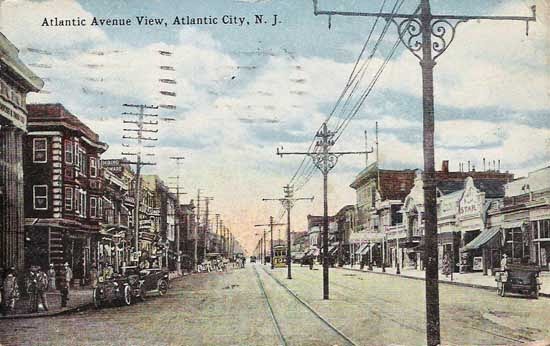
Historical records indicate that Freeman was born in London, England, in 1871, although one census listed him as a native of Germany.  His parents were German Jewish émigrés to England, Isaac Freeman (sometimes given as Freedman or Friedman) and Esther (Hester) Altmark.  The second of at least three Freeman sons, Abraham emigrated to the United States from England at an early age, likely settling first in Philadelphia.  There he met his wife, Rose Meyerhoff and wed her in Philadelphia in 1885.  She was the daughter of a German immigrant couple, Raphael (called Robert) Meyerhoff and Julie Isenberg.   Abe was 24 and Rose a year younger.  By the following year the couple had moved to Atlantic City, New Jersey, where Abe went to work for his father-in-law.  Robert Meyerhoff about 1882 had  established a liquor business on Atlantic Avenue, the street shown here in an early 1900s postcard.


The 1910 U.S. census found the Freemans at home in the Third Ward of Atlantic City with three daughters,  Julia, 16;  Irma, 14, and Dorothy, 11.  Living with the family was the widower Robert Meyerhoff and two servants.   Now in his mid-seventies,  Meyerhoff by death or design turned the business over to Freeman sometime after 1910.  By 1913 Abe was aggressively advertising “Freeman’s Cut Price Liquor Store.”  His price list featured his picture and the assertion that “It Will Pay to Meet Me.” Freeman’s list featured a full line of whiskeys, champagnes,and other wines at “New York Cut Prices.”  His  case whiskeys included an array of national brands, including Overholt, Green River, Gibson, Clarke, Trimble, Wilson, Gallagher & Burton, and Mt. Vernon.   Under Freeman’s management the business prospered.  In 1911 he expanded the premises, adding a warehouse and a garage at the rear of his store.

In addition to his retail trade Freeman sold bulk whiskey on a wholesale basis to saloons and restaurants, often providing it in stoneware jugs with cobalt script of his name.  He also gave his customers, both wholesale and retail, several varieties of shot glasses all of them with measuring lines on them and topped with what appears to be a moose or elk head.  Since he gave these items away, he must have been popular with many folks in Atlantic City.   But likely not with Mssrs. Brown, Fleming and Sooy.

These three men figured in a bizarre episode in Freeman’s life:  While automobiles were not an entirely new conveyance, they were expensive and many people, including Abe, did not own one but he liked “joy riding” with friends around town and the countryside.   In 1913 Freeman engaged a vehicle from  William Brown who rented out his open touring car for $4 an hour (a whopping $100 in present currency) and provided a chauffeur, in this case Mr. Fleming.  Loading the automobile with friends,  Freeman jumped into the front seat beside Fleming and they took off.  Enroute, a gust of wind blew the driver’s hat in the air and in an effort to catch it Fleming let go of the wheel momentarily.  Seizing the opportunity to drive, Freeman grabbed the steering wheel and swerved the automobile to the side of the road and crashed into a ditch.  According to an account given in court:  “All the occupants of the car were more or less injured and Fleming sustained a dislocated shoulder.”

Freeman’s troubles had just begun. The car was left where it had been ditched and Abe hied off to the nearest inhabited place where he met, likely for the first time, Mr. Sooy.  He hired Sooy and some assistants on the spot to remove Brown’s damaged car from the ditch.  By the time the party returned to the scene of the accident, it had turned dark. They carried a gas lantern to assist their work, sitting it on the ground to light the scene.  As they began to raise the car an odor of gasoline was detected where it apparently had leaked from the gas tank and soaked into the earth.  In an instant the flame from the lantern touched off the fumes and the ground caught fire, spreading quickly to Brown’s expensive automobile.  The vehicle swiftly was consumed by flames and rendered a total loss.   When Brown sued Freeman for damages, the liquor dealer contended that it was Sooy’s fault and he himself bore no responsibility.  The court of first jurisdiction disagreed and told him to pay up.  Continuing to object, Freeman appealed the verdict to the New Jersey Court of Errors and Appeals. There the result was the same.  Sooy was found to be in the employ of Freeman and as the employer Freeman was liable.  He paid.

Still other troubles were ahead.  A year later, Federal Food and Drug agents entered Freeman’s 1532 Atlantic Avenue premises and seized 20 cases of “Radio-Active Mountain Valley Water.” Each case contained a dozen green embossed glass bottles.  The product,  reputedly from Hot Springs, Arkansas, carried a label claiming to be a remedy for Bright’s (kidney) disease, diabetes, cystitis, and rheumatism.   This was a period when nostrum peddlers, taking advantage of public ignorance about radioactivity were pushing such mineral waters as panaceas.   In the case of Mountain Valley Water, scientists had determined that patients would have to consume an entire liter at one time to get even a modicum of radioactivity.  Moreover, there was no evidence that the water was useful in the treatment of the diseases as claimed.  Although Abe Freeman was the distributor, this time the fine of $500 fell on the Mountain Valley Water Company.

In addition to selling Mountain Valley Water, Freeman was the Atlantic City agent for another bottled water called “Clysmic.”  This product, which was the self-declared “King of Table Waters,”  made no specific therapeutic claims but advertised that it “promotes health, pleases the palate and exhilarates the mind.”   Just in case the mind needed additional exhilarating, Clysmic provided customers with a serving tray that depicted a bare breasted,  beauty with long tresses sitting in a stream while a deer drinks at her side.


Freeman had a relatively short time to make his mark in the whiskey trade, possibly as brief as seven or eight years after taking over for his father-in-law.  Although New Jersey was not a “dry” state, the enactment of National Prohibition meant the end of all liquor sales, even cut rate ones.  Abe shut his doors on Atlantic Avenue, never to open them again.  Records indicate two dates of death for Freeman.   One shows him dying in Atlantic City in 1927; a second in 1948 in Forest Hills, New York.

But the story does not end there.  The Freemans’ daughter Irma married a man named Mark Bertram Bacharach, a well-known syndicated newspaper columnist.  That couple produced one of the most celebrated American singers, song writers, composers, pianists and record producer of the 20th Century, Burt Freeman Bacharach.  Obviously named after Abe, Bacharach, a six time Grammy Award winner and three times Academy Award winner, might or might not have known his grandfather.  The song writer was born in 1928, one year after Freeman died according to one record; by another account Bacharach would have been 20 years old and certainly have known Abe Freeman, a man who wanted people to meet him.