Monday, November 10, 2014

Milwaukee’s Peter Barth: 94 Years in Service and Whiskey

Beginning with his service as a Union soldier in the Civil War, to his elected service as an alderman and his participation in Milwaukee philanthropic organizations into his 90s,  Peter Barth clearly understood the meaning of the word “service.”  Barth also understood whiskey and its marketing, and flourished there.  He deserves to be remembered for a long life well spent.
During his formative years Barth’s prospects for a long life during were not promising.  He was born in 1839 in Hesse-Darmstadt, Germany, the son of John and Frederica Barth, the sixth of nine children.  While he was still a youngster in 1847 his father uprooted the family and headed to Wisconsin, taking them on what often was a perilous sea voyage, subject to disastrous storms and disease.  The Barths made it safely and settled onto a farm in Lake Township, an agricultural area just south of Milwaukee.  

From the safety of the farm, on a 1862 visit to Minnesota, Peter, now 23, took a step that put his life in frequent danger.  He enlisted in the Minnesota Fifth Voluntary Infantry serving as a private in Company E, donning the feathered hat sported by its men, shown above.  His regiment was involved in more than 25 scenes of combat, including such bloody battles as those in Iuka, Mississippi, and the Siege of Corinth, Mississippi.  
Perhaps the most serious battle in which he was engaged was the May 22, 1862, attack on the Confederate works at Vicksburg.  Fortunately for him the Fifth Minnesota was in the rear of the attacking column;  his regiment did not suffer the high casualties of the leading units. A monument, as shown here, stands at Vicksburg in tribute to his unit.   By the time Barth was mustered out in September 1865, his regiment had suffered four officers and 86 enlisted me killed in action or who later died of wounds.  Another 179 had died of disease.

Spared in that bloody war, Barth returned to Milwaukee and almost immediately opened a liquor dealership.  Characterized as “a small beginning,”  the former infantryman soon demonstrated a knack for the trade.  His first address was 137 Reed, the choice of a location indicating his business sense.  His store was adjacent  to one of Milwaukee’s busiest places, the Reed Street Railroad Station, then the city’s railway center, with a depot for all incoming and outgoing trains.  Barth watched as Civil War heroes like Generals Grant and Sherman arrived for the Grand Army of the Republic (G.A.R.) National Encampment in 1880.  Barth himself served for a time as the Commander of a Milwaukee G.A.R. post.


By 1897 his business had grown large that he needed larger quarters and moved down Reed Street to No. 251, his address for the rest of the existence of the Peter Barth Company.  Above is a photo of the store.  That may be Peter with the long beard on the steps.   The building was three stories with full basement and covered an area 26 by 112 feet. 
 

The facility allowed Barth not only to sell liquor but to “refine and blend” his own proprietary whiskey.  Among his house labels were “Barth,” “Beaver,” “Patrick Henry Whiskey,” “Waldron,” and the unusually named, “Bung Hole.” He does not appear to have trademarked any of his brands.  Barth has endeared himself to collectors, however, by the fine colors of his embossed bottles.  From his half pints to quarts, some shown here, Barth put his name on glass that ranged from yellow amber to dark red.  Many of those containers bore the mark of the Chase Valley Glass Company, a Milwaukee glass plant founded in 1880. Like many other Milwaukee liquor dealers Barth also issued a number of advertising shot glasses and an attractive decanter-like back-of-the-bar bottle.

In 1967, not long after Peter had returned from the Civil War, he married a woman named Emma, 17, who like him had emigrated from Germany.  We are fortunate that the couple and their family were recorded in the U.S. censuses of 1870, 1880, 1900, 1910, and 1930.  At the time of the 1870 census the Barths had only one child, Robert, a baby of nine months.  During the ensuing decade, the family added five other siblings, two boys and three girls, ages 8 to 3.  As he matured, Robert was taken into the liquor firm as a clerk about 1901 and eventually made a partner.

In 1985, Barth incorporated his firm under Wisconsin laws with a paid up capital of $100,000 (equivalent to $2.5 million today).  Robert, described by a contemporary as “a young man of unimpeachable probity,” became secretary and treasurer.  By this time the sales of the Peter Barth Company had placed it among Milwaukee’s largest liquor wholesalers.  It covered not only all of Wisconsin but also Minnesota and Michigan.  Including its sales force, it employed eight people.
Nor was Barth neglecting his service to the community.  He was an active member on the Board of Trade and the Milwaukee Merchant Trader’s Association where he was said by a biographer to be “always…among the first in promoting the city’s best interests.”  His interests extended to the political field.  A Republican in a largely Democratic city, he was elected as an alderman from Milwaukee then Fifth Ward, serving from 1878 to 1882 until being defeated by a Democrat.  

He was a member of the Knights of Pythias, the Ancient Order of United Workmen, and the Oddfellows, all of them fraternal and service organizations, devoted to philanthropic work.  The Oddfellows seemed closest to Peter Barth’s heart, which he joined in 1883.  It was British-founded and known particularly for its charitable work, conducting fundraisers for both local and national charities.  At the age of 91, Barth was still attending meetings of the Milwaukee Oddfellows, recorded in press accounts as its oldest active member. 
As his father aged, Robert increasing took over the management of the firm.  In 1910 at age 71, however, Peter was still listed by the census as “liquor dealer.”  He was living at 302 19th Street, then a mansion-filled fashionable area of Milwaukee.  With him was his wife, Emma, and a grown bachelor son, George, who was a well-known Milwaukee physician. Although the Barths had amassed their fortunes by 1919, it must have been a blow to them when National Prohibition was enacted.  The business that Peter had founded and fostered for 53 years was forced to shut its doors. 

During the ensuing years Barth continued to be active in Milwaukee’s civic and social life.  For the last six months of life he was invalided, living just long enough to see Prohibition being repealed in 1934.  When he died at the age of 94, he was buried in Milwaukee County’s Forest Lawn, a cemetery not far from where he had been born.  Two years later Emma joined him.  Buried nearby are other members of the family, including both Robert and George Barth.


Note:  A chief source of information for this article and the picture of the Barth Company building are from the 1896 book, “Milwaukee— A Half Century’s Progress.”  Census data also was particularly useful.  The bottle pictures are from the “mrbottles.com” website which has many excellent photos of Wisconsin vintage whiskeys.




Wednesday, November 5, 2014

Bachtold & Achermann: Swiss on Watch in Walla Walla


Both Alfred Bachtold and Charles Achermann hailed originally from the German-speaking part of Switzerland.  Emigrating as youths to the United States, both found occupations in other states until joining forces in Walla Walla, Washington, in 1897 to create a major West Coast wholesale liquor firm. These Swiss watched their sales grow yearly and also were on the watch for conflagrations as volunteers on the Walla Walla Fire Department. 

Alfred Bachtold came first.  Born in 1870, when twelve years old he accompanied his older brother, John, to America.  The brothers located initially in South Dakota where they found employment as farm workers.   After a number of years in the fields the brothers went their separate ways. John traveled west to the State of Washington where he clerked in a hotel, managed another, and in 1890 came to Walla Walla where he opened a saloon.  Meanwhile Alfred went to Wisconsin where he was a plumber until 1891 when he too headed west, stopping in the Dakotas and Portland, Oregon, before rejoining John in Walla Walla in 1892.

That is where Charles Achermann found them.  Born in 1870, he had left Switzerland for France where he lived for 11 years.  He likely learned the wine trade there before leaving for America in 1893.  After brief sojourn in Alabama, he went to the Napa Valley of California where for three and a half years he was engaged in the manufacture of wines.  About 1897 Achermann relocated to Walla Walla, his first lodging there being with John Bachtold.
Shortly after arriving, he and Alfred Bachtold teamed up to open a wholesale wine and liquor business.  My conclusion is that Achermann was the partner knowledgeable in the trade.  Up to that time Alfred had been engaged in manufacturing wire fencing.  It may have been Bachtold financing, however, that fueled the enterprise.  An early ad from the firm indicates a modest beginning with the company having offices and its cellars in the basement of the Dusenbery Building, located between 2nd and 3rd Streets in Walla Walla.
Over the next three years the Bachtold & Achermann firm clearly prospered. Their business had moved from the basement and they now had a ground level office and cellars, shown here, at 15 West Main, a major Walla Walla commercial street, shown above as it looked in 1901. The company was an agent for Sutter Home Wines,  Olympia Beer, Jesse Moore Whiskey and Lash’s Bitters.  Beyond that the partners were blending and compounding their own whiskeys.  Among their house brands were “Kentucky Blue Stem Whiskey,” sporting a label that pictured a farmhand, perhaps harking back to Bachtold’s agricultural beginnings in America.  Other house brands were “White Cloud,” and “B & A,”  the latter seen here advertised on an elaborately etched and decorative shot glass.  In 1906 Bachtold & Achermann trademarked both the Blue Stem and White Cloud brands.

The partners expanded sales rapidly to other cities of the West Coast, including Seattle, Astoria and smaller Washington towns, as well as Portland, Oregon.  Up-to-the-Times Magazine of December 1912 said of Bachtold & Achermann that they “are practically the only wholesale liquor dealers doing business in the Inland Empire country between Portland and Spokane.”

Meanwhile the partners were having personal lives. Albert Bachtold was married in Walla Walla in 1897 to Mary Ganswig.  They had two children, one of whom died in childhood.  In 1902, Charles Achermann wed a German-born woman named Carrie,  I can find no record of children from this marriage.  Additionally the partners participated actively in the city’s social life.  They both were members of the Fraternal Order of Eagles and the Red Men, Alfred a former “sachem” (chief). Other activities had an ethnic slant.  They were members of the Sons of Herman, an organization formed in 1840 as a mutual protection society for German immigrants and to promote the preservation of German language and traditions.  In addition,  Charles was a member of Maennerchor, literally translated into English as “men’s chorus.”  Founded in the 1850s, this organization was a German social club with an emphasis on music and singing.   

But their major passion appears to have been their service on the Walla Walla fire department.  John Bachtold was the the fire chief and both Alfred Bachtold and Charles Achermann were volunteer members of the force.  They must have been husky men:  The department did not have horse drawn pumpers until somewhat later and fire fighters rolled out hoses by hand, as shown here in a Walla Walla photo from 1901.   Horses could be dangerous, as the Swiss partners found out in 1905 when their horse-drawn delivery wagon struck a nine year old boy who was crossing the street in a small wagon, fracturing his skull and badly bruising his body.  He later died.

This tragedy may have been on their mind when Bachtold and Achermann were among the first businessmen in Walla Walla to convert to motorized transport.  The local press carried a picture of their primitive looking vehicle, boasting thirty horse power, and characterized by the local newspaper as a “rapid truck.”  The news article marveled that it could do the work of three horse teams:  “It has a capacity of a ton and a half and a top speed of twenty miles an hour.  The firm does all its draying and delivering about the city with it….right in advance of the times.”
However ahead of the times Bachtold & Achermann might have been, they could not out pace the prohibitionary forces that rapidly were gaining strength in the State of Washington.  On November 3, 1914, after an all-out Anti-Saloon League lobbying effort, Washington voters approved an initiative by some 18,000 votes to prohibit the manufacture and sale — but not consumption — of liquor.  Cities in Washington, including Walla Walla, voted against the measure but small town and rural folks carried the day.  After 17 successful years in business Bachtold-Achermann were forced to shut their doors.

Before Washington went dry,  Alfred Bachtold had expanded his interests to real estate development, engaging in construction projects in Walla Walla.  In 1909, for example, he was recorded obtaining a building permit to erect a two story brick building downtown at the corner of Sixth and Main Streets.  Even with income from his whiskey trade ended, he had his investments for income generation.  Unfortunately, Alfred did not have long to live, dying in October 1919 at the age of 49.  With his grieving widow, Mary, and only surviving child at the graveside, Alfred was buried in Walla Walla’s Mountain View Cemetery.  His gravestone is shown below.  Mary subsequently moved to Los Angeles where she died.  Her body was returned to Walla Walla where she lies beside Alfred.
Meanwhile, Charles Achermann had moved back to Napa Valley, California, which was still “wet.”  With his continuing connections to the wine industry there, my guess is that Charles found work in the vintner trade until  the imposition of National Prohibition in 1920.  He also made California his permanent home.  The 1940 census found him, age 70, with wife, Carrie, living in St. Helena in the heart of the Napa Valley.  He died in March 1954 at the advanced age of 84 and is buried in St. Helena.

Please excuse the “Swiss watch” pun that opens this vignette.  It is clear that Bachtold and Achermann are worthy of notice on several counts.  Not only were they among the very few immigrants from Switzerland to engage in the American liquor trade, they were important in the economic, social, and public safety development of their chosen city.  As the 1901 History of Walla Walla County expressed it, the both men in their careers were “energetic and progressive.”    Well-deserved praise for these immigrant, pioneering whiskey men.

Note:  The History of Walla Walla County cited above contains short biographies of both Charles Achermann and Alfred Bachtold, as well as one of John Bachtold.  Much of the information in this post came from that source as well as census data and newspaper articles.


Friday, October 31, 2014

The Baltimore Walters: From The Art of Whiskey to Whiskey and Art

The Walters Art Museum of Baltimore recently ran a newspaper ad headlined:  “From Rye to Raphael:  The Walters Story,”  highlighting the fact that its founder, William Thompson Walters, shown here, initially made his fortune selling quality whiskey, using the proceeds lavishly to buy fine art and antiquities.  Although William eventually left the liquor trade for other enterprises, his brother, Edwin, carried on with his own “artful” whiskey.  
The Walters brothers came from Liverpool, Pennsylvania, a small mining town about 23 miles from Harrisburg.  Born in 1819, William was the eldest of eight children.  Edwin was 14 years younger.  Both were brought up with little education and had limited chances for financial success in Liverpool.  Recognizing those limitations early,  William by age 21 had decamped for Baltimore, a city that was booming economically.  There he was able to apprentice with a civil engineer and work in the grain trade.  Dealing in grain apparently was a short move to selling Baltimore rye whiskey. By 1847, age 28, Walters was able to open his own liquor company.

Shown here in an 1855 advertisement is his impressive five story building at 68 Exchange Place in Baltimore.  By this time, younger brother Edwin had joined him as an employee in the enterprise.  In the meantime, at age 26, William married Ellen Harper.  The couple had three children, William Jr., who died in childhood, Henry born in 1848 and Jennie born in 1853.  As his prosperity grew, William moved his family from quarters in downtown Baltimore to a mansion in the fashionable, suburban-like setting of 65 Mount Vernon Avenue (now 5 West Mount Vernon Place).   A stereopticon view of the house shows it boasting a four story “Chinese” looking architecture.  That may be Ellen Walters on the front porch in a white dress.

The Civil War brought a dilemma for William.  Like many Marylanders, he was torn in his loyalties.  Some of his friends had gone south to join the Confederates.  Others had stayed and joined the Union Army.   His distilling colleague, Outerbridge Horsey, had decamped for Europe.  Packing up his family, William did the same, arriving in Paris in the summer of 1861.  Meanwhile  the William T. Walters Company continued generating profits, probably under the watchful eye of Edwin.  Almost immediately the Walters began collecting European works of art, scouring the Continent from England to Italy for paintings, sculptures, ceramics and other object d’art.  They and their money were eagerly welcome by a host of artists, dealers and exhibitors.

Then tragedy struck.  While on a trip to London in November 1862, Ellen contracted pneumonia and with antibiotics still unknown, died quickly.   She was only 40 and left two minor children.  Even her death could not prompt William to return to the United States.  Instead — it has been suggested to console himself — he threw his energies even more fervently into  collecting.  Only at the end of the Civil War in 1865 did Walters return to the U.S. with his children.


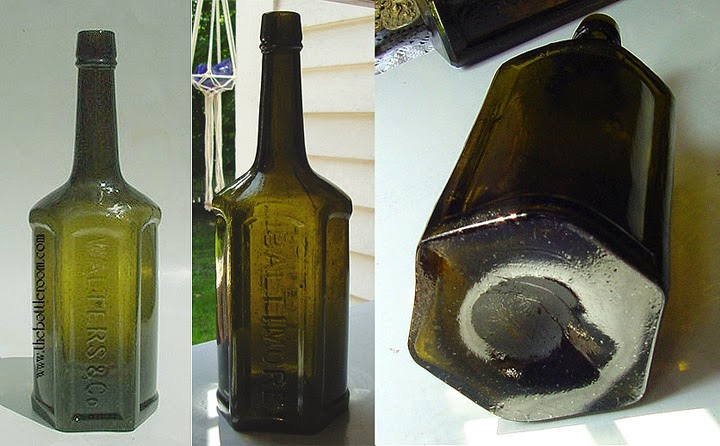
With characteristic vigor Walters resumed everyday management of his liquor business.  He was not a distiller but “rectifying,” that is blending and compounding whiskeys purchased from Pennsylvania and Maryland distillers, using an upper floor of his Exchange Place building. Rectifying is an art and William and Edwin had mastered it.   Among the firm’s proprietary brands were "Imperial Monongahela Rye,” "J. Martin Old Rye,” Superior Old Monongahela Rye,” "Superior Rose Gin,” "Tuscaloosa Monongahela Rye,” and "Very Fine Old Monongahela Rye.”  Walters packaged many of these products in glass bottles bearing two slim panels and two larger panels.  Embossed on one slim panel is “Walters & Co.”  On the other, “Baltimore,” as shown here.  In olive green, the bottles have been blown in a mold with a separately applied mouth, and much coveted by collectors for their rarity. 
Not satisfied with collecting for his own pleasure, Walters wanted to bring art to the Baltimore public, at the time virtually bereft of viewing opportunities.  Beginning in 1874,  he opened his house every Wednesday in April and May, charging the public 50 cents admission, the proceeds donated to charity.  These openings became an annual event.  Meanwhile, William was turning his attention to other investments.   Early on he had put money into East Coast railroads and subsequently was involved in the coal and iron industries.   Walters managed a smelting operation in Pennsylvania said to have produced the first iron manufactured from mineral coal in the United States.   He also had maritime interests.  As these other activities took his attention, in 1882 William Walters dissolved his liquor company.  In 1889, a city directory listed him under the heading “capitalist.”


Among brands Edwin Walters was selling were “Baker’s,”  “Mountain Pure Rye,”  “Walter’s Private Stock.”  The flagship label was “Orient Rye.”  Because the distillery had its own dock, barrels could easily be loaded and from the Port of Baltimore shipped to other parts of the country.  According to Jim Bready, the guru of Baltimore whiskey, Orient Rye eventually was being sold in San Francisco and other points West.  Edwin obviously had mastered the “art” of making whiskey. 

When William Walters died in 1894, his passing was marked with long newspaper obituaries that discussed his career in railroads and other industries.   Almost nothing was said about the 35 years he had owned one of the largest and most successful liquor concerns in Baltimore.  At his death he bequeathed his entire collection to his son Henry, who also added to the artworks.  The assemblage came to include everything from European master paintings and decorative arts to Greek and Roman antiquities and Far Eastern ceramics — a total of nearly 22,000 works of art.   Henry Walters, true to his father’s interest in opening the collection to the public, created an art gallery on Charles Street at the edge of downtown Baltimore.  The original gallery interior is shown here.

The whiskey business bearing the Walters name has long been gone, distillery and office shut down by National Prohibition.   At his death in 1931,  Henry Walters gave his gallery building and its contents to the City of Baltimore where it has become the Walters Art Museum.  On October 26, 2014, that institution opened a special exhibit dedicated to its founders.  Hence the headline:  “From Rye to Raphael.”   Walter’s beginnings in whiskey, albeit belatedly, are being acknowledged -- as they should be.

Note:  Information for this post was obtained from multiple sources, principal among them the Walters Art Museum website and Ferdinand Meyer’s “Peachridge” site.  Several illustrations also are from those sources.


Sunday, October 26, 2014

The Schloss Family Westward Took the “Jug of Empire”

                        
“Westward the Jug of Empire takes its way.   How solemn and beautiful is the thought, that the earliest pioneer of civilization, the van-leader of civilization, is never the steamboat, never the railroad, never the newspaper, never the Sabbath-school, never the missionary — but always whiskey!  Such is the case.  Look history over; you will see.” — Mark Twain

The “Jug of Empire” did not move by itself.  It took human intervention.  As a result, the Schloss family should be considered exemplars of Twain’s observation.  Jacob, Henrietta, Simon, and Abraham Schloss, with son-in-law Moses Stern, brought many jugs of whiskey to Western sites like Leadville, Colorado, and Albuquerque, New Mexico.   As such, they can be accounted among Twain’s “civilizing” pioneers of the West.

The Schloss family odyssey began in Germany where the father, Jacob, was born in 1838.  His wife, Henrietta, also was German-born in 1840.  The newly married young couple emigrated to the United States about 1860 before the outbreak of the Civil War, settling in St. Joseph, Missouri, where Jacob found work as a butcher.  The 1870 U.S. Census found them living there with four children.  Among them were Rosa, born 1860; Simon, 1865; Carlotta and Eva, 1869.  A fifth child,  Abraham (“Abe”), was born a year later. 

St. Joseph, Missouri, in those days was a bustling frontier town, serving as the last supply point and the “jumping off” place on the Missouri River heading to the “Wild West.”  It was the western most point in the United States accessible by rail until after the Civil War.  It is likely that Jacob Schloss was involved in provisioning settlers traveling West and likely hankered himself to join them.  The tipping point for him likely occurred in the mid-1870s when lode silver deposits were found near a place called Oro City, setting off the Colorado Silver Boom.  Mine owners had set up a town to serve their strikes, first calling it “Slabtown,” but later changing the name to “Leadville.”  Shown here in an magazine illustration, by 1880 Leadville was one of the world’s largest and richest silver camps, boasting a population of more than 14,000.


The census that year found Jacob and his family in Leadville. Earlier in the decade they had made the trek west from Missouri, through Kansas to Colorado and Leadville, a journey of some 700 miles,  With many thirsty miners and dozens of saloons, the Schlosses decided that a wholesale liquor business, supplying an evident need for lots of whiskey, was an profitable trade.  Jacob accordingly established a “whiskey depot” on what is now Second Street.  Apparently needing larger quarters as the business grew, he moved to 116 West Second.  The family was living at 216 West Fifth Street, several blocks away.

A 1879 bill from J. Schloss makes it clear that he was dealing “strictly” wholesale.  His wife, Henrietta,  apparently was actively working with him in the business.   In the 1870 census in Missouri Henrietta had been recorded as “keeping house.” Both of them were recorded by the 1880 census with the occupation of “liquor dealer.”   Evidently not just male Schlosses had taken the jug westward.  

Moreover, it appears that the family were having a civilizing influence in rough and ready Leadville.  One commentary says of them:  “Jacob Schloss and his family were significant contributors to Leadville’s economic, political and social life.”   Just a few examples:  In 1880, Jacob was elected as treasurer of the Turnverein Society, the German gymnastics organization.  The next year he was part of a citizen group that organized an electric light company to supply power to Leadville and surrounding areas.  Later he joined with other businessmen to underwrite the construction of the Tabor Grand Hotel.  

Henrietta also was busy.  She became president of the Hebrew Ladies Benevolent Association, providing assistance to less fortunate Jewish residents at a time “when sickness and destitution prevailed.”  According to local press accounts, even the the Schloss children had a civilizing influence, by regularly participating in local theatricals.

When an 1881 fire in the next door Pioneer Saloon did some damage to their 2nd Street location, the Schlosses moved into space at 108-110 Harrison Avenue.  Their business continued at that address until 1899 when it was moved to 322 Harrison, its final location.   Meanwhile Jacob’s sons were being brought into the whiskey trade.  Simon Schloss is recorded clerking for his father as early as 1881, but left for a time to partner in a Leadville stable and horse sales business.


About 1897, a major management shift occurred.  Perhaps for reasons of health, Jacob turned over the business to Simon and his younger brother, Abe.  Simon was president while Jacob remained a director.  The company, at the same address, now became Schloss Bros., as shown above in an early photo.  Simon moved in to live above the liquor store.  He was joined for a time by Abe who shortly after died at the age of 30.  Moses L. Stern, who had married their sister, Carlotta, was brought into the firm as the secretary and treasurer.  

As wholesalers, the Schlosses received whiskey by the barrel and often transferred it into smaller containers, usually one and two gallon ceramic jugs.  As shown here, the Schloss Bros. jugs featured Albany slip brown tops and neck with Bristol glaze bodies with cobalt blue lettering.  Today the jugs are much sought by collectors.   As many other saloons and liquor dealers,  the Schloss brothers also featured tokens, good in trade.  The one shown here was could be redeemed for 12.5 cents.  Sometimes these Schloss tokens are over-stamped for five cents.
That reduction in value may have been symptomatic of what was happening in Leadville. The collapse of silver prices and the slowing of mining activity led to a significant economic decline in the region and a strong exodus of the citizenry to other climes. Among those decamping was Simon Schloss.  Shutting down the Schloss Bros. liquor dealership in Leadville and accompanied by his brother-in-law Moses Stern, he set out to take the “Jug of Empire” even further West. 

Schloss’s objective was New Mexico and the town of Albuquerque.  After New Mexico had been wrested from Mexican control by war, the town slumbered along until after the Civil War when the Atchison, Topeka and Santa Fe Railroad arrived in 1880 and along with it many mountain men, settlers and Anglo merchants.   Although for a time it was a wild and violent place, by 1885 it boasted a major commercial center, shown here.  As Leadville was declining, Albuquerque was on the rise. 
The partners saw the possibilities there and established a liquor dealership they called Stern, Schloss & Company, wholesale liquors, located at 115 West Copper Street.  Simon was president; Moses was secretary and treasurer.   Using the successful model the Schlosses had developed in Leadville, they sold much of their whiskey in ceramic jugs, of which two are shown here. 

The partners were in business for a relatively short time, likely about 12 years.   Temperance sentiment was strong both in the New Mexico territory and after statehood.  In 1917 residents approved statewide prohibition by the staggering majority of three to one.  That vote was three years before National Prohibition.  Stern, Schloss was forced to shut down by 1918.

Simon, who apparently never married, is recorded in the 1920 census as living as a boarder with an Hispanic family in Albuquerque .  His occupation was listed as “none.”  Meanwhile his father and mother who had hung on in Leadville for a few more years are said to have suffered financial reverses.  At some point they moved to the Denver area.

Section 7 of the Congregation Emanuel Cemetery in Denver is graced by a large granite plinth that is prominently marked, “Schloss.”  Having died in 1914, Henrietta is buried in the plot along with Jacob who passed in 1918.  They were joined by Simon in 1934.  Lying nearby is Abe.  The Schlosses are at rest having been instrumental in bringing jugs of whiskey — and presumably civilization — Westward.  Mark Twain would be proud.  

Note:  Some of the information about the Schloss family in Leadville and several illustrations shown here are from a website maintained by Temple Israel of Leadville about the history of Jews in that region.  


Thursday, October 23, 2014

Billie Bott Escaped from Behind the Eight Ball

 William “Billie” Bott and his brother, Joseph, were well known in Columbus, Ohio, as proprietors of the city's most prosperous saloon and liquor dealership, as well as the largest and most elegant billiard parlor.  Then Billie found himself “behind the eight ball” at the center of a well publicized sex scandal.  It was a soap opera with twist that supplied a fortunate ending for the Botts.
Billie, pictured right, and Joseph, left, were born in Zanesville, Ohio, the sons of Caspar and Magdalena Huff Bott.  Caspar, a shoemaker, had emigrated from Bavaria, Germany, and settled in Zanesville in 1840.   Ending his formal education at the age of 13 and seeking larger opportunities, Joseph came to Columbus in 1871 and found work in a variety of retail establishments.  Within a few years, he happened on his true love:  billiards.  Working in a local pool parlor, he became an expert pool and billiards player.

Billie, who had been nine when Joseph left, arrived in Columbus a few years later.  The brothers soon opened a billiard parlor in downtown Columbus immediately across from the State House, guaranteeing a lively traffic from lawmakers and gaining the reputation as the “third house” of the legislature, a place where “a meeting” was always going on.   Later the Botts would move to larger and more elaborate quarters, advertising 40 tables.   They were also branching out into other enterprises.  Their pool halls had always featured a bar;  in 1886 they opened a full-fledged saloon, a part of its interior shown here.  The long and ornate front bar had been purchased from a Chicago saloon erected at the 1893 World’s Fair.  The Botts featured an animated electric bulb sign outside that outlined a pool table where a pool cue descended and balls scattered.  Columbus had never seen its like; customers flocked to the place. 


The following year Joseph and Billie organized the Bott Brothers Manufacturing Company, an enterprise that sold pool and billiard tables and supplies, bar fixtures, refrigerators, playing cards, and even bathroom fixtures.  In short, the Botts handled everything needed to set up, in the minds of many, “dens of iniquity.”  Joseph Bott headed this operation which had a traveling sales force and did business coast to coast.

In 1888, obviously seeing the money to be made in whiskey, the brothers, with a third partner,  founded the Bott & Cannon Company, a liquor dealership, whose principal address was 269 High Street, the main commercial avenue of Columbus. They advertised themselves as “wholesale whiskey and wine merchants, straight and blended whiskies.”  Billie Bott was the president.  Although the company ads sometimes claimed them to be distillers, they were in reality “rectifiers,” blending and compounding whiskey and selling the results under their own brand names.   Those labels included “Old Botts,” “Columbus,” “Edgewater, “Cannon,” and “Old Cannon.  The latter was the flagship brand, advertised most heavily and featuring a Civil War gun on the label.  Bott & Cannon packaged their whiskey largely in embossed glass containers of various sizes, including quart and gallons with bail handles. 
During this period, the Bott brothers also were having personal lives.  Joseph married a woman named Annie Schimpf, a Philadelphia native who was eight years his junior.  I can find no record of children.  Living in the Chittenden Hotel, a recognized socialite and lady’s man, Billie Bott, now his late 30s, had taken a different path.  That path led to the mansion home of a woman named Mary Sells, a woman 18 years of age when she had married a rich man in his mid-30s who subsequently was much absent.  Restless, Mary accepted male visitors when her husband was away, of whom Billie was accounted the first.

In January of 1900 Mr. Sells filed suit against Bott, alleging he had “alienated his wife’s affections” and seeking damages.  He also wanted a divorce from Mary.  Here is a description of what ensued:  “The trial opened on Monday, November 12, 1900, to a packed courtroom…Columbisites were  fascinated with the proceedings and each day jammed into the courtroom in record numbers.” Local newspapers kept their customers rushing for the latest editions to read about the frequently steamy testimony of the participants.  

The most incriminating evidence against Billie was supplied by private detectives hired by the husband to watch the house during his absence.  One of them testified that he had seen Bott ride up on a bicycle and leave it in an archway when he entered the Sells mansion.  The detective stole the bike that night — apparently leaving Billie to walk home after his assignation — and stowed it in his attic as evidence.  When the detective wheeled the incriminating cycle into the courtroom, the sight is said to have been met “with considerable excitement.”  To many it seemed that Billie Bott, the Columbus billiard baron now was “behind the eight ball.”   

The trial lasted five titillating weeks with headlines most days in the Columbus press. Testimony that Mary Sells had entertained multiple lovers put the spotlight on her, however, and not her suitors.  The court found Mary guilty of “gross neglect of duty” to her husband.  This verdict absolved Bott of blame for alienation.  He walked away without paying a cent.  The aggrieved  husband, by contrast, had spent $12,000 on the trial. He was granted a divorce decree in which alimony for Mary was involved.  Although the amount of the settlement was kept secret by the court, the local press reported it at $30,000 (equivalent to $750,000 today).  Mary was forced to vacate the mansion her now estranged husband had built for her.  She soon left Columbus for parts unknown. 

Meanwhile Billie Bott apparently emerged from the trial relative unscathed. His business and personal life apparently went on as if nothing had happened.  The blame widely fell on Mary Sell.  One newspaper summed up the verdict by opining: "When a woman is a devil, she is the whole thing.”   Before very long, Billie married.  His bride was Frances C. O’Conner Farley,  who although nine years his junior was a widow.    She had been born in Columbus in 1870, the daughter of Irish immigrants,  Patrick T. and Mary Farrell O’Conner.  In 1915 Bott purchased a 6.5 acre estate on the outskirts of Columbus and built three homes, including a mansion for Frances and himself at 1070 Broadview, a house that still stands, shown here.  Although the home was spacious, the couple had no children.


Throughout the early part of the 20th Century Bott & Cannon continued to thrive in their liquors sales both retail and wholesale.  As other Columbus whiskey dealers did, they supplied etched shot glasses bearing their advertising to favored customers like saloonkeepers and bartenders.  All that ended for the Bott brothers in 1916 when Ohio voted to go “dry.”  Joseph Bott had already expanded into real estates as president of the Sun Realty Company.  Billie Bott was a partner in that firm as well as secretary of the Crystal Ice Mfg. & Cold Storage Co.  A later addition to their business ventures was the Bott Soda Water Company.  Both men had become  figures of affluence and influence in the Ohio capital.  They were acknowledged as such when the Bott Brothers photos were featured in the program for the 100th Anniversary of the founding of Columbus.


William “Billie” Bott died in 1930, at the age of 69.  His obituary gave the cause of death “apoplexy,” a term that covered several conditions including heart attack and stroke.  His funeral was held at Our Lady of Victory Church in Columbus.  Among the mourners was his widow, Frances, and three sisters.  He was buried in St. Joseph Cemetery.  Frances would join him two years later, as shown here on their joint gravestone.  Joseph Bott died in 1940 and is buried nearby. 

From modest beginnings and only a little formal education, the Bott brothers had turned a passion for billiards — coupled with their business genius — into a fortune and local fame.  Capping this success, Billie Bott, as I have never been able to do, figured a way out when seemingly stuck “behind the eight ball.”