Tuesday, March 10, 2015

Was S. A. Sloman “Skunked” by His Whiskey Advertising?


Seen here in a caricature, the portly gentleman contemplating the pelt of a skunk is Samuel Alexander (S.A.) Sloman of Detroit.  Apparently believing there was quick money to be made in the liquor business, Sloman in the 1890s devised a business plan that largely depended on luring customers by advertising his “Diamond Wedding Whiskey” heavily in Midwestern newspapers.  After several years of vigorous and expensive merchandising, he encountered an expert who told him that his ads were all wrong — and may have propelled Sloman out of selling hooch and into selling hides.

Sloman’s liquor company first is recorded in Detroit business directories in 1892.  Initially his enterprise was located at 100 Griswold with subsequent moves to 1312-1323 in the Majestic Building and 40-41 Buhl Block.  After 1895 Sloman opened a second establishment in Cincinnati, Ohio, at 518 Pearl Street.  At that location he likely was creating his flagship brand, Diamond Wedding Whiskey, a label he trademarked in 1896.  He was buying whiskey supplies from Kentucky and Pennsylvania distillers, and blending and compounding them to achieve a desired taste and smoothness.  Nonetheless, his bottles boasted that the contents were “guaranteed light years old.”   

About the same time that he opened his doors in Cincinnati, Sloman hit the public with a barrage of ads, some of them seen below.  Their most striking aspect is the diversity of designs and the messages they send.  The first one below featuring a bottle, has an “art nouveau” look.  The theme is the purity and medicinal value of Diamond Wedding Whiskey, claiming that it “invigorates feeble constitutions, renews life and arrests disease.”  By contrast, the second ad shows a young bard, apparently in Venice, playing a song for his love on the balcony beyond.  The scene is quaintly medieval.


Look to the first ad below.  Now we have entered fantasy land with little elfin people, ones with thick bodies and skinny legs, many with infirmities,  hastening toward a bottle of Diamond Wedding Whiskey that is being opened by another elf.  The slogan again is “invigorates enfeebled constitutions” without being specific just how it worked.  In the second ad,  the central image now is of a doctor waiting on a clearly debilitated woman while a servant girl pours her a shot of whiskey.  The message here was that Sloman’s Diamond Wedding is invaluable for nursing mothers.  If all three of the squabbling children are being nursed, no wonder the lady has an enfeebled constitution.

The final ad is somehow the most puzzling of all.  Gone is the young bard, the elves, the doctor, the kids and the nursing mother.  Now we are greeted with a parade of men on bicycles, riding one-handed while holding in the other a medley of signs that have a variety of messages.  The most prominent banner attributes to Diamond Wedding Whiskey “power and suppleness to the muscles, warmth and richness for the blood.”  Sloman was paying out large amounts of money to design and print these ads and more dollars to the newspapers carrying them.  He soon discovered that despite this costly merchandising he reaping only meager sales returns.


Enter Charles Austin Bates, seen left.  Beginning as a printshop owner Bates was motivated by the lure of high salaries to become a copywriter in New York City for “Printer’s Ink,” the lead publication of the advertising industry.  Soon he began his own publication called “Criticism” in which he advertised as following: “Send me two dollars, along with a batch of your trade paper, magazine, or newspaper ads, and I will send you a critical opinion of them with suggestions for their improvement, if improvement is possible.”  Clearly frustrated by the poor results of his advertising blitz, in 1898 Sloman sent Bates copies of his newspaper ads, including I imagine some of those shown above.  What Bates sent him back, according to Sloman, was “a beautiful roasting.”  Nonetheless the whiskey man was grateful:  “However, after recovering from the first shock cause by all the unpleasant things you said about our advertising effort, and the realization that so many hard earned dollars had been diverted in practically useless channels, we started in to follow some of the suggestions thrown out for our benefit.” 


For another $2.00 Sloman sent Bates a copy of an advertising booklet that he had issued in 50,000 copies.  They had been sent to dealers, imprinted with their names, for distribution to customers in hopes of enticing them to buy Diamond Wedding Whiskey.   I cannot find a record of Bates’ response.  But his “copy credo” was well known:  “Show price.  Use simple English.  Never overestimate the consumer’s IQ.”  Finally and most important:  “Be truthful.”  Just what advice Bates gave Sloman is not clear but the critic cannot have been pleased with the hyperbole about the dubious medicinal values of Diamond Wedding Rye.
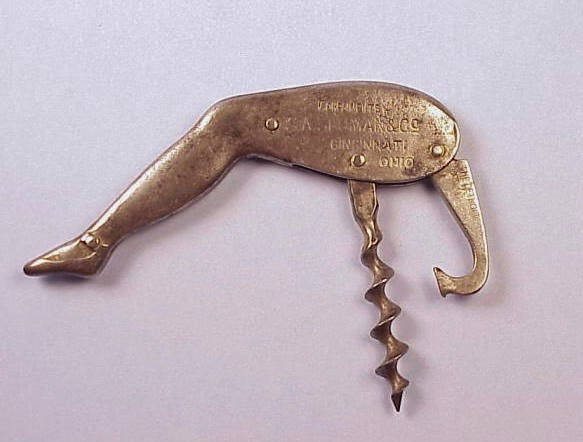
Sloman seemingly had high hopes for his brochures, and probably for the sales value of a tool for bartenders in the form of a woman’s shapely leg, one that contained a cork screw and a bottle opener.  Just like the newspapers ads, those merchandising efforts appear to have fallen significantly short of success.  Just two years later, in 1900, Sloman shut the doors on his liquor establishments in both Detroit and Cincinnati, gave up his trademark on Diamond Wedding Whiskey, and completely exited the whiskey trade.

The death of his father, Mark Sloman, that same year may have provided additional motivation. The elder Sloman had been born and educated in Germany, arriving in the United States in 1851.  The father began as a Jewish peddler in Ypsilanti, Michigan, and subsequently was employed in tanning industry in Detroit.  By 1888 he had saved sufficient resources to strike out on his own as a furrier. Very successful in business, he married Amelia Schlesinger in 1853.  The 1900 census found the couple living with their family of five children, among them Samuel, born in 1858.  Mark Sloman’s net worth was recorded in that census at an astonishing $90,000 — equivalent to $2.25 million today.

When Samuel decided to abandon furs in favor of whiskey, one can imagine that the elder Sloman was not happy with the decision.  But with his death, the prodigal son returned to take over the company his father had built.  Still just 42 years of age, Samuel proved equally sagacious as his father in that trade.  The verse that accompanied the 1917 caricature above reads:

“Samuel A. Sloman is a great fur man;
He hails from old Detroit;
The way he grades all kinds of skins
Is said to be adroit. 
No matter where a fur was caught,
In northern Maine or southern Wis.,
He knows just what it is and why —
Long practice made him wise to this.”

In addition to Samuel’s takeover of M. Sloman & Company, Dealers in Furs and Wools, he also engaged in other business activities.  He became a director of the Standard Sanitary Company of Detroit and a member of the firm of William Wertheimer & Company of Dayton, Ohio, and Wheeling, West Virginia.  He was a member of the Detroit Board of Commerce and the Phoenix Club.  The 1910 U.S. Census found him, at age 53 still a bachelor, living with his 84-year-old mother and a servant.


Within the next four years, he was to marry for the first time.  She was Grace Zenner Blumenthal, born in New York City and a woman some 17 years younger.  They lived together in a spacious neo-Georgian home, shown above, that Sloman built in 1914.  The couple lived there together with his wife’s mother.  They are known to have had one son.  Samuel died in June 1934 at age 76  and was interred at Woodmere Cemetery in Detroit.  The home still stands, part of the Lewis College of Business.

As a final comment on the question that is posed by the title of this vignette, I am convinced that by the time of his father’s death, Sloman had determined that despite all the money he had poured into advertising, Diamond Wedding Whiskey clearly was not making it in the marketplace.   The $2.00 interaction with Charles Austin Bates had given him a cold bath of reality.  With the opportunity to enter the fur trade, one in which his family was well versed, I believe Sloman knew he had been “skunked” and probably never regretted his decision to leave the liquor business. 
Note:  In researching this vignette, I was unable to find a reliable record of Samuel Sloman’s death and place of interment and asked if an alert reader could help me fill in this gap.  A great-grand niece of Samuel Sloman, Carol Borthwick, has come to my rescue and provided this information. I am most grateful to her for this help in bringing a conclusion to the life of this unusual entrepreneur, a man who publicly could admit costly mistakes.  


Friday, March 6, 2015

The Shooting of B. B. Dillard: Accident or Suicide?

    
Below the headline here, datelined December 15, 1909, is the story of B. B. Dillard, a well known Roanoke, Virginia, whiskey dealer and civic leader.  At the age of 40, in front of his wife of only four months, he shot and killed himself.  Was it an accident, as she insisted, or had he committed suicide?   The event is worth exploring.

Dillard was born in November 1868 in Southwestern Virginia, to Alfred Terrell and Sarah Jane Brosius Dillard.  His parent christened him with the startling given names of “Burger Brosius.”  Little wonder that he preferred to be called “B. B.” throughout his adult life.  The Dillards had five children, all boys, but clearly had not run out of standard names when Burger Brosius came along.

The 1880 census found the family living on a farm in the hamlet of Bonbrook in Franklin County, Virginia.  At 12 years old Dillard was in school, where he must have faced teasing over his unusual name.  During his early manhood he appears to have gravitated to the county seat, Rocky Mount.  Named for a steep cliff near the town, Rocky Mount had been founded by English colonists around 1760 who established a courthouse soon after the Revolutionary War.  During the Civil War numerous planter families sought refuge there, bring their slaves with them.  Confederate General Jubal Early was born on a nearby farm as was Booker T. Washington, the first major leader of African-Americans.

Although B. B. Dillard’s activities during his years in Rocky Mount go unrecorded, my speculation is that he was engaged in the mercantile trades while keeping a hand in farming. It was in Rocky Mount that he met and married his first wife, Estelle.  She had been born about 1871 and was slightly younger than B.B.  Although his obituary says that this couple had several children, I have been unable to find census or other data on their identities.

About 1888, Dillard decided that he needed a larger town to satisfy his ambitions or perhaps to finance his growing familial responsibilities.  As a result he moved his business and family to nearby Roanoke, Virginia.  His move was well timed.  To provide the junction of the Shenandoah Valley Railroad and the Norfolk and Western tracks,  rail executives chose a small village named “Big Lick.”  Recognizing the benefits conferred by this development, grateful citizens renamed the town “Roanoke,” coinciding with the river that passes through it.  Within a short time Roanoke became 20 times larger than Rocky Mount and the commercial hub for all of Southwestern Virginia. Inhabitants called it, “The Magic City.”

A major source of trade was selling whiskey — two ways.  First, a thirsty populace inhabited Roanoke so that saloons proliferated.  Second, the railroads made it possible to send liquor by express mail north and south, east and west.  Given a proliferation of distillers in the Virginia mountains (many of them legal), supplies were plentiful.  Dillard saw the opportunity and established a wholesale liquor store downtown on Salem Avenue, the street shown right.  In addition to his Salem Avenue store, Dillard owned a livery stable on West Court Street, having bought the Walter L. Young Livery & Feed Store, the ownership recorded on 1898 and 1902 Sanborn fire maps.  Dillard’s saloon was located near the stables.


The photo above captures the interior of Dillard’s liquor store, indicating that it was a substantial establishment.  The place featured a potbellied stove for heat and gas lamps for light.  Note the row after row of bottles on the shelf on both sides of the aisle.  On the left at back are barrels full of whiskey with spigots to fill stoneware jugs that can be seen on the floor.  My guess is that the gent with the long coat, bow tie and mustache at far left is Dillard himself.   

Although the jugs seen in the photo are of one and two gallon size, Dillard also sold his whiskey in smaller containers, such as the quart bail jug shown here.  He also provided whiskey in small amounts for giveaways to favored customers or perhaps as salesman samples.  Both his large and smaller stoneware have an underglaze transfer label that identified them as from B. B. Dillard at 187 Salem Avenue-West.   Just as mini jugs were a popular way of advertising in Roanoke among the whiskey trade, so were shot glasses, probably gifted to saloonkeepers and barmen.  Dillard’s were among the most ornate, featuring gold rims, elegant design, and deep etching.  All were gifted with the whiskey man’s compliments and messages such as “Liquor Dealer” and “Fine Whiskey.”

In 1904, tragedy struck the Dillard family.  Estelle Dillard, only 33 years old, died.  B.B. was left with small children to raise.   As great a sorrow as this may have been, he did not immediately remarry but appears to have thrown his efforts into his work and community development.  In 1906 Dillard was part of a local group of businessmen and investors who sought a charter from the Roanoke City Council to build an electric railway in the city.  They were successful and in 1907 the Roanoke Traction Company was incorporated, capitalized at $40,000 ($1 million today).  Dillard was named a member of the board.  During this period he also was investing in Roanoke area real estate.

The following year he was a member of a group of Roanoke whiskey dealers who complained to the State of Virginia Corporation Commission that the Southern Express Company, the principal shipper in that part of America, was refusing to take their mail order whiskey into three far western Virginia towns that had voted themselves “dry” under local options laws.  It was still technically legal to ship liquor into such localities but express agents who did so frequently were targeted for arrest by local authorities.  Although the State Commission ruled in favor of the liquor dealers, Dillard sold his liquor store the following year, likely sensing the onrush of prohibition in Virginia.

In 1909, five years after Estelle’s death,  Dillard married again.  His second wife was Nannie Carrie Flagg, the daughter of Lucius Comee Flagg and Everline Walker Franklin.  Nannie was 23 years of age, he was 40.  Whether this age differential played any part in what occurred is unknown.  What is known is that on December 14, 1909, B.B. went home and shot and killed himself in the presence of Nannie Carrie.  They had been married only four months.

There seems to have been little reason for a suicide.  His obituary noted that he “had been successful in real estate and had amassed a fortune.”  His investment in the electric railway also seems to have been rewarded.  The Roanoke Traction Company was successful and within a few years was building inter-urban railway lines not only in Virginia but also in North Carolina. Friends who had seen him the evening before his death declared he was in a happy mood. Finally, his widow was adamant that the shooting had been an accident.  Nevertheless, press accounts hinted at suicide.  In the end, it is impossible to know.

Dillard was buried in Fairview Cemetery, not far from where his first wife, Estelle, was interred. Both tombstones are shown here.   B.B.’s memorial stone at right does not give his full name, just the initials he preferred.  Of interest is the inscription etched in the stone:  “God gave—He took—He will restore.  He does all things well.”

Nannie Dillard, however, had one last surprise for the people of Roanoke who were buzzing over these events.  At the time B. B. died she was three months pregnant.   In July of the following year the Widow Dillard gave birth to a boy.  With a full range of names available to her, almost unbelievably, she had him christened “Burger Brosius Jr.”  (His friends called him “Bill.”)


Wednesday, March 4, 2015

How the Baetzholds Bloomed in Buffalo

 August Baetzhold spent much of his early life in Germany and in the United States earning a living with hammer and saw as a carpenter.   Beginning in 1862, however,  August used other tools to construct a liquor establishment that lasted more than half a century, had a nationwide reach, and thrust the family into the forefront of the business world in Buffalo, New York.

Born near Bad Langenfalza in the State of Saxony in 1833,  Baetzhold as a youth apprenticed as a carpenter and joiner.  Leaving Germany at the age of 19 in 1852 he settled immediately in Buffalo, where he may have had relatives. While working in the building trades there he met and married a woman named Esther. The couple’s first child, August, Jr., was born in 1859, followed in quick succession by Theodore (1860), Emilia (1863), Albert (1864) and George (1867).


Perhaps recognizing that his growing family required more resources than carpentry could provide, DBaetzhold opened a small liquor store on Main Street in the Cold Spring District in 1862.  Proving to be extraordinarily able in the whiskey trade, his business grew rapidly and by 1870 he was forced to find a larger venue, settling into retail space at 346 Ellicott Street.  That also would prove to be too small and within two years Baetzhold had purchased the Odd Fellows Hall, remodeling it from the ground up. His construction skills insured its long-term utility.  Shown here,the three story building at 567-571 Michigan St., cor. Cypress, would be the headquarters for the family business for the next 48 years.

As the signage on the side of his building boldly proclaimed, A. Baetzhold was a “rectifier of spirits,”  that is, blending and compounding whiskeys from a variety of distillers to create his own desired taste and smoothness.  At wholesale he sold this liquor in large “beehive” shaped stoneware jugs, with his name imprinted on them.  These would have been decanted by bartenders and served over the bar.  Baetzhold also featured his own proprietary brands.  They included “Deer Run,” “Santa Fe,” and “Gold Coin.”  He trademarked the first two in 1905 and the last in 1906.  He also featured an alcoholic remedy called “Dr. Capias Herb Bitters” and was the local agent for “Sloman’s Diamond Wedding Pure Rye.”  He gifted saloons with reverse glass signs and tip trays that advertised several of these brands.


As his business burgeoned, August faced a personal setback when his wife, Esther, only 38 years old, died in 1869, leaving him with five children under ten to care for.  Curiously enough, his biography in a 1912 book called “Buffalo and Its German Community” fails to mention anything about her death.  Nor does it mention his having married a second time, as indicated by U.S. census records.  Both the 1880 and 1900 census show Baetzold as having wed a woman whose name was given variously as “Mary” or “Anna M.”   The 1900 census data indicates that the couple married in 1870, about a year after Esther’s death. No children were indicated from this union. By 1910, this second wife had died.

 Another sorrow occurred in 1895 when Baetzold’s third son, Albert, died suddenly.  A news account reported:  “He went into the street in a heated condition after a contest in a bowling alley, caught cold, and was carried off by pneumonia in two days. He was 31 years old, nearly 6 feet tall, weighed 180 pounds, and had the red cheeks of a girl.”

Despite these personal tragedies August seems to have continued on course.  With the success of his business came recognition from fellow Buffalo residents.  In 1877 he was elected to a term as a Buffalo alderman from his (then) Sixth Ward.  He became a director of the German American Bank and a director of the Excelsior Brewery.  He was elected State Treasurer of the New York Wholesale and Retail Liquor Dealers for many years.  August also had vigorous social life, deem a prominent member of the Maccabees, a Canadian founded fraternal organization; the Buffalo Orpheus, a theater group; Sangerbund, a German choral society, and the Gymnastics Club.


Baetzhold was devoted to his family.  As his boys matured, one by one he introduced them into the business.  A Buffalo directory for 1893 showed three of his sons working in his wholesale wine and liquor business — August Jr., Theodore and George.  Eventually a grandson, August C., would join the firm.  In 1908, recognizing the family affair his company had become, the father changed its name to “August Baetzold & Sons.”  

August Jr., shown left, seems to have been groomed by his father for top management.  Said to have been a “chip off the old block,” he had been given a good education before joining the firm.   Theodore, at right, may have left school early to go to work with his father. He became a traveling salesman, reputed to have introduced the firm into new territories and increased its customer base throughout the U.S. George's role was undisclosed.

Under the new organization name, the Baetzolds continued to pursue the same merchandising course as had proved successful in the past.  Now, however, the stoneware jugs in which they wholesaled their liquor had shed the beehive look for the more practical and cheaper “shoulder” jugs, as those shown here.  They also continued the tradition of providing attractive give away items, such as the reverse glass saloon sign below that advertises all three major Baetzold brands.


In  January 1911, August Baetzhold Sr, died and was succeeded by his eldest son as president of the company.  The book “Buffalo and Its German Community” in 1912 said of August Jr.:  “Today he is considered among the most respected citizens and businessmen in the city.  He is well liked and esteemed in all he circles in which he travels.”   August Jr., was a joiner like his father, with membership in many of the same German-oriented groups to which his senior belonged as well as in local, state and national liquor dealer associations.  In addition he was said to be a “prominent” Free Mason.  This Baetzold too would know heartbreak.  About 1882 he had married Natalie Kuster and with her raised a family of four children, two girls and two boys.  Just a few months before his father passed in 1911, Natalie died at the age of 53. 

Meanwhile, during times “off the road” selling Baetzhold whiskey, Theodore also had a personal life.  In 1886 he married Jenny Hitschler.  They would have two children.  He too made his mark in Buffalo,  being a member of the same German-oriented groups as his father and brother as well as a member of the Fraternal Order of Elks.

Two years after their father’s death, reflecting the new management structure, the brother changed the company name for a third and final time to “August Baetzhold’s Sons.”  Artifacts can be found that bear all three names, allowing them to be dated more precisely.  The sons also briefly opened a second Buffalo outlet at 567 Washington Street.

Already with years of experience in the wholesale liquor trade the brothers found no difficulty in maintaining the reputation their father had built. The book cited above enthused about the Baetzholds’ Rhineland and California wines, and called their liquor “first class goods.”  It ended its biography of the family by stating:  “The firm of August Baetzold & Sons is built on strictly honest business practices and it is one of the largest and best known firms of its kind in this part of the country.” 

None of those attributes obviously mattered when alcohol prohibition advanced across America, cutting off sales locality by locality and state by state.  When National Prohibition became inevitable, the Baetzholds shut the door on their enterprise of 56 years in 1919.
The Baetzhold brothers lived to see Repeal.  August Jr. at age 77 died in 1937 and Theodore, age 79, in 1945.  Both men are buried next to their wives in the Forest Lawn Cemetery of Erie County, in adjoining plots.  Nearby is the grave of their father,  August, and Esther, his first wife and their mother.  Shown here is the elaborate monument that stands over their interments with the Baetzhold name at the base and the monogram “AB” on the shaft.

Note:  Much of the information here was derived from the book cited above, “Buffalo and Its German Community.”   This was an illustrated text, including photos of the Baetzholds, published by the German-American Historical and Biographical Society in 1912.  Originally published in German, it has been translated and made available online by Susan Kriegbaum-Hanks.


Saturday, February 28, 2015

John Kellenberger Made “Whoop-E-Tee-Whoop” in Durango

                     
The saloon token  above, good for a princely $1.00 in trade, has no identification as to who issued it, on both sides simply stating “Whoop-E-Tee-Whoop” and Durango.  It had no need to.  Everyone in Durango knew this was the standard greeting and trademark of John Kellenberger, a Swiss immigrant who came to the Colorado town run a liquor business and saloon and became a local legend for his colorful personality.

Kellenberger, shown here about 1901, was born in 1861 and came to the United States in 1880.  After landing in New York City, the young Swiss made his way to Brechenridge, Colorado, perhaps drawn there by the similarities in the landscape of his homeland that promised Alpine style skiing opportunities.  With gold having been found in the vicinity, Breckenridge was thronged with prospectors, some with money, who were hungry for fresh bread and pastry.  Probably with some early experience in the trade, Kellenberger started a bakery.  Either because this enterprise was not successful or because he sought more lucrative opportunities, after two years he closed up shop and headed to Southern California.

Upon arrival on the West Coast he served an apprenticeship in wine making, an industry in which many Swiss immigrants were engaged.  Kellenberger clearly had a talent for wine.  It is reported that during his ten years in California he established wineries at three sites south of Los Angeles.  He also ran a saloon in Santa Ana.  Ignoring a local ordinance against Sunday sales, he was caught by the local police for selling liquor out the back door.  Hauled into court he was fined $40 for his indiscretion.  The Los Angeles Herald commented:  “Kellenberger didn’t like to pay the fine, but he did so and now he is a sadder but  much wiser man.”

As he “wised up,” Kellenberger decided to return to Colorado.  During his California sojourn he had met an Austrian immigrant woman named Marie who was nine years his junior.  She is said to have been a woman of considerable culture, speaking five languages including German, French and Italian.  They married and a daughter, Lydia, was born in 1892, just in time to join the family move to Durango, Colorado.  This settlement, nestled in the Animas River Valley and surrounded by the San Juan Mountains, had been founded by the Denver and Rio Grande Railroad to serve nearby mines.  Durango too might have reminded John of his Alpine roots.  Perhaps the same held true for Marie.   A second child, Erma, was born not long after they arrived.

Durango, named after a town in Mexico (in turn, after a town in Spain), literally means “water town.”  As a place where mine workers dwelled, however, something strong than water was their preference, and Kellenburger was eager to supply it to them.  With the money he had saved in California he opened a liquor and cigar store and saloon at  951 Main, the major commercial street, shown above as it looked in the late 1800s.  

Kellenberger’s drinking establishment was like nothing Durango had ever seen before.  The front windows, shown above, were crammed full of whiskey bottles together with the owner’s eccentric collection.  As can be seen, it included a stuffed dog, owl and pistol packing bear.   Other items included violins, ore samples, a snakeskin and a scalp.  Seen below, the bar was dark mahogany with a brass rail and an array of saloon signs behind the bartenders.  Note the spit bucket on the floor.  Sales were conducted in a rear room where whiskey could be bought by the barrel or the bottle.

Kellenberger was not just buying finished and bottled products, but “rectifying” whiskey;  that is, buying raw liquor in large quantities from distillers, probably in California, then blending and compounding it to taste in a back room of his store.  Much of his whiskey he sold in large ceramic jugs, gallon and half-gallon sizes.  Ever canny, he recognized that the Kellenberger brand could get recognition just by exhibiting at various international expositions.  That reputedly gained him medals at New Orleans in 1885, Chicago in 1893 and Paris in 1900.  He also was bottling beer and created a delivery system for his products throughout Colorado and Northern New Mexico.


The personality of a Western saloon owner was crucial to its success and Kellenberger had personality to burn.  Not only was his “Whoop-E-Tee-Whoop” greeting to his customers a source of conversation for Durango locals but, according to Historian Kathy Myrick, stories abounded about him and his cronies taking train trips while playing cards and lunching on fine cheeses, bread and smoked tongue he supplied.  The February 1903 Mining Reporter listed Kellenberger recording a claim for a mineral lode near Durango at a mine he whimsically called “Canary Bird.”
Like many saloonkeepers Kellenberger was lavish with giveaway items including bar tokens.  In additional to the $1 token that opens this vignette, he handed out 12 and 1/2 cent ducats that had his name on one side and a pictorial of the Durango smelter and grazing deer stamped on the other.  The tokens have been dated about 1897.  Still another attractive gifted item was a clear glass back-of-the-bar bottle with gold lettering advertising “John Kellenberger…Wholesale Liquor…Durango, Col.”

Kellenberger’s time in Durango encompassed the worst disaster in the town’s history.  An historic rainfall in October 1911 turned the Animas River into a torrent that destroyed crops, washed away more than 100 bridges and damaged some  300 miles of railroad tracks.  Lives were lost as fifteen feet of water rushed through Durango streets.  Kellenberger was in Telluride 120 miles away when the torrent hit.  Anxious to return home, he tried many several routes, finding each of them washed out and impassable.  He finally was able to telephone the Durango Evening Herald for a report on conditions.  “John Kellenberger phones in from Telluride that he is now doing a ring-around-the-rosy act,”  the paper quipped.


Meanwhile, another torrent was rising.  The forces of prohibition were closing in on Colorado and the liquor trade.  Kellenberger saw them coming and in 1915, just before the state went dry, he bought the Durango Bottling Works.  Subsequently he was forced to close his saloon and the liquor store, shown above.  Then he and his employees simply moved down the street, exchanging hard drinks for soft.  Shown here about 1916 is a train car apparently full of Kellenberger’s “Raspberry Julep” bound for Leadville, Colorado. Once laced with alcohol, his julep recipe had reappeared as “soda pop.”


Although Kellenberger had left California apparently wiser about breaking the law, the advent of prohibition in Colorado caused him to hatch another scheme.  He went to still “wet” New Mexico, near the small town of Chama, and is believed to have buried a supply of his whiskey.  According to Historian Myrick, in 1916 he attempted to smuggle liquor back into Colorado in a train car with a bill of lading that gave the contents as “hay.”  Once again, the authorities caught him, penalty unknown.  Legend has it that some of Kellenberger’s stash may still lie underground somewhere in New Mexico near the Colorado border.

After this incident, Kellenberger seemingly reconciled himself to producing and selling only non-alcoholic beverages.  He bought the Adolph Coors building in Durango, built originally as an adjunct to the brewing family’s Golden headquarters.  Obtaining the first Coca-Cola franchise in the region, he converted the building to a successful Coke bottling plant. In the 1920 U.S. census, his occupation was recorded as “merchant, wholesale cigars and beverages.”  He and Marie still were living in their spacious Durango home at 827 Third Avenue at the Boulevard.

Although I have been unable to find information on Kellenberger’s death and burial site, a fitting memorial to this whiskey man was provided in a 1901 article that described the Swiss immigrant as: “…A public spirited man, one who stands very high in business circles in Durango and throughout the State.  He is liberal and progressive…benefits his community by his enterprise and pluck.”  And, it must be added, he greatly entertained his fellow citizens by his “Whoop-E-Tee-Whoop.”

Note:  I was in the process of researching a post on Kellenberger when I came across a current article on him by Kathy Myrick in the Winter/Spring 2014-2015 issue of Durango Magazine, published in that city.  I have included here some information and three photos of Kellenberger’s saloon from her article as “fair use,” because I strongly advise anyone interested in Kellenberger or Durango to buy the magazine, which has a number of excellent articles, including hers. It also has interesting ads and is well worth the price.  Check the magazine website.  An aside:  Although I have never been in Durango, the nickname “Jocko-from-Durango” was given to me in 1958 by a newspaper editor for reasons too complicated to go into here. I have used it as a “nom de plume” on numerous occasions and have always wanted to visit the city itself.


Wednesday, February 25, 2015

E. H . Roche Came Out of the Boonies into the Big Time

After years of toiling in the hinterlands of the upper Midwest, saving his money and making a reputation  in small towns like Rochester, Minnesota, and Aberdeen, North Dakota, Edmund Henry (E. H.) Roche at the age of 45 moved to Chicago, a city rapidly making a name on the world scene.  Embracing the “Big Time,”  Roche never looked back.

Edmund was, after all, a big city boy, born in New York City in 1854 to Irish immigrant parents, James and Susan Gould Roche.  After being given an elementary education in local schools, at the age of 13 he left the Big Apple for  Minnesota where he worked on a farm until he reached 21.  Obviously a thrifty and enterprising youth, Roche moved to Rochester, Minnesota, in 1876 and opened a general store.  This town had been founded as the seat of Olmstead County and with the arrival of railroads in the 1860s, the village was growing rapidly.   Today Rochester is third largest city in Minnesota and the site of the famed Mayo Clinic. 

In Rochester he met his future wife, Anna Dwyer.   Born in Ripon, Wisconsin, she was the daughter of Mary and William Dwyer,  both Irish immigrants.  Edmund and Anna married in 1878 and produced five children, four girls — Susanne, Mary, Clara Frances, Katherine —  and the last one a boy, John Pierre.  Roche’s store was selling whiskey, often the biggest money maker for such enterprises.  He also opened a Rochester drinking establishment.  The 1880 census gave his occupation as “saloon keeper.”

In 1883 after five years in Rochester, Roche, apparently seeking better prospects, uprooted his family and moved 360 miles overland west to Aberdeen, North Dakota, a town officially plotted only two years earlier when the Milwaukee Road railhead arrived.  The new community was granted a charter by the state legislature the year Roche got to town.  As a result of the railroad Aberdeen was attracting new residents and apparently seemed to Roche a more fruitful location for his kind of business.  There he became known throughout the Upper Midwest as a spokesman for liquor interests and an ardent anti-Prohibition spokesman.  In 1886 he became a founder/director of the National Protective Association, an organization fighting prohibition efforts at both state and national levels.

Roche’s was an embattled stance in North Dakota where so-called “temperance”  forces had lobbied hard and effectively to declare the state “dry.”   The legislature obliged them in 1889 after Roche had been in business for only five years.  He then shut his doors in Aberdeen, uprooted his by now larger family, and moved 700 miles east from a Northern Tier backwater to America’s second largest city — Chicago.  He clearly had been saving his money because on his arrival he announced that he was purchasing the established liquor business of Enright & Kelly, founded in 1877 and operated successfully for two decades at 226-28 Kinzie St.  

In 1888, however, those Irish partners had been hauled into court for having “engaged in business within said city of Chicago, selling and offering for sale spirituous and vinous liquors in quantities of one gallon or more at a time without having or having had any license therefor from said city of Chicago.”   Found guilty, Enright & Kelly had to fork over the equivalent today of $11,200 and soon after sold out to Roche. He renamed the business the “E.H. Roche Company.” and told industry publications that he also intended to start a brewery in the city on Lake Michigan.

Roche was made for Chicago — and Chicago for Roche.  The era was one of exuberance in the “hog butcher for the world,” as Carl Sandburg termed the city.  The 1891 pamphlet cover that opens this post captured the tenor of the self-proclaimed “Metropolis of the West” with its global aspirations in the arts, science and industry. That drive that would culminate in the Columbian Exposition of 1893, a World’s Fair of a proportion and impact seldom if ever to be equaled. Roche was quick to catch the flavor of Chicago, symbolically naming one of his flagship whiskeys “World’s Fair Rye” and issuing a colorful paperweight that advertised the liquor and the fair.  Other brands were “Aberdeen Club Rye,”  “W.W. Brownfield Sour Mash Whiskey,” and “Edro Rye.”  Shown throughout this post are containers and giveaway items Roche provided to advertise those brands.  
Moreover, like Chicago, Roche rapidly was expanding the scope of his business.  Only two years after settling there, he opened an outlet in Des Moines, Iowa, at 213 Fourth St.  He advertised “Roche’s Royal Rye” brand in his ads there.  Two years after that he opened stores in Detroit, Michigan.  They occupied several locations:  365 Grand River Avenue (1898), 47 Cadillac Sq. (1894-1898), and 119 Woodward Avenue (1896-1905).  In 1901 he obtained an interest in the bankrupt Brewer & Hofmann Brewing Company of Chicago.

By the early 1900s Roche also had become the president of the Hendryx Distilling Co., shown below.  Despite the name of the firm, he was not a distiller, but a rectifier, that is, blending and compounding whiskeys on one of the floors of his building at 170 East Ohio Street.  In order to insure a steady flow of raw whiskeys for rectifying, he had investments in or contracts with outside distilleries.  Among them was a stake in the Atherton Distillery (RD #87, 5th District) located in La Rue County, Kentucky.  (See my post on Atherton, February 2015.)

In addition, Roche had made friends for himself in Illinois politics.  He became a confidant of Judge Edmund F. Dunne who in 1904 was elected to a two-year term as mayor of Chicago.  Upon assuming office, Dunne appointed Roche as  purchasing agent for the city.   The job paid $4,000 a year, a hefty pay check equivalent to $100,000 today.  A newspaper rundown of the mayor’s “cabinet” had this to say:  “This office requires a businessman who is thoroughly posted on business methods, as all purchases of the city, except those made by contract, are made through it, amounting to nearly $800,000 per year [$20 million today]. Mr. Roche conducts his office on strictest business principles and fills his position most credibly.”
Strong praise for a man who likely never finished high school and whose principal business experience was juggling a large liquor enterprise spread over three cities.  Roche, however, did not hold the position long.  The Republicans swept Illinois in the 1906 elections, beating Mayor Dunne by 13,000 votes.  At least temporarily Roche was sidelined but was hired back later when Democrats controlled Chicago. In interim periods he worked as an insurance broker.  By 1916, at age 62 he was being referred to as “Hon. Edmund H. Roche” and was serving as the State of Illinois’ Department and Institution Auditor.

With his emergence as a public servant, Roche shut down his liquor empire.  His Detroit stores disappeared from local business directories in 1905 and his Chicago headquarters was delisted in 1906.  He also terminated the Des Moines outlet. His career as a leading whiskey man came to an end.  During subsequent years Roche’s wife, Anna, died in May 1916.  Meanwhile his son, John Pierre, was making a name for himself in as a successful Chicago advertising executive.  Roche himself died in Chicago in November 1929, age 75, and was buried in Calvary Cemetery in a plot beside his wife and and adjacent to two grandchildren who died young.  A seven-foot monument, inscribed “E. H. Roche,” stands 40 yards from his grave near a plot where four of his children are buried.

Edmund H. Roche, the child of Irish immigrants who received only a limited education, had emerged by dint of his energy and intelligence from the hinterlands of America at a relatively advanced age to “make it” in the booming metropolis of Chicago, not only as the head of an expansive whiskey business and as a prominent national spokesman for the liquor industry, but also as a effective and respected public servant.  Exchanging the “boonies” for Chicago’s “big time” had been productive.