Thursday, September 10, 2015

“The House of Fee on the Genessee Since 1863”


The Fee Company of Rochester produces more than 80 drink mix products and the fourth
generation Fee family uses the rhyme above to represent the company’s roots in a saloon
and liquor business that the Fee brothers and their mother began in 1863.  When I find a 
good piece on whiskey men, such as the one here, this one authored by the Fee Company 
itself, I use it for this blog, rather than reinventing the narrative.  In this case, however I 
have shorten the story to include only pre-Prohibition events:

The year was 1835. It was a cold March day when 31-year-old Owen Fee first set eyes on America. He had been born in Ireland's County Monaghan. By 1847, Owen had opened a butcher shop and was living in Rochester, New York with his wife, Margaret, and their three children, James, Mary Jane, and Owen Jr. Within the next three years, two younger brothers were added to the family. John Fee was born in 1848. (This was also the year that Owen Sr. became a US citizen.) Joseph arrived in 1850. Later, the records of St. Bridget's Church indicate that 6-year-old John and his 15-year-old brother James were the first altar boys there when it formed in 1854.

Owen Sr. died in 1855, and on that sad day, left Margaret to raise their five children alone. This was a daunting task as they ranged in age from five to mid-teens. Margaret was a strong woman though. She brought James through some stormy teen years and by 1863, the family had converted the butcher shop into a saloon and delicatessen. Together they made sandwiches and sold them at the depot to passengers waiting on trains. By the time James was 25, he had opened a grocery/liquor store. Margaret had mortgaged her house to enable her son to do this.

James Fee
The years passed by quickly and James grew to be a fine young man. In his mid-thirties he was elected Police Commissioner and also Collector of Canal Tolls in Rochester. James must have had unbounded energy for he ran these posts as well as managing his business. He did, however, invite his brothers to help him with the liquor store. 
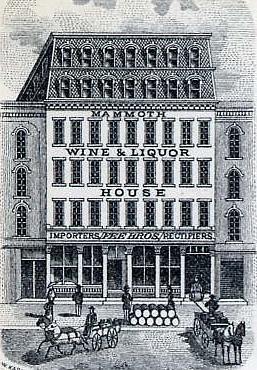
They were now located on North Water Street near the Genesee River in downtown Rochester. Their company further developed into a winery and import business. The Fee brothers not only made many kinds of their own wine but also brought in wine from California and imported European wine.  Various brands of liquor were handled there as well. Much of this was stored in wooden barrels. The story has been told of a tenant in that same building who drilled a hole through the wall and into a barrel. Then, with a long tube inserted into the barrel, his liquor supply was endless.

Owen Fee
Brother Owen was a partner and bookkeeper until November 1881 when he died of heart failure at the age of 35. It was only four short months later that their mother, Margaret, died of cancer. In 1883, the three remaining brothers changed the company name from "James Fee and Brothers" to "Fee Brothers." James and John had formed a partnership and Joseph was their right-hand man. They worked together for twelve years building their business until Joseph died in 1895 at the age of 45.


Joseph Fee
James and John had been through some rough times but more hard times were yet to come. On February 5, 1908, one of the worst fires in Rochester history caused $400,000 destruction to their building on North Water Street. It must have been difficult for them to pick up the pieces of their shattered business and continue. However, by August of that same year, rebuilding was completed and they were back in business. By this time the next generation (John's son, 15-year-old John, Jr. and James' children, 29-year-old J. Leo and 21-year-old Marguerite) had begun to help at Fee Brothers.

John Fee
It is said that John Fee always had a sparkle in his eye, a good sense of humor and a ready laugh. He raised his son with those same attributes and also with good business sense. John died in 1912 at the age of 64, leaving John, Jr. to succeed him. One year later, at the age of 20, John, Jr. enlisted in the New York Cavalry. During his five-year service, John was assigned to the Mexican border. At that time the U.S. was engaged in the Mexican Border Incident with Pancho Villa. Upon returning to Rochester, John, Jr. continued working alongside his cousins, Marguerite and J. Leo and his Uncle James until April of 1920 when James died at the age of 79. Fee Brothers had been passed on to the next generation.


Addendum:  Shown here are examples of the shot glasses issued by the Fee Brothers during their rise to prominence as liquor merchants.  Below is a picture of Rochester’s Holy Sepulchre Cemetery where the four Fee brothers are buried.  With National Prohibition the company moved to making and selling altar wine and kits for home wine-making.  After Repeal the company over time moved away from liquor and wine to bitters and nonalcoholic drink mixes.  It continues in business today after 152 years of Fee family 
ownership.  


Sunday, September 6, 2015

Lacy Holt’s “Out of Time” North Carolina Whiskey

                 
“Private Wightman passed on taking a drink…but he dld read the writing on the vessels as he passed them on.  ‘Lacey Holt Distillery, Graham, N.C.,’ and he looked at me, ‘Yeah, looks like the Lieutenant got a gift from home just for us.

“A couple of times around our squad and that old jug of Mr. Holt’s was as dry as a creek bed in the middle of a summer drought…”I…remember John Henry getting Mr. Booger to let us have a taste of Lacy Holt’s finest,”  I said.  Joseph reached up, scratched his head and said, “Little Brother, Mr. Booger may have given you and John Henry a taste but that corn whiskey never touched my lips.”  — a passage from the 2007 Civil War novel, “The Underground Brotherhood,” by Franklin Martin Kimball. 

If Albert Lacy Holt had been alive in 2007, he might have been proud to have his whiskey mentioned so prominently and praised in print.  But he also would have been considerably puzzled. Lacy Holt was born in 1867, two years after the end of the Civil War.  His whiskey in a variety of jugs did not appear until several decades later.

This Holt was from a long lineage of North Carolinians.  He could trace his ancestry there back to the 1700s.  His father, Sidney Brower Holt had been born in 1834 in Orange County, moving to Alamance County and the town of Graham, shown below, as a young man.  There in 1866 he married Lacy’s mother, Mary Ann  Roney, the daughter of Benjamin and Delilah M. Roney.  She also had been born in Orange County.  A year later Lacy was born, the first of four children.

Sidney Holt was a farmer and like many farmers at the time it is likely that he ran a small distillery on his homestead.  Growing corn as his principal crop, he recognized the “value added” of making some of it into whiskey.  Most of this product would have been sold locally to neighbors or people stopping off at the Holt farm near Graham, shown above.  Lacy as a chld may well have been learning distilling, as well as agricultural skills.

The 1900 U.S. Census found Lacy Holt farming on land that, as the eldest son, he likely inherited from his father, who died in 1895.  This farm was located near Great Alamance Creek, adjacent to the covered bridge that is now a historical landmark along Highway 87.  By 1900 Holt had created a larger distillery, one that was engaged in creating a considerable number of barrels annually and selling whiskey to a wide customer base in Alamance County and beyond.  Holt was noted for having kept barrels sitting on shelves of his distillery with tags stating the age of the whiskey.

Most of all, however, Holt became known for being the first whiskey-maker in the region to have jugs made with a label advertising his distillery.  Shown throughout this vignette are the variety of ceramic containers that he commissioned from the some of the area potteries.  His jugs range in size from several gallons to half gallons and Bristol glazed with cobalt blue labels to those with brown Albany slip tops.

By 1900 Holt also had been married four years.  His wife was Ora Wood, a woman nine years his junior and a North Carolinian by birth.  They married in Alamance County.  Their first child, a girl, was born in 1901, followed by two boys and a girl, born over the next dozen years.

As another indication of Holt’s expanded facility was his registering his operation with Federal authorities and accepting government regulation.  His plant was designated Registered Distillery #2092, located in North Carolinia’s Tax District No. 4.  Incomplete records show Holt making a number of transactions from 1898 to 1904 — storing and subsequently removing whiskey for sale. The clear implication is that he was carrying on an active liquor business.
As the 20th Century moved on, however, North Carolina increasingly was putting strictures on sales of alcohol.  After a number of counties and communities had gone “dry” under local option laws, a statewide prohibition was imposed in 1909.  If Holt had not shut down his distillery earlier in anticipation of the ban, he would have been forced to before its imposition.  

The 1920 census found Lacy and Ora off the farm and living in Graham on Melville Street.  Holt was running a store with a partner named C.L. Howard that they called the Graham Grocery. It was located on Main Street near the Alamance Court House, shown below.  Holt appears to have operated this business for a number of years until a chronic heart condition caused his retirement.  He died in 1930, the cause given as  “heart failure,” and was buried in Graham’s Linwood Cemetery.  His gravestone is shown below.  Ora, his widow, would join him there 37 years later.  
Meanwhile the excellence of Lacy Holt’s whiskey may have taken on  mythic significance in Alamance County and perhaps even elsewhere in North Carolina.  His liquor was sufficiently iconic to have merited attention in Kimball’s Civil War novel.  The author’s introduction  warns that:  “Certain characters in this work are historical figures and certain events did take place.  However, this is a work of fiction.”   

My guess is that Mr. Kimball thought Holt and his whiskey were among the historical elements.  Unfortunately, Holt was unable to oblige — being born two years after the Civil War ended. In this instance his distillery literally was cited “out of time.”  But Lacy Holt likely would have greeted this obviously erroneous reference with a grateful but wry smile.


Thursday, September 3, 2015

The Becks of New York Pioneered in Paris

Joseph Beck & Sons were not the only whiskey men to display their wares at the Paris Exposition of 1900, but the New York City distiller/rectifiers appear to have been the smallest company among the pioneering fourteen exhibitors who made “so fine a showing,” won a plethora of medals, and early on brought American whiskey aggressively to the attention of the European Continent.
According to the letterhead shown above, Joseph Beck & Sons was founded in New York City in 1866, just after the conclusion of the Civil War.   At some point Beck took two of his boys into the business with him.  Local business directories listed Joseph as president, son Max was treasurer and secretary, and son Albert, a manager and company director.  

The Becks advertised themselves as “distillers and rectifiers” (i.e. blenders).  In addition to “Goose Gin”  they featured two brands of whiskey, “Belle of New York” and “Beckmore Rye,” the latter their flagship label.  Shown here is a flask with Beckmore embossed across the front and an elaborate back-of-the bar bottle with that name in an etched gold label.  “Beckmore” was also the company’s cable address.   Although several street addresses were listed for the firm over time, the firm likely was located at 133 Reade Street when the Becks made their potentially risky financial leap to create a display at “Exposition de Paris de 1900.”

That World’s Fair had been announced by the French government as a celebration of the dawning of the Twentieth Century.  Countries from around the world were invited by France to showcase their achievements and products. The hosts emphasized that the Exposition would feature a learning atmosphere aimed at increasing inter-cultural tolerance, a good atmosphere for the upstart Americans to show off their wares to the Europeans.  Shown here is the cover of the official program for the fair, displaying the "art nouveau" style that was all the rage at the time.

An official of the U.S. Department of Agriculture named Dr. H.W. Wiley, considered an expert on wine and liquor, decided that the Paris Exposition was a perfect time to show Europeans the decided benefits of  American made alcoholic beverages.  Using his many contacts in the liquor industry, Wiley, shown here collected commitments from fourteen “leading houses”  to submit their whiskeys for exhibit in Paris.  Those were on display in the United States pavilion, sponsored by the U.S. Government under the auspices of the Agriculture Department.

We can imagine some or all the Becks making a trip to France in order to supervise and view their exhibit.  Journalist James Boyd described the setting they would have experienced:  “On leaving the Swiss Pavilion, the United States section lay to the left.  It occupied almost the whole length of the palace, and was surrounded by a vast arcaded gallery, similar to the marketplace at San Francisco. To the right and left of the entrance were bells of liberty, reproductions of the bell being sounded on the opening of the War of Independence.  The large doorway was ornamented with flat, heavy pylons, and surmounted by the American eagle.”   Boyd described the exhibit cases inside as containing “various products of the soil.”  This included whiskey.
As shown above, Wiley had organized a large “Wine and Liquor Court” within the U.S. Pavilion, featuring a number of large cases stacked with labeled containers. Considerably more elaborately installed than those containing wine, the whiskey exhibits were displayed in two “handsome” cases, each six feet square and eight feet high and facing on the two main isles.  While some ten distillers displayed their wares together in Case 108, the Becks had invested in a much larger exhibit and shared Case 107 with only two “big hitters” in the industry, H. B. Kirk & Co. of New York and J. W. McCulloch of Owensboro, Kentucky.  [See my post on McCulloch, April 2014.]  The Becks’ exhibit featured rank after rank of the company’s flagship brand, “Beckmore.”

In his final report on results of the Wine and Liquor Pavilion, Dr. Wiley had this to say:  “Some of the best brands of rye and indian-corn whiskey made in the country were on exhibition and all the whiskies were of exceptional high quality.  This exhibit has the unique merit, I believe, of being the only one containing more than one display in which every sample secured an award.  One-third of the samples received gold medals and all the others silver or bronze.  The whiskey exhibits were most attractively arranged and commanded a great deal of attention.”

Among the prize winners was Joseph Beck & Sons.  They were awarded a medal for “merit and quality” for their Beckmore brand whiskey, bestowed by the tasting judges of the Paris Exposition.  It is unclear, however, if this award represented a top ranked gold medal, or a lesser silver or bronze. The rank apparently made no difference to the Becks.  They made the success of their Paris excursion a centerpiece of their subsequent merchandising, displaying the honor on their letterhead, whiskey labels, and advertising it on shot glasses given to favored customers. 

The Beck family’s prize-winning Beckmore Rye also resonated with the fanciest restaurants in New York City.  At the Terrace Garden Restaurant, located at 58th Street and Lexington Avenue, Beckmore Rye was the first whiskey to be recommended to diners.  A shot cost fifteen cents, equivalent to $3.75 today.  

Unfortunately the Exposition itself had not been a financial success; only about two-thirds of the expected public attended. It had been so expensive to build the elaborate pavilions and to operate them that the cost per visitor ended up about six hundred francs more than the price of admission.  This lack of attendance may have been in Dr. Wiley’s mind when he cautiously summed up the final impact of the Becks' and other whiskey exhibits:  “Whether or not the exhibition of our whiskies will command a European market will be a matter for the future to decide, but it is gratifying to our distillers to know that so fine a showing was made and so much attention called to this project.” 

Fast forward a decade.  During ensuing years Congress had passed the Food and Drug Act of 1906 and Dr. Wiley had become the head of what is known today as the Food and Drug Administration.  Ironically, in that role he took dead aim at liquor “rectifiers” like Joseph Beck & Sons.  Wiley’s position, shared by some distillers and political figures, was that blended whiskeys were “imitation” and that only “straight” bourbons and ryes qualified for the name “whiskey.”  This battle would be fiercely fought out in Washington, D.C., until 1909 when President Taft declared that all whiskey is whiskey, a ruling that has held to this day.


In New York City, now located at 85 Ninth Avenue, the Becks must have been much relieved by the decision.  Their whisky blends had been legitimized, despite Dr. Wiley and his allies.   According to city directories, the Becks continued to sell liquor in New York City until at least 1911.  After that the trail goes cold and the assumption must be that the Becks terminated their business interests.

Beck saloon sign
 Although Dr. Wiley in 1901 was cautious about the impact of the Paris Exposition exhibits, U.S.-made bourbon and other whiskeys subsequently gained a strong customer base throughout Europe.  By joining those early whiskey makers who saw opportunities abroad, the Becks had been instrumental in initiating that process.  America honors her pioneers. In a real sense, the Becks were pioneers.

Note:  This post is deficient in personal details about the Becks, father and sons.  The number of Joseph Becks in NYC from census data was more than 4,000. Lacking information about birth and death dates it became virtually impossible to find out more.  I am hopeful that a Beck descendant will see this post and help me fill in the blanks.


Sunday, August 30, 2015

The Baugh Brothers: “Victorious in Vincennes”

 Born in Tennessee to a hard scrabble farmer and Confederate veteran, the Baugh brothers — John, Richard and Murphy — had little or no formal education and likely went to work as pre-teens.   None of this mattered when the trio fetched up in Vincennes, Indiana, and went on to own a half dozen thriving businesses there, including several in the whiskey trade.
Their father was John M. Baugh, born in Rutherford County, Tennessee, of transplanted parents, his father from North Carolina and mother from Virginia.   Many Carolinians had settled in central Tennessee, following the example of Griffith Rutherford, an American Revolutionary War general from North Carolina, an early settler who gave the county its name.

Rutherford County strongly supported the Confederacy during the Civil War and records indicate that John M. joined Tennessee’s 11th Confederate Cavalry organized at Murfreesboro, the county seat.  That unit fought in a half dozen battles, including Chicamauga, illustrated right; Resaca, and the defense of Atlanta.  Although the regiment lost 160 men before the 1865 surrender, John Baugh lived to return to Rutherford County and resume farming.

When he left for the war, John M. was married and the father of one son.  His wife was Miriah, born in Tennessee as were her parents.  Upon his return, the couple would produce at least six more children.  Among them were John B., born in 1870;  Richard , 1875; and Murphy G., 1877 — the trio that would become known as the Baugh Brothers.   Census records indicate that their education may have been truncated.  One brother was listed as a “farm worker” at age 11; another told a census taker that although he could read and write he had never been to school.

Just when when the brothers arrived in Vincennes — and, just as important, why — is not clear.  The brothers moved 235 miles almost directly north from Tennessee to a modest-sized Indiana town on the lower Wabash River.  Founded in 1732 by the French as a fort against Indian raids, although far from the centers of American power, Vincennes could boast itself as “America’s First Main Street,” a community that existed before the American Revolution.   The postcard view shown above from about 1900 shows it to have evolved a typical Midwest downtown. 

The Baughs established themselves there initially as druggists.  John gave his occupation in the census as “merchant - retail drugs.”  For a time Richard likely joined him in that pursuit.  Both men quickly became aware that liquor sales through the drugstore were a financial bonanza.  As a result, the brothers, with Richard taking the lead, moved into the whiskey trade.  The Baughs' first venture was the Wabash Bank Saloon, a popular local drinking spot.  By 1902, the Baughs, now including their younger brother, Murphy, were selling liquor and beer, first at 19 North First Street.  Later they moved to 10 North First in a building that bore their name, shown left as it looked in later years.

The brothers described their company as a “distillery.”  In reality they were rectifying whiskey, that is, buying spirits from Pennsylvania or perhaps Kentucky distillers and blending it on their own premises to achieve particular taste and color.  They called their flagship brand, “Stoneheart Rye,”  advertising it as “rich and mellow” and “ripe with age.”  A second label was “Fort Harrison Pure Rye” after an Indiana U.S. Army post established in 1903 and named after Benjamin Harrison, the 23rd President who hailed from Indiana.  Shown here are shot glasses advertising both brands that would have been given away to favored customers running saloons and restaurants that featured Baugh liquor. 

In the meantime, the brothers were having personal lives.   John appears to have married late; his wife Esther was born in Indiana and was 17 years his junior  The 1920 census found the couple in the Third Ward of Vincennes with two children, a girl three years old and an infant male.   Richard, running the saloon at age 26, initially lived in a Vincennes boarding house but in 1903 married  a woman named Myrtle and set up housekeeping with her.  They would have two children.  The youngest Baugh, Murphy, married about 1911.  His wife, a native of Illinois, was Katherine, called “Kate.”  They would have one daughter.

With the success of their liquor interests, the Baugh Brother expanded their fields of enterprise.  About 1908 Richard moved to Terre Haute, Indiana, 65 miles from Vincennes, to start another liquor store there.  Located first at 329 Ohio Street, by 1910 Richard had moved the business to 313 Wabash Avenue.  Back in Vincennes, the brothers opened a haberdashery at 231 Main Street, advertising themselves as dealers in hats and furnishing goods. In 1915 the Baughs announced to the public that they were  “arranging to install a modern and up-to-date drug store” at the corner of Main Street and the Vincennes City Hall plaza.

Perhaps the Baughs’ most important announcement involved  the three-story Gimbel’s Building on Main Street,  shown here as it looked in later years.  The very first Gimbel's dry goods store was founded in Vincennes in 1842 by Adam Gimbel, a Jewish Bavarian immigrant who started out as a pack-peddler.  In 1887 Gimbel moved on to a larger market in Milwaukee.   In the 1890s his store expanded to Philadelphia and in the early 1900s to its famous location in New York City.  Concerned about the empty building in the center of town, the Baughs closed a deal to buy it and return the productivity of the space.  With their multiple enterprises, these Tennessee implants clearly had risen to the top of the business community of Central Indiana.

The Baughs were not fated to create a dynasty.  Following the lead of other Midwestern states, Indiana in 1918 voted a complete ban on sales of alcohol.   The Wabash Bank Saloon shut its swinging doors and the liquor outlets in Vincennes closed.  Their Terra Haute outlet had terminated by 1916.  Unlike other whiskey men, however, the brothers had their non-alcoholic enterprises to fall back on.  According to 1920 census data,  John continued to operate the family drug store.  Richard was recorded as operating a farm on his land near Terre Haute.  My guess is that Murphy, who gave his occupation as “merchant,” was running the haberdashery.

All the Baugh brothers lived long enough to see the repeal of Prohibition in 1934, but no evidence exists that they attempted to re-enter the liquor business.  Murphy was the first to die, passing in 1955 at 78, and John followed two years later, age 87.  Both men were buried in the Vincennes City Cemetery.   Richard, diagnosed with arteriosclerosis, died last in 1958 at age 83.  Buried in Highland Lawn Cemetery in Terre Haute, his gravestone is shown below.

During their extended lifetimes, the three Baugh brothers had overcome their disadvantaged origins and lack of formal schooling to shine as businessmen in one of America’s oldest cities.   In other words, they had emerged “victorious in Vincennes.”


Wednesday, August 26, 2015

Minneapolis’ Kelly Took Whiskey to the Bank


In the days before Prohibition, selling whiskey was an extremely lucrative business.  Many a liquor dealer could be said to have smiled “all the way to the bank” as he deposited the week’s profits.  Patrick J. Kelly went one step further.   This Minneapolis whiskey man also operated the bank.
No one could have predicted Kelly’s business success.  He was born in Hannibal, Missouri, in 1868, just two years after his parents John and Mary (Canty) Kelly had left Ireland and come to America.  Patrick received his education in Hannibal schools, but left during his teens to work on the railroad.  He departed Hannibal in 1890 at the age of 22 for Sioux City, Iowa, soon leaving there for Mankato, Minnesota.  My surmise is that Kelly was engaged in some aspect of the liquor trade in  Mankato.   He also found time in 1904 to marry there.  His bride was Celia Morain, about ten years his junior and a native of Iowa.  They seemingly had no children.

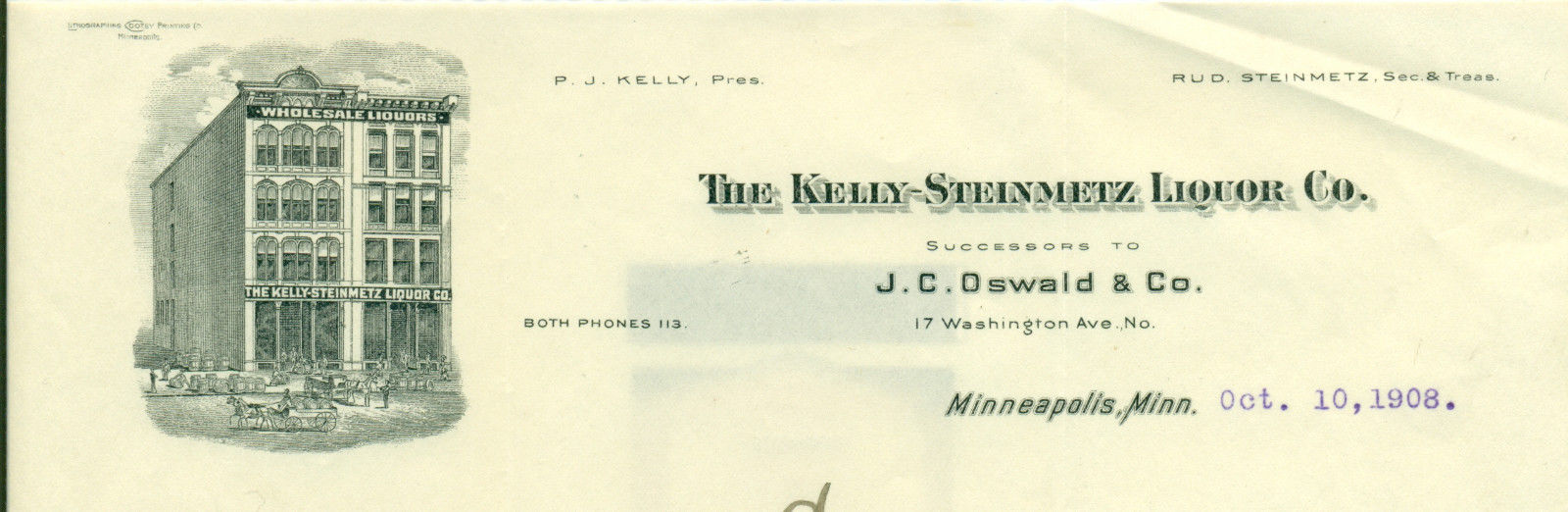
Kelly arrived in Minneapolis in 1906, apparently primed to open his own liquor business.  In 1890 a local named J.C. Oswald had opened a wholesale/retail whiskey store at 17 Washington Avenue, North, shown above.  After Oswald died in 1906, Kelly, with a partner, took over the business renaming it The Kelly-Steinmetz Liquor Company and remaining at the same address for the next decade.

The company was not only selling liquor, it also was rectifying whiskey, that is, blending and compounding the raw products, bottling the results, and selling them under its own brand names.  They included: “Umpire,” “Tandem,” “Green Leaf,” and “KSL Co. Monogram.”  Those labels seem to have been successful.  In 1910 and 1911, Kelly took steps to trademark his brands, indicating a concern about infringements.  He also had his own brand of gin, called “Tanager” that he blended and bottled himself.

As shown here, and below, he also issued “back of the bar” bottles for several of them.  Those would have been given to favored customers such as saloonkeepers and bartenders.  Kelly also provided advertising shot glasses and saloon signs.  One sign for his Tandem Whiskey was particularly attractive, showing a Gibson Girl being driving by  two horses in a tandem hitch team.  The motto was “One Drink Followed by Another.”

Even as his liquor enterprise was flourishing, this enterprising Irishman could see Prohibitionary pressures reducing his markets.  In 1914, for example, the State of North Dakota, having gone “dry” deemed his shipments of Umpire Whiskey into the state as “in violation of the beverage law” and liable to prosecution.  As a result Kelly looked for other business opportunities.  One presented itself in the field of banking.  With others he organized the Gateway State Bank, formed in September 1915. Soon after he became its president and chief executive officer.  By 1923 the bank was capitalized at $100,000 ($2.5 million equivalent today) and had on hand cash of $50,000.  Gateway was described in the local press as “one of the substantial and growing banks of Minneapolis.”

Although Kelly was active in Democratic Party politics, he never ran for office. He also was involved in local social organizations, including the Minnesota Athletic Club, the Elks Club, and the Interlachen Country Club.   Closest to Kelly’s heart was his relationship to the Minneapolis Baseball Association and its often winning team, the Minneapolis Millers, where he was a director and treasurer. 

In 1916, with prohibitionary force gradually “drying up”  markets for his whiskey, Kelly moved to new and likely smaller quarters at 25-29 North Second Street.  By 1918 as National Prohibition threatened, he shut down his liquor business completely.  The firm became Kelly Brothers Company, a real estate development and investment enterprise.  Patrick also became a director of the Franklin Motor Car Company, a popular automobile at the time.
The 1920 U.S. census found him, age 51, at home with his wife, Celia.  Asked his occupation, he said “none,” likely still smarting over the end of the Kelly-Steinmetz Company and ignoring his other business activities.  Kelly was still living at the age of 71, still at the same West 22nd Street address in the 1940 census with Celia still by his side. This time he gave his occupation as “president-real estate company.”   I cannot find his date of death or place of interment.  
A final word on this remarkable whiskey man can be taken from in his biography in the 1923 volume, “History of Minneapolis, Gateway to the Northeast,” edited by Dr. Marion Shutter.  That publication asserted:  “Mr. Kelly…in all things he has undertaken has met with success, wisely and carefully directing his interests along the paths that led to prosperity.”   These words remind us that the main path Patrick Kelly trod regularly was from his liquor business, smiling all the way, to the bank -- his own bank.


Saturday, August 22, 2015

Jacob Bloch and Louisiana Mail Order Liquor

As the 19th Century turned to the 20th, prohibition forces had resulted in many towns and counties voting themselves “dry” under local option laws.  In addition,  by 1908 most states of the Deep South had voted to ban sales of alcoholic beverages.  Under the interstate commerce clause of the Constitution, however, mail order sales of liquor were still legal.  In Monroe, Louisiana, a canny businessman named Jacob Bloch saw an opportunity.  In a town well served by railroads traveling north, south, east and west, and by water transport through the Ouachita River shown below, Bloch was said to have launched the first mail order liquor dealership in Monroe.  His would be the first of many in town.
  
The Wine & Spirits Journal in 1916 reported a talk given by Kentucky Distiller R. E. Wathen to a convention of mail order whiskey men, a group that included dealers from Monroe, and likely among them, Bloch. The speech provided, as the publication said, “food for thought” when Wathan opined:  “At the present time — a chaotic period for the distiller, for the jobber and for the retailer — the mail order man has his great opportunity.  We are witnesses a great upheaval in the liquor industry.  A great change may permanently be made in the distribution end of the business.  As State after State votes the local retailer out, it would seem the door of opportunity is opening wider every day for the mail order man.”

Wathen warned, however, that mailed whiskey should be recognized brands:  “Your line of work is to carry to millions in local option territory through a perfectly legal channel a product that that they have a perfect legal right to have.  There is no reason to doubt that they want the same good quality of product that they purchased when they came face to face with the seller,” he said.

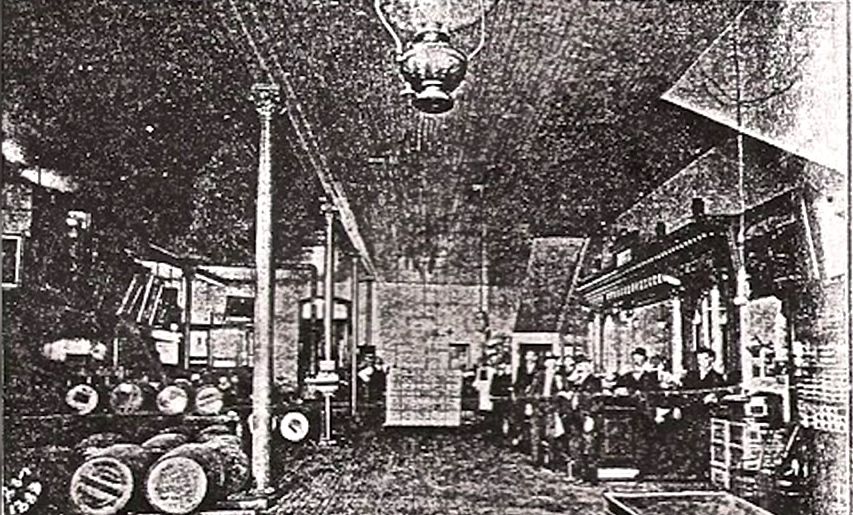
As early as 1893, Jacob Bloch recognized the opportunities involved in selling liquor by mail.  That was the year that the J.S. Bloch Building was erected in Monroe at 101 North Grand Street, corner of Desiard, to house his growing out-of-state sales.   Now on the National Register of Historic Places, shown left, this structure is physical proof that Bloch already had accumulated sufficient finances to construct an iconic headquarters and stock it with liquor.  His store and adjacent saloon featured cast iron Corinthian support columns and an elaborate cast iron shop front featuring a lace work of iron scrolls.  The second story facade showed pressed tin ornamentation with triangular pediments over the windows and triglyphs at either end of the parapet.  The interior had cast iron columns running the length of the first floor and an elaborate back staircase.  As shown below, there was a bar for over-the-counter sales and barrels of whiskey on the floor.

Heeding R.E.Wathen’s admonition to sell quality whiskey by mail order, Bloch advertised recognized brands like “High Sport” from the High Distillery of Cincinnati,  “Anderson County” marketed widely by the Kentucky “Whiskey Trust,” and “Shenandoah Rye,”  distributed by Simon Hasterlik Co. of Chicago. [See my post on Hasterlik, Feb. 2013.]  On the second floor,  Bloch was bottling his own whiskey, possibly after “rectifying” it, that is, blending it and adding ingredients to achieve taste and color.  He was selling it in ceramic jugs bearing his label.  Bloch’s mail order catalogues offered to sell liquor in both glass and ceramic, in sizes from a gallon to a pint.

The Monroe Star News said of Bloch’s enterprise:   “He operated an extensive retail and wholesale liquor business and is said to have been the one to originate the plan of mail order selling of his product. Others saw a new field for activity and in a short time, Monroe became known for its extensive mail order business in spiritous liquors.”  During this period Bloch also was an agent for Budweiser beer and sold cigars.

Although details of Bloch’s early life are sketchy, we know that he was born in Mississippi of German Jewish immigrants in July 1859. Later he told a census taker that although he could read and write, he had little or no formal education.  That did not deter him from migrating to Monroe as a youth.  There he met Lena Kuhn, born in Vicksburg, Mississippi, in 1866, the daughter of Mr. and Mrs. Samuel Kuhn.  Her parents had moved to Monroe when she was a small child.  That was where, about 1888, Jacob and Lena were wed.  He was 29 and she was 23.  They had one child who died in infancy.

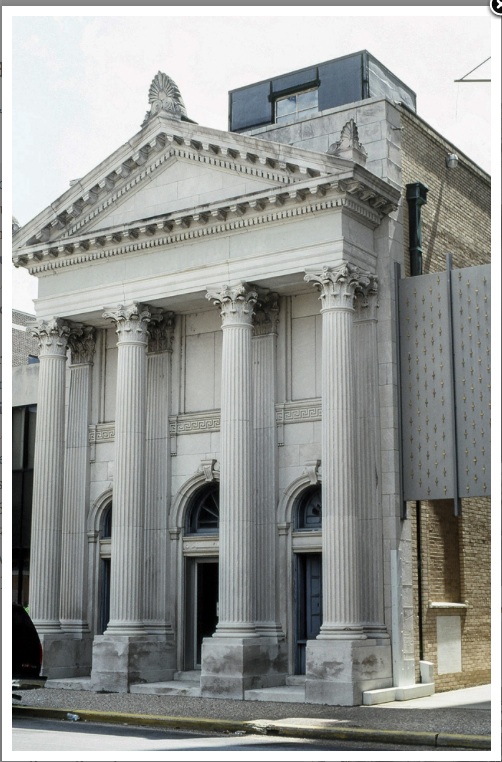
Bloch’s success as a businessman was having effects in other areas of Monroe life.  He served several terms on the Monroe City Council under two mayors,  Alexander Jackson Herring and his successor, Dr. Andrew J. Forsythe.  Jacob also was a director of the Ouachita National Bank, a financial institution founded in 1907, housed in the columned building shown here.  The bank was notable for having issued more than $1.5 billion in national currency over its life span.  In addition, according to the local press, Bloch “was interested in many other local institutions.”   With his wife, he was active in the affairs of B’Nai Israel synagogue, including caring for the Jewish Cemetery.

Despite the encouraging words by Distiller R. E. Wathen to mail order whiskey men, Bloch may have sensed that prohibition forces were winning the battle.  In one ad he indicated that in addition to selling liquor, etc., he was dealing in hides, wool and fur.  One writer has suggested that Bloch shut down his whiskey trade as early as 1908.  My guess is that he stayed in business longer than that, terminating when Federal legislation after 1913 curbed the mail order trade. Louisiana went “dry” only with National Prohibition in 1920.

The U.S. Census of that year found Jacob and Lena residing on Catalpa Street in Monroe.  Living with them were two of Lena’s brothers and a sister-in-law.  Ask his occupation, Jacob was recorded telling the census taker that he was a “machinist.”  At the time of the 1930 census, Bloch and family had moved to 215 Hudson Lane in Monroe.  He was 70 years old and gave his occupation as “retired.”   In August of the following year he died and was interred in Monroe’s Jewish Cemetery. His gravestone is shown here.  A decade later his widow Lena followed him there.

After the closing of Bloch’s liquor business, the building that bore his name experienced a number of uses, including a cotton exchange, general store, cafeteria, book store — and some say “offices” on the second floor were used for a time as a brothel.  Today the building houses an upscale Monroe restaurant known as “Cotton” where the management has tried to maintain the space approximately as it looked in the early 1900’s.

In the midst of the Prohibition hurricane, one promising business avenue remained open for many whiskey men — mail order liquor sales.  Jacob Bloch early saw the opportunity, took advantage of it, and prospered in the relatively brief time the way remained open.  He thereby laid the foundation for others to emulate and initiated a thriving trade in Monroe and Louisiana.