Monday, March 12, 2018

Farm Girl Flora — Boston’s “First Lady” of Whiskey


In 1898, a farmer’s daughter, Flora Doble, found herself filling the shoes of her late husband, Otis Neale, at the head of a large liquor, wine and bottling business in Boston.  It secured her a place in the high society “Blue Book” of Boston, but also brought financial and legal challenges that she may not have expected. 

Flora J. Doble was born on a farm near Oxford, in the southeastern part of Maine about 1846, the daughter of Phineas and Lucinda Doble.  Although girls were being educated in local co-educational public schools and private “seminaries,” it is doubtful that Flora received more than an elementary education.  Likely growing a little hay and feeding cattle, her father, according to net worth figures given in the 1860 census, was far from rich.  Moreover, the Dobles had five children to feed and clothe.  The oldest four were girls.

Thus it probably was considered a family blessing when Flora, still in her teens, was courted by Otis S. Neale, shown here in middle age.  Neale had only recently returned from Civil War military service.  At the outbreak of the conflict in 1861, at the age of 19 he had enlisted as a private in the Massachusetts 1st. Light Artillery Battery and almost immediately shipped out to guard the Nation’s Capitol.  A gunner, he later was extolled for his “generosity, tact, and energy” in military service.  Advanced to full corporal during the war, Neale was mustered out in 1864 and returned to Boston.

How Flora and Otis met is uncertain, but on June 14, 1866,  they were married and took up housekeeping in Boston.  At some point in the 1860s Neale went to work for an old established bottler of mineral and soda waters called Moses Fairbanks & Co.  Shown left is an embossed bottle from the company.

Since its earliest beginnings this company had been located in the Athaneum theater building on Howard Street.  Among the city’s most famous theaters, shown here with adjoining buildings, the address was a prime one for beverage sales.  After the retirement of Moses Fairbanks,  Neale, showing promise as a  business executive, about 1872 became a junior partner in the business with Levi Fairbanks.  By the early 1880s the Civil War veteran had taken over full ownership, renaming the business the Otis S. Neale Co. while remaining in the Athaneum building, shown right.

Meanwhile, Flora was playing the role of dutiful wife and mother.  The couple had a single child, Albert.  In the 1880 census her occupation was given as “housekeeping.”   There is no indication that she was playing any part in her husband’s rapidly expanding commercial activities.  Dubbing himself “Doc” Neale, Otis was selling a “fine old private stock” whiskey under his own name, as well as a line of liquors called “Outing Club” that included whiskey and cocktails. 

He also offered ginger ale, twelve flavors of tonics, apple cider, brandy, rum, gin and wine by the barrel or by the gallon, in cases or by the bottle, as those shown here.  He also offered lager beer “of the best brands” and Philadelphia ale and porter.  His ads touted a wide range of beverages, both alcoholic and non-.   In short, if it was drinkable, “Doc” Neale could sell it to you. 


Neale ascendancy did not go unnoticed by his colleagues.  In 1883 he was elected to the board of a national organization called the United States Bottlers’ Protective Association, a group primarily concerned about the growing temperance movement. He also found time to become the manager of the A. J. Houghton Brewery, founded in 1891 and located in the Roxbury District of Boston.  

Then in 1898 Otis Neale suddenly died, only about 52 years old, perhaps weakened by the strain of running both a major liquor house and a brewery.  His funeral was well attended and marked by the rituals of the Masonic order to which he had belonged.  He also was accorded military honors by the GAR, the veterans organization in which he had been active.  He is buried in Forest Hills Cemetery, his monument shown here. 

Seemingly in an instant Flora Neale was thrust forward into running the Otis S. Neale Company.   As the 1901 billhead that opens this post indicates, she assumed the titles of both president and treasurer of the company, the only woman in Boston with that distinction.  Although aided by a manager named Gardner, evidence is that Flora was an active participant in the business from 1898 forward.  She advertised extensively.


The “Blue Book” of Boston, a directory of the rich and powerful took due notice of the widow, Mrs. Otis T. Neale.  She was listed, along with several neighbors, living in one of the area’s luxury apartment houses.  Shown here, Richmond Court likely was the first in the Northeast made to resemble an English Tudor manor house.  On the National Register of Historic Places today, it was then a highly fashionable place to live.  Flora, the former farm girl, made herself at home.

Flora’s time at the helm of the company was not, however, without its difficulties.  In 1908 an involuntary petition in bankrupcy was filed against the Neale Company by three creditors, the largest being Burkhardt Brewing, an Akron, Ohio, a company also headed by a woman.  It claimed to be owed $13,000, the equivalent of more than $300,000 today. Flora appears successfully to have survived that challenge.  The company avoided bankruptcy.

Flora also found herself in trouble with the Massachusetts Board of Health from time to time over beverages her company was selling.  In February 1907 she was called to account as the result of an analysis of her “Golden Seal” champagne cider, found to contain neither champagne nor cider.  Rather, said the Board, it was a “large admixture of sugar, malic acid and carbonated water.”  The state came down hard on her again in 1913, this time for a purported “non-alcoholic” temperance drink.  Along with eight other similar Massachusetts products, her “Imperial - A Liquid Food” was found to be adulterated with salicylic acid, considered poisonous if taken in quantity.

The last year for Flora’s leadership of the Neale Company appears to be 1913.  That year she moved to Winthrop, Massachusetts, an oceanside Boston suburb, and was living in elegant apartment with a relative.  No further references to the Neale Company can I find past that date.  The company Otis built passed into the mists of history.  I have also been unsuccessful in finding details of Flora’s death.

Note: I am always on the lookout for women who had responsibilities for whiskey related businesses as distillers, distributors or saloon keepers during the pre-Prohibition era.  Thus it was that the billhead from the Otis T. Neale Co. of Boston caught my eye.  “Mrs. Otis T. Neale, President and Treasurer,”  it read.  That was all I needed to begin researching the farmer’s daughter who began life as Flora Doble.  Brief profiles of five other women who succeeded in the whiskey trade can be found in my post of June 19, 2017.




Tuesday, March 6, 2018

Born Free — Three Generations of a Rye Distilling Family

     
For more than 62 years a Pennsylvania family named Free perpetuated a whiskey-making tradition that ended only with National Prohibition.  From Adam to Henry & Augustus to H. Kister & Ralph, three generations of Frees gave America a rye whiskey that claimed to be: “Always the Same.”   Their hometown was always the same — York, shown below as it looked in 1890.


The progenitor and first distiller of the Free family was Adam, of Scotch descent who began life in Maryland about 1795 and relocated to Pennsylvania in 1818.  After spending several years working as a carpenter and saving his money, about the age of 30 he purchased a farm near a crossroads called Emigsville, adjacent to York.  Early on, Adam Free began distilling, using his excess grains to make whiskey and selling it locally.  That trade proved highly lucrative and having started with virtually nothing, he built an estate in property worth the equivalent of $1.8 million today and was elected a York County commissioner.  Adam died in 1854, age 54.

Thus was the pattern set for the next generation of Free sons.  Adam had married a Pennsylvania woman of German ancestry seven years his junior named Mary Hake.  Over the next fourteen years their union would produce eleven children, among them were sons, Henry and Augustus.  Henry, born in August 1831, was educated in local schools and lived on the family farm.  His first occupation was buying and selling livestock but apparently soon tired of that trade.  In 1856 he joined with younger brother Augustus in a partnership to distill whiskey.   


Calling it H. Free & Company, the brothers located their facility on the turnpike along the Susquehanna River that linked York to the state capitol at Harrisburg. Initially the site of a tavern that had been an important stopping place on the stage coach route, the crossroads became known as Free’s Distillery.  The brothers began with the capacity of mashing 100 bushels of grain daily, a major step up from the production of their father and other local farmer distillers.  With the coming of the York and Cumberland Railroad to their vicinity, Henry and Augustus were able to ship their rye whiskey to other parts of Pennsylvania.


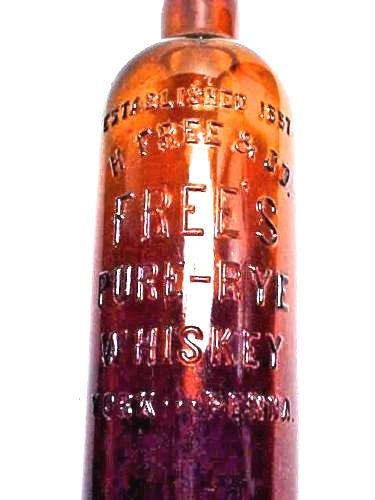
The brothers bottled their rye in amber-hued glass, as shown here. It was heavily embossed with “Established 1887, H. Free & Co., Free’s Pure-Rye Whiskey, York, Penna.”  The bottle was covered with a black and white paper label that contained the Free logo and declared:  “Pure Rye, fully matured in wood before being bottled, unsurpassed in purity, flavor and mellowness.”

Not long after establishing the distillery, Henry married Leah Rutter, the daughter of John Rutter, a well-known figure in York County.  Not a young woman when they married, she bore him four children and died in 1881 at the age of 50 when the younger ones were still in school.  Despite the burdens of a single parent Henry found time to do public service, as his father had.  A Republican, Henry repeatedly was elected township auditor.   His wealth from liquor allowed him to buy three “fine farms” near the Free distillery, and to help organize the State Capital Oil Company and serve as a director.   

Meanwhile his brother, Augustus, also was prospering from the distillery.  The 1870 census gave his net worth at the equivalent today of $247,000.  During the mid-1860s, Augustus had married Jennie Kister, a local woman about five years his junior.  Their first child, Harry, was born in 1869, to be followed by a daughter, Annie, in 1874 and a son, Ralph, in 1878.  

As the brothers aged, they looked to a new generation of Frees to take over the reins of management.  Henry’s sons, all of them with advanced education, including one who became a doctor, apparently had little interest in the distilling trade.  By contrast, Augustus had groomed his sons, Harry — now known as H. Kister — and Ralph, for the business.  When Augustus died in 1900,  Henry Free was semi-retired and living on a small farm one mile north of York where his daughter was keeping house for him.  He died four years later at the age of 73, his monument shown here.

Upon his father’s death H. Kister immediately had taken the reins of management and changed the name of the firm to his own.  Now the embossing on the amber bottles read:  “H. Kister Free, Successor to Established 1857 H. Free & Co., Free’s Pure Rye Whiskey, York Penna.”   With the help of his brother Ralph he was vying with the William Foust Distillery at Glenn Rock for the rye whiskey market in York and surrounding counties.  Given Billy Foust's reputation for multiple giveaway items to customers,  the Frees issued a number of shot glasses advertising Free’s Pure Rye, proclaiming it “Always the Same.”

The sons of Augustus successfully maintained the distillery for the next nineteen years, until forced to shut down by National Prohibition.  H. Kister then moved into restaurant management, according to the 1920 Census.   By this time he was married to Annie M. Stallman.  They would have two sons, both of whom died in childhood.  Eventually H. Kister would engage in selling insurance.  When Repeal came in 1935, the Frees made no effort to return to distilling.  H. Kister died in 1952 at the age of 83 and is buried in Prospect Hill Cemetery, York, where many of his ancestors lie. 

The 62 years the Free Distillery and "Free Pure Rye" existed, while impressive, is not a Pennsylvania record.  But if the distilling of Adam Free is considered, the tradition stretches back an additional 25 years — a truly astonishing story of a family devoted to making rye whiskey.

Note:  Much of the material on Adam and Henry Free is from the 1886 volume, “History of York County, Pennsylvania,” edited by John Gibson and published by the F. A. Battey Publishing Co., Chicago.  My vignette on Billy Foust and his distillery was posted June 9, 2011.


Saturday, March 3, 2018

How John Cooke Became Lord of Ara Glen

   
John S. Cooke, an Irish cobbler’s son, found success in Chicago selling liquor and beer.  An entrepreneur extraordinary,  with the proceeds from his enterprises  he funded the design and construction of a summer home on Lake Geneva, Wisconsin, shown above, that has been called “a tour de force of the Shingle Style.”  He called it “Ara Glen” after a scenic spot a few miles from his 1837 birthplace in County Cork. 

Cooke’s early circumstances were better than many in impoverished Ireland.  His shoemaker father was fairly well off, owning property in the town of Glenwood.  His mother, Mary, was from the well-known Clancy clan in County Cork.  Despite a desultory education, as one writer has put it:  “Cooke at 14 was energetic, ambitious and a little better off (and better shod) than his peers.”   These attributes soon propelled him to try his fortunes in the United States.

After two years of working at menial jobs in New York City, in 1857 Cooke determined to move west and chose to settle in Chicago .  Having apprenticed as a baker in Ireland, he readily obtained employment in that trade but found the pay low compared to sailing the Great Lakes as a seaman and working on construction.  Cooke cut an imposing figure at six feet, one and one half inches, muscular, regular features, dark brown eyes, and a shock of brown hair that eventually turned gray.

During the Civil War he went to work for a fellow Irishman named Michael Keeley who was a Chicago soda and mineral water bottler.  After working with Keeley for five years, he joined a wholesale liquor and wine firm called Schwab, McQuaid, and Monheimer,  He stayed for fourteen years as a traveling salesman, buying into the company over time.  With the departure of other partners by 1881, the business became Monheimer & Cooke.  Located on Randolph Street, the company used the brand names:  "Edgebrook", "Phoenix ", and "Phoenix Club.”

In the meantime in 1863 Cooke had married.  His wife was Charlotte Rowland, originally of Rochester, New York, a woman of Irish ancestry who was eight years John’s junior.   The 1880 census found the family with four children.  The first three were boys, Charles, George and John; the fourth a girl, Irene.  Cooke’s 81-year-old father, a widower who had emigrated from Ireland, was living with them.

As an indication of his respect in the liquor industry, Cooke was elected in 1882 and again in 1884 as the president of the Bohemian Liquor Dealers Association, an Illinois group involved in assisting political candidates who favored the saloon trade.  They vetted candidates, mostly Democrats, and contributed to the local party organization.  Cooke himself later would run on the Democratic ticket for treasurer of Chicago.  Although the Chicago Eagle claimed he “had proven a tower of strength to the ticket,” he lost and never again sought public office.

Several years after buying into the liquor house, Cooke made a move into brewing, in 1885 buying out the Union Brewing Co.(UBC), a Chicago brewery established in 1867.  UBC had been struggling, selling its beer through street carts at the rate of about two barrels a day.  With no regular customer base, UBC was hard pressed to complete with the bigger, more established local breweries.  Cooke subsequently changed its name to the Cooke Brewing Company and expanded the operation.  He also invented and patented a new device for cooling beer, equipment that added efficiency and speed to the process.

By 1900, Cooke was selling 190,000 barrels of
beer a year.  This was a notable achievement since at that time most Chicago breweries had exclusive hold on “house” saloons.  Cooke was an independent brewer bucking the trend and resisting the blandishments of larger beer-makers to merge with their combines. Nonetheless, according to observers, he was making “tidy profits” on his beer.

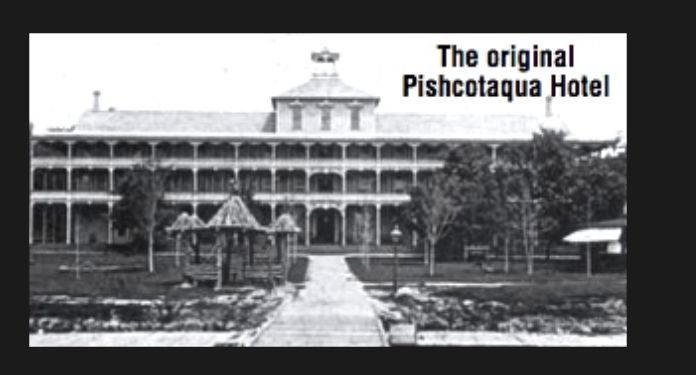
Now Cooke was ready for new challenges.  The opportunity came in the form of a former “dry” hotel on the shores of Lake Geneva in Southeastern Wisconsin called the Pishcotaqua, at the time among the largest hotels in the Midwest.  No alcohol meant sparse customers, however, and the hotel had been through four owners and foreclosure when Cooke bought it.  The hotel went “wet” under his guidance and he changed its name to the Cooke Parke Villa Hotel.   He bought a steam yacht for his guests to ride there on the large lake from William Bay where the trains from Chicago arrived.  Occupancy grew and for a time the hotel made money.


Fire proved a bane.  In 1891 an errant cigar smoker set fire to some of the  outbuildings that Cooke quickly repaired.  The following year, however, a more serious blaze ruined a major portion of the hotel, causing him to quit the hospitality business.  At the same time, however, Cooke had become enamored of Lake Geneva and decided to build a summer home for his family there. He commissioned an architect to turn the hotel’s free-standing billiards hall, which had survived the fire, into a summer residence for his family.  

The result was a home of more than usual interest.  It was given Victorian elements such as wide verandas, turrets, and significantly the use of wood — thousands and thousands of shingles.  At the same time the house abandoned the Victorian boxy look in favor of a plentitude of angles that make it stand out architecturally.  Cooke called it Ara Glen.  Today it is listed on the National Register of Historical Places.

But the entrepreneur in Cooke was not finished.  At the age of 60, in 1897 he started a mineral water business, buying supplies from springs in Wawatosa, Wisconsin, and Quincy, Illinois.  He called it Diuretin Mineral Water and claimed it was a remedy for Bright’s Disease, kidney troubles, dyspepsia and indigestion.  Headquartered in Chicago, he named the enterprise the Ara-Glen Mineral Water Bottlng Company.

But Cooke had limited time to enjoy his Ara Glen home. On March 5, 1899 he was stricken with a heart attack while he was attending Mass at Chicago’s St. James Catholic Church.  He lingered for a week, gradually failing, and died at his residence at 2976 Michigan Avenue.   He was buried at Calvary Cemetery in suburban Evanston, Illinois; his monument is shown here.


After his death his sons George and Charles took over the family businesses. His estate with its many facets proved to be a legal tangle and the family feuded over it, generating several court actions.   Cooke’s liquor house disappeared from Chicago directories after 1910.  The brewery goes unrecorded after that same year.  The house was among the disputed assets and was split among family members.  By 1925 they had sold it to a family that has maintained it to this day.

For a final word on John Cooke, one only need go to an 1897 commentary that appeared in the “Biographical History of the Irish in Chicago,” edited by Charles Ffrench.  There Cooke is characterized as: “Fearless and energetic, gifted with a most wonderful power of perseverance, entirely unrecognisive of defeat, he has surmounted innumerable difficulties, from a poor lad, whose only capital was his rich business endowments and unimpeachable integrity….”   

Note:  As I was doing my research on this post I was fortunate to come across article by Jessica Franzene that appeared in the June 2013 issue of “Welcome Home, Southeastern Wisconsin Living,” that featured her cover story on John S. Cooke and Ara Glen.  As a result I was able to bring the story up to the present time when the house Cooke built still is used as a family residence.  The article is a reminder that as along as Ara Glen stands, the memory and achievements of John S. Cooke will be with us.  


Sunday, February 25, 2018

Theodore Roosevelt and the Whiskey Men


Foreword:   Having profiled the relationship of President Grover Cleveland with several  whiskey men, it seemed natural to follow up with another president, Theodore Roosevelt.  The photo above is a clear spoof.  Although “Teddy” as he was known, had formed the Bull Moose party in his second, unsuccessful, run for President, he never rode one, nor did he drink martinis.   Referenced here are three “whiskey men” whose lives, in varying ways, touched Roosevelt’s.

George Curry owed much of his career to his relationship with Roosevelt.  No figure looms larger in the early history of New Mexico than Curry, a transplant from Louisiana who was running a saloon in Lincoln Station NM, shown below,  when the Spanish American War broke out in 1898. The governor of New Mexico was authorized to raise four companies of cavalry.  Curry recruited one company and was appointed its captain.  


His troops, along with other Western recruits, composed the regiment commanded by Colonel Theodore Roosevelt that became known as the “Rough Riders.” shown here with their commander in the center  During the training Curry became a friend and confidant of Roosevelt but eventually was denied by the flip of a coin the chance to see action in Cuba and participate in the famous charge up San Juan Hill.  Instead he remained in the U.S. to provide logistical support to the Riders. 

Almost immediately after the war, with Teddy’s backing, Curry volunteered to go to the Philippines to help put down a revolt by local rebels against American occupation following departure of the defeated Spanish.  His success during two years of combat led to his appointment as governor of several Philippine provinces and eventually as chief of police of Manila.  When now President Roosevelt was looking to appoint a governor for New Mexico, he chose Curry who is said to have accepted only upon Roosevelt’s promise to push for full statehood for the territory. 

 Although he had been a Democrat, Curry moved to Roosevelt’s Republican Party.  He proved to be an effective territorial governor of New Mexico and was able to see statehood achieved in1910, after years of struggle in which he played a major role.  Perhaps out of gratitude for his years of service the people of New Mexico elected Curry to the U.S. Congress where he served one term.


No sooner had the man known as “Devil Dan” Roberts opened his Stand Up Bar in Belle Fourche, South Dakota, shown above, than he was embarked on the trip of his life at the behest of President Roosevelt.  A colleague, Seth Bullock, had been a Rough Rider and had been befriended by Roosevelt. When Teddy was inaugurated as President in 1905 Bullock conceived the idea of having a cowboy section in the inaugural parade.  With Roosevelt’s enthusiastic approval, Bullock recruited 62 cowboys from around the West for the ride. Among them were five from Belle Fourche, including Dan Roberts and his son Henry, the youngest rider in the group.  

Shipping their horses by rail ahead of them, the cowboys, including future movie star Tom Mix, followed in their own railroad coaches, having a raucous time. In Washington, as shown here, Roberts and the others were reunited with their ponies and rode around streets of the Nation’s Capitol to exercise their mounts. For the parade, security agents allowed the riders to carry pistols in their holsters as part as their costume, but the guns were unloaded. Riding eight abreast in the parade, they were cheered lustily by the waiting crowds. As they passed the reviewing stand President Roosevelt is said to have jumped up, clapped his hands and shouted: "That's bully! That's excellent, Captain Bullock!”


Excitement was running high in Hot Springs, Arkansas, on January 10, 1910, with the anticipated visit of former president, Theodore Roosevelt, for a ceremony and speech.  John Wesley Freeman, as a leading citizen, was among those planning the visit.  At Freeman’s Barrelhouse & Saloon a trio of soldiers from Fort Roots near Little Rock gathered, anticipating their role as honor guard in a reception committee.  Among them was Edward L. Haley, a Mississippian, described as “the most peaceable man in the company.”

When the soldiers got up to leave, Haley got into a dispute about the bill with bartender George Kilgore, a man with a violent temper.  When the soldier refused to pay the designated amount, Kilgore took a hand gun from behind the bar. In the argument that ensued, he shot and killed Haley.  Violence of this nature was not uncommon in Hot Springs. Ten years earlier Kilgore had shot and killed another man in Freeman’s saloon.

How Haley’s murder affected Freeman, a deputy sheriff, former postmaster, and leading town citizen, has gone unrecorded.  He had been a leader among those who had helped put Hot Springs on the map as highly desirable resort community where 47 "hot springs" gushed forth nearly a million gallons of 143 degree water every day.   By 1903 three Freeman saloons were operating simultaneously in Hot Springs to quench thirsts for something stronger than water.  

Freeman undoubtedly was “front and center” to shake the former President’s hand when Roosevelt visited and was the the town’s honored guest.  The photo below shows Teddy during ceremonies at the fairgrounds, looking toward the military honor guard at left, standing at attention.  He may have known that it was missing one young soldier that day. 


Thursday, February 22, 2018

E. R. Lilienthal: Noble (Cyrus) of Western Whiskey


Shown right, Ernest Reuben Lilienthal was the scion of a family that had no businessmen in it.  His father Sam was a famous homeopathic doctor and his uncle Max a well known rabbi.  Nevertheless, Ernest forged a highly successful business career in the Western liquor trade selling a brand of whiskey called “Cyrus Noble.”

The Lilienthal family had originated in a valley in Schnaittach-Huttenbach, Germany, a Jewish enclave, and until 1814 had been named Seligmann until an ancestor changed it to Lilienthal, meaning “lily of the valley.”  Sometime during the 1840s, Dr. Sam and Rabbi Max and their wives had emigrated from Germany, settling in Lockport, New York, near Buffalo.  There Ernest was born in 1840.  He had a good education culminating in a law degree from the Cincinnati Law School.

Lillienthal never practiced.  Cincinnati also was the home of Rabbi Max’s good friend, Julius Freiberg of the firm of Freiberg & Workum, wholesale liquor dealers, rectifiers and distillers of whiskey.   Max convinced Freiberg to give his nephew a job.  The newly-minted attorney began in the blending department and, impressing the partners, subsequently was sent as a salesman to New York City.  

At the time Freiberg and Workum’s principal brand was Cyrus Noble Bourbon, named after an Ohio man whose talent for tasting and blending whiskey earlier had earned him the superintendent’s job in their distillery.  Noble, however, was a heavy drinker and, so the story goes, one day while inebriated and checking a premium vat of whiskey, fell in and drowned.  Nothing would do but to name the company’s flagship whiskey as a memorial to Cyrus. 


Lilienthal strongly embraced the brand and convinced Freiberg & Workum to give him the financial backing to establish a wholesale liquor agency in San Francisco.  Arriving in town in 1871, he lost no time in renting store space at 223 California Street and putting out his sign:  “Lilienthal & Company.” At the outset he bought his liquor only from Freiberg & Workum.  They made sure he was well stocked with Cyrus Noble and their other straight and blended brands.

The whiskey was shipped in barrels, most often on sailingships that took it around Cape Horn.  The rock and roll ride at sea widely was believed to speed aging and add flavor.  Once landed in San Francisco, Lilienthal sold the liquor by the barrel or bottled and sold it by the case to saloons and restaurants. 

Through the 1880s, Lilienthal’s traveling salesmen, marketing an expanding list of alcoholic products, fanned out through the West, not only in Pacific Coast states but throughout Arizona, Nevada, Idaho, Utah and Montana.  The sales force even made forays into Mexico and Central America in search of customers.

With the aid of these efforts and vigorous outdoor advertising, such as the huge painted sign on a San Bernardino building, Lilienthal & Company grew rapidly and by 1895, it had become the largest wholesale liquor company on the West Coast.   As Lilienthal diversified his business, the distilling and rectifying operations were hived off and became “Crown Distilleries,”  a name that occurred on the labels of his whiskey and embossed on bottles of Cyrus Noble. 

In the meantime, Ernest was having a personal life.  In May 1876 he married Hannah Isabelle (called “Bella”) Sloss in San Francisco.  He was 34, his bride was 20 and the daughter of Sarah and Louis Sloss, a prominent member of the Alaska Fur Company.  The Lilienthal’s first child was born a year later.  They would go on to have a family of seven, including four sons, all of whom later would be employed in their father’s liquor interests.

In their 1968 book on “Spirits Bottles of the Old West,” Bill and Betty Wilson provided some observations into Lilienthal’s personality:  “A good salesman, Ernest talked freely in a deep baritone voice.  His reputation for fair dealing, his judgment of markets, his ability to make quick sound decisions, and the assurance he had for his product won him a respect not always accorded to those in the industry…He could talk well…and could argue in legal terms on almost any subject.  He rarely showed anger and never grew personal — a quality his customers enjoyed.”

Within two decades of Lilienthal’s arrival in San Francisco, Cyrus Noble had become a favorite among Western whiskey drinkers.  The story is told that in May of 1899 when George Dewey, “the hero of Manila Bay,” was informed of his promotion to Admiral of the United States Navy he celebrated with a friend: “He reached for a bottle of Cyrus Noble, a sour mash bourbon, and filled two glasses.”  They drank a toast.  

In 1901, another story goes, a thirsty prospector named John Coleman stumbled into Searchlight, Nevada, willing to trade his claim for a bottle of the best bourbon in town.  It turned out to be a bottle of Cyrus Noble.  When the claim later yielded more than $250,000 in gold (more than $7 million today) it was christen the Cyrus Noble Mine.


Lilienthal was lavish with his giveaways to saloons, restaurants and other establishment carrying his liquor.  Shown throughout this post are bar signs he provided, all of them with a “Old West” motif.  He also handed out multiple varieties of back-of-the-bar bottles and shot glasses, many advertising Cyrus Noble whiskey.

Other Lilienthal family members were enlisted in the business.  Albert, a son of Rabbi Max, and Ernest’s first cousin joined the Lilienthals in San Francisco with the idea of developing the hops and grain business of the company.  He did not like California, according to the Wilsons, and returned to New York.  There, with his sibling Theodore, he founded Lilienthal Brothers, the East Coast representative of the family’s liquor interests.

Ernest Lilienthal as he aged turned over responsibilities for running his multifaceted liquor-based empire to family members, chief among them his eldest son, Benjamin.  Anticipating the coming of National Prohibition, they shut down Crown Distillers Company in 1917.  The 1920 census found father and son both claiming their occupation as “sugar” merchants, likely one of the subsidiary businesses they had spun off from Lilienthal & Co.   Ernest lived long enough to see America go dry, dying in December 1922 in San Francisco.  He was 76 years old.

Throughout National Prohibition Benjamin kept the trademark for Cyrus Noble whiskey but sold it in 1934 to his brother Samuel as Repeal approached.  Samuel in turn sold the rights to the name to the Haas Brothers, related to the Lilienthals by marriage.  Originally San Francisco grocers, the Haases switched to whiskey wholesaling and continued to market Cyrus Noble for a number of years.

A final appreciation of Ernest R. Lilienthal, a man who built the largest liquor wholesaling house on the West Coast and made a household name of Cyrus Noble whiskey, can be gleaned from the Wilsons’ biography.  His customers, they said, “got good liquor…and plenty of good conversation” from an urbane entrepreneur with an aristocratic bearing.  Lilienthal truly had become a recognized nobleman of American whiskey.