Wednesday, March 13, 2019

James Duffy’s Was No Pulpit for Prohibitionists


Never before have I opened a profile of a whiskey man on an event that occurred a year after his death.  In the case of James J. Duffy of Troy, New York, however, it is appropriate because of the dedication of an imposing brass and marble pulpit in a New York church, given by Duffy’s family in 1909 as a lasting memorial to a man whose life was devoted to selling liquor.  It is shown here in a fuzzy 1900s photo.

Not only was the gift noted in the local press, the national Jesuit magazine, America, featured a note on the pulpit, calling it “magnificent” and noting it had been made by the Gorham Company.  It was a New York City firm renowned as gold and silversmiths whose production included pulpits. Compare the one pictured in its catalog to the one above.  The church in which it had been installed was St. Henry in Averill Park, a town about 12 miles from Troy.  The photo below shows the newly constructed house of worship next to the original church that eventually would be torn down.


Born in Troy on Christmas Day in 1855,  the son of James and Ellen McEnrow Duffy,  James Duffy was educated in  Catholic schools, including the Christian Brothers Academy.  Except for four years living in St. Louis, 1872-1876, Duffy spent his entire life in Troy.  For four years he was the local agent for Coleman Bros. brewers and malt producers in Albany New York, proprietors of the Chestnut Street Brewery.  This experience not only educated him in the alcohol beverage trade, it gave him the opportunity to save sufficient funds to open his own liquor house in Troy about 1880.

The young Duffy had made a good decision.  Through much of the 19th and into the early 20th century, Troy was not only one of the most prosperous cities in New York State, but one of the most prosperous in the entire country.  Strong in iron and steel manufactures, as well as other industrial facilities, its work force not only was thirsty but also had disposable income to spend on liquor. Saloons proliferated.  Duffy prospered. 

Moreover, his headquarters was well located at 485 River Street, a major commercial avenue that paralleled the Hudson River, a location he advertised widely.  Not only was Duffy’s liquor house on a main street car line, it was located between two highly frequented hotels, the Rensselaer and the Northern.  The former was among Troy’s premier hostelries.  It is shown here at right.  My guess is that the three story building at the left was Duffy’s establishment.


The structure was large enough to allow the proprietor to import barrels of whiskey  by rail or water directly from distilleries in New York, Pennsylvania, Maryland and Kentucky and to decant them into jugs of a gallon or more capacity that would be retailed to saloons in Troy and the surrounding region. 

The source of his containers likely was Fort Edwards, New York, a town only fifty miles away.  That town, boasting a ready supply of ceramic clay, was a major producer of pottery, recognized worldwide for the quality of its stoneware, known as “Fort Edwards Crock.”  A Duffy jug shown above carries the mark of the Ottoman Bros. & Co.  Others shown here carry no mark but likely also were obtained at Fort Edwards. 


Meanwhile, James was having a personal life.  He had married in the late 1870s at about the age of twenty-five.  His bride was Mary, a local woman born in New York State of Irish immigrant parents.  They do not appear to have had children and within just a few years of their marriage, Mary died in 1885.  After several years Duffy married a second time.  Five years younger than James, Jennie was a native of Brooklyn from Irish immigrant parents.  The couple would have five children, according to census records, four of whom lived to maturity.

Duffy also had his own brand of whiskey that he called “Club House Whiskey.”  Shown here is a shot glass advertising it.  It was well named by Duffy who was notable for joining multliple Troy men’s clubs, including the Pilsner Club, the W. S. Earl Boat Club and the Olympic Club.  He also was active in Irish-American activities as a member of both the Ancient Order of Hibernians and the Emerald Society, an organization dedicated to assisting new immigrants from Ireland. Little wonder that the 1889 publication “Young Irish Americans of Troy, N. Y.”  featured an illustration, shown above, and a short biography of Duffy.

Duffy had little time to enjoy his prosperity and his children, dying at the age of 52.   The liquor house he had run so successfully for almost three decades, however, never faltered.  His widow, Jennie, took over its management becoming president and treasurer of the company.  Her business savvy must have approached that of her late husband because she ran James J. Duffy Co. for the next ten years until shut down by the coming of National Prohibition.

Jennie Duffy’s devotion to her late husband demonstrated itself in several ways.  Not only was she the instigator and driving force behind the gift of the pulpit to St. Henry’s, she also arranged for a large Duffy monument to be raised in Troy’s St. Peter’s Cemetery where James is buried   A granite plinth holds a statue of what appears to be the young Christ as a carpenter.  Unusually, Jennie also arranged for her husband to have not just one but two headstones, each marker linked to one of his two wives.  Jennie would join him at St. Peters in 1933 at the age of 70.  

Today the pulpit given in James Duffy’s memory is no longer present in the sacristy of St. Henry’s.  Its fate apparently is unknown.  Wherever it may be, it likely still bears the plaque that memorializes the New York whiskey man.  And abides no sermons of a prohibitionary content.

Note:  Thanks go to St. Henry’s and Kerin Banker of its staff for sending me photos of the church interior that show the pulpit standing in the early 20th Century but gone by 1977.  From the first photo it was possible to isolate the Duffy pulpit and present it above, fuzzy but recognizable.

Addendum:  This is to alert both followers of this blog and others that I have a new website involving whiskey.  It is a compilation of more than thirty vignettes about Old West saloons and saloonkeepers.  Outlaws, gunslingers, and shootings abound.  This new blog can be accessed at wet enterprise: select saloons of the old west@blogspot.com. If this new website proves popular, other compilations under the “wet enterprise” heading may be forthcoming.




Saturday, March 9, 2019

Whiskey Men Scheming to Evade Prohibition


Foreword:  As towns, counties and states increasingly banned the consumption of alcohol within their boundaries, many whiskey men were faced with the reality that their customer base increasingly was being eroded — or in some cases eliminated entirely.  Some in the liquor trade simply shut their doors, found other things to do or retired.  Others seem to have stayed up nights thinking of how they might evade the restrictions of prohibition and continue to make or peddle booze.  The results of these gambits differed sharply. This post is devoted to three of them.

A.P. Simms once was a big man in Natchez, Mississippi.  He owned a furniture store.  He owned a meat market and a grocery store. He owned a saloon and a flourishing liquor business.  That profited him very little when, in 1909 he was, as the Mississippi Supreme Court ruled in unusually strong terms, “perpetually banned from doing business in the state.”

This drastic blow to Simms occurred after the voters of  Mississippi with their strong ties to the Baptist Church in 1908 voted a complete ban on the sale of alcohol throughout the state.  Natchez, despite its reputation as a rip-roaring river town, was left high and very dry.  A. P. Simms was undaunted.  Forced to shut down his saloon and liquor retail operation, he simply moved his business across the river to “wet”  Louisiana and set up shop.  A Simms jug dated 1909, shown below, helps tells the story.  Not only did Simms plan to sell whiskey in Louisiana,  but also to send it into an increasingly thirsty Mississippi.  

Several state courts had ruled that the Interstate Commerce clause of the Constitution made mail order sales into “dry” areas legal until such time as the U.S. Congress decreed otherwise. That did not stop local officials from harrassing parcel companies and railway express by arrests and other legal actions.  As a result, some carriers were refusing to carry booze into dry areas. 

Simms, always the entrepreneur, sought to obviate that problem by establishing his own carrier in 1908.  He called it the “Simms Express & Telegraph Company.”  His intent was to take telegraphed orders for whiskey and ship it through his Louisiana operation back into Mississippi, delivering it via his own express company.  It did not take officials in the State of Mississippi long to determine that this scheme was an attempt to skirt Prohibition laws.  In 1909 they enjoined him from selling or delivering liquors in the state. 

Simms, not one to buckle to the authorities, took the case to the Mississippi Supreme Court asking that the injunction be dissolved.  The court not only disagreed, it made the injunction permanent.  Moreover, Simms was  enjoined “perpetually” from doing business in Mississippi, his company was declared “ousted from the State” and he was required to pay hundreds of dollars in attorney fees, expert witnesses and all court costs.  He permanently moved to Louisiana.

Try to put yourself in Herman Egger’s shoes.  In an overcrowded field of liquor dealers in Louisville, Kentucky, he was trying to distinguish himself and his “Old Drennon” whiskey by emphasizing mail order sales.  As more and more Kentucky counties under “local option” laws voted dry, however, he found his business rapidly dwindling. What could he do?

Faced with a dismal financial future, Eggers in 1912 from his Jefferson Street liquor house hatched a scheme to sell his whiskey to customers in officially dry Kentucky counties.  He composed and sent a form letter to doctors and druggists there asking for help.  In his letter the Louisville liquor dealer pointed out that for “medicinal purposes”  Kentucky law allowed licensed doctors and druggists to receive whiskey shipments in five gallons or less.  Eggers explained:  “There are a number of people in your neighborhood who would like to receive goods but cannot order within the state as the laws prevent shipments….If you will permit those who order to have goods shipped to you, without expense to you, it will be an accommodation to both of us.” 

Eggers gave the dubious assurance to potential collaborators that his proposal was within Kentucky law and urged them to write him with the names of friends who might be interested in shipments.  As a reward for their trouble in handling his liquor, cooperating doctors and druggists would be given one free gallon of whiskey for every ten gallons he shipped.  “I do not know if this would be legal,”  Eggers acknowledged, but went on to give detailed instructions how the process would work.

Among the physicians who received Eggers’ letter was Dr. Thomas C. Holloway, an eminent gynecologist of Lexington, Kentucky, a town that intermittently had gone dry.   Dr. Holloway was caustic in his response to Eggers:  “As I have no intention of engaging in the whiskey business, I do not see what right you had to presume I would be interested in your bootlegging proposition.”  His letter went on to blister the whiskey man.  Then the outraged physician went further by sending the exchange of letters to the Kentucky Medical Journal, the state’s leading publication for doctors and druggists.  They published it under the headline “Forum” on September 1, 1912.  

With Eggers’ scheme exposed to the world, its utility was gone.  Even if tempted initially, doctors and druggists almost certainly walked away from the whiskey dealer’s proposition once it was widely known to the Kentucky medical fraternity and likely revealed to law enforcement officials.  Moreover, in addition to having his scheme fail,  Eggers had been exposed as someone willing to conspire to evade the law.

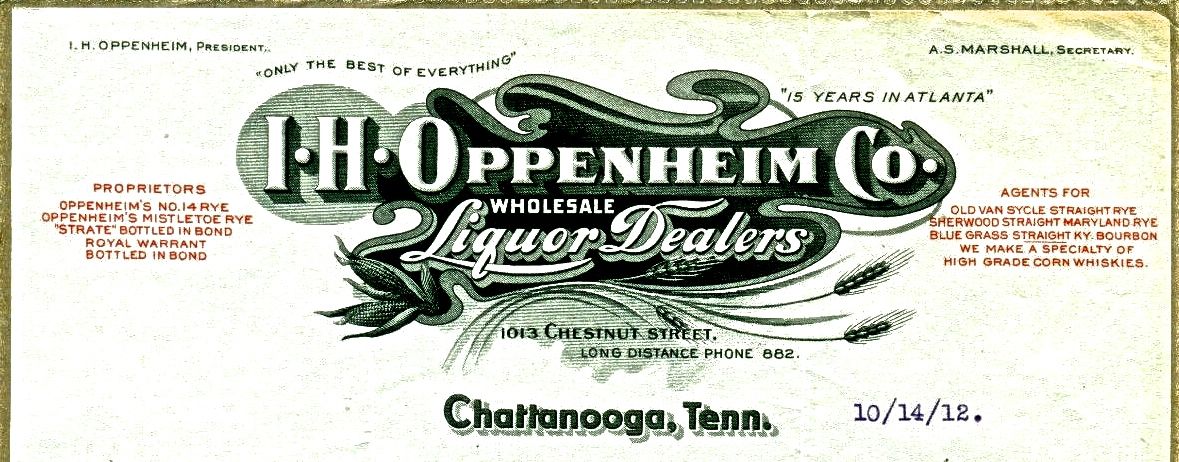
Issac Oppenheim was typical of the whiskey men who embraced the “Jug Train,” a scheme legal until after 1913 to bring liquor from “wet” states into “dry” via the railroads, protected from being seized under the Interstate Commerce Clause of the U.S. Constitution.  Oppenheim, a successful saloonkeeper and liquor dealer was forced out of Atlanta, Georgia, by prohibition into Tennessee, parlayed the Jug Train into personal prosperity.


When Georgia voted its statewide on alcohol production and sales, Oppenheim quickly moved his operation to Chattanooga, Tennessee, 120 miles east of Atlanta.  He set up his liquor house at 1013 Chestnut Street and in that railroad town quickly made use of the Jug Train.  He ran ads for his “Farm Belle” rye and corn whiskeys in Atlanta newspapers stating:  “Fifteen years in Atlanta — send your orders now to Chattanooga.”  

A buyer would send Oppenheim money by mail order.  Upon receipt of the funds in Chattanooga he would send a “wet” package via the Jug Train to Atlanta.  Since it had been purchased out of state, the liquor was legal in Georgia.  Competition came from what was known as the “lightning express.”   This was an illegal extension of the Jug Train phenomenon.  An Atlanta buyer paid cash to an intermediary and thirty minutes later liquor was delivered in a package stamped “Chattanooga” — clearly having made the 120 mile trip in “lightning” time.

The transplanted Georgian was not alone in Chattanooga using the Jug Train. A local business directory from 1908 listed some 28 wholesale liquor dealers in “Train Town,” many of them employing railroad express sales to Southern states and localities that had banned alcohol.  Shown here is a cartoon that depicts whiskey being pumped south into “dry” Georgia from Chattanooga and north from Jacksonville, Florida, via the rails.  Although Atlanta was a principal destination, secondary Jug Trains fanned out from that city across Georgia to smaller towns.

The prominence of Jug Trains throughout the United States caused Congress to outlaw the practice in the Webb-Kenyon Act of 1913.  Court challenges, however, delayed its enforcement for months.  After seven years of riding the Jug Train Oppenheim was forced to shut the doors on his Chattanooga liquor house in 1915 when Tennessee also went “dry.”  He returned to Atlanta a considerably wealthier man to run a cigar business.  From Chattanooga virtually every day he had shipped liquor back to Georgia via the Jug Train.   No only did railroad traffic make him rich, it provided a measure of sweet revenge on the state that had banned the sale of alcohol and put him out business in Atlanta.

Addendum:  This is to alert both followers of this blog and others that I have a new website involving whiskey.  It is a compilation of more than thirty vignettes about Old West saloons and saloonkeepers.  Outlaws, gunslingers, and shootings abound.  This new blog can be accessed at wet enterprise: select saloons of the old west@blogspot.com.  If this new site proves popular, other compilations under the “wet enterprise” heading may be forthcoming.


Tuesday, March 5, 2019

The Schmidt Liquor House Was All About Family


In 1899, a commercial review of the Pittsburgh area enthused about the liquor business of George W. Schmidt, one that had been founded by his father: “…It has come to a golden epoch in its history as a progressive house in Western Pennsylvania.”  Not many years later, however, Schmidt, shown here, was filing for bankruptcy having diverted today’s dollar equivalent of almost $1.2 million from the corporation to other purposes.  Those with the most to lose, however, did not care:  They were family.

The Schmidt liquor interests long had been a family affair.  William Schmidt had established the business in 1836 at 409 Penn Avenue in an area called Bayardstown.  In those days liquor and wine had to be shipped into Pittsburgh via sailing vessels to New Orleans and then brought upriver on the Mississippi and Ohio Rivers.  With the construction of the Pennsylvania Canal network it became possible to receive shipments by canal boat from New York and Philadelphia.  According to the review:  “The journey from the wine cellars of Europe to this city then consumed from four to six months, while at the present time by steamer and the use of cable, it requires about fourteen days for the filling of an order.”

William ran the Schmidt liquor enterprise until 1854 when management was taken over by his son, Joseph, who is recorded as having run it until 1865.  At that point a second son, George, just 19 years old, took charge. He is shown above in a portrait done when he was about 35. He had been married the year before the painting. His bride, Ellen, a Pennsylvania woman of Irish Ancestry. was fourteen years younger, according to census records.  The couple would have nine children over the next twenty years, one of whom died in infancy.  

Upon George’s accession to the liquor trade, he took a partner, William J. Friday, an older Pittsburgh local with a background as a distiller and wholesale liquor dealer.  Their collaboration over the ensuing years proved to be highly profitable. After several moves to larger quarters, they took over a building at 384 & 386 Penn Streets.  This three story structure provided the partners with ample room to store rye and bourbon whiskeys and additionally allowed them to “rectify,” that is, blend, their own brands on premises, including “1855 Pure Rye,” “McKim’s 1860,” and “Old Columbia.”

The need for more space continued to press the partners and in 1885 Schmidt determined to build a new building to house the enterprise.  Accompanied by considerable hoopla, the company opened there on May 24th, 1886.  The Pittsburgh Press headlined: "Formal opening of the Schmidt Building," "Colossal Establishment," "A Triumph of Architectural Art Blended with Mercantile Enterprise."   Shown here, the building was located on Pittsburgh’s principal business street, Fifth Avenue.   It was eight stories high.  The cellar, first floor and a connecting four-story warehouse in the rear were occupied by the liquor house.

The upper stories were divided into some ninety offices.  The Press story called the building Schmidt’s “cherished dream” and:  “…The finest structure in the land devoted to the wholesale wine, liquor and cigar business….It has been erected at great expense and in the most thorough manner, with the sole purpose of making a superior office building and perfect in all its appointments.”

A decade after the move, however, the partnership of Schmidt and Friday broke up.  William Friday opened his own wine, liquor and cigar sales at 630-633 Smithfield.  What precipitated the split is not clear but given the subsequent money problems that embroiled Schmidt, it may well have involved differences over financial management of the firm. 

With Friday gone, a new letterhead was rolled out for the business. Moreover,  the owner’s son,  George W. Jr., was now working for his father, being trained in the liquor trade and groomed for management.  This period saw the liquor house issue its blended whiskies in large ceramic jugs with Schmidt’s name stenciled on them and the emergence of a new brand, “Fine Old Rye Whiskey,” shown right with its elaborate paper label.  The company was advertising itself as “The largest and most complete Wine and Liquor House in the United States.”

With the departure of Friday, the company also incorporated.
Directors all were members of George’s family, including Ellen J., his wife; Mary Ann, his daughter; George Jr., and Mary Fuherer, his married sister.  The liquor house was capitalized at $150,000.  Among the assets was the Fifth Avenue building, on which a large mortgage was owing and $35,000 in whiskey stocks in warehouses.  Shortly thereafter, however, business began to turn sour apparently forcing Schmidt to draw money to pay creditors out of the corporation to the tune of $52,213 (equiv. to almost $1.2 million today).  Eventually the situation led to his filing for bankruptcy.

These withdrawals might have gone unremarked as the bankruptcy proceeded had it not been for J. F. Erny, a cashier at Pittsburgh’s German American Savings and Deposit Bank who saw a chance to make a quick buck.  He enticed the bank to sell its 50 shares of liquor company stock to him for $100, then sued Schmidt and the other directors — the family members — claiming the $5,000 face value on the certificate.  Erny’s case centered on the money Schmidt had taken out of the corporation, an act he characterized as fraudulent.

The Supreme Court of Pennsylvania dismissed Erny’s case.  The judges noted that Schmidt’s withdrawals were part of his effort to save his business and only a minor amount had gone to “private purposes.”  Moreover, the owner had kept strict accounts of the withdrawals and their rationale, and that the directors (family members) were completely in favor of his efforts.  Erny had bought the shares two years after the bankruptcy, the court pointed out, and had no cause for complaint.  It charged him and fellow plaintiffs court costs.

Nevertheless, the bankruptcy proved extremely costly to Schmidt.  The building that he had so carefully designed and that once bore his name had to be sold.  Stocks of aged whiskey that he owned were required to be sold at a fraction of their value to pay off creditors.  With his family still behind him, however, George persevered.  He moved to a smaller space in the Bessemer Building on Duquesne Way at Sixth (Federal) Street, shown here, and continued in the whiskey trade.  

In April 1905 another blow fell on the Schmidt family.  The eldest son and heir apparent to the liquor business, George Jr., died, only 30 years old.  He was a veteran, having served as with Company H of the Pennsylvania Voluntary Infantry in World War One.  A younger son, Erhard, was taken into the business and eventually raised to the position of vice president. 

Schmidt continued the business strategies that once had proved so successful. To match the competition for liquor sales in Pittsburgh, he issued shot glasses with his Bessemer Building address.  For 1918 Christmas holidays he issued an attractive painting under glass flask featuring a comely young woman.  It may have been farewell gesture because within months he had closed down the George W. Schmidt Co. and retired from the liquor trade.

This whiskey man lived another twelve years, until 1930 — long enough to see National Prohibition imposed but not repealed.  Age 86 and plagued in his latter years with a chronic heart condition, Schmidt was interred in Pittsburgh’s at the family plot in Section N of St. Mary’s Cemetery.  George’s grave is adjacent to his son.  His wife, Ellen, would join him there nine years later.

The Schmidt liquor house, despite taking blows, survived from 1832 to 1918.   From the founder, William, down through Joseph and on to George, the House of Schmidt experienced the Civil War, several 19th Century financial panics, and most traumatic of all, a bankruptcy.   A twenty year run usually meant success for a liquor house.  The Schmidts’ enterprise survived for 82. The reasons for its longevity were rooted in the fabric of the Schmidt clan.  It truly was all about family.

Note:  The material for this post was gathered from numerous references, with the principal one — and the source of all quotations —  the "Pittsburgh and Allegheny Illustrated Review: Historical, Biographical and Commercial,” published by J M Elstner & Co., Pittsburgh, PA., in 1889.


Friday, March 1, 2019

Geekie Knew How to Make Lady’s Blush

     
“Often times the weary traveler desired a somewhat stronger potion than mineral water, he could stop in the establishment of Charles W. Geekie’s at Number 123 Baltimore Commons (street) and purchase a decanter of “Lady’s Blush” to satisfy his thirst.”  — From a historical guidebook to Baltimore.

The Geekie family harbored an inventive streak and Charles’ claim to fame lay in a cocktail he contrived in his saloon and billiards parlor.  He dubbed it “Lady’s Blush.”  It was an alcoholic drink whose main ingredient was creme de noyaux, which, translated from the French, means “cream of pits.”

The liqueur is well named.  Although almond flavored, creme de noyaux is made from the kernels within the pits of apricots, peaches and sometimes cherries.  Those kernels also contain elements of hydrocyanic acid, better known as cyanide, a deadly poison.  Although cyanide was not present in dangerous amounts in Geekie’s “Lady’s Blush,” if bottles of creme de noyaux are left for years in a cellar all the cyanide can float to the top with fatal results for the first imbiber.  Nonetheless, some have attributed medicinal benefits to the liqueur.

The assumption is that Geekie was well aware of the dangers and benefits.  Born in Scotland in 1819,  at the age of 18 Charles emigrated with his father from his homeland to the United States, settling initially in northern New York.  Shown here as a youth, Geekie early demonstrated a wanderlust, recorded as working in hotels in New York, St. Louis, New Orleans, and Chicago over the next 22 years. 

At the age of 40 in April 1859 the peripatetic Scotman was wed in Philadelphia to 19-year-old Mary Pauline Shaw, a Pennsylvania native.  His marriage and the birth of a daughter not long after seems to have curbed his travels. The couple would go on to have 12 children over the next 26 years.  

Geekie settled his family in Baltimore about 1860.  He had saved enough money to open a liquor business at 123 W. Baltimore Street, the avenue shown above.  Says the Baltimore guidebook:  “During the 1860’s, Master Geekie operated his billiard saloon and sold liquors wholesale and retail where travelers to our fair city could seek both recreation in a game or two of billiards along with a drink to calm their trembling nerves.” 


That drink might have been a “Lady’s Blush” since Geekie provided multiple incentives, issuing tokens in both brass, above, and a zinc amalgam known as “German silver” that provided five cents toward purchase of the libation.  For favored customers he also provided an official looking paper token good for a 25 cents toward a Lady’s Blush or “fruit cobbler” or rum cooler.  Mixed drinks were Charles’ speciality.

Still exhibiting his restlessness, after 16 years promoting Lady’s Blush and about the time of the birth of his seventh child, Geekie quit his liquor business, pulled up stakes and moved his family to Kent County on Maryland’s Eastern Shore.  There he took up raising livestock.  He and Mary may have decided that the fresh breezes and open spaces of farm life was more salubrious for his children than the city air of Baltimore.  Two more children were born there.

The record is scanty about Geekie’s experience with livestock.  He is listed as having bought a prize cow named Rosa Shepherd from W. Shirley but nothing further.  Nor was this agricultural stint to take his attention very long.  Within six years Geekie had returned to Baltimore and the whiskey trade, opening a new saloon and liquor house.  For two years he did business at 6 South Charles St. and then apparently needing more space in 1884 moved to 3 North Liberty.  Meanwhile he was grooming two sons, Frederick (“Fred”), and Charles Junior in the whiskey trade.


In April 1892, Mary Geekie, age 52, died, her youngest child still only six years old.  Although her husband continued to run his business, he too died in October of the same year, age 72.  Fred and Charles Jr. continued to run the saloon and liquor sales, changing the company name to Charles Geekie’s Sons, as shown above on a letterhead.  

In the meantime, Charles Jr., was carrying on the family tradition of invention.  Just as his father had given the world the Lady’s Blush cocktail, this Geekie owned patents for mechanical devices he had invented.  Perhaps the most interesting was a contrivance for sealing a bottle to prevent its contents being tapped by an interloper.  It was just the thing in which a saloonkeeper like Geekie might have had a personal interest.  Shown here, his stopper seems unduly complicated, involving a perforated tube, a second tube as a valve cage, a third tube as a valve, and a cork at the mouth.  While the Geekies might have employed the device in their Baltimore establishment, there is no indication of commercial production.

In 1914, Fred died, leaving Charles Jr. to run the Geekie enterprises.  As the coming of National Prohibition became more and more evident, the son shut down the business for good.  With the demise of the firm came the end of the elder Geekie’s celebrated libation.  The cocktail recipe seems to have disappeared along with Charles W. Geekie Sons Company.  Today, as shown above, Bols still makes the deep red “creme de noyeux,”  but it gives no instructions on how to make “Lady’s Blush.”