Sunday, April 7, 2019

Billy Wood and Death by Fly Paper


Foreword:  Given the easy access to strong drink, I find it somewhat surprising that of the some 680 whiskey men I have profiled, only two definitely have been identified as becoming alcoholics.The saloonkeeper whose short biography appears below is one of them.  In his case, the outcome was tragic in the extreme.

William H. “Billy” Wood was well-known and for a time well-respected in Eureka, Utah, a pioneer settlement that grew from a mining camp to become the largest city and the center of commerce for an entire region. Billy Wood contributed to that development as well being a popular saloonkeeper whose Oxford Resort, according to press reports: “…Had the best business in town.”

Billy was born about 1866 in Pleton, Ontario, Canada, the son of David and Deberiah (Welbank) Wood.  His early life, education and immigration into the United States have gone unrecorded. By his early twenties he was working in the general merchandise and hotel business in Ogalalla, Nebraska.  Located in western part of the state, Ogalalla had been a stop on the Pony Express and later famous as a terminus for cattle drives from Texas to the Union Pacific railhead located there.  Ogalalla’s main street, shown here, has been reconstructed to reflect its early history.


In 1892 Wood pulled up stakes in Nebraska and likely boarding a Union Pacific train traveled west to Ogden, Utah, then trekked the 100 miles south to Eureka.  He arrived the year the city incorporated.  Why he chose Eureka is unclear.  As it is shown above in a colorized photo from its early days, the town was just one street of ramshackle buildings.   As mining production increased, however, Eureka’s population grew, triggering a commercial and residential building boom.  Wood’s early days in Eureka go unrecorded but the assumption is that he was running a saloon.

Disaster hit the town in 1893 in the shape of a fire that burned out most of Main Street.  Fearing a repeat, elected officials decreed that any new buildings had to be constructed of brick or cement block. Wood-framed structures were to be covered with iron-clad sheeting.  Townsfolk quickly began to rebuild.  Among those leaping into action was Billy Wood.  By this time the Canadian immigrant had achieved some wealth.  He pitched in by spending $25,000 (equivalent to $550,000 today) to construct a block of storefronts.  They can be seen in this 1890s photo of Eureka’s Main Street, identified by the awning at right.  

As part of his complex Wood opened an establishment of 4,000 square feet he called “The Oxford Resort.” The letterhead shown here provides clues to his operation.  Billy was running a saloon and cafe as well as selling liquor and cigars at retail.  The reference to private club rooms suggests on-premises gambling and possibly sexual activity.  

The emphasis on A.B.C. beer indicates his was a “tied establishment,” reaping extra profits by featuring only the advertised brew from St. Louis.  Wood’s place became the most popular drinking establishment in Eureka.  A genial personality was a prerequisite for a successful publican.  Billy had that “in spades” as well as a reputation as a “sporting man,” willing to bet on almost anything.

His business was aided by his active membership in the Ancient Order of United Workman (AOUW), a fraternal organization dedicated to improving the working conditions of its members which had established a highly popular insurance fund. In 1893 an amendment to the general laws of the organization mandated: "Any member of the order who shall after August 1, 1893, enter into any business of selling, by retail, intoxicating liquors as a beverage, shall be expelled from the order."  Since Wood had begun his liquor business shortly before that date it would appear that he continued to be in AOUW’s good graces.

By this time Billy had married, fathered two daughters, and gradually, as his obituary put it, developed “an uncontrollable appetite for alcohol.”  Recognizing the strains his drinking was putting on his marriage and business, Woods twice put himself into the hands of the Keeley Institute, a nationwide chain of 200 clinics that claimed to offer a “scientific” cure for alcoholism.  Despite glowing testimonials from former patients, the medical profession was skeptical.  Keeley treatments clearly did Billy little good.  In the Fall of 1899, returning from a “Keeley Cure” on the West Coast, he resumed his drinking almost immediately and his wife made good on her promise to leave him unless he reformed.

Plunged into despair, Wood decided on a desperate way out.  According to his obituary in the Salt Lake Tribune of September 22, 1899, he soaked strips of flypaper in water, knowing that they contained arsenic.  Then he drank the water.  Death by arsenic poisoning is not an easy way to commit suicide.  Symptoms begin with headaches, severe diarrhea, and drowsiness.  When the poisoning becomes acute, symptoms include diarrhea, vomiting blood, muscle cramps, stomach pain and convulsions.  The final result of arsenic poisoning is coma and death.  Wood’s suicide occurred when he was only 33 years old.

With his funeral arrangements and cortege organized by his fraternal brothers in the AOUW, Wood’s body was carried to the Eureka Cemetery and interred there.  Among the mourners were his widow, identified as proprietress of the Oxford rooming-house, and his daughters.  Billy’s saloon then fell into other hands, operating until the onset of Utah’s statewide prohibition in 1917.  Subsequently the building, as shown below, was allowed to fall into disuse.

Restored to some extent in recent years the building now bears a plaque that was paid for and placed there in 1999 by Eureka residents.  Shown here, It reads:  “OXFORD RESORT — Built in 1893 as a saloon.  In the 20th Century much fun was had in this building.”   In the light of the tragic history of the man who created the Oxford Resort, that last sentence seems highly ironic.

Notes:  Although the information for this post was drawn from a number of documents, the principal source was the obituary of Wood that appeared in the September 22 issue of the Salt Lake Tribune, published the day after the saloonkeeper’s death.


Wednesday, April 3, 2019

Was Fred Hipsh Bad at Judging People — Or Just Bad?


Frederick “Fred” Hipsh, a Hungarian immigrant who spent most of his working life in New York City in the whiskey trade, seemingly was plagued with bad judgment in selecting business associates and even his spouse.  Questions remain, however, about whether Hipsh himself always walked the straight and narrow.

Hipsh was born in Lagos, Hungary, in August 1867.  His early life has gone unrecorded but at the age of 22 in 1893 he immigrated to the United States, landing at New York City and making it his home.  There he appears to have been employed by a liquor house where he learned the ins and outs of the whiskey business, eventually striking out on his own in the Big Apple as a “distiller’s agent.”  The duties of agents essentially were three: 1) to represent distillers or whiskey rectifiers in a specific market, 2) to solicit and take orders for the sale of spirits produced by their clients, and 3) to conduct promotional events, including tastings.


The Hungarian immigrant appears to have met with some success.  Among his clients he counted the McBrayer Distillery of Lawrenceberg, Kentucky, a brand with a national reputation for quality.  William Harrison McBrayer, called Judge McBrayer for much of his life, is credited with being among the handful of Kentucky distillers who raised the quality and image of the state’s whiskey to international renown.  Landing that account was huge for Hipsh — and likely profitable.

Hipsh began to branch out.  In October 1903 he wrote the editor of the Wine & Spirits Bulletin announcing that he had bought the “Old York Distillery” in Louisville, Kentucky and “will conduct the business as heretofore under the same name and style.”  Shown here a label for “Elkridge Special Whiskey” which is purported to be a blend of old straight whiskies from Old York Distilleries. My research, however, has failed to find any such distillery in Louisville or anywhere else in America.

The appearance of owning a Kentucky distillery had its benefits.  As was common in those days of loose security regulations, it allowed the sale of bond certificates for whiskey supposed to be stored in an Old York warehouse in Louisville.  In 1904 a Los Angeles saloonkeeper bought an interest in twenty barrels of whiskey, paying $101 (more than $2,200 today) from a man who said he represented Hipsh.  When the certificates proved fraudulent, the seller, who identified himself as H. Hiller (an assumed name), was arrested and caught with dozens of Old York certificates in his possession.  An example of a certificate is below:


In New York Hipsh’s reaction to the arrest was odd. Rather than responding strongly to the frauds committed in his name, Hipsh, in effect, refused to press charges.  According to newspaper reports, in a telegram to the Los Angeles Chief of Police, he explained that Old York was not a corporation and he was a sole proprietor.  Furthermore, he did not care to incur the expense of a transcontinental trip to prosecute Hiller.  The latter subsequently was arrested on separate felony charges and taken in handcuffs to San Francisco.

Fast forward to 1908.  Despite the situation that occurred on the West Coast, Hipsh continued to peddle certificates related to whiskey reputedly in a Kentucky warehouse.  He hired an agent named Alexander Ruberti to hawk them.  Ruberti sold some to a fellow Italian, Joseph Fiorello, who paid for them with promissory notes that Ruberti sent on to Hipsh.  It later was indicated that Fiorello was could neither read nor write English.  When he learned that the certificates apparently were fraudulent, he communicated with Hipsh, canceling his contract and demanding his notes back.  

By that time, however, Hipsh had passed the now worthless paper on to a third party who sued — not Hipsh or Ruberti — but Fiorello.  Hipsh was summoned into a New York Circuit Court before a judge and jury, not as a defendant, but to testify to whether Ruberti, indeed, was his agent.  The court judgment declared that Fiorello “had the undoubted right to rescind the contract for fraud.”  Yet the same jury found Hipsh “innocent in the transaction.” Ruberti was blamed but somehow not found liable.  The State Supreme Court later confirmed the verdict.  The individual holding Fiorello’s notes was left out in the cold. 


That court appearance was followed in 1909 by a suit Hipsh filed for $200,000 (more than $4 million today) against Theodore P. Shonts, one of New York’s richest and most powerful men.  The accusation made headlines in The New York Times and other newspapers.  The whiskey man charged that Shonts had alienated the affections of Mrs. Hipsh.  Fred had married a woman named Anna Lovell who was working as a stenographer when they met.  Desribed in news stories as “attractive,” Anna was 14 years younger than her husband. 

Shonts, president of a New York interborough transit company and an officer in a number of large railroads, shown here, said it was an case of mistaken identity and that the real culprit was a “double.”  In Reno, Nevada, at the posh Riverside Hotel, apparently in town for a “quicky” divorce from Hipsh, Anna acknowledged to a reporter that she knew Shonts, saying: “He has always treated me as a gentleman should treat a woman.”  But she denied they were having an affair.

As evidence, Frederick had a telegram for Anna that he had intercepted and identified as being from Shonts, asking to meet his wife surreptitiously .  She unsuccessfully had tried to snatch the message from his hand and when accused had packed her bags for Reno.  The couple eventually divorced, a settlement with Shonts apparently was reached, and the railroad magnet, who clearly had an unhappy marriage and a roving eye, went on to other women and scandals.  Hipsh, now single, was found living at New York’s Marseilles Hotel, shown left.

Hipsh's days in court, however, were not over.  In 1913 the Roualet Wine Company of Hammondsport, New York, took him to court apparently to recover funds owed.  He appealed to the State Supreme Court which unanimously affirmed a lower court decision, added $10 in court costs, and ordered him to pay up. 

That was in January.  By June of the same year Hipsh was dead at the age of 46.  He was in Pittsburgh at the time, his occupation listed as traveling salesman.  Cause of death was given as “acute indigestion.”  For reasons unclear, despite his long residence in New York City, Hipsh’s body was conveyed to Chicago for burial.

The question remains:  Was Hipsh’s major flaw his inability to select honest business associates and a good wife or was something else at work here?  Given his claim to own a distillery that evidently did not exist, his unwillingness to prosecute “Hiller,” the proliferation of apparently worthless whiskey certificates, and the excessive recompense sought against Shonts for his failed marriage, it would appear that Frederick Hipsh had more than a little larceny in his heart.


Friday, March 29, 2019

Yukon Bill McPhee: Gold and a Whiskey Chaser


The contention that “every bottle has a story,” is fully borne out by the small ceramic flask shown here.  It tells the story of W. H. (“Bill”) McPhee, a figure in the frozen North whose role in the Yukon Gold Rush was not to moil for the shiny stuff in the earth but to get it in payment for whiskey in his saloons.  Said the Dawson Yukon Sun:  “The memory of man runneth not back to the time when Bill McPhee first came to the Yukon.”

According to his response to the 1910 census, McPhee was born in Eastern Canada in 1841 of Scottish ancestry.  Shown here, he came to the United States in 1870 and eventually became a citizen, although equally at home in Canada.  Of his early years, information is scant.  He appears to have had some early employment in the whiskey trade, likely spending a period employed in a saloon.  He is shown here in middle age.

Although he indicated he had arrived in the Canadian Yukon in 1888, McPhee first shows up in the public record six years later running a drinking establishment in “Forty Mile,” accounted as the oldest town in Canada’s Yukon.  It was established in 1886 at the confluence of the Yukon and Fortymile Rivers by prospectors in search of gold after a strike had been made on the banks of the Fortymile River. With a population of about 600 by 1894, the town, shown below, boasted two general stores, a lending library, billiard room, ten saloons, two restaurants, a theatre, an opera house, a watchmaker, and several distilleries.


After McPhee with two partners opened a saloon in Forty Mile he was soon active in public affairs in the town and became one of the founders of the Yukon Order of Pioneers.  This group was formed in 1894 by members of the community to bring an element of “law and order” to Forty Mile where claim-jumping and violence were all too common — and there was no local police force.  At the first meeting of the Order the popular Bill was elected treasurer.  Shown here is a photo of the Pioneers against a backdrop of log buildings.  McPhee is second from left, seated in the first row.

It was at McPhee’s saloon, late in the afternoon of August 17, 1896, that George Carmacks made his initial announcement that he had discovered gold on a tributary of the Yukon River forty miles to the south.  Although townspeople at first were skeptical, Carmacks pulled out a shotgun shell full of the metal plus a nugget the size of a dime.   He had found a huge quantity of gold, describing seeing raw gold in pieces of bedrock “laying thick between the flaky slabs, like cheese sandwiches.”  and had marked out four claims along the creek for himself and two companions.  The next day he registered them at at the nearest police post and news spread rapidly from there to other mining camps in the Yukon River valley.  The Klondike Gold Rush was on.


The denizens of Forty Mile did not wait.  Many of them set out immediately that evening to the site.  By the next morning Forty Mile was a ghost town as residents used every available pole boat to get upriver.  Among those quick to move was Clarence Berry, one of McPhee’s bartenders.  Berry, a muscular giant, was a California fruit farmer caught in the depression of the 1890s who had come North in 1894.  With little initial luck as a prospector, he had gone to work in the saloon.

When opportunity beckoned, Berry did not hesitate and with partners staked claims along what became known as Bonanza Creek.  By the following summer he and his buddies were millionaires.   While waiting for the rivers to thaw so he could ship out to civilization and spend money,  Berry reportedly placed an coal-oil can full of gold and a bottle of whiskey in front of his cabin with a sign reading “Help Yourself.”

McPhee himself was not slow in realizing the need to move his saloon to what was becoming known as Dawson City.   There he opened an establishment he called the “Pioneer.”  Said one observer: “In a city of greenhorns like Dawson, McPhee was a genuine oldtimer and his watering hole was one of the most popular in town.”  According to author Michael Gates, however:  “McPhee was not universally admired, because he was reputed to encourage men to drink themselves into insolvency.”

In the spring of 1898, Dawson’s population ballooned to 30,000 as prospectors arrived from all over the globe. As shown here, the main drag, Front Street, was lined with hastily built frame buildings and warehouses, together with log cabins and tents spreading out across the settlement. In Spring, the unpaved streets were churned into thick mud and in Summer the settlement reeked of human waste and was plagued by flies and mosquitoes.

Despite the squalor, the quantities of gold coming through Dawson triggered inflationary prices for land, food and other hard to get commodities.  At his Pioneer Saloon, McPhee was benefiting from the lavish spending among the wealthier prospectors.  Establishments like McPhee’s typically were open around the clock.  Whiskey, much of it of dubious quality, was the standard drink.  Gambling was popular, with major saloons each running their own gaming rooms and taking a generous cut for the house.

As had occurred earlier at Forty Mile, the Yukon Gold Rush slackened after 1898.  Most land with potential for gold had been claimed.  Many of the prospectors arriving in Dawson City could not make a living and left for home.  Most important were gold strikes elsewhere in Canada and Alaska.  A stampede of prospectors left Dawson City for other locations.  Among the destinations was a former trading post on the south bank of the Chena River in Alaska where gold was discovered about 1902.  Thousands of people flocked to the area in search of their fortune, creating a boom town the residents called Fairbanks.  The main street is shown below in the 1900s.  

McPhee was relatively quick to see that the local boom economy was finished and as he had done before at Forty Mile, he left Dawson City and in 1904 moved down the Yukon River to Fairbanks.  There he established the Washington Saloon at the corner of First and Lacy Streets, an establishment the locals called “McPhee’s Place.”  The proprietor’s genial personality and reputation as an “old pioneer,” combined with his generosity in handing out tokens good for 25 cents in trade.  He made the Washington Saloon one of the most popular in Fairbanks.  


Two years after opening, however, McPhee’s place was consumed in the Great Fairbanks Fire of May 26, 1906.  Shown here, the conflagration destroyed most of the town, which was quickly rebuilt.  McPhee had men working the day after the flames ended constructing a new one story saloon and store building.  Remembering the kindness the proprietor had shown him by hiring him when he was down on his luck, the millionaire Clarence Berry quickly had wired McPhee all the money he needed to rebuild. 


McPhee’s saloon was famous for harboring his pet moose that reputedly had a habit of eating potatoes and stale bread and chasing it down with beer — causing considerable havoc when the moose got drunk.  According to the local press: “Since the mayor’s repeated demands to remove the moose from the Saloon were refused, he drew up an ordinance prohibiting moose on the city sidewalks—so that the large ungulate couldn’t lawfully enter the bar.”  With McPhee’s permission, the moose was killed and his patrons ate it.  

In 1909 controversy arose about a hiker’s claim to have climbed Denali (Mt. McKinley).  To prove whether the story was true or not, McPhee who had been drinking beer, offered $500 to anyone who would make the climb, claiming, according to a New York Times story, that “no living man could make the ascent.” He gathered two other sponsors and each contributed $500 (the total worth over $37,000 today.)  A group of four prospectors took him up on the challenge.


The prospectors subsequently claimed to have reached the summit after climbing more than 8,000 feet of steep snow and ice, then back down again— all in a single day in 1910.  Lugging a 25-pound, 14-foot flagpole to mark their success, they claimed to have mastered North America’s highest peak using sheet metal crampons, coal shovels, hatchets, and alpenstocks to carve their way up the mountain. The claim of the prospectors soon was proven spurious. They got no payoff. The Denali was first conquered in 1913 by professional mountaineers.

Meanwhile, McPhee’s saloon business continued brisk as Fairbanks advanced from a camp to a settlement to a town and then to the largest city in Alaska.  The flask that opens this post is an indication of the proprietor’s prosperity.  It was made in Germany by the Schafer & Vader, a German company known for their humorous small ceramic items.  Founded in 1890, the factory was located in Volkstedt-Rudolstadt.  Shown here front and back, this was an expensive giveaway item for McPhee.  The ceramics themselves were not cheap.  Then they had to be brought by ship from Germany all the way to the American Yukon, likely after rounding the tip of Latin America.  Upon arrival, McPhee was obliged to fill them with whiskey before presenting them to favored customers. 

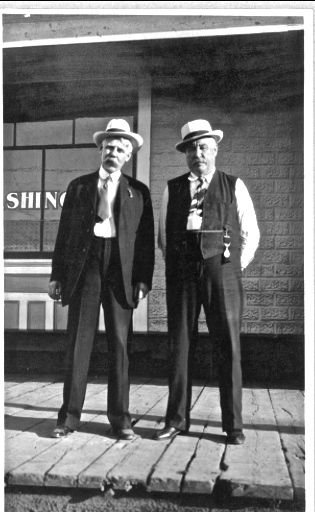
Gestures like this made Bill McPhee a legendary figure, known well to the power brokers in Alaska.  He is shown here, right, posing with Tom Megowan, his good friend and a political insider.  There is no evidence McPhee ever married or had children to assist him as he aged.  At 72 years old in 1913 he was still running the Washington Saloon and continued, despite declining eyesight, until closed by National Prohibition.  By then he was almost blind and about 1921 left Fairbanks for San Francisco and better care.  Then McPhee fades into history and I have been unable to find his burial place.

“No one who ever knew him ever forgot Bill McPhee,” according to one author.  Today, however, no one who ever knew him is still living.  Yet through the iconic ceramic flask McPhee issued we can learn the story of this resourceful Yukon pioneer who preferred pouring golden liquid over a bar to laboriously unearthing the shiny stuff in the frozen tundra.

Notes:  While this post was composed from many sources, a key one was an item entitled “A Most Popular Resort:  Bill McPhee’s Saloon” by Terrence Cole from “A Walking Tour of Fairbanks” published by the Tanana-Yukon Historical Society.

Addendum:  This is to alert both followers of this blog and others that I have a new website involving whiskey.  It is a compilation of more than thirty vignettes about Old West saloons and saloonkeepers.  Outlaws, gunslingers, and shootings abound.  This new blog can be accessed at wet enterprise: select saloons of the old west@blogspot.com. If this new site proves popular, other compilations under the “wet enterprise” heading may be forthcoming.


Monday, March 25, 2019

Whiskey Men Hounded by Tax Collectors


Foreword:  Almost from the outset of the Republic, the Federal Government has collected taxes on the production of whiskey.  George Washington himself rode out to help put down the Pennsylvania “Whiskey Rebellion” of farmer/distillers objecting to federal taxation.  For many years the principal revenue stream into Washington, D.C., came from taxing liquor.  Shown here is a $500 whiskey revenue stamp.  Before and even after passage of the Bottle-in-Bonding Act of 1897 by Congress, tax collectors could use their authority to harass and even bring ruin to distillers.  Recounted here are three examples of government overreach.

William McRoberts, an immigrant from Northern Ireland, found considerable initial success as a distiller and wholesale liquor dealer from Cincinnati.  When the Civil War ended, McRoberts built a distillery near Latonia Station, on the Louisville Short Line & Kentucky Central Railroads, located about four miles south of Cincinnati.  Known on Federal rolls as RD #2, 6th District of Kentucky, McRoberts designated this plant the Willow Run Distillery.  His success was such that he was able to build his family the mansion home, shown below.


Fire was to be McRoberts’ undoing.  Just after Christmas 1867, a conflagration ignited at the distillery, destroying the plant.  Storage areas held 9,000 barrels of highly flammable whiskey that fueled a fire so intense that the stone walls of the building crumbled.  The loss to McRoberts and his partner was set at $450,000, equivalent to more than $9 million today.  Although insurance paid $200,000, the remainder came from the owners’ pockets Undeterred by this setback,  McRoberts immediately rebuilt. 

His fire precautions proved unavailing.  In 1869 McRoberts suffered a second major fire, again with great monetary loss.  This time he lacked the resources to rebuild.  He sought to recoup from the Federal government the amount he already had paid in taxes for the now destroyed whiskey, but was refused.  Prior to passage of the Bottled-in-Bond Act of 1897, distillers were taxed on product immediately after it was put in barrels and stored for aging.  

Eventually McRoberts sued in Federal Court for a refund, triggering a tense confrontation with authorities.  In 1870 a Federal liquor gauger/inspector named Mohan had a heated argument with McRoberts, attacked him with a knife and was arrested.  In the end the distiller was forced to sell his mansion, his wife left him taking their two children, and he faced financial ruin.  When McRoberts died in 1875 at the age of 52 following a train accident that cost him both legs, his lawyers were still arguing unsuccessfully for a refund.


Fast forward eighteen years.  Jacob Sheaffer was highly respected in his home town of Lancaster, Pennsylvania.  The scion of an early settler family, Sheaffer owned a distillery, a liquor dealership and a shoe store.  Times were good until October, 1893, when a fire destroyed his distillery, resulting in relentless pressure from a federal collector of revenue that ultimately may have resulted in ending Sheaffer’s life.  As the U.S. Government years later tacitly acknowledged, he deserved a better fate. 

In 1893, Sheaffer’s warehouse was destroyed by fire, taking with it some 40,000 gallons of whiskey that was aging there.  He had insurance, but that proved problematic.  Although the policies were in full force, many of the companies that had issued them refused to pay on the grounds that the fire had been set, in effect accusing Sheaffer of arson.  He took them to court and won.


Using the money he received in the insurance settlement, Sheaffer rebuilt his distillery and began to make whiskey again.  Then, after a delay of three years, the U.S. Government in 1896 demanded immediate payment of the tax on the whiskey that had been destroyed in the fire, assessing the debt at $45,166, equivalent today to about $1 million.  Although Sheaffer asked authorities to abate the tax in view of the circumstances, he was was refused and the Treasury Department proceeded to enforce collection.  In desperation, the Pennsylvania distiller stole some cattle, sold them, and was caught.

With his reputation in Lancaster now besmirched, Sheaffer almost certainly knew and dreaded what  would come. In 1897 Federal authorities seized all Sheaffer’s business properties, including the distillery, the warehouse, its contents, and his shoe store.  Jacob had borrowed almost $15,000 from relatives and friends to rebuild his distillery; now he met to inform them he was forced to default on their loans.  The cumulation of these events threw  Shaeffer into deep despair and impaired his health.  A year later at age 52, he died.


Outraged at what had occurred, his relatives appealed to Washington for redress.  A Pennsylvania senator in 1903 introduced a sympathetic bill that asked the U.S. Court of Claims to determine compensation for the injustice. It passed. The Court agreed that a mistake had been made and that recompense was due. It awarded the Sheaffer estate $34,055.  Unfortunately, the money ceded to Sheaffer’s family could not bring Jacob back from the early grave to which his own government seemingly had hounded him.  

Mark Twain called it a “ten million dollar swindle.”  The U.S. Commissioner of Revenue saw it as the answer to preventing the government from being deprived of “a vast amount of revenue” through frauds committed by liquor distillers. They both were referring to the spirits meter invented by a New York mechanical engineer.  Peoria, Illinois, liquor dealers Adolphus and Julius Nusbaum were typical of the hundreds caught up in the Tice Meter controversy.

The story began in 1867 when evidence emerged that the U.S. Government was being cheated out of tax money through frauds committed by distillers, often in collusion with dishonest inspectors.  For the Commissioner of Revenue the answer was to improve measuring liquor output by means of meters attached to stills that reputedly would aid inspectors in detecting gross understatement of the amount of spirits manufactured.  After a competition, it selected the design offered by Isaac P. Tice. Called the Tice Meter, the patent design is shown below.  The Treasury subsequently demanded that all distillers and rectifiers in the U.S. buy the expensive device. This included the Nusbaum brothers.  


It did not take long for the Commissioner of Revenue to begin having doubts about the utility of the Tice Meter and an expert commission was appointed to make a series of practical tests.  When the report came in negative, the Treasury Department in 1871 discontinued requiring use of the device, claiming to have found a more accurate meter than Tice’s.  In the meantime, hundreds of distillers and rectifiers had been forced to buy them — and now the Tice meters had been trashed.  Some distillers asked for a payback from Congress.  A bill approving repayment was vetoed by President William McKinley.  Another recourse was to the courts, the path taken by the Nusbaums.  They sued Enoch Emory, the U.S. collector of revenue for the Chicago district in Federal District Court to recover the $1,500 they had sent him to pay for the Tice meter for use in their whiskey blending operation.  Today that cost would be equivalent to at least $33,000. 

Emory’s lawyers argued that the money was Tice’s and not his and implied the Nusbaums should be litigating against Tice. The judge agreed and threw out the brothers’ case.  At that point, the now wiser Nusbaums ceased their efforts at repayment and took their losses.  By 1873 — just two years later — they shut the doors on their Peoria liquor house and went out of business, likely agreeing with Mark Twain about the “ten million dollar swindle.”

Note:  More extensive articles on each of these whiskey men can be found elsewhere on this blog:  William McRoberts, November 19, 2016;  Jacob Schaeffer, January 22, 2016; and the Nusbaum Bros., January 29, 2018.
  
Addendum:  This is to alert both followers of this blog and others that I have a new website involving whiskey.  It is a compilation of more than thirty vignettes about Old West saloons and saloonkeepers.  Outlaws, gunslingers, and shootings abound.  This new blog can be accessed at wet enterprise: select saloons of the old west@blogspot.com. If this new site proves popular, other compilations under the “wet enterprise” heading may be forthcoming.