Wednesday, October 9, 2019

The Rise and Fall of David Porter, Frisco Whiskey Baron

  
A Scottish immigrant, David Porter began his California career as a drayman, driving a team of horses hauling barrels for a liquor dealer.  Before long Porter owned the company and had expanded his business interests and wealth to become part of the city’s financial elite and make his daughter the object of greedy eyes.  Then came an event that changed everything. 

Born in Scotland in 1833, Porter arrived in the Golden State in 1845 at the age of 18.  He likely had been raised on a farm, exhibiting a knowledge of livestock.  He soon secured work with the liquor house of Fox & Connor in Stockton, California driving a horse-powered wagon around the city.  According to one observer, Porter demonstrated “so much zeal and capacity” that the partners soon advanced him to bookkeeper.  

In 1854 when the company moved 83 miles west to San Francisco, the Scotsman had become so valuable a part of the operation, he was made a partner.  Not long after the move Connor left the business and the firm of Fox & Porter was born, doing its liquor sales at the corner of Leidesdorff and Clay Streets in San Francisco’s financial district.  

After some 14 years working successfully as partners,  Henry Fox retired and Porter purchased his interest.  With the company name now simply “David Porter,” the sole proprietor moved to the Parrott Building, shown here, at the northwest corner of Montgomery and California Streets, considered a premier location.  There Porter wasted no time asserting his merchandising genius, rapidly building his wholesale liquor house into among San Francisco’s largest.

Porter’s flagship brand was Shield Bourbon Whiskey, a name he never bothered to trademark. He made no pretense about being a distiller, announcing on rather that the whiskey had been distilled “expressly” for him.  The source remains unknown although Kentucky might be expected given his use of the term bourbon.   

He packaged his product in ceramic jugs with a with an elaborate label  that contained a simulated coat of arms depicting a plumed knight and the initials “D.P.” (David Porter) and “S.F.” (San Francisco).  Those jugs, as shown here, came in sizes ranging from a quart to a half gallon.

Meanwhile, Porter was rising in San Francisco business circles.  Accounted a millionaire in the press, he was hobnobbing with the city’s elite.  For example, when local luminaries such as Leland Stanford, founder of Stanford University, and railroad executives and bankers, Charles Crocker and Mark Hopkins, decided to choose California Street as a residence location for themselves, a franchise was granted to a group for a cable railroad that included the “Big Three,” with David Porter and others. The line was soon constructed. Shown here at its terminal and power house, the cable car stretched from First Street to Kearney, serving the mansion homes on the hilltop.


Among them was the Porter mansion at 1414 Folsom Street that had a commanding view of San Francisco from atop Nob Hill.  Now the site of the posh Fairmont Hotel, the liquor baron’s home was two and a half stories high with a wrap-around yard and garden.  Of frame construction, it was Victorian in architecture — a visible sign of wealth and wellbeing.  The net worth Porter gave the 1870 census taker was equivalent to over $1,000,000 today.

As he advanced, Porter never forgot his Scottish roots.  He was a ruling elder and large contributor to St. John Presbyterian Church, organized in 1870 with 220 members, and he assisted with the purchase of a place of worship.  He also was the president of the local St. Andrew’s Society, formed for the purpose of granting temporary relief to impoverished Scotsmen and their families.  Again, he was generous in his philanthropy.

Sharing the mansion with David was his wife, the former Elizabeth Green, who had been born in Maryland of immigrant Irish parents. She was eleven years younger than her husband.  They had married in the late 1860s and had two children, Grace born in 1868 and Mary in 1870.   The 1870 census found the family living in the Folsom Street mansion with Elizabeth’s mother, Mary Green, and a man identified as a bookkeeper, likely working for Porter in his liquor house.

As his reputation as a businessman rose, Porter and his wife became known a socialites, entertaining frequently in their mansion home.  In 1884 they hosted an opera singer named Enrico Campobello, a dashing figure who had made a splash in San Francisco society.  One of a number of British singers of the time who adopted Italian identities, Campobello’s real name was Henry Mclean Martin, born in Campbeltown, Scotland.  

The Porters likely were thrilled to have a celebrity like Martin who reputedly came with letters of introduction from acquaintances of David’s in Scotland.  One can imagine the two men having a pleasant evening recounting their memories of the old country.   Campobello/Martin was married and sang with his wife, an operatic soprano.  When their tour ended, the baritone/bass announced that he would stay in Frisco and form his own opera company.  His wife left town without him.  

Little did the Porters realize what was transpiring.  At their home Compobello/Martin had met their daughter, Grace, now a winsome young woman of 16, and decided that marriage to an heiress would assure his future.  The inexperienced Grace for her part was utterly smitten with the suave opera singer.  The unsuspecting Porters even hosted the fortune-seeker the following year.  When David finally understood what his fellow Scotsman was up to, he forbade him to visit the mansion ever again.  But it was too late.  Campobello/Martin divorced his wife and induced the love-smitten teenager to run away with him and marry.

As one writer commented:  “San Francisco society was shocked.  It was all very well to have singing lessons from the handsome baritone, but to marry him….Back in England, the St. James Hotel in Piccadilly advertised they were selling off a trunk of his property…that he’d abandoned there.  But Henry didn’t care.  He’d married a millionaire’s daughter.”   How David Porter and his wife reacted to the marriage is unclear. The marriage itself may have been shortlived. A San Francisco newspaper in Jun 1893 reported: “Mrs. Grace Porter Campobello is visiting her parents, Mr. and Mrs. David Porter, on California street, and will not probably rejoin her husband in Memphis.”


 For onlookers, Porter appeared to continue to operate a successful liquor house as before and manage a portfolio of other investments.  As one press account called him “one of the most widely known of San Francisco merchants.”  He made a business call in the late afternoon of January 17,1893, arriving at the Mills Building, a major financial center shown here, and took the elevator to the seventh floor.  After visiting an office there, the liquor dealer returned to the elevator that stood next to a spiral staircase open to the ground floor lobby.

Suddenly Porter fell. He crashed on the second floor, fracturing his skull, and died instantly as his body rolled down the stairs to the lobby.  A coroner’s jury ruled it an accidental death.  The San Francisco Examiner the following day report that the liquor dealer had been ill and the previous Sunday had suffered a bout of vertigo.  Its story speculated that when an elevator car was not at hand, Porter walked over to the bannister, looked down the seven stories, had a second attack of vertigo, tipped over the railing and plunged fifty feet to the second floor.  The newspaper termed it:  “A fearful descent.”
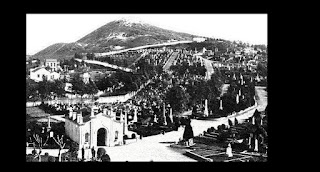
After an inquest, Porter’s body was taken from the San Francisco Morgue to Wright’s undertaking establishment where it was prepared for a well attended funeral at St. John Presbyterian Church.  He initially was buried at San Francisco’s historic Laurel Hill Cemetery, shown here in a vintage photo.  In 1901 the city, in order to make more space for development, ordered all graves within the city limits to be moved elsewhere.  Some 35,000 buried at Laurel Hill were forced out of San Francisco and moved to a former Japanese cemetery in the adjoining community of Colma, the graveyard now called Cypress Lawn.  Porter’s body was among those re-buried but without any identifying monument or headstone.

Not long after Porter’s death speculation arose that his fall might not have been accidental.  Although all his obituaries spoke of his wealth, Porter soon was revealed no longer to be a rich man. He apparently owed large amounts of money and was on the brink of bankruptcy.  Could the fall be attributed to financial distress?  The individual most shocked by this news may have been Campobello/Martin.  Despite appearances, his wife’s father was actually no millionaire after all.  Porter had died worse than penniless, it seemed, and Grace had nothing to inherit.   Additionally, after his death the liquor house that Porter had built over almost a half century went out of business.

David Porter, however, deserves to be remembered by something better than the manner of his death.  He was, after all, a Scottish immigrant who rose from a lowly drayman to owning a major liquor house and respect as one of San Francisco’s premier pioneer merchants.  


Saturday, October 5, 2019

John Schweyer's All-America Liquor Ads

           
Most liquor dealers advertised.  The majority kept their ads local to their city or county.  Some advertised regionally and had traveling sales forces to back up their efforts.  Dealers emphasizing mail order sales advertised more widely throughout the U.S., but constrained by cost often just with small notices in trade journals.  John Schweyer, a Chicago liquor dealer, consciously set out to break that mold, issuing large display ads in magazines with coast-to-coast circulations.  It worked.

Schweyer was born in Zutzendorff, Alsace, then part of the German empire, now a town in France.  When he was 21 in 1870, he emigrated to the United States, settling in Chicago and in 1875 becoming a naturalized American citizen.  From a  passport description, Schweyer was 5 feet, 8 inches tall, with black hair, green gray eyes, a high forehead, long face and “sallow” complexion. He seems almost immediately to have engaged in the whiskey trade, learning the business in one of the many liquor houses in the Windy City. 

Within five years of coming to America John found a bride in Chicago.  Her name was Louise and at 15 years old, she was nine years younger than John.  They would have two children, Edward, born in 1875, and Frieda, in 1879.  Perhaps it was the impetus of a growing family that caused Schweyer to strike out on his own.  He began being listed as an independent liquor merchant in local business directories in 1877, located at 581 West 12th Street. As his business succeeded, he soon moved to larger quarters along the same Chicago commercial avenue.  By 1887 he was occupying the building shown here.

Although he called himself an “old Pennsylvania distiller,” Schweyer was in fact a “rectifier,” that is someone blending whiskeys to achieve a particular color, smoothness and taste.  He featured a great many  brands, including:  “Arcola,” "Chicago Club,” "Oak Glen,” "Old Cabinet Penn,” "Rich Valley,” "Schweyer 10 X Cabinet,” "Schweyer Cabinet,” "Schweyer Cabinet Reserve,” "Schweyer Pure Rye,” “Nestor Sour Mash,” and "Straight Trip.”

Although he also tapped distilleries in Illinois and Pennsylvania, a major source of Schweyer’s supplies was The Old Darling Distillery in Carroll County, Kentucky, known in federal parlance as RD #4, 6th District.  Founded in the late 1870s, over time Old Darling became an extensive facility with eight different warehouses, four free and four in bond.  All but one were constructed of brick with metal or slate roofs.  The distillery itself was of the same construction.  The complex also included a barrel house (cooperage) on site, an engine and boiler house, an iron-clad grain elevator and frame cattle pens 26 feet south of the still.

The Old Darling Distillery could provide Schweyer with a substanial amount of the raw product he was rectifying in the back room or upper floors of his large quarters.  He was mixing up his various brands, bottling them onsite, and putting his own labels on them as shown here for Chicago Club “Old Fine” Whiskey and The Schweyer Double Copper Distilled “White Rye.”  The latter and a shot glass above contain illustrations of his trademark, a bird sitting on a barrel of whiskey surrounding by sheaves of grain.   Most of his bottles have lost their labels over time but Schweyer embossed his containers with his name and “Chicago,” as shown on the flasks below.


It is not clear just when Schweyer decided that his best opportunity for marketing his whiskey was to sell nationwide by running advertisements in major publications. An ad, below, in 1889 carried a note, written to look as if it were added by the magazine:  “The Schweyer Distilleries have been well known in the liquor trade for upwards of 25 years.  Their change and future course of supplying consumers direct is said to be due to the increasing adulteration of their whiskies by wholesale and retail dealers.”   The implications of this statement are preposterous.  Schweyer was not a distiller but one of the wholesalers/retailers being demeaned in the ad.  He had complete control of his Chicago blending, bottling, and sales process.  There was no way any wholesalers or retailers could have tampered with his products.

The ad ran in Munsey’s Magazine, a monthly founded in New York City in 1889.  The publication featured an innovative front cover in color and 36 pages of articles on subjects of widespread interest.  It sold nationally on newsstands and through subscription. By 1895, the magazine had a circulation of 500,000 a month.  Schweyer also was advertising in Leslie’s Weekly, a nationally circulated illustrated literary and news magazine with a circulation of 65,000 weekly.  Shown below are Schweyer ads from each publication.


Although display ads in both magazines were expensive — Schweyer later sized them down — his gambit paid off.  By the turn of the century many localities under prohibitionist pressure had voted themselves “dry,” banning alcohol sales.  Many states and more localities would do so in ensuing years.  Mail order booze, however, remained protected by the commerce clause of the Constitution.  Schweyer pre-paid express fees east of Colorado and sent his liquor in plain boxes and parcels to thwart noisy neighbors.  His whiskey found a ready — and thirsty — market. For 15 years the German immigrant prospered.

A few months after Congress acted to end the loophole of out of state shipments to “dry” areas, Schweyer died in Chicago at the age of 63.  He was buried in in Section K of Forest Home Cemetery, Cook County, next to his wife, Louise, who had died earlier.  His grave marker is shown here. The company he had founded, John Schweyer & Co., continued to be operated under his name by associates until closed in 1919 with the coming of National Prohibition.

By the time of Repeal, American advertising had become increasingly sophisticated.  Leslie’s Weekly had folded in 1922;  Munsey’s in 1929.  Their place was taken by national magazines like the Saturday Evening Post, Colliers and the New Yorker that after 1934 ran liquor ads of considerably less dense text and emphasized “modern” design quality.  Earlier ads, such as those shown here, have come to look quaint, almost archaic. Nevertheless, John Schweyer deserves to be remembered among whiskey men for his pioneering advertising to sell liquor to all America. 


Tuesday, October 1, 2019

Whiskey Men Who Committed Suicide


Forward:  Suicide is the ultimate act of despair,  It can spring from many causes to lead an individual to lose all hope of the future and take his own life.  Although whiskey men generally were of an optimistic mindset, a few found themselves in situations where death seemed the best way out.  Here are recounted briefly the stories of three men who close that alternative.

Given the easy access to strong drink, I find it somewhat surprising that of the some 720 whiskey men I have profiled, only two definitely have been identified as becoming alcoholics. Billy Wood was one of them. Wood was well-known and for a time well-respected saloonkeeper in Eureka, Utah, a pioneer settlement that grew from a mining camp to become the largest city and the center of commerce for an entire region.  Wood contributed to that development as well being a popular publican whose Oxford Resort, according to press reports: “…Had the best business in town.”   The building is shown as it looks today, run down.

As time passed, Billy married, fathered two daughters, and gradually, as his obituary put it, developed “an uncontrollable appetite for alcohol.”  Recognizing the strains his drinking was putting on his marriage and business, Woods twice put himself into the hands of the Keeley Institute, a nationwide chain of 200 clinics that claimed to offer a “scientific” cure for alcoholism.  Despite glowing testimonials from former patients, the medical profession was skeptical.  Keeley treatments clearly did Billy little good.  In the Fall of 1899, returning from a “Keeley Cure” on the West Coast, he resumed his drinking almost immediately and his wife made good on her promise to leave him unless he reformed.  

Plunged into despair, Wood decided on a desperate way out.  According to his obituary in the Salt Lake Tribune of September 22, 1899, he soaked strips of flypaper in water, knowing that they contained arsenic.  Then he drank the water.  Death by arsenic poisoning is not an easy way to commit suicide.  Symptoms begin with headaches, severe diarrhea, and drowsiness.  When the poisoning becomes acute, symptoms include diarrhea, vomiting blood, muscle cramps, stomach pain and convulsions.  The final result of arsenic poisoning is coma and death.  Wood’s suicide occurred when he was only 33 years old.


Below the headline here, datelined December 15, 1909, is the story of B. B. Dillard, a well known Roanoke, Virginia, whiskey dealer and civic leader.  At the age of 40, in front of his wife of only four months, he shot and killed himself.  Was it an accident, as she insisted, or had he committed suicide?  Popular opinion at the time held the latter.


The photo above captures the interior of Dillard’s liquor store, indicating that it was a substantial establishment.  The place featured a potbellied stove for heat and gas lamps for light.  Note the row after row of bottles on the shelf on both sides of the aisle.  On the left at back are barrels full of whiskey with spigots to fill stoneware jugs that can be seen on the floor.  My guess is that the gent with the long coats, bow tie and mustache at far left is B. B. himself.   

In 1904, tragedy struck Dillard and his family, his wife only 33 years old, died, leaving him with small children to raise.   As great a sorrow as this may have been, he did not immediately remarry but appears to have thrown his efforts into his work and community involvement.  

Five years after his wife’s death, Dillard married again.  His second wife was Nannie Carrie Flagg, 23 years of age;  he was 40.  Whether this age difference played any part in what occurred is unknown.  What is known is that on December 14, 1909, B.B. went home, shot and killed himself in the presence of Nannie Carrie.  They had been married only four months.  

There seems to have been little reason for Dillard deliberately to take his life.  His obituary noted that he “had been successful in real estate and had amassed a fortune.”  Friends who had seen him the evening before his death declared he was in a happy mood. Finally, his widow was adamant that the shooting had been an accident.  Nevertheless, the coroner suspected suicide.  In the end, it is impossible to know.  

William W. Cooper may never have gotten to New York City, but he might have wished he had.  He contracted a bad case of those “little town blues” when he was forced to close up his prosperous distillery and liquor business in Marion, McDowell County, after North Carolina banned making or selling “spiritous liquors” in towns of fewer than 1,000 residents.  Marion missed the cut and Cooper had to shut down his flourishing operation and in 1902 move 70 miles east to Statesville, North Carolina. 


Although Cooper again was successful in Statesville, he was forced to shut down his liquor business in 1908 for a final time because of a statewide ban on all alcohol sales.  Just 34 years old at the time, he was recorded in the 1910 census living with his wife, Camille. His occupation at that time was given as “Agent, Restaurant.” 

When earlier I wrote about Cooper employing the "little town blues" theme, it was without any idea that he was afflicted with depression and later showed signs of being suicidal.  Subsequently, however, a thoughtful resident of Statesville after reading my post sent me news stories, recounting the details of Cooper’s death. While living in Statesville, William had to be institutionalized several times and in June 1913 ended by taking his own life, surely a tragic end for so young and talented an individual. 

Only one of the news stories about his suicide directly addressed W.W. Cooper’s character and it is that on that note that it seems most fitting to end: “..Mr. Cooper was a kindly, generous man and readily made friends."  May he rest in peace together with Billy Wood and B.B. Dillard.

Note:  Each of these men has been treated with a more extensive vignette in previous posts on this blog.  Billy Wood on April 7, 2019;  B. B. Dillard, March 6. 2015; and W. W. Cooper, February 4, 2016.


Friday, September 27, 2019

Death Around Him, F.W. Bradley Made a Life

                    
From pre-teen to maturity, Francis William Bradley frequently experienced the deaths of loved ones and comrades, always moving on to new challenges,  He ultimately fetched up in San Diego, where he ran a saloon, established a wholesale liquor house, founded a bottling company, and owned a locally famous mineral spring.  For Bradley and his beverages, California truly was “The Golden State.”

The son of Nancy Scott and John Isom Bradley, a farmer, Francis was born in Audrain County, Missouri, in May 1848.  His grandfather William had moved west to Missouri from Virginia not long after the War of 1812, in which he had served as a teenaged soldier.  Many Southerners, taking advantage of inexpensive farmland, had moved to the area and Audrain was one of six counties popularly called “The Heart of Little Dixie.”

Francis would have his first experience of a loved one dying when his mother, Mary, passed away at the age of 33 when he was twelve.   An only child, he was raised by his father.  As soon as young Bradley was able, with the example of his grandfather, he joined the Union Army in his mid teens.  It was something of a courageous decision.  Audrain County was sharply divided about the war.   Many Southern migrants had brought slaves and slaveholding traditions with them.  Their sons, Francis’ schoolmates, were joining the Confederate  Army.

In August 1864, Bradley enlisted as a private in Company A of the 44th Regiment of Missouri Infantry.  Enlistment papers provide the following description:  “Eyes: blue; hair, dark; complexion, fair; height 5 feet, 5 inches.”  He quickly was sent to the Union Army camp for basic training at Rolla, Missouri, shown here.  A month later Bradley was engaged in combat.  By November he had fought in three major battles against rebel forces in Tennessee:  the Battle of Columbia, the Battle of Spring Hill and the Battle of Franklin.


At the Battle of Franklin, shown above, the Missouri 44th was severely tested.  As a regimental history tell the story:  “When the Confederate Army attacked the Union lines they were able to breach the area at the pike and as they did Union troops up front were forced back. The whole mass crashed right into the 44th Missouri. Simply stated, had the 44th faltered the Battle of Franklin may have been lost. Instead they stood their ground and fought with great courage until reinforcements came forward and until the retreating main line troops were able to gather themselves and rejoin the fight.”

In each battle Bradley had seen death all around as comrades and friends were killed on the field of combat.  He himself was hospitalized, whether for wounds or disease is not clear, and in late 1864 sent to the Army hospital at Rolla.  Months later he was transferred to the Marine General Hospital in St. Louis where he was mustered out of the service, discharged for disability.  Although he later received a pension as an “invalid,” his medical condition apparently did not hamper his subsequent career.

His father having died during the war and with no immediate family left in Audrain County, after the Civil War Bradley moved about 200 miles west to St. Joseph, Missouri.  St. Joe, as it was known by many, was the “jumping off point” for pioneers heading west.  Often wagon trains tarried in the city, buying supplies and waiting for favorable weather conditions.  St. Joe teemed with saloons and Bradley, 23 years old and a bachelor, found employment in one of them.

During the early 1870s Francis also found a wife in St. Joseph.  She was Rachel Louisa Juliett Blondeau, a woman six years younger than he, born in Illinois of French immigrant parents.  They were married on April 21, 1874, with the Rev. Henry Bullard, pastor of St. Joseph’s Westminster Presbyterian Church presiding.  In quick succession the couple would have two sons, William B. and John E.  The 1880 census found the Bradleys living on French Street in St. Joe. Francis continued to be listed as a saloon keeper.  

What occasioned Bradley to moved his family across the continent to San Diego is not clear.  Traffic through St. Joseph had fallen off during the 1890s as railway transport opened up large areas of the West. The saloonkeeper may have decided that brighter prospects awaited 1,700 miles away.  About 1887 the Bradleys moved to San Diego, shown below as it looked at his arrival. There Francis is initially recorded partnering in a saloon called “Bradley & Williams.” 


Only a year later death again was to strike down a loved one.  Rachel, Francis’ wife of 14 years, died in May 1888, leaving him to raise their two sons, William 14 and John 11.  About the same time San Diego directories recorded Bradley and a partner as proprietors of the “Eintracht” Saloon at 963 Fifth Street.  Meaning in German “peace and harmony,” the Eintracht was one of city’s more upscale drinking establishments. A subsequent owner would call it a “resort.”  The saloon featured a hot lunch available before noon, cold steam and lager beer, and mixed drinks — nor just shots of rotgut at the bar.

By 1891, perhaps in part to have a mother for his sons, Francis married again.  She was Ella A., a woman about his age who was born in Maine of parents from New England.  The couple would have no children.  The 1900 census found the family living downtown at the corner of Front Street and Broadway in San Diego where Bradley was running the Albemarle Hotel.  The hostelry, built in 1888 during an economic boom, billed itself as a family hotel.  It also was popular with officers of the ships docked in the nearby bay, as well as by traveling theater companies and comedy troupes.


The next few years would mark the heyday of Bradley’s success in San Diego.  California would live up to its reputation as “The Golden State.”  After leaving the hotel job Francis founded two businesses, the Bradley Spring Water and Bottling Company, located at 1225 C Street,  and F.W. Bradley Wholesale Wines and Liquors, located at 1058-1062 Fourth Avenue.  Francis advertised his liquor house relentlessly.   The ad shown above ran at the top of dozens of pages of the 1901 San Diego business directory. Bradley’s flagship brand was “Good Roads,” a blended whiskey.  He was issued a trademark for the name in February 1910.

At his liquor house Bradley was rectifying (blending) his own brands of whiskey in order to achieve a particular color, smoothness and taste, then retailing it in his own bottles. Shown here are an amber quart and a closeup of the embossed label.  Note the elaborate monogram of Bradley’s initials.  The transplanted Missourian also merchandised his liquor in clear embossed pint flasks, as shown below.  Both containers likely initially bore paper labels that have been lost with the passage of time. 


Throughout his career as a San Diego whiskey merchant, Bradley continued to promote his goods vigorously.  Showing a figure straddling a rail, the ad below asserted:  “On the fence as to where to secure the best wines and liquors of all kinds?  Settle the question by buying here.  Don’t poison yourself by buying inferior liquors when you can buy pure goods at very little more cost….Buy here and be sure of quality….”

At the same time, the proprietor’s spring water and bottling plant were flourishing.  Francis claimed to be sole owner of what he called “the Celebrated Bradley Spring” near San Diego. His ads touted his bottled spring water as “a pure natural mineral water, efficacious in all kind of kidney and stomach problems.”

His company also sold a full line of carbonated soft drinks, including root beer, ginger ale and flavored soda waters.   Bradley bottled his non-alcoholic beverages in Hutchinson type bottles that featured a spring stopper that prevented the escape of carbonation.  Those bottles also carried his embossed name.


Bradley's enterprises proved to be highly profitable, allowing Francis and Ella to buy one of San Diego’s more elegant homes, shown here.  It is now on the register of San Diego historical houses.  Constructed in 1887, the mansion is said to exemplify the “architectural and aesthetic development of San Diego in the Second Empire Victorian style.”  Located at 1546 A Street, the house was a “medium to large” elite dwelling.  The Bradleys purchased it from the original owner in 1904 but lived in it only two years and sold, possibly finding it too large for a couple living alone.

Then death visited Francis Brady once again.  Ella, his wife of 16 years, the woman who had helped him raise his sons into maturity and stood by him as he advanced in business and wealth, died in March 1907 at the age of 55.  Within a year, Bradley had married a third time.  She was Ida May Little,  born in California, the daughter of William and Honora Little of San Diego.  One record shows her as having been married earlier, possibly in her early teens.  At the time of their nuptials, Ida May was 32, Francis was 60 — a 28 year difference in their ages. At least for a time, they may have lived apart.  The 1910 census indicates that although recorded as married, Bradley was lodging alone at an apartment building on San Diego’s D Street, his occupation given as “merchant-wines.”

Two years later, death, something that Bradley had known so well in his life, became personal.  He succumbed to a heart attack in San Diego on May 3, 1912.  He was 66 years, 11 months and 10 days old.  Under the auspices of the Heintzelman Post, No. 33 of the G.A.R., his funeral was held at the chapel of a local funeral home.  Francis Bradley was buried San Diego’s Mount Hope Cemetery.  Shown here is the graveyard monument memorializing his Civil War service.

Addendum:  Bradley’s relationship with third wife Ida May, despite some apparent separation, must have remained cordial because he named her as the administratrix of his very substantial estate.  A controversy subsequently arose with the whiskey man’s other heirs, likely his sons William and John, over a private sale of property by Ida May.  They claimed that it had been sold for considerably less than it was worth and hinted at collusion.  After hearing arguments the probate judge voided the sale.  

Note:  The information and illustrations for this post have been taken from wide variety of sources.  Two of the more important ones are the Western Whiskey Gazette website of January 20, 2010, featuring a brief story and images of Bradley whiskey bottles, and a Legacy 106 Historic House Research report by Ronald V. May and Kiley Wallace on the former Bradley mansion, a document that contains a brief biography of the whiskey man.