Tuesday, April 14, 2020

Herman Braunschweiger and his Prodigal Son


Foreword:  In December 2014, I featured a biography of San Francisco liquor dealer, Amandus Fenkhausen, a German immigrant often credited with introducing the Christmas tree to the California city.  In the course of the story in passing I noted in passing his business relationship with another German named Herman Braunschweiger, shown below. Subsequently I have learned that Herman had his own story, one not so “sunny” as Fenkhausen’s, a tale involving his son, Herman Braunschweiger Jr., hereafter identified as “Junior.”

Herman Braunschweiger was born in October 1839 in Stadtkreis Braunschweiger, more commonly known as Brunswick, Germany.  Although his early life has gone unrecorded, an 1890 passport application indicates that in 1859 at the age of 20 he arrived in New Orleans from Bremen on the S.S. New York, a packet that carried freight and had forty passenger cabins.  He appears to have lived in New Orleans for a few years, possibly working in the liquor trade, and was naturalized a U.S. citizen there in 1868.

By 1870 Braunschweiger had migrated to San Francisco where he later teamed up for several years with Fenkhausen as importers and jobbers of wines and liquors in a business located at the northwest corner of Front and Sacramento Streets.  By 1882, he was in a brief co-partnership with E. H. Bumstead that ended in 1884 with Herman going it alone in a liquor dealership he called Braunschweiger & Co., its headquarters shown right.


Meanwhile, the German immigrant had immersed himself in family life.  Shortly after arriving in San Francisco he married Elise Roper, an immigrant herself from Lower Saxony, Germany, who was six years his junior.  In quick succession the couple would have three children:  Edward, born in 1871;  Herman Junior, 1872; and Elise, 1875.  A fourth child, Frieda, would come in 1884.

As Braunschweiger was struggling hard to build his business and provide for his family, he and Elise were having increasing difficulties controlling their second son.  Junior seemed cut from a different cloth than their other children.  At the age of fifteen the boy ran away from home in 1888, stealing his mother’s jewelry to finance his fling.  Found and brought home, Junior now 17 absconded a second time.  Braunschweiger tracked him down and had him arrested on a vagrancy charge.  A San Francisco newspaper told the story:  “Last night the father found his son in a lodging house at No. 17 Fourth Street in company with a dissolute woman named Frankie Ray, with whom he had been living.  In the lad’s possession was found a lot of valuable jewelry, which he had stolen from his parents’ house….”

Apparently unwilling to pursue criminal charges against his son and wanting him out of the clutches of Franky Ray, Braunschweiger arranged to send Junior abroad for a period.  The errant boy was issued a passport in April 1890 — his occupation given as “scholar” — and by June had arrived in England.  In a subsequent passport filing Junior indicated he spent the next few months traveling around the Continent and was now residing  in Bremen, Germany, but planned to come back to the U.S. in “one or more” years.

When he returned, Junior may have been contrite and more mature, leading Braunschweiger to bring him into the firm and trusting him as a traveling salesman.  The young man likely carried a sample case, like the one shown here. The case held vials of Brauschweiger wines and whiskeys, including the company’s flagship labels,  “Bear Grass” and “Old Pioneer,” the latter brand name acquired subsequent to Fenkhausen's death in 1893. 


Accounts suggest that Junior was successful as a salesman, for several years traveling around California profitably for his father.  But the youth could not stay out of trouble.  In June 1892, he was aboard a yacht with a group of friends that embarked from Triburon, located on a peninsula that reaches south into San Francisco Bay, shown here.  Among those aboard was a young lithographer, Walter H. Nitchy, who complained of being sleepy, according to testimony at the inquest into his death.  Junior and others testified before a coroner’s jury that he agreed to let them throw him into the water and that he enjoyed the dip.  The day following, however, Nitchy died at home of congested lungs.  Medical diagnosis subsequently indicated he had existing heart and lung impairments “so weak that death could come at any time.”  Junior and the others went free.

That incident was dredged up by the press four years later when Junior once again made the headlines in San Francisco newspapers.  This time because — and whom — the young Braunschweiger had wed.  In August 1896 Junior was married in Oakland by a justice of the peace to Sadie Nicholas, a woman who not only was a dozen years older than his 24 years, but known to be a notorious brothel madam who once had been arrested for keeping her young daughter resident in her house of ill fame.

When contacted by reporters about the nuptials, Braunschweiger seemed resigned to the situation.  “As he is of age, and they are legally married,” the liquor dealer is quoted saying, “I cannot see what I can do about it.”  With further reflection, however, the father changed his mind, swore out a warrant and had Junior arrested on the grounds that he was insane and required institutionalization.  

The case quickly came before a San Francisco judge.  Junior’s mother testified that her son had an “over-fondness” for drink and that she considered him “weak minded,” a mental weakness made worse by drinking.  She revealed that in May Junior had gone to a “Home of the Inebriates” for treatment for the liquor habit. Briefly he had kept straight until he again began to drink heavily and during this spree had married Sadie Nichols.  On the witness stand his father, according to the press, “reluctantly acknowledged that there was a taint of insanity in the family, and said he desired to have his son placed in some institution where he could be taken care of.”

The new Mrs. Braunschweiger Jr., a.k.a. Sadie Nichols, told  the judge a different story.  She said it was not a hasty marriage and that the matter had been talked over between herself and her new husband several times. She did not believe him insane and had never noticed anything to indicate that such was a fact.  The judge, after listening to the testimony, ordered Junior released:  “His Honor said that, although the young man might be irrational when drinking, he was no fit subject for an insane asylum.”

Despite walking out a free man, Junior could not stay out of trouble.  After the trial the Braunschweiger family cut off all financial assistance to him.  The couple soon was hard pressed for money and turned to Sadie’s niece, Ella Holstein, for help.  Their constant demands soon wearied Ella and upon their visitation to her apartment in early September she refused any further funds.  Whereupon Junior is said to have seized her by the throat and choked her.  Saved from further injury by the interposition of the landlady, Ella swore out an assault warrant.  The headline in the San Francisco Examiner read “Braunschweiger in Trouble Again, Attacks Wife’s Niece.”

Those scandals erupted while Braunschweiger faced a critical time in his business ventures.  At the equivalent cost of $880,000 today, he had committed to constructing a new building for his liquor house on Drumm Street adjacent to his California St. address.  It was a spacious edifice, shown here, five stories and a basement with large glass windows for showing his liquor products.  The building had two entrances, one directly into the store, another leading to a staircase to the upper floors and basement, that also were served by an electric passenger and freight elevator.  

At the time Braunschweiger also was expanding his marketing reach to other parts of the West and even as far away as Hawaii.  He also introduced and was attempting to market successfully new proprietary brands, "California Club,” "Extra Pony,” ”Golden Chief,” "Golden Cupid,” "Golden Rule,” ”Bear Valley,” "Golden Rule XXX Sour Mash,” “Kentucky Bourbon Whiskey,” "Oak Valley Distilling,” Brunswick Extra Pony Pure Bourbon Whiskey,” "Tennessee White Rye,” and "Silver Wedding.”


It is not entirely clear what the future brought for Junior.  It would appear that the battery charges were dropped.  He and Sadie divorced, an event that may have smoothed his welcome back into the Braunschweiger fold and even working again at the liquor firm.  The evidence is in a certificate from his second marriage.  There Junior is described as a “commercial traveler,” his former employment.  In December 1899 he was recorded marrying Louise Rogers, the daughter of an Irish immigrant laborer. The nuptials took place before a justice of the peace in a hamlet in Washington State, more than 800 miles from San Francisco, indicating some element of secrecy.

Meanwhile, Braunschweiger continued to operate his liquor business with success and prosperity.  In October 1905, however, he sickened and died in his residence at 2216 California Street, a few days short of his 66th birthday.  His funeral services were held at the Masonic Temple under the auspices of the Herman Lodge to which he had belonged.  He was cremated and his ashes deposited in the San Francisco Colombarium, next to his wife who had died in 1899.  Herman’s urn is shown here.

Given his reckless lifestyle it probably is no wonder that Junior died only four years after his father, passing at 37 years old in June 1909.  He was still married to Louise but no children are recorded.  As a sign of this “prodigal son” having reformed and been welcomed back into the Braunschweiger fold, Junior’s ashes are also in the San Francisco Colombarium, occupying a niche not far from his parents.

Note:  Much of the information for this post was gathered from San Francisco newspaper stories that chronicled the Braunschweiger family and their errant son.  Genealogical sites provided important data and images; other information and images were obtained from websites Western Whiskey Gazette and Ferd Meyer’s Peachridge Glass. 


Friday, April 10, 2020

Robert Mugge’s Big Ideas for Tampa — and America


When Robert Mugge, an immigrant boy from Germany, stepped ashore in New York City in September 1870 he began a career that only “a land of opportunity” can provide.  Selling liquor as his launching pad, Mugge, shown here, is credited with developing the city of Tampa, Florida, while authoring a political treatise that has been termed “part of the knowledge base of civilization as we know it.”

Mugge was born in January 1852 in Lauterberg, Harz, Germany, the son of Louis and Louisa Manzel Mugge.  At seventeen, an age when many adventurous German youths emigrated to the U.S. to seek their fortune, Robert boarded the steamship, SS Hansa, likely in Bremen, and headed west.  He first settled in Terre Haute, Indiana, where he had relatives.  A watchmaker and jeweler by trade, Mugge had an Indiana cousin, George Mugge, who was a distiller.  George may have taught him some of the rudiments of making whiskey. 

At the age of 22, Mugge married an Indiana girl, Alice McCullough, who may have been as young as 15 at their nuptials.   She would bear him three sons.  A lifelong asthma suffer, Robert apparently thought a sea voyage would be therapeutic and with his brother-in-law, William Mahn, in 1886 boarded a schooner in Mobile, Alabama, to take them to Cuba.  When the ship stopped in Tampa for several days to unload cargo, Mugge had chance to look around.

After the Civil War, Tampa, a former Confederate military post, had become a poor, isolated fishing village with fewer than 1,000 residents and little industry outside of its port.  Yellow fever, borne by mosquitoes from nearby swamps, broke out several times during the 1860s and 1870s, causing many deaths and convincing more people to leave.  Remaining residents in an apparent act of economic desperation in 1876 voted to abolish the city government.  Nevertheless, Mugge saw potential in Tampa and with Mahn moved there in 1877.  

While their families in Indiana waited for them to get established, the brothers-in-law opened a grocery and general merchandise store, buying a lot at Marion and Jackson Streets for $50.  They erected a two-story building with the business on the ground floor and rooms for rent above.  Eventually joined by their families, they housed them in a building at the rear.


Mugge’s early days in Tampa were not without heartache.  In February 1879 his wife Alice and all three sons died during a yellow fever epidemic.  After some months passed Robert may have remembered a young friend from his youth in Germany and began to correspond with her.  She was Caroline Rautenstrauch who lived in Goslar, Hanover.  Eventually agreeing to marry, Caroline came to America and the couple were wed in Florida in October 1882.  She was 21;  Robert, 29.  The couple would have nine children, two of whom died in infancy.  Caroline is shown here with two of their girls.

His marriage to Caroline and ever-increasing familial responsibilities seem to have spurred Mugge to even greater energy in business and civic activities.  While continuing to work as a jeweler and maintaining the general store, he established an industrial complex along Tampa’s Central Avenue, shown here in an insurance drawing. It included an electric generating works, an ice plant and  Florida’s first distillery, opened about 1901.  The plant included a still, a U.S. bonded warehouse and outbuildings, indicating that Mugge was abiding by the federal Bottled-in-Bond Act.  Government records show Mugge’s distilling activities extending well into the 1900s.

The German immigrant began advertising himself as a whiskey wholesaler, merchandising the products of his distillery in ceramic jugs of half-gallon, gallon and larger sizes to the many saloons that dotted the Tampa landscape.  Among them were several drinking establishments that Mugge himself owned, including a saloon shown below in Ybor City, a commercial district located just northeast of downtown Tampa.  Note the sign for Anheuser-Busch beer.  Mugge operated a plant that exclusively bottled beer from the St. Louis brewery.  He was also making a line of soft drinks including lemon, strawberry, sarsaparilla and sparkling soda water.


Beginning in 1896 Mugge operated a beachfront amusement park in partnership with a local Spanish cigar manufacturer and wine merchant.  Located outside the city limits in the eastern part of Tampa, it was known as DeSoto Park.  The oceanfront venue, shown below, featured a bath house, bowling alleys, a dance pavilion, and — of course — an expansive bar.  Attractions included circus acts and balloon ascensions. With burgeoning profits from his liquor and other enterprises, Mugge also constructed a number of brick buildings in Tampa, including the ten-story Bay View Hotel downtown, shown right.


At the same time Mugge was civicly active, providing electric power virtually at cost to the city and erecting street lighting in some neighborhoods out of his own pocket.  When an 1886 fire destroyed an entire business block in Tampa, partially because of a woefully equipped fire department, Mugge donated a “hand pumper” costing $600 to the city, known to all as the “Mugge pumper.”  When a new Tampa Fire Company was organized later that year, he was elected secretary.  Said one biographer: “Robert Mugge devoted his life to the building of Tampa which he loved so well.  He would invest every dollar he made in Tampa back into the Tampa economy, thereby giving employment to thousands of breadwinners.” 

Mugge was to find that although he was a hero in Tampa some people in nearby Kissimmee were prepared to attest that he was not “a law abiding citizen of good character.”  The accusations grew out of his efforts to buy a saloon in that city only to find local prohibitionists strongly opposed.  They brandished an affidavit from a police official alleging that Mugge once had been guilty of violating a Kissimmee city ordinance.  After a well-publicized battle, however, county commissioners granted his license.  Mugge lost no time in advertising his Kissimmee Eagle Saloon.

The Kissimmee incident and the growing tide of prohibition in Florida and elsewhere likely were the impetus that turned Robert Mugge, liquor purveyor, into a political theorist.  Over the next several years he evolved a concept of the ideal American society in a 52-page monograph he entitled “Practical Humanity.”  Issued initially in 1909, it has been reprinted through the years, most recently by a publisher who claims:  “Scholars believe, and we concur, that this work is important enough to be preserved, reproduced, and made generally available to the public.”   Mugge would be proud.

Mugge’s preface signals his utopian outlook:  “Good Old Mother Nature can be made to produce an abundance to supply every human being on earth, with all the necessities of life, all the comforts and not a few of the luxuries.  Read this little book and learn how.”  He then proceeds to lay out a vision for society that primarily aimed at reforming America into a kind of altruistic corporate state.

Although Mugge explicitly disavows any identification with socialism, his ideas might be characterized as “Karl Marx meets Mr. Rogers.”  Marx thought the state would “wither away.”  Mugge suggested that in his system state and local governments gradually would collapse in favor of directing everything from a national center from which one or more individuals make all the rules for numerous “colonies” across America in which the residents would enjoy a small town “agrarian” lifestyle. 

Marx called organized religion “the opiate of the people.”  Mugge banned all churches from his colonies but people would be free to go elsewhere to worship.  Marx advocated “from each according to his ability, to each according to his need.”  Under Mugge’s proposal poverty and crime would be abolished along with capitalistic greed. This harmony somehow would be accomplished by largely abolishing paper money.

Mugge devoted more than one-third of his treatise on “The Liquor Question.”  Given his background, he not surprisingly created plenty of room for alcoholic spirits in his utopia.  “We might just as well give up the idea of founding these colonies at all as to establish them under a hypocritical prohibition law and expect them to be a success.”

How Mugge’s ideas were received in his lifetime is unclear. He continued to be an active participant in his business ventures, including those involving whiskey and beer.  Meanwhile he was watching prohibitionary forces, working under local option laws, gradually turn Florida “dry.”   He never saw National Prohibition imposed, however, dying on December 17, 1915 at the age of 63.  Shown here is a portrait of Mugge in his older years. After a funeral described as “one of the largest ever held in Tampa,” he was buried in the city’s Woodlawn Cemetery, the gravesite shown below.


As a last word on this extraordinary individual, a quote from his obituary in the Tampa Tribune under the headline “A Great Man Gone,” deserves repeating: “Robert Mugge was an old citizen of Tampa but not an old man, and was a remarkable character.  A man of intelligence and business acumen. One of the most enterprising of our citizens. A man of energy; he fought the battles for fortune unsurpassed though afflicted physically. This was a "great" man, though few people knew it, nor did he.”

Note:  Much of information and some of the images used for this post come  from "Robert Mugge, Pioneer Tampan,” by Margaret Regener Hunter, Mugge’s granddaughter, appearing in the Sunland Tribune, Journal of the Tampa Historical Society, Vol. 15, Nov. 1989, and the writings of Robert E. Mugge, a great-grandson.  Robert the Pioneer apparently pronounced his name “mew-ge,” while his descendents prefer “mug-ge.”  The quote that opens this post is from the publisher blurb on "Practical Humanity."


Monday, April 6, 2020

Carl Lauber & “Selling Alcohol to Protestants”


In February 1986 a columnist for the Philadelphia Inquirer named Clark DeLeon received an official looking letter marked “PROSECUTOR’S OFFICE.”  In part the message said:   “The charge…is SELLING ALCOHOL TO PROTESTANTS.  Accordingly we have erected a protest shanty behind the mausoleum of CARL F. LAUBER….In his day LAUBER sold vast quantities of alcohol to Protestants.  We have not forgotten.”  Obviously the letter was a spoof.  But why out of hundreds of Philly whiskey dealers had Carl Friedrich Lauber been singled out?

The answer may lie in the high profile Lauber created for himself, advertising as “Philadelphia’s most dependable wine and liquor merchant,” claiming that his Cabinet No. 9 Rye was “The Finest Whiskey in America,” and continually trumpeting the silver medal his products won at the National Export Exposition of 1899.  Even in death Lauber remained prominent.  His mausoleum stands on a Philadelphia hillside overlooking a major highway where thousands of motorists passed it daily. Moreover, at night, all night, it is lighted.

Born in Bavaria in January 1857, the son of Carl Fredrick Lauber Sr. and Pauline T. Holly,  Carl Lauber emigrated from Germany to the United States in 1873, about the age of 16.  Indicating some advanced level of education, an early occupation in America according to a 1877 Philadelphia directory was as a bookkeeper, possibly in one of the city’s many liquor houses.  By the 1880 census he had been joined by a younger sister, Bebetta, who was working as a cashier in a hotel.  The two lived together in a boarding house.

Frugal and clearly not content to toil for others, with a partner named George Schleicher, the 26-year-old immigrant struck out on his own about 1883, opening a saloon at 28 North Ninth Street, the building shown here. The venture proved so successful that within several years the partners added a wholesale and retail liquor business.  Like others before him Lauber had realized that supplying  whiskey and other spirits to saloons and other drinking establishments was more profitable than selling drinks over the bar.

Carl F. Lauber & Co. bought whiskey by the barrel from some of the many Pennsylvania distillers and blended it on the premises, bottling the results as proprietary liquor brands.   Among company labels were “Lauber Rye,”  “Luxus Whiskey” “Cabinet No. 9 Rye” and “Lethe Rye.”  Luxus, Lauber claimed in ads, was a straight unblended rye.  Cabinet No. 9 was by contrast a blend of the “choicest and old straight rye whiskies.”  

He trademarked only two of those labels and then only considerably later:  Lauber Rye in 1905 and Lethe in 1916. The  apparent success of his “house” brands allowed him to open a second outlet at 904 Filbert Street, shown left.

For eleven years while Lauber was building his liquor business, he remained a bachelor.  That changed in 1896, however, when he met the teenaged daughter of Carl A. and Therese Holly, both immigrants from Germany.  She was American-born Pauline Therese Holly, called “Lina.”  When they married in 1894, Carl was 37 and Lina only 17.  

The couple would have three children, Gertrude, born 1895; Carl Junior, 1896, and Estelle, 1898.  Eventually Lauber would house his family and a servant girl in an impressive four-story home at 1837 North 33rd Street.

Lauber’s marketing strategy included placing a display, shown right, at the Philadelphia National Export Exposition of 1809, sponsored by the Franklin Institute, the city’s science museum and center for research. The Institute had a worldwide reputation for sponsoring exhibitions, and recognizing scientific advancement and invention by awarding with medals.  The display of Lauber’s wares earned his liquor house a silver medal, diploma and “official” blue ribbon for Luxus Rye and for a line of beer he sold.

Winning the medal may convinced Lauber that he needed a distinctive logo for his stationary.  The result, shown here, was a very elaborate drawing that the liquor dealer trademarked in 1905 with the following description:  “The representation of an arbor of lattice-work, over which trail grape-vines bearing fruit.  Up on the top arch of the arbor is an enlarged wine cup mounted on a pedestal, and on the ground at the base of said arch, on either side of the opening therein, stand groups of bottles. Within the archway stands a male child unclad and leaning against a barrel mounted on a trestle, his left hand holding a  wine-cup raised above his head, the head of the barrel being marked with the last name of the applicant , “LAUBER,” and the letters “C F” in monogram form above said name.”   Trademarking was a step to avoid image theft.  But who would want to copy that?

The trademark graced the covers of multi-page catalogues Lauber issued to customers and potential customers to sell his products.  They included photographs of the interior of his North Ninth Street store.  Shown immediately below is his office.  I believe the two figures at right are Lauber and his son, Carl Junior, who upon reaching maturity would be taken into the business.  The middle photo is of Lauber’s store.  The bottom photo is of his storeroom.


For 35 years Lauber guided the profitable fortunes of his liquor house, for the last few assisted by Carl Junior.  Although he was forced by the advent of National Prohibition to shut down the company in 1919, both he and his son continue to list their occupations in the 1920 Federal census as “merchant: wine and liquors.”  Lauber did not live to see Prohibition repealed, dying in January, 1927, as recorded on a plaque at his mausoleum.


Addendum:  As accused in the opening paragraph of this post, during his lifetime Carl Lauber had indeed sold “vast quantities of alcohol to Protestants” as well as to Catholics and adherents of other faiths.  Whether he deserved being singled out by the jokester who said he represented the “Society to Prevent Fallen Over Catholics from Selling Alcohol to Protestants” remains highly questionable.


Thursday, April 2, 2020

Iconic West Coast Saloons & Their Owners

Foreword:  In writing about the whiskey men who operated saloons, I have particularly struck by three such West Coast drinking institutions.  For different reasons two not only reached iconic status in retrospect, but were well recognized in their own time for having notable qualities.  The third is still operating, recognized for its longevity and the man whose name it bears.  

Nautically named, for more than 55 years the Ensign Saloon was a favorite watering hole for seafaring populations along San Francisco’s waterfront.  While the proprietors probably knew, few patrons likely were aware that the Ensign, on the ground floor of one of city’s then taller buildings, sat on top of a ship, the schooner Rome, shown here, sunk deliberately in 1890 by a developer who urgently needed to claim title on an underwater lot at the wharf at what would become the southwest corner of Market Street and the Embarcadero.

  
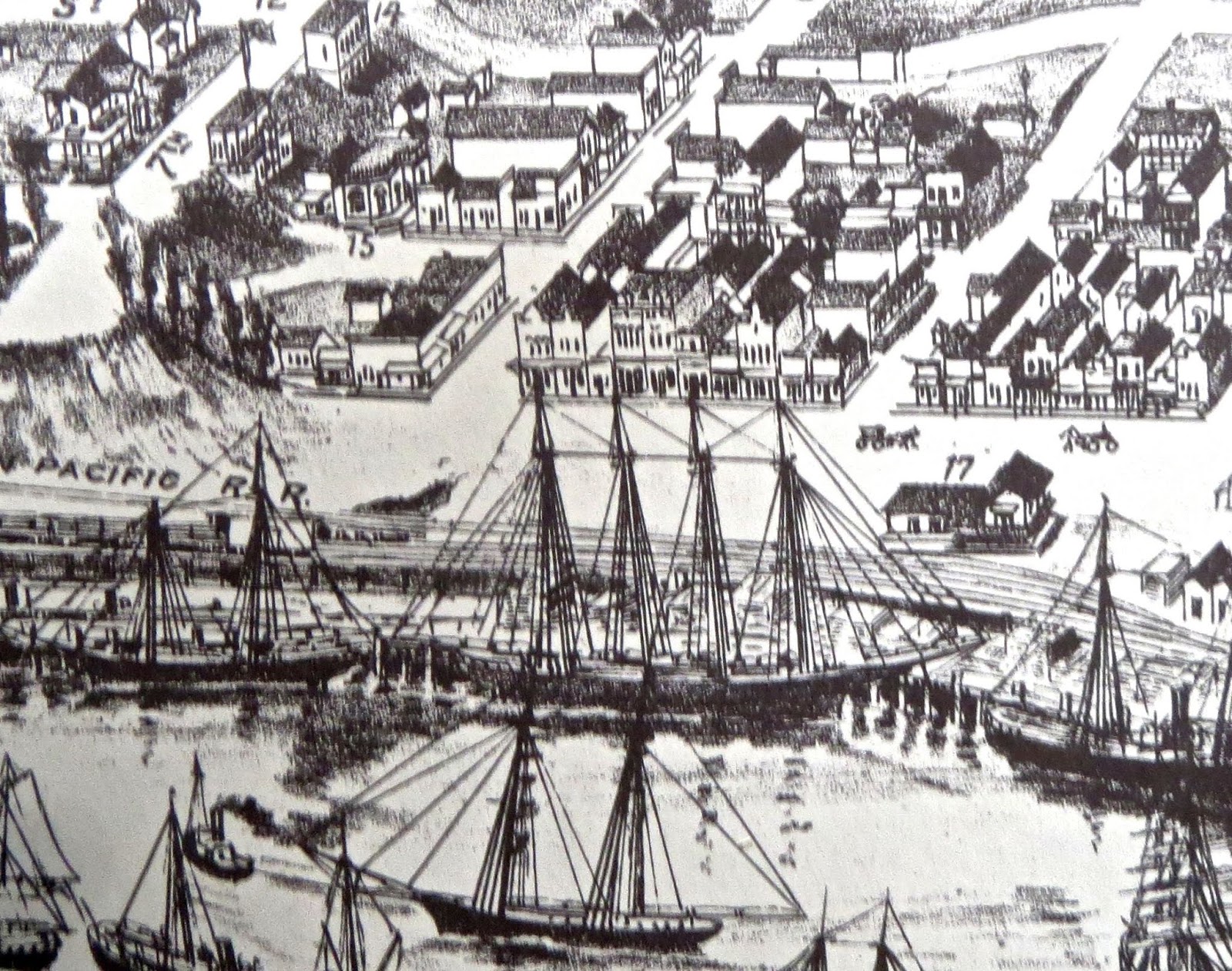
Over the next few years the wharf area gradually was filled in and the Rome disappeared underground.  A 1895 drawing of the dock area above shows the extent of the fill area on which a number of structures had been built, including the ferry dock and the Southern Pacific Railroad station.  The Ensign Saloon looms large on the landscape as the ground floor of a three story building. It became the favored hangout for the seafaring crowd.

During its history the Ensign Saloon knew multiple owners.  The first proprietors were George and Charles Osmer, German immigrants who ran it from about 1860 to 1869.  They sold to Claus Schwartz, Rathy Husing and Alfred Meyer who operated it for the next 40 years, rebuilding the saloon when it was destroyed in the 1906 San Francisco earthquake and fire.  About 1910, the Ensign Saloon was sold for a third time to M. Theodore Reinke.  Like previous owners an immigrant from Germany, Reinke was forced to shut the Ensign down with the advent of National Prohibition. 

But the story does not end there.  Although the Ensign Saloon had sat on top of a sunken ship for decades, when the building was torn down and the site subsequently turned into a civic plaza, San Francisco forgot the vessel was down there.  In 1994, however, while the city was excavating a subway tunnel from the Embarcadero Station to Folsom Street, construction crews ran smack dab into the Rome, where it had laid undisturbed for 144 years.  It was too large to be excavated so the tunnel was bored right through the ship, as shown on the illustration here.  Remnants of the Rome are now in a local museum. 

Today in the San Pedro district of Los Angeles a central open space, shown below, is designated Pepper Tree Plaza.  A metal plaque on a water fountain  marks the  former site of the Pepper Tree Saloon, a sometimes rowdy drinking establishment whose history paralleled that of the community.  The waterfront saloon flourished under the aegis of three California proprietors.


Gustave Falk was the founder.  Born in Sweden in 1840, reputedly of German ancestry, he early went to sea and over time advanced to captain. Visiting San Pedro with his ship periodically, Falk could see the potential for growth and in 1890 settled there permanently.  He bought property at the corner of Sixth and Front Streets and constructed a block of buildings that included the Pepper Tree Saloon. An 1893 map of the San Pedro showed the area and in a detail below, the site of the saloon. 


Although one author cited the Pepper Tree as “infamous,” it was teeming at all hours with sailors and dock workers and appears to have had a good reputation with ships captains looking to recruit reliable seamen for their vessels and for wharf bosses seeking stevedores.  About 1900 Falk sold it to John Goudie, a Scotsman, who in 1915 sold it to another Scot, Caspar McKelvy.  He ran it until closed by National Prohibition.

The Pepper Tree Saloon remained in the lore of San Pedro which was originally a city in its own right, but subsequently annexed by Los Angeles.   In 1988 — 100 years to the day the town incorporated — a group of longtime residents re-enacted the signing of San Pedro’s incorporation papers in a replica of the Pepper Tree Saloon.  By that time the building itself had been torn down and in its place a community park was created, appropriately named Pepper Tree Plaza.


Unlike the prior two saloons, Kelly’s Olympian of Portland, Oregon, shown above, is still operating.  Local news media regularly feature the drinking establishment because of its more than one hundred years in existence.  The saloon owes its continuity to John Kelly who opened his first Portland “watering hole” in 1888 at the age of 23 and went on to become one of the city’s best known publicans.

The Olympian opened in 1902 as a saloon “tied” to the newly founded Olympia Brewing Company, a practice common in pre-Prohibition days.  According to one account:  “It is truly a colorful part of Portland’s history.  In the early days it was a popular gathering spot for locals as well as visiting timber men, sailors, shipyard workers, longshoremen and others passing through.”  

In 1916, however, both Olympia Brewery and the Olympian were forced to shut down by state prohibitionary laws.  Eager to unload the property, the owners were happy to sell it to Kelly.  He incorporated, naming himself as president.   The Olympian Company, as it was now designated, advertised cigars and tobacco, soft drinks and restaurant food.  Before long, the name was altered to Kelly’s Olympian.

Evidence is, however, that Kelly was not finished selling booze.  The Olympian sits above the Old Portland Underground, better known locally as the “Shanghai Tunnels,” a complex of passages that connected the basements of saloons and hotels to the waterfront.   One tunnel had an opening into Kelly’s basement. A section of that space has been discovered to contain a wall and remnants of an old tile floor, strongly suspected as the remains of a subterranean speakeasy that Kelly operated under the Olympian during “dry” times.  He died in 1925 without ever seeing Repeal and the revival of his saloon — or revealing his secret.

More than a century after Kelly owned the saloon, the establishment still bears his name, offering whiskey and other liquor as he did before, and likely during, Prohibition.  This iconic West Coast saloon that can still be visited.  If you go, be sure to lift a glass to John Kelly, a whiskey man worth remembering. 

Note:  More complete articles on each of these saloons may be found on this blog at the following dates:  Ensign Saloon, August 22, 2019;  Pepper Tree Saloon, November 25, 2018; and John Kelly Saloon, March 18, 2018.