Tuesday, January 12, 2021

Charles Reilley — A Rogue in the “City of Saints”


In my estimation of all the risqué items that pre-Prohibition men issued to wholesale and retail customers, the most blatant use of nudity to sell whiskey was from a saloonkeeper in perhaps the most unlikely city in America:  the so-called “City of Saints,” — Salt Lake City, Utah.  Shown here is a pocket mirror issued in the Mormon city that displays four nubile females in full frontal nudity without a shred of clothing or any pretense at modesty.


The individual responsible for this artifact was Charles H. Reilley, shown here, who was born in Providence, Rhode Island, in 1862.  He was one of six children of Bridget (McGahagan) and John Reilly, both immigrants from Ireland.  His father was a boiler maker.  At the age of 21 in 1883 Charles moved to Salt Lake City.  There he met and in 1890 married Lillian Indge, a local woman raised by a single parent, a hair stylist.  Charles and Lillian would go on to have seven children over the next eleven years.


Although Reilley’s early career in Salt Lake City has gone unrecorded, I surmise that he may have begun as a bartender in one of the many saloons that the city boasted.  Although the Mormon Church officially frowned on drinking, its leaders were hesitant to ban alcohol, preferring to control and tax supplies.  They were said to be wary of stirring revolt among Utah’s “Gentiles,” i.e. non-Mormons.  With his growing family, Reilley made the decision to strike out on his own. In 1892 he opened a retail liquor store at State and First South Street.  He called it the Elk Liquor Store.  The establishment likely held a saloon.


Reilley appears from the outset to have been a successful businessman, soon outgrowing his initial quarters and moving to a much larger location at 216-218 South State Street.  By this time he had expanded into selling liquor at wholesale as well as retail.  Moreover, he had become the Salt Lake agency for distributing the products of the Lemp Beer Company, a popular suds-maker from St. Louis.  Its flagship brand was Falstaff Beer.  By holding the franchise Reilley was profiting from every bottle of Falstaff and other Lemp brands sold in Salt Lake City bars, cafes, groceries, and drug stores.  Reilley advertised the beer vigorously, including calling the saloon co-located with his liquor store, “The Falstaff Bar.”


As shown on this paper cup, along with Lemp products, Reilly featured “Brook Hill Sour Mash Whiskey.”  This was the flagship brand of Friedman, Keiler & Co. of Paducah,Kentucky.  [See my post on Friedman, June 5, 2014.]  Shown here is a flask with the typical black label for the brand.  At right is another Brook Hill bottle, one of the most unusual spirits containers to be found.  Measuring about 9.5 inches high, the neck protrudes from a metal outer body, two sides of which have hand-etched designs.  One side says “Brook Hill” and the other is a detailed drawing of a baseball player.  A fervent sports enthusiast, Reilly could relate to this bottle. 


Reilly also became well-known for his advertising giveaway items.  Shown here are a blue and red thimble that bear his name and “Drink Lemp Beer.”  It was perhaps a token for a male customer to take home to “the little woman” if she smelled beer on his breath.  Another gift was a 1917 datebook, that also featured several pages of Lemp advertising.  Reilley also provided customers with a multipurpose tool containing a corkscrew and bottle opener. These likely were presented to bartenders who were featuring Reilley's products.


Most of all, perhaps, Reilley became known in Salt Lake City for his pocket mirrors.  In addition to the item that opened this post, he issued another that shows a nude woman from the side as she primps in front of a mirror.  Both images were made possible by the invention of celluloid that was light, reasonably durable, and could hold complicated images and multiple colors.  The mirror that opens this post recently sold for $500; the second for $100.  Remember that Reilly gave them away.


Reilley’s growing wealth allowed him to establish a sizable bottling works at Third West and Eighth South Streets.  Costing the equivalent of $880,000 today, this facility employed 27 workers.  He also was making a name in Salt Lake for his activities in fraternal organizations like Elks, Eagles, and the Salt Lake Commercial Club.  A 1914 biography noted Reilley’s “wide acquaintanceship” and his efforts in Salt Lake City “to build up the community.” 


Even as Reilley was prospering and gaining local recognition, prohibitionary forces in Utah were closing in on the liquor trade.  The local press in January, 1917, headlined a story that state agents had raided the Elk Liquor Store and confiscated 250 cases of whiskey on the grounds that all the bottles were short two ounces of the amount claimed on the label. The same year the Jewish governor of Utah pushed through a law that banned all products containing alcohol except for patent medicines, flavoring extracts, pure grain alcohol for scientific and industrial purposes, and sacramental wines. 


Forced to shut down his saloon and liquor store, Reilley attempted to recoup by featuring a Lemp-produced non-alcoholic drink called “Cerva,”  He called on his customer to “acquire the habit,” calling Cerva “the most refreshing cereal beverage on the market.”  Apparently the drink did not catch on.  Reilley shut down the Lemp distributorship and, with a partner entered the automotive world.  Their dealership sold the Nelson, an automobile built in Detroit, Michigan, by the E. A.  Nelson Motor Car Company. The models, shown below, never caught the public’s fancy and was out of business by 1922.


Reilley was not around to see the demise of car company nor the imposition of National Prohibition in 1920.  In October 1918 while on a trip to Ocean Park, California, he died at the age of 57.  His body was returned by train to Salt Lake City where he was buried at Mount Calvary Catholic Cemetery.   He lies beneath the Reilley monument where his widow, Lillian, joined him 24 years later.


Note:  Among the multiple sources for this post, biographical information was obtained from ancestry.com and “Utah Since Statehood:  Historical and Biographical,” Volume III, Clark Publishing (1919).


Labels:  Charles H. Reilley, Elk Liquor Company, The Falstaff Bar, Lemp Beer. Falstaff Beer, Rock Hill Whiskey, risque' whiskey advertising, pocket mirrors




Friday, January 8, 2021

Did Dr. Hessig Write a Prescription for Murder?


The whiskey jug shown here bears the name of H.T. Hessig, a  distillery owner and physician in Paducah, Kentucky, whose wife died in June 1905 of mysterious causes. The couple were known to have physical altercations, she had filed for divorce demanding alimony and he was being forced into bankruptcy.  Suspicion immediately fell on Dr. Hessig. But was he guilty?


Dr. Hessig’s road to this pivotal time in his life began about 1860 when, according to the 1920 census, he was born in Germany of parents who originally hailed from Switzerland.  Although Herman’s time of arrival in America is unknown, according to his obituary he was graduated from the Long Island Hospital [Medical] College in 1871, shown left, and for sixteen years practiced medicine in New York City.  He then returned briefly to Germany to study pharmacy.


Exactly how and when Dr. Hessig made the move to Paducah is unknown but it likely occurred in the late 1870s or early 1880s.  Established as a town in 1830, Paducah lies at the confluence of the Tennessee and Ohio Rivers.  Steamboats plied the rivers and the city’s port facilities were important to trade and transportation. The Illinois Central Railroad arrived as the primary north-south railway connecting the industrial cities of Chicago and East St. Louis to the Gulf of Mexico at Gulfport, Mississippi and New Orleans.  A foundry for making rail and locomotive components added to a thriving economy — one that could afford a European trained doctor. The downtown in 1900 is shown below.


Although Paducah was not a major Kentucky whiskey-making and distribution center like Louisville or Lexington, it did contain distilleries.  The scanty documentation available about Dr. Hessig’s distillery indicates it was designated on federal rosters as Registered Distillery #35 in District #2.  Whiskey guru Chester Zoeller in his book “Bourbon in Kentucky” provides few details but indicates that the distillery was founded by the doctor around the turn of the 20th Century, located two miles southwest of the Paducah Courthouse at the corner of Bridge and Mill Streets.


According to Zoeller, the Hessig Distillery opened with a mashing capacity of 40 bushels of grain a day, yielding about four barrels of whiskey daily, a small output for a Kentucky plant.  Storage capacity for aging barrels was similarly limited. Moreover, the distillery was only in operation six months per year.  My assumption is that Dr. Hessig was selling his “Clark’s River Handmade Sour Mash Whiskey” mainly at wholesale to Paducah area saloons in gallon and two gallon (left) ceramic jugs like the ones shown below. 


Federal records show transactions at the distillery as late as 1904 under the name of Hessig.  Available evidence indicates Dr. Hessig sold the facility about 1904 or 1905 to members of the well-known Weil distilling family. It is unclear whether the sale was related to the doctor’s marital and financial problems.  In succeeding years until National Prohibition the Weils greatly expanded production.


Meanwhile Dr. Hessig had more than enough on his mind.  He had married, apparently for the first time, about the age of the age of 45.  His bride was Ida Ethel Levan, a woman about 21 years old.  She originally came from a farm in Livingston County about 20 miles north of Paducah and was the daughter of William and Barbara Levan.  The couple met when Ida Ethel moved to Paducah in 1898.


The significant difference in their ages likely was a problem.  It was not long before Dr. Hessig and his wife began “fussing,” to use the words of Elita Towie, their African-American housekeeper.  According to press reports at the inquest Ms. Towie related that she witnessed one altercation “…In which they fought from the library into the kitchen…Mrs. Hessig ending the quarrel with two blows on the doctor with a poker.”  According to press accounts the couple had been in police court more than once for domestic disturbances.


On the morning of June 13, 1905, Ida Ethel Levan Hessig was found dead in her bedroom.  She had been discovered there by her doctor husband who was alone at the time.  The circumstances were deemed suspicious although Dr. Hessig insisted his wife had died as the result of an epileptic seizure. Paducah detectives Baker and Moore were assigned to the case and a coroner’s jury was empaneled.  The all-male jury met at the funeral home three days after Ida Ethel’s death.


When her female physician, Dr. Olivia Nelon, took the stand, a juryman ask her why Ida Ethel had not chosen her husband to be her doctor.  Dr. Nelon replied that she could only answer by repeating Mrs. Hessig’s own words to her:  “The damned wooden-shoed Dutchman hasn’t got sense enough.”  Perhaps there was some deeper concern lurking in Ida Ethel’s mind.  Ida Ethel confided to Ms. Towie that she was afraid Dr. Hessig might attempt to hurt her once he found out she was determined to get a divorce.  She also was asking a large alimony settlement that likely was part of the financial troubles driving her husband to declare voluntary bankruptcy.


Some locals attending the inquest thought Dr. Hessig might have been setting the stage for ridding himself of a major headache.  He had spread the word that Ida Ethel had shown signs of epilepsy soon after their marriage and that she was subject to frequent seizures.  He cautioned her parents and others never to mention that condition to her lest it cause her further damage.  The Dr. Hessig’s mother, who later admitted doting on her boy, testified that she had seen Ida Ethel have “fits” multiple times.  Strangely enough, however, the live-in staff had never witnessed such episodes.  Dr. Nelon testified that while she had treated Mrs. Hessig for “female complaints,” she had not known of any epilepsy.  Ida Ethel’s father testified that she had never before shown any signs of that malady while growing up.  Her brother earlier had died of epilepsy, however, found dead in bed.


Levan also testified that he had heard many spats between the couple and threats against his daughter from Dr. Hessig.  Characterized in the The Paducah Sun as a “gruff but kindly old man,” Levan told the coroner’s jury he had heard the doctor say he would be “getting rid of his wife” but assumed he was referring to allowing the divorce to go forward.  


In his testimony Detective Moore said that preliminary investigation indicated that while Ida Ethel may have had epilepsy he was not satisfied she died from it.  Moore asked for more time to gather evidence but the coroner would not allow it, calling on the jury to rule immediately on the basis of the evidence already submitted.  The initial decision, according to the Paducah Sun was “somewhat disagreeable to Dr. Hessig.”  His lawyer later in the day, however, was able to persuade the jury members to amend the language. In the end they exonerated Dr. Hessig completely from any connection to Ida Ethel’s death.  Case closed.  Many locals remained convinced the doctor had gotten away with murder.


When he declared insolvency, Dr. Hessig had claimed $15,000 in liabilities and no assets.  At the bankruptcy court his mother made still another effort to assist her beloved son.  She claimed that the doctor owed her $17,000 that took precedence over all other claims.  Although the judge took the her statement under advisement, it is unlikely he honored it in his final 1906 decision.


Dr. Hessig went back to the practice of medicine, ignoring the hostile stares of townsfolk.  Ancestry records indicates that he remarried not long after Ida Ethel’s death.  Her name was May Essie Graham Boylan.  If her date of birth is correct , May Essie was only 17 0r 18 at the time of their nuptials, some 35 years younger than Dr. Hessig.  That marriage seeming did not last.  A 1913  record shows Herman then marrying Mary Jane Page of Birmingham, Kentucky.  Fourteen years younger than the doctor, she appears to have been married previously.


In 1931 while vacationing in Tampa, Florida, Dr. Hessig died at the age of 78.  His body was returned to Paducah where he was buried in Oak Grove Cemetery,  Old Addition, Section 19, Lot 301. The Hessig plot and monument are shown here, along with Dr. Hessig's headstone.  Mary Jane, who died in 1944, is buried beside him.  Ida Ethel is also buried at Oak Grove, but at another location.  The mystery of her death was never solved.


Note:  As often happens I was alerted to the story of Dr. Hessig by seeing and trying to identify the origins of a single whiskey jug, the one that opens this post.  Although the doctor appears to have owned his distillery for only four or five years, his name does appear in Kentucky whiskey history.  Through genealogy sites and Paducah newspaper stories, it was possible to reconstruct the story of Dr. Hessig’s first marriage and its fatal conclusion.


Monday, January 4, 2021

John F. Callahan: A Whiskey Man Who Knew Need


Born in 1852 into poverty and thrust by necessity into child labor, John Francis Callahan through the sale of liquor rose in wealth and attained community recognition for his civic contributions to Boston, his home town.   Callahan’s career culminated in his appointment as a Director of Public Institutions for the city, responsible for managing the feeding and shelter of Boston’s poor, a population he knew all too well.


John was the son of John and Elizabeth (Callinan) Callahan, both immigrants from Ireland who had arrived in America several years before his birth.  The boy received six years of education in Boston schools before being forced at 12 to go to work to help support his family.  Callahan’s initial employment was in a local grocery store that featured wines and liquor.  He rapidly understood the profitability of the latter and showed an aptitude for the whiskey trade.


The next 12 years are shrouded in the mists of history as Callahan rose to management positions in Boston liquor houses.  In 1874 at the age of 26 he had achieved sufficient resources to marry.  His bride was Mary C. Donovan of similar age, an immigrant from Ireland.  In rapid succession they would have two sons, Frank and George.  His growing familial obligations may have moved Callahan to go into business for himself, opening a wholesale and retail liquor store in Boston on March 15, 1879.  He called it John F. Callahan & Co.


The 27-year old seems to have been successful from the outset.  Like many wholesalers Callahan featured proprietary brands of his own.  They included “Callahan’s Famous Home,” "Callahan's Whiskey,” "Old Kentucky Club House Whiskey,” "Walnut Rye,” and “Walkhill Rye.”  He was receiving barrels of whisky, most likely by rail, from area distilleries and rectifying (blending) them to achieve desired flavor, smoothness and color.  In this he was following the tradition of Irish whiskey, all of which is blended.  


Callahan sold these whiskeys in embossed glass bottles with his name and Boston in calligraphy.  Those containers came in both quart and flask size in clear and possibly cobalt, although such bottles later may have been artificially colored.The proprietor’s flagship brand, heavily advertised, appears to have been “Old Kentucky Club House.”  Callahan issued a shot glass for this label, an item that would have been given to prime customers.


While other wholesalers were presenting copies of nude painting to saloons, restaurants and bars carrying their products, Callahan give away calendars. They were unusual in that each had two holes from which the calendar could be unfurled.  As a result, shown below, one month could be horizontal and when the following month came along, flipped to vertical.  Every month called forth an arty illustration and a message. 


Callahan’s merchandising efforts met with success.  His headquarters at 158-162 Federal Street drew a “puff piece” in the Boston Post that headlined:  “Look into the House of John F. Callahan & Co., New England’s Greatest Wholesale and Mail Order Liquor House,” and included four photos of the interior operations. 


Meanwhile Callahan was making his mark in Boston, working in the Democratic Party.  He was a member of the City Committee, serving on the finance and executive committees, and for two years was on the State Central Committee. While not running for political office himself, those posts allowed him to play a significant role in state, congressional, and senatorial conventions.  For four years Callahan also served as treasurer of the Irish Charitable Society, a major force in assisting indigent Irish residents of Boston.


His combination of Democratic Party ties and charitable work resulted in Callahan being appointed a Director of Public Institutions for Boston.  From 1885 to 1889, he was among nine men charged with overseeing the operations of Boston’s public institutions involving the poor, street youths, and legal offenders.  


Those institutions included the almshouses, like the structure shown above on Deer Island, actually a promontory jutting into Boston Harbor. In the middle of the 19th century, the island was the landing point for thousands of refugees from the Great Famine of Ireland, many sick and poverty-stricken. Opened in 1853, the almshouse was administered for decades by the City of Boston to provide shelter for indigent adults and children.


About the time of Callahan’s term, new facilities known as the “House of Industry” were erected on the site and carried a penal character.  An article in the national Frank Leslie's Sunday Magazine described the prisoners on Deer Island in the 1880s: "They in the main are from the lowest stratum of the cosmopolitan society of New England's metropolis, embracing representatives of almost every nationality under the sun, and from the shortness of the sentences, many being confined for 10 days only, for nonpayment of one dollar and costs for drunkenness, and none for more than a year.”


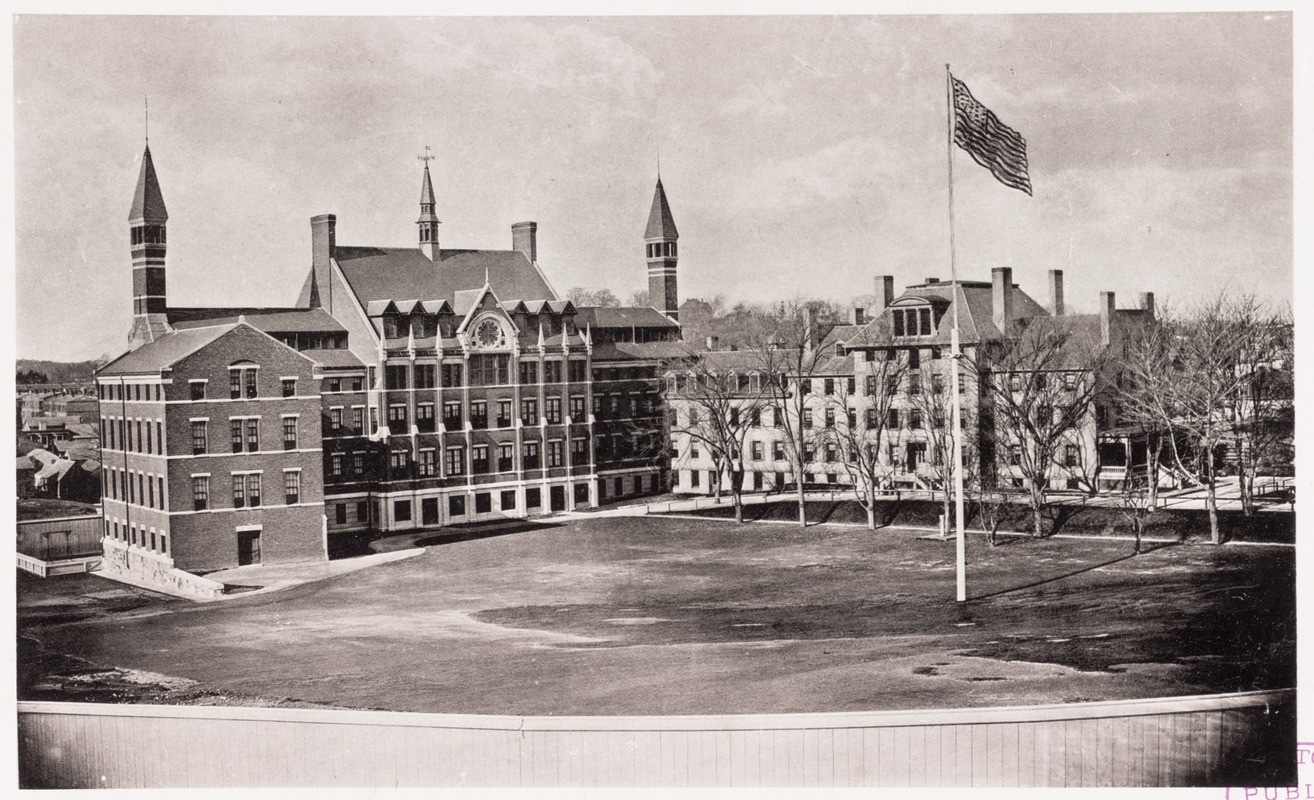
Callahan would also have had responsibilities for the Marcella-Street Home, shown here, opened in 1877 and closed in 1898.  That Boston institution housed orphaned or “street” boys after a court hearing determined they were without adult support or supervision.  In the 1880s girls housed in the almshouse on Deer island also were sent to the Marcella-Street facility.


Callahan’s term as a director occurred during a period of major changes in Boston’s administration of its social and penal services.  From 1857 to 1885 the city’s public institutions had been under the charge of a twelve-member Board of Directors.  Deciding that a somewhat smaller board was desirable, city officials in 1885 reduced the number to nine.  Callahan’s term was during that interim period, one that lasted only four years. In 1889 the Board was abolished in favor of three full-time professionals designated as Commissioners of Public Institutions.  Following his term Callahan continued to be active in civic and philanthropic causes.

A 1914 directory listing when he would have been 62 years old indicates that he was still in charge of operating John F. Callahan & Co.  He died that same year and is buried in Holy Cross Cemetery in Malden, Massachusetts.  In the meantime this “whiskey man” who rose from poverty and a childhood at labor to a major position supervising Boston’s care for the indigent and “street” children deserves a final tribute.  One occurs in the volume, “One Thousand Representative Men Resident in the Commonwealth of Massachusetts” (1899). The author has this to say:  “…Mr. Callahan stands foremost among the Irish-American sons of the old Bay State.”


Note:  This vignette on John F. Callahan has been drawn from multiple sources, chief among them “Representative Men…”  the volume cited above, and from “Men of Progress: One Thousand Biographical Sketches…” edited by Edgar Monroe Bacon (1896).  The photo of John Callahan is from that document.


Thursday, December 31, 2020

Whiskey Men & Pennsylvania Coal


Foreword:   Pennsylvania anthracite coal is known the world over for its clean burning qualities. It has the highest carbon content, the fewest impurities, and the highest energy density.  Some whiskey men began their careers working in the mines of the Keystone State.  Others turned their revenues from selling liquor into investments in Pennsylvania coal. This post briefly recounts the story of three such men: one who climbed out of Pennsylvania mining and two who bought into it.


The function of a “breaker boy” in mining was to break coal into pieces and sort those pieces into categories of nearly uniform size, a process known as “breaking."  He also chipped away any impurities that might be clinging to the coal.  It was hard, low-paying labor.  Michael Bosak went from breaker boy in a Pennsylvania mine to proclaiming himself “The Richest Slovak in America” 


Bosak emigrated to the United States from Slovakia at the age of 17. He settled in the anthracite-rich region of Northeastern Pennsylvania and went to work in a mine at Hazelton as a breaker boy to make a living. A photo left shows them at work. Finding the work unrewarding on many counts, he eventually shifted employment and worked for Slovak liquor merchants in the area, taking orders and delivering merchandise.  Frugal in his habits, Bosak saved sufficient money to open his own liquor store in Hazelton in the 1890s.  When it succeeded he opened a saloon and subsequently a liquor store in Scranton that became his headquarters.  By dint of intelligence and hard work he prospered.


Bosak’s wealth allowed him to pursue other business interests.  Early on he moved into banking.  The force of his personality led other Slovak immigrants to trust him and seek his help in purchasing steamship tickets, exchanging foreign currency, and making  small loans.   Bosak established a private Scranton bank in 1897 that by 1915 grew into the Bosak State Bank.  He organized financial institutions in Northeastern Pennsylvania and became president of the Miners Savings Bank of Olyphant and the Pennsylvania Bank and Trust Company of Wilkes-Barre.  Bosak’s operations reaped such a financial bonanza that he proclaimed himsel the "Richest Slovak in America.”


Bosak’s fall was just as dramatic his rise.  Not long after the imposition of National Prohibition shut down his liquor business entirely. The ultimate blow to Bosak’s business empire came in 1929 and the dawn of the Great Depression.  His banks faltered and finally in 1931, failed and closed.   His earning of a lifetime were virtually wiped out.  Bosak was 61 years old.  He would live another six years, dying on February 18, 1937.   


For several years before the Civil War Samuel “Sam” Dillinger drove a large Conestoga wagon pulled by six horses across the Allegheny Mountains on the Nation Pike, transporting merchandise between Baltimore and Pittsburgh.  After settling down in Pennsylvania, he became the second largest distiller in the state, producing fifty newly-filled whiskey barrels every day from his distillery to store in his warehouses and then delivering a quality aged rye to his customers.


After his first distillery was destroyed by fire in 1881, Dillinger, now with sons Daniel and Samuel Jr. to assist, built a second in Ruff’s Dale, Pennsylvania.  This distillery eventually had a mashing capacity of five hundred bushels of grain daily, producing 50 barrels of whiskey, and six warehouses with a combined storage capacity of 55,000 barrels.


Meanwhile, Sam had been expanding further. With growing prosperity he purchased additional farmland adjoining Home Farm until he owned more than 600 contiguous acres, all of it on top of rich fields of coke coal.  That spurred him in 1872 to erect a number of coke ovens, eventually said to total more than 100.  One author has opined: “Dillinger and Sons are therefore entitled to rank among the pioneer coke producers of Pennsylvania.”  Sam also was one of the founders of the Southwest Pennsylvania Railway in 1872 and served as a director for years. 


Marked by extraordinary vigor throughout his life, at age 79 Dillinger in 1889 very suddenly was felled by a paralyzing stroke and never regained consciousness.  Interred in the Mennonite Cemetery at Alverton, Dillinger lies beneath a monument, inscribed “Erected to the Memories of an Honest Man and Constant Friend.”


Samuel J. ”Sam” Thompson won a distillery located near Brownsville, Pennsylvania, game in a poker game about 1850 and built it into a going concern.  He began with a small plant with the meager capacity of consuming only eight bushels of grain a day but in time enlarged it into the facility shown here in a postcard view.  Incorporated into the complex was an old stone building that had been a roadside tavern.  It was turned into offices and a small warehouse.   During the next several decades, the name Sam Thompson Pure  Rye became synonymous with quality whiskey.


Meanwhile Thompson’s ability as a businessman was being recognized.  His distillery was the major industry in Brownsville.   At the same time, he was moving into other endeavors, hiring a manager to run the distillery and later selling it. Sam invested heavily in the coal business.  By 1898 he owned the Champion, Caledonian and Wood's Run Coal Works that had a combined daily output of ten thousand bushels of coal. Those three works were situated close together in Washington County and produced, according to a contemporary account, “ a desirable article of coal which is in great demand in the Western and Southern markets.” Thompson also owned seventeen farms, aggregating three thousand acres of good farming land.  All were said to be underlain with coal. 


Sam died in December 1899 at the age of 79 and was buried in a Thompson family plot in the Beallsville Cemetery, Washington County, Pennsylvania.  After 1920 the distillery he built was shut forever and left to molder for decades along the banks of the Monongahela River.  Sam’s whiskey is still celebrated as one of the finest ryes ever produced in Pennsylvania.


Note:  Longer posts on each of these whiskey men can be found on this blog:  Michael Bosak, August 23, 2013;  Sam Dillinger, February 12, 2016; and Sam Thompson, September 4, 2012.  An earlier piece on whiskey men and mining appeared on August 25, 2020.