Wednesday, February 10, 2021

Henry Campe’s Three Stumbles to Success

In baseball it takes three strikes and “you’re out!”  In contrast, Henry Campe discovered that after his three partnerships in the San Francisco liquor trade had failed, going it alone could mean success.  His liquor house survived for 30 years, providing a range of artifacts to remember Campe, a man who refused to give up.


Census records from 1870,1880 and 1900 differ widely about when Henry Campe was born in Hanover, Lower Saxony, Germany.  The date cited on Ancestry.com from the 1900 census is 1846.  That means Henry was brought to the United States when he was six years old.  The names of his parents have gone unrecorded, as has his education and early career.  


Campe first appeared in the census of 1870 living in San Francisco.  His Ancestry entry cites his wife as Anna Bearden, born in 1845 in New York.  She was the mother of Campe’s son, Harry M., and two daughters, Anna and Mary.  Although the date of  Anna’s death is not recorded, by 1878 Henry had married again.  She was Elise Thode, 30, born in Schleswig-Holstein, Germany.  They also would have children.


The confusion in Campe’s census records carries over to his career selling liquor.  The highly respected author of the Western Whiskey Gazette blog, signing himself as JSGlass, cites Campe as “a true survivor, lasting through three failed partnerships.”  He records Campe’s ultimately ended collaborations with George Siebe, Henry Wolters and Henry Decker, the last a partner who apparently died within a year.  I have found a “certificate of copartnership” between Campe and Siebe dated January 1, 1884, but nothing on Wolters or Decker.


JSGlass suggests that these failed partnerships ultimately impelled the German immigrant to strike out on his own, creating Henry Campe & Company. In 1888 he initially located his liquor house at 301 Front Street. With the growing success of his enterprise there years later he moved to larger quarters at 221-225 Front.  Campe was a liquor retailer and wholesaler, selling his whiskeys and other alcoholic products to San Francisco’s saloons, hotels and restaurants.


 The company used the brand names:  “Americus Club,”  "Black Eagle,” "Briar Rose,” Edgedale," “Ferndew,” and "Old Campe.”  Americus Club was its flagship label.  Packaged in attractive square-bodied flasks, shown above, this whiskey also came in a “pony” size that replicated the larger bottles, shown right.  The company did not register any of its proprietary brands with the government until after 1905 when Congress strengthened the laws.  The company then trademarked Ferndew in 1905, Old Campe and Briar Rose in 1906 and Americus Club in 1907.  It also warned on the rear of its bottles:  “Some unscrupulous dealers make it a practice to REFILL our flasks allowing the labels to remain intact.” To discourage this practice, Campe put a strip with his name over the cap.  If broken or missing it was evidence that the flask had been refilled.


As his son Harry reached maturity, his father took him into the firm and taught him the fine points of whiskey merchandising.  That would have included the art and science of “rectifying” raw whiskeys for the company’s proprietary brands, That is, blending batches of raw whiskeys obtained from California and out-of-state distilleries to achieve desired color, smoothness and taste.
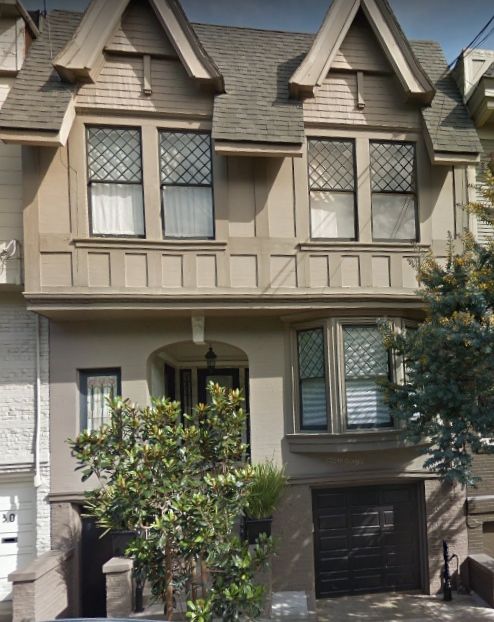

The 1900 census found Campe living in a spacious three-story San Francisco townhouse at 20 Devisadero St., shown here as it looks today. With him was his wife, Elise; daughter Clara, 21, and son George,13.  As he aged Campe’s heath deteriorated.  Suffering from chronic heart disease and kidney problems in September of 1900 he died at the age of 54 and was cremated.


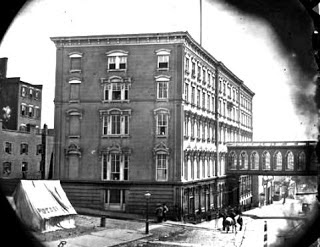
By this time, his eldest son, Harry Campe, 35, was fully capable of taking over and operating the liquor business his father had founded.  Retaining the company name, he moved the store to 53-61 Drumm Street, the building shown here and brought his half- brother, George, into management.  The liquor house continued to thrive.


Given the timeframes, I credit Henry’s boys with trademarking the proprietary brands and issuing many of the artifacts associated with the Campe name.  Those likely included the attractive back-of-the-bar bottles that were given to saloons, hotels and restaurants featuring Campe products.  Shown above are two bottles advertising Edgedale and Briar Rose whiskeys.  To both wholesale and retail companies might be given etched shot glasses advertising Americus Club and other house labels.  


Of particular note were the serving and tip trays the Campes gifted to customers.  Although such trays were a common give-away item from distilleries and wholesale liquor houses, many of them bore stock pictures of comely women, animals and other scenes.  By contrast the Campes went the extra mile on cost and designed their trays to present their distinctive Amicus Club whiskey bottle.  


Even more interesting is an artifact that I assume is a blue metal ashtray, with an elderly man smoking a long pipe.  He is identified as “Old Tom,” advertising “London Club Gin.”  Near the base it says “Compliments of Henry Campe & Co.”  After years of looking at liquor artifacts, I have seen nothing comparable. 


Harry Campe operated the company as president for the next 16 years until his own health failed and he died. George Campe became president until 1919 when the firm was shut down by the advent of National Prohibition.  The liquor house that the German immigrant founded had prospered thirty years under family management.  For Henry Campe striking out early in business turned out to be a prelude to hitting a home run.


Note:  This post relies heavily on the account of Henry Campe provided in the Western Whiskey Gazette blog from JSGlass, dated May 5, 2013, both for facts and photos. Other information came from genealogical and bottle sites.






Saturday, February 6, 2021

R.C. Wills & His Scranton “Rags to Riches” Story


When Robert Charles Wills arrived in the United States from Ireland in 1876 at the age of 14, he was virtually penniless.  During a career of 52 years in Scranton, Pennsylvania, Wills became one of the city’s most influential citizens, a business tycoon owning multiple enterprises.  Shown right, Wills owed his ascent to selling whiskey.


Wills was born in 1858 in Ireland, some records say in County Mayo; others, County Sligo.  He was the son of Henry and Elizabeth O’Donaghoe Wills, said to be “sturdy old Irish folk.”  When he immigrated in 1872, it is not clear whether young Robert came with other relatives.  He initially settled in Olyphant, Pennsylvania, a borough in Lackawanna County, six miles northeast of downtown Scranton.  His education and early employment have gone unrecorded.  In time he became a traveling salesman in Pennsylvania for a New York dry goods firm.  After a brief sojourn in Missouri, Wills returned to Scranton in 1885 and stayed for the remainder of his life.

Two years later he married Anna E. Coroner, a woman of Irish descent who was born in the United States.  Both were 29 at the time of their nuptials.  Over the next five years Anna would bear Robert four sons.  Sadly only the eldest, Joseph, would live to maturity.  Henry, born in 1889 died at two years;  John, born 1890 died at ten, and Robert, born 1891, died at eight.  The pain in the Wills household often must have been intense.


By the time of his marriage and family Wills was well established in the Scranton business community.  With a brother-in law he owned and operated a hotel at 430 Lackawanna Avenue.  The hotel with its restaurant and bar gave Wills  acquaintance with the profitability of the liquor trade and he opened a liquor store in the building.   From that beginning he exited the hospitality industry and opened a larger liquor house at 329 Penn Avenue, the building here as it looks today.


From the beginning Wills seems to have had a genius for advertising.  Shown below are two ads.  The one at left advised:  “You would be much better off if you would keep a bottle of pure whiskey in the house during winter months. It would prevent chills, colds and grippe.”  It touts “Spring Valley Rye,” Wills’ proprietary brand. The other ad shows a doctor ostensibly prescribing rye whiskey and claims:  “If you mention our name to your physician, he’ll say:  Right, none better!”


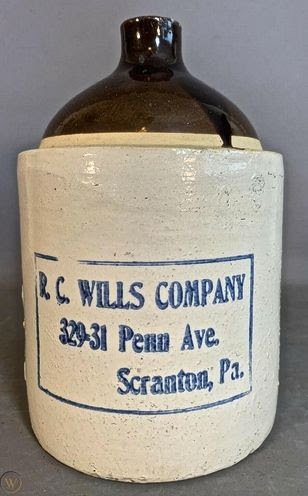
Wills was selling liquor at both retail and wholesale.  He was receiving shipments of whiskey from Pennsylvania and perhaps out-of-state distilleries by rail in barrels and “rectifying” them on his premises.  That process involved combining the contents of several barrels to achieve a desired color, taste and smoothness.  He then decanted the blends into ceramic jugs ranging in size from four gallons to quarts.  Larger containers would have been sold to the saloons, restaurants and hotels carrying his liquor;  smaller ones directly to the public.  Shown throughout this post are examples of the various jugs employed by Robert C. Wills & Company over the 25 years it was in business. 


Meeting with great success at his Penn Street location, Wills then turned his attention to a struggling brewery called the Keystone Brewing Company, located in Dunmore, a suburb of Scranton.  Wills purchased it in 1899 and immediately applied his advertising genius.  One ad warned:  “The water which you drink may contain germs of typhoid fever, the milk which the dairyman sells you may contain the germs of tuberculosis, but your beer has been cooked and boiled sufficiently to kill every possible germ in it.  As to purity, beer is more reliable than milk or water.”  


Such pitches must have worked.  In September 1900 the Scranton Tribune newspaper reported of Will’s brewery:  “A year ago it was an experiment, now it is an unqualified success, and all through the Lackawanna Valley the mention of Keystone beer is the signal for honest and hearty commendation….”  Unlike his whiskey, Wills sold his beer in glass bottles of an amber shade.


Within a few years Wills became a very rich man and branched out with his investments.  Among his business affiliations were the United States Lumber Company, Blue Creek Coal and Land Company, and Kanawha & West Virginia Railroad.  He also gain a reputation in Pennsylvania banking circles for his position in the Scranton Trust Company, the Fidelity and Discount Bank of Dunmore, and the Dime Bank of Scranton.  A caricature book depicting Scranton “Men of Affairs,” shows Wills driving a team of horses past a vast pile of lumber, with captions indicating his many business interests.


Wills also was a major investor in the International Correspondence Schools, founded in Scranton to educate miners.  Because of many accidents, the State of Pennsylvania had passed a law in 1885 requiring miners and inspectors to pass examinations on mine safety. The test was exhaustive and the language was confusing, especially for miners who spoke little or no English. The schools  played an essential role in educating them. 


As befitted a prominent businessman, Wills also took an active role in local civic affairs. he was credited with fostering the growth of the Scranton Chamber of Commerce and other civic organizations, as well as hailed for his contributions to charitable organizations.  Those including Scranton’s Mercy Hospital where he served as a director.  Wills most notable gift occurred in 1939, 15 years after his death, when it was disclosed that with the death of his son, Joseph, the bulk of his estate reverted to Scranton Diocesan Charities. Valued at $1 million then, the gift would be the rough equivalent of $18 million today.  Father and son are shown here.


With the coming of National Prohibition in 1920, Wills was forced to shut down his liquor house and a short time later sold his interest in the Keystone Brewery. From his office in the Dime Bank Building, he devoted his time to management of his investments.   Wills also continued to be active in Ireland related organizations, including the Irish-American Society of Lackawanna County, for which he served as president.


During the early 1920s, Wills began to suffer kidney failure. In a day before the advent of dialysis, this often meant a slow death from uremic poisoning.  In March 1924, Wills died at the age of 65. His passing made headlines in the Scranton newspapers as he was recorded as one of Scranton’s wealthiest men and most prominent citizens:  “News of his passing will come as a shock to the community, for as recently as three weeks ago he had been able to be about, while not in the best of health…A week ago his condition became critical and he had failed gradually during the past few days.”


As his widow, Anna, and son Joseph looked on, Wills was given an elaborate funeral at the Cathedral of Scranton, celebrated by his brother, a Catholic priest.The church was crowded with relatives, family friends, local dignitaries, and dozens of clergymen from the Scranton diocese.  After the service, Wills’ body was given temporary burial in the Cathedral cemetery, awaiting completion of the Wills mausoleum at a location nearby.


When Robert Wills arrived in America with a few coins in his pocket in 1876, neither he nor any onlookers could have imagined that 51 years later he would have become a multi-millionaire.  Given a chance in this “land of opportunity,” the impoverished Irish lad had used his native intelligence and hard work to rise to the top of his home town’s business community — an ascent attributable to his ability to sell whiskey.


Note:  This vignette on Robert C. Wills was created from a wide variety of sources, principally newspaper stories and advertisements spanning more than two dozen years.  The images similarly come from a variety of locations.


Tuesday, February 2, 2021

African-American Whiskey Men


Foreword:  The documented record of pre-Prohibition African-Americans involved in the liquor trade is sparse indeed.  Blacks were not uninvolved in making and selling whiskey.  Given the tenor of the times in the 19th and early 20th Centuries, however, their activities were generally ignored by the press and in other forms of publication.  Nonetheless, the stories of a few have emerged in recent years as interest in Black History has intensified.  Here are presented brief vignettes of three men of color, one born a slave who became a bartender, another who ran a saloon in a “Wild West” boomtown, and a third who operated a liquor store in the “Jim Crow” South.  Each manage to survive and prosper.


Fields Cook, shown here, was born into slavery in King William County, Virginia, about 30 miles east of Richmond.  Early in life, he was involved in the liquor trade as a bartender in an upscale Richmond, Virginia, hotel and restaurant.  In time, Fields became a major early civil rights activist, a juror in the indictment of Jefferson Davis and a Baptist minister. 


It appears Cook’s owner allowed him to be hired out, although the practice was strictly forbidden by Virginia law.  He went to Richmond and while still a slave became associated with the Ballard House Hotel, right.  Fields was listed in the 1860 census as a waiter.  He also was tending bar at the Ballard.  As one writer put it:  “He was six feet tall, literate, personable and industrious.”  One could add, thrifty.  By 1850 Cook had purchased his freedom, supplementing his earnings by working as a “leech doctor,” using traditional methods of healing.


Throughout the Civil War Cook remained in Richmond, managing the bar and restaurant at the Ballard House.  According to a narrative from his youth Fields believed “that God has called me to the ministry.”  The Virginia Legislature in 1823, however, had enacted a law that prevented blacks from preaching or conducting religious services.  After the war he was able to be ordained as a Baptist minister.  


Fields also became an ardent civil rights advocate.  In August 1865, he  represented Richmond in the first state convention of African-Americans, that met in Alexandria, Virginia.  He was named a vice president and designated to write the convention's address to the public.  As a result of his activism, Fields was chosen as one of the black men on the Richmond grand jury that indicted Jefferson Davis for insurrection, below. 

In 1870 Cook and his wife moved to Alexandria.  After serving for a time as pastor of the Alexandria’s Third Baptist Church, Rev. Cook became founding pastor of Ebenezer Baptist Church, a congregation that still exists and numbers some of Alexandria’s most notable citizens among its members. 


Details of William A. G. Brown’s life before arriving in Virginia City, Nevada, are scant.  Local records listed his death there in April 1893 and gave his age as 63.  This would put his birth at 1830 in Massachusetts and likely in or near Boston, the name he gave his saloon.  Although Brown was not born in slavery, his education would have been in segregated schools.   He is shown here in a photo from Virginia City.


Brown was drawn to Virginia City by the promise of wealth, related to the silver and gold being extracted from Nevada’s Comstock lode.  After an initial stint as a bootblack by 1864 Brown had abandoned his shoeshine stand and opened the Boston Saloon at site described as on “an upslope location along Virginia City’s mountainside setting and well beyond the center of town.”  Two years later Brown moved to the center of Virginia City’s entertainment and red light district, the site shown below, ringed.  Although brothels were plentiful, the district also was the site of Virginia City’s opera house, theaters, and some respectable drinking establishments.

Brown’s saloon, while a watering hole for African-Americans, was one of the high end eateries in Virginia City, frequented by white patrons as well.  Archeologists excavating the site of Brown’s saloon point to his entrepreneurship and sophistication  For example, he was not relying on beer and local “rogut” whiskey to serve over his bar.  A bottle of French champagne, shown here, and a shard from a Gordon’s (English) gin have been found on the site.  Another fragment disclosed a soda water from Cantrell & Cochrane of England.  These imported items required inter-continental shipping and were pricey. 


Whether it was a shooting incident at the saloon or another cause, after eleven years in the liquor business, Brown sold the Boston Saloon in 1875 at the age of about 45 and retired in town with his profits.  By so doing he avoided the ravaging fire the same year that leveled the saloon and much of Virginia City. The Boston was not rebuilt.  Brown’s activities in ensuing years have gone unrecorded along with his place of interment.


Jere M. Blowe ran a saloon and liquor business in Vicksburg, Mississippi, during a period of history when the local newspaper opined:  “Don’t mess with white supremacy;  it is loaded with determination, gunpowder and dynamite.” Yet Blowe managed to provide leadership in his community and, apparently against all reason, professed to be proud of the city in which he spent his life.


Blowe, shown here in maturity, was born in 1861, the son of slaves.  Of his early life we have little information.  By the late 1800s, he had established himself as a Vicksburg saloonkeeper and was operating a retail liquor store at 316 S. Washington Street.  During a period in the South when discriminatory laws were being enacted against blacks, Blowe still could afford to sell his whiskey in ceramic jugs with his name proudly emblazoned  He also could indulge in  whimsical containers for his whiskey, such as the pig bottle shown below.

With his business success, Blowe became an leader in black Vicksburg.  He was a officer and member of a number of organizations. His primary affiliation was as the historian of the Most Worshipful Stringer Lodge F. and A. M., a Masonic order introduced into Mississippi for blacks in 1867.  Blowe, who also had literary gifts, authored a book on the history of the organization that still can be found in local libraries.  His picture conveys the image of a man at once serious and genial.


In addition,  Blowe had political ambitions.  For a time he reportedly served as an alderman, a position that seems to have had little power in Vicksburg.   Blowe also was selected an alternate delegate to the GOP Convention of 1908.   As one author put it: “Although impotent in the state and local context, Mississippi’s blacks, like Republican functionaries in other parts of the South, took an important part in the nomination of Presidential candidates.”


That same year, 1908, Mississippi voters dealt all of the state’s saloons and retail liquor establishments a fatal stroke when they voted a complete ban on alcohol statewide. White and black, all such establishments were forced to shut down.  Blowe’s was among them.  The 1910 census found the Blowe family living with Lulu’s 68-year-old mother at her Vicksburg home.  Jere, still just age 45, was listed as working in the insurance business.  Although living during the imposition of discriminatory Jim Crow laws. Blowe reputedly is said often to have expressed his pride in the “Historic City,” of Vicksburg.  


Note:  Longer posts on each of these African-American whiskey men may be found on this blog:   Fields Cook, June 30, 2020;  William A. G. Brown, June 14, 2020;  Jere Blowe, April 6, 2013.


Thursday, January 28, 2021

Edward Pattison: Success Through Perseverance

“The Pattison family was quite prominent in the Cincinnati, Ohio, and area business community from the 1860's until the middle of the 20th century, primarily but not exclusively in the business of distilling whiskey,” — Anonymous 

The statement above is accurate but fails to convey the hard work and persistence that the “Founding Father,” Edward Moore Pattison exhibited to achieve his family’s status.  Shown here at 80, Pattison knew setbacks and disappointments in his efforts to achieve prosperity and recognition but persevered in a career that covered half a century.


Edward was born in 1839, the son of Leah H. and Elijah C. Pattison.   His father, originally from Kentucky, was quick to join the Indiana 16th Infantry at the outset of the Civil War.  Elijah rose to sergeant before being discharged a year later, just before his entire regiment was captured at the Battle of Richmond.  By that time, Edward, age 21, had married his childhood sweetheart, Mary Josephine Fisher. Over the next 14 years the couple would have five children, three in quick succession:  Nettie, born in 1862; Kate,1863; Crawford, 1864.  Then came Harry, 1971, and Edward Jr. 1876.


This rapidly growing family must have acted as an impulse for Pattison to make a life outside of rural Rush County.  He moved his family to Cincinnati where he first showed up working as a “hat and fur merchant.”  In Ohio Pattison met and allied with James Gaff, one of the noted Gaff family who ran distilleries.  Impressed with the younger man, Gaff, shown right, gave him management responsibilities.


Pattison’s abilities led to an assignment running the Eastern Distilling Company in Blissvillle, New York.   He moved his family to New York.  A joint venture between the Gaffs and the Fleischmann distilling interests, the company president was Max Fleischmann, a noted yachtsman then living in New York City.  Max, shown left, proved to be a difficult partner for the Gaffs and after several years the distillery was sold.  Pattison was out of a job.


Dealing with that disappointment, Pattison moved back to the Cincinnati area. With his brother Frank, about 1866 he established a liquor store at 11 East Pearl Street.  By the following year, perhaps needing more space, the brothers moved to 56 Main Street.  That would be the home of the E.M. Pattison Company for the next 12 years.  In 1879, for reasons unknown, this enterprise disappeared from Cincinnati directories, suggesting another business setback for the young entrepreneur.


Pattison found an opportunity to partner in a distillery located in nearby Hamilton, Ohio.  Initally given the title of corporate secretary, he advanced as other partners departed, finally becoming president and treasurer of his own whiskey-making operation.  Pattison called it the Miami Distilling Company.  The corporation was reorganized and according to a stock certificate capitalized at $100,000.


The document contained an artist’s drawing of Pattison’s facility, with the distillery building in the back and a bonded warehouse in the front, facing the railroad tracks where a train is passing.  It bears the initials “C H & D,” representing the Cincinnati, Hamilton and Dayton Railroad. This line, based in Ohio, existed between March 1846 and its acquisition in 1917 by the Baltimore and Ohio Railroad.  The same drawing in color exists on a paperweight Pattison issued for his distillery, an item I deem “The Holy Grail” of pre-Prohibition whiskey glass weights.  Unfortunately, as shown here, this one has suffered significant damage.


Pattison’s venture into distilling apparently was not successful.  Within several years the Miami Distilling Company disappeared from directories.  Once again he persisted.  With the assistance of his two sons, Harry and Edward Junior, Pattison purchased the Turner-Look Company of Cincinnati.  This firm was a “rectifier”  (blender) and wholesaler of whiskey and other liquors.  Pattison subsequently retired from the liquor business leaving it to his sons. Harry, shown here, became company president.  The boys changed its name to Pattison Brothers Kentucky Bourbon Distilling Co.  About 1912 they established a second liquor house in nearby Covington, Kentucky, issuing shares of stock toward its incorporation.  They specialized in mail order sales, advertising widely.


Pattison Brothers issued a blizzard of whiskey brands.  Those included “Beechmont,” "Bunker Hill,’ ”Clovertop,” "Coon Club,” "Deerford Rye,” "Earth's Best,” "Fallbrook Rye,” "Fremont Rye,””Fresco Rye,” "Green Ridge Rye,” "Heron's Pure Malt,” "Jim Town,” "Kentucky Jewel," "Margrave Penn Rye,” "Martha Hill Rye,” "Miles Standish,” "Old 101,” “Old Sarabie," "Old Anderson County,” "Old Bradlee Rye,” "Old Cooper,” "Old Larabie Rye,” "Old Licking Club,” "Old Orchard Rye,” "Old Tom Jarrett Rye,” ”Our Pet Bourbon Old 66,” and "Owl Grove.”  Of these brands, the company trademarked only Beechmont — and not until in 1914.  Shown here are shot glasses issued for two company whiskeys.


Meanwhile, the founding father was enjoying retirement, living in the pleasant family home at 954 Hawthorne St., Cincinnati.  From there he could watch his sons succeed, building on the foundation he had laid by his perseverance.  The photo that opens this post was taken of Pattison, now a widower, for a passport as he was about to embark on a pleasure trip to the Bahamas and Cuba.  He had never been out of the country before.   


Not long after, this “Founding Father” would witness the imposition of National Prohibition when all his family’s liquor interests summarily were to forced shut down.  He died in 1927 at the age of 88 and was buried in Cincinnati’s Spring Grove Cemetery next to his wife, Mary Josephine.  After a lifetime of striving, Edward Pattison was at rest.


Note:  Establishing a timeline for Edward Pattison's career has been difficult since the sources from which the information is drawn are often vague on dates.  I am hopeful that a sharp-eyed descendant will see this piece and provide such corrections as may be required.  Posts on other distillers mentioned here can be found thus:  James Gaff, July 8, 2018;  Max Fleischmann, March 29, 2012; and Turner-Look, December 4, 2017.