Thursday, May 13, 2021

Whiskey Men As Big City Mayors

Foreword:  Involvement in the liquor trade frequently led pre-Prohibition “whiskey men” into the political arena.  Their profits fueled investments and philanthropic giving that often brought them wide public attention.  Many also had an interest in politics and participated actively in elections.  For three such men their careers led them to becoming the mayors of large cities — Cleveland, San Francisco and Denver.  In office, however, their experiences differed, sometimes widely. 

Born on Christmas Day 1825 in Tuscarawas County, Ohio, Stephen Buhrer was the son of farm folks who had immigrated from Germany.  Buhrer did not attend school and was educated mainly in Sunday school and by any education he could pick up after a long day’s work.  Buhrer learned the trade of coopering (making barrels) and did various jobs including work in breweries and slaughter houses.


After years of employment at such pursuits to little advantage, Buhrer decided to make Cleveland his home and turned his attention to the business of rectifying and purifying whiskey.  He had a definite talent for the liquor trade and became a well-known wholesale distributor of alcoholic beverages.  He eventually owned the Eagle Distilleries Company. 


At age 29 Buhrer had only been a resident of Cleveland for eleven years, when in 1855 he was elected a member of the City Council.  He also served on that body in 1863 and 1865, during the Civil War.  Eligible to be conscripted into the Union Army he was not drafted because of bad health.  Nonetheless Buhrer was a stalwarchampion of the Union and Federal government. After his three terms with the Council, he was elected Democratic mayor of Cleveland in 1867 serving in that post until 1870.  


Recognized as progressive, Mayor Buhrer was the driving force for creating a viaduct to connect the east and west sides of Cleveland.  A photo here shows him at a construction site.  Replacing an outmoded facility, a new Cleveland House of Correction & Workhouse was built during his two terms in office.  Turning down an opportunity to run a third time for mayor, Buhrer later was elected to a fourth term on the City Council. He died in Cleveland on December 8, 1907, just short of his 83rd birthday. 


Described by a biographer as a man of “active temperament and speculative turn,” Edward B. Pond, shown left, followed a career path that involved substantial twists and turns until he engaged in the liquor trade in San Francisco and was propelled into the job of that city’s mayor.  Accord to a biographer, despite the bitterness of politics in his day: “Mayor Pond’s name was unsmirched and in the midst of the frictions…he has without obsequiousness or compromise of his integrity, retained the confidence of all factions.” 


Born in Jefferson County, New York, in 1833, and given a good education by an affluent family, the young Pond caught “gold rush fever” and in 1854, five years after the strike at Sutter’s Mill, he saddled up and started from New York for California.  Interrupted by winter snows in the Rockies he laid up until spring in Salt Lake City, arriving on the West Coast in 1855, settling in Butte County in north central California.


Pond’s mining efforts apparently were not fruitful and he took up mercantile pursuits.  In 1868, partnering with two locals, he opened a wholesale and retail liquor house at 325 Front Street in San Francisco. The liquor business flourished, developing a clientele up and down the West Coast.   Pond, however, increasingly was investing in other enterprises.   Still restless at the age of 43,  after eight years at the helm of his liquor house Pond sold out and semi-retired.  In today’s dollar his net worth was estimated in the range of $2.1 million.


Said to have had a lifelong interest in politics, in 1882 Pond was elected to the San Francisco Board of Supervisors, apparently served with diligence, and was re-elected in 1884.  In the Fall of 1886, leaving his supervisor’s seat, he ran for mayor as a Democrat and was elected “not on strict party lines, but a large and complimentary vote from all parties,” says a biographer.  Two years later Pond was easily re-elected.  

Los Angeles City Hall

Some of his popularity may have come from his financial prowess. Upon taking office Pond inherited a city debt of $520,000, which was substantial for the time. As mayor he discovered that San Francisco gas and water companies had not been paying their share of taxes. He negotiated a settlement and turned the city’s deficit into a surplus.


Pond had one more political try — an 1890 run for Governor of California.  At the California Democratic State Convention, a San Francisco political boss backed Mayor Pond and he won the nomination. In the general election, however, he lost to the Republican candidate.  That appeared to end the whiskey man’s political ambitions. In 1910 Pond died at the age of 76.


While Buhrer and Pond served with distinction during their terms as mayors,  Wolfe Londoner had a different story. In 1899 liquor dealer Londoner, with the help of two Western desperadoes, won the mayoralty race in Denver by a narrow margin.  How this Manhattan-born son of Jewish immigrants got to this place and what happened afterwards is the stuff of fictional characters in novels. 


Often in poverty, the youthful Londoner bounced around America from coast to coast until settling in Leadville, Colorado, about 1860.  There he managed a general store, one selling liquor.  Only about 21 when he arrived in town Londoner early began his political career there.  A gifted orator, he spent four years variously as the elected Leadville county clerk and recorder, county treasurer and county commissioner.  


Having saved his money, in 1865 Londoner moved to Denver and opened a grocery and liquor store.  Successful, in 1887 he built his own four story building. It was a large establishment with well stocked shelves and a whiskey-tasting bar. The upper floors allowed ample storage and allowed him to mix up his own liquor.  Using stocks received from Kentucky, Pennsylvania and Maryland, Londoner  created his own brands of whiskey, then bottled, labeled, and sold it.  Soon he was doing the equivalent today of $25,000,000 in sales annually.


Londoner came to public notice in Denver when he took time off from his liquor business to manage the construction of a new courthouse, right.  He was described by one author as “faithful and conscientious….He was proud that not a penny’s worth of graft occurred in the construction….”  The building quickly became the pride of Denver.   For the manner in which he had discharged his trust, Londoner wrote, city officials “drew up a resolution which was good enough to put on my grave when I die.”


With his stock high after completion of the courthouse Londoner decided to run for mayor.  He was a Republican, however, in a city that usually voted Democrat over the “free silver” issue.  As friends and supporters he could count on the local saloon and gambling proprietors, men who wielded considerable political influence in Denver.  They provided him with paid “volunteers.”  Among them were notorious Western gunslingers Bat Masterson and “Soapy” Smith.  


Led by those “bad boys,” Londoner’s supporters stuffed ballot boxes and traded drinks for votes at local saloons on election day.  As a result, Londoner became Denver’s 20th mayor by a whopping 77 votes.  Even before he could take office opponents were filing corruption charges against his campaign.  It took months before the legal challenges could make their way through the courts. While they were pending Londoner served more than a year as mayor, until forced by a court order to resign.  He was the only mayor in Denver’s history ever removed from office.  


Londoner seems not to have been daunted by his fall from power.  A skilled writer and wit, he subsequently devoted himself to the Denver Press Club and went back to selling groceries and liquor.  Managing his business to the end, in 1912 Londoner died at the age of 70.  A half century earlier when Wolfe Londoner first came to Colorado he had $1.50 in his pocket and knew not a soul.  When he took his leave he was extravagantly wealthy and known by virtually everyone.  


Note:  More complete vignettes on each of these three whiskey men may be found elsewhere on this blog:  Stephen Buhrer, April 3, 2018;  Edward B. Pond,  June 10, 2020, and Wolfe Londoner, November 26, 2017.  References for each article may be found there.  


Sunday, May 9, 2021

When E. Mulligan’s Sons Discovered X-Rays


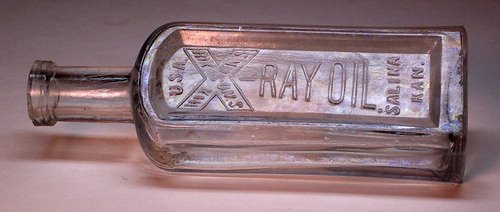
E. Mulligan’s sons, Edward J. and Thomas F., were Philadelphia liquor dealers, not physicists.  But when Wilhelm Roentgen in 1895 discovered a type of radiation using electromagnetic waves that could see through skin and picture bones, a phenomenon he called X-Ray, the Mulligan boys were excited.  They quickly seized on it as a name for their booze.  Thus was born “X-Ray Whiskey.”  


The Mulligan story began with the birth of the founding father, Edward, in Clontibret, County Monaghan, Northern Ireland in 1838.  Of his early life little has been recorded.  He appears to have arrived in the United States at the age of 22 aboard the SS British Princess, shown below, from Liverpool to Philadelphia where he lived the rest of his life.  There he met and married Mary Brannon, of Irish descent, in 1860.  They would have two sons.


About the time of Edward J.’s birth, E. Mulligan opened a liquor house at the southwest corner of Tenth and Christian Streets, operating it for more than 30 years and becoming “well and favorably known throughout business circles,” according to his obituary in the Philadelphia Inquirer.  The newspaper added:  “His wholesale liquor business, from comparatively small proportions, of late years became very great, the bulk of his trade being throughout this and near-by states.”  


As his sons grew into manhood, their father took them into the business.  Edward J. showed up initially in city directories as a clerk in E. Mulligan Liquors, moving to the position of salesman.  In June 1875, Father Ed died, leaving Edward J., shown left, as the principal officer, assisted by brother James F., to run the liquor business.  They promptly changed the name to E. Mulligan Sons.


Meanwhile,  In 1895, at his laboratory at the Physical Institute of the University of Würzburg, Röentgen was investigating the external effects from various types of vacuum tube equipment.   At one point while he was investigating the ability of materials to stop the rays, he brought a small piece of lead into position while a discharge was occurring. Röentgen thus saw the first radiographic image: his own bones.


About six weeks after his discovery, he took a picture—a radiograph—using X-rays of his wife’s hand. When she saw her skeleton she exclaimed "I have seen my death!”  Röentgen's original paper, "On A New Kind of Rays" was published on 28 December 1895.  It ws only a matter of a few days that an Austrian newspaper reported the scientist’s discovery.  Immediately the word spread worldwide.


The news set off a wave of excitement, perhaps nowhere as intense as in the United States.  For those with an entrepreneurial spirit, the merchandising possibilities of the Roentgen’s discovery seemed endless.  E. Mulligan’s sons were among the first to climb on the X-ray bandwagon. Shown above is the application the Mulligans made for a trademark.  Note that they claimed use of the name beginning March 26, 1896, just two months after Roentgen’s discovery burst on world.  Just weeks later the brothers formally had trademarked the brand.  Shown below are ads the brothers ran in local publications, advertising X-Ray Whiskey as “Scientific, Substantial, Beneficial.”  They also gifted change purses with X-Ray advertising.


Before the year was out, the Philadelphia Times had published a “puff” piece for their label saying:  “Edward Mulligan & Sons…have secured the attention of good judges with their X-Ray whiskey.  It has a fine brandy tone and is forging to the front as a brand of whiskey that fascinates an educated taste.”  The Mulligans’ liquor was joined by a plethora of products from prophylactics to stove polish, claiming the X-Ray imprimatur.  Shown below are some of the goods, including two kinds of liniment (one for a horse, another for a human).


Meanwhile the brothers were having personal lives.  In May 1897, two years after taking over the management of the liquor firm,  Edward J. married in Philadelphia at the age of 32.  His bride was Isadora Nichols, shown here, a woman born in New Jersey who was seven years his junior.  A year later, a son, also named Edward was  born.  He would be followed by daughter Dorothea in 1904 and sons Francis in 1908 and Harry in 1910.  James apparently was a lifelong bachelor.


Although the brothers continued to operate a successful liquor business featuring X-Ray Whiskey, by 1910 Edward J. had moved to Atlantic City, some 60 miles from Philadelphia, an easy rail commute.  My guess is that Isadora wished to be closer to her family there.  James remained in Philadelphia, responsible for day to day operations of the liquor business. 


As he entered middle age Edward J. developed a heart condition that steadily worsened. At only 51 in August 1916 he died at his home on South Texas Avenue in Atlantic City as his grieving wife and family gathered at his bedside.  His youngest son was only six years old.  Edward was buried in Old Cathedral Cemetery.  The business was carried on for a few more months by James Mulligan and then terminated.  In 1918, James was recorded as working as a bartender at 4700 Girard Avenue and living above the saloon.


The demise of X-Ray Whiskey appears to have been as swift as its rise after the news of Roentgen’s discovery.  Edward Mulligan’s sons had proven to be canny merchandisers who immediately saw the sales potential of this “scientific” liquor but it did not survive them.  Unfortunately, I have been unable to locate a bottle with an original label and am hoping some sharp-eyed reader will help me out so that one could be added to this post.  In the meantime a drawing from a Mulligan ad must suffice.


Note:  The sale of a E. Mulligan Sons ad for X-Ray Whiskey piqued my interest, leading me to an article by Edwin S. Gerson MD, a radiologist and collector who wrote about the X-ray craze for the RadioGraphic publication in 2004, an article later made available online.  In it Dr. Gerson displayed many of the products that bore the name.  The three non-whiskey illustration displayed here are from his very informative and interesting piece.


Wednesday, May 5, 2021

Peter McGowan: "Dean" of American Distillers

Peter McGowan spent a lifetime building liquor distilleries in the United States, Canada, Mexico and South America, never skipping a beat even during National Prohibition. Seen by some as “The Dean of American Distillers,” McGowan's record stands as one likely never to be broken.

Born in New York City in 1869 McGowan came from a noted Northern Irish distilling family founded by a grandfather.  His father was Dominic McGowan, the inventor of a “continuous” whiskey distilling process who had come from Ireland to New York City after the Civil War.  The family lived there for the next decade until Dominic in the early 1880s decided that Cincinnati offered him better prospects.


Dominic’s choice of the Ohio city was a canny one.  At the time Cincinnati was the center of America’s whiskey industry.  Its proximity to booming Kentucky distilling, the many whiskey “rectifiers” (blenders) in town, and city’s centrality to major population centers, made it an ideal location for an expert whiskey-maker like Dominic.  Under his father’s tutelage, Peter learned quickly.


The youth’s first job was down river from Cincinnati at Aurora, Indiana, working for J.W. Gaff’s Mill Creek Distilling Co. [See post on Gaff, July 8, 2018]. Shown above is the distillery, occupying sixteen acres where Mill Creek empties into the Ohio River.  The facility could turn out as much as 16,000 gallons of whiskey a day.  When working at full capacity it annually generated federal taxes of $172,800 — more than one-fortieth of the entire revenue yearly collected by the United States.


Peter would find a bride in Cincinnati.  Also of Irish heritage, she was Anna Haney, daughter of James and Mary Haney, both native Ohioans. Peter was 25, Anna was 21.  After marrying Peter in 1894, she would bear him seven children during ensuing years.  The couple is shown here in a wedding portrait.


Peter was one of his father’s distilling team.  A highly sought-after distillery builder, Dominic was widely employed by whiskey makers.  Working with his father meant considerable travel to construction sites throughout the country.  Often bringing along his growing family, Peter was required to move frequently to assist with the assignments at hand.  


After his father’s death in 1907 in Cincinnati, Peter, carrying on the family tradition and reputation, continued to travel widely to design and supervise the construction of distilleries.   Over the next few years, the McGowans were recorded living for short periods in Vincennes, a center for Indiana distilling, and Louisville, Kentucky.  Their home base remained Cincinnati. 


McGowan’s work in the United States terminated in 1920 as a result of National Prohibition.  Distilleries were shut down and sometimes torn down, not built during the fourteen “dry “ years.  That did not deter the Irishman.  In Canada new distilleries were springing up to seize American markets and, oh yes, to feed  bootlegger needs in the United States.  His services were in demand there and in Mexico and South America.


During Prohibition McGowan is credited with designing, building from scratch and equipping nine distilleries in Mexico.  Many of those plants likely were turning out spirits like tequila, mescal and rum.  One or more of McGowan’s Mexican projects, I believe, was producing whiskey.  Whiskey guru Fred Minnick has singled out two distilleries in Juarez, just across the border from the U.S., as major facilities.  One was a plant created by Mary Dowling with help from the Beam family. [See my post on Dowling, Jan. 22, 2014.]  The other might well have been the work of Peter McGowan.  


Shown above, the D.M. Distillery was the largest in Mexico, owned by J.M. Gomes, a Mexican national, and F. A. Mackay, a Tucson, Arizona, businessman.  My identification of McGowan with this distillery is based on a rare piece of movie short footage that features the distillery.  Several frames of that film, including one shown here, depict a man directing activities that resembles McGowan.


 As Minnick pointed out: “…In the grand scheme of overall liquor production, Juarez was free to produce whiskey and even “bourbon.” No laws regulated the Mexican producers from labeling their whiskey bourbon, as it did not become a U.S.-only product until 1964.”  Called “Juarez Whiskey” it was advertised as “straight American” and “Bourbon…aged in wood.”  Americans visiting Mexico legally could bring a quantity home with them but much of Juarez whiskey is said to have found its way into the United States through illicit channels.  


In 1932 Anna McGowan died.  She had been stricken with tuberculosis about two years earlier and although every effort was expended to halt the disease she passed away in May of that year.   Anna was buried in St. Joseph New Cemetery in Cincinnati.  After her death and the end of National Prohibition in 1934, McGowan moved where the distilling action was — Louisville.


Before National Prohibition the Bonnie Bros. Distillery of Louisville had been one of Kentucky’s largest and most successful. [See my post on the Bonnies, April 29, 2014.]   Like other distilleries, the plant had been forced to close for the duration.  After Repeal family members attempted to restart the operation but ultimately were not successful. They sold out  to Wright and Taylor, now managed by a group of Louisville businessmen who kept the original name.  Over time the facility had been allowed to deteriorate and the new owners built an entirely new plant, likely under McGowan’s direction, and hired him to run it.  


Terming him “The Dean of Kentucky Distillers,” the new management made Peter the centerpiece of a promotional booklet that featured the new facility.  One photo showed him inspecting the weighing process as clean grain from the storage bins was being conveyed to the mills on the floor below to be ground for the mash.  A second featured McGowan “about to test the fermenting mixture.”  According to the booklet, he was demonstrating that:  “Eternal vigilance and strict supervision are part of the price of fine whiskey.”


By this time McGowan was approaching his late sixties after a lifetime of constant activity.  He retired from Bonnie Bros. and returned to Cincinnati where siblings and some of his children lived.  As he aged Peter suffer from a bad heart and kidney failure.  In July 1945 he died at the age of 76, the proximate cause pneumonia.  He was buried in St. Joseph’s cemetery next to Anna.  Their joint gravestone is shown below.


When he died Peter McGowan left behind him a legacy of distilleries that are believed to be unmatched in their numbers.  Thus it was quite fitting that his death certificate contained this information:  “11. Usual occupation: Distiller; 12. Industry or Business:  Distillery.”  To which one can only add:  Indeed!


Notes:  My attention to Peter McGowan was drawn by the promotional brochure:  “All Aboard for Louisville:  The Home of Bonnie Bros. Distillery,” undated but circa 1938.  Entitled “Cross Border Bourbon,”  the article by Fred Minnick appeared in a publication called “Places.”  Other data came from ancestry.com and similar Internet sources.  As can be seen from the comment below from Bill Breitenbach, a great grandson of Peter McGowan, the information from Ancestry, that I had assumed came from from family members, was wrong on several counts. Bill has done me the favor of correcting those mistakes and I have made the required changes.  He also has added other interesting information about Peter that I urge be read.


Saturday, May 1, 2021

The Whiskey Rant of “Big Swede” Jespersen

 Because no photo of Chris J. Jespersen has come to light, I have substituted a drawing of a large bartender with a somewhat belligerent look to stand in for the Gardnerville, Nevada, saloonkeeper known as “Big Swede.”  The image introduces a man, described as “out of humor and a grouch for fair” who was asked about his whiskey and answered with an oration.

Jespersen’s words were captured — and possibly embellished — by a local reporter who prefaced them by setting the scene.  A young whiskey salesman from the West Coast representing Cincinnati liquor companies entered the Big Swede’s Gardnerville establishment  and “in plaintive tones” asked the proprietor:  “Is this a saloon?”  When told in no uncertain terms that it was, the drummer feebly asked:  “What kind of whiskey have you got?


The Record Courier of February 18, 1908, recorded this response from Jepersen: “Why you rosy cheeked lummox, we’ve got all kinds of whiskey; we’ve got common ordinary, everyday whiskey, the kind that killed father at the age of 95.  We’ve got wisdom whiskey, the kind that makes the absorber think he’s backed Solomon off the map.  Throw some of it under your belt and in ten minutes you’ll be wondering why they didn’t make you president instead of Teddy.  We’ve got whiskerbroom whiskey, the kind that makes you throw a fit on the floor and when you get up you dust your clothes off with a whiskerbroom.


“We’ve got honest whiskey, the kind that causes a man to pay debts when he’s drunk, and to kick him all over the lot when he’s sober.  We’ve got fool whiskey, the kind that causes your dear neighbor to lead you off somewhere in Pine Nut Hills and whisper in your waiting ear a piece of news that was all over town the day before.  Then we’ve got lovin’ whiskey, the kind that makes some lobster crawl up to you, put his arm around your neck and blow a breath into your face that would drive a turkey buzzard away from a dead coyote or stampede the employes of a glue factory.


“We’ve got fightin’ whiskey, the kind that gets action on Tobe Ward [a race horse] or make an Antelope Valley cowboy haul out his sixshooter and plug out the lights.  We’ve got crying whiskey, the kind that makes a tenderfoot shed tears of anguish and sorrow whenever he hears a funny story.  We’ve got sporting whiskey, the kind that makes you want to tackle the wheel or craps.  Why, gol durn it, we’ve got the biggest stock in Nevada.


“If what I’ve mentioned ain’t enough, why we’ll give you some whoopin’ whiskey, the kind that will make an undertaker jump his job and join a circus.  We’ve got screamin’ whiskey, the kind that makes a deaf mute scream for a job.  We’ve got social whiskey, the kind that’ll make a man who has given you a glass eye for the past ten years hunt you up and give you the glad mitt.  We’ve got family whiskey, the kind that makes a man go home and smash the furniture and call his mother-in-law unpleasant names.  We’ve got…”  At this point, according to the newspaper, the neophyte salesman offered a “…Guess you’re stocked up.  Good day.”  And he beat a hasty retreat out the saloon door.  The report concluded: “And the Swede says he wasn’t halfway through the list yet.”


Despite his nickname, the originator of this declamation was from, Aalberg, Denmark, shown above, the center of the country’s third largest metropolitan area.  Born there in 1865, Jespersen immigrated to the United States in 1886 from Hamburg, Germany, on a British ship, the Aston, that took him to Scotland and from there around the South America to the West Coast.  The passenger list gave the 20-year-old’s occupation as farmer.  Perhaps drawn to America initially by the lure of riches from mining, Jesperson arrived in Gardnerville just as the town was being established. 


During his initial years there Jesperson labored as a carpenter, teamster and at a variety of odd jobs.  Given an opportunity to work behind a bar, he rapidly learned the liquor trade and was employed at several Gardnerville saloons before opening his own drinking establishment at the corner of Main and Eddy Streets. It was known as the “Big Swede’s” and later the J-T Bar. The two story structure with its adjunct bath house is shown on the photo left, along with a later photo below showing the line of buildings.  As a saloonkeeper Jespersen rapidly became known throughout northwest Nevada.  A hulk of a man over six feet tall and weighing some 250 pounds, Big Swede’s bad disposition was legendary.


In 1892 Jesperson found time to be married in Gardnerville.  His wife was Mary Louise Buerger, born in 1860 in Wright City, Warren County, Missouri, a woman older than he by five years.  Over the next nine years they would have five children of whom four lived to maturity, Frederick born in 1893; Minnie, 1894, Christine, 1896, and Andrew, 1899.  In order to shelter this growing family, Jesperson about 1893 bought a Victorian house in Virginia City, Nevada, and moved the structure to Gardnerville, where it remains a private residence.  Below are photos as the house looks today and a historical plaque.


When Nevada went dry in 1918, Jesperson was forced to shut down his saloon and seek other employment, becoming a contract deliverer of mail.  Trading on his celebrity in Douglas County in 1920 the Big Swede decided to run for constable.  In that job he would be an agent of the county courts and also have law enforcement powers.  His first run for office thrust him into a Republican primary election against two other candidates.  Jesperson won.  He then was pitted against the incumbent Democratic constable, A. W. Ramsey.  The Big Swede lost in a landslide.


Two terms later Jepperson in 1928 again ran against Ramsey.  This time he registered as an Independent and beat the incumbent handily.  Now he walked around Gardnerville with a badge that likely looked a lot like the one from another Nevada town.  The Big Swede, despite his temperament, apparently was popular because in 1928 he ran unopposed.  In 1930, he stood as a Republican again and was beaten narrowly by John Brown, an Independent.  Jeppersen tried again in 1932 and Brown, who would be Douglas County constable for more than a decade, swamped him.  Big Swede permanently returned to delivering mail.


At age 60 Jespersen suffered a cerebral hemorrhage on the day after Christmas 1940.  He was taken to Gardnerville’s small hospital, then considered one of Nevada’s best.  He lingered for 28 days before dying on January 24, 1941.  Chris, the voluble Big Swede, was buried in the Gardnerville Cemetery, shown above.  Mary Louise would join him there in 1950, 90 years old.  Their badly eroded joint tombstone is shown here.


The Big Swede’s drinking establishment has survived him in Gardnerville still bearing the name J-T Bar.  With the end of Prohibition nationally and in Nevada, the whiskey began to flow again there as it had in the Jespersen’s day.  Shown here is a photo of the saloon interior as it looked in 1991.  Below is the building as it looks today, housing a restaurant featuring Basque cuisine. 


Notes:  This post was suggested to me by the book, “Saloons of (Old — and New) Nevada,” by Raymond M. Smith, Silver Plate Printing, 1992.  In it Smith includes Jesperson’s disquisition on whiskey taken directly from the newspaper story.  Other material on this post is from Internet sources.  The vintage photos of the Big Swede’s bar are from the Nevada Historical Society. The 1991 interior photo is from Smith’s book. If someone out there has a photo of Chris Jespersen, I would dearly love to use it.