Thursday, January 13, 2022

D.L. Moore: A “Distillers’ Distiller” — and Much More

Born into a prosperous family of Kentucky gentry, well educated and eminently successful in business, Daniel Lawson Moore carved his niche in Kentucky whiskey history by fighting to keep alive the name of his father-in-law.  Moore also used distilling premier bourbon as the economic stimulus to create for himself an agricultural empire that stretched from the Blue Grass State to Mississippi and Colorado. 

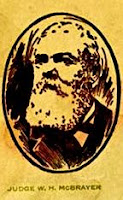
Among the most celebrated early Kentucky whiskey distiller was Judge W. H. McBrayer.  One contemporary account says of his “Cedar Creek” brand: “It was the whiskey that made the crowned heads of Europe turn from Scotch to bourbon.”  After McBrayer’s death in 1888 his will passed the distillery to his grandchildren.  Having married the judge’s daughter, distiller D. L Moore was their widower father.  The ninth clause of the Judge’s will stated that his heirs could run the distillery in his name for three years after his death: “After which time I desire that my name be entirely stricken from the business.”


This unusual request probably stemmed from the fact that McBrayer had been an elder in the Presbyterian Church, a denomination that frowned on drinking, and personally was a tee-totaler. His widow Mary also had developed strong objections to alcohol. Moore, as manager of the distillery and with Mary co-executor of the Judge’s will, attempted to nullify the clause. He argued that the McBrayer name was worth at least $200,000 to the Judge's grandchildren (millions today). Nonetheless, Mary took him to court.


When a lower court agreed with her, Moore appealed to the Kentucky Supreme Court. The judges there were more sympathetic, apparently well acquainted with McBrayer’s bourbon. While their opinion suggested that the quality of the whiskey had suffered since the Judge’s death, they agreed with Moore that he had never intended to disadvantage his beloved grandchildren. The McBrayer name was retained.  By persisting Moore had perpetuated a Kentucky legend.
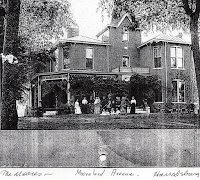

Daniel Moore was born in Mercer County, Kentucky in January 1847, from a distinguished English family.  His spacious boyhood home, shown here was called “Moorland.” His father, a physician, horse breeder and “gentleman” farmer, could afford to have young Daniel educated by private tutors, attend Center College in Danville, and study law under an eminent Kentucky barrister.  Moore passed the bar but never practiced.  Instead, according to one biographer, “…He used his legal knowledge altogether in handling his extensive business affairs.”


From the outset of his career, Moore was drawn to distilling.  About the age of 25, he built the distillery shown above.  It was located five miles east of the Harrodsburg Courthouse at Shawnee Run Creek on the turnpike between Danville and Pleasant Hill, Kentucky.  Distillery water originated in a pristine stream issuing from a cave where Daniel Boone famously had spent the winter of 1769-1770.  By the mid-1880s, Moore’s distillery was mashing 250 bushels a day and had two bonded warehouses with a total capacity of 12,500 barrels. 
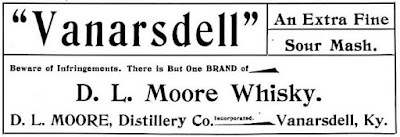


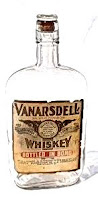
Moore dubbed the location “Vanarsdell” and called his premier bourbon the same name.  He advertised the brand extensively.  Shown here is an apparently unembossed clear quart bottle of “Vanarsdell Hand Made Sour mash” whose colorful label alone apparently made it worth $2,100 at auction recently.   Below are two views of a Vanarsdell flask, also apparently unembossed.  Another Moore brand was “Stone Wall Whiskey.”  He also produced whiskeys sold by Charles Rebstock, a leading liquor wholesaler of St. Louis. [See my  post on Rebstock at September 6, 2011.]

Following McBrayer’s death Moore sold his own distillery to the Dowling Brothers and devoted his energies to managing the McBrayer Lawrenceburg plant.  Early in the 1900s, however, Moore sold the McBrayer distillery to the Kentucky Distilleries & Warehouse Company, one of the expressions of the monopolistic “Whiskey Trust.”  He continued to manage the facility and the Trust was happy to have title to prestigious McBrayer’s bourbon.


In 1891 Moore found a woman to provide mothering for his three minor children.  She was Minnie Ball, descended from the same family as the mother of George Washington.  They were married in her home in Versailles, Kentucky, and would go on to have two girls of their own.  Shown here is a portion of a family photo that pictures Daniel, Minnie and their daughter, Anita.


Meanwhile Moore was increasingly busy in other activities.  In 1881 he was elected on the Democratic ticket to represent the 20th District in the Kentucky State Legislature.  There he is said to have performed “his duties in an intelligent and capable manner and eliciting the commendation of his constituents.”  Despite being a distiller, Moore pushed through a bill levying a special tax on Kentucky whiskey to be used for schools. He also had become the largest individual stockholder in the Mercer National Bank and from 1892 to 1908 served as its president.


A “gentleman” farmer, Moore was responsible for overseeing the planting and harvesting of cotton in Mississippi on three plantations totaling thousand of acres originally accrued by his father.  He also owned several thousand acres of timberland in that state and supervised the logging.  His work there led him to built a spacious home on one cotton plantation where he, Minnie and the children spent the winter months.  Described as a “nature lover,” Moore then turned his attention to Colorado, the Rockies and the  “spiritual uplift of the mountain solitudes.”  In 1881 he bought a ranch of 6,000 acres in North Park, Colorado.  According to a biographer he then “…Introduced some of the finest cattle and horses, making it a center of improved livestock in the far West….”  


Although these activities took him away from Kentucky about half the year, Moore determined to build Minnie and their family a spectacular home on Lexington Pike near Harrodsburg, a structure, shown here, that still stands as a landmark.  Taking five years to build and costing the equivalent of $1.4 million, the Romanesque Revival mansion features a verandah of large semicircular arches on short round pillars of polished granite with carved limestone capitals.  Among its other elegant features is a four story tower crowned by a parapet.  


Moore was living there when he developed heart trouble as he approached his mid-60s.  His heavy work schedule presumably had begun to catch up to him.  After several months of decline, Daniel died on October 20, 1916.  His death certificate read “organic heart disease.”  He was buried in Harrodsburg’s Spring Hill Cemetery, Section S, Lot 29, below a large cross.  


For the next two decades, Minnie Moore took up where Daniel had left off, running Mississippi cotton plantations, the stock ranch in Colorado and a farm in Kentucky where she supervised tobacco production and the breeding of quality livestock.  One observer commented:  “Mrs. Moore since the death of her husband has given convincing evidence of the possession of unusual business talents and has handled her extensive affairs with admirable judgment and efficiency.”


Of Daniel Moore a fitting testimony appeared in “Kentucky: A History of the State,” by Battle, Perrin, & Kniffin, 4th ed., 1887:  The authors wrote: “Few men have more friends, or retain them better than Senator Moore….He is liberal and generous to a fault, a representative of true Bourbon Democracy, of strict integrity, and thorough honesty of purpose and deed. As a business man he has by his success in other fields reflected great credit upon his native State of Kentucky.”


To this encomium I would add that Moore’s court battle to keep the McBreyer name before the drinking public has paid dividends down to the present day.  Descendants have formed an organization called McBreyer Legacy Spirits and in limited quantities have issued a bourbon in his name.  If Moore had not challenged the Judge’s will, this welcome development might well have been impossible.


Notes:  This post was gathered from a wide variety of sources.  Unless otherwise indicated in the text, direct quotes are from “A History of Kentucky and Kentuckians,”  by C. Polk Johnson, 4th edition. 1912.


Sunday, January 9, 2022

Whiskey Men Who Owned Hotels

Foreword:   It is not surprising that a substantial number of liquor dealers owned hotels.  The identification of inns with taverns is embedded in American history.  Brought to the current day it is not unusual for an individual (like me) to check in, find the room, and then head down to the hotel bar to see what’s gong on.  Presented here are three men, all of whom became wealthy through whiskey sales, that owned and operated hostelries in pre-Prohibition times.

At five feet, nine inches tall, Frederick Rudolph Welz was not a big man, but he carried a lot of weight in St. Paul, Minnesota, as owner of the city’s largest and most prestigious hotel and a major liquor house and saloon.  An immigrant from Germany, Wells was worth the equivalent today of $25 million when he died. It was said of him: “…Every dollar which he possesses has been earned since he came to America….”


Welz launched his career in hotels in 1878 when he purchased the Circle Park House in Indianapolis, a leading hostelry and favorite of circus folks.  After three years, he sold it and headed north to St. Paul, Minnesota, where he initially was in the liquor trade.  In his new home city,  Welz eventually acquired the Clarendon Hotel.  Although that hostelry had proven unprofitable under three previous owners, Welz transformed it into a first class, money-making property.  “He brought to the business keen discernment, unflagging enterprise, and a knowledge of the demands of the traveling public….”   After three years, however, Welz tired of running the Clarendon, sold it, and took an extended holiday with his wife to Germany.


Upon his return, Welz brought or, some sources say, leased the Merchants Hotel, shown left. This was a premier property in St. Paul at the corner of Jackson and Third Streets, a popular place for social reunions and political gatherings.  Just before the convening of the Minnesota legislature and state conventions the hotel’s rotunda and halls were crowded with politicians and onlookers.


As was his usual pattern, after five years of operating the Merchants Hotel, Welz decided to get out of the hotel business and again set his sights on St. Paul’s lucrative liquor trade.  Welz took a local businessman, Robert Mangler, as a partner and established a wholesale and retail liquor business called “Welz-Mangler Co., Importers and Jobbers, Wines and Liquors.” 


While still involved in the liquor house, Welz’s interest took another turn.  A St. Paul family named Mehls had built and attempted to operate a large luxury hotel called the Ryan. It is shown right.  Apparently not experienced at managing such an establishment and facing a economic downturn during the Panic of 1893, the Mehls went bankrupt and a bank repossessed the hotel.  Welz bought it.


St. Paul newspapers were positive about the takeover, citing Welz’s past success in turning hotels profitable and noting that the new owner, despite other business interests like the liquor house, would be “giving his whole attention to the Ryan.” The economy rebounded.  The Ryan Hotel prospered. To quote a biographer:  “[Welz] made it the leading hotel of the city….Made the name of Ryan famous throughout the Northwest….”  This time Welz stayed the course, running the hotel until 1904 when he reached 71.


Unlike many of the impoverished immigrants to the U.S. who engaged in the liquor trade, William Sheppard Norman, born in 1859, was the scion of a wealthy family of Cheltenham, England that owned and operated two newspapers as well as a large printing and lithographing business.  Upon immigrating to the U.S. Norman’s business acuity led to his managing Spokane companies that provided telephone, telegraph, electric and street railway services. 


Hailed for his “ability, power of organization and initiative spirit,” Norman’s next foray was into hotels.  When the Spokane Hotel, shown right, went into bankruptcy in 1893, he saw an opportunity, bought and remodeled it into what was termed “the finest hotel in the ‘Island Empire.’”   From there Norman went on to purchase the posh Tacoma Hotel, below left, and the North Yakima Hotel, right.  Aided by his brother, Benjamin, before long William was operating a string of hotels in the West under the name of Norman Hotels, Ltd.  A biographer said of him in 1912:  “In a summary of his life, Mr. Norman can be accorded a prominent place among the empire builders of Eastern Washington.”


Being an hotelier took Norman into the whiskey trade.  Each of his hotels  contained a liquor store that Norman called “Silver Grill Cellars.” Norman claimed not to be a rectifier but said he was bottling and selling only straight goods in ceramic jugs of half-gallon (below left) and gallon size. Norman’s flagship whiskey label was “Viking,” a name he never bothered to trademark.  Eventually his efforts in alcohol would conflict with Washington State’s prohibition laws and he was arrested and fined.


Forced to shut off the alcohol in his hotels, Norman expanded his  investments to include mining and real estate.  The millionaire utilities executive, hotelier and whiskey man lived to see Prohibition repealed in 1934, remaining active into his nineties.  


Unlike Welz and Norman, Harris Franklin, an immigrant from Eastern Europe, came late to the hotel business.  Moreover, unlike the other two who bought struggling properties, he built an hotel himself from money he made selling whiskey in the South Dakota boom town of Deadwood.


With a partner, Franklin created the largest liquor wholesale house in the Upper Midwest region with an annual trade approaching $125,000, equivalent to more than $3 million today.  This wealth also took him into successful investments in banking, mining, and railroads, all benefiting his adopted city.  Despite its development, however, Deadwood lacked a first class hotel.  For years business leaders had been attempting to construct one without success.  One try resulted in an abandoned foundation used for a time as swimming pool for local children.


In 1902 Franklin stepped into the situation. It was only when the whiskey dealer offered in 1902 to match any contribution to a building dollar-for-dollar that construction began in earnest.  The hotel, finished a year later and considered a marvel of modernity, was named for him.   Shown here, half of its 80 rooms had private baths, a novelty at the time.  Theodore Roosevelt, William Taft, Buffalo Bill Cody, Babe Ruth and world heavyweight champion John L. Sullivan were among Franklin Hotel guests in its heyday.  The Franklin Hotel became Deadwood’s pride and its owner a hero.


Note:  More complete posts on each of these three whiskey men may be found elsewhere on this website:  Frederick Welz, February 16, 2017;  William Norman,  March 21, 2020; and Harris Franklin, May 30, 2017.


.


Wednesday, January 5, 2022

The Triumphs and Tragedies of Buffalo’s Gilligs


Charles Gillig, proprietor of a prosperous Buffalo, New York, liquor house and saloon, on a steamy night in mid-August, 1890, closed up shop at his Washington Street location and with two of his employees rented a boat for a cooling night swim in Lake Erie.  What ensued was related by the sole survivor.  It was yet another tragedy in the lives of the Gillig family, three generations who had found success and community standing in America by selling whiskey. 


Charles’ Father was Lorenz Gillig, born in Baden, Germany, about 1819.  At the age of 20, he immigrated to the U.S., settling in Buffalo.  He soon returned to Germany, apparently drawn back by his love for Maria Anna Koehler.  They married and Charles, the eldest of their six children, was born in Germany.  In 1843, Lorenz with Maria and their two-year-old returned to Buffalo.  His early employment in that city has gone unrecorded but likely involved acquaintance with the whiskey trade.


In 1848 Lorenz founded his own liquor house in Buffalo, one that apparently met with early profitability.  When the Civil War broke out, despite being over 40 with a business and growing family, Lorenz volunteered with the 65th New York Infantry Regiment.  Indicating likely earlier Prussian army service, he was commissioned as a major and was third in command.  Charles, now of military age, enlisted in the same unit as a private.  In June 1863 the 65th was ordered to Harrisburg, Pennsylvania, garrisoned as a guard against Confederate incursions.  Mustered out of federal service six months later, father and son apparently remained part of  the New York militia while returning to manage the liquor business.  An early Gillig whiskey jug is shown right.


At the conclusion of the Civil War, Lorenz brought Charles into the business as a full partner.  The company became L. Gillig & Son. and moved to 273 Washington Street, the address it would maintain for the remainder of its 50 years in business.  The building was five stories including a storage basement and covered an area 27 by 132 feet.  The first floor was for retail sales;  the upper floors for wholesale.  When he arrived at his majority, John Gillig was taken into the firm that subsequently became L. Gillig and Sons.


Meanwhile Lorenz was making a name for himself, said by one observer to have become “thoroughly identified with the interests of Buffalo, both with reference to its municipal and commercial affairs.”  For a number of years, as a Republican, he was elected as a Buffalo alderman.  In 1869 he ran for the office of City Assessor.  Lorenz was hailed by one publication as “not an office-seeker, but one of those citizens who are solicited to accept these important offices of municipal trust and responsibility as a matter of public duty.”   Elected to the position, a subsequent assessment of Lorenz noted that: “…He became widely known for his discernment and probity.”


By this time, two tragic events already had befallen the Gilligs.  In 1868, Charles married a local Buffalo woman of 19 named Maria Magdelena Zins.   Before long Maria was expecting twins.  As the first grandchildren, their impending births likely engendered great excitement in the Gillig family.  They were given names: a girl would be Mary Magdelena, after the mother; a boy, Charles after his father.  To great sorrow both twins were dead at birth.  Moreover, after lingering for about a week, wife Maria died, age 20.   The three were buried in adjacent graves.  The shock to Charles and his family must have been intense.


Those three deaths were followed two years later by the death of the second of Lorenz and Maria’s three sons, Henry, only 24 years old.  That was followed in 1878 by the death of Lorenz himself.  Because of an indeterminate birth date his age was estimated at about 61. Lorenz was buried in Buffalo’s Forest Lawn Cemetery, his monument shown here.  Charles and John retained the company name.


Yet another time of sorrow was awaiting the Gilligs.  In 1872 John married Louisa Knickenberg of Bufffalo.  They would have two sons in quick succession, Henry James born in 1873 and Charles Edward in 1875.  Seven years later the young father died leaving behind a grieving widow and the two little boys.  Within the space of 13 years the Gilligs had experienced six family deaths.


Of Lorenz’ sons, only Charles remained.  After his first wife’s death he married again in 1871.  His bride was Mary Anna Knickenberg, likely the sister of John’s wife.  They would have one child during their marriage.   Charles promptly sought help in running the Gillig liquor house and found it in J. Christ Bernhardt, another Buffalo liquor wholesaler.  [See my post on Bernhardt, July 24, 2015].  Their partnership was ill-fated and within two years they went separate ways.  Charles remained at the Washington Street address, operating both a liquor house and a saloon to considerable success for the next five years.  


Then came that night in August 1895 when Charles and two of his employees opted for a swim in Lake Erie off Buffalo’s Government Pier. It was a moonless pitch black night. They rented a small boat, moved offshore and, without incident, took a dip in the cooling waters.  Deciding to move farther into the lake, the swimmers re-entered the boat. Charles held the rudder, his bartender Henry Sacht manned the oars.  At some point the two men agreed to change places.  In so doing, they upset the skiff, throwing all three occupants into the water.  Only the third man, Andrew Lehner, surfaced.   


A Buffalo newspaper recounted how Lehner swam back to the boat and looked for his companions:  “…Whom he did not see and believes never rose to the surface.  His survey of the vicinity occupied, as he thinks, three or four minutes, when he came to the conclusion that the two men were drowned, and realizing his own danger and approaching exhaustion, at once made a loud outcry for help.”  His cries were heard by a lifeguard on patrol duty and Lehner was saved.


Amid its grief the Gillig family offered a reward of $100 for anyone recovering the bodies of Charles or Henry Sacht.   Three days later two Buffalo men spotted Charles’ body floating near a dock, obtained a boat and brought it ashore.  He was buried in the United German and French Cemetery in Cheektowaga, Erie County, New York.


Despite the loss of its proprietor the Gillig liquor house moved on, now operated by John Gillig’s sons, Henry, 22, and Charles, 20,  doing business initially as “Gillig Brothers.”  Two ceramic jugs bearing that company name are shown below.  After only a year or so the young Gilligs changed the name of the liquor company for the sixth time.  It now became Gillig Wine Importing Co. (Successors to Gillig Bros.)  Emphasis was on the importation of Hungarian wines, said to be “for medicinal purposes.”  


The Gillig brothers advertising harkened back to the family patriarch, Lorenz, and his 1849 founding of the liquor house.  By 1900, however, the company had ceased appearing in Buffalo city directories, thus ending a half century of family ownership — and times of tragedy.


Note:  The 80 year saga of the Gillig family was reconstructed from a host of sources.  Most important of these were the biography of Lorenz Gillig in the 1880 publication, “Commerce, Manufacturers & Resources of Buffalo & environs:  Historical and Statistical Review;”  Buffalo newspaper accounts of the drownings, and genealogical websites.  Unfortunately I could find no photos of either Lorenz or Charles Gillig and hope some descendant can help me fill that gap. 


Saturday, January 1, 2022

The Yeast Man Rises in William B. Saffell

 Considered by some to be among Kentucky “Whiskey Barons”  and honored recently with a legacy bourbon named for him, William Butler Saffell largely has escaped the attention given to other historic Kentucky distillers.  Shown here, Saffell of Lawrenceburg spent twenty years working as the yeast-maker for another distilling giant before setting his own course to making what he called “my own small product.”

Saffell, born in August, 1843, was part of a pioneer family that settled  in Anderson County in the late 1700s, roughly halfway between Louisville and Lexington, Kentucky.  His grandfather, Joshua, is said to have owned and farmed, likely with enslaved help, 1,000 acres.  His father, Samuel Saffell, was a farmer, and his mother, Sarah Belle Woods, Pennsylvania born.


Educated in the one-room school houses of rural Kentucky, William is reputed as early as the age of sixteen to have been involved in distilling on his father’s farm.Although of sufficient age to have been seen military service during the Civil War, he seems to have avoided it.   Although Kentucky did not secede, Lawrenceburg in general had Southern sympathies.  The Staffells may have harbored other views.  Only three years after the end of hostilities, at the age of 25, William received federal employment as “United States revenue storekeeper” for  Anderson County.  Also known as “gaugers” such agents were responsible for assessing liquor taxes owed by local distillers.  A political appointment, Saffell would not have been selected with suspect loyalties. 


This occupation brought the young man in regular contact with distillers.  During his six years on the job Saffell made close inspections of the equipment and processes of each of the distilleries in his district and came to know well their proprietors.  Likely aware of growing corruption in the federal revenue service, Saffell resigned his commission in 1874, just months in advance of the major “Whiskey Ring” scandal in which many of his colleagues went to jail.


Almost immediately Saffell went to work for W. H. McBrayer.  William Harrison McBrayer, called Judge McBrayer for much of his life, is credited with being among the handful of Kentucky distillers who raised the quality and image of the state’s whiskey to international renown. One contemporary account says of his Cedar Creek brand: “It was the whiskey that made the crowned heads of Europe turn from Scotch to bourbon.”  [See post on McBrayer, Oct. 2, 2011.]


Saffell played a major role in that success.  He became McBrayer’s yeast-maker.  As whiskey guru Michael Veach has pointed out:  “Yeast is a very important flavor component to whiskey. There are people who say it only makes up about 5% of the flavor of the whiskey. I personally think this is a low figure and yeast makes a larger contribution than most people think. However even if this 5% figure is correct it is a vital component to the whiskey. Think of it this way – adding salt to a dish is a small part of the overall flavor, but if there is too little or too much it is noticed in the taste. The same can be said for yeast in whiskey — the wrong yeast will be noticed.”


Saffell’s yeast was an important ingredient in the success of McBrayer’s bourbon.  The two men grew very close.  Saffell's first son bore the middle name of McBrayer.  The Judge in time made the young Kentuckian master distiller and manager of his distillery.  A year after the older man died, Saffell left the company and struck out on his own.  In 1889 he constructed a distillery on Fox Creek near Alton, Kentucky,  a hamlet northwest of Lawrenceburg. His plant was capable of producing 385 barrels of bourbon annually. According to a 1903 account, its two ironclad bonded warehouses had the capacity to hold 21,000 barrels,


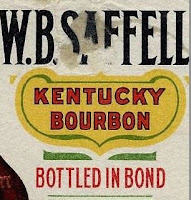
Saffell gave his whiskey his own name and bottled it ceramic jugs and in clear quart glass containers.  The bottles carried an elaborate label that depicted a warehouse full of aging liquor barrels.  From a revenue stamp it appears that his “W. B. Saffell Kentucky Bourbon was 100 proof (50% alcohol) that had been aged four years in federal bond.  Saffell’s whiskey appears to have been very popular, acquiring a customer base for a bourbon of which the distiller boasted:  “My own small product is not excelled by any.”  About Saffell the Wine & Spirits Bulletin commented:  “By his carefulness and knowledge of the business he has built up a high reputation and a successful business.”


Throughout this period William was conducting a personal life.  In October 1883, at the age of 40, he married Frances E. “Frankie” Bond, the daughter of a local political figure.  She was 12 years younger than he.  Over the next 17 years the couple would have seven children, six daughters and one son.  The latter, Franklin McBrayer Saffell, died in infancy, a great family sorrow.


At the time other Anderson County distillers were building mansions in Lawrenceburg, the most imposing being one constructed by the Ripy family [See my post on the Ripys, Sept. 15, 2016.]  Purchasing a lot not far from the Ripy home, Saffell built an imposing two and one-half story house for wife Frankie and his growing brood of children.  Shown here, it was done in “Richardsonian Romanesque,” employing such elements of the style as towers, an asymmetrical facade, masonry walls, a projecting central entrance bay, and other expensive elements of the style.  While not as large as the Ripy residence, it provided plenty of room for the Saffells.  Today it is a funeral home.


With the wealth from his distilling, Saffell also was extending his business interests. For many years he was a vice president and director of the Lawrenceburg National Bank.  Shown here is ten dollar bill issued by that institution.  Saffell also was farming 500 acres in Anderson County.  My guess is that this land was part of the 1,000 acres that his grandfather had claimed.  He likely was growing some wheat for use in mashing for his bourbon.


Saffell continued to meet with distilling success into the 20th Century as the word spread about the quality of his whiskey.  It was considered a worthy rival of premium Kentucky whiskeys, including Cedar Brook, the bourbon he had helped make famous for Judge McBrayer.  At the same time, however, Saffell’s health was declining.  He died in August 1910, at the age of 67.  His youngest daughter was just nine years old.


Honored by the population as one of the city’s most prominent citizens, Saffell was buried in the Lawrenceburg Cemetery at the base of a large granite plinth.  Soon after, the city named a street for him.  When a school was built on that thoroughfare, it became Saffell Street School.   Despite the loss of its founder, Saffell’s distillery, under other management, continued to produce a high quality product until shut down by National Prohibition.  The brand was not revived after Repeal. The distillery itself was left abandoned and in time disappeared.


William Saffell’s contribution to bourbon history, however, has been revived. The folks who make “Wild Turkey” have created a “Whiskey Baron Collection” that honors major distillers of yore.  Among them is Saffell.  Shown here is are the bottle and the label of “W.B. Saffell Bourbon.”  Pictured on the label is the bearded distiller in front of his mansion.  The yeast man has risen again.


Note:  This post was constructed from a number of sources.  Among them the most important was the Saffell family biography in “Kentucky: A History of the State,” by Battle, Perrin, & Kniffin, 5th ed., 1887.