Saturday, May 13, 2023

Kaufman Brothers and the “Jewish Golden Age”


The Western States Jewish History Assn. cites the late 19th Century and early 20th Century in America’s “Wild West” as one of three golden ages for Jews in world history.  “It was a time when we were free to do the best we could, using our intelligence, creativity, hard work ethic, and Jewish Values.”  The story of the Kaufman brothers in Montana seems to validate that belief.

The Kaufmans were natives of Germany, sons of Helen and Leopold Kaufman.  Louis, born in April 1865 was two year older than his brother, Jacob.  Of the boys’ early life little is known.  Because of differing census data Louis’ arrival date in the United States is variably given from 1880 to 1885.  My preference is for the earlier date since his younger brother’s arrival is recorded at 1881.


Louis is first recorded in Montana in 1887 living in Glendale, Beaverhead County.  Now considered a ghost town, Glendale, shown here, at its peak population boasted 2,000 residents and was a community owned by the Hecla Consolidated Mining Company.  Louis at 22 years old was listed as a “dry good merchant,” likely an employee of the mining outfit’s general store. 


Not long after, Louis appears to have moved to Melrose in Silver Bow County , about 34 miles south of Butte, where he was employed at the Hecla Mercantile & Banking Company, a subsidiary of the mining firm.  There he may have had a managerial position involving general goods and some banking activity.  Within a few months, possibly occasioned by Jacob’s arrival, he moved to Butte, shown below in 1904.


The  Western States Jewish History Assn: “We came with merchandise, in wagons and ships. We brought anything we thought would sell in this vast new territory that had literally nothing with which to start… If we arrived in a new town with the “right stuff,” we were often an instant success.”


For the Kaufmans, the “right stuff” was whiskey.   As recorded in the Butte city directory, about 1900 Louis stepped out on his own, opening a wholesale liquor house at 26 East Broadway called the Montana Liquor Company.  He advertised that it sold “Wines, Whiskies, Cordials & Cigars, Bar Glassware and Utensils”  — in short, anything that the burgeoning number of Butte saloons might want.  Louis was company president; Jacob, secretary and treasurer.


The Western States Jewish History Assn:  Whoever had the best prices, the best quality, the best service, and kept the best records usually succeeded the most.


The Kaufmans appeared to have been successful from the outset.  Experienced in the ways of Western merchandising, they aimed for quality in their advertising, as evident in the outdoor sign that opens this post, and in their flagship whiskey, “Overland Rye.”  Trademarked in 1905 after Congress had strengthened the laws,  this brand found widespread approval throughout Montana and adjoining states.


The brothers also paid considerable attention to the quality of the packaging for their whiskey.  At a time when liquor often was marketed in locally made crude earthenware containers with “scratch” labels, the Kaufman’s bought relatively expensive underglaze transferred stoneware jugs from Red Wing, Minnesota, two states and 1,100 miles east.  Avidly collected today, those containers came in one, two and three gallon sizes. 


The Kaufmans also were selling whiskey by the bottle to customers.  Once again they opted for an enhanced appearance.  In an era when whiskey often was sold in crudely made, clear bottles bearing a hand-lettered label, the brothers sold well made amber bottles bearing a “slab seal” label.  That feature added to the cost but advertised the brothers’ Montana Liquor Co. in perpetuity.


With their quick success, the Kaufmans were able to erect a three story building at 26 East Broadway in the heart of the Butte business district. There the brothers blended whiskeys imported from actual distilleries into their Overland Rye and other brands.  They also maintained a warehouse on Ohio Street at the railroad tracks to facilitate bringing in supplies and shipping out whiskey.  Both buildings are shown below.


The Western States Jewish History Assn:  “We expanded quickly into retailers, wholesalers, and commodity brokers — sometimes all three at the same time.”


From their highly profitable wholesale liquor house the Kaufmans expanded into other products in demand as the West developed.  The brothers advertised as sole agents for the Hall's Safe & Lock Company of Cincinnati.   Incorporated by Joseph L. Hall in 1867 that company quickly had grown to become the largest safe and vault manufacturer in the world. By 1892 Hall was responsible for one-half the entire output of fire proof and burglar proof safes and vaults in the United States. Safes were in increasing demand in the “Wild West” where fires and thefts were all too common.  The Kaufmans understood.


Another area of high demand was for milling equipment associated with mining.  The machinery is essential to break down minerals into granules. Valuable metals like gold, gemstones, and minerals used in construction all required a milling process after being extracted from the ground.  Again the Kaufmans responded.  By 1904 the brothers had established a separate enterprise selling milling equipment, calling it “Louis Kaufman & Company.” In time the firm would become the “Butte Machinery Company” and Jacob would assume the presidency.


The  Western States Jewish History Assn:  Everything was open to us, and, in general, we did well. 


The Kaufmans’ expansion efforts, however, were not always appreciated in Butte.  Apparently even a Golden Era may produce some “slag.”  The City of Butte hauled Louis into court in 1914 for intruding on land he did not own that earlier had been designated as a right-of-way for a city street.  Louis had constructed a barn worth $200 on the anticipated public thoroughfare and appropriated and fenced the land around it.  Taken to court by the city, Kaufman lost, appealed to the Montana Supreme Court and lost again.


When prohibitionary forces prevailed in Montana in 1918, the Kaufmans were forced to close their liquor house, but had their milling and mining machinery business to fallback on.  The brothers continued live in Butte, Louis dying in 1931 at the age of 66.  Jacob followed in 1946, age 79.  The brothers lie in adjacent plots in Butte’s Bnai Israel Cemetery, likely unaware that their success had been part of what later would be called  “A Golden Age.”


Note:  This post and illustrations were assembled from a variety of Internet sources.  The Western States Jewish History Assn. whose October, 2012, article provides the context for this post is located at 285 Sierra Woods Drive in Sierra Madre CA 91024.




Tuesday, May 9, 2023

Five Women Who Found Success in Whiskey

The history of the liquor industry in the United States traditionally has been dominated by men, particularly before National Prohibition was imposed in 1920.  Over time as I have profiled more than 1,000 “pre-pro” distillers, liquor wholesalers and saloonkeepers, I have found five women whose careers in whiskey were truly outstanding and deserve special recognition.

Mary Dowling from Anderson County, Kentucky, not only owned and ran major distillery, shown above, she found a way to stay in the liquor business after 1920 and, in effect, thumbed her nose at Prohibition.  Kentucky-born to Irish immigrant parents, at seventeen she married a distiller named Dowling at least 17 years her senior who saw her intelligence and brought her into the business.  When he died, she inherited his interest in the Waterfill & Frazier distillery, bought out his partners, and ran it successful for two decades.


Her success, however, came to screeching halt with the imposition of National Prohibition.   Federal records shown her withdrawing large quantities of whiskey from her bonded warehouse in the run up to the complete ban on alcohol.   Some of this whiskey she is reported to have sold to those Kentucky distillers fortunate enough to be licensed to sell liquor for “medicinal purposes.”   Other stocks, she successfully “bootlegged” for four years until Federal agents arrested her. 


After authorities were unable to convict her, Mary Dowling hatched a new -- and more successful -- business plan.  About 1926 she hired Joseph Beam, one of Kentucky’s premier distillers but now out of work, to dismantle the distillery, transport the pieces to Juarez, Mexico, reassemble it there, and resume making whiskey.  Mexico had no prohibition so the liquor production was completely legal.  Using several strategies to get her whiskey legally over the border to American consumers, she continued to operate until she died, four years short of Repeal.


Mary Jane Blair also was a Kentuckian who inherited her late husband’s share of a distillery, this one in Marion County, shown above. She promptly bought out his partners and changed the name to the “Mary Jane Blair Distillery.”  Although the greater part of her life had been spent in the Blair home as housewife and mother, evidence is that she took an active role as president of the company, one that distilled about five months in the year.   Limited production was not unusual in the Kentucky whiskey industry,  some distillers believing that fermentation was done best only in certain months.  As her distiller Mrs. Blair hired W. P. Norris, a well known Marion County whiskey man.


For the next seven years, with the help of a son, Mary Jane Blair operated the distillery, considerably expanding its operations.  By 1912  the plant had the mashing capacity of 118 bushels per day and four warehouses able to hold 9,000 barrels.  The Blairs produced whiskey sold under several labels.  The flagship was “Old Saxon,”  as illustrated here by a back-of-the-bar bottle.  About 1914 the family sold the facility.  Mary Jane Blair died in 1922 at the age of 76.


Lovisa McCullough was a strong women’s rights advocate who successfully ran a liquor wholesale business in Pittsburgh following the death of her husband.  A 1888 Pittsburgh directory under the heading “Liquors, Wholesale,” listed forty-nine such establishments in the city.  All of them save one are readily identifiable as male-run.  The exception is “McCullough, Louisa (sic) C., 523 Liberty Av.”    That same year Lovisa became a delegate from Pittsburgh to the historic founding meeting of the International Council of Women (ICW) devoted to women’s suffrage.  It is a safe bet that she was the only liquor dealer at the convention. 

Obviously a woman of great energy, Lovisa McCullough threw herself into other causes.  A lover of animals, she was a longtime member of the Humane Society and served on the board of the Pittsburgh chapter.  She also was among women who worked toward buying up and preserving the grounds and structures at Valley Forge, Pennsylvania, where Gen. George Washington and his troops passed the winter.  A true “daughter of the American Revolution,”  Lovisa’s grandfather was a soldier.


In 1893, after more than a half century of operation, the McCullough liquor dealership disappeared from Pittsburgh business directories.  Its demise cannot be explained by National Prohibition that still was years away and Pennsylvania was “wet” until the end.  Lovisa may have found her passion for feminist and other causes eclipsed her ardor for keeping alive the liquor enterprise.  Or it may have been advancing age.  Lovisa died in 1917, about 82 years old, and was buried beside her late husband, John, in Allegheny Cemetery. 


Mary Moll, living in Montgomery County, Pennsylvania, earned this tribute from a local newspaper: Mrs. Moll, when she took possession of the business, had many obstacles to overcome but, being a woman of wonderful business tact, she bravely fought the many unpleasant features connected with the business and successfully built up a trade far superior to any in this country.”  Like the other women here, after her husband she died inherited his whiskey wholesale trade but also his three daughters from a prior marriage.  They are shown at the family home, Mary at far right.


Rejecting advice by friends to sell the business, she set out not only to run the liquor dealership, but also to expand it.  Her first instinct was to go on the road as a “drummer,”  and give existing and potential customers her personal attention to stimulate sales.  The strategy worked and she was credited with ultimately tripling the business.   After three years, however, Mary tired of traveling.  Looking at the costs-benefits she concluded she could build her trade more effectively by staying home and keeping prices low.


Eventually,  Mary Moll was selling three hundred barrels of whiskey a year.  Although not a rectifier, that is a dealer mixing and blending her own brands, she was decanting the whiskey by the barrel into her own embossed glass containers, shown here, an estimated 53,400 quarts of whiskey annually, an impressive number for any liquor house.  Mary Moll died in 1910 while still running her business. She was 64.


When her husband died in 1912, Catherine Klausman was left with five minor children in addition to a saloon, liquor store and small hotel, together known as “The German House,”  shown below.  She hesitated not a moment in taking over their management.  As a result, “Mrs. Klausman” as she was respectfully known in St. Mary’s, Pennsylvania, made her mark on whiskey history.


With the help of her bartender, Mrs. Klausman not only kept all the businesses open, she prospered by selling both at wholesale and retail her own brands of whiskey.  Taking a leaf from the liquor wholesalers and rectifiers of the time, she bought whiskey from both Pennsylvania and Kentucky, blending the spirits, bottling them and then applying her own labels.   My favorite is Mrs. Klausman’s “Corn Whiskey,” with its predominantly yellow label showing a rural distillery and a shock of corn, a design worthy of one of the big liquor outfits.


In 1920, however, National Prohibition brought a close to the thriving business she was doing in whiskey sales.  Moreover, the hotel bar no longer could serve alcohol.  Regardless of these setback, she persevered in running the German House through the 1930s.  No evidence exists that after the end of Prohibition in 1934, she went back to liquor sales.  When Catherine died in 1963, at the age of 88, she was buried next to her late husband in St. Marys Cemetery.  The German House remains standing on Railroad Street as part of the town’s historic district.


These five strong women helped pave the way for the many women who have engaged in  the whiskey trade since Prohibition and today fill some of the top spots in the Nation’s liquor industry.  They deserve a special place in the annals of American liquor.


Note:  Author Fred Minnick has written an informative book on “Whiskey Women,” detailing the effects that women, past and present, have had on the American distilled spirits business.  Through his writing I came upon Mary Jane Blair.  Minnick failed, however, to pick up on his radar Mary Dowling, Lovisa McCullough, Mary Moll and Catherine Klausman.  I am hopeful that this piece will bring these other four outstanding “whiskey women” the attention they also justly deserve.  For those interested in more biographical details about these five women I have written more extended accounts on each elsewhere on this blog:  Mary Dowling, Jan. 22, 2014; Mary Jane Blair, June 2, 2014; Lovisa McCullough, Jan. 14, 2017; Mary Moll, Oct. 28, 2015; and Catherine Klausman. Dec. 12, 2015.


Friday, May 5, 2023

Rosskam & Gerstley: Back of the Bar “Kings”

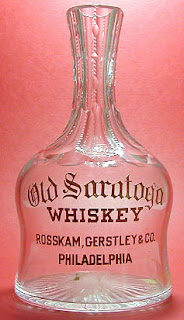
For many years I have been fascinated by pre-Prohibition back-of-the bar bottles (BoBBs).   Gifted by distillers and liquor wholesalers to favored customers like saloons, hotels and restaurants, the bottles were among the most expensive liquor-related giveaways, often featuring fine glass and gold accents.  BoBBs were expected to catch the eye of patrons  — and did.  


In featuring these bottles it seems appropriate to highlight a wholesale liquor house that stood out for the variety and attractive bottles it issued — the Rosskam, Gerstley & Co.  of Philadelphia.  To my mind, the two proprietors were the “kings” of those collectibles.

It is unlikely that any were made during the 13 years of National Prohibition. Subsequently, the legislation that accompanied the 1934 Repeal of  Prohibition outlawed them.  As a result, today all existing BoBBs are more than 100 years old and considered “antiques.”

Isaac Rosskam and his wife’s brother, Henry Gerstley, both immigrants from Germany,  settled in Philadelphia and in 1869 opened the doors of their establishment.  The company initially was located at 336 North Third Street but within a year had moved to larger quarters at 402 North Third, where it would stay until 1876.”  Their proprietary brands were “Old Saratoga,” “Monogram," and “Fine Old Whiskey.”


Reflecting the rapid and impressive growth of its business volume, the partners that year moved to two new buildings.  One was five stories at 226 S. Front Street that advertised “Rye & Bourbon Whiskies” on the storefront.  The other at 133-135 Dock Street of six stories proclaimed “Old Rye Whiskies.”  Both locations allowed the firm adequate space to undertake “rectifying,” that is, blending whiskey bought from multiple sources to achieve tastes determined to have broad public appeal


Because Philadelphia, and indeed the U.S., was loaded with distillers, rectifiers, and wholesalers, the partners had to combat stiff competition for the business of  restaurants, bars and saloons to stock their liquor.  They also had to appeal to members of the drinking public to request their brands from bartenders.  One way of advertising was to provide giveaway items that contained the names of Rosskam & Gerstley products.  Although the partners also gave away tip trays and shot glasses, they specialized in elegant back-of-the-bar bottles.


Those included bottles in fancy molded glass with stoppers, ornate gold lettering, and in one case a metal or pewter body.  Shapes varied from bulbous bases to ginger jar shapes to straight sided bottles.  Lettering might be in script, squared-off letters or san serif, and colored black, gold or cobalt blue.  I have counted at least 21 varieties of Rosskam, Gerstley & Co. bar bottles.  Ten of them are illustrated throughout this post.  No other distiller or whiskey house I have researched comes close in number or variety. 


At the turn of the Century, things changed at the Philadelphia liquor house.  In 1899, Henry Gerstley died at age 61 at his residence.  As Rosskam aged he turned over the reins of management to his son.  A 1900 Philadelphia business directory lists William Rosskam as president of the firm.   In 1904 Isaac died, age about 70.  Although the company continued to prosper for a time under William,  eventually it was forced to shut down by the enactment of National Prohibition.


The banning of bar bottles after the end of Prohibition was the result of their  having been used for purposes that neither Rosskam nor Gerstley would have approved.  Bartenders had a tendency when “Old Saratoga” or another whiskey had been dispensed from its fancy bar bottle to refill it with an inferior brand and cheerfully pour it out to customers under false pretenses.  Today bottles behind the bar must be the container in which the liquor was sold, carrying an original label and tax stamps.


A good example of the value some of these bottles have achieved is the the one shownright.  It was issued by Julius Goldbaum, a pioneer whiskey man in Tucson, Arizona.   Although most BoBBs are clear glass,  Goldbaum chose his in amber with white and gold accents.  The results are a stunning bottle of which only a few are known.  One recently sold at auction for more than $22,000.


There remains a treasure trove of back-of-the-bar bottles.  They steadily grow older.  No more will be made and I have seen little evidence of fakery.  Most BoBBs can be bought for under $100.  Attractive and displaying well, they are certain to accrue in desirability and value in the future.


Note:  A previous whiskey man vignette on this website featured Isaac Rosscom, focusing on his personality and religious orientation.  It may be found on this website at February 10, 2014.


Monday, May 1, 2023

This Wren Flew High in Bridgeport CT


Arriving in Bridgeport, Connecticut, in 1870 at the age of 22, Peter W. Wren (born Byrne), joined with a partner to form a liquor house that prospered for thirty years, producing the revenues that allowed him to soar to the top echelons of the city’s leadership.  Wren developed and co-owned one of the largest and most popular seaside resorts in the state, was president of two major breweries, a director of a bank owned by P.T. Barnum, a hydraulics company, and a hospital.  He also served a term in the Connecticut legislature and years on the Bridgeport Board of Education. 


Born in New York City in 1847, Peter was the son of Mary M. and Thomas S.Byrne, both of Irish ancestry.  Educated in the schools of New York and New Haven, Connecticut, he left school at age 15 to pursue a career as a printer for the New Haven Journal and Courier until 1870 when he Moved to Bridgeport, his home for the rest of his life.  For unknown reasons, sometime before 1880 he changed his surname from Byrne to Wren.


Still a youth of 22, Wren almost immediately joined with John McMahon, a Bridgeport local of a similar age, to found a wholesale liquor dealership located at the city’s Water Street dock and ferry terminal.  The partners prospered there for almost 30 years until McMahon’s death in 1899.  Their flagship whiskey was “Lexington Club,” shown below as advertised on shot glasses.  The brand was not trademarked.  Liquor profits soon fueled the partners’ forays into stocks, bonds and real estate.


Pleasure Beach:  Wren and McMahon’s primary investment was to develop and own a seashore amusement park on an island in the Atlantic Ocean near Bridgeport, described as “one of the largest and most popular seaside resorts in Connecticut.”   Shown above at the eastern tip of the island, the site was believed by many to have been a haven for Captain Kidd and the site of buried pirate treasure. Pleasure Beach featured a roller coaster, boardwalk, miniature railroad, wooden horse rides on tracks, skating rink, arcade, merry-go-round, and a 5000-seat coliseum. 


The park was aimed at providing recreation for working people. “No exorbitant prices, an honest dollar’s worth for all,” was the motto. The Pleasure Beach Cafe served broiled lobster and soft-shell crab for 50 cents, broiled bluefish for 40 cents, and clams on the half shell (when local oyster beds were abundant) for 25 cents a dozen.  In time Wren and his co-investors ran into financial difficulties operating Pleasure Beach, vexed by frequent fires that plagued the island. The first blaze occurred in 1907 and destroyed the grandstand and horse rail concession. The Bridgeport Board of Park Commissioners bought the park for $220,000 in 1919 and took over full operation, probably to the relief of Wren and the others. The postcards below give some indication of Pleasure Beach.


Breweries:  Beginning in 1887, Wren broadened his attention to include beer.  With McMahon and two businessmen from Meriden, Connecticut, he co-founded the Meriden Brewing Company and became its president and treasurer.  Well financed, this brewery from its outset was hailed as a “substantial operation” with a distribution network that covered all of Connecticut and major commercial centers in surrounding states.  Strategically located directly on the New York, New Haven and Hartford rail line, the company had the advantage of a steady in and out flow of supplies and product.  The plant included a brewhouse, shipping and warehouse facilities, a cold storage unit, fermenting house, artificial ice-making plant, boiler house, and a stable for delivery wagons and horses.  Among its most popular brews was “Nutmeg Beer,” sold in clear bottles.


The success of the brewery under Wren’s management caught the attention of investors in a smaller and struggling Bridgeport brewery.  In 1890, the two organizations, located about 40 miles apart, merged to form the Connecticut Brewery Company.  Wren was named president of both operations.  Represented here by a beer bottle, according to a contemporary newspaper report: “The Connecticut Breweries Company enjoyed considerable success into the early 1900s and its line of lagers, ales, and porters gained both local and regional followings, with some product traveling as far as the Bahamas, Cuba, and South America.”  National Prohibition forced the closing of both breweries.


Other Business Interests:  The revenues from his liquor and beer allowed Wren to become a major investor and director of other Bridgeport businesses.  Among them was the Pequonnock Bank, a financial institution founded by famed showman P.T. Barnum.  The bank’s $3 bill, above, is considered a rarity.  It depict’s  Barnum and his Bridgeport home “Iranistan.”  The lower right corner is portrait of Jenny Lind, a singer known as “The Swedish Nightingale.” Barnum actually signed some of these bills.  Wren also served on the boards of the Bridgeport Hydraulics Company and St. Vincent’s Hospital.


Community Service:  A fervent Democrat, Wren made one foray into politics, elected to the Connecticut General Assembly in 1882 and serving two years.  He declined to run for a second term, preferring to focus his energies in Bridgeport where he was a member of the city’s first Board of Public Works and was its president for six years.   Wren’s efforts on behalf of elementary and secondary education in Bridgeport are considered his most enduring contribution.  He began his tenure on the Bridgeport Board of Education in 1880, serving for 26 years until resigning in 1906 at the age of 58.  During that time he was board president  for 15 consecutive years and the chairman of the committee on school construction and maintenance for most of his time on the board. 


Wren’s biography in the 1907 “Men of Mark in Connecticut,” characterized his contribution to Bridgeport education this way:  “…His name was synonymous with the management and control of local schools and his excellent performance of his great trust won the greatest respect and appreciation from the entire community.”


Family Life:  In 1869, at age 22, Wren married his childhood sweetheart from New Haven, Johannah “Hannah” Carey, also 22.  They would have six children, George W., Marion V., Frederick W., Sarah, Arthur and Irene.  Hannah died in May 1920 at the family home at 484 State Street.  Her well attended funeral Mass was held at the St. Augustine’s Catholic Church.  Interment was in the family plot in St. Michael’s Cemetery.  Dying at 80 years old, Peter would join her there eight years later.  Unfortunately, no photo is available of their gravesite although a monument, shown here, marks the graves of Wren’s parents and other close relatives.


Note:  This post was constructed from a number of sources available on the internet.  Of those, the most important was Wren’s biography in “Men of Mark in Connecticut, Volume III,” edited by Colonel N. G. Osborn, editor of the New Haven Journal and Courier, and published in 1907.  It also is the source of Peter Wren’s picture.